
Champagne Market Report 2026
Global Outlook – By Product (Prestige Cuvée, Blanc De Noirs, Blanc De Blancs, Rosé Champagne, Other Products), By Occasion (Weddings, Corporate Events, Celebrations, Gifts), By Price Point (Economy, Mid-Range, Luxury), By Sales Channel (Online Retail, Supermarkets, Specialty Stores, Duty-Free Shops) – Market Size, Trends, Strategies, and Forecast to 2030
Champagne Market Overview
• Champagne market size has reached to $8.38 billion in 2025 • Expected to grow to $12.05 billion in 2030 at a compound annual growth rate (CAGR) of 7.5% • Growth Driver: Growing Culture Of Celebrations Fueling The Growth Of The Market Due To Rising Importance Of Personal Milestones And Festive Spending • Market Trend: Ultra-Premium Champagne Gains Traction With Rare, Small-Batch Cuvées • Europe was the largest region in 2025 and Asia-Pacific is the fastest growing region.What Is Covered Under Champagne Market?
Champagne is a sparkling wine that originates exclusively from the Champagne region of France and is produced using the traditional method champenoise, which involves secondary fermentation in the bottle, typically using Chardonnay, Pinot Noir, and Pinot Meunier grapes. It is commonly used for celebratory occasions, gourmet pairings, and luxury events to symbolize sophistication and festivity. The main products in champagne are prestige cuvée, blanc de noirs, blanc de blancs, rosé champagne, and others. Prestige cuvée refers to the top-tier, most premium Champagne produced by a house, often made from the finest grapes and aged longer to represent the brand’s highest quality. This is utilized on occasions such as weddings, corporate events, celebrations, and gifts, categorized by price points including economy, mid-range, and luxury, provided by sales channels such as online retail, supermarkets, specialty stores, and duty-free shops.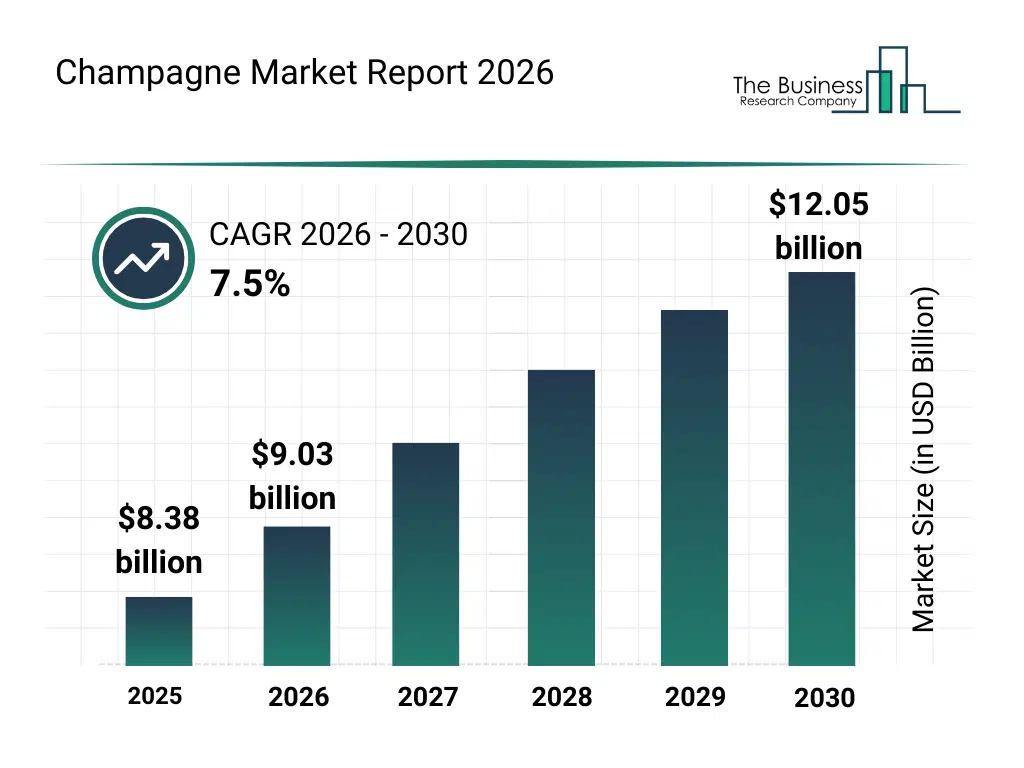
What Is The Champagne Market Size and Share 2026?
The champagne market size has grown strongly in recent years. It will grow from $8.38 billion in 2025 to $9.03 billion in 2026 at a compound annual growth rate (CAGR) of 7.8%. The growth in the historic period can be attributed to expansion of global luxury wine consumption, strong heritage branding of champagne houses, growth of celebratory and gifting occasions, established export markets for champagne, premium pricing acceptance.What Is The Champagne Market Growth Forecast?
The champagne market size is expected to see strong growth in the next few years. It will grow to $12.05 billion in 2030 at a compound annual growth rate (CAGR) of 7.5%. The growth in the forecast period can be attributed to increasing demand from emerging affluent consumers, expansion of organic and sustainable champagne offerings, growth of experiential wine tourism, rising digital luxury retail channels, increasing interest in low-alcohol premium variants. Major trends in the forecast period include growing demand for premium and luxury wines, rising popularity of limited edition and vintage champagne, expansion of sustainable viticulture practices, increasing focus on experiential and event-based consumption, growth of direct-to-consumer luxury alcohol sales.
Global Champagne Market Segmentation
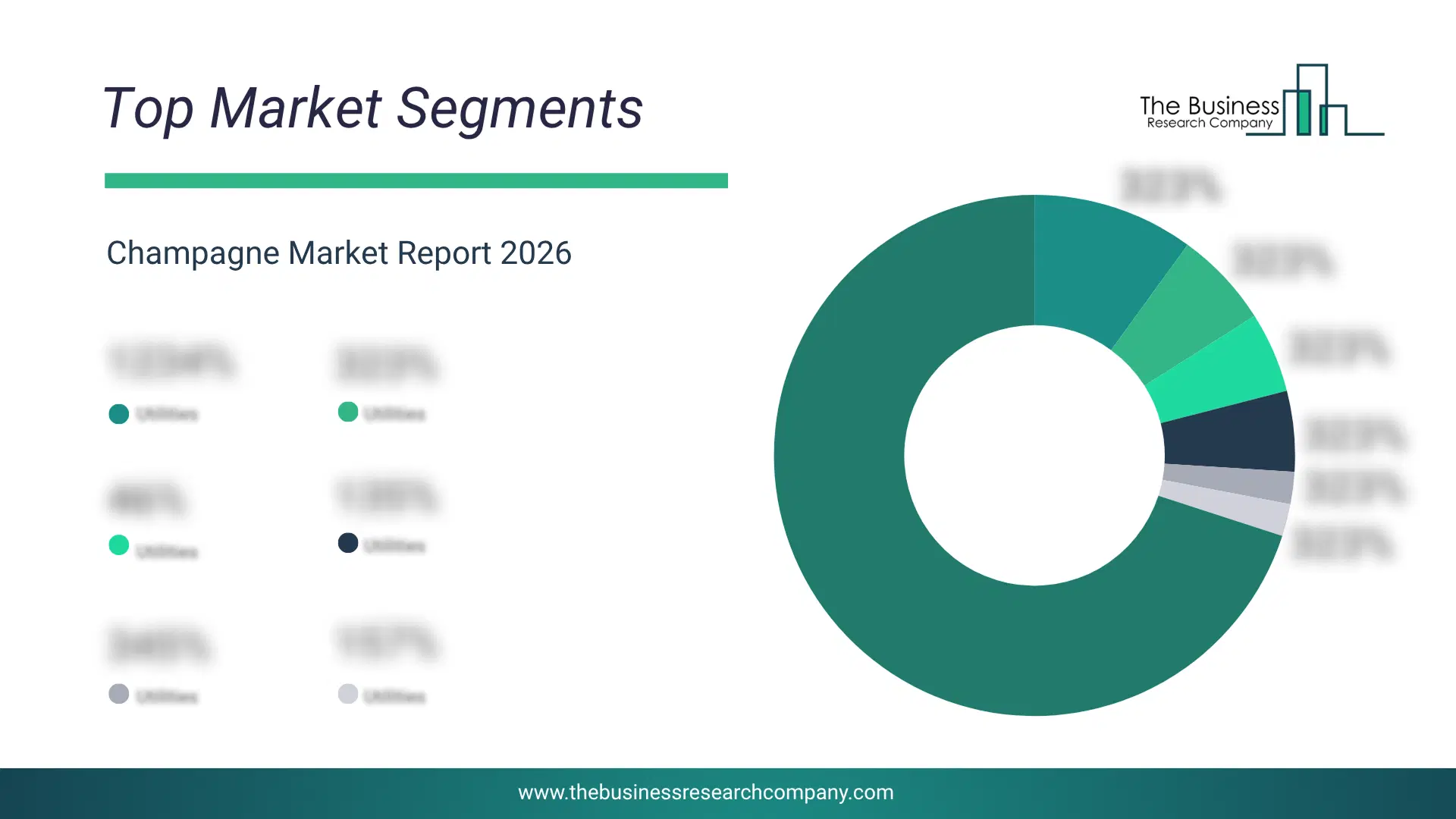
1) By Product: Prestige Cuvée, Blanc De Noirs, Blanc De Blancs, Rosé Champagne, Other Products 2) By Occasion: Weddings, Corporate Events, Celebrations, Gifts 3) By Price Point: Economy, Mid-Range, Luxury 4) By Sales Channel: Online Retail, Supermarkets, Specialty Stores, Duty-Free Shops Subsegments: 1) By Prestige Cuvée: Grand Marque Prestige Labels, Limited Edition Releases, House Signature Cuvées, Anniversary And Commemorative Editions 2) By Blanc De Noirs: 100% Pinot Noir, 100% Pinot Meunier, Single Vineyard Blanc De Noirs, Multi-Vintage Blanc De Noirs 3) By Blanc De Blancs: 100% Chardonnay, Grand Cru Blanc De Blancs, Single Village Chardonnay, Aged Blanc De Blancs 4) By Rosé Champagne: Maceration Method Rosé, Blending Method Rosé, Vintage Rosé, Single Vineyard Rosé 5) By Other Products: Organic Champagne, Vegan Champagne, Low- Or No-Alcohol Champagne, Barrel-Aged ChampagneWhat Is The Driver Of The Champagne Market?
The growing culture of celebrations is expected to propel the growth of the champagne market going forward. Celebrations refer to social or cultural gatherings marked by joy, rituals, and shared experiences that honor special events, milestones, or traditions. The growing culture of celebrations is driven by increasing importance placed on personal and social milestones as people seek to create memorable experiences that honor life’s significant moments. Champagne enhances celebrations by symbolizing luxury and festivity, making it a preferred choice for marking special occasions. It adds a sense of joy and elegance, elevating the overall experience and creating memorable moments. For instance, in September 2024, according to the National Retail Federation (NRF), a US-based retail trade association, Halloween (an annual cultural celebration held on the 31st of October) spending reached $12.2 billion in 2023, an increase from $10.6 billion in 2022. Therefore, the growing culture of celebrations is driving the growth of the champagne industry.Key Players In The Global Champagne Market
Major companies operating in the champagne market are Louis Vuitton SE, Pernod Ricard, Henkell Freixenet, Moët & Chandon, Laurent-Perrier, LANSON-BCC, Arvitis, Korbel Champagne Cellars, Pol Roger, Cattier, Dom Pérignon, Bollinger, Centre Vinicole – Champagne Nicolas Feuillatte, Champagne Deutz, Chandon, Perrier Jouet, Charles Heidsieck, G.H. Mumm et Cie, Cook's California Champagne, Artwinery, Billecart-Salmon, Gosset, Louis Roederer, Ayala, Champagne Piper-Heidsieck, Krug, Andre Champagne Cellars, Canard-Duchêne, Champagne GH Martel & Co, Champagne Lanson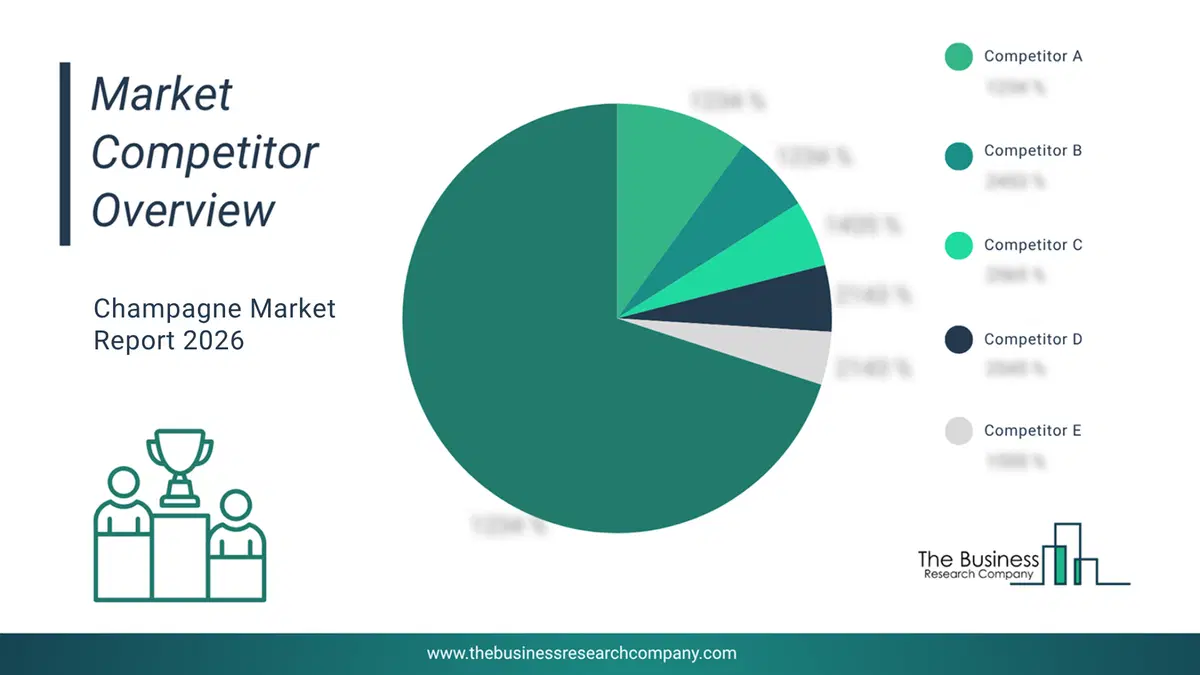
This chart is for illustrative purposes; the full report includes a detailed competitor analysis and comprehensive overview of the top 10 companies in the market.
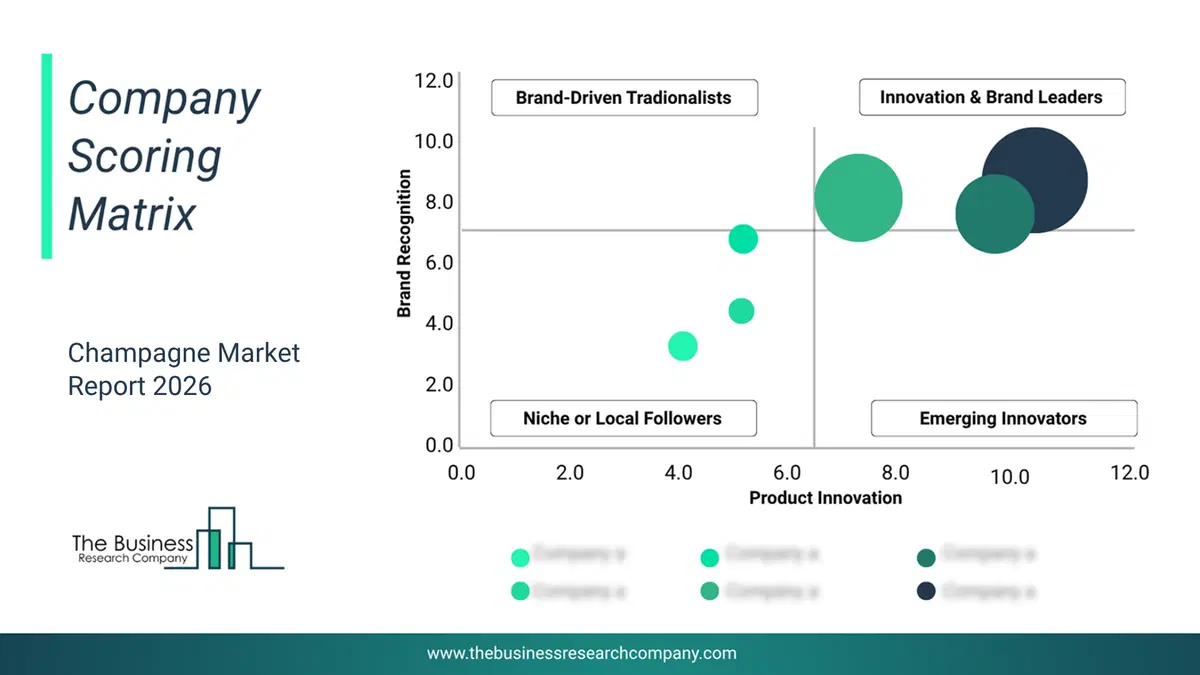
This chart maps companies by product innovation and brand strength, with bubble size indicating relative revenue, helping identify market leaders, challengers, and niche players. This is an illustrative chart; the full report provides a complete and accurate competitive analysis.
Global Champagne Market Trends and Insights
Major companies operating in the champagne market are focusing on developing innovative products, such as limited-edition vintage champagne, to strengthen brand prestige and appeal to high-end champagne consumers seeking exclusivity. Limited-edition vintage Champagne is a premium sparkling wine produced from grapes harvested in a single exceptional year, released in restricted quantities with distinctive packaging or aging characteristics to highlight its rarity and collectible value. For instance, in October 2024, Armand de Brignac, a France-based beverage manufacturing company, launched the Blanc de Noirs Vintage 2015, a limited-edition vintage champagne exclusively available in 1.5-liter magnum bottles. This inaugural vintage release is crafted from 70% pinot noir and 30% pinot meunier sourced from prestigious grand cru and premier cru vineyards, reflecting the brand’s commitment to superior quality. It is produced in a limited run of just 1,258 bottles and aged for seven years prior to release, showcasing exceptional rarity and craftsmanship that solidify the brand’s status in the ultra-premium champagne segment.What Are Latest Mergers And Acquisitions In The Champagne Market?
In October 2024, Castel Group, a France-based beverage company, acquired Champagne Malard for an undisclosed amount. With this acquisition, Castel aims to expand its presence in the champagne market by adding a recognized champagne house to its portfolio and strengthen its position in the sparkling wine market. Champagne Malard is a France-based company specializing in the production of premium champagne.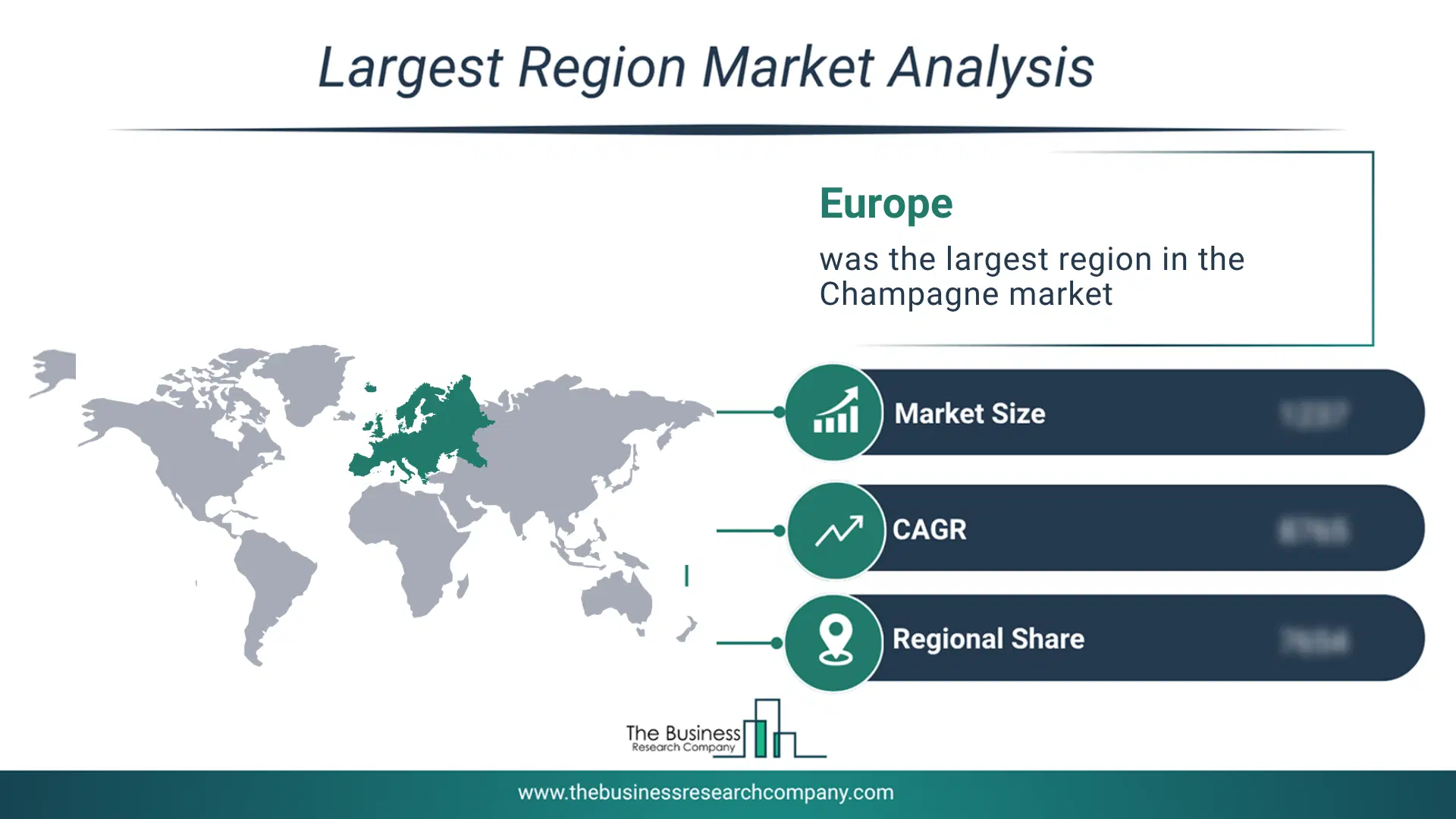
Regional Outlook
Europe was the largest region in the champagne market in 2025. Asia-Pacific is expected to be the fastest-growing region in the forecast period. The regions covered in this market report are Asia-Pacific, South East Asia, Western Europe, Eastern Europe, North America, South America, Middle East and Africa. The countries covered in this market report are Australia, Brazil, China, France, Germany, India, Indonesia, Japan, Taiwan, Russia, South Korea, UK, USA, Italy, Spain, CanadaWhat Defines the Champagne Market?
The champagne market consists of sales of demi-sec champagne, brut champagne, extra brut champagne, sec champagne, extra sec champagne, and doux champagne. Values in this market are ‘factory gate’ values, that is, the value of goods sold by the manufacturers or creators of the goods, whether to other entities (including downstream manufacturers, wholesalers, distributors, and retailers) or directly to end customers. The value of goods in this market includes related services sold by the creators of the goods.How is Market Value Defined and Measured?
The market value is defined as the revenues that enterprises gain from the sale of goods and/or services within the specified market and geography through sales, grants, or donations in terms of the currency (in USD unless otherwise specified). The revenues for a specified geography are consumption values that are revenues generated by organizations in the specified geography within the market, irrespective of where they are produced. It does not include revenues from resales along the supply chain, either further along the supply chain or as part of other products.
This chart presents market attractiveness based on a quantitative evaluation of growth, competition, strategic alignment, and risk, offering a clear view of opportunity areas for decision-making. This chart is for illustrative purposes; the full report contains the complete analysis.

This chart highlights the Total Addressable Market (TAM) by estimating the maximum revenue opportunity using an assumption-driven approach, supporting strategic planning and opportunity sizing across markets. The chart is illustrative; the full report provides a more comprehensive analysis.
What Key Data and Analysis Are Included in the Champagne Market Report 2026?
The champagne market research report is one of a series of new reports from The Business Research Company that provides market statistics, including industry global market size, regional shares, competitors with the market share, detailed market segments, market trends and opportunities, and any further data you may need to thrive in the champagne industry. The market research report delivers a complete perspective of everything you need, with an in-depth analysis of the current and future state of the industry.Champagne Market Report Forecast Analysis
| Report Attribute | Details |
|---|---|
| Market Size Value In 2026 | $9.03 billion |
| Revenue Forecast In 2030 | $12.05 billion |
| Growth Rate | CAGR of 7.8% from 2026 to 2030 |
| Base Year For Estimation | 2025 |
| Actual Estimates/Historical Data | 2020-2025 |
| Forecast Period | 2026 - 2030 |
| Market Representation | Revenue in USD Billion and CAGR from 2026 to 2030 |
| Segments Covered | Product, Occasion, Price Point, Sales Channel |
| Regional Scope | Asia-Pacific, Western Europe, Eastern Europe, North America, South America, Middle East, Africa |
| Country Scope | The countries covered in the report are Australia, Brazil, China, France, Germany, India, Indonesia, Japan, Taiwan, Russia, South Korea, UK, USA, Canada, Italy, Spain. |
| Key Companies Profiled | Louis Vuitton SE, Pernod Ricard, Henkell Freixenet, Moët & Chandon, Laurent-Perrier, LANSON-BCC, Arvitis, Korbel Champagne Cellars, Pol Roger, Cattier, Dom Pérignon, Bollinger, Centre Vinicole – Champagne Nicolas Feuillatte, Champagne Deutz, Chandon, Perrier Jouet, Charles Heidsieck, G.H. Mumm et Cie, Cook's California Champagne, Artwinery, Billecart-Salmon, Gosset, Louis Roederer, Ayala, Champagne Piper-Heidsieck, Krug, Andre Champagne Cellars, Canard-Duchêne, Champagne GH Martel & Co, Champagne Lanson |
| Customization Scope | Request for Customization |
| Pricing And Purchase Options | Explore Purchase Options |