
Commercial Supersonic Aircraft Market Report 2026
Global Outlook – By Aircraft Type (Commercial Supersonic Aircraft, Business Jet Supersonic Aircraft), By Engine Type (Turbojet Engines, Turbofan Engines), By End-Use Industry (Commercial Airlines Agencies, Private Aerospace Companies, Luxury Travel Operators) – Market Size, Trends, Strategies, and Forecast to 2030
Commercial Supersonic Aircraft Market Overview
• Commercial Supersonic Aircraft market size has reached to $46.06 billion in 2025 • Expected to grow to $56.72 billion in 2030 at a compound annual growth rate (CAGR) of 4.2% • Growth Driver: Rising Demand For Faster Air Travel Is Due To Increasing Preference For Time Efficiency • Market Trend: Advancing Aviation Through Supersonic Noise Reduction Innovations • North America was the largest region in 2025 and Asia-Pacific is the fastest growing region.What Is Covered Under Commercial Supersonic Aircraft Market?
Commercial supersonic aircraft are advanced passenger airplanes engineered to fly faster than the speed of sound, typically above Mach 1, allowing them to dramatically cut travel times on long-haul routes while offering a premium, high-speed transportation option for business and commercial aviation. These aircraft aim to combine cutting-edge aerodynamics, noise-reduction technologies, and sustainable aviation innovations to meet modern regulatory standards and environmental goals while revolutionizing global air travel efficiency. The main aircraft types of supersonic aircraft are commercial supersonic aircraft and business jet supersonic aircraft. Commercial supersonic aircraft are designed for high-speed passenger travel over long distances, offering reduced travel times and enhanced connectivity between global hubs. These aircraft are categorized by engine type into turbojet engines, turbofan engines, and serve different end-users such as commercial airlines agencies, private aerospace companies, and luxury travel operators.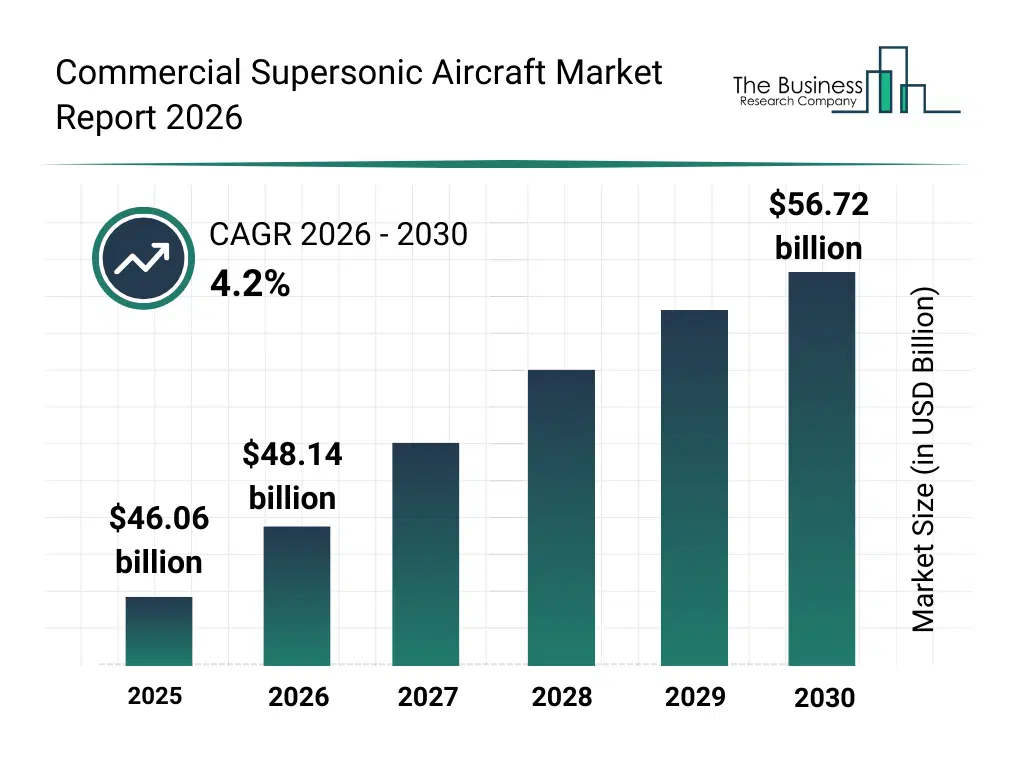
What Is The Commercial Supersonic Aircraft Market Size and Share 2026?
The commercial supersonic aircraft market size has grown steadily in recent years. It will grow from $46.06 billion in 2025 to $48.14 billion in 2026 at a compound annual growth rate (CAGR) of 4.5%. The growth in the historic period can be attributed to increasing development of high-speed aviation concepts, reliance on advanced propulsion research, rising investment in premium air travel solutions, growing focus on aerodynamic innovation, adoption of early supersonic design programs.What Is The Commercial Supersonic Aircraft Market Growth Forecast?
The commercial supersonic aircraft market size is expected to see steady growth in the next few years. It will grow to $56.72 billion in 2030 at a compound annual growth rate (CAGR) of 4.2%. The growth in the forecast period can be attributed to expansion of sustainable supersonic aircraft projects, increasing integration of autonomous flight systems, rising demand for ultra-fast commercial travel, development of advanced lightweight materials, growth in global high-end aviation infrastructure. Major trends in the forecast period include advancement of AI-assisted flight control systems, adoption of sustainable supersonic propulsion technologies, integration of smart manufacturing processes, development of autonomous safety and navigation enhancements, expansion of secure digital aircraft ecosystems.
Global Commercial Supersonic Aircraft Market Segmentation
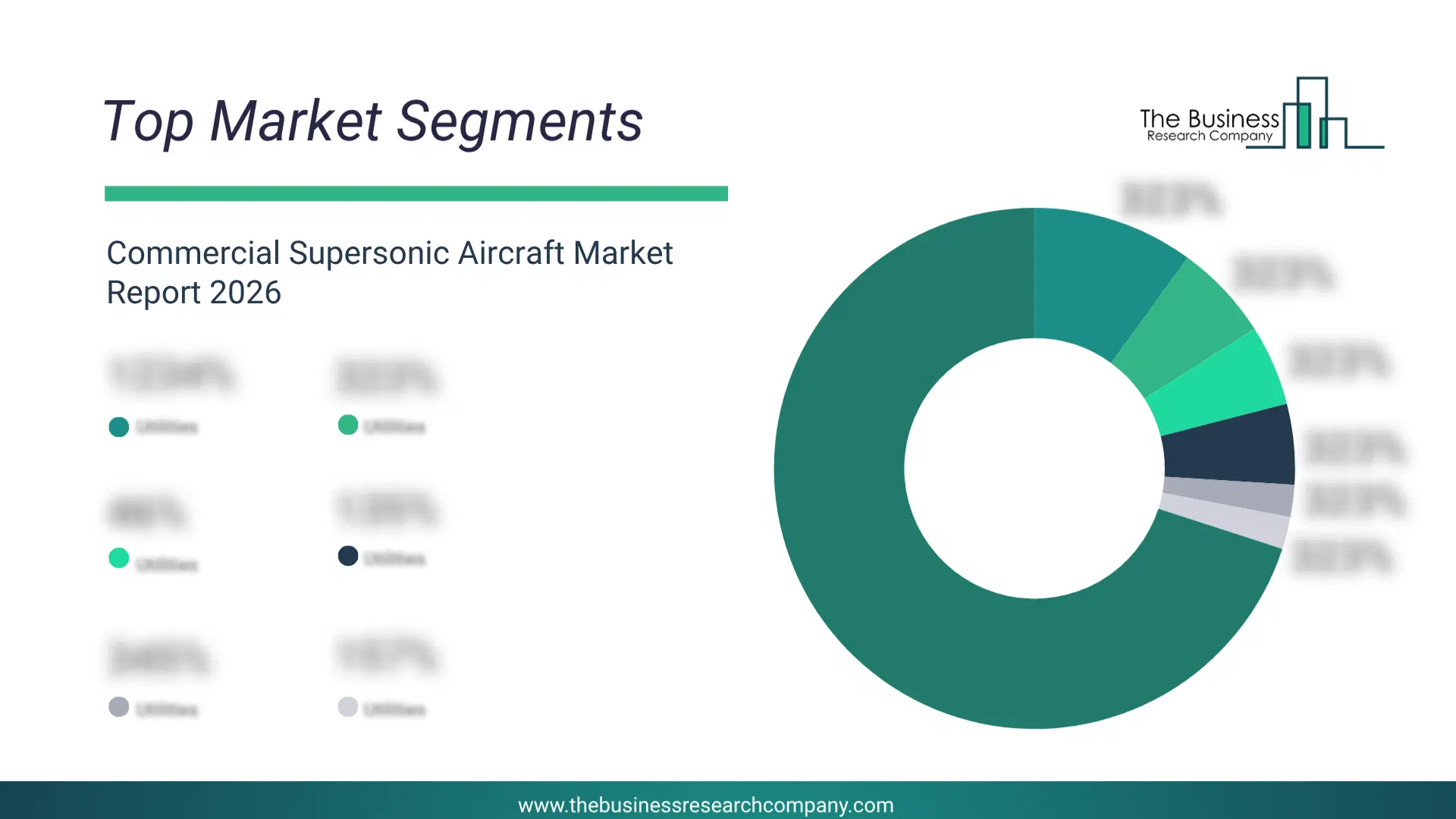
1) By Aircraft Type: Commercial Supersonic Aircraft, Business Jet Supersonic Aircraft 2) By Engine Type: Turbojet Engines, Turbofan Engines 3) By End-Use Industry: Commercial Airlines Agencies, Private Aerospace Companies, Luxury Travel Operators Subsegments: 1) By Commercial Supersonic Aircraft: Long-Haul Commercial Supersonic Aircraft, Medium-Haul Commercial Supersonic Aircraft, Narrow-Body Commercial Supersonic Aircraft, Wide-Body Commercial Supersonic Aircraft 2) By Business Jet Supersonic Aircraft: Light Business Supersonic Jet, Mid-Size Business Supersonic Jet, Large And Ultra-Long-Range Business Supersonic Jet, Government And Executive Supersonic JetWhat Is The Driver Of The Commercial Supersonic Aircraft Market?
The growing demand for faster air travel is expected to propel the growth of the commercial supersonic aircraft market going forward. Faster air travel refers to the ability to move passengers or cargo over long distances in significantly less time compared to traditional commercial aircraft. The rise in faster air travel is due to growing demand for time-saving transport, as passengers increasingly prioritize reduced flight durations for efficiency and convenience. Commercial supersonic aircraft help faster air travel by flying at speeds greater than Mach 1, significantly reducing flight times and enabling quicker long-distance journeys compared to traditional subsonic planes. For instance, in December 2023, according to the International Air Transport Association, a Canada-based trade association, global passenger traffic increased by 40.1% compared to 2022 and is expected to double by 2040. Therefore, the growing demand for faster air travel is driving the growth of the commercial supersonic aircraft industry.Key Players In The Global Commercial Supersonic Aircraft Market
Major companies operating in the commercial supersonic aircraft market are Aviation Industry Corporation of China, Lockheed Martin Corporation, Northrop Grumman Corporation, Hermeus Corporation, United Aircraft Corporation, Japan Aerospace Exploration Agency, National Aeronautics and Space Administration, Boom Technology Inc., Aerion Corporation, Baykar Technology, Dawn Aerospace Limited, Reaction Engines Ltd., Spike Aerospace Inc., Exosonic Inc., Hypersonix Launch Systems Ltd., Virgin Galactic, EON Aerospace Inc., Overture, Symphony, Destinus.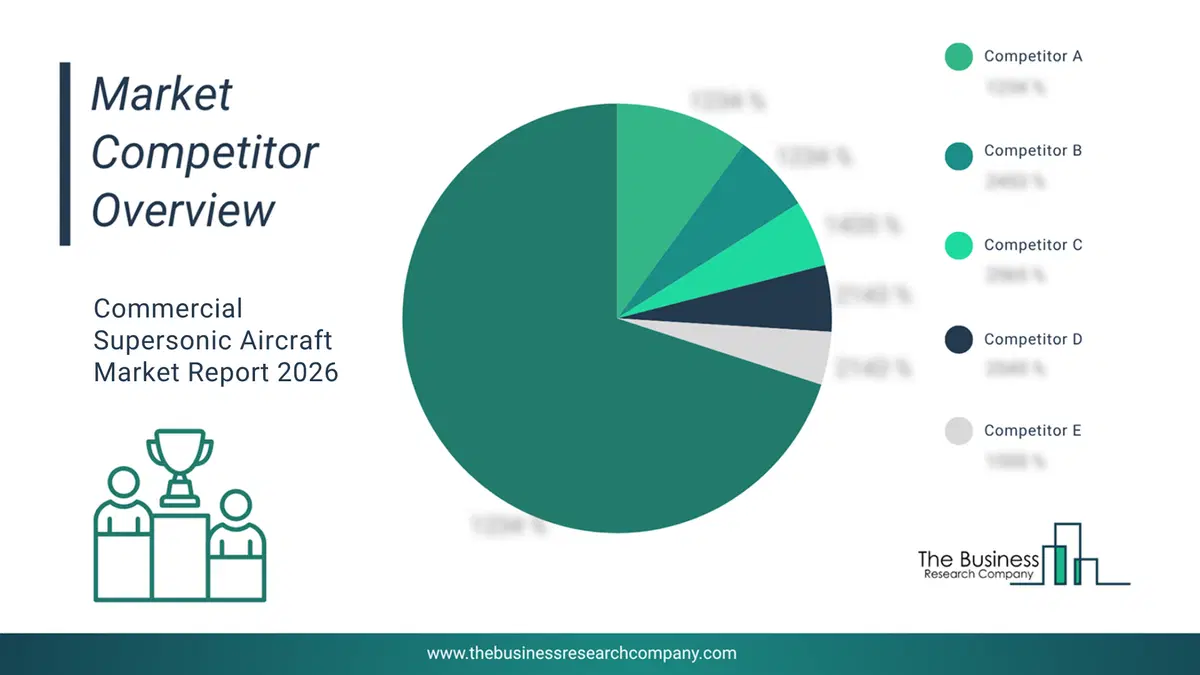
This chart is for illustrative purposes; the full report includes a detailed competitor analysis and comprehensive overview of the top 10 companies in the market.
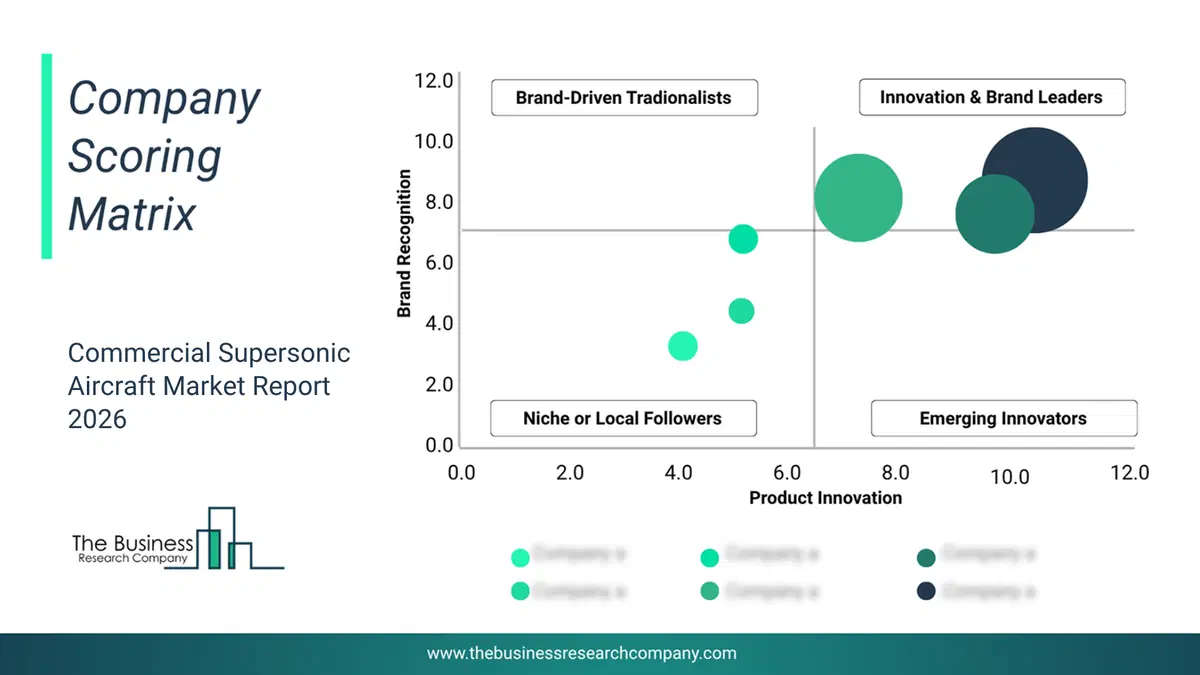
This chart maps companies by product innovation and brand strength, with bubble size indicating relative revenue, helping identify market leaders, challengers, and niche players. This is an illustrative chart; the full report provides a complete and accurate competitive analysis.
Global Commercial Supersonic Aircraft Market Trends and Insights
Major companies operating in the commercial supersonic aircraft market are focusing on advanced noise reduction technologies to develop next-generation aircraft that meet environmental standards while enabling faster, more efficient travel for global passengers. Noise reduction technologies refer to a set of innovations and engineering methods designed to reduce or control the noise produced by aircraft during various phases of flight, especially takeoff, cruising at supersonic speeds, and landing. For instance, in January 2025, Boom Technology Inc., a US-based aerospace company, launched the human-piloted supersonic jet Boom Supersonic’s XB-1, breaking the sound barrier and validating critical technologies such as carbon fiber composites, augmented reality landing systems, digitally optimized aerodynamics, and advanced supersonic intakes. It demonstrates that key innovations required for commercial supersonic travel are now proven and scalable, laying the foundation for Boom’s Overture airliner and signaling a new era of faster, more efficient passenger air travel.What Are Latest Mergers And Acquisitions In The Commercial Supersonic Aircraft Market?
In March 2025, Boom Technology Inc., a US-based aerospace company, partnered with the National Aeronautics and Space Administration to capture an iconic image of civil supersonic flight. Through this partnership, Boom Supersonic aims to capture the first images of the external flow structure around a supersonic aircraft in flight, supporting the development of its Overture airliner and accelerating its mission to return commercial supersonic flight to the skies. The National Aeronautics and Space Administration is a US-based commercial supersonic aircraft development and research and development agency.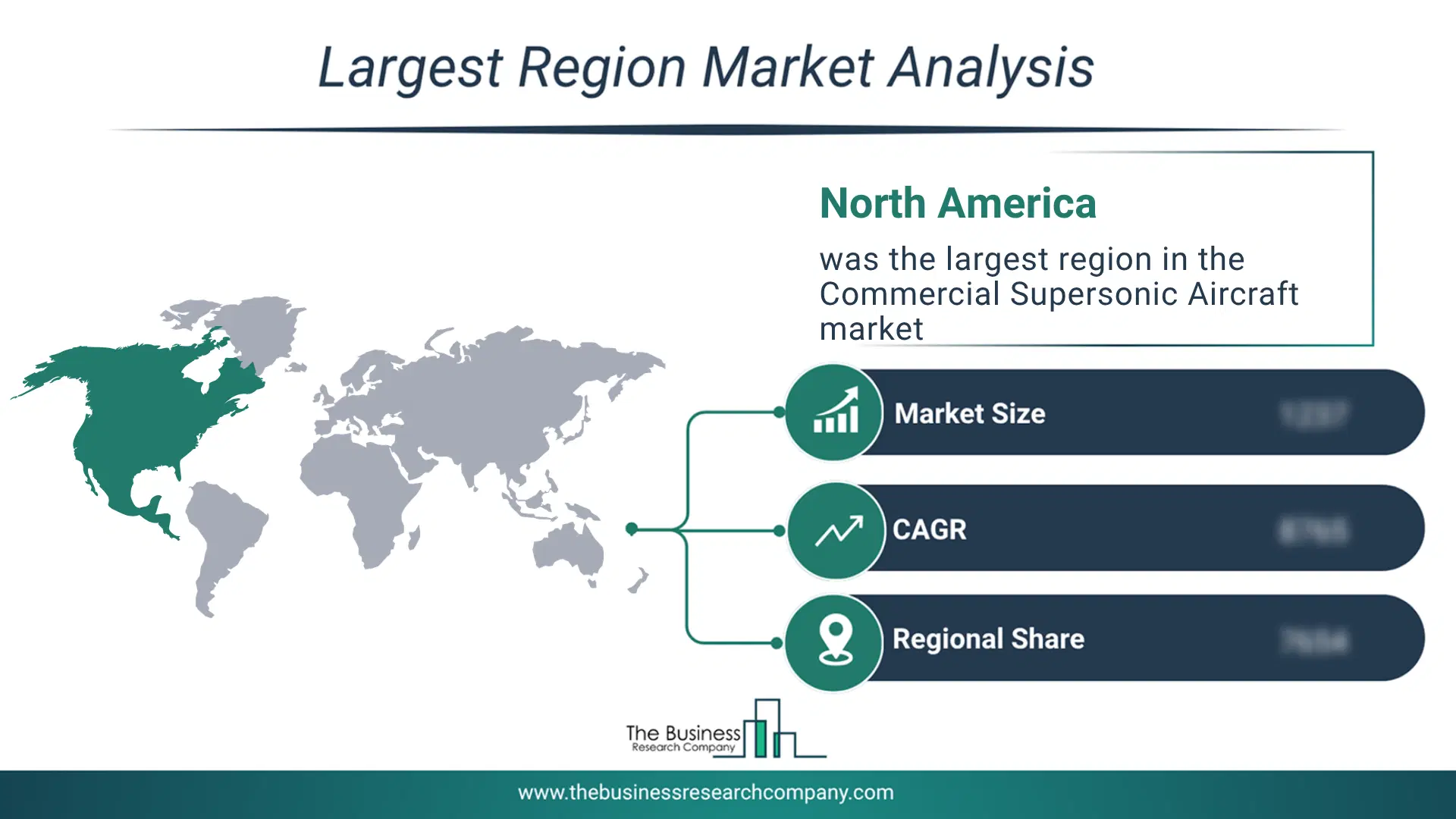
Regional Insights
North America was the largest region in the commercial supersonic aircraft market in 2025. Asia-Pacific is expected to be the fastest-growing region in the forecast period. The regions covered in this market report are Asia-Pacific, South East Asia, Western Europe, Eastern Europe, North America, South America, Middle East, Africa. The countries covered in this market report are Australia, Brazil, China, France, Germany, India, Indonesia, Japan, Taiwan, Russia, South Korea, UK, USA, Canada, Italy, Spain.What Defines the Commercial Supersonic Aircraft Market?
The commercial supersonic aircraft market consists of sales of conventional jet propulsion, short-range supersonic aircraft, and long-range supersonic aircraft. Values in this market are ‘factory gate’ values, that is, the value of goods sold by the manufacturers or creators of the goods, whether to other entities (including downstream manufacturers, wholesalers, distributors, and retailers) or directly to end customers. The value of goods in this market includes related services sold by the creators of the goods.How is Market Value Defined and Measured?
The market value is defined as the revenues that enterprises gain from the sale of goods and/or services within the specified market and geography through sales, grants, or donations in terms of the currency (in USD unless otherwise specified). The revenues for a specified geography are consumption values that are revenues generated by organizations in the specified geography within the market, irrespective of where they are produced. It does not include revenues from resales along the supply chain, either further along the supply chain or as part of other products.
This chart presents market attractiveness based on a quantitative evaluation of growth, competition, strategic alignment, and risk, offering a clear view of opportunity areas for decision-making. This chart is for illustrative purposes; the full report contains the complete analysis.

This chart highlights the Total Addressable Market (TAM) by estimating the maximum revenue opportunity using an assumption-driven approach, supporting strategic planning and opportunity sizing across markets. The chart is illustrative; the full report provides a more comprehensive analysis.
What Key Data and Analysis Are Included in theCommercial Supersonic Aircraft Market Report 2026?
The commercial supersonic aircraft market research report is one of a series of new reports from The Business Research Company that provides market statistics, including industry global market size, regional shares, competitors with the market share, detailed market segments, market trends and opportunities, and any further data you may need to thrive in the commercial supersonic aircraft industry. The market research report delivers a complete perspective of everything you need, with an in-depth analysis of the current and future state of the industry.Commercial Supersonic Aircraft Market Report Forecast Analysis
| Report Attribute | Details |
|---|---|
| Market Size Value In 2026 | $48.14 billion |
| Revenue Forecast In 2030 | $56.72 billion |
| Growth Rate | CAGR of 4.5% from 2026 to 2030 |
| Base Year For Estimation | 2025 |
| Actual Estimates/Historical Data | 2020-2025 |
| Forecast Period | 2026 - 2030 |
| Market Representation | Revenue in USD Billion and CAGR from 2026 to 2030 |
| Segments Covered | Aircraft Type, Engine Type, End-Use Industry |
| Regional Scope | Asia-Pacific, Western Europe, Eastern Europe, North America, South America, Middle East, Africa |
| Country Scope | The countries covered in this market report are Australia, Brazil, China, France, Germany, India, Indonesia, Japan, Taiwan, Russia, South Korea, UK, USA, Canada, Italy, Spain |
| Key Companies Profiled | Aviation Industry Corporation of China, Lockheed Martin Corporation, Northrop Grumman Corporation, Hermeus Corporation, United Aircraft Corporation, Japan Aerospace Exploration Agency, National Aeronautics and Space Administration, Boom Technology Inc., Aerion Corporation, Baykar Technology, Dawn Aerospace Limited, Reaction Engines Ltd., Spike Aerospace Inc., Exosonic Inc., Hypersonix Launch Systems Ltd., Virgin Galactic, EON Aerospace Inc., Overture, Symphony, Destinus. |
| Customization Scope | Request for Customization |
| Pricing And Purchase Options | Explore Purchase Options |