
Crude Oil Carrier Market Report 2026
Global Outlook – By Vessel Type (Very Large Crude Carrier (VLCC), Suezmax, Aframax, Ultra Large Crude Carrier (ULCC)), By Dead Weight Tonnage (120,000 MT-180,000 MT, 180,000 MT -320,000 MT, 25,000 MT-50,000 MT, 50,000 MT-75,000 MT, 75,000 MT-120,000 MT, Above 320,000 MT), By Application (Crude Oil Transportation, Unrefined or Blended Crude Oil Transport, Strategic Petroleum Reserve (SPR) Transportation, Offshore Production to Refinery Transport, Inter-Regional or Cross-Border Crude Oil Trade, Other Applications) – Market Size, Trends, Strategies, and Forecast to 2030
Crude Oil Carrier Market Overview
• Crude Oil Carrier market size has reached to $203 billion in 2025 • Expected to grow to $249.07 billion in 2030 at a compound annual growth rate (CAGR) of 4.4% • Growth Driver: Increasing Crude Oil Demand Drives Expansion In The Crude Oil Carrier Market • Market Trend: Advancements In Carrier System For The Crude Oil Carrier Market • Asia-Pacific was the largest region in 2025.What Is Covered Under Crude Oil Carrier Market?
A crude oil carrier refers to ocean-going vessel constructed and intended for transporting crude oil or its products. They are used for to transfer massive amounts of crude oil across the seas and oceans. The main types of vessels included in crude oil carriers are very large crude carriers (VLCC), suezmax, aframax, ultra large crude carriers (ULCC), and panamax. Very Large Crude Carrier (VLCC) refers to vessels having a capacity of more than 250,000 DWT. The several types of dead weight tonnage included are 120,000 mt-180,000 mt, 180,000 mt-320,000 mt, 25,000 mt-50,000 mt, 50,000 mt-75,000 mt, 75,000 mt-120,000 mt, and above 320,000 mt. The various hull types are double bottom, double hull, and single bottom, which are used for several applications, such as diesel, gasoline, aviation turbine fuel, and others.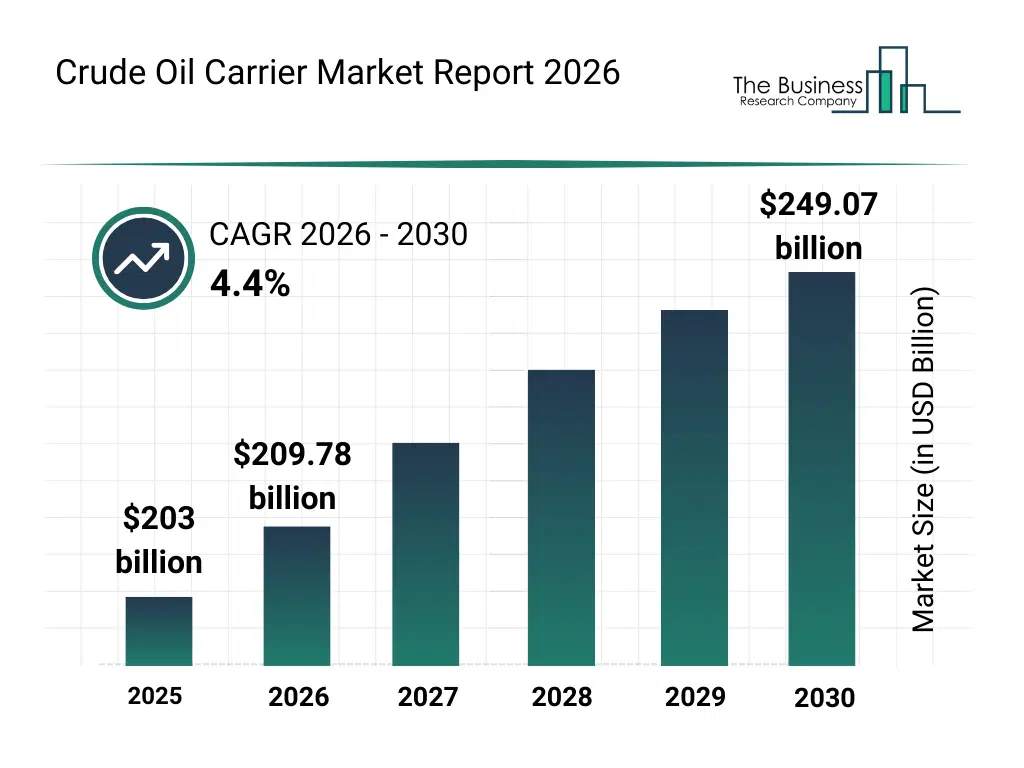
What Is The Crude Oil Carrier Market Size and Share 2026?
The crude oil carrier market size has grown steadily in recent years. It will grow from $203 billion in 2025 to $209.78 billion in 2026 at a compound annual growth rate (CAGR) of 3.3%. The growth in the historic period can be attributed to global oil trade expansion, offshore production growth, energy demand increase, shipbuilding investments, maritime trade routes.What Is The Crude Oil Carrier Market Growth Forecast?
The crude oil carrier market size is expected to see steady growth in the next few years. It will grow to $249.07 billion in 2030 at a compound annual growth rate (CAGR) of 4.4%. The growth in the forecast period can be attributed to decarbonization of shipping, demand for fuel-efficient vessels, smart fleet management, compliance with maritime safety norms, modernization of aging fleets. Major trends in the forecast period include demand for large-capacity tankers, fleet modernization initiatives, adoption of double-hull designs, growth in long-haul crude transport, focus on operational efficiency.
Global Crude Oil Carrier Market Segmentation
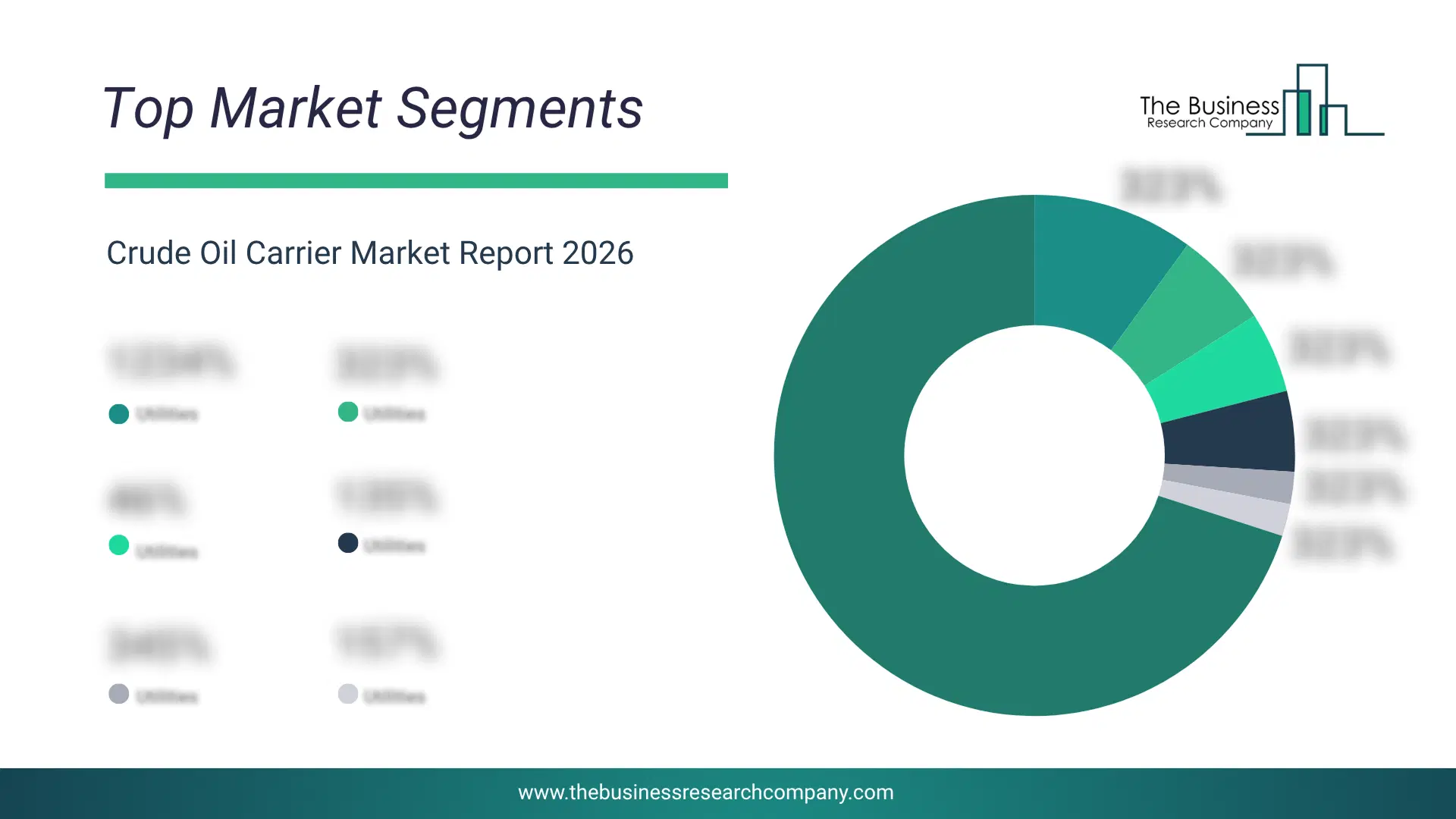
1) By Vessel Type: Very Large Crude Carrier (VLCC), Suezmax, Aframax, Ultra Large Crude Carrier (ULCC) 2) By Dead Weight Tonnage: 120,000 MT-180,000 MT, 180,000 MT -320,000 MT, 25,000 MT-50,000 MT, 50,000 MT-75,000 MT, 75,000 MT-120,000 MT, Above 320,000 MT 3) By Application: Crude Oil Transportation, Unrefined or Blended Crude Oil Transport, Strategic Petroleum Reserve (SPR) Transportation, Offshore Production to Refinery Transport, Inter-Regional or Cross-Border Crude Oil Trade, Other Applications Subsegments: 1) By Very Large Crude Carrier (VLCC): Conventional VLCC, Modern VLCC, Converted VLCC 2) By Suezmax: Conventional Suezmax, Modern Suezmax, Converted Suezmax 3) By Aframax: Conventional Aframax, Modern Aframax, Converted Aframax 4) By Ultra Large Crude Carrier (ULCC): Conventional ULCC, Modern ULCC, Converted ULCCWhat Is The Driver Of The Crude Oil Carrier Market?
The rising demand for crude oil and its by-products is expected to propel the growth of the crude oil carrier market going forward. Crude oil is a combination of hydrocarbons that occurs in the liquid phase in natural subterranean reservoirs and stays liquid under normal pressure despite passing through surface-separating facilities. The by-products are products obtained by the extraction process in a refinery, and these products include gasoline, aviation fuel, diesel, and asphalt. The crude oil carriers are used in the transportation of bulk crude oil and related by-products from the offshore platforms to a transshipment terminal. For instance, in March 2023, according to the US Energy Information Administration, a US-based federal statistical system for gathering, processing, and disseminating energy data, the U.S. crude oil output increased to 12.4 million b/d in 2023 from the record high of 11.7 million b/d in 2022. Furthermore, the US consumed an average of 86.6 billion cubic feet of natural gas per day (Bcf/d) in 2022, the highest annual consumption of natural gas in the U.S. as compared to the previous year. Therefore, the rising demand for crude oil and its by-products is driving the crude oil carrier industry.Key Players In The Global Crude Oil Carrier Market
Major companies operating in the crude oil carrier market report include China Shipping Tanker Co Ltd, Maersk Tankers A/S, Kuwait Oil Tanker Company SAK, OSG Ship Management Inc, Alaska Tanker Company LLC, Shipping Corporation of India Ltd, Frontline Ltd, Tsakos Energy Navigation Limited, National Iranian Tanker Company, Euronav NV, Tankers International LLC, Nordic American Tankers Limited, AET Tanker Holdings Sdn Bhd, Teekay Corporation, Angelicoussis Shipping Group Limited, Mitsui OSK Lines Ltd, Scorpio Tankers Inc, DHT Holdings Inc, Oman Shipping Company SAOC, Dynacom Tankers Management Ltd, Gener8 Maritime Inc, International Seaways Inc, PAO Sovcomflot, Maran Tankers Management Inc, Navios Maritime Partners LP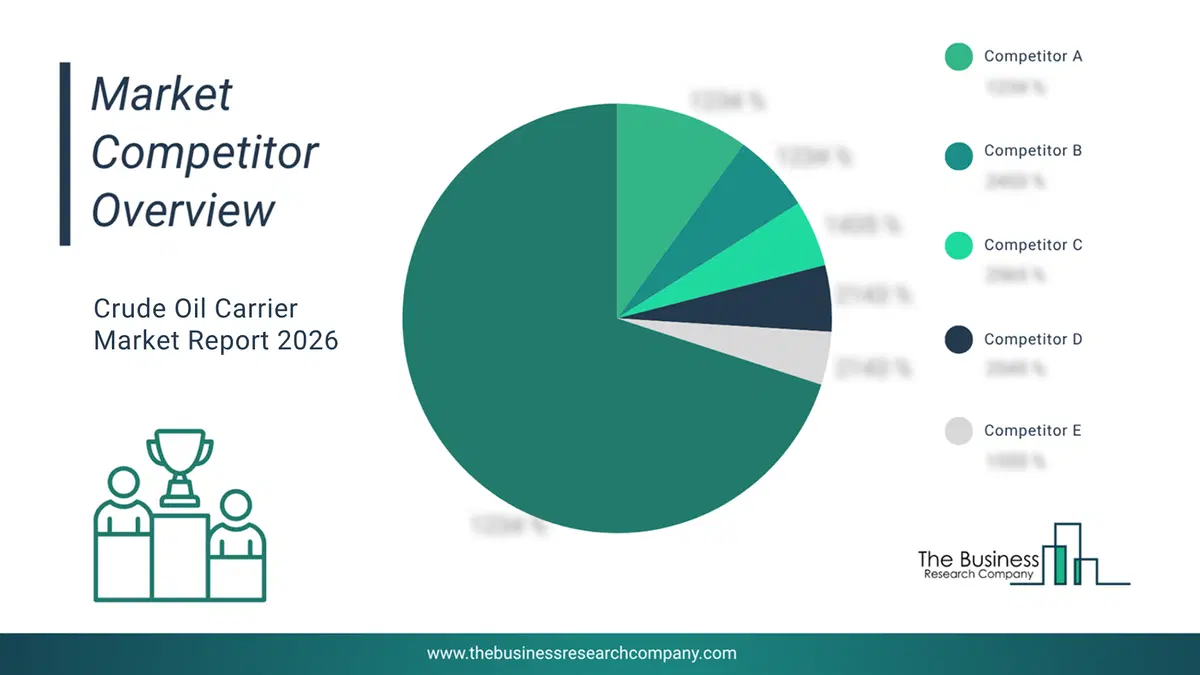
This chart is for illustrative purposes; the full report includes a detailed competitor analysis and comprehensive overview of the top 10 companies in the market.
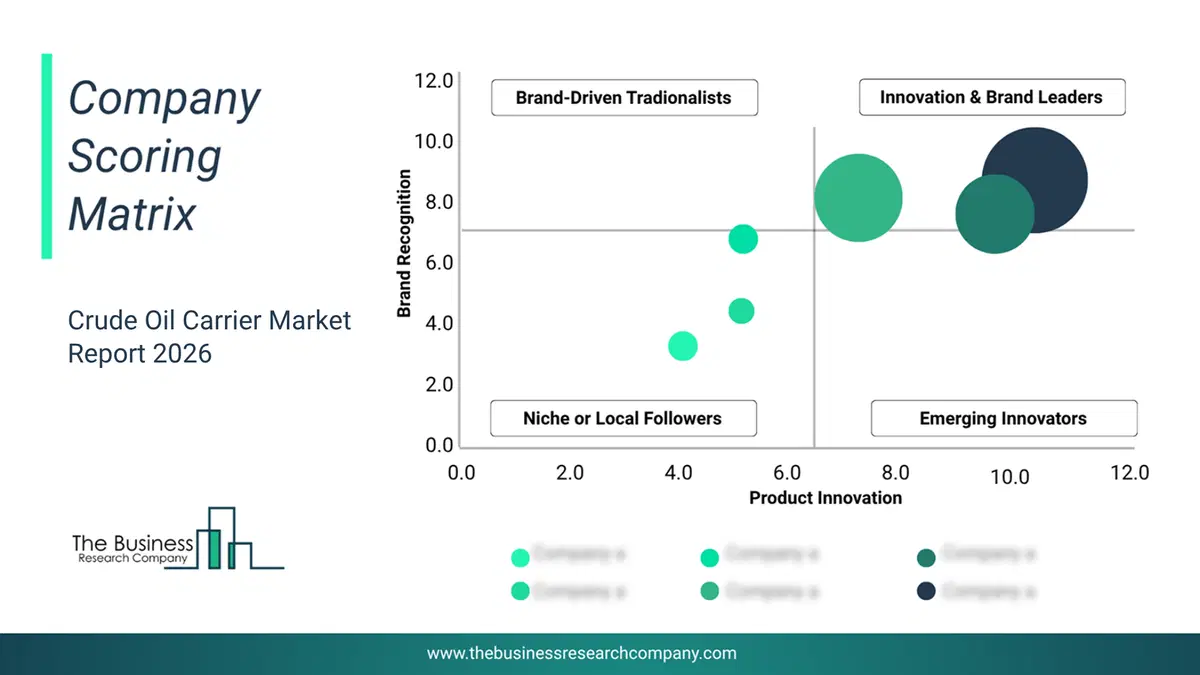
This chart maps companies by product innovation and brand strength, with bubble size indicating relative revenue, helping identify market leaders, challengers, and niche players. This is an illustrative chart; the full report provides a complete and accurate competitive analysis.
Global Crude Oil Carrier Market Trends and Insights
Major companies operating in the crude oil carrier market are developing innovative solutions, such as the crude oil and liquefied natural gas (LNG) carriers, to enhance fuel efficiency and reduce emissions. Crude oil and liquefied natural gas (LNG) carriers refer to specialized vessels designed for the transportation of crude oil and LNG, ensuring safe and efficient delivery of these energy resources. For instance, in August 2023, Zvezda shipyard, a Russia-based shipbuilding company, launched Arc6 Valentin Pikul and Arc6 Sergei Witte to transport oil and liquefied natural gas (LNG) as part of ongoing projects.The latest in this series is a vessel named Sergei Witte, which has a capacity of 172,600 cubic meters. These ships are critical for Russia's Arctic energy projects, given the growing demand for LNG and oil exports from the region.What Are Latest Mergers And Acquisitions In The Crude Oil Carrier Market?
In May 2023, DHT Holdings Inc., a Bermuda-based crude oil tanker company acquired VLCC by Hyundai Heavy Industries for an amount of $94.5 million. This acquisition of the VLCC is expected to improve the DHT fleet's efficiencies, such as the Annual Efficiency Ratio (AER) and Energy Efficiency Operational Index (EEOI) metrics. Hyundai Heavy Industries is a South Korea-based company involved in the crude oil carrier.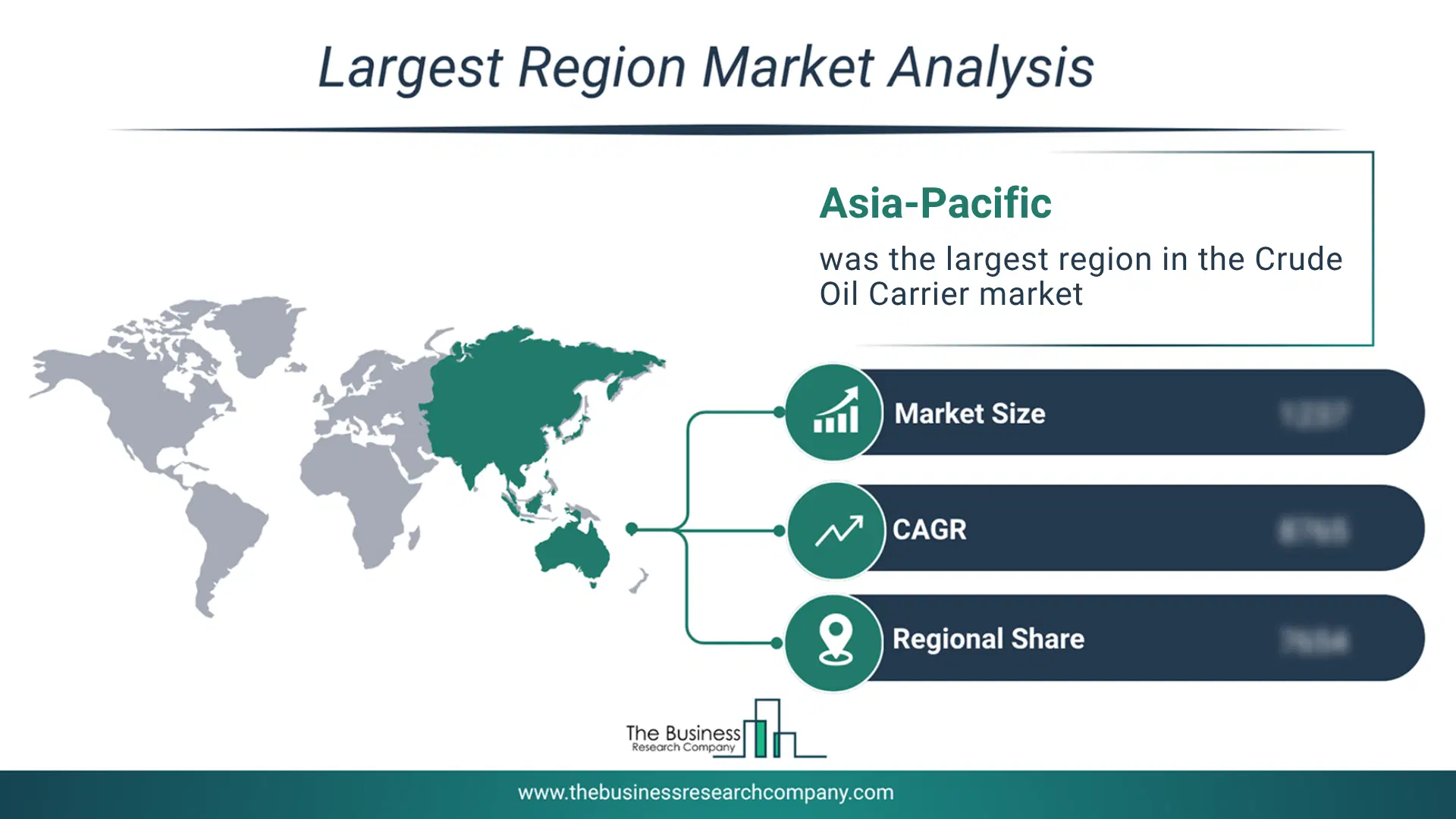
Regional Outlook
Asia-Pacific was the largest region in the crude oil carrier market in 2025. The regions covered in this market report include Asia-Pacific, South East Asia, Western Europe, Eastern Europe, North America, South America, Middle East, Africa. The countries covered in this market report include Australia, Brazil, China, France, Germany, India, Indonesia, Japan, Taiwan, Russia, South Korea, UK, USA, Canada, Italy, SpainWhat Defines the Crude Oil Carrier Market?
The crude oil carrier market consists of sales of shuttle tankers, arctic crude oil tankers, oil storage vessels, oil barges, and deck oil carriers. Values in this market are ‘factory gate’ values, that is, the value of goods sold by the manufacturers or creators of the goods, whether to other entities (including downstream manufacturers, wholesalers, distributors, and retailers) or directly to end customers. The value of goods in this market includes related services sold by the creators of the goods.How is Market Value Defined and Measured?
The market value is defined as the revenues that enterprises gain from the sale of goods and/or services within the specified market and geography through sales, grants, or donations in terms of the currency (in USD unless otherwise specified). The revenues for a specified geography are consumption values that are revenues generated by organizations in the specified geography within the market, irrespective of where they are produced. It does not include revenues from resales along the supply chain, either further along the supply chain or as part of other products.
This chart presents market attractiveness based on a quantitative evaluation of growth, competition, strategic alignment, and risk, offering a clear view of opportunity areas for decision-making. This chart is for illustrative purposes; the full report contains the complete analysis.

This chart highlights the Total Addressable Market (TAM) by estimating the maximum revenue opportunity using an assumption-driven approach, supporting strategic planning and opportunity sizing across markets. The chart is illustrative; the full report provides a more comprehensive analysis.
What Key Data and Analysis Are Included in the Crude Oil Carrier Market Report 2026?
The crude oil carrier market research report is one of a series of new reports from The Business Research Company that provides market statistics, including industry global market size, regional shares, competitors with the market share, detailed market segments, market trends and opportunities, and any further data you may need to thrive in the crude oil carrier industry. The market research report delivers a complete perspective of everything you need, with an in-depth analysis of the current and future state of the industry.Crude Oil Carrier Market Report Forecast Analysis
| Report Attribute | Details |
|---|---|
| Market Size Value In 2026 | $209.78 billion |
| Revenue Forecast In 2030 | $249.07 billion |
| Growth Rate | CAGR of 3.3% from 2026 to 2030 |
| Base Year For Estimation | 2025 |
| Actual Estimates/Historical Data | 2020-2025 |
| Forecast Period | 2026 - 2030 - 2030 |
| Market Representation | Revenue in USD Billion and CAGR from 2026 to 2030 |
| Segments Covered | Vessel Type, Dead Weight Tonnage, Application |
| Regional Scope | Asia-Pacific, Western Europe, Eastern Europe, North America, South America, Middle East, Africa |
| Country Scope | The countries covered in the report are Australia, Brazil, China, France, Germany, India, Indonesia, Japan, Taiwan, Russia, South Korea, UK, USA, Canada, Italy, Spain. |
| Key Companies Profiled | China Shipping Tanker Co Ltd, Maersk Tankers A/S, Kuwait Oil Tanker Company SAK, OSG Ship Management Inc, Alaska Tanker Company LLC, Shipping Corporation of India Ltd, Frontline Ltd, Tsakos Energy Navigation Limited, National Iranian Tanker Company, Euronav NV, Tankers International LLC, Nordic American Tankers Limited, AET Tanker Holdings Sdn Bhd, Teekay Corporation, Angelicoussis Shipping Group Limited, Mitsui OSK Lines Ltd, Scorpio Tankers Inc, DHT Holdings Inc, Oman Shipping Company SAOC, Dynacom Tankers Management Ltd, Gener8 Maritime Inc, International Seaways Inc, PAO Sovcomflot, Maran Tankers Management Inc, Navios Maritime Partners LP |
| Customization Scope | Request for Customization |
| Pricing And Purchase Options | Explore Purchase Options |