
Data Center Accelerator Market Report 2026
Global Outlook – By Processor Type (CPU (Central Processing Unit), GPU (Graphics Processing Unit), FPGA (Field-Programmable Gate Array), ASIC (Application-specific Integrated Circuit)), By Type (HPC Accelerator, Cloud Accelerator), By Application (Deep Learning, Public Cloud Interface, Enterprise Interface), By End-User (Telecommunication & IT, Healthcare, BFSI, Government, Energy, Other End Users) – Market Size, Trends, Strategies, and Forecast to 2030
Data Center Accelerator Market Overview
• Data Center Accelerator market size has reached to $27.13 billion in 2025 • Expected to grow to $93.06 billion in 2030 at a compound annual growth rate (CAGR) of 27.8% • Growth Driver: Rising Data Center Numbers Drive Growth In The Data Center Accelerator Market • Market Trend: Adoption of High-Performance AI Accelerators in Data Centers to Optimize AI Workloads • North America was the largest region in 2025 and Asia-Pacific is the fastest growing region.Market Gains By 2030 – Top Opportunities By Segment
Market Gain identifies the most promising market opportunities by highlighting the segments or products expected to generate the highest incremental revenue growth over the next five years.
What Is Covered Under Data Center Accelerator Market?
A data center accelerator is a software program or hardware device that improves the computer's overall performance by handling visual data. It generally aids in raising consumer-centric data demand and improving the use of artificial intelligence (AI)-based services to propel the demand for AI-driven data centers, which improves data center performance. It is used to improve the operational efficiency of computers. The main types of data center accelerators are HPC accelerators and cloud accelerators. HPC accelerators are used to solve sophisticated computation issues. High-performance computing (HPC) employs supercomputers and computer clusters for various applications. The different processor types include CPU (central processing unit), GPU (graphics processing unit), FPGA (field-programmable gate array), and ASIC (application-specific integrated circuit), and involve several applications such as deep learning, public cloud interface, and enterprise interface. It is employed in several sectors, including telecommunication and IT, healthcare, BFSI, government, energy, and others.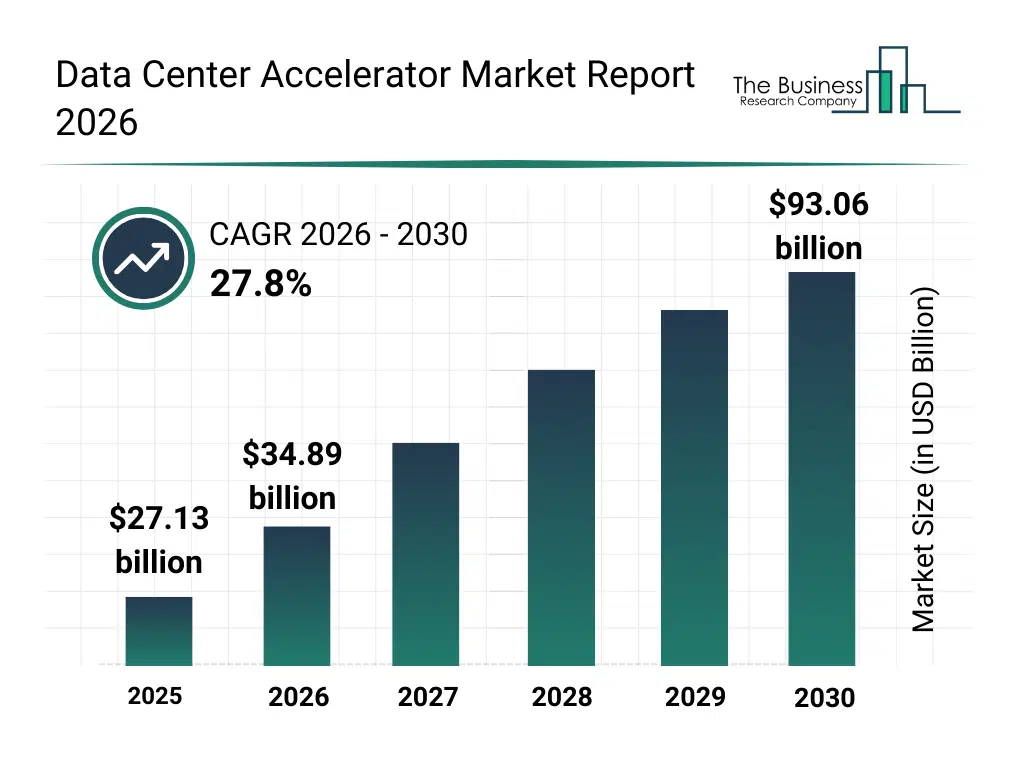
What Is The Data Center Accelerator Market Size and Share 2026?
The data center accelerator market size has grown exponentially in recent years. It will grow from $27.13 billion in 2025 to $34.89 billion in 2026 at a compound annual growth rate (CAGR) of 28.6%. The growth in the historic period can be attributed to rising data center compute intensity, expansion of cloud service providers, increasing demand for high-performance computing, early adoption of gpu acceleration, growth in enterprise data workloads.What Is The Data Center Accelerator Market Growth Forecast?
The data center accelerator market size is expected to see exponential growth in the next few years. It will grow to $93.06 billion in 2030 at a compound annual growth rate (CAGR) of 27.8%. The growth in the forecast period can be attributed to expansion of generative AI applications, rising investments in hyperscale data centers, growing demand for low-latency processing, increasing focus on accelerator power efficiency, wider adoption of heterogeneous computing architectures. Major trends in the forecast period include increasing adoption of ai-optimized accelerators, rising deployment of gpu-based data center workloads, growing use of asics for AI inference, expansion of hpc accelerators in cloud data centers, enhanced focus on energy-efficient accelerator architectures.

Global Data Center Accelerator Market Segmentation
1) By Processor Type: CPU (Central Processing Unit), GPU (Graphics Processing Unit), FPGA (Field-Programmable Gate Array), ASIC (Application-specific Integrated Circuit) 2) By Type: HPC Accelerator, Cloud Accelerator 3) By Application: Deep Learning, Public Cloud Interface, Enterprise Interface 4) By End-User: Telecommunication & IT, Healthcare, BFSI, Government, Energy, Other End Users Subsegments: 1) By CPU (Central Processing Unit): Server-Class CPUs, Cloud-Native CPUs, AI-Optimized CPUs 2) By GPU (Graphics Processing Unit): Data Center GPUs, AI And Deep Learning GPUs, HPC GPUs 3) By FPGA (Field-Programmable Gate Array): High-Performance Data Center FPGAs, AI And Inference Acceleration FPGAs, Network And Storage Acceleration FPGAs 4) By ASIC (Application-Specific Integrated Circuit): AI And Machine Learning ASICs, Deep Learning Training ASICs, Inference Acceleration ASICs The top segments in the data center accelerator market will be: • GPU (Graphics Processing Unit) will reach $59.16 Billion by 2030. • FPGA (Field-Programmable Gate Array) will reach $14.3 Billion by 2030. • ASIC (Application-specific Integrated Circuit) will reach $9.78 Billion by 2030. • CPU (Central Processing Unit) will reach $9.41 Billion by 2030.What Is The Driver Of The Data Center Accelerator Market?
The increasing number of data centers is expected to propel the growth of the data center accelerator market going forward. A data center is a facility where computer systems and related equipment, like storage and telecommunications, are kept. In addition to distributing and facilitating access to resources, it is used to store, process, and manage enormous volumes of data. Data center accelerators play an increasingly important role in data centers by providing significant performance and efficiency gains for a wide range of workloads. For instance, according to Savills, a UK-based real estate services company, 60% of South Korea's data center capacity is currently located in Seoul, and this figure is expected to rise to 80% by 2029. To mitigate this concentration, the Korean government is encouraging data center development in other regions by offering incentives such as discounted power and infrastructure support. Therefore, the increasing number of data centers is driving the growth of the data center accelerator industry.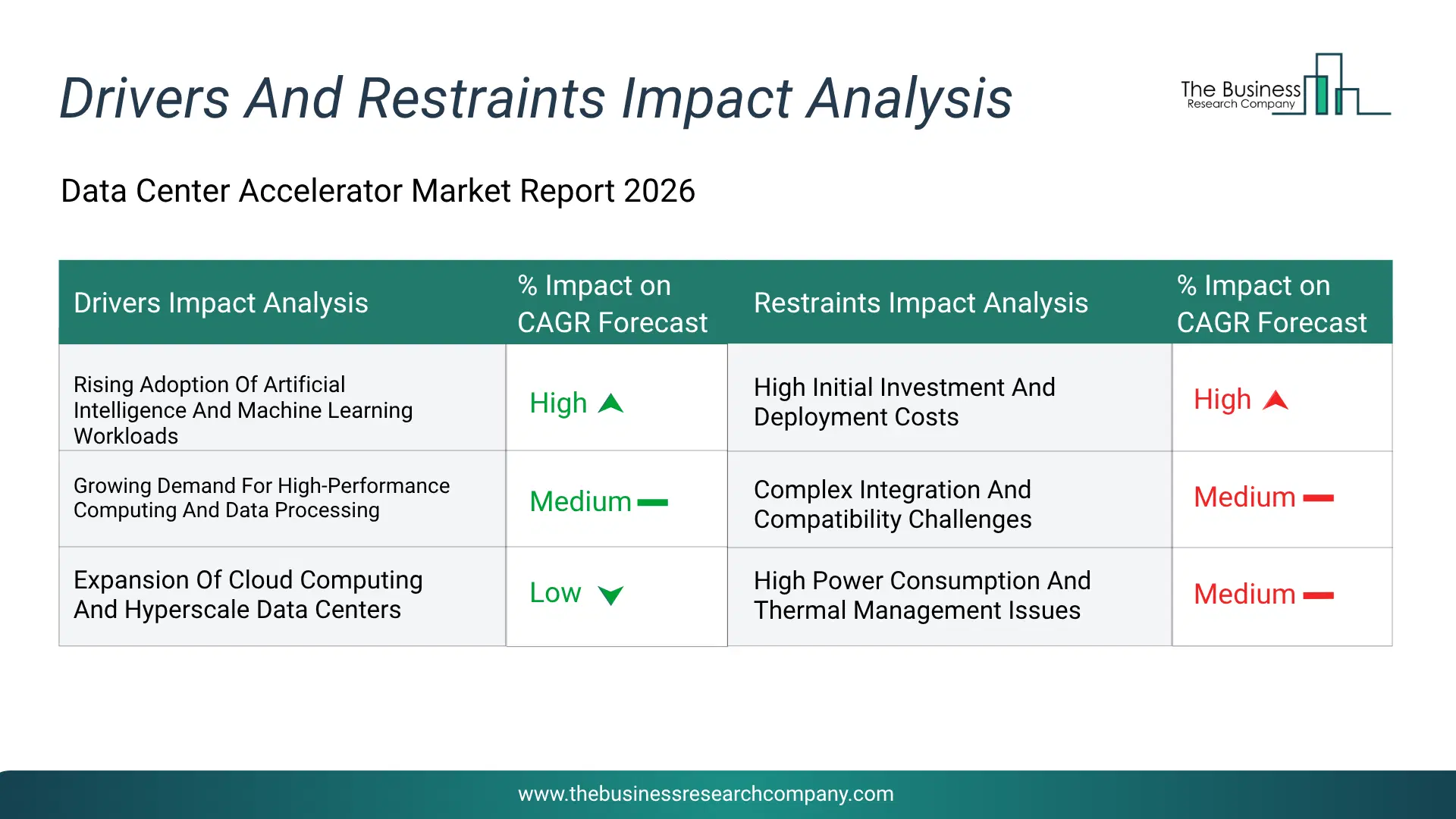
Infographic Chart Showing Key Market Drivers Analysis And Restraints For Data Center Accelerator Market
The chart presents an impact analysis of key drivers and restraints, quantifying their relative influence on the market's growth rate and helping assess the balance between growth enablers and limiting factors. This chart offers a high-level perspective; the full report contains more detailed insights.
How Will The Drivers Impact Growth In The Global Data Center Accelerator Market?
• Rising Adoption Of Artificial Intelligence And Machine Learning Workloads (High) – During the forecast period, the rising adoption of artificial intelligence and machine learning workloads is expected to become a key growth driver for the data center accelerator market by 2030. Enterprises across industries are increasingly deploying AI models for applications such as natural language processing, computer vision, and predictive analytics, requiring specialized acceleration hardware to handle complex computations efficiently. Accelerators enable faster model training and inference, reducing latency and improving overall system performance. Technology providers are therefore scaling investments in AI-optimized chips to meet evolving computational demands. This transition toward AI-driven infrastructure is reinforcing strong market expansion. • Growing Demand For High-Performance Computing And Data Processing (Medium) – During the forecast period, the growing demand for high-performance computing and data processing is expected to emerge as a major factor driving the expansion of the data center accelerator market by 2030. Industries such as scientific research, financial modeling, and real-time analytics require advanced computing capabilities to process large volumes of data with high speed and accuracy. Accelerators significantly enhance computational throughput and energy efficiency compared to traditional processing units, making them essential for modern data center operations. Organizations are increasingly integrating heterogeneous computing architectures to meet these requirements. • Expansion Of Cloud Computing And Hyperscale Data Centers (Low) – During the forecast period, the expansion of cloud computing and hyperscale data centers is expected to act as a key growth catalyst for the data center accelerator market by 2030. Leading cloud service providers are rapidly expanding their infrastructure to support increasing workloads from enterprises and consumers, driving large-scale deployment of accelerators for improved efficiency and scalability. Hyperscale environments require optimized hardware to manage dynamic workloads, enhance virtualization capabilities, and ensure seamless service delivery. Additionally, the shift toward cloud-native applications is further increasing the need for accelerated computing solutions. As cloud infrastructure continues to expand globally, adoption of accelerators is expected to rise significantly.How Will The Restraints Impact Growth In The Global Data Center Accelerator Market?
• High Initial Investment And Deployment Costs (High) – During the forecast period, the high initial investment required for data center accelerators acts as a significant restraint on market growth. Advanced hardware such as GPUs, FPGAs, and ASICs involves substantial capital expenditure, making it challenging for small and medium-sized enterprises to adopt these technologies. In addition to procurement costs, expenses related to installation, integration, and infrastructure upgrades further increase the financial burden. Organizations must also invest in cooling systems and power management to support high-performance accelerators. This limits adoption primarily to large enterprises and hyperscale data centers with strong financial capabilities. Budget constraints often delay or restrict deployment decisions. As a result, the high cost barrier slows the overall expansion of the market. • Complex Integration And Compatibility Challenges (Medium) – During the forecast period, integrating data center accelerators into existing IT infrastructure can be complex and acts as a restraint for the market. Many organizations operate on legacy systems that may not be compatible with modern accelerator technologies. Ensuring seamless interaction between hardware, software frameworks, and workloads requires specialized expertise and time. Compatibility issues can lead to inefficiencies, increased downtime, and additional costs during deployment. Moreover, optimizing workloads to fully utilize accelerators often demands significant changes in application architecture. This complexity discourages organizations from rapid adoption. Consequently, integration challenges hinder the widespread implementation of data center accelerators. • High Power Consumption And Thermal Management Issues (Low) – During the forecast period, data center accelerators typically consume large amounts of power, creating challenges in energy efficiency and thermal management. Increased power usage leads to higher operational costs and puts pressure on existing energy infrastructure. Additionally, accelerators generate significant heat, requiring advanced cooling solutions to maintain optimal performance and prevent hardware failure. Implementing such cooling systems further raises operational and maintenance expenses. These energy and thermal concerns are particularly critical for large-scale data centers aiming to achieve sustainability goals. Organizations may hesitate to deploy accelerators extensively due to these challenges. Therefore, high power consumption and cooling requirements act as key restraints for the market.Key Players In The Global Data Center Accelerator Market
Major companies operating in the data center accelerator market are Intel Corporation; Advanced Micro Devices Inc.; NVIDIA Corporation; International Business Machines Corporation; Google LLC; Microsoft Corporation; Amazon.com Inc.; Oracle Corporation; SAP SE; Fujitsu Limited; NEC Corporation; Lenovo Group Limited; Hewlett-Packard Development Company; Cisco Systems Inc.; SambaNova Systems Inc.; Groq Inc.; Cerebras Systems Inc.; Graphcore Ltd.; Ampere Computing LLC; Lightmatter Inc.; Esperanto Technologies Inc.
This chart is for illustrative purposes; the full report includes a detailed competitor analysis and comprehensive overview of the top 10 companies in the market.

This chart maps companies by product innovation and brand strength, with bubble size indicating relative revenue, helping identify market leaders, challengers, and niche players. This is an illustrative chart; the full report provides a complete and accurate competitive analysis.
Global Data Center Accelerator Market Trends and Insights
Major companies are operating in the data center accelerator market, focusing on developing technological advancements such as high-bandwidth, inference-optimized GPUs to meet the rising demand for large-language-model training and AI inference. A high-performance AI accelerator is a specialized GPU or ASIC designed to offload compute-intensive AI tasks from traditional CPUs, featuring massive parallelism, high-bandwidth memory, and optimized tensor cores. Compared to conventional CPU-only architectures, these accelerators deliver significantly higher throughput, lower latency, and improved energy efficiency. For instance, in October 2024, AMD, a U.S.-based semiconductor company, launched the AMD Instinct MI325X, an advanced AI accelerator for data centers. The MI325X features 256 GB of HBM3E memory, up to 6.0 TB/s memory bandwidth, and FP16/FP8 tensor cores, offering accelerated performance for foundation-model training, inference, and large context LLM workloads. The product is optimized for hyperscale data centers and cloud environments, delivering better AI performance, higher memory capacity, and enhanced software ecosystem support via AMD ROCm compared to previous-generation accelerators.What Are Latest Mergers And Acquisitions In The Data Center Accelerator Market?
In May 2023, KKR, a US-based global investment firm, acquired CoolIT for $270 million. Through this acquisition, KKR aims to strengthen its position in the data center market by enhancing its capabilities in liquid cooling solutions. CoolIT is a UK-based company specializing in advanced thermal management technologies for data centers and high-performance computing environments.
Regional Insights
North America was the largest region in the data center accelerator market in 2025. Asia-Pacific is expected to be the fastest-growing region in the forecast period. The regions covered in this market report are Asia-Pacific, South East Asia, Western Europe, Eastern Europe, North America, South America, Middle East, Africa. The countries covered in this market report are Australia, Brazil, China, France, Germany, India, Indonesia, Japan, Taiwan, Russia, South Korea, UK, USA, Canada, Italy, SpainWhat Defines the Data Center Accelerator Market?
The data center accelerator market includes revenues earned by entities by providing AI training and inference services, storage systems and computing infrastructure services. The market value includes the value of related goods sold by the service provider or included within the service offering. Only goods and services traded between entities or sold to end consumers are included.How is Market Value Defined and Measured?
The market value is defined as the revenues that enterprises gain from the sale of goods and/or services within the specified market and geography through sales, grants, or donations in terms of the currency (in USD unless otherwise specified). The revenues for a specified geography are consumption values that are revenues generated by organizations in the specified geography within the market, irrespective of where they are produced. It does not include revenues from resales along the supply chain, either further along the supply chain or as part of other products.
This chart presents market attractiveness based on a quantitative evaluation of growth, competition, strategic alignment, and risk, offering a clear view of opportunity areas for decision-making. This chart is for illustrative purposes; the full report contains the complete analysis.

This chart highlights the Total Addressable Market (TAM) by estimating the maximum revenue opportunity using an assumption-driven approach, supporting strategic planning and opportunity sizing across markets. The chart is illustrative; the full report provides a more comprehensive analysis.
What Key Data and Analysis Are Included in the Data Center Accelerator Market Report 2026?
The data center accelerator market research report is one of a series of new reports from The Business Research Company that provides market statistics, including industry global market size, regional shares, competitors with the market share, detailed market segments, market trends and opportunities, and any further data you may need to thrive in the data center accelerator industry. The market research report delivers a complete perspective of everything you need, with an in-depth analysis of the current and future state of the industry.Data Center Accelerator Market Report Forecast Analysis
| Report Attribute | Details |
|---|---|
| Market Size Value In 2026 | $34.89 billion |
| Revenue Forecast In 2030 | $93.06 billion |
| Growth Rate | CAGR of 28.6% from 2026 to 2030 |
| Base Year For Estimation | 2025 |
| Actual Estimates/Historical Data | 2020-2025 |
| Forecast Period | 2026 - 2030 |
| Market Representation | Revenue in USD Billion and CAGR from 2026 to 2030 |
| Segments Covered | Processor Type, Type, Application, End-User |
| Regional Scope | Asia-Pacific, Western Europe, Eastern Europe, North America, South America, Middle East, Africa |
| Country Scope | The countries covered in the report are Australia, Brazil, China, France, Germany, India, Indonesia, Japan, Taiwan, Russia, South Korea, UK, USA, Canada, Italy, Spain. |
| Key Companies Profiled | Intel Corporation; Advanced Micro Devices Inc.; NVIDIA Corporation; International Business Machines Corporation; Google LLC; Microsoft Corporation; Amazon.com Inc.; Oracle Corporation; SAP SE; Fujitsu Limited; NEC Corporation; Lenovo Group Limited; Hewlett-Packard Development Company; Cisco Systems Inc.; SambaNova Systems Inc.; Groq Inc.; Cerebras Systems Inc.; Graphcore Ltd.; Ampere Computing LLC; Lightmatter Inc.; Esperanto Technologies Inc. |
| Customization Scope | Request for Customization |
| Pricing And Purchase Options | Explore Purchase Options |