
Data Center Blade Server Market Report 2026
Global Outlook – By Type (Tier 1, Tier 2, Tier 3, Tier 4), By Enterprise Size (Large Enterprises, Smal And Medium Enterprises), By End User (Banking, Financial Services And Insurance (BFSI), IT and Telecom, Manufacturing, Healthcare, Energy and Utility, Other End Users) – Market Size, Trends, Strategies, and Forecast to 2030
Data Center Blade Server Market Overview
• Data Center Blade Server market size has reached to $19.75 billion in 2025 • Expected to grow to $29.28 billion in 2030 at a compound annual growth rate (CAGR) of 7.9% • Growth Driver: IoT Adoption Propelling Growth In Data Center Blade Server Market • Market Trend: Ultra-Dense Blade Innovations Drive Scalable, Energy-Efficient Computing • North America was the largest region in 2025 and Asia-Pacific is the fastest growing region.What Is Covered Under Data Center Blade Server Market?
Data center blade servers are modular servers designed for data centers, offering high computing density, business optimization, and virtualization capabilities. These thin, hot-swappable servers offer high-density and shared resources within a common chassis, enhancing efficiency and scalability in large-scale data environments. The main types of data center blade server market are tier 1, tier 2, tier 3, and tier 4. Tier 1 typically refers to the top level in a hierarchical structure, often denoting a primary supplier, manufacturer, or service provider in various industries. The various enterprise sizes are large enterprises, and small and medium enterprises used by various end users including banking, financial services and insurance (BFSI), IT and telecom, manufacturing; healthcare, energy and utility, and other end users.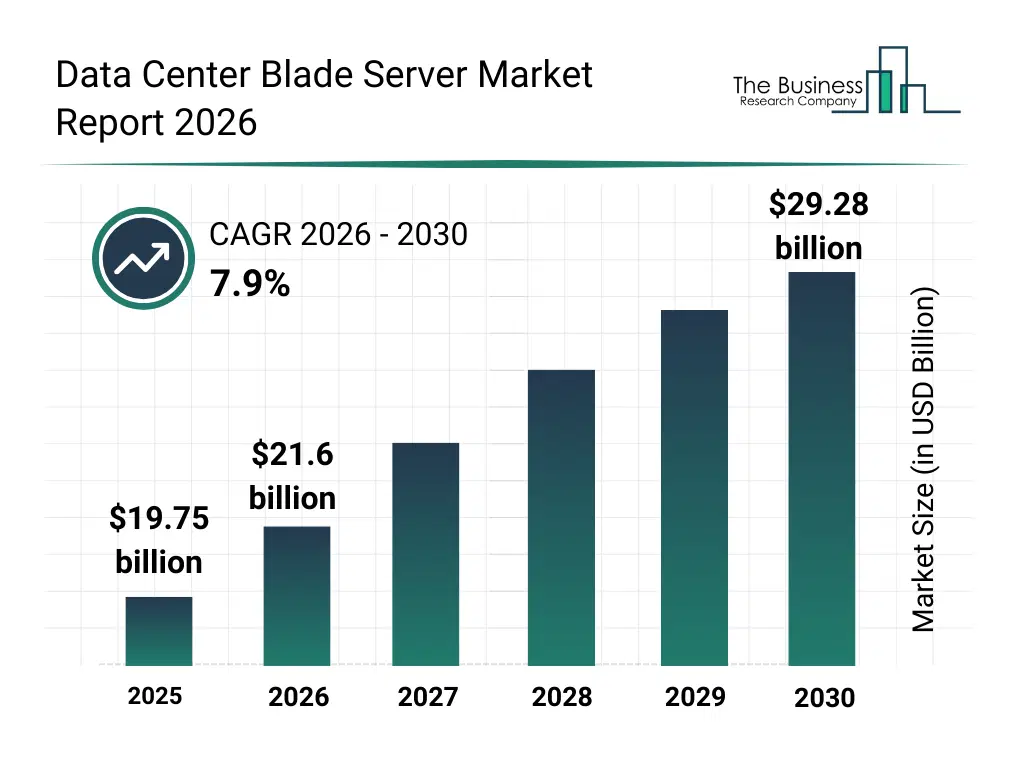
What Is The Data Center Blade Server Market Size and Share 2026?
The data center blade server market size has grown strongly in recent years. It will grow from $19.75 billion in 2025 to $21.6 billion in 2026 at a compound annual growth rate (CAGR) of 9.4%. The growth in the historic period can be attributed to growth of centralized data centers, rising server consolidation needs, early adoption of virtualization, demand for space-efficient hardware, increasing enterprise it workloads.What Is The Data Center Blade Server Market Growth Forecast?
The data center blade server market size is expected to see strong growth in the next few years. It will grow to $29.28 billion in 2030 at a compound annual growth rate (CAGR) of 7.9%. The growth in the forecast period can be attributed to expansion of hyperscale data centers, demand for high-performance computing, focus on energy-efficient infrastructure, increasing cloud service deployments, need for scalable enterprise-grade servers. Major trends in the forecast period include high-density computing adoption, modular and scalable server architectures, virtualization-optimized blade deployments, shared resource optimization within chassis, enhanced cooling and power efficiency designs.
Global Data Center Blade Server Market Segmentation
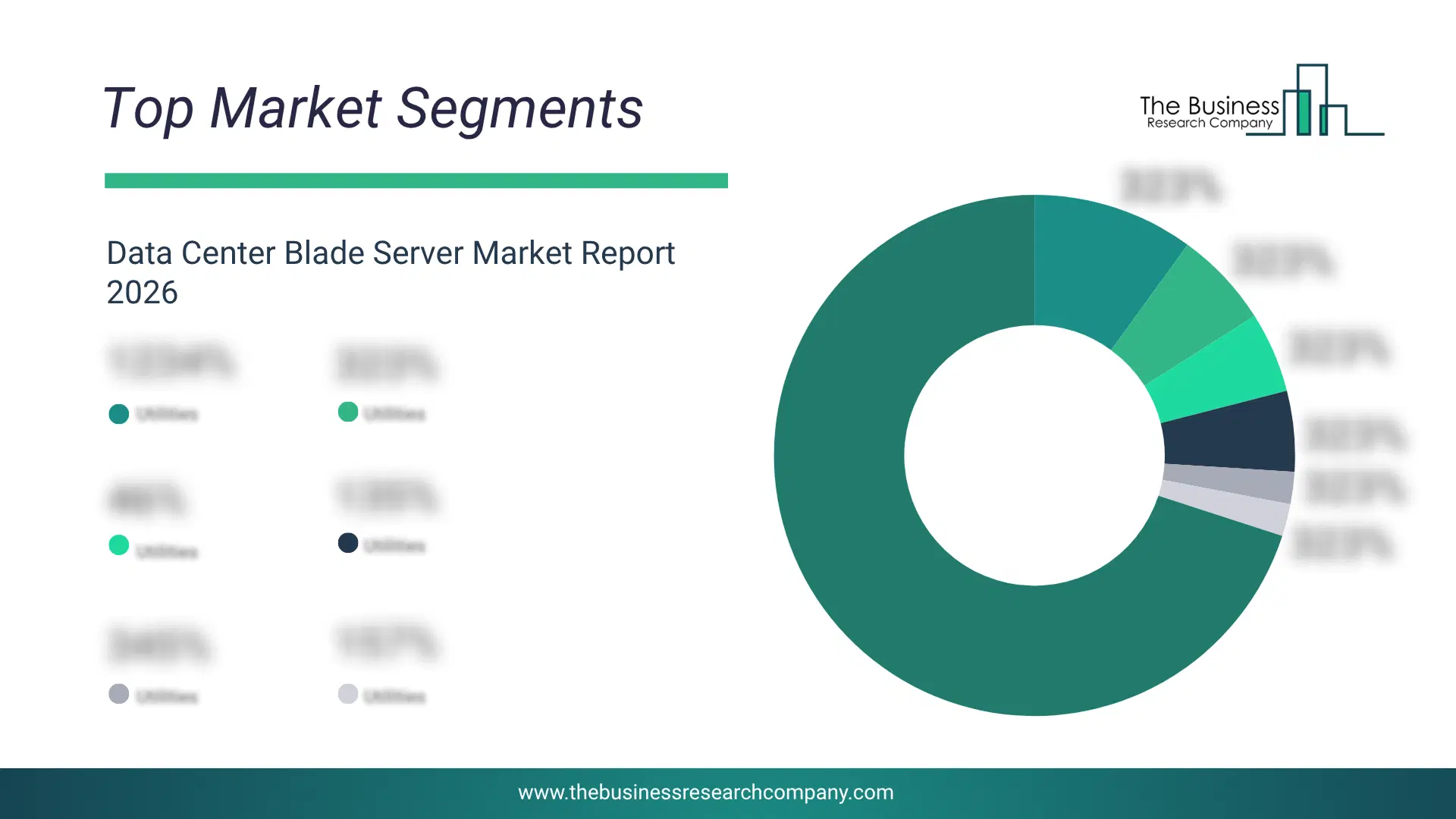
1) By Type: Tier 1, Tier 2, Tier 3, Tier 4 2) By Enterprise Size: Large Enterprises, Smal And Medium Enterprises 3) By End User: Banking, Financial Services And Insurance (BFSI), IT and Telecom, Manufacturing, Healthcare, Energy and Utility, Other End Users Subsegments: 1) By Tier 1: Entry-Level Blade Servers, Basic Configuration Blade Servers, Small to Medium Business (Smb) Blade Servers, Low-Cost Blade Servers, Single Processor Blade Servers 2) By Tier 2: Mid-Level Blade Servers, Balanced Performance Blade Servers, Dual Processor Blade Servers, Blade Servers for Business Applications, Mid-Range Storage and Processing Blade Servers 3) By Tier 3: High-Performance Blade Servers, Advanced Configuration Blade Servers, Blade Servers for Virtualization and Cloud Computing, High-Capacity Memory Blade Servers, Blade Servers with Enhanced Security Features 4) By Tier 4: Enterprise-Class Blade Servers, Ultra-High-Performance Blade Servers, Mission-Critical Blade Servers, High Availability and Redundancy Blade Servers, Blade Servers for Data Centers with Demanding Applications, Top-Tier Blade Servers with Advanced Cooling and Power ManagementWhat Are The Drivers Of The Data Center Blade Server Market?
The increasing adoption of IoT is expected to propel the data center blade server market going forward. IoT (Internet of Things) refers to the interconnected network of physical devices, vehicles, appliances, and other objects embedded with sensors, software, and network connectivity, enabling them to collect and exchange data. The increasing adoption of IoT is driven by its ability to enhance efficiency, improve customer experiences, leverage advanced technologies In data center blade servers, IoT is utilized to monitor and manage server performance, energy consumption, and security, optimize overall operational efficiency, and contribute to smart and automated data center environments. For instance, in July 2025, the European Commission, a Belgium-based governing body, reported that in 2023, the number of installed IoT-connected devices was around 40 billion and is projected to grow to 49 billion by 2026, representing an annual growth rate of 7%. Therefore, the increasing adoption of IoT is driving the growth of the data center blade server industry. The increasing data traffic is expected to boost the growth of the data center blade server market going forward. Data traffic refers to the movement of digital data packets across a computer network or the internet. Data center blade servers play a crucial role in managing increasing data traffic demand by providing efficient, scalable, and highly integrated computing infrastructure. With their high-density design, modular scalability, integrated networking and management features, blade servers are designed to maximize computing density within data center racks. For instance, in 2023, according to Ericsson Group, a Sweden-based telecommunications company, 5G subscriptions will reach 5.6 billion by the end of 2029 and data traffic per smartphone user in Southeast Asia is forecasted to grow to 42 GB/month by 2029 from 17 GB/month in 2023. Therefore, increasing data traffic is driving the growth of the data center blade server industry.Key Players In The Global Data Center Blade Server Market
Major companies operating in the data center blade server market are Dell Inc; Huawei Technologies Co. Ltd; Lenovo; Intel Corporation; Cisco Systems Inc; Oracle Corporation; Quanta Computer; Fujitsu Limited; Hewlett Packard Enterprise Development LP; NVIDIA Corporation; NEC Corporation; AMD (Advanced Micro Devices); Inventec Corporation; ASUS; Bull Atos Technologies; Atos SE; Wiwynn Corporation; Super Micro Computer, Inc; Arm Ltd; Hitachi Vantara Corporation; Inspur Software Co. Ltd; Sugon; MSI (Micro-Star International); TYAN Computer Corporation; ASRock Rack; ZT Systems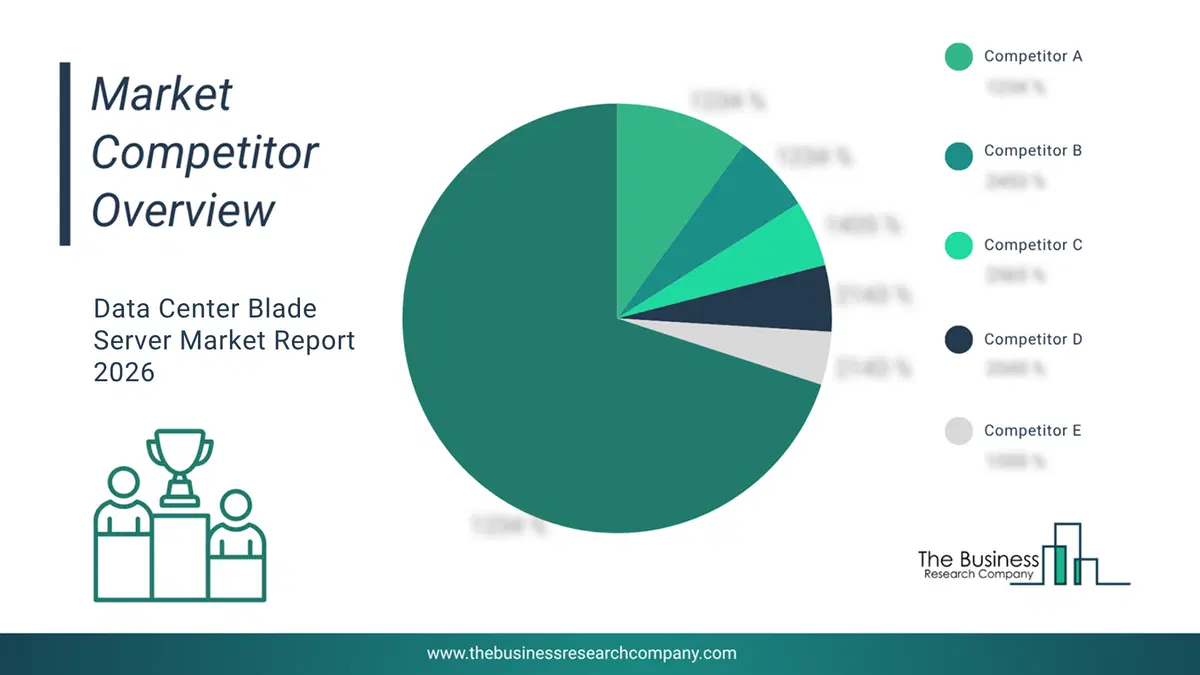
This chart is for illustrative purposes; the full report includes a detailed competitor analysis and comprehensive overview of the top 10 companies in the market.
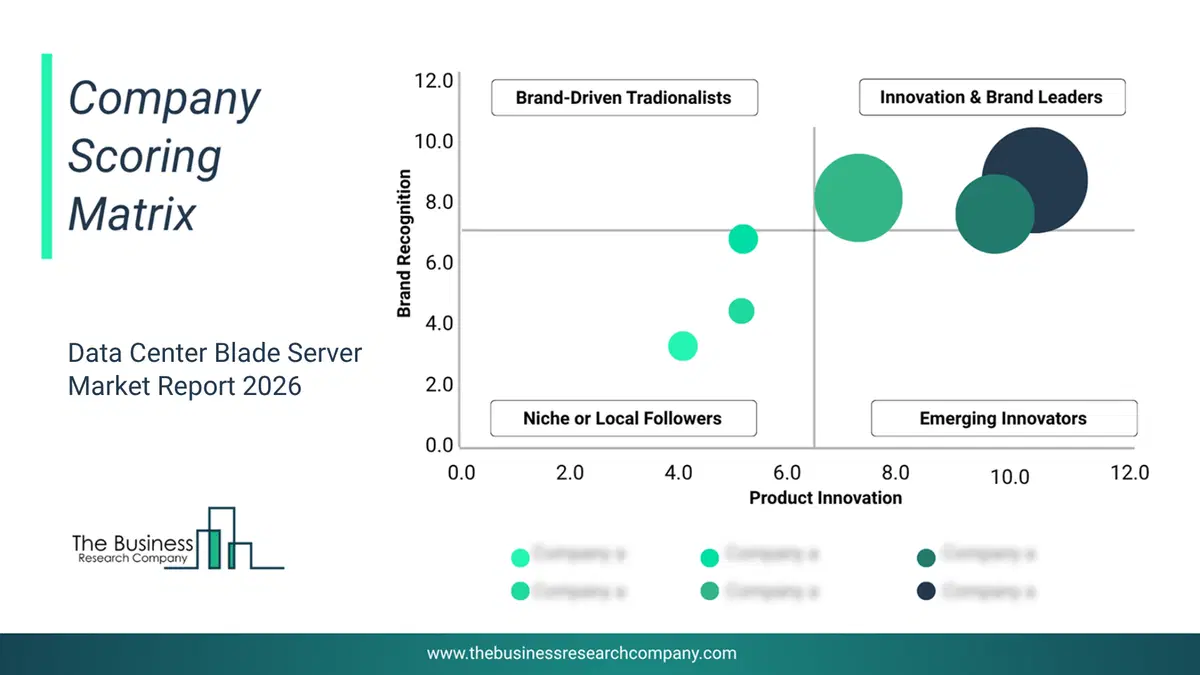
This chart maps companies by product innovation and brand strength, with bubble size indicating relative revenue, helping identify market leaders, challengers, and niche players. This is an illustrative chart; the full report provides a complete and accurate competitive analysis.
Global Data Center Blade Server Market Trends and Insights
Major companies in the data‑center blade server market are focusing on developing innovative solutions, such as ultra‑dense, high‑performance blade servers, to meet rising demand for scalable and energy‑efficient computing. Ultra-dense, high-performance blade servers are compact server units designed to maximize computing power and storage capacity within a minimal physical space, allowing data centers to run more workloads efficiently while reducing energy consumption compared to traditional rack servers. For instance, in August 2025, Giga Computing Technology Co., Ltd., a Taiwan‑based data‑center hardware company, launched the first 3U 10‑node blade servers under its GIGABYTE B‑series models B343‑C40 (supporting AMD EPYC 4005 or Ryzen 9000 processors) and B343‑X40 (supporting Intel Xeon 6300-series processors). These blade servers feature a compact shared chassis housing ten independent server nodes, each with high-speed PCIe Gen5 lanes, dual LAN ports for redundancy, and support for DDR5 memory (in the Intel variant), along with a chassis‑level backplane and shared power supplies to maximize energy efficiency and simplify management. Uniquely, these servers incorporate post‑consumer recycled (PCR) low‑carbon materials in key structural components such as air ducts, heat sinks, and chassis, aligning performance needs with sustainability and enabling enterprises to meet tightening carbon‑regulation and ESG reporting requirements.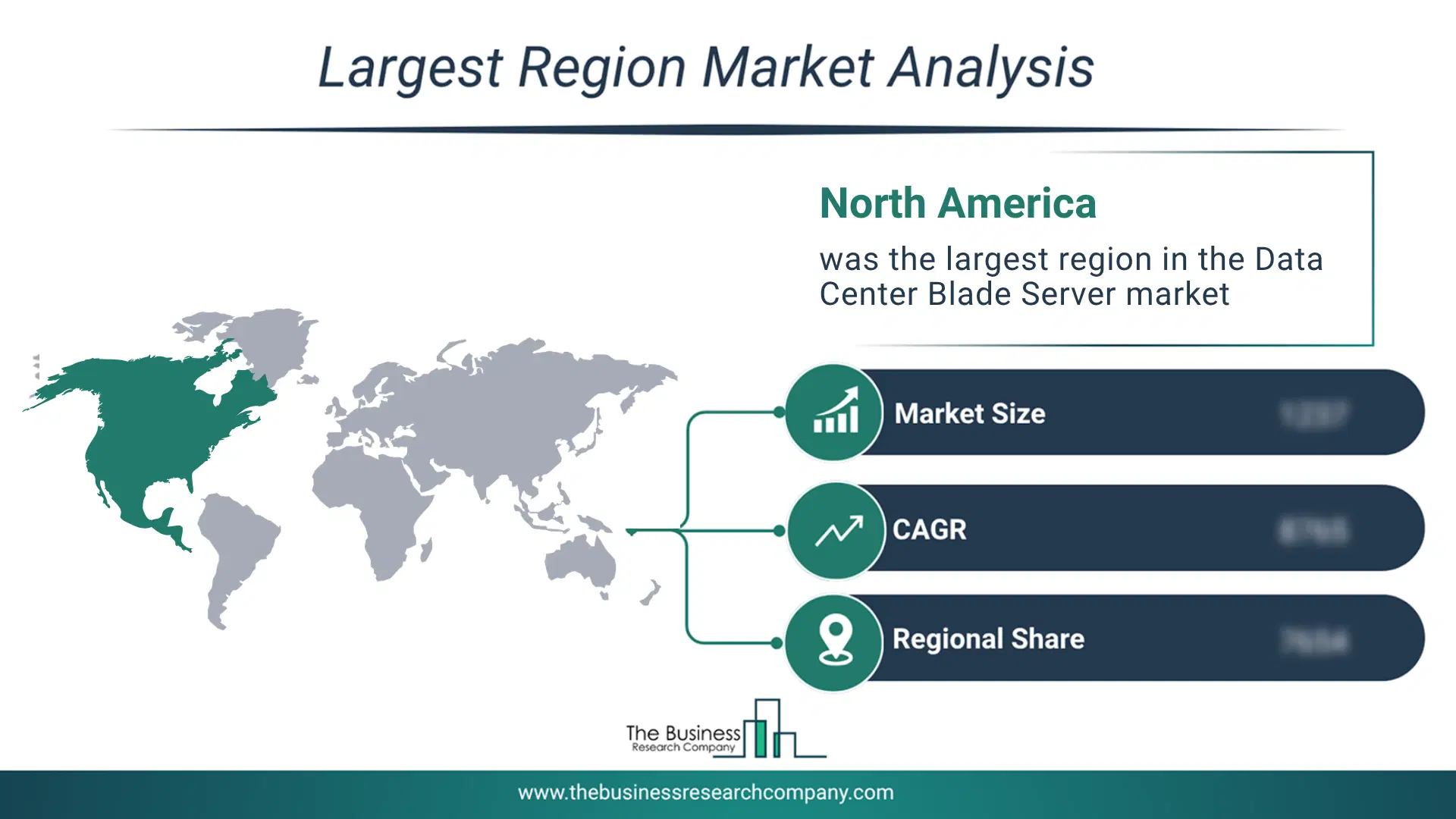
Regional Insights
North America was the largest region in the data center blade server market in 2025. Asia-Pacific is expected to be the fastest-growing region in the forecast period. The regions covered in this market report are Asia-Pacific, South East Asia, Western Europe, Eastern Europe, North America, South America, Middle East, Africa. The countries covered in this market report are Australia, Brazil, China, France, Germany, India, Indonesia, Japan, Taiwan, Russia, South Korea, UK, USA, Canada, Italy, SpainWhat Defines the Data Center Blade Server Market?
A data center blade server market includes revenues earned by entities by providing services such as virtualization, processing power, storage capacity, and data redundancy. The market value includes the value of related goods sold by the service provider or included within the service offering. The data center blade server market also consists equipments such as, high-speed networking, network load balancing, remote management, automation, and vertical and horizontal scaling. Values in this market are ‘factory gate’ values, that is the value of goods sold by the manufacturers or creators of the goods, whether to other entities (including downstream manufacturers, wholesalers, distributors, and retailers) or directly to end customers. The value of goods in this market includes related services sold by the creators of the goods.How is Market Value Defined and Measured?
The market value is defined as the revenues that enterprises gain from the sale of goods and/or services within the specified market and geography through sales, grants, or donations in terms of the currency (in USD unless otherwise specified). The revenues for a specified geography are consumption values that are revenues generated by organizations in the specified geography within the market, irrespective of where they are produced. It does not include revenues from resales along the supply chain, either further along the supply chain or as part of other products.
This chart presents market attractiveness based on a quantitative evaluation of growth, competition, strategic alignment, and risk, offering a clear view of opportunity areas for decision-making. This chart is for illustrative purposes; the full report contains the complete analysis.

This chart highlights the Total Addressable Market (TAM) by estimating the maximum revenue opportunity using an assumption-driven approach, supporting strategic planning and opportunity sizing across markets. The chart is illustrative; the full report provides a more comprehensive analysis.
What Key Data and Analysis Are Included in the Data Center Blade Server Market Report 2026?
The data center blade server market research report is one of a series of new reports from The Business Research Company that provides market statistics, including industry global market size, regional shares, competitors with the market share, detailed market segments, market trends and opportunities, and any further data you may need to thrive in the data center blade server industry. The market research report delivers a complete perspective of everything you need, with an in-depth analysis of the current and future state of the industry.Data Center Blade Server Market Report Forecast Analysis
| Report Attribute | Details |
|---|---|
| Market Size Value In 2026 | $21.6 billion |
| Revenue Forecast In 2030 | $29.28 billion |
| Growth Rate | CAGR of 7.9% from 2026 to 2030 |
| Base Year For Estimation | 2025 |
| Actual Estimates/Historical Data | 2020-2025 |
| Forecast Period | 2026 - 2030 |
| Market Representation | Revenue in USD Billion and CAGR from 2026 to 2030 |
| Segments Covered | Type, Enterprise Size, End User |
| Regional Scope | Asia-Pacific, Western Europe, Eastern Europe, North America, South America, Middle East, Africa |
| Country Scope | The Countries Covered In This Market Report Are Australia, Brazil, China, France, Germany, India, Indonesia, Japan, Taiwan, Russia, South Korea, Uk, Usa, Canada, Italy, Spain. |
| Key Companies Profiled | Dell Inc, Huawei Technologies Co. Ltd, Lenovo, Intel Corporation, Cisco Systems Inc, Oracle Corporation, Quanta Computer, Fujitsu Limited, Hewlett Packard Enterprise Development LP, NVIDIA Corporation, NEC Corporation, AMD (Advanced Micro Devices), Inventec Corporation, ASUS, Bull Atos Technologies, Atos SE, Wiwynn Corporation, Super Micro Computer, Inc, Arm Ltd, Hitachi Vantara Corporation, Inspur Software Co. Ltd, Sugon, MSI (Micro-Star International), TYAN Computer Corporation, ASRock Rack, ZT Systems |
| Customization Scope | Request for Customization |
| Pricing And Purchase Options | Explore Purchase Options |