
Decentralized Insurance Market Report 2026
Global Outlook – By Coverage Type (Smart Contract Failure Insurance, Protocol Hack And Exploit Insurance, Stablecoin De-Peg Insurance, Oracle Failure Insurance, Custodial And Wallet Risk Insurance, Yield Loss And Slashing Risk Insurance, Cross-Chain Bridge Risk Insurance), By Technology (Blockchain, Smart Contracts, Decentralized Oracles, Distributed Ledger Technology, Cryptographic Risk Pools), By Insurance Model (Peer-To-Peer (P2P) Insurance, On-Chain Mutual Insurance, DAO-Governed Insurance, Parametric Insurance, Open-Source Insurance Protocols), By Application (Protocol Risk Coverage, Claims Automation And Settlement, On-Chain Risk Assessment, Decentralized Underwriting, Liquidity Pool And Capital, Insurance Aggregation), By End-User – Market Size, Trends, Strategies, and Forecast to 2030
Decentralized Insurance Market Overview
• Decentralized Insurance market size has reached to $2.31 billion in 2025 • Expected to grow to $8.82 billion in 2030 at a compound annual growth rate (CAGR) of 30.3% • Growth Driver: Surge In Cryptocurrency Adoption Fueling The Growth Of The Market Due To Increasing Financial Freedom And Liquidity • Market Trend: Adoption Of Innovative Technologies In Decentralized Insurance To Improve Efficiency And Transparency • North America was the largest region in 2025 and Europe is the fastest growing region.What Is Covered Under Decentralized Insurance Market?
Decentralized insurance refers to a blockchain-based insurance model that operates without traditional intermediaries, using smart contracts to automate policy issuance, premium collection, and claims processing. It enables peer-to-peer risk sharing and ensures transparency, efficiency, and trust by recording all transactions on a decentralized ledger. This model is commonly used in decentralized finance (DeFi) to protect against risks such as smart contract failures, protocol hacks, and more. The main types of decentralized insurance are property insurance, health insurance, business insurance, life insurance, and travel insurance. Property insurance provides financial protection against risks to physical assets such as homes, buildings, and personal belongings, covering damages due to events such as fire, theft, or natural disasters. It leverages technologies such as blockchain, distributed ledger technology, artificial intelligence, smart contracts, and the internet of things, which are implemented through different models, including peer-to-peer, centralized, open source, mutual, and consortium models, with applications in insurance exchange, risk assessment, claims processing, underwriting, and reinsurance.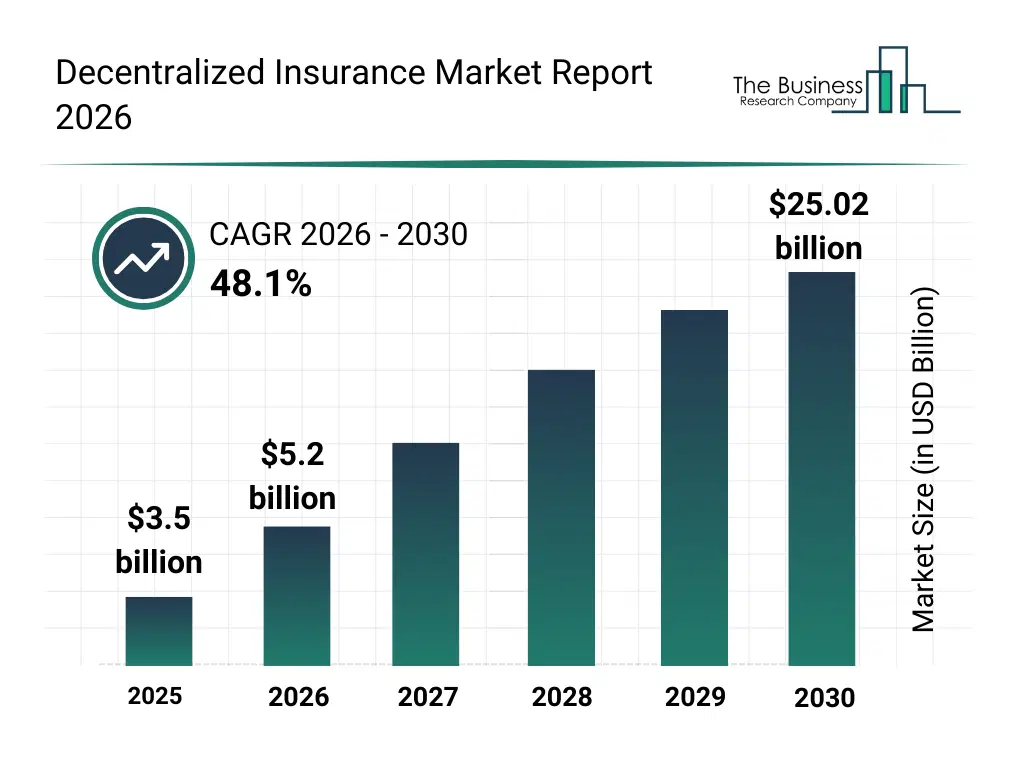
What Is The Decentralized Insurance Market Size and Share 2026?
The decentralized insurance market size has grown exponentially in recent years. It will grow from $2.31 billion in 2025 to $3.06 billion in 2026 at a compound annual growth rate (CAGR) of 32.3%. The growth in the historic period can be attributed to emergence of decentralized finance ecosystems, increasing incidents of smart contract vulnerabilities, early adoption of blockchain-based financial services, limitations of traditional insurance intermediaries, growth of crypto-native risk exposure.What Is The Decentralized Insurance Market Growth Forecast?
The decentralized insurance market size is expected to see exponential growth in the next few years. It will grow to $8.82 billion in 2030 at a compound annual growth rate (CAGR) of 30.3%. The growth in the forecast period can be attributed to increasing regulatory clarity for digital assets, rising institutional participation in defi insurance, expansion of cross-chain insurance coverage, growing demand for automated and instant claims processing, advancement of decentralized governance models. Major trends in the forecast period include increasing adoption of smart contract-based insurance models, rising deployment of peer-to-peer risk sharing protocols, growing integration of automated claims settlement mechanisms, expansion of protocol-level coverage solutions, enhanced focus on transparent and trustless insurance frameworks.
Global Decentralized Insurance Market Segmentation
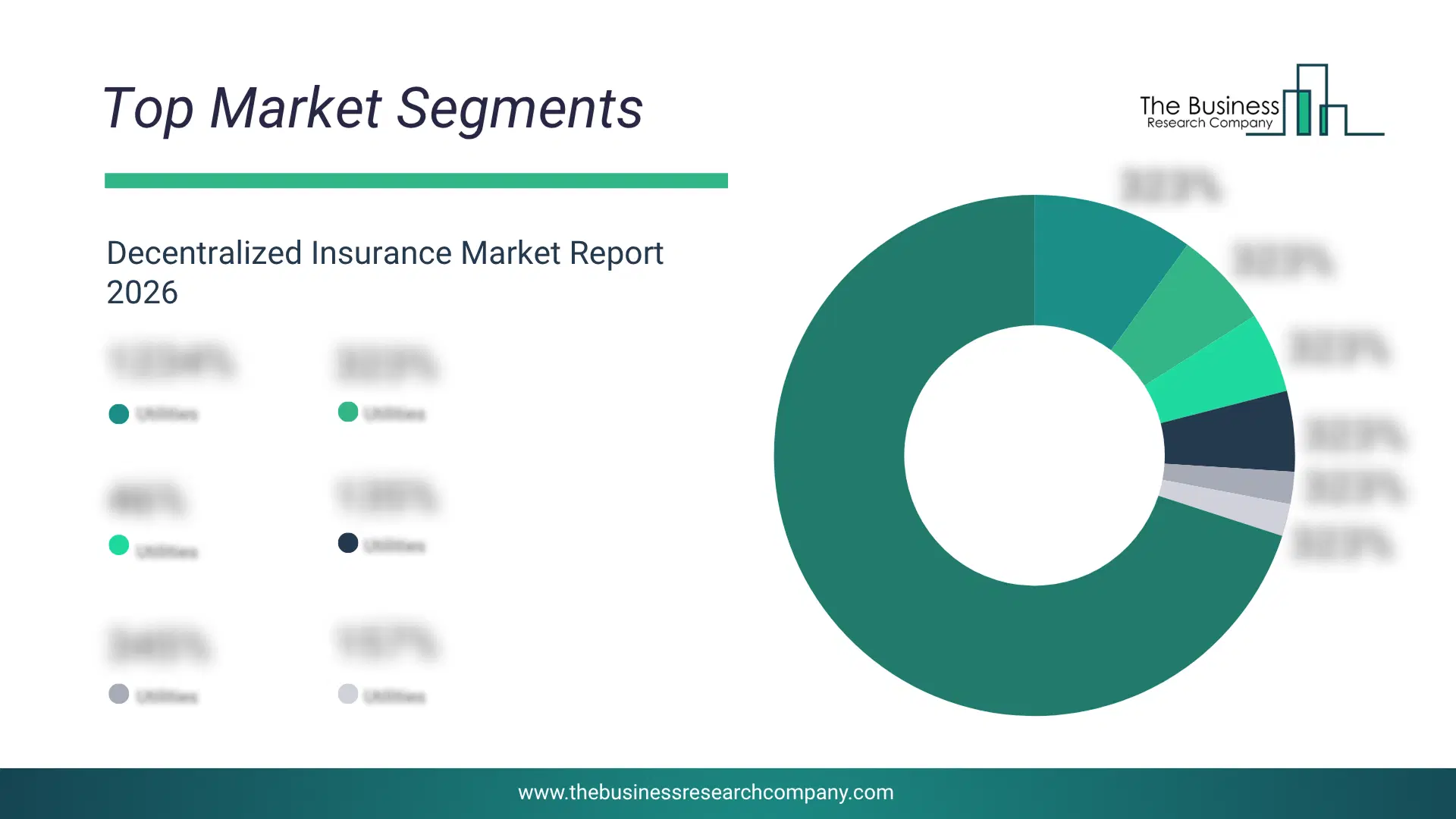
2) By Technology: Blockchain, Smart Contracts, Decentralized Oracles, Distributed Ledger Technology, Cryptographic Risk Pools 3) By Insurance Model: Peer-To-Peer (P2P) Insurance, On-Chain Mutual Insurance, DAO-Governed Insurance, Parametric Insurance, Open-Source Insurance Protocols 4) By Application: Protocol Risk Coverage, Claims Automation And Settlement, On-Chain Risk Assessment, Decentralized Underwriting, Liquidity Pool And Capital Management, Insurance Aggregation And Marketplaces 5) By End-User: DeFi Protocols, Cryptocurrency Exchanges, DAO Treasury Managers, Retail DeFi Users, Institutional DeFi Participants Subsegments: 1) By Smart Contract Failure Insurance: Code Vulnerability And Bug Exploit Coverage, Upgrade And Migration Failure Coverage, Governance Attack And Malicious Proposal Coverage, Flash Loan Attack Coverage, Reentrancy And Logic Error Coverage 2) By Protocol Hack And Exploit Insurance: Liquidity Pool Drain Coverage, Protocol Exploit And Theft Coverage, Governance Takeover Coverage, Insider Key Compromise Coverage, Front-Running And MEV Exploit Coverage 3) By Stablecoin De-Peg Insurance: Fiat-Backed Stablecoin De-Peg Coverage, Crypto-Collateralized Stablecoin De-Peg Coverage, Algorithmic Stablecoin Collapse Coverage, Peg Deviation Threshold Trigger Coverage, Liquidity Run And Redemption Failure Coverage 4) By Oracle Failure Insurance: Price Feed Manipulation Coverage, Oracle Downtime And Latency Coverage, Incorrect Data Submission Coverage, Single-Oracle Dependency Failure Coverage, Cross-Chain Oracle Mismatch Coverage 5) By Custodial And Wallet Risk Insurance: Smart Wallet Contract Failure Coverage, Private Key Compromise Coverage, Multi-Signature Wallet Failure Coverage, Custodian Insolvency Coverage, Phishing And Social Engineering Loss Coverage 6) By Yield Loss And Slashing Risk Insurance: Validator Slashing Coverage, Yield Farming Exploit Coverage, Staking Reward Reduction Coverage, Liquidity Pool Impermanent Loss Coverage, Lock-Up And Withdrawal Failure Coverage 7) By Cross-Chain Bridge Risk Insurance: Bridge Contract Exploit Coverage, Relay And Validator Failure Coverage, Asset Lock-Up And Transfer Failure Coverage, Wrapped Asset Devaluation Coverage, Cross-Chain Message Manipulation CoverageWhat Is The Driver Of The Decentralized Insurance Market?
The increasing adoption of cryptocurrencies is expected to propel the growth of the decentralized insurance market going forward. Cryptocurrencies are digital or virtual currencies that use cryptography for secure transactions and operate on decentralized networks, typically based on blockchain technology. The adoption of cryptocurrencies is increasing as they provide financial freedom by allowing users to make transactions without the need for traditional banks or government control. Decentralized insurance in crypto offers transparent, trustless protection against blockchain-related risks through smart contracts and community-funded pools. For instance, in November 2024, according to the Financial Conduct Authority, a UK-based financial regulatory body, 12% of UK adults now own cryptocurrency, up from 10% previously, while awareness has increased from 91% to 93%. The average value of crypto holdings has risen from $2,000 (£1,595) to $2,300 (£1,842). Therefore, the increasing adoption of cryptocurrencies is driving the growth of the decentralized insurance industry.Key Players In The Global Decentralized Insurance Market
Major companies operating in the decentralized insurance market are Nexus Mutual, Etherisc, Tidal Finance, Neptune Mutual, Unslashed Finance, Bridge Mutual, InsurAce, Risk Harbor, Solace, Cover Protocol, Sherlock, Opyn, Bright Union, OpenCover, Armor, Nsure Network, Uno Re, Yinsure, VouchForMe, Ease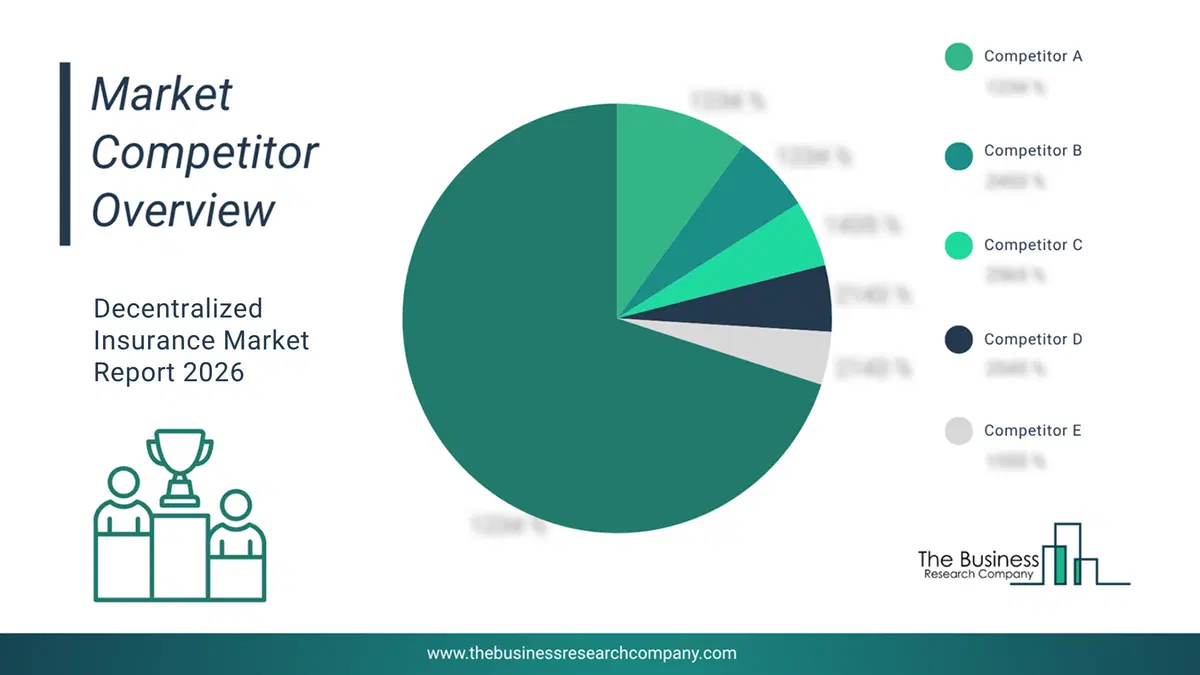
This chart is for illustrative purposes; the full report includes a detailed competitor analysis and comprehensive overview of the top 10 companies in the market.
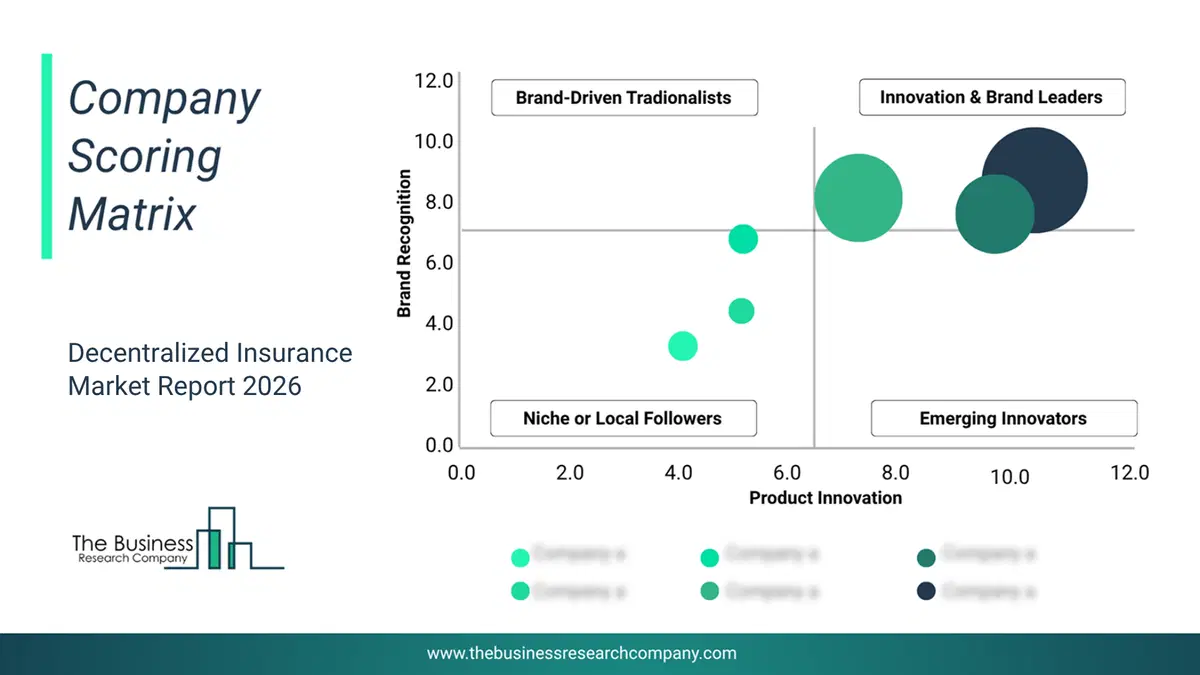
This chart maps companies by product innovation and brand strength, with bubble size indicating relative revenue, helping identify market leaders, challengers, and niche players. This is an illustrative chart; the full report provides a complete and accurate competitive analysis.
Global Decentralized Insurance Market Trends and Insights
Major companies operating in the decentralized insurance market are focusing on developing innovative solutions, such as risk management infrastructure layers, to enhance efficiency and transparency. The risk management infrastructure layer enables decentralized insurance by assessing, pricing, and mitigating risks through data analytics and smart contract automation. For instance, in March 2023, Nexus Mutual, a UK-based decentralized insurance provider, launched Nexus Mutual v2 on the Ethereum mainnet. The upgrade introduced a modular system that allows users to create and manage their own mutuals for various risk types, including smart contract and custody risk. The new version supports permissionless product development, cross-chain functionality, and improved capital efficiency, enabling broader participation in decentralized risk-sharing. Nexus Mutual v2 aims to accelerate the growth of blockchain-based insurance by fostering innovation and community-driven insurance models.What Are Latest Mergers And Acquisitions In The Decentralized Insurance Market?
In August 2023, InShare, a UK-based provider of alternative risk transfer and mutual insurance solutions, partnered with Nexus Mutual to use on-chain capital to cover excess losses for small independent retail businesses in the UK. This collaboration allows Nexus Mutual to provide discretionary excess and aggregate risk transfer support to The Retail Mutual, which protects over 5,000 small retail businesses, such as shopkeepers, against risks such as fire, theft, and accidental damage. Nexus Mutual, a UK-based provider of decentralized insurance solutions, specializes in offering smart contract coverage to protect against risks in decentralized finance (DeFi) platforms.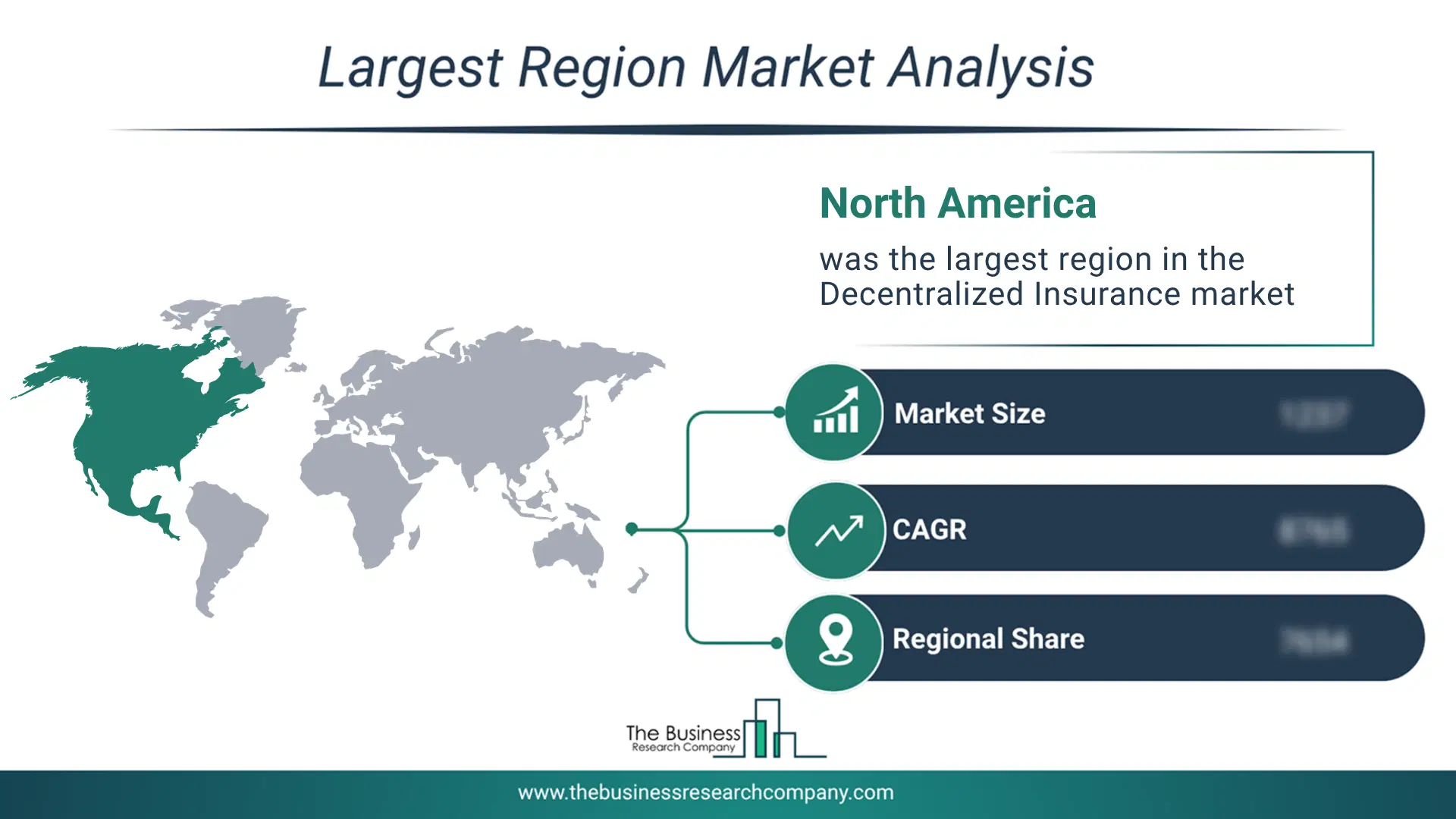
Regional Outlook
North America was the largest region in the decentralized insurance market in 2025. Europe is expected to be the fastest-growing region in the forecast period. The regions covered in this market report are Asia-Pacific, South East Asia, Western Europe, Eastern Europe, North America, South America, Middle East, Africa. The countries covered in this market report are Australia, Brazil, China, France, Germany, India, Indonesia, Japan, Taiwan, Russia, South Korea, UK, USA, Canada, Italy, Spain.What Defines the Decentralized Insurance Market?
The decentralized insurance market consists of revenues earned by entities providing services such as blockchain-based insurance solutions, smart contract-driven policy management, peer-to-peer risk sharing, and automated claims processing. The market value includes the value of related goods sold by the service provider or included within the service offering. The decentralized insurance market also includes sales of decentralized applications (dApps), blockchain infrastructure, tokenized coverage platforms, governance tools, and crypto wallet integrations essential for facilitating decentralized risk management and claim execution. Values in this market are ‘factory gate’ values, that is, the value of goods sold by the manufacturers or creators of the goods, whether to other entities (including downstream manufacturers, wholesalers, distributors, and retailers) or directly to end customers. The value of goods in this market includes related services sold by the creators of the goods.How is Market Value Defined and Measured?
The market value is defined as the revenues that enterprises gain from the sale of goods and/or services within the specified market and geography through sales, grants, or donations in terms of the currency (in USD unless otherwise specified). The revenues for a specified geography are consumption values that are revenues generated by organizations in the specified geography within the market, irrespective of where they are produced. It does not include revenues from resales along the supply chain, either further along the supply chain or as part of other products.
This chart presents market attractiveness based on a quantitative evaluation of growth, competition, strategic alignment, and risk, offering a clear view of opportunity areas for decision-making. This chart is for illustrative purposes; the full report contains the complete analysis.

This chart highlights the Total Addressable Market (TAM) by estimating the maximum revenue opportunity using an assumption-driven approach, supporting strategic planning and opportunity sizing across markets. The chart is illustrative; the full report provides a more comprehensive analysis.
What Key Data and Analysis Are Included in the Decentralized Insurance Market Report 2026?
The decentralized insurance market research report is one of a series of new reports from The Business Research Company that provides market statistics, including industry global market size, regional shares, competitors with the market share, detailed market segments, market trends and opportunities, and any further data you may need to thrive in the decentralized insurance industry. The market research report delivers a complete perspective of everything you need, with an in-depth analysis of the current and future state of the industry.Decentralized Insurance Market Report Forecast Analysis
| Report Attribute | Details |
|---|---|
| Market Size Value In 2026 | $3.06 billion |
| Revenue Forecast In 2030 | $8.82 billion |
| Growth Rate | CAGR of 30.3% from 2026 to 2030 |
| Base Year For Estimation | 2025 |
| Actual Estimates/Historical Data | 2020-2025 |
| Forecast Period | 2026 - 2030 |
| Market Representation | Revenue in USD Billion and CAGR from 2026 to 2030 |
| Segments Covered | Coverage Type, Technology, Insurance Model, Application, End-User |
| Regional Scope | Asia-Pacific, Western Europe, Eastern Europe, North America, South America, Middle East, Africa |
| Country Scope | The countries covered in the report are Australia, Brazil, China, France, Germany, India, Indonesia, Japan, Taiwan, Russia, South Korea, UK, USA, Canada, Italy, Spain. |
| Key Companies Profiled | Nexus Mutual, Etherisc, Tidal Finance, Neptune Mutual, Unslashed Finance, Bridge Mutual, InsurAce, Risk Harbor, Solace, Cover Protocol, Sherlock, Opyn, Bright Union, OpenCover, Armor, Nsure Network, Uno Re, Yinsure, VouchForMe, Ease |
| Customization Scope | Request for Customization |
| Pricing And Purchase Options | Explore Purchase Options |