
Defense Contracting Service Market Report 2026
Global Outlook – By Service Type (Engineering And Technical Services, Logistics And Sustainment, Training And Simulation, Cybersecurity, Program Management, Professional Services), By Contract Type (Fixed-Price Contracts, Cost-Reimbursement Contracts, Time And Material Contracts, Indefinite Delivery Or Indefinite Quantity Contracts), By Application Area (Aerospace, Land Systems, Maritime Systems, Information Technology, Cybersecurity, Intelligence, Homeland Security), By End-User (Government Agencies, Military Branches, Defense Contractors, Industry Partners) – Market Size, Trends, Strategies, and Forecast to 2030
Defense Contracting Service Market Overview
• Defense Contracting Service market size has reached to $705.44 billion in 2025 • Expected to grow to $905.51 billion in 2030 at a compound annual growth rate (CAGR) of 5.1% • Growth Driver: Rising Geopolitical Tensions Fuelling The Growth Of The Market Due To Heightened Military Preparedness • Market Trend: Advancement In Directed Energy Solutions Transforming Modern Warfare • North America was the largest region in 2025 and Asia-Pacific is the fastest growing region.What Is Covered Under Defense Contracting Service Market?
Defense contracting refers to providing goods, services, or expertise by private companies to military or defense agencies under formal contracts. These services include logistics, maintenance, research and development, construction, and other mission-critical support functions essential to defense operations. Defense contracting services are critical in supporting national security by ensuring armed forces have the necessary resources, equipment, and expertise to operate effectively. The main service types of defense contracting services are engineering and technical services, logistics and sustainment, training and simulation, cybersecurity, program management, and professional services. Engineering and technical services encompass expert support such as systems engineering, technical direction, analysis, and advisory work that assist defense programs from design through deployment. Contract types include fixed-price contracts, cost-reimbursement contracts, time and material contracts, and indefinite delivery or indefinite quantity contracts. The primary application areas are aerospace, land systems, maritime systems, information technology, cybersecurity, intelligence, and homeland security. The end-users of these services include government agencies, military branches, defense contractors, and industry partners.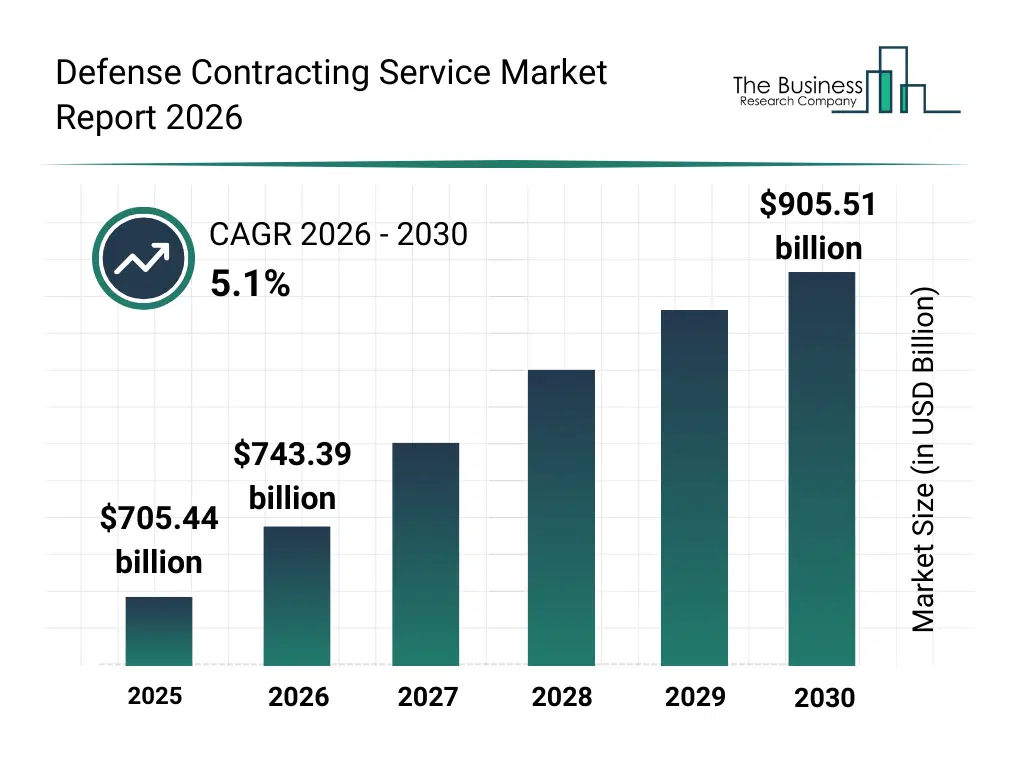
What Is The Defense Contracting Service Market Size and Share 2026?
The defense contracting service market size has grown strongly in recent years. It will grow from $705.44 billion in 2025 to $743.39 billion in 2026 at a compound annual growth rate (CAGR) of 5.4%. The growth in the historic period can be attributed to expansion of military modernization programs increasing demand for outsourced logistics and maintenance services, rising reliance on private contractors for simulation and training solutions, growth in procurement of aviation, naval, and ground vehicle systems supplied by defense contractors, development of satellite-based services supporting communication and reconnaissance operations, increased complexity of defense supply chains driving demand for specialized management services.What Is The Defense Contracting Service Market Growth Forecast?
The defense contracting service market size is expected to see strong growth in the next few years. It will grow to $905.51 billion in 2030 at a compound annual growth rate (CAGR) of 5.1%. The growth in the forecast period can be attributed to growing adoption of advanced digital tools to enhance contractor-led maintenance and lifecycle support, rising demand for integrated multi-domain platforms requiring specialized contractor expertise, expansion of satellite and space-based defense services delivered through private contracting, increasing focus on cybersecurity and secure supply chain management within defense contracts, development of autonomous and unmanned defense systems driving new contracting opportunities. Major trends in the forecast period include increasing outsourcing of mission-critical logistics and sustainment, rising demand for advanced simulation and training solutions, expansion of integrated lifecycle management services, growing adoption of performance-based contracting, surge in modernization programs needing engineering and technical support.
Global Defense Contracting Service Market Segmentation
1) By Service Type: Engineering And Technical Services, Logistics And Sustainment, Training And Simulation, Cybersecurity, Program Management, Professional Services 2) By Contract Type: Fixed-Price Contracts, Cost-Reimbursement Contracts, Time And Material Contracts, Indefinite Delivery Or Indefinite Quantity Contracts 3) By Application Area: Aerospace, Land Systems, Maritime Systems, Information Technology, Cybersecurity, Intelligence, Homeland Security 4) By End-User: Government Agencies, Military Branches, Defense Contractors, Industry Partners Subsegments: 1) By Engineering And Technical Services: Systems Engineering, Test and Evaluation, Design and Development, Integration Services, Prototyping 2) By Logistics And Sustainment: Supply Chain Management, Maintenance, Repair, and Overhaul (MRO), Depot Services, Spare Parts Management, Lifecycle Support 3) By Training And Simulation: Live Training, Virtual Training, Constructive Simulation, Computer-Based Training, Mission Rehearsal Systems 4) By Cybersecurity: Network Security, Endpoint Security, Threat Intelligence, Security Operations Centers (SOC), Risk and Compliance Management 5) By Program Management: Project Planning and Scheduling, Cost Estimation and Control, Risk Management, Contract Administration, Performance Monitoring 6) By Professional Services: Consulting Services, Financial and Auditing Services, Legal and Compliance Services, Human Capital Services, Strategic AdvisoryWhat Is Driver Of The Defense Contracting Service Market?
The increasing geopolitical tensions are expected to propel the growth of the defense contracting service market going forward. Geopolitical tensions refer to escalating disagreements or competition between countries due to political, military, or strategic factors. The increasing geopolitical tensions are primarily due to territorial disputes, as nations assert sovereignty over contested regions, leading to heightened military presence, diplomatic confrontations, and regional instability. Defense contracting services help address geopolitical tensions by enabling governments to rapidly procure advanced military technologies and strategic capabilities that strengthen national security and deterrence, support allied operations, and maintain a competitive edge in regions affected by conflict or instability. For instance, in July 2024, according to the Armed Conflict Location and Event Data, a US-based non-profit organization, between July 2023 and June 2024, over 165,273 incidents of political violence were reported worldwide, representing a 15% increase from the previous year. During this time, it is estimated that approximately one in seven people around the world were affected by conflict. Therefore, the increasing geopolitical tensions are driving the growth of the defense contracting service industry.Key Players In The Global Defense Contracting Service Market
Major companies operating in the defense contracting service market are Science Applications International Corporation Inc., RTX Corporation, The Boeing Company, Lockheed Martin Corporation, Airbus SE, General Dynamics Corporation, Northrop Grumman Corporation, Honeywell International Inc., BAE Systems plc, L3Harris Technologies Inc., Leonardo S.p.A., Leidos Holdings Inc., Textron Inc., Amentum Government Services Holdings LLC, Huntington Ingalls Industries Inc., Booz Allen Hamilton Holding Corporation, Saab AB, CAE Inc., BWX Technologies Inc., AeroVironment Inc.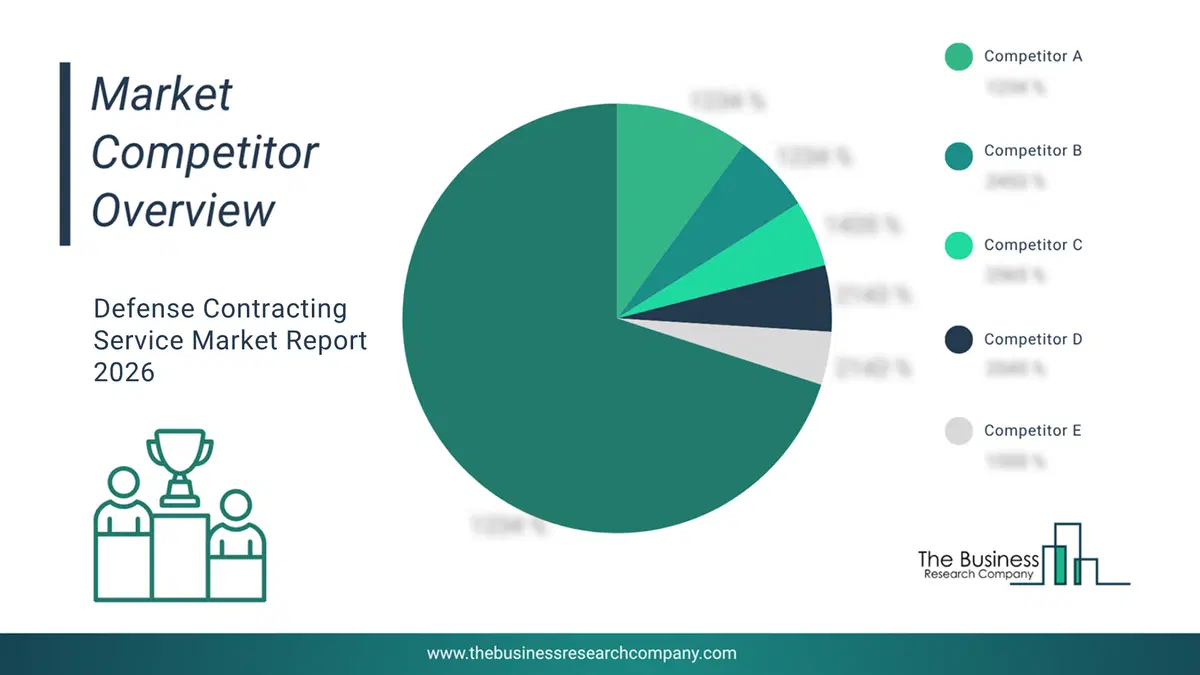
This chart is for illustrative purposes; the full report includes a detailed competitor analysis and comprehensive overview of the top 10 companies in the market.
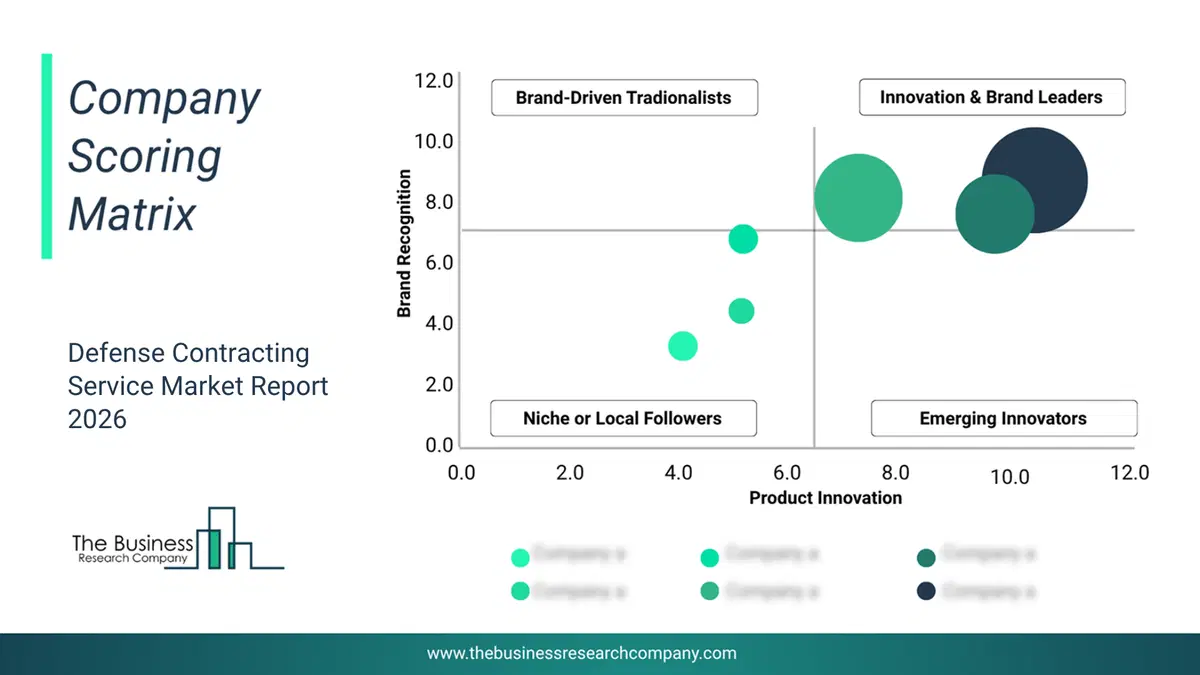
This chart maps companies by product innovation and brand strength, with bubble size indicating relative revenue, helping identify market leaders, challengers, and niche players. This is an illustrative chart; the full report provides a complete and accurate competitive analysis.
Global Defense Contracting Service Market Trends and Insights
Major companies operating in the defense contracting service market are focusing on developing innovative solutions, such as advanced tactical directed energy solutions, to provide cost-effective alternatives to traditional munitions. Tactical directed energy solutions are advanced weapons that use concentrated energy, such as lasers or microwaves, to precisely target and neutralize threats with reduced collateral damage. For instance, in March 2025, Parsons Corporation, a US-based technology company, signed a cooperative research and development agreement (CRADA) with the U.S. Air Force Civil Engineer Center, Readiness Directorate (AFCEC/CX), and unveiled its next-generation Zeus 4 directed energy system integrated onto the Joint Light Tactical Vehicle (JLTV), featuring AI-powered targeting sensors and a palletized, bolt-on configuration to enhance operational flexibility, reduce costs, and enable precise neutralization of unexploded ordnance with minimal collateral damage. This advancement builds on the success of the previous Zeus 3 system and reflects a growing shift in defense contracting toward mobile, scalable, and vehicle-agnostic directed energy capabilities that can be rapidly deployed across diverse combat scenarios.What Are Latest Mergers And Acquisitions In The Defense Contracting Service Market? CACI Acquired Azure Summit To Expands Defense Portfolio
In October 2024, CACI International Inc., a US-based technology company, acquired Azure Summit Technology Inc. for approximately $1.28 billion. With this acquisition, CACI aims to expand its defense technology portfolio and strengthen its presence in the maritime and airborne markets to better serve the U.S. Department of Defense and national security agencies. Azure Summit Technology Inc. is a US-based company that provides defense contracting services by developing and delivering high-performance RF hardware and software-defined.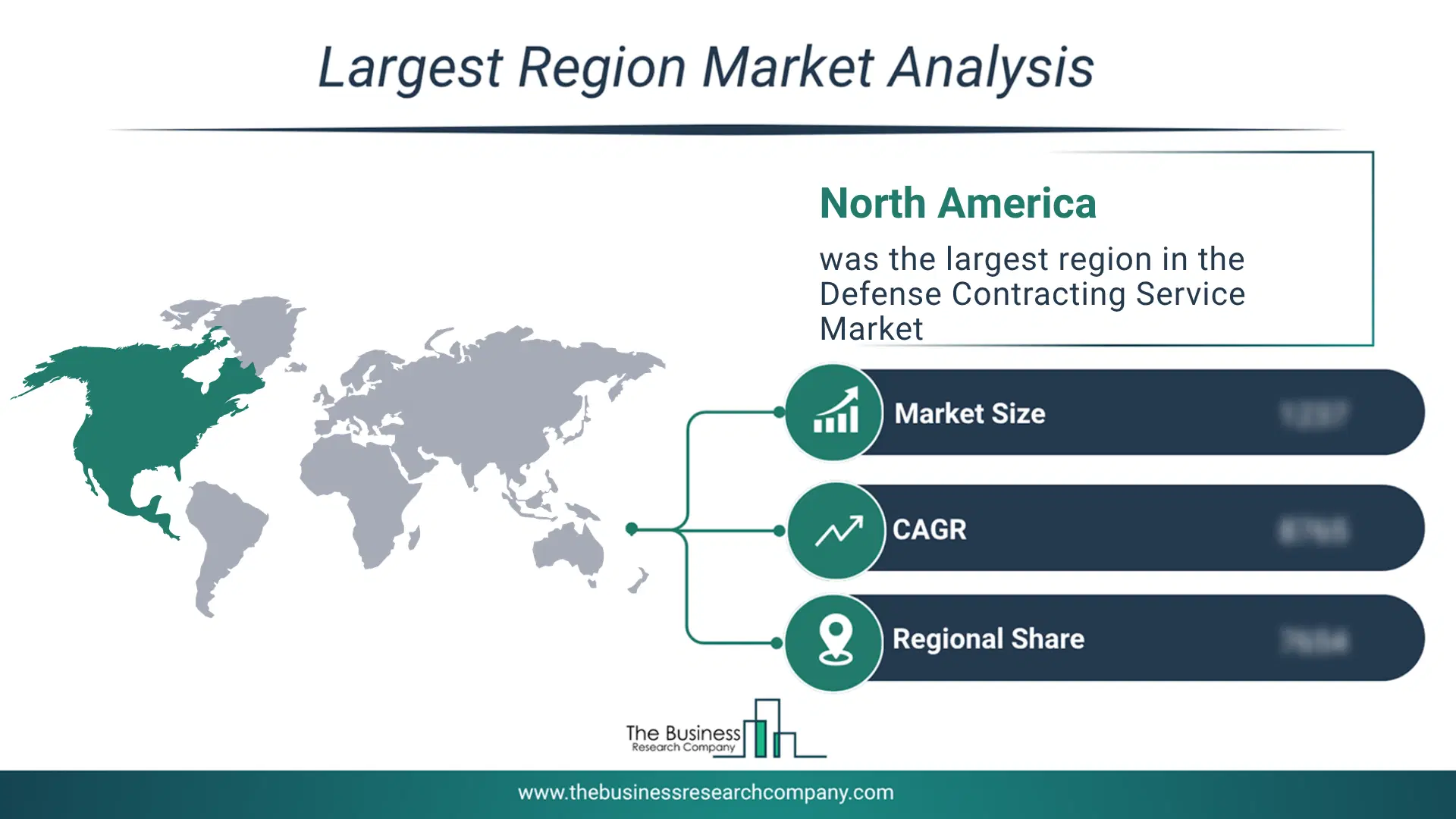
Regional Insights
North America was the largest region in the defense contracting service market in 2025. Asia-Pacific is expected to be the fastest-growing region in the forecast period. The regions covered in the defense contracting service market report are Asia-Pacific, South East Asia, Western Europe, Eastern Europe, North America, South America, Middle East, Africa. The countries covered in the defense contracting service market report are Australia, Brazil, China, France, Germany, India, Indonesia, Japan, Taiwan, Russia, South Korea, UK, USA, Canada, Italy, SpainWhat Defines the Defense Contracting Service Market?
The defense contracting service market includes revenues earned by entities providing services such as supply chain management, simulation services, and satellite services and related products such as aviation systems, naval systems, and ground vehicles. The market value includes the value of related goods sold by the service provider or included within the service offering. Only goods and services traded between entities or sold to end consumers are included.How is Market Value Defined and Measured?
The market value is defined as the revenues that enterprises gain from the sale of goods and/or services within the specified market and geography through sales, grants, or donations in terms of the currency (in USD unless otherwise specified). The revenues for a specified geography are consumption values that are revenues generated by organizations in the specified geography within the market, irrespective of where they are produced. It does not include revenues from resales along the supply chain, either further along the supply chain or as part of other products.
This chart presents market attractiveness based on a quantitative evaluation of growth, competition, strategic alignment, and risk, offering a clear view of opportunity areas for decision-making. This chart is for illustrative purposes; the full report contains the complete analysis.

This chart highlights the Total Addressable Market (TAM) by estimating the maximum revenue opportunity using an assumption-driven approach, supporting strategic planning and opportunity sizing across markets. The chart is illustrative; the full report provides a more comprehensive analysis.
What Key Data and Analysis Are Included in the Defense Contracting Service Market Report 2026?
The defense contracting service market research report is one of a series of new reports from The Business Research Company that provides market statistics, including industry global market size, regional shares, competitors with the market share, detailed market segments, market trends and opportunities, and any further data you may need to thrive in the defense contracting service industry. The market research report delivers a complete perspective of everything you need, with an in-depth analysis of the current and future state of the industry.Defense Contracting Service Market Report Forecast Analysis
| Report Attribute | Details |
|---|---|
| Market Size Value In 2026 | $743.39 billion |
| Revenue Forecast In 2030 | $905.51 billion |
| Growth Rate | CAGR of 5.1% from 2026 to 2030 |
| Base Year For Estimation | 2025 |
| Actual Estimates/Historical Data | 2020-2025 |
| Forecast Period | 2026 - 2030 |
| Market Representation | Revenue in USD Billion and CAGR from 2026 to 2030 |
| Segments Covered | Service Type, Contract Type, Application Area, End-User |
| Regional Scope | Asia-Pacific, Western Europe, Eastern Europe, North America, South America, Middle East, Africa |
| Country Scope | The countries covered in the defense contracting service market report are Australia, Brazil, China, France, Germany, India, Indonesia, Japan, Taiwan, Russia, South Korea, UK, USA, Canada, Italy, Spain |
| Key Companies Profiled | Science Applications International Corporation Inc., RTX Corporation, The Boeing Company, Lockheed Martin Corporation, Airbus SE, General Dynamics Corporation, Northrop Grumman Corporation, Honeywell International Inc., BAE Systems plc, L3Harris Technologies Inc., Leonardo S.p.A., Leidos Holdings Inc., Textron Inc., Amentum Government Services Holdings LLC, Huntington Ingalls Industries Inc., Booz Allen Hamilton Holding Corporation, Saab AB, CAE Inc., BWX Technologies Inc., AeroVironment Inc. |
| Customization Scope | Request for Customization |
| Pricing And Purchase Options | Explore Purchase Options |