
Diagnostic Ultrasound Market Report 2026
Global Outlook – By Technology (Two-Dimensional (2D) Ultrasound Imaging, Three-Dimensional (3D) And Four-dimensional (4D) Ultrasound Imaging, Doppler Imaging), By Portability (Trolley-Based Devices, Hand-Held Devices), By Application (Anesthesiology, Cardiology, Gynecology Or Obstetrics, Musculoskeletal Radiology, Critical Care, Radiology, Other Applications), By End-user (Hospitals, Maternity Centers, Diagnostic Centers, Ambulatory Surgical Services, Other End-Users) – Market Size, Trends, Strategies, and Forecast to 2030
Diagnostic Ultrasound Market Overview
• Diagnostic Ultrasound market size has reached to $7.95 billion in 2025 • Expected to grow to $10.32 billion in 2030 at a compound annual growth rate (CAGR) of 5.3% • Growth Driver: Rising Demand For Minimally Invasive Surgeries Fueling The Growth Of The Market Due To Enhanced Recovery Outcomes And Real-Time Imaging Needs • Market Trend: Advanced Portable Ultrasound Solutions Enhance Cardiac Imaging Workflows • North America was the largest region in 2025 and Asia-Pacific is the fastest growing region.What Is Covered Under Diagnostic Ultrasound Market?
Diagnostic ultrasound is a test that uses sound waves to create pictures of the inside of the body. It helps doctors see organs, tissues, and blood flow without needing to cut the body open. This method is safe and painless and does not use harmful radiation. It is often used to check on health problems or during pregnancy. The main technologies of diagnostic ultrasound are two-dimensional (2D) ultrasound imaging, three-dimensional (3D) and four-dimensional (4D) ultrasound imaging, and doppler imaging. Two-dimensional (2D) ultrasound imaging is a medical technique that produces flat, real-time cross-sectional images of internal body structures using high-frequency sound waves. These systems offer portability and are available as trolley-based or handheld devices. They are used in various applications such as anesthesiology, cardiology, gynecology or obstetrics, musculoskeletal radiology, critical care, radiology, and others, and serve end-users including hospitals, maternity centers, diagnostic centers, ambulatory surgical services, and others.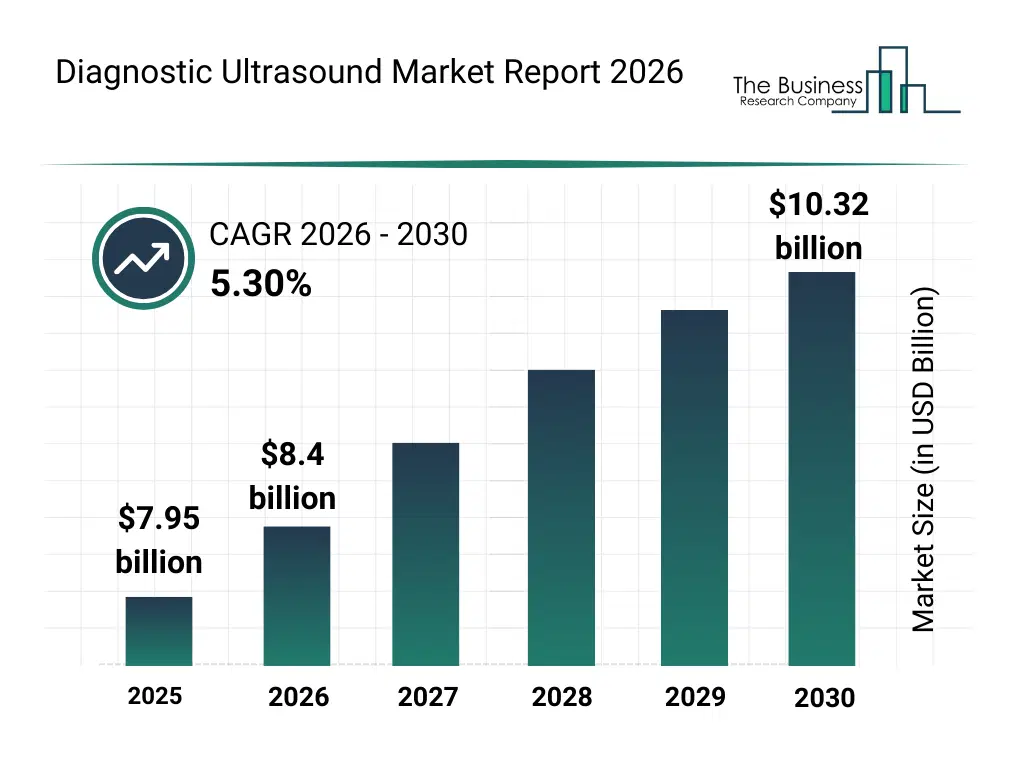
What Is The Diagnostic Ultrasound Market Size and Share 2026?
The diagnostic ultrasound market size has grown strongly in recent years. It will grow from $7.95 billion in 2025 to $8.4 billion in 2026 at a compound annual growth rate (CAGR) of 5.7%. The growth in the historic period can be attributed to limited adoption of advanced imaging technologies, reliance on traditional 2d ultrasound devices, increasing awareness of prenatal and cardiac diagnostics, growing hospital and diagnostic center infrastructure, demand for non-invasive imaging solutions.What Is The Diagnostic Ultrasound Market Growth Forecast?
The diagnostic ultrasound market size is expected to see strong growth in the next few years. It will grow to $10.32 billion in 2030 at a compound annual growth rate (CAGR) of 5.3%. The growth in the forecast period can be attributed to advancement in ai-powered ultrasound systems, rising adoption of handheld and portable devices, increasing geriatric and maternal healthcare requirements, integration with telehealth and cloud-based diagnostics, development of high-resolution 3d/4d and doppler imaging systems. Major trends in the forecast period include rising adoption of portable and hand-held ultrasound devices, increasing use of 3D and 4d imaging in obstetrics and gynecology, growing application of doppler imaging in cardiology and critical care, integration of ultrasound with telemedicine and remote diagnostics, focus on non-invasive and radiation-free diagnostic methods.
Global Diagnostic Ultrasound Market Segmentation
1) By Technology: Two-Dimensional (2D) Ultrasound Imaging, Three-Dimensional (3D) And Four-dimensional (4D) Ultrasound Imaging, Doppler Imaging 2) By Portability: Trolley-Based Devices, Hand-Held Devices 3) By Application: Anesthesiology, Cardiology, Gynecology Or Obstetrics, Musculoskeletal Radiology, Critical Care, Radiology, Other Applications 4) By End-user: Hospitals, Maternity Centers, Diagnostic Centers, Ambulatory Surgical Services, Other End-Users Subsegments: 1) By Two-Dimensional (2D) Ultrasound Imaging: Static 2D Imaging, Real-Time 2D Imaging, High-Resolution 2D Imaging, Portable Or Handheld 2D Ultrasound 2) By Three-Dimensional (3D) And Four-Dimensional (4D) Ultrasound Imaging: Static 3D Imaging, Real-time 3D Imaging, 4D Live Motion Imaging, 3D Or 4D Transvaginal Imaging, 3D Or 4D Cardiac Imaging 3) By Doppler Imaging: Color Doppler, Power Doppler, Continuous Wave Doppler, Pulsed Wave Doppler, Spectral DopplerWhat Is The Driver Of The Diagnostic Ultrasound Market?
The rising demand for minimally invasive surgeries is expected to propel the growth of the diagnostic ultrasound market going forward. Minimally invasive surgeries refer to medical procedures that are performed through small incisions using specialized instruments and imaging technologies, causing less trauma to the body compared to traditional open surgeries. The demand for minimally invasive surgeries is increasing primarily because they offer faster patient recovery with less pain and fewer complications compared to traditional open surgeries. Diagnostic ultrasound supports minimally invasive surgeries by offering real-time imaging guidance, enabling accurate targeting, improving surgical precision, and minimizing the need for more invasive diagnostic approaches. For instance, in August 2023, according to The Aesthetic Society, a US-based organization of plastic surgery and cosmetic medicine, Americans spent more than $11.8 billion on minimally invasive surgical procedures overall, marking a 2% increase from the previous year. Therefore, the rising demand for minimally invasive surgeries is driving the growth of the diagnostic ultrasound industry.Key Players In The Global Diagnostic Ultrasound Market
Major companies operating in the diagnostic ultrasound market are Siemens Healthcare Private Limited, Fujifilm Holdings Corporation, GE Healthcare, Koninklijke Philips NV, Konica Minolta Inc, Mindray Medical International Limited, United Imaging Healthcare Co Ltd, Samsung Medison Co Ltd, Analogic Corporation, Esaote SpA, SonoScape Medical Corporation, Canon Medical Systems Corporation, Chison Medical Imaging Co Ltd, Clarius Mobile Health, MedGyn Products Inc, Terason, TELEMED Medical Systems, Hitachi Medical Systems, Shimadzu Corporation, Carestream Health Inc, Edan Instruments Inc, Mindray DS USA
This chart is for illustrative purposes; the full report includes a detailed competitor analysis and comprehensive overview of the top 10 companies in the market.
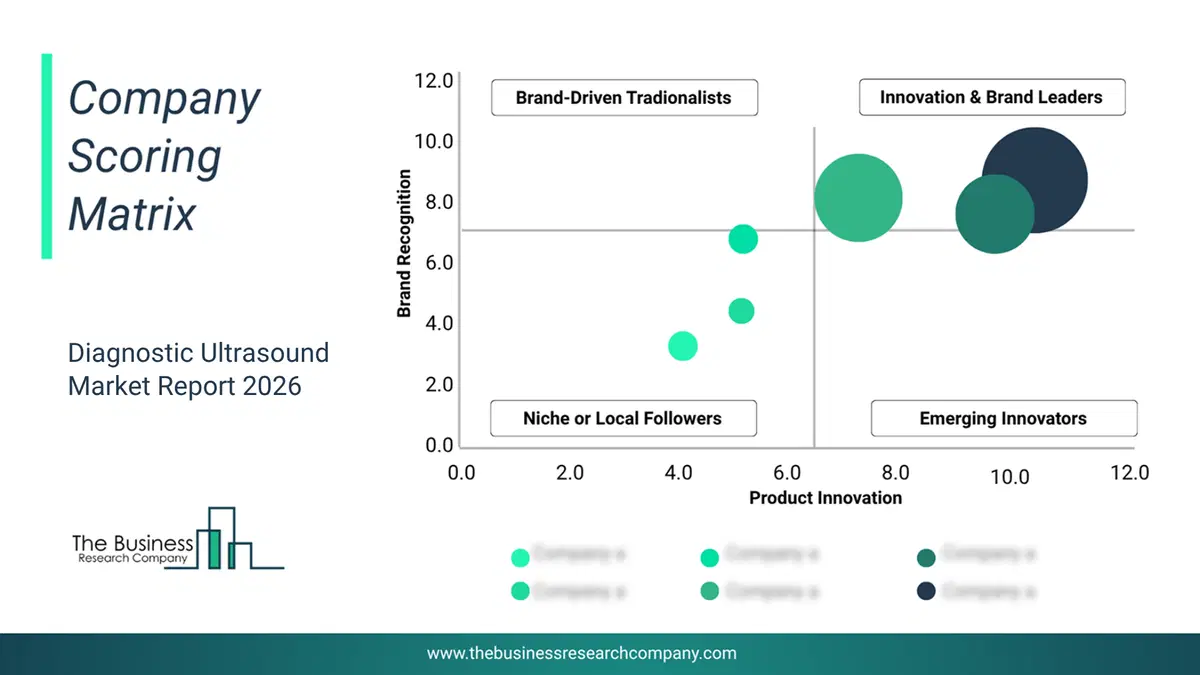
This chart maps companies by product innovation and brand strength, with bubble size indicating relative revenue, helping identify market leaders, challengers, and niche players. This is an illustrative chart; the full report provides a complete and accurate competitive analysis.
Global Diagnostic Ultrasound Market Trends and Insights
Major companies operating in the diagnostic ultrasound market are focusing on developing advanced solutions, such as artificial intelligence (AI)-enhanced compact echocardiography systems, to improve imaging accuracy, accelerate exam workflows, and expand access to high-quality cardiac diagnostics across diverse care environments. AI-enabled compact ultrasound systems refer to portable imaging platforms that integrate automated measurement tools, intelligent guidance, and high-resolution imaging to support fast and reliable cardiac assessments at the point of care. For instance, in March 2025, Royal Philips, a Netherlands-based health technology company, launched its AI-enhanced Compact Ultrasound 5500CV, a next-generation echocardiography system designed to help clinicians perform exams up to 50% faster through automated cardiac measurement tools, while delivering advanced imaging capabilities in a portable format to support efficient, high-quality cardiac evaluations across multiple clinical settings.What Are Latest Mergers And Acquisitions In The Diagnostic Ultrasound Market?
In October 2024, GE HealthCare, a US-based medical technology company, acquired the clinical artificial intelligence (AI) business from Intelligent Ultrasound for $0.053 billion. With this acquisition, it aims to strengthen its ultrasound imaging capabilities by integrating advanced AI technologies that support real-time image analysis and decision-making. Intelligent Ultrasound is a UK-based medical software company that develops AI solutions to enhance the efficiency and accuracy of ultrasound examinations.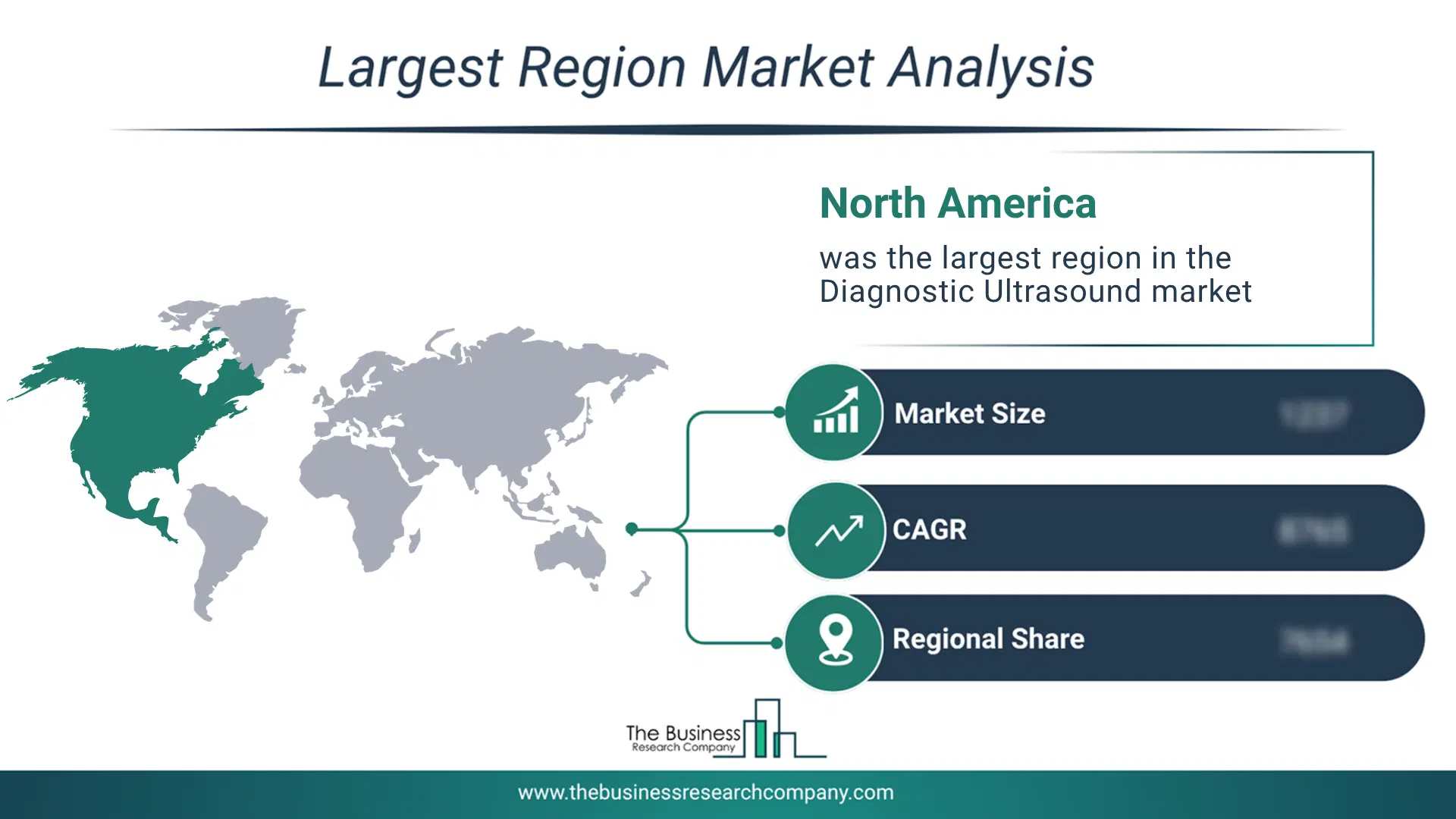
Regional Outlook
North America was the largest region in the diagnostic ultrasound market in 2025. Asia-Pacific is expected to be the fastest-growing region in the forecast period. The regions covered in this market report are Asia-Pacific, South East Asia, Western Europe, Eastern Europe, North America, South America, Middle East, Africa. The countries covered in this market report are Australia, Brazil, China, France, Germany, India, Indonesia, Japan, Taiwan, Russia, South Korea, UK, USA, Canada, Italy, SpainWhat Defines the Diagnostic Ultrasound Market?
The diagnostic ultrasound market consists of revenues earned by entities by providing services such as ultrasound imaging services, tele-ultrasound services, and training and education services. The market value includes the value of related goods sold by the service provider or included within the service offering. The diagnostic ultrasound market also includes sales of portable ultrasound systems, laptop-based ultrasound systems, linear array probes, transesophageal probes, needle guidance probes, and elastography ultrasound systems. Values in this market are ‘factory gate’ values; that is, the value of goods sold by the manufacturers or creators of the goods, whether to other entities (including downstream manufacturers, wholesalers, distributors, and retailers) or directly to end customers. The value of goods in this market includes related services sold by the creators of the goods.How is Market Value Defined and Measured?
The market value is defined as the revenues that enterprises gain from the sale of goods and/or services within the specified market and geography through sales, grants, or donations in terms of the currency (in USD unless otherwise specified). The revenues for a specified geography are consumption values that are revenues generated by organizations in the specified geography within the market, irrespective of where they are produced. It does not include revenues from resales along the supply chain, either further along the supply chain or as part of other products.
This chart presents market attractiveness based on a quantitative evaluation of growth, competition, strategic alignment, and risk, offering a clear view of opportunity areas for decision-making. This chart is for illustrative purposes; the full report contains the complete analysis.

This chart highlights the Total Addressable Market (TAM) by estimating the maximum revenue opportunity using an assumption-driven approach, supporting strategic planning and opportunity sizing across markets. The chart is illustrative; the full report provides a more comprehensive analysis.
What Key Data and Analysis Are Included in the Diagnostic Ultrasound Market Report 2026?
The diagnostic ultrasound market research report is one of a series of new reports from The Business Research Company that provides market statistics, including industry global market size, regional shares, competitors with the market share, detailed market segments, market trends and opportunities, and any further data you may need to thrive in the diagnostic ultrasound industry. The market research report delivers a complete perspective of everything you need, with an in-depth analysis of the current and future state of the industry.Diagnostic Ultrasound Market Report Forecast Analysis
| Report Attribute | Details |
|---|---|
| Market Size Value In 2026 | $8.4 billion |
| Revenue Forecast In 2030 | $10.32 billion |
| Growth Rate | CAGR of 5.3% from 2026 to 2030 |
| Base Year For Estimation | 2025 |
| Actual Estimates/Historical Data | 2020-2025 |
| Forecast Period | 2026 - 2030 |
| Market Representation | Revenue in USD Billion and CAGR from 2026 to 2030 |
| Segments Covered | Technology, Portability, Application, End-user |
| Regional Scope | Asia-Pacific, Western Europe, Eastern Europe, North America, South America, Middle East, Africa |
| Country Scope | The countries covered in the report are Australia, Brazil, China, France, Germany, India, Indonesia, Japan, Taiwan, Russia, South Korea, UK, USA, Canada, Italy, Spain. |
| Key Companies Profiled | Siemens Healthcare Private Limited, Fujifilm Holdings Corporation, GE Healthcare, Koninklijke Philips NV, Konica Minolta Inc, Mindray Medical International Limited, United Imaging Healthcare Co Ltd, Samsung Medison Co Ltd, Analogic Corporation, Esaote SpA, SonoScape Medical Corporation, Canon Medical Systems Corporation, Chison Medical Imaging Co Ltd, Clarius Mobile Health, MedGyn Products Inc, Terason, TELEMED Medical Systems, Hitachi Medical Systems, Shimadzu Corporation, Carestream Health Inc, Edan Instruments Inc, Mindray DS USA |
| Customization Scope | Request for Customization |
| Pricing And Purchase Options | Explore Purchase Options |