

Digital Ad Spending Market Report 2026
Global Outlook – By Ad Format (Display Ads, Social Media, Native Advertising, Search Ads, Video Ads, Other Ad Format), By Platform (Mobile, Laptop, Desktop), By End User (Retail, Health care, Automotive, Media And Entertainment, Education, Transport And Tourism, IT And Telecom) – Market Size, Trends, Strategies, and Forecast to 2030
Digital Ad Spending Market Overview
• Digital Ad Spending market size has reached to $709.65 billion in 2025 • Expected to grow to $1088.04 billion in 2030 at a compound annual growth rate (CAGR) of 8.6% • Growth Driver: Mobile Revolution Drives Digital Ad Spending • Market Trend: Tech-Driven Transformation Leads Digital Ad Spending • North America was the largest region in 2025.Market Gains By 2030 – Top Opportunities By Segment
Market Gain identifies the most promising market opportunities by highlighting the segments or products expected to generate the highest incremental revenue growth over the next five years.
What Is Covered Under Digital Ad Spending Market?
Digital ad spending refers to the amount of money spent on digital advertising, which includes any type of online marketing that uses electronic media channels to advertise a product, service, or company. The digital advertising involves paying for clicks, impressions, or other interactions that drive traffic to a website or other digital property. The main types of digital ad spending include add-formats such as display ads, social media, native advertising, search ads, video ads, and others. Display ads refer to a type of digital advertising that includes text, images, and a URL that directs viewers to a website where they can read more about or make buying decisions. They are used on platforms such as mobile, laptop, and desktop, and are used by retail, health care, automotive, media and entertainment, education, transport and tourism, IT, and telecom.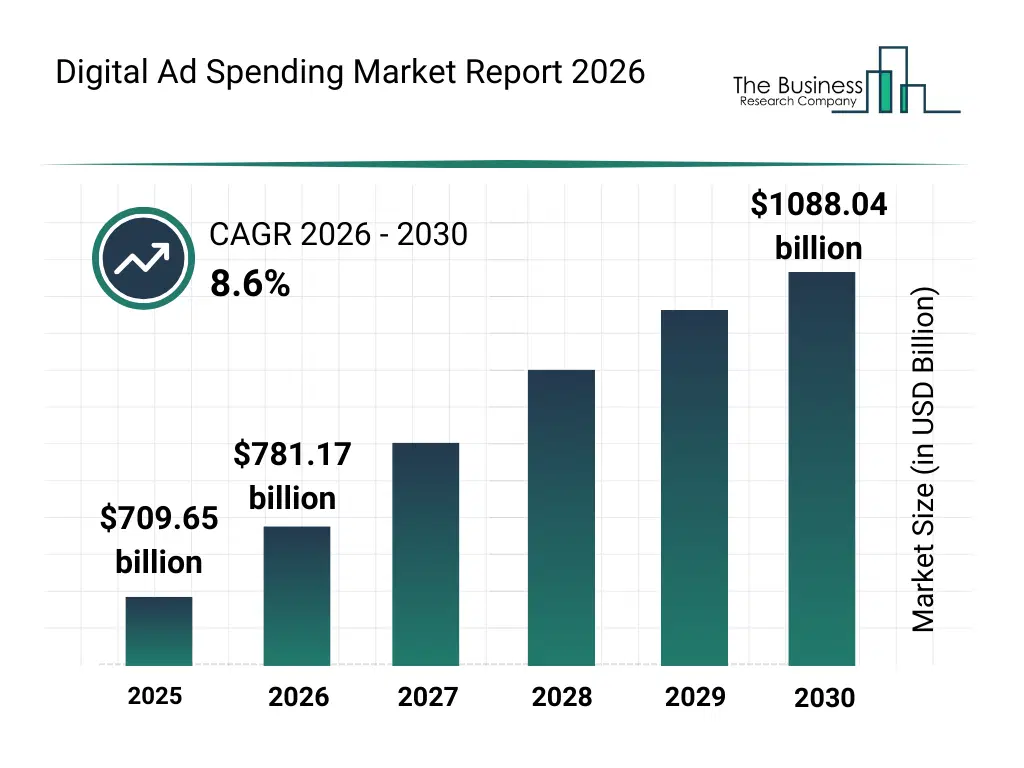
What Is The Digital Ad Spending Market Size and Share 2026?
The digital ad spending market size has grown rapidly in recent years. It will grow from $709.65 billion in 2025 to $781.17 billion in 2026 at a compound annual growth rate (CAGR) of 10.1%. The growth in the historic period can be attributed to increased internet penetration, growth of social media platforms, rising e-commerce adoption, mobile device proliferation, expansion of digital content.What Is The Digital Ad Spending Market Growth Forecast?
The digital ad spending market size is expected to see strong growth in the next few years. It will grow to $1088.04 billion in 2030 at a compound annual growth rate (CAGR) of 8.6%. The growth in the forecast period can be attributed to ai-powered ad targeting, growth in video and immersive advertising, rise of connected tv & streaming platforms, expansion of data analytics & martech, adoption of privacy-first advertising solutions. Major trends in the forecast period include programmatic advertising growth, personalization & hyper-targeting, cross-platform campaign optimization, mobile-first ad strategies, influencer & content marketing expansion.
Global Digital Ad Spending Market Segmentation
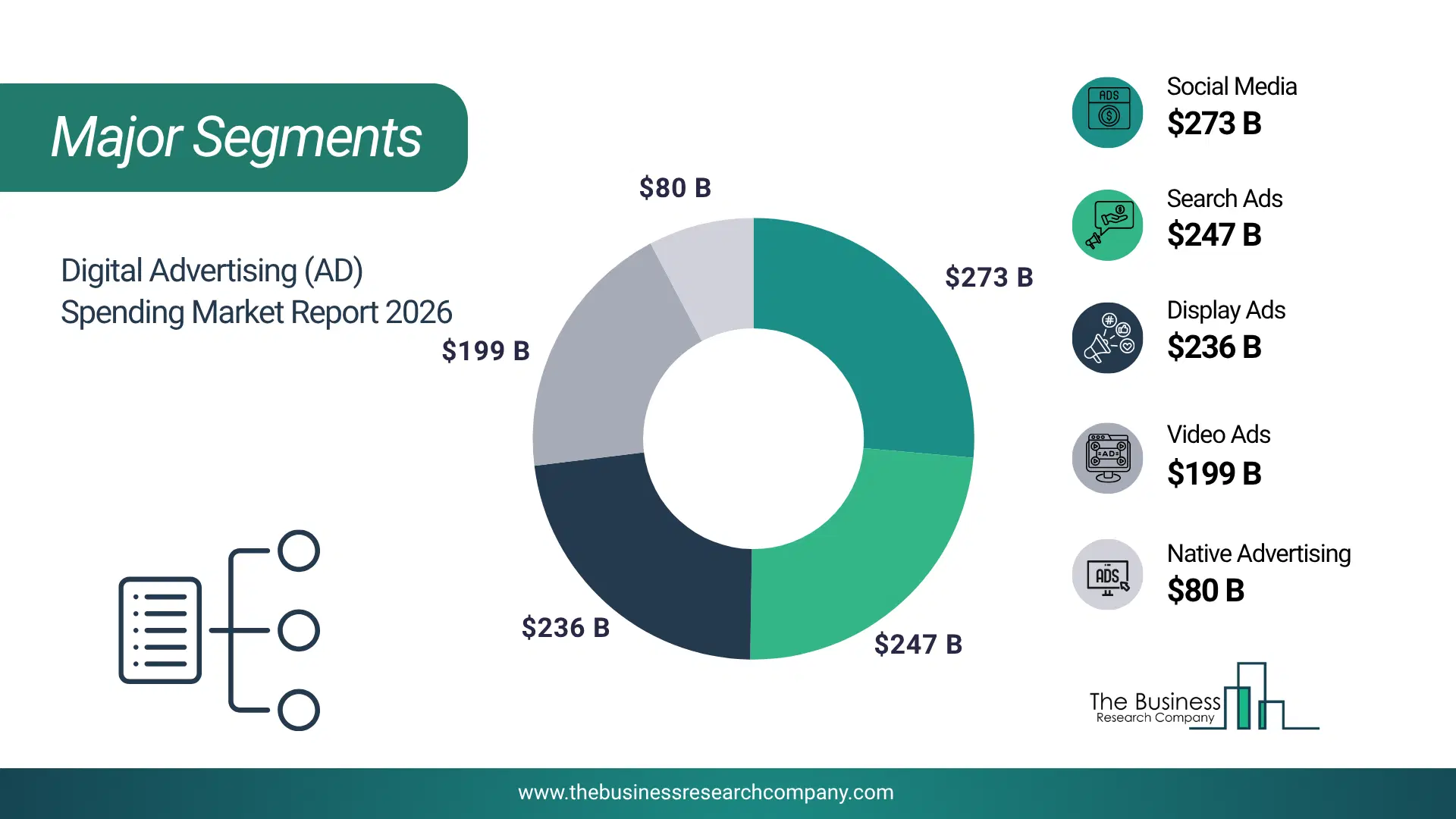
1) By Ad Format: Display Ads, Social Media, Native Advertising, Search Ads, Video Ads, Other Ad Format 2) By Platform: Mobile, Laptop, Desktop 3) By End User: Retail, Health care, Automotive, Media And Entertainment, Education, Transport And Tourism, IT And Telecom Subsegments: 1) By Display Ads: Banner Ads, Rich Media Ads, Interstitial Ads, Pop-Up Ads 2) By Social Media: Sponsored Posts, Stories Ads, Carousel Ads, Messenger Ads 3) By Native Advertising: Sponsored Content, In-Feed Ads, Recommendation Widgets 4) By Paid Search Ads: Pay-Per-Click (PPC) Ads, Product Listing Ads, Local Search Ads, Text Ads 5) By Video Ads: In-Stream Ads, Out-Stream Ads, Interactive Video Ads, Social Video Ads 6) By Other Ad Format: Email Marketing, Affiliate Marketing, Influencer Marketing, Podcast Ads The top segments in the digital advertising (ad) spending market will be: • Social Media will reach $273.32 Billion by 2030. • Search Ads will reach $246.72 Billion by 2030. • Display Ads will reach $235.87 Billion by 2030. • Video Ads will reach $198.54 Billion by 2030. • Native Advertising will reach $80.03 Billion by 2030.What Is The Driver Of The Digital Ad Spending Market?
The rising penetration of tablets and smartphones is expected to propel the growth of the digital ad spending market going forward. Tablets and smartphones are mobile devices that enable users to access the internet, run applications, and engage in activities such as video streaming, gaming, social networking, and video calling. The increase in tablet and smartphone usage is driven by widespread availability of affordable devices, improved mobile connectivity, and the growing consumption of digital content on mobile platforms. Penetration of tablets and smartphones drives digital ad spending by expanding the audience reach and enabling advertisers to deliver targeted, personalized campaigns directly to users’ mobile devices. For instance, in November 2024, according to Eurostat, a Luxembourg-based statistical office of the European Union (EU), in 2023, 89% of people aged 16–74 living in cities used smartphones or mobile phones to access the internet, compared with 86% in towns and suburbs and 82% in rural areas. Therefore, the rising penetration of tablets and smartphones is driving the growth of the digital ad spending industry.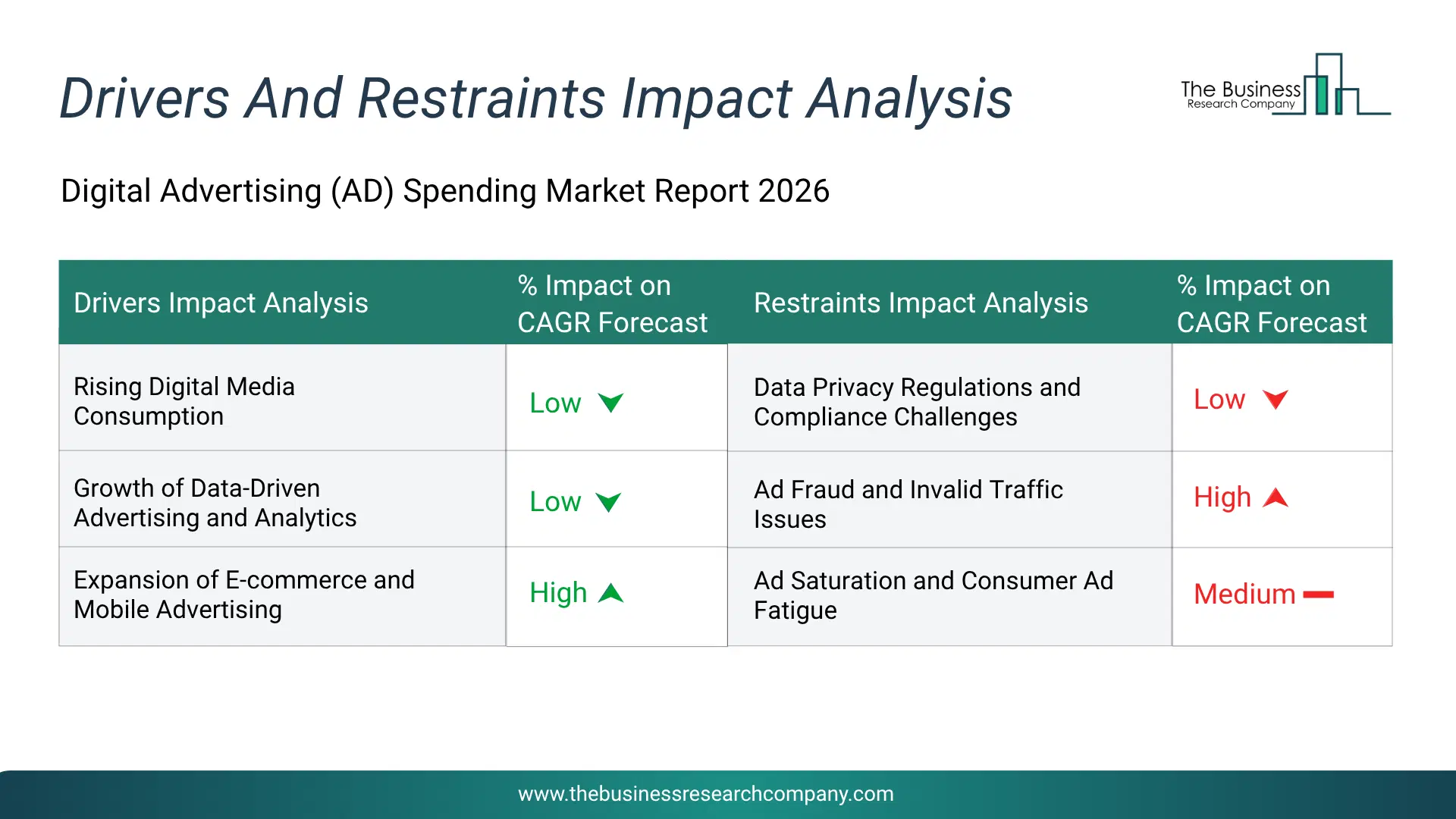
Infographic Chart Showing Key Market Drivers Analysis And Restraints For Digital Ad Spending Market
The chart presents an impact analysis of key drivers and restraints, quantifying their relative influence on the market's growth rate and helping assess the balance between growth enablers and limiting factors. This chart offers a high-level perspective; the full report contains more detailed insights.
How Will The Drivers Impact Growth In The Global Digital Advertising (AD) Spending Market?
• Rising Digital Media Consumption (Low) – During the forecast period, the rising digital media consumption is expected to become a key growth driver for the digital advertising (AD) spending market by 2030. The rapid increase in digital media usage across smartphones, laptops, and connected devices is a primary growth catalyst for digital advertising (AD) spending. Consumers are spending more time on social media platforms, streaming services, websites, and mobile applications, creating a larger inventory of ad spaces. This expanded user engagement enables advertisers to reach highly targeted audiences through personalized campaigns. As businesses shift their focus from traditional channels to digital platforms, advertising budgets are increasingly allocated toward online media. Additionally, the measurable nature of digital ads, such as clicks and impressions, enhances their effectiveness compared to conventional advertising. • Growth of Data-Driven Advertising and Analytics (Low) – During the forecast period, the growth of data-driven advertising and analytics is expected to emerge as a major factor driving the expansion of the digital advertising (AD) spending market by 2030. The integration of advanced analytics, artificial intelligence, and big data has significantly improved the efficiency of digital advertising. Advertisers can now track user behavior, preferences, and engagement patterns in real time, enabling precise targeting and campaign optimization. This data-driven approach ensures higher return on investment (ROI), encouraging businesses to increase their digital ad budgets. Tools such as programmatic advertising automate ad placements, further improving efficiency and reducing costs. The ability to measure campaign performance through metrics like conversion rates and impressions strengthens advertiser confidence. As a result, companies increasingly rely on digital channels for marketing, accelerating overall ad spending growth. • Expansion of E-commerce and Mobile Advertising (High) – During the forecast period, the expansion of e-commerce and mobile advertising is expected to act as a key growth catalyst for the digital advertising (AD) spending market by 2030. The global rise of e-commerce platforms and mobile commerce has created substantial demand for digital advertising. Businesses operating online require continuous promotion to attract and retain customers, leading to increased spending on search ads, display ads, and in-app advertisements. Mobile devices, in particular, have become a dominant channel for digital interactions, making mobile advertising a critical component of marketing strategies. The integration of ads within mobile apps and social platforms enhances visibility and user engagement. Furthermore, the growth of direct-to-consumer brands and online marketplaces has intensified competition, pushing companies to invest more in digital marketing. This expansion directly contributes to sustained growth in digital advertising (AD) spending revenues.How Will The Restraints Impact Growth In The Global Digital Advertising (AD) Spending Market?
• Data Privacy Regulations and Compliance Challenges (Low) – During the forecast period, data privacy regulations and compliance challenges are significantly restricting the growth of the digital ad spending market. Strict regulatory frameworks such as consent requirements, data usage limitations, and cross-border data restrictions are reducing targeting precision and increasing compliance costs for advertisers and platforms. • Ad Fraud and Invalid Traffic Issues (Low) – During the forecast period, ad fraud and invalid traffic issues are significantly restricting the growth of the digital ad spending market. Increasing instances of bot traffic, click fraud, and fake impressions are reducing advertiser trust, inflating costs, and lowering overall return on investment in digital advertising campaigns. • Ad Saturation and Consumer Ad Fatigue (High) – During the forecast period, ad saturation and consumer ad fatigue are restricting the growth of the digital ad spending market. The overwhelming volume of advertisements across digital platforms is reducing user engagement, increasing ad avoidance behaviors, and limiting the effectiveness of advertising campaigns.Key Players In The Global Digital Ad Spending Market
Major companies operating in the digital ad spending market are Microsoft Corporation, Google LLC, Meta Platforms Inc., Hulu LLC, Alibaba Group Holdings Limited, Amazon Web Services Inc., Baidu Inc., Dentsu Group Inc., Omnicom Group, Publicis Groupe, Tencent Holdings Limited, Adobe Inc., The Trade Desk Inc., Verizon Communications Inc., Twitter Inc., Pinterest Inc., Snap Inc., Roku Inc., Spotify Technology S.A., JD.com Inc., Criteo SA, InterActiveCorp, PubMatic Inc., Magnite Inc., Taboola, Outbrain Inc., AdRoll Group, Rubicon Project Inc., Xandr Inc., OpenX, MediaMath Inc.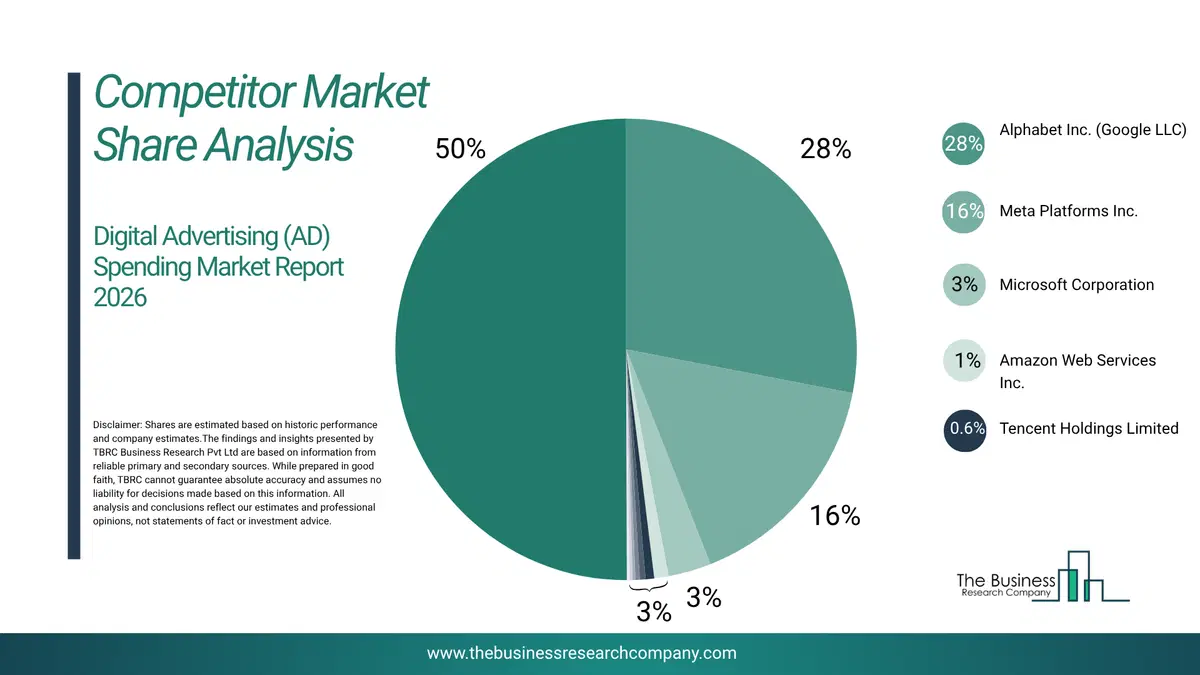
This chart is for illustrative purposes; the full report includes a detailed competitor analysis and comprehensive overview of the top 10 companies in the market.
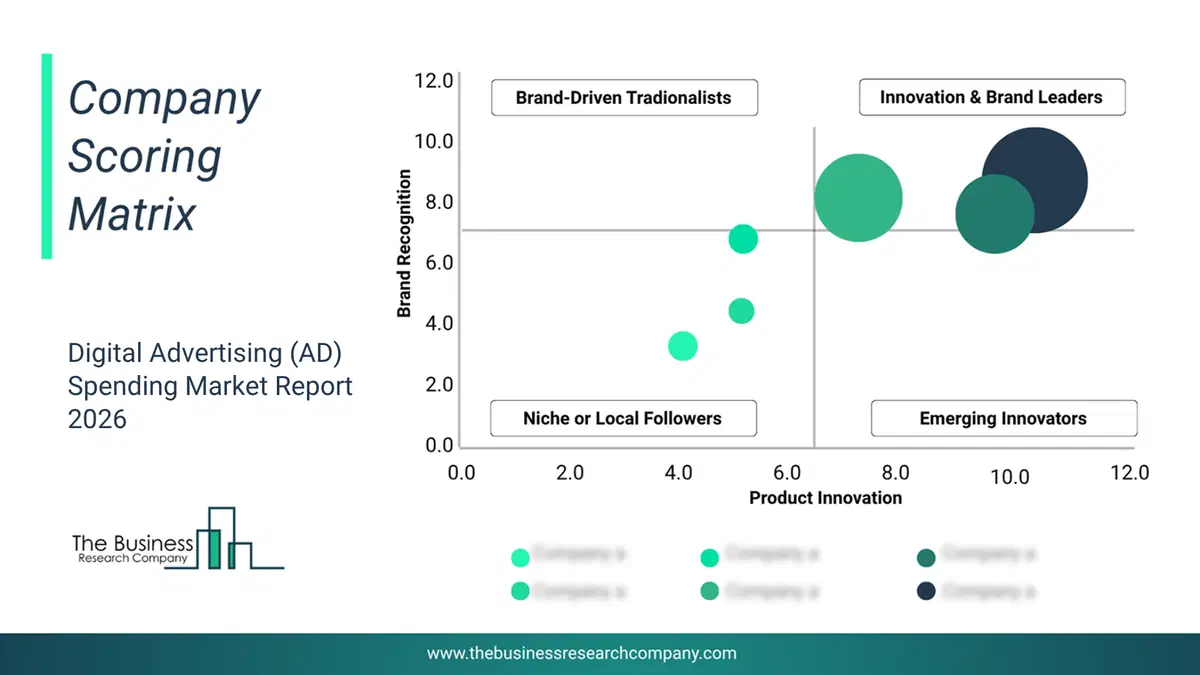
This chart maps companies by product innovation and brand strength, with bubble size indicating relative revenue, helping identify market leaders, challengers, and niche players. This is an illustrative chart; the full report provides a complete and accurate competitive analysis.
Global Digital Ad Spending Market Trends and Insights
Major companies operating in the digital ad spending market are focusing on developing advanced technologies, such as artificial intelligence (AI), machine learning, augmented reality (AR), virtual reality (VR), and blockchain, to improve ad relevance, audience targeting, and campaign effectiveness while adapting to a privacy-first environment. These advanced advertising technologies enable brands to deliver personalized and contextual ad experiences by analyzing real-time signals such as content context, location, device type, and environmental factors, reducing reliance on third-party cookies and user-level identifiers. For instance, in January 2023, Verizon Media Group a US-based technology company providing communications, information, and entertainment services, launched a next-generation advertising solutions suite designed to deliver relevant ad experiences without using cookies or mobile app IDs. The solution leverages content and real-time data signals, including weather, location, and device type, combined with machine-learning algorithms to connect advertisers with relevant audiences without browser storage or user-level profiles, thereby improving privacy compliance, targeting efficiency, and overall advertising performance.What Are Latest Mergers And Acquisitions In The Digital Ad Spending Market?
In October 2025 Publicis Groupe S.A. a France-based advertising and communications company, acquired HEPMIL Media Group for an undisclosed amount. With this acquisition, Publicis Groupe aims to strengthen its influencer marketing and data‑driven creator capabilities across Southeast Asia by combining HEPMIL’s creator network and culturally relevant content expertise with its own analytics and identity‑driven media solutions. Hepmil Media Group is a Singapore‑based company that provide digital advertising services, including managing and facilitating digital ad spending for brands.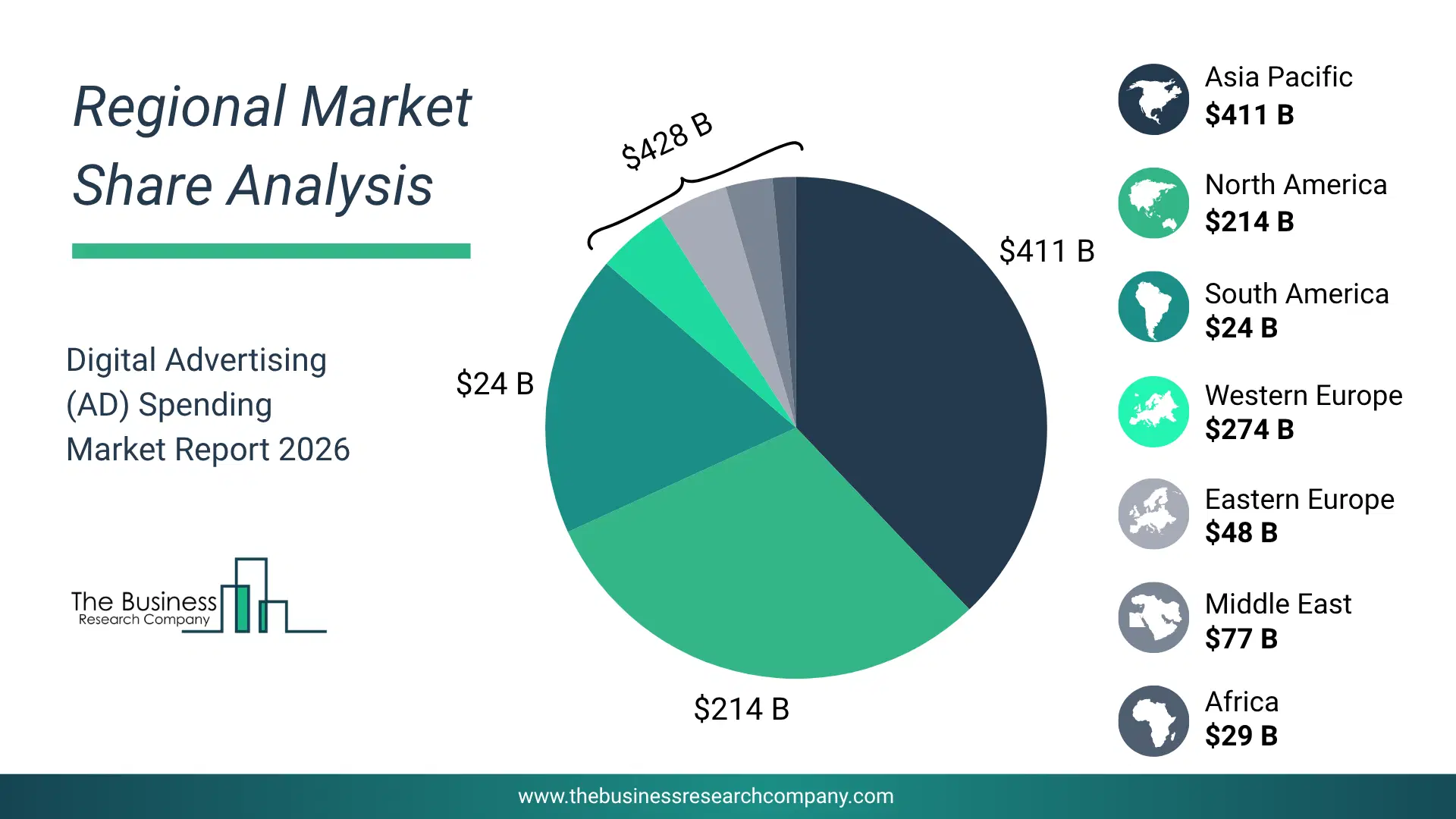
Regional Outlook
North America was the largest region in the digital ad spending market in 2025. The regions covered in this market report are Asia-Pacific, South East Asia, Western Europe, Eastern Europe, North America, South America, Middle East, Africa. The countries covered in this market report are Australia, Brazil, China, France, Germany, India, Indonesia, Japan, Taiwan, Russia, South Korea, UK, USA, Canada, Italy, Spain.What Defines the Digital Ad Spending Market?
The digital Ad spending market includes revenues earned by entities through audio ads, in-app ads, mobile applications, and email marketing. The market value includes the value of related goods sold by the service provider or included within the service offering. Only goods and services traded between entities or sold to end consumers are included.How is Market Value Defined and Measured?
The market value is defined as the revenues that enterprises gain from the sale of goods and/or services within the specified market and geography through sales, grants, or donations in terms of the currency (in USD unless otherwise specified). The revenues for a specified geography are consumption values that are revenues generated by organizations in the specified geography within the market, irrespective of where they are produced. It does not include revenues from resales along the supply chain, either further along the supply chain or as part of other products.
This chart presents market attractiveness based on a quantitative evaluation of growth, competition, strategic alignment, and risk, offering a clear view of opportunity areas for decision-making. This chart is for illustrative purposes; the full report contains the complete analysis.

This chart highlights the Total Addressable Market (TAM) by estimating the maximum revenue opportunity using an assumption-driven approach, supporting strategic planning and opportunity sizing across markets. The chart is illustrative; the full report provides a more comprehensive analysis.
What Key Data and Analysis Are Included in the Digital Ad Spending Market Report 2026?
The digital ad spending market research report is one of a series of new reports from The Business Research Company that provides market statistics, including industry global market size, regional shares, competitors with the market share, detailed market segments, market trends and opportunities, and any further data you may need to thrive in the digital ad spending industry. The market research report delivers a complete perspective of everything you need, with an in-depth analysis of the current and future state of the industry.Digital Ad Spending Market Report Forecast Analysis
| Report Attribute | Details |
|---|---|
| Market Size Value In 2026 | $781.17 billion |
| Revenue Forecast In 2030 | $1088.04 billion |
| Growth Rate | CAGR of 8.6% from 2026 to 2030 |
| Base Year For Estimation | 2025 |
| Actual Estimates/Historical Data | 2020-2025 |
| Forecast Period | 2026 - 2030 |
| Market Representation | Revenue in USD Billion and CAGR from 2026 to 2030 |
| Segments Covered | Ad Format, Platform, End User |
| Regional Scope | Asia-Pacific, Western Europe, Eastern Europe, North America, South America, Middle East, Africa |
| Country Scope | The countries covered in the report are Australia, Brazil, China, France, Germany, India, Indonesia, Japan, Taiwan, Russia, South Korea, UK, USA, Canada, Italy, Spain. |
| Key Companies Profiled | Microsoft Corporation, Google LLC, Meta Platforms Inc., Hulu LLC, Alibaba Group Holdings Limited, Amazon Web Services Inc., Baidu Inc., Dentsu Group Inc., Omnicom Group, Publicis Groupe, Tencent Holdings Limited, Adobe Inc., The Trade Desk Inc., Verizon Communications Inc., Twitter Inc., Pinterest Inc., Snap Inc., Roku Inc., Spotify Technology S.A., JD.com Inc., Criteo SA, InterActiveCorp, PubMatic Inc., Magnite Inc., Taboola, Outbrain Inc., AdRoll Group, Rubicon Project Inc., Xandr Inc., OpenX, MediaMath Inc. |
| Customization Scope | Request for Customization |
| Pricing And Purchase Options | Explore Purchase Options |