
Disability Devices Market Report 2026
Global Outlook – By Device Type (Vision Aids, Hearing Aids, Mobility Aids, Other Device Types), By Material (Plastic, Metal, Wood, Fabric), By Application (Home Care Settings, Hospitals, Ambulatory Care Centers And Rehabilitation Centers), By End User (Elderly, Physically Challenged, Visually Impaired, Hearing Impaired) – Market Size, Trends, Strategies, and Forecast to 2030
Disability Devices Market Overview
• Disability Devices market size has reached to $25.38 billion in 2025 • Expected to grow to $33.33 billion in 2030 at a compound annual growth rate (CAGR) of 5.5% • Growth Driver: The Higher Rates Of Sensory Impairments Driving Market Growth Due To Increasing Functional Dependency • Market Trend: Brain-Controlled Wearables Redefine Accessibility In Disability Devices Market Evolution • North America was the largest region in 2025 and Asia-Pacific is the fastest growing region.What Is Covered Under Disability Devices Market?
Disability devices are specially designed tools, instruments, or equipment intended to assist individuals with physical, sensory, cognitive, or developmental impairments in performing daily activities, enhancing mobility, communication, or independence, and compensating for functional limitations caused by temporary or permanent disabilities. These devices are employed in healthcare, rehabilitation, educational, occupational, and domestic settings to support participation, improve quality of life, and promote social inclusion. The main device types in disability devices are vision aids, hearing aids, mobility aids, and others. Vision aids are assistive devices designed to enhance or compensate for visual impairments, helping individuals with low or no vision to perform daily activities more independently. These are made with materials including plastic, metal, wood, and fabric, which are used in applications such as home care settings, hospitals, ambulatory care centers and rehabilitation centers by the end users, including the elderly, physically challenged, visually impaired, and hearing impaired.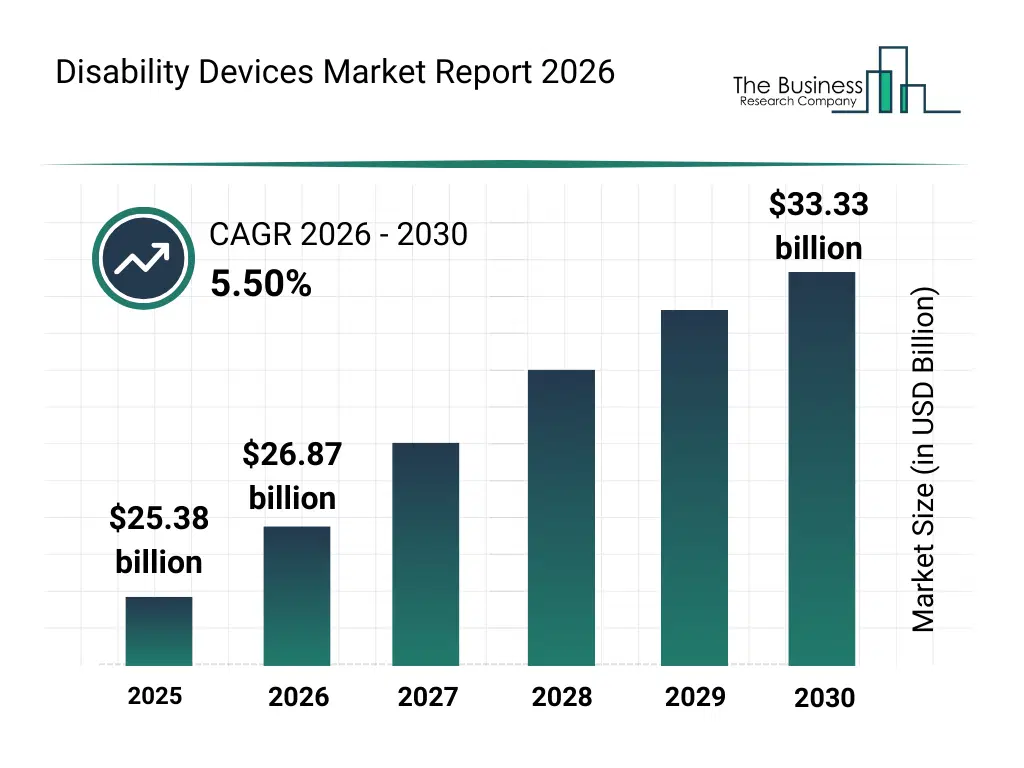
What Is The Disability Devices Market Size and Share 2026?
The disability devices market size has grown strongly in recent years. It will grow from $25.38 billion in 2025 to $26.87 billion in 2026 at a compound annual growth rate (CAGR) of 5.9%. The growth in the historic period can be attributed to limited availability of advanced disability devices, high cost of assistive technology, reliance on conventional mobility aids, increasing elderly population, low awareness about cognitive and communication aids.What Is The Disability Devices Market Growth Forecast?
The disability devices market size is expected to see strong growth in the next few years. It will grow to $33.33 billion in 2030 at a compound annual growth rate (CAGR) of 5.5%. The growth in the forecast period can be attributed to technological advancements in smart and connected disability devices, rising government support and insurance coverage, growth in rehabilitation centers and home care services, increasing focus on inclusive education and accessibility, development of AI-powered vision and hearing aids. Major trends in the forecast period include rising adoption of smart mobility devices, growing demand for vision and hearing aids, integration of cognitive and communication assistance tools, increased use of environmental control and home automation devices, focus on customizable and ergonomic disability devices.
Global Disability Devices Market Segmentation
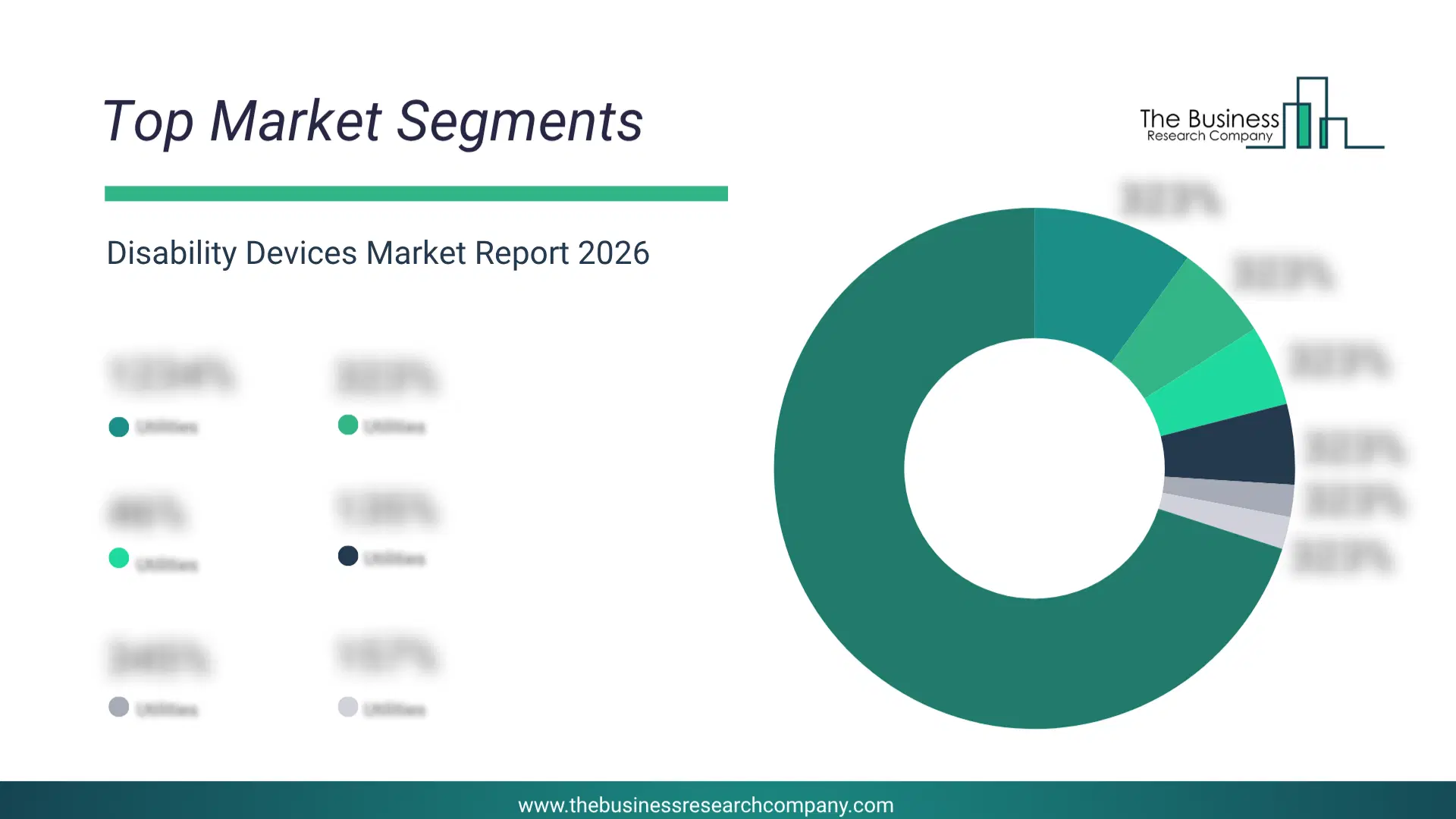
1) By Device Type: Vision Aids, Hearing Aids, Mobility Aids, Other Device Types 2) By Material: Plastic, Metal, Wood, Fabric 3) By Application: Home Care Settings, Hospitals, Ambulatory Care Centers And Rehabilitation Centers 4) By End User: Elderly, Physically Challenged, Visually Impaired, Hearing Impaired Subsegments: 1) By Vision Aids: Magnifiers, Braille Readers, Screen Reading Software, Smart Glasses 2) By Hearing Aids: Behind-The-Ear (BTE), In-The-Ear (ITE), Receiver-In-Canal (RIC), Cochlear Implants 3) By Mobility Aids: Wheelchairs, Walkers And Rollators, Crutches, Mobility Scooters 4) By Other Device Types: Communication Aids, Cognitive Aids, Environmental Control Devices, Prosthetic DevicesWhat Is The Driver Of The Disability Devices Market?
The higher rates of sensory impairments are expected to propel the growth in the disability devices market going forward. Sensory impairments refer to partial or complete loss of one or more senses, primarily affecting vision, hearing, or other sensory functions, and significantly limiting an individual’s ability to perceive, interpret, or respond to environmental stimuli. Higher rates of sensory impairments are primarily driven by factors such as population aging, chronic health conditions, and increasing exposure to environmental risks, as these conditions often deteriorate sensory functions over time and become more prevalent with advancing age, leading to a greater incidence of impairments. Disability devices play a critical role in addressing the growing burden of sensory impairments by enhancing functional capabilities, supporting independence, and improving overall quality of life for affected individuals. For instance, in November 2024, according to The Hull Joint Strategic Needs Assessment (JSNA) by the Hull City Council, a UK-based unitary authority, sensory impairment accounts for 6.0% of healthy life years lost, with a higher burden in older age, rising from 2.5% in those under 50 to 12.9% in people aged 70+ in hull. Additionally, serious visual impairment among those 75+ is expected to rise from 2,100 to 3,100 by 2040 due to aging. Therefore, the higher rates of sensory impairments are driving the growth of the disability devices industry.Key Players In The Global Disability Devices Market
Major companies operating in the disability devices market are Medline Industries LP, Sonova Holding AG, William Demant Holding A/S, GN Store Nord A/S, Ottobock SE & Co. KGaA, Hollister Inc., Cochlear Ltd., Arjo AB, Invacare Corporation, GN Hearing A/S, MED−EL Elektromedizinische Geräte Gesellschaft m.b.H., DRIVE MEDICAL GMBH & CO. KG, Permobil AB, Pride Mobility Products Corporation, Steeper Group, GF Health Products Inc., WHILL Inc., Carex Health Brands Inc., Merits Health Products, MEYRA Group, Hearing Health & Technology Matters LLC, Magic Mobility Pty Ltd, LEVO AG, Batec Mobility S.L., BetterLiving.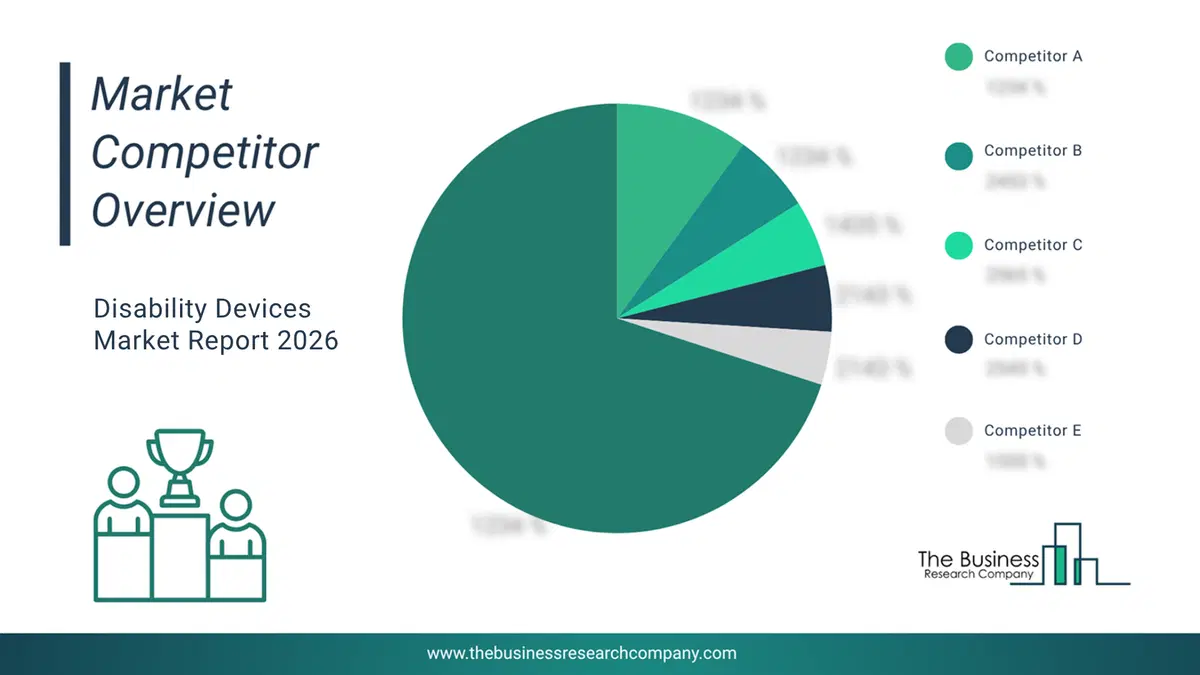
This chart is for illustrative purposes; the full report includes a detailed competitor analysis and comprehensive overview of the top 10 companies in the market.
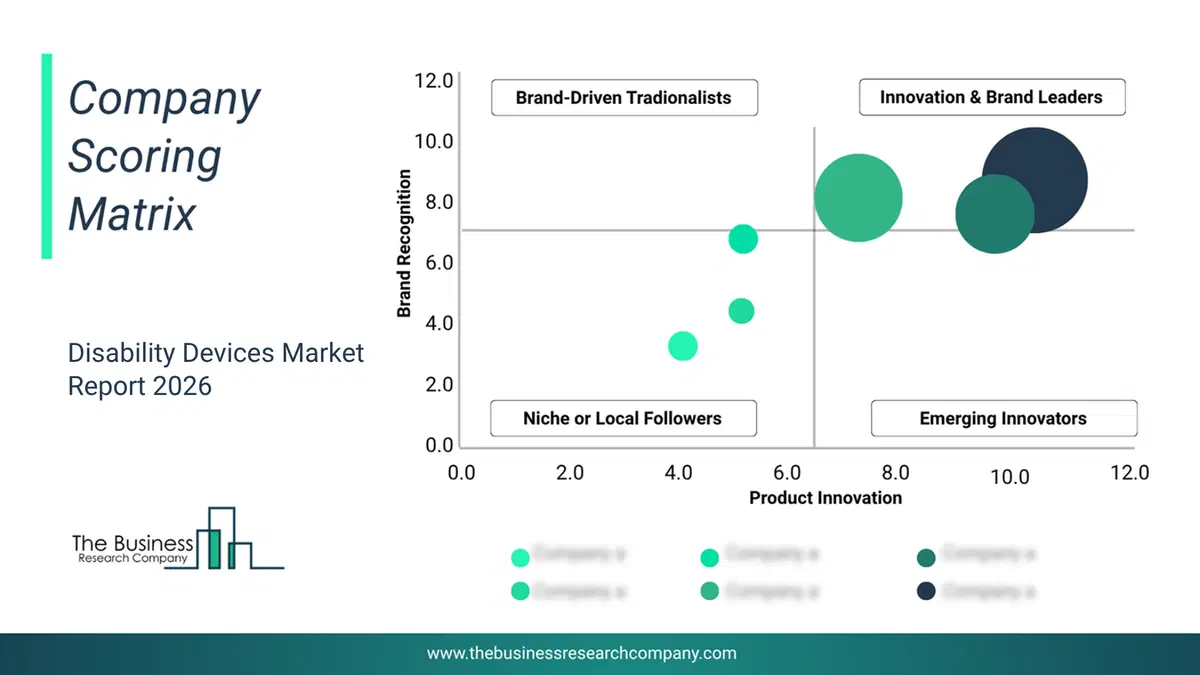
This chart maps companies by product innovation and brand strength, with bubble size indicating relative revenue, helping identify market leaders, challengers, and niche players. This is an illustrative chart; the full report provides a complete and accurate competitive analysis.
Global Disability Devices Market Trends and Insights
Major companies operating in the disability devices market are focusing on developing advanced technologies such as brain-controlled assistive wearables to improve accessibility and enhance user autonomy through intuitive, non-invasive control mechanisms. A brain-controlled assistive wearable is a device that uses neural and physiological signals to allow individuals with physical or motor impairments to interact with digital systems through non-verbal, movement-based commands. For instance, in March 2024, AAVAA Inc., a Canada-based neurotechnology company, launched the Brain-Computer Interface (BCI) System for Smart Glasses. The system enables users to operate digital devices using eye movements, facial gestures, and head motion by interpreting brain and biosignals. Its lightweight sensors and computationally efficient design allow seamless integration into eyewear, offering enhanced usability for assistive, smart home, augmented reality, and virtual reality applications.What Are Latest Mergers And Acquisitions In The Disability Devices Market?
In May 2025, Asker Healthcare Group, a Sweden-based medical products and solutions company, signed an agreement to acquire ITAK OÜ for an undisclosed amount. This deal aims to strengthen Asker Healthcare Group’s position in the European disability devices market by expanding its presence in the mobility and personal assistive equipment sector through ITAK’s established Estonian network and patient-focused services. ITAK OÜ is an Estonia-based company providing assistive equipment, mobility aids, care items, and incontinence products.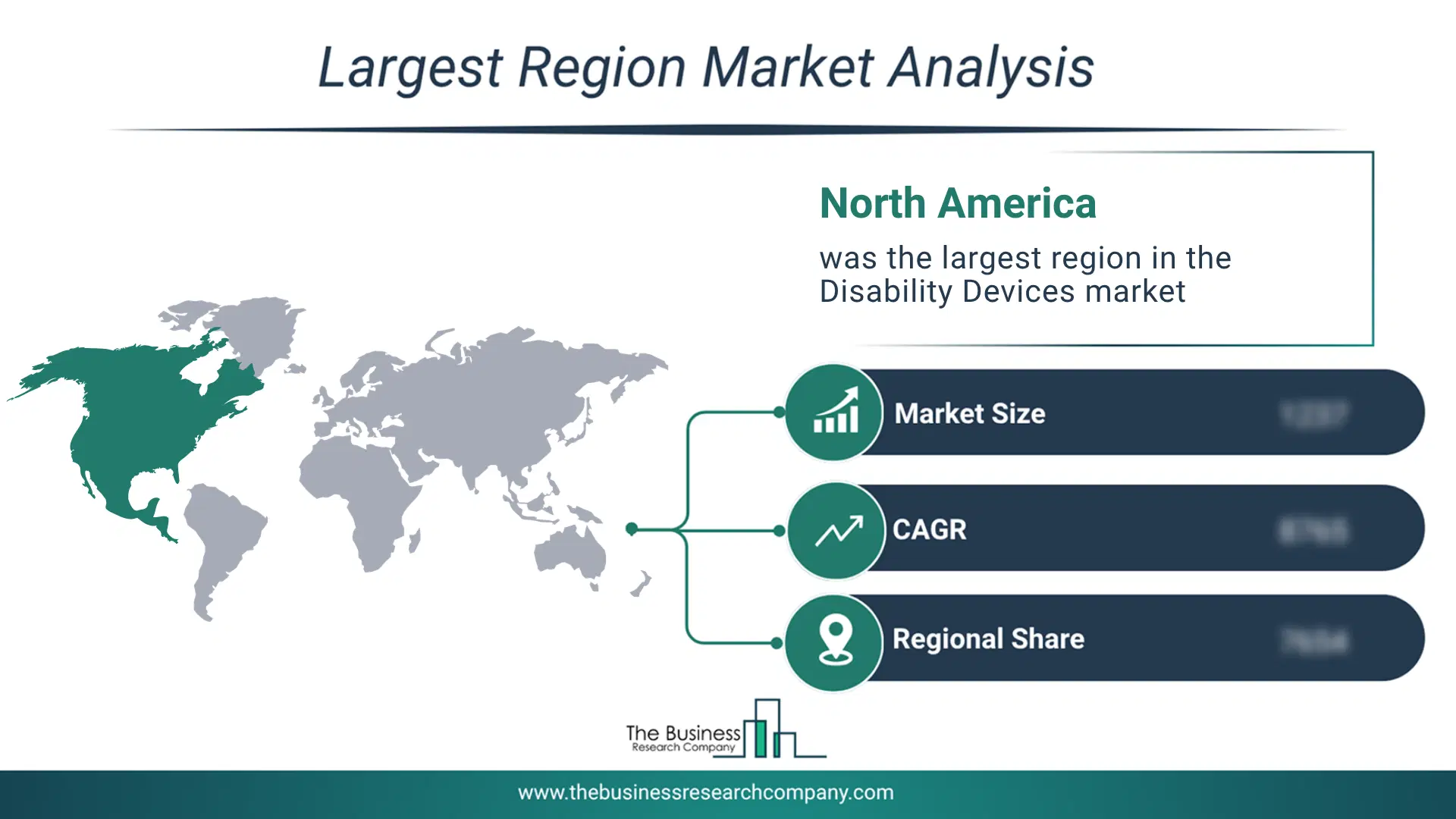
Regional Outlook
North America was the largest region in the disability devices market in 2025. Asia-Pacific is expected to be the fastest-growing region in the forecast period. The regions covered in this market report are Asia-Pacific, South East Asia, Western Europe, Eastern Europe, North America, South America, Middle East, Africa. The countries covered in this market report are Australia, Brazil, China, France, Germany, India, Indonesia, Japan, Taiwan, Russia, South Korea, UK, USA, Canada, Italy, SpainWhat Defines the Disability Devices Market?
The disability devices market consists of sales of adjustable beds, patient lifts, stair lifts, pressure relief mattresses, orthotic devices, handrails and grab bars, adaptive kitchen tools, and accessible bathroom equipment. Values in this market are ‘factory gate’ values, that is the value of goods sold by the manufacturers or creators of the goods, whether to other entities (including downstream manufacturers, wholesalers, distributors and retailers) or directly to end customers. The value of goods in this market includes related services sold by the creators of the goods.How is Market Value Defined and Measured?
The market value is defined as the revenues that enterprises gain from the sale of goods and/or services within the specified market and geography through sales, grants, or donations in terms of the currency (in USD unless otherwise specified). The revenues for a specified geography are consumption values that are revenues generated by organizations in the specified geography within the market, irrespective of where they are produced. It does not include revenues from resales along the supply chain, either further along the supply chain or as part of other products.
This chart presents market attractiveness based on a quantitative evaluation of growth, competition, strategic alignment, and risk, offering a clear view of opportunity areas for decision-making. This chart is for illustrative purposes; the full report contains the complete analysis.

This chart highlights the Total Addressable Market (TAM) by estimating the maximum revenue opportunity using an assumption-driven approach, supporting strategic planning and opportunity sizing across markets. The chart is illustrative; the full report provides a more comprehensive analysis.
What Key Data and Analysis Are Included in the Disability Devices Market Report 2026?
The disability devices market research report is one of a series of new reports from The Business Research Company that provides market statistics, including industry global market size, regional shares, competitors with the market share, detailed market segments, market trends and opportunities, and any further data you may need to thrive in the disability devices industry. The market research report delivers a complete perspective of everything you need, with an in-depth analysis of the current and future state of the industry.Disability Devices Market Report Forecast Analysis
| Report Attribute | Details |
|---|---|
| Market Size Value In 2026 | $26.87 billion |
| Revenue Forecast In 2030 | $33.33 billion |
| Growth Rate | CAGR of 5.5% from 2026 to 2030 |
| Base Year For Estimation | 2025 |
| Actual Estimates/Historical Data | 2020-2025 |
| Forecast Period | 2026 - 2030 |
| Market Representation | Revenue in USD Billion and CAGR from 2026 to 2030 |
| Segments Covered | Device Type, Material, Application, End User |
| Regional Scope | Asia-Pacific, Western Europe, Eastern Europe, North America, South America, Middle East, Africa |
| Country Scope | The countries covered in the report are Australia, Brazil, China, France, Germany, India, Indonesia, Japan, Taiwan, Russia, South Korea, UK, USA, Canada, Italy, Spain. |
| Key Companies Profiled | Medline Industries LP, Sonova Holding AG, William Demant Holding A/S, GN Store Nord A/S, Ottobock SE & Co. KGaA, Hollister Inc., Cochlear Ltd., Arjo AB, Invacare Corporation, GN Hearing A/S, MED−EL Elektromedizinische Geräte Gesellschaft m.b.H., DRIVE MEDICAL GMBH & CO. KG, Permobil AB, Pride Mobility Products Corporation, Steeper Group, GF Health Products Inc., WHILL Inc., Carex Health Brands Inc., Merits Health Products, MEYRA Group, Hearing Health & Technology Matters LLC, Magic Mobility Pty Ltd, LEVO AG, Batec Mobility S.L., BetterLiving. |
| Customization Scope | Request for Customization |
| Pricing And Purchase Options | Explore Purchase Options |