

Electronic Design Automation (EDA) Tools Market Report 2026
Global Outlook – By Type (Computer-Aided Engineering (CAE), Integrated Circuit Physical Design And Verification, Printed Circuit Board And Multi-Chip Module (PCB And MCM), Semiconductor Intellectual Property (SIP), Services), By Deployment Modes (On-Premises, Cloud-Based), By End-Use (Aerospace And Defense, Automotive, Consumer Electronics, Industrial, Healthcare, Other End-Users) – Market Size, Trends, Strategies, and Forecast to 2030
Electronic Design Automation (EDA) Tools Market Overview
• Electronic Design Automation (EDA) Tools market size has reached to $18.11 billion in 2025 • Expected to grow to $28.39 billion in 2030 at a compound annual growth rate (CAGR) of 9.4% • Growth Driver: Growing Adoption Of The Internet Of Things (Iot) Fueling The Growth Of The Market Due To Increasing Connectivity And Digital Transformation • Market Trend: AI-Driven Innovation Accelerates Efficiency In Semiconductor Design • Asia-Pacific was the largest region in 2025.What Is Covered Under Electronic Design Automation (EDA) Tools Market?
Electronic Design Automation (EDA) tools are software tools used in the design and development of electronic systems, including integrated circuits (ICs) and printed circuit boards (PCBs). EDA tools together form a design flow that is used by chip designers for the purpose of designing and evaluating whole semiconductor chips. The main types of electronic design automation (EDA) tools are computer-aided engineering (CAE), integrated circuit physical design and verification, printed circuit board and multi-chip module (PCB and MCM), semiconductor intellectual property (SIP), and services. Computer-aided engineering (CAE) refers to the use of computer software to simulate the performance of products to improve their quality and efficiency. It can be deployed in several modes, including on-premises and cloud-based, and it is used by several end-users, including aerospace and defense, automotive, consumer electronics, industrial, healthcare, and others.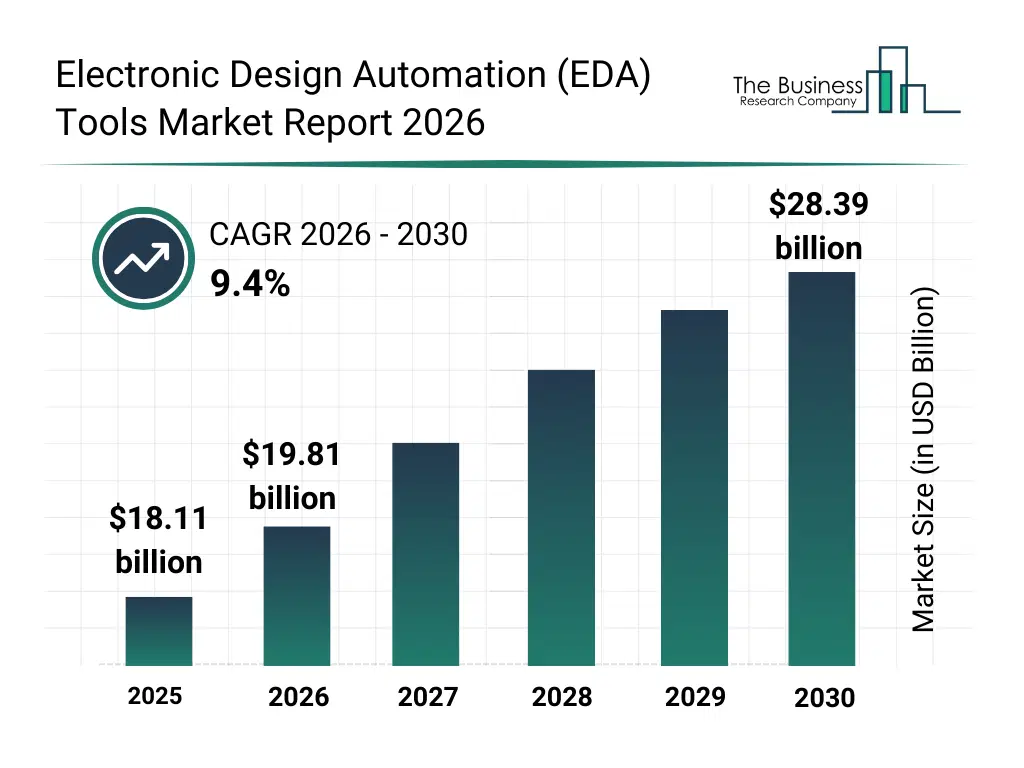
What Is The Electronic Design Automation (EDA) Tools Market Size and Share 2026?
The electronic design automation (eda) tools market size has grown strongly in recent years. It will grow from $18.11 billion in 2025 to $19.81 billion in 2026 at a compound annual growth rate (CAGR) of 9.4%. The growth in the historic period can be attributed to rising adoption of pcb and ic design software, increasing complexity of semiconductor devices, early integration of design automation in automotive and consumer electronics, demand for faster design cycles, need for accurate verification and simulation.What Is The Electronic Design Automation (EDA) Tools Market Growth Forecast?
The electronic design automation (eda) tools market size is expected to see strong growth in the next few years. It will grow to $28.39 billion in 2030 at a compound annual growth rate (CAGR) of 9.4%. The growth in the forecast period can be attributed to growth in cloud-based eda adoption, integration of AI and machine learning in eda tools, increasing semiconductor design complexity, expansion in aerospace and automotive electronics, rising demand for multi-chip module and pcb optimization. Major trends in the forecast period include cloud-based eda solutions, ai-driven design verification, high-performance pcb and mcm design tools, integration of semiconductor ip cores, advanced simulation and thermal analysis.
Global Electronic Design Automation (EDA) Tools Market Segmentation
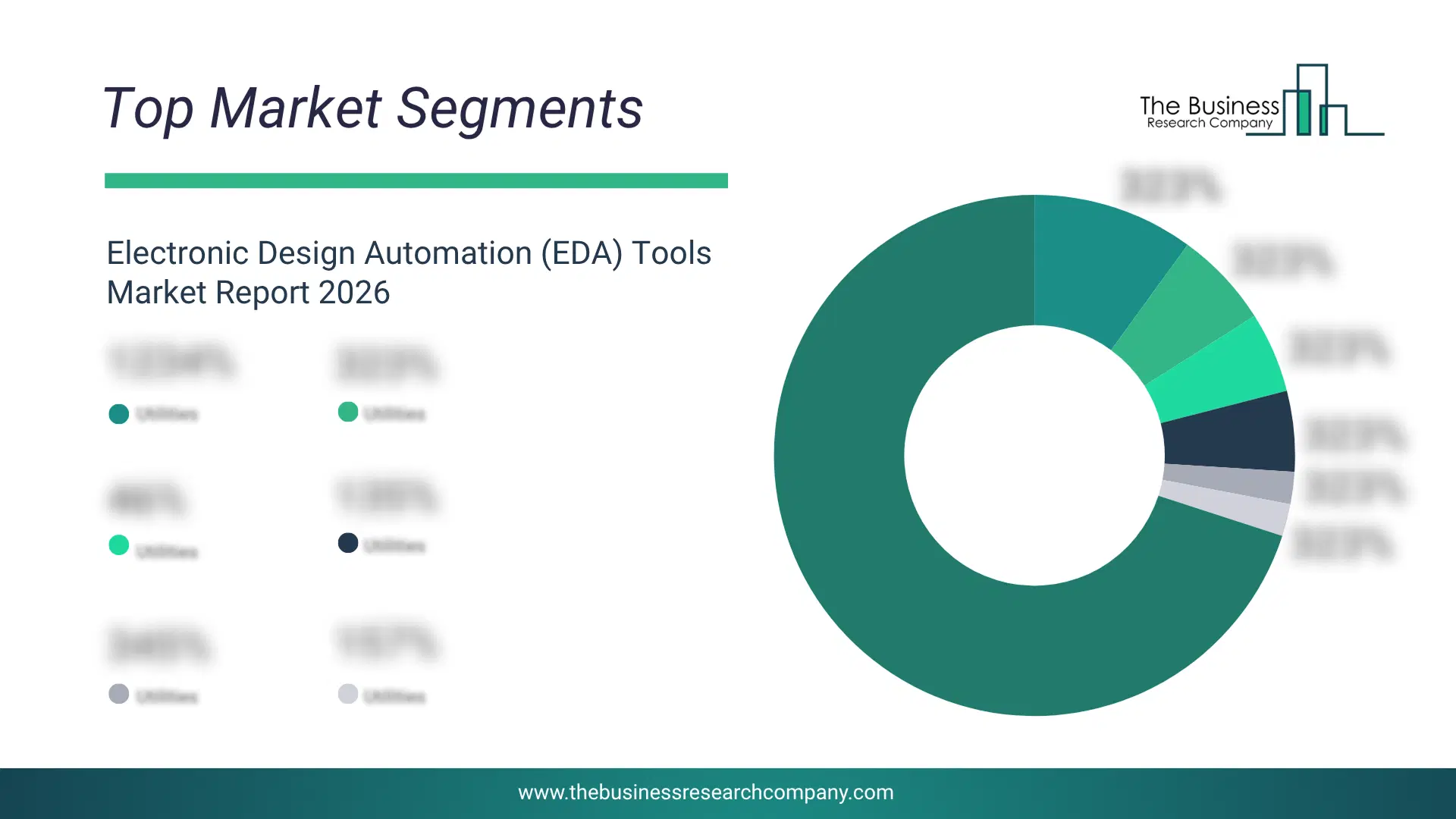
1) By Type: Computer-Aided Engineering (CAE), Integrated Circuit Physical Design And Verification, Printed Circuit Board And Multi-Chip Module (PCB And MCM), Semiconductor Intellectual Property (SIP), Services 2) By Deployment Modes: On-Premises, Cloud-Based 3) By End-Use: Aerospace And Defense, Automotive, Consumer Electronics, Industrial, Healthcare, Other End-Users Subsegments: 1) By Computer-Aided Engineering (CAE): Simulation And Analysis Tools, Signal Integrity Analysis, Thermal Analysis Tools 2) By Integrated Circuit Physical Design And Verification: Place And Route Tools, Design Rule Checking (DRC) Tools, Layout Versus Schematic (LVS) Tools 3) By Printed Circuit Board And Multi-Chip Module (PCB And MCM): PCB Design Software, MCM Design Tools, Schematic Capture Tools 4) By Semiconductor Intellectual Property (SIP): Soft IP Cores, Hard IP Cores, Verification IP 5) By Services: Consulting Services, Training And Support Services, Custom Design ServicesWhat Is The Driver Of The Electronic Design Automation (EDA) Tools Market?
The growing adoption of the internet of things (IoT) is expected to propel the growth of the electronic design automation (EDA) tools market going forward. The internet of things refers to a network of physical objects embedded with sensors, software, and connectivity, enabling them to collect, exchange, and act on data across diverse environments. The rise in IoT adoption is driven by advancements in wireless technology, edge computing, and enterprise digitization, which are expanding IoT deployment across consumer, industrial, and infrastructure sectors. EDA tools support this growth by enabling the design, verification, and testing of increasingly complex and connected electronic systems, such as integrated circuits and system-on-chips. For instance, in February 2023, according to the BuildOps Inc., a US-based software-as-a-service (SaaS) company, the number of IoT-connected devices increased by 28% from 2022 to 2023 and is projected to reach 16 billion by the end of 2023. Therefore, the growing adoption of the internet of things (IoT) is driving the growth of the electronic design automation (EDA) tools industry.Key Players In The Global Electronic Design Automation (EDA) Tools Market
Major companies operating in the electronic design automation (eda) tools market are Siemens AG; Intel Corporation; Arrow company; Agnisys Inc.; Keysight Technologies Inc.; Synopsys Inc.; Cadence Design Systems Inc.; Forte Design Systems; Xilinx Inc.; ANSYS Inc.; Microsemi Corporation; National Instruments Corporation; JEDA Technologies Inc.; Mentor Graphic Corporation; Altair Engineering Inc.; AWR Corporation; Faraday&Future Inc.; Zuken Inc.; Magwel NV; Altium Limited; Silvaco Inc.; Lauterbach GmbH; Computer Simulation Technology AG; EnSilica Limited; Aldec Inc.; EMA Design Automation Inc.; ELECTRO-SYSTEM CO. LTD.; MunEDA GmbH; Intercept Technology Inc.; Labcenter Electronics Ltd.; Pulsic Limited
This chart is for illustrative purposes; the full report includes a detailed competitor analysis and comprehensive overview of the top 10 companies in the market.
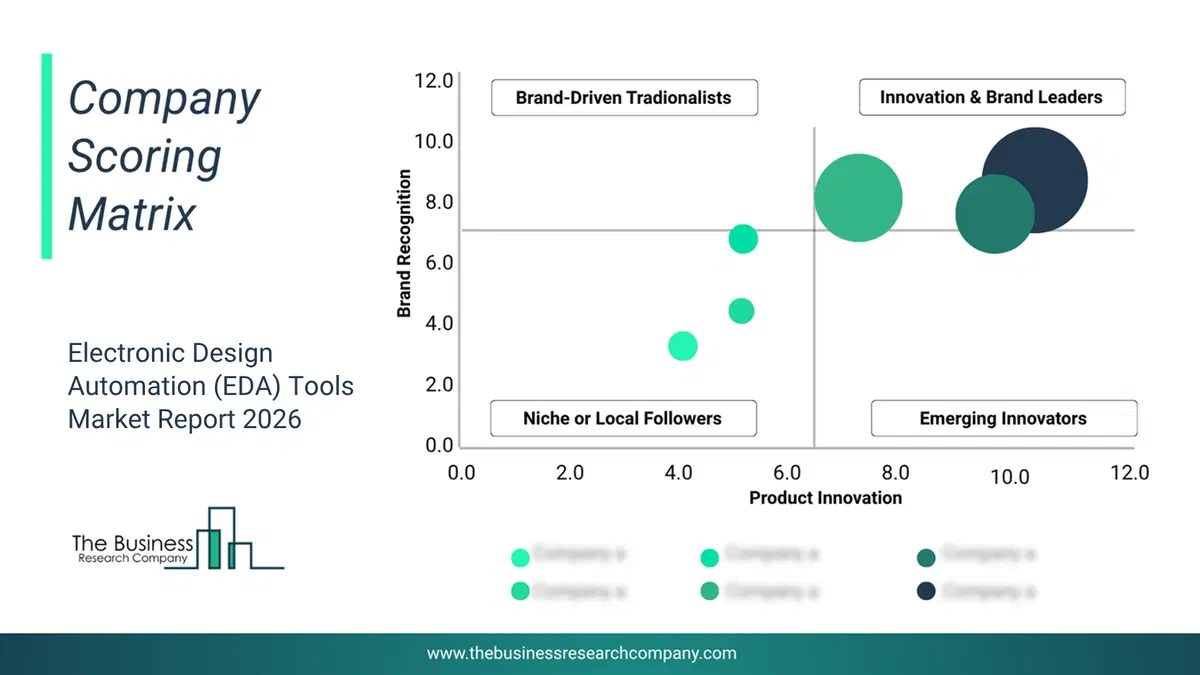
This chart maps companies by product innovation and brand strength, with bubble size indicating relative revenue, helping identify market leaders, challengers, and niche players. This is an illustrative chart; the full report provides a complete and accurate competitive analysis.
Global Electronic Design Automation (EDA) Tools Market Trends and Insights
Major companies operating in the electronic design automation (EDA) tools market are focusing on developing innovative solutions such as artificial intelligence (AI)-driven full-stack EDA suites, to meet the rising demand for faster, more efficient, and automated semiconductor design workflows that reduce time-to-market and improve chip performance. AI-driven EDA tools leverage artificial intelligence (AI) and machine learning algorithms to optimize complex chip design processes, automate verification, and predict design outcomes, offering a significant advancement over traditional EDA tools that rely heavily on manual configuration and iterative simulations. For instance, in May 2023, Synopsys Inc., a US-based semiconductor design software company, launched SynopsysAI, the industry’s first full-stack AI-driven EDA suite for chipmakers. SynopsysAI integrates AI across the entire chip design flow, including logic design, physical design, verification, and testing, enabling designers to accelerate decision-making, optimize power, performance, and area (PPA), and reduce design iterations. Its unique features include AI-based predictive analysis, automated design suggestions, and adaptive learning models that continuously improve with design data, making it suitable for designing advanced semiconductors for applications such as AI accelerators, mobile processors, and high-performance computing chips.What Are Latest Mergers And Acquisitions In The Electronic Design Automation (EDA) Tools Market?
In November 2023, Siemens Digital Industries, a US-based software company, acquired Insight EDA Inc. for an undisclosed amount. Through this acquisition, Siemens will expand its Calibre integrated circuit reliability verification offering, aiming to enable design engineers to more easily add design-specific reliability verification and analysis to integrated circuit (IC) design. This acquisition is expected to accelerate Siemens' circuit reliability verification roadmap and bring Insight EDA's solutions to the global semiconductor ecosystem. Insight EDA Inc. is a US-based electronic design automation (EDA) tool provider that offers calculation, error detection, domain leakage prediction, analytical solutions, and technical services.
Regional Insights
Asia-Pacific was the largest region in the electronic design automation (EDA) tools market in 2025. It is expected to be the fastest-growing region in the forecast period. The regions covered in this market report are Asia-Pacific, South East Asia, Western Europe, Eastern Europe, North America, South America, Middle East, Africa. The countries covered in this market report are Australia, Brazil, China, France, Germany, India, Indonesia, Japan, Taiwan, Russia, South Korea, UK, USA, Canada, Italy, SpainWhat Defines the Electronic Design Automation (EDA) Tools Market?
The electronic design automation (EDA) tools market consists of revenues earned by entities by providing services such as consulting services, integration services, customization services, maintenance and support services, and verification and testing services. The market value includes the value of related goods sold by the service provider or included within the service offering. The electronic design automation (EDA) tools market also includes sales of cadence design systems, high-frequency structure simulators, design-for-test (DFT) tools, physical verification tools, and simulation and modeling tools. Values in this market are ‘factory gate’ values, that is the value of goods sold by the manufacturers or creators of the goods, whether to other entities (including downstream manufacturers, wholesalers, distributors, and retailers) or directly to end customers. The value of goods in this market includes related services sold by the creators of the goods.How is Market Value Defined and Measured?
The market value is defined as the revenues that enterprises gain from the sale of goods and/or services within the specified market and geography through sales, grants, or donations in terms of the currency (in USD unless otherwise specified). The revenues for a specified geography are consumption values that are revenues generated by organizations in the specified geography within the market, irrespective of where they are produced. It does not include revenues from resales along the supply chain, either further along the supply chain or as part of other products.
This chart presents market attractiveness based on a quantitative evaluation of growth, competition, strategic alignment, and risk, offering a clear view of opportunity areas for decision-making. This chart is for illustrative purposes; the full report contains the complete analysis.

This chart highlights the Total Addressable Market (TAM) by estimating the maximum revenue opportunity using an assumption-driven approach, supporting strategic planning and opportunity sizing across markets. The chart is illustrative; the full report provides a more comprehensive analysis.
What Key Data and Analysis Are Included in the Electronic Design Automation (EDA) Tools Market Report 2026?
The electronic design automation (eda) tools market research report is one of a series of new reports from The Business Research Company that provides market statistics, including industry global market size, regional shares, competitors with the market share, detailed market segments, market trends and opportunities, and any further data you may need to thrive in the electronic design automation (eda) tools industry. The market research report delivers a complete perspective of everything you need, with an in-depth analysis of the current and future state of the industry.Electronic Design Automation (EDA) Tools Market Report Forecast Analysis
| Report Attribute | Details |
|---|---|
| Market Size Value In 2026 | $19.81 billion |
| Revenue Forecast In 2030 | $28.39 billion |
| Growth Rate | CAGR of 9.4% from 2026 to 2030 |
| Base Year For Estimation | 2025 |
| Actual Estimates/Historical Data | 2020-2025 |
| Forecast Period | 2026 - 2030 |
| Market Representation | Revenue in USD Billion and CAGR from 2026 to 2030 |
| Segments Covered | Type, Deployment Modes, End-Use |
| Regional Scope | Asia-Pacific, Western Europe, Eastern Europe, North America, South America, Middle East, Africa |
| Country Scope | The Countries Covered In This Market Report Are Australia, Brazil, China, France, Germany, India, Indonesia, Japan, Taiwan, Russia, South Korea, Uk, Usa, Canada, Italy, Spain. |
| Key Companies Profiled | Siemens AG, Intel Corporation, Arrow company, Agnisys Inc., Keysight Technologies Inc., Synopsys Inc., Cadence Design Systems Inc., Forte Design Systems, Xilinx Inc., ANSYS Inc., Microsemi Corporation, National Instruments Corporation, JEDA Technologies Inc., Mentor Graphic Corporation, Altair Engineering Inc., AWR Corporation, Faraday&Future Inc., Zuken Inc., Magwel NV, Altium Limited, Silvaco Inc., Lauterbach GmbH, Computer Simulation Technology AG, EnSilica Limited, Aldec Inc., EMA Design Automation Inc., ELECTRO-SYSTEM CO. LTD., MunEDA GmbH, Intercept Technology Inc., Labcenter Electronics Ltd., Pulsic Limited |
| Customization Scope | Request for Customization |
| Pricing And Purchase Options | Explore Purchase Options |