

Embedded Finance Market Report 2026
Global Outlook – By Type (Embedded Payment, Embedded Lending, Embedded Investment, Embedded Insurance, Embedded Banking), By Business Model (Business-To-Business, Business-To-Consumer, Business-To-Business-To-Business, Business-To-Business-To-Consumer), By End-User (Retail, Healthcare, Logistics, Manufacturing, Travel And Entertainment, Other End-users) – Market Size, Trends, Strategies, and Forecast to 2030
Embedded Finance Market Overview
• Embedded Finance market size has reached to $94.42 billion in 2025 • Expected to grow to $250.95 billion in 2030 at a compound annual growth rate (CAGR) of 21.5% • Growth Driver: Increasing Popularity Of Online Payment Services Fueling The Growth Of The Market Due To Convenience Speed And Security • Market Trend: Comprehensive Embedded Finance Platform For Seamless Integration Of Financial Services • North America was the largest region in 2025 and Asia-Pacific is the fastest growing region.Market Gains By 2030 – Top Opportunities By Segment
Market Gain identifies the most promising market opportunities by highlighting the segments or products expected to generate the highest incremental revenue growth over the next five years.
What Is Covered Under Embedded Finance Market?
Embedded finance refers to the seamless integration of financial services directly into non-financial products or platforms, allowing users to access financial capabilities within their everyday interactions. The main purpose is to enhance user experience, increase convenience, and unlock new revenue streams for non-financial companies. It enables businesses to offer services such as payments, loans, insurance, or investment options without needing to be a licensed financial institution. The main types of embedded finance are embedded payment, embedded lending, embedded investment, embedded insurance, and embedded banking. Embedded payment refers to the integration of payment processing capabilities directly into a software application or digital platform, allowing users to make transactions without leaving the platform. This model supports various business formats, such as business-to-business, business-to-consumer, business-to-business, and business-to-consumer, and serves a wide range of end users, including retail, healthcare, logistics, manufacturing, travel, entertainment, and others.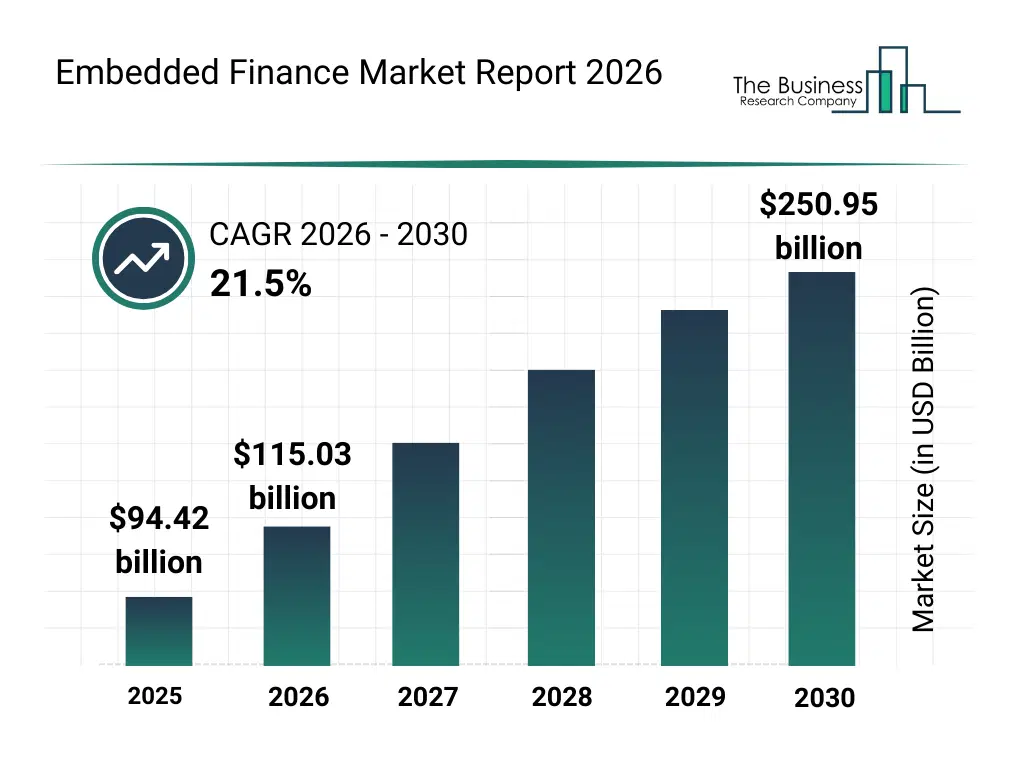
What Is The Embedded Finance Market Size and Share 2026?
The embedded finance market size has grown exponentially in recent years. It will grow from $94.42 billion in 2025 to $115.03 billion in 2026 at a compound annual growth rate (CAGR) of 21.8%. The growth in the historic period can be attributed to growth of digital commerce ecosystems, expansion of platform-based business models, rising consumer preference for frictionless payments, increased collaboration between fintechs and enterprises, availability of open banking frameworks.What Is The Embedded Finance Market Growth Forecast?
The embedded finance market size is expected to see exponential growth in the next few years. It will grow to $250.95 billion in 2030 at a compound annual growth rate (CAGR) of 21.5%. The growth in the forecast period can be attributed to expansion of embedded finance across new industry verticals, increasing regulatory clarity for non-bank financial services, rising adoption of embedded investment products, growth of ai-driven credit assessment models, increasing demand for contextual financial services. Major trends in the forecast period include expanding integration of payments into non-financial platforms, rising adoption of buy now pay later solutions, growing use of api-based financial services, increased deployment of embedded lending products, enhanced focus on seamless user journeys.
Global Embedded Finance Market Segmentation
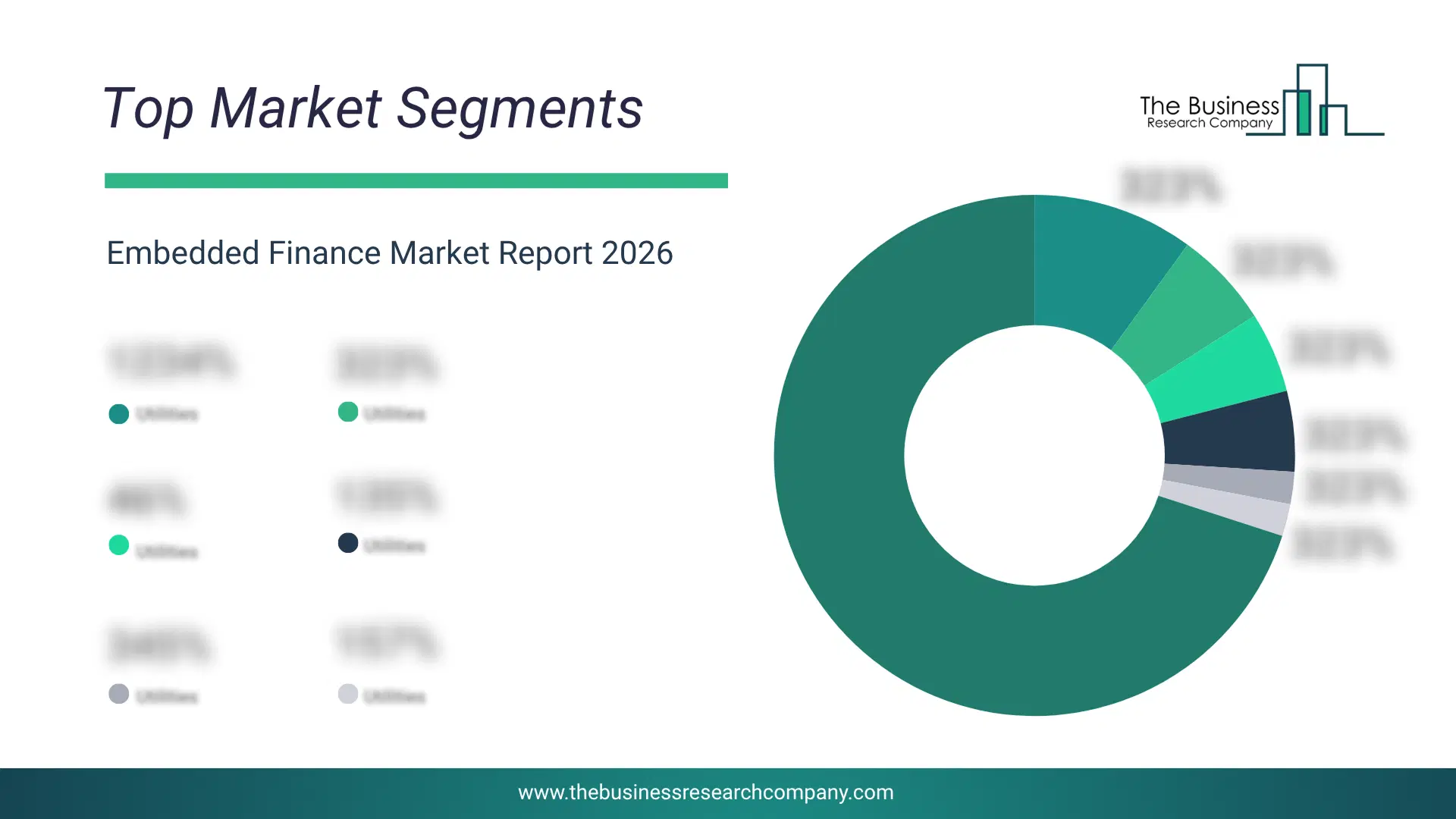
1) By Type: Embedded Payment, Embedded Lending, Embedded Investment, Embedded Insurance, Embedded Banking 2) By Business Model: Business-To-Business, Business-To-Consumer, Business-To-Business-To-Business, Business-To-Business-To-Consumer 3) By End-User: Retail, Healthcare, Logistics, Manufacturing, Travel And Entertainment, Other End-users Subsegments: 1) By Embedded Payment: In-App Payments, Checkout Financing, Buy Now, Pay Later, Payment Application Programming Interfaces For E-commerce, Point-Of-Sale Financing 2) By Embedded Lending: Consumer Loans, Small And Medium-Sized Enterprises Lending, Paycheck Advance And Salary Loans, Student Loans Integration, Invoice Financing 3) By Embedded Investment: Robo-Advisory Services, Stock And Exchange-Traded Fund Trading, Crypto Investment Platforms, Micro-Investing, Retirement Planning Tools 4) By Embedded Insurance: Life Insurance, Health Insurance, Auto Insurance, Travel Insurance, Product Warranty And Protection Plans 5) By Embedded Banking: Checking And Savings Account Integration, Debit And Prepaid Card Issuance, Direct Deposit Services, Mobile Banking Tools, Expense Tracking And Budgeting Features The top segments in the embedded finance market will be: • Embedded Payment will reach $81.64 Billion by 2030. • Embedded Lending will reach $65.62 Billion by 2030. • Embedded Insurance will reach $42.08 Billion by 2030. • Embedded Banking will reach $39.49 Billion by 2030. • Embedded Investment will reach $28.89 Billion by 2030.What Is The Driver Of The Embedded Finance Market?
The increasing popularity of online payment services is expected to propel the growth of the embedded finance market going forward. Online payment services refer to digital platforms or systems that enable individuals and businesses to send and receive money over the internet securely and efficiently. The increasing popularity of online payment services is primarily due to their convenience, speed, and ability to facilitate secure transactions anytime and anywhere. Embedded finance streamlines online payment services by integrating financial functionalities directly into digital platforms, enhancing the user experience. It simplifies transactions, reduces friction, and offers seamless payment solutions, making it easier for businesses to manage and customers to make purchases efficiently. For instance, in July 2024, according to UK Finance, a UK-based financial services company, 62% of UK adults used online banking in 2023, while 60% accessed banking services through mobile apps. Therefore, the increasing popularity of online payment services is driving the growth of the embedded finance industry.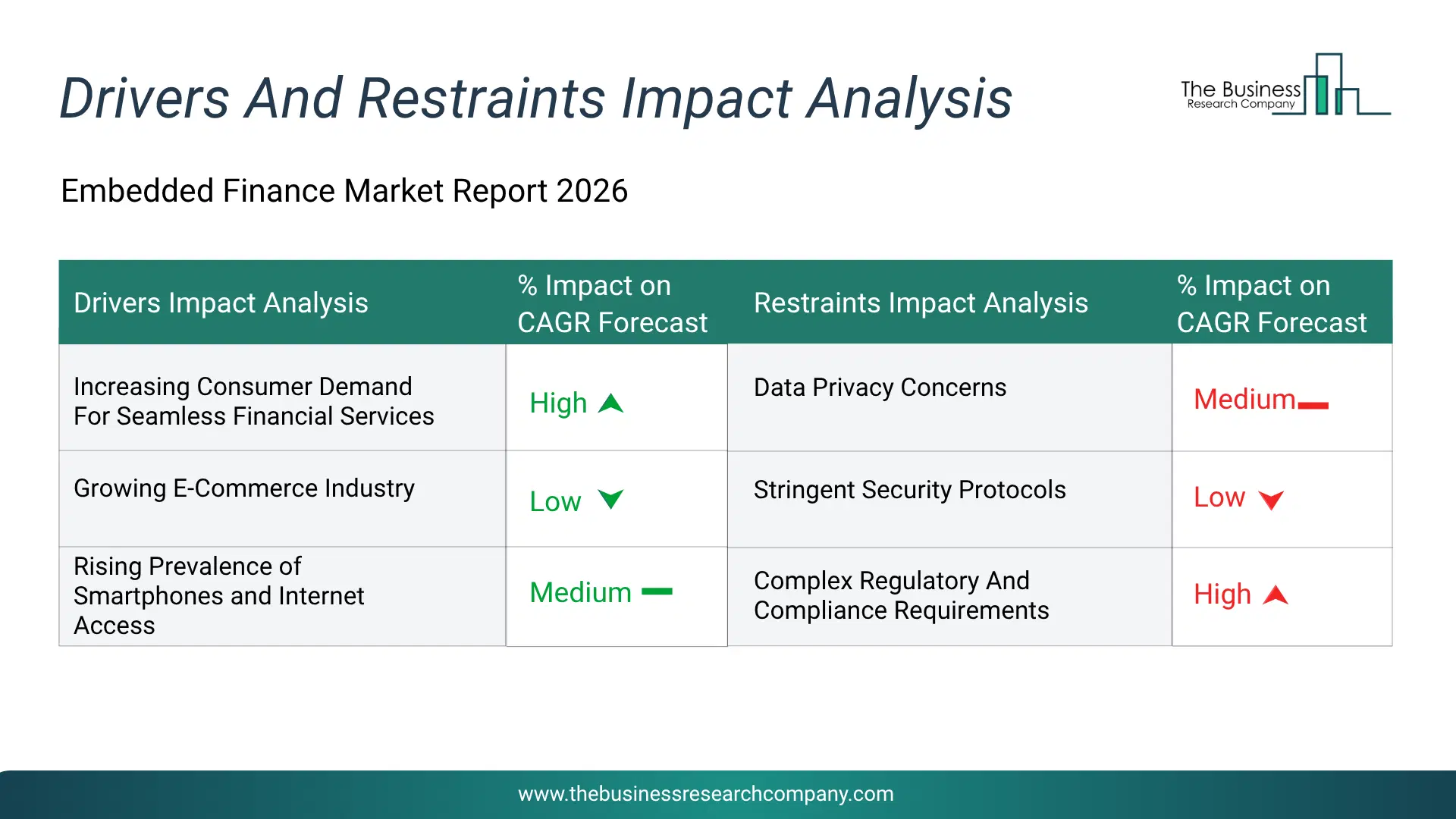
Infographic Chart Showing Key Market Drivers Analysis And Restraints For Embedded Finance Market
The chart presents an impact analysis of key drivers and restraints, quantifying their relative influence on the market's growth rate and helping assess the balance between growth enablers and limiting factors. This chart offers a high-level perspective; the full report contains more detailed insights.
How Will The Drivers Impact Growth In The Global Embedded Finance Market?
• Increasing Consumer Demand For Seamless Financial Services (High) – During the forecast period, the increasing consumer demand for seamless financial services is expected to become a key growth driver for the embedded finance market by 2030. Increasing consumer demand for seamless financial services is a major driver of the embedded finance market because customers increasingly expect financial products to be available instantly within the digital platforms they already use. Integrating payments, lending, insurance, and banking into non-financial applications eliminates the need to switch between multiple service providers, creating a faster and more convenient experience. This improves customer satisfaction while encouraging higher usage of digital platforms. Businesses benefit from stronger customer engagement, greater retention, and additional revenue streams through integrated financial offerings. The growing preference for frictionless digital experiences is prompting companies across industries to embed financial capabilities into their ecosystems. • Growing E-Commerce Industry (Low) – During the forecast period, the growing e-commerce industry is expected to emerge as a major factor driving the expansion of the embedded finance market by 2030. Growing e-commerce industry is significantly driving the embedded finance market as online retailers increasingly integrate financial services directly into their shopping platforms. Features such as embedded payments, buy now pay later (BNPL), digital wallets, and instant financing simplify the purchasing process and reduce transaction friction. These services enhance customer convenience while increasing conversion rates and average order values for merchants. E-commerce companies also strengthen customer loyalty by offering personalized financial solutions within the purchasing journey. The continuous rise in online shopping worldwide is expanding the demand for integrated financial experiences. • Rising Prevalence of Smartphones and Internet Access (Medium) – During the forecast period, the rising prevalence of smartphones and internet access is expected to act as a key growth catalyst for the embedded finance market by 2030. Rising prevalence of smartphones and internet access is accelerating the embedded finance market by enabling consumers to access digital financial services anytime and anywhere. Mobile applications and internet-connected platforms allow businesses to integrate payments, lending, insurance, and banking services directly into everyday digital experiences. Greater smartphone penetration increases the adoption of digital commerce, mobile wallets, and app-based financial transactions. Improved internet connectivity also expands financial inclusion by reaching previously underserved populations. Businesses can deliver personalized and real-time financial solutions through connected digital ecosystems. This widespread digital accessibility is fueling the rapid expansion and adoption of embedded finance solutions globally.How Will The Restraints Impact Growth In The Global Embedded Finance Market?
• Data Privacy Concerns (High) – During the forecast period, the data privacy concerns act as a significant restraint on the embedded finance market because financial transactions involve the collection, storage, and processing of highly sensitive customer information. Consumers are becoming increasingly aware of how their personal and financial data is used, making them more cautious about adopting embedded financial services. Businesses must invest heavily in data protection measures and comply with evolving privacy regulations, which increases operational costs and implementation complexity. Any data breach or misuse of customer information can damage brand reputation and reduce consumer trust. These concerns also slow partnerships between financial institutions and non-financial platforms due to strict compliance requirements. As a result, growing data privacy concerns limit the pace of adoption and expansion of the embedded finance market. • Stringent Security Protocols (Low) – During the forecast period, the stringent security protocols restrain the embedded finance market by increasing the complexity and cost of deploying integrated financial solutions. Providers must implement advanced authentication methods, encryption technologies, fraud detection systems, and continuous security monitoring to protect financial transactions and customer data. Meeting these security standards often requires significant investments in technology, infrastructure, and regulatory compliance. The lengthy implementation and certification processes can delay product launches and reduce operational flexibility. Smaller businesses and startups may face greater challenges in meeting these security requirements due to limited resources. Consequently, stringent security protocols can slow innovation and hinder the widespread adoption of embedded finance solutions. • Complex Regulatory And Compliance Requirements (Medium) – During the forecast period, the complex regulatory and compliance requirements restrain the embedded finance market because providers must comply with diverse financial regulations, licensing requirements, anti-money laundering (AML) standards, know your customer (KYC) procedures, and consumer protection laws across different jurisdictions. The regulatory landscape varies significantly between countries, making cross-border expansion and service integration more challenging. Organizations must continuously update their compliance frameworks to address evolving legal requirements, increasing operational costs and administrative complexity. Lengthy approval processes and regulatory uncertainty can delay product launches and partnership development. Consequently, complex compliance obligations limit the speed of innovation and expansion in the embedded finance market.Key Players In The Global Embedded Finance Market
Major companies operating in the embedded finance market are State Bank of India, eBay Inc., Adyen N.V., Cybrid Technology Inc., Stripe Inc., Finastra Group Holdings Limited, Green Dot Corporation, Affirm Holdings Inc., Paytm, Thoughtworks, Marqeta Inc., Q2 Holdings Inc., Xendit Inc., Zopa Bank Limited, Plaid Inc., Qover SA/NV, Transcard LLC, Lendflow Inc., Walnut Insurance Inc., SoFi Technologies Inc.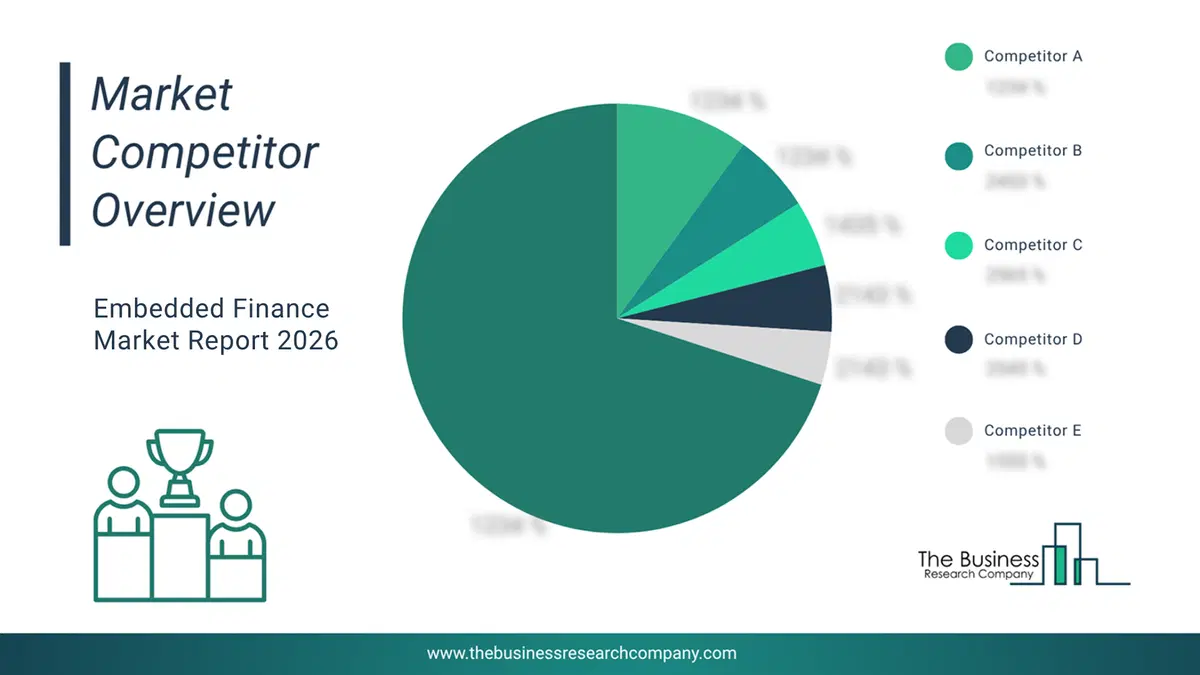
This chart is for illustrative purposes; the full report includes a detailed competitor analysis and comprehensive overview of the top 10 companies in the market.
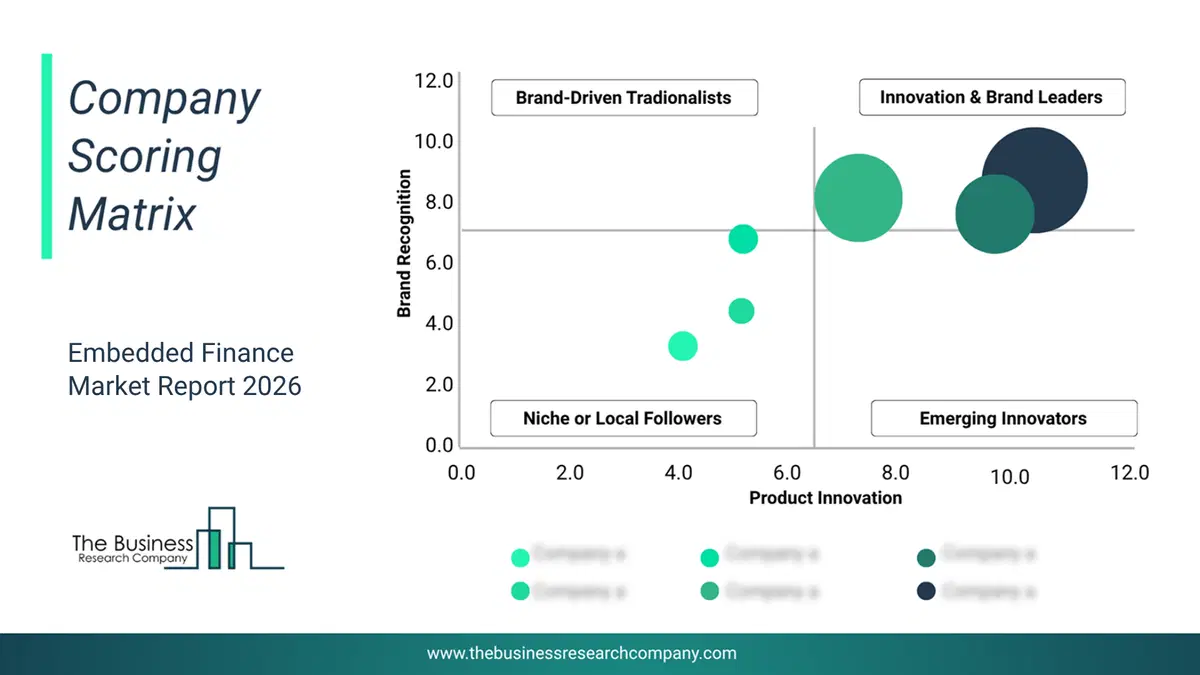
This chart maps companies by product innovation and brand strength, with bubble size indicating relative revenue, helping identify market leaders, challengers, and niche players. This is an illustrative chart; the full report provides a complete and accurate competitive analysis.
Global Embedded Finance Market Trends and Insights
Major companies operating in the embedded finance market are focusing on developing innovative platforms, such as comprehensive fintech platforms, to streamline payment solutions and enhance customer experience. Comprehensive fintech platforms refer to integrated digital platforms that offer a wide range of financial services, including payments, lending, insurance, investment management, and banking, all within a single, cohesive system. For instance, in May 2024, Fidelity Information Services (FIS), a US-based financial services company, launched Atelio by FIS, designed for use by financial institutions, businesses, and software developers. These platforms offer a comprehensive embedded finance platform with easy-to-integrate application programming interfaces (APIs), enabling businesses and financial institutions to embed services such as deposit collection, money movement, card issuance, lending, and know your customer (KYC) onboarding directly into their products. The platform excels in offering robust security, regulatory compliance, and developer-friendly tools, allowing rapid deployment of customizable financial solutions while leveraging FIS’s extensive technology and expertise.What Are Latest Mergers And Acquisitions In The Embedded Finance Market?
In June 2023, Bnkbl Ltd., a UK-based banking-as-a-service (BaaS) provider, acquired Arex Markets for an undisclosed amount. With this acquisition, Bnkbl aims to enhance its embedded finance offerings by integrating advanced credit and working capital solutions to provide a comprehensive, pan-European banking platform for neobanks, fintechs, and multinational brands. Arex Markets is a Spain-based fintech company that specializes in embedded finance, particularly focusing on invoice financing solutions for small and medium-sized enterprises.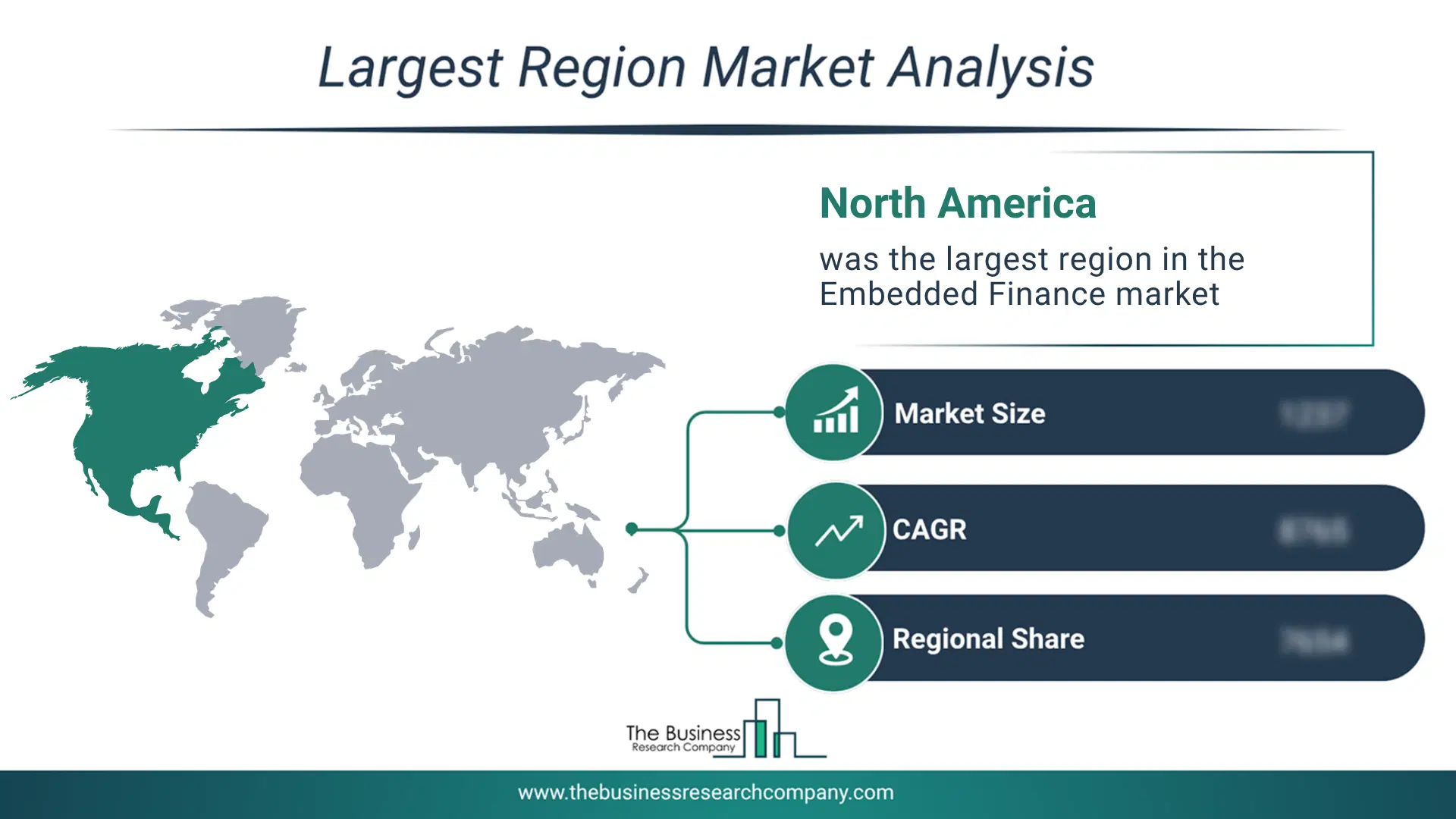
Regional Outlook
North America was the largest region in the embedded finance market in 2025. Asia-Pacific is expected to be the fastest-growing region in the forecast period. The regions covered in this market report are Asia-Pacific, South East Asia, Western Europe, Eastern Europe, North America, South America, Middle East, Africa. The countries covered in this market report are Australia, Brazil, China, France, Germany, India, Indonesia, Japan, Taiwan, Russia, South Korea, UK, USA, Canada, Italy, Spain.What Defines the Embedded Finance Market?
The embedded finance market consists of revenues earned by entities by providing services such as buy now pay later, card issuance, identity verification, and fraud detection. The market value includes the value of related goods sold by the service provider or included within the service offering. The embedded finance market also includes sales of smart POS terminals, smartwatches, and vending machines. Values in this market are ‘factory gate’ values, that is, the value of goods sold by the manufacturers or creators of the goods, whether to other entities (including downstream manufacturers, wholesalers, distributors, and retailers) or directly to end customers. The value of goods in this market includes related services sold by the creators of the goods.How is Market Value Defined and Measured?
The market value is defined as the revenues that enterprises gain from the sale of goods and/or services within the specified market and geography through sales, grants, or donations in terms of the currency (in USD unless otherwise specified). The revenues for a specified geography are consumption values that are revenues generated by organizations in the specified geography within the market, irrespective of where they are produced. It does not include revenues from resales along the supply chain, either further along the supply chain or as part of other products.
This chart presents market attractiveness based on a quantitative evaluation of growth, competition, strategic alignment, and risk, offering a clear view of opportunity areas for decision-making. This chart is for illustrative purposes; the full report contains the complete analysis.

This chart highlights the Total Addressable Market (TAM) by estimating the maximum revenue opportunity using an assumption-driven approach, supporting strategic planning and opportunity sizing across markets. The chart is illustrative; the full report provides a more comprehensive analysis.
What Key Data and Analysis Are Included in the Embedded Finance Market Report 2026?
The embedded finance market research report is one of a series of new reports from The Business Research Company that provides market statistics, including Market Report 2026?global market size, regional shares, competitors with the market share, detailed market segments, market trends and opportunities, and any further data you may need to thrive in the embedded finance Market Report 2026? The market research report delivers a complete perspective of everything you need, with an in-depth analysis of the current and future state of the Market Report 2026?Embedded Finance Market Report Forecast Analysis
| Report Attribute | Details |
|---|---|
| Market Size Value In 2026 | $115.03 billion |
| Revenue Forecast In 2030 | $250.95 billion |
| Growth Rate | CAGR of 21.8% from 2026 to 2030 |
| Base Year For Estimation | 2025 |
| Actual Estimates/Historical Data | 2020-2025 |
| Forecast Period | 2026 - 2030 |
| Market Representation | Revenue in USD Billion and CAGR from 2026 to 2030 |
| Segments Covered | Type, Business Model, End-User |
| Regional Scope | Asia-Pacific, Western Europe, Eastern Europe, North America, South America, Middle East, Africa |
| Country Scope | The countries covered in the report are Australia, Brazil, China, France, Germany, India, ... |
| Key Companies Profiled | State Bank of India, eBay Inc., Adyen N.V., Cybrid Technology Inc., Stripe Inc., Finastra Group Holdings Limited, Green Dot Corporation, Affirm Holdings Inc., Paytm, Thoughtworks, Marqeta Inc., Q2 Holdings Inc., Xendit Inc., Zopa Bank Limited, Plaid Inc., Qover SA/NV, Transcard LLC, Lendflow Inc., Walnut Insurance Inc., SoFi Technologies Inc. |
| Customization Scope | Request for Customization |
| Pricing And Purchase Options | Explore Purchase Options |