
Energy Chemicals Market Report 2026
Global Outlook – By Type (Fuel Additives, Oilfield Chemicals, Refining Chemicals, Power Generation Chemicals, Industrial And Process Solvents), By Application (Fuel Production and Blending, Oil & Gas Exploration and Production (E&P), Refining and Petrochemical Processing, Power Plant Operations (Cooling, Water Treatment, Emissions Control), Energy Storage and Transmission Systems, Other Energy-Related Applications), By End-Use Industry (Oil and Gas, Power Generation, Petrochemicals and Refineries, Renewable Energy, Other End-Use Industries) – Market Size, Trends, Strategies, and Forecast to 2030
Energy Chemicals Market Overview
• Energy Chemicals market size has reached to $132.88 billion in 2025 • Expected to grow to $179.77 billion in 2030 at a compound annual growth rate (CAGR) of 6.2% • Growth Driver: Meeting Rising Global Energy Demands With Energy Chemicals • Market Trend: New Energy Blue Launches New Energy Chemicals To Drive Sustainable Energy Solutions • North America was the largest region in 2025 and Asia-Pacific is the fastest growing region.What Is Covered Under Energy Chemicals Market?
Energy chemicals are substances used in the production, processing, and distribution of energy resources such as oil, natural gas, and renewable energy sources. Energy chemicals are formulated to enhance or manipulate energy levels within various systems. These chemicals play crucial roles in a wide array of industries and applications, from fuel production to pharmaceuticals. The main types of energy chemicals are polymers, fuel additives, and solvents. Polymer energy chemicals refer to a class of polymers that are specifically designed and engineered for applications in energy-related devices and systems. They are used for petrochemicals, pharmaceutical, packaging products, cleaning and detergent products, automotive, and other applications by various end-use industries such as oil and gas, power generation, and construction.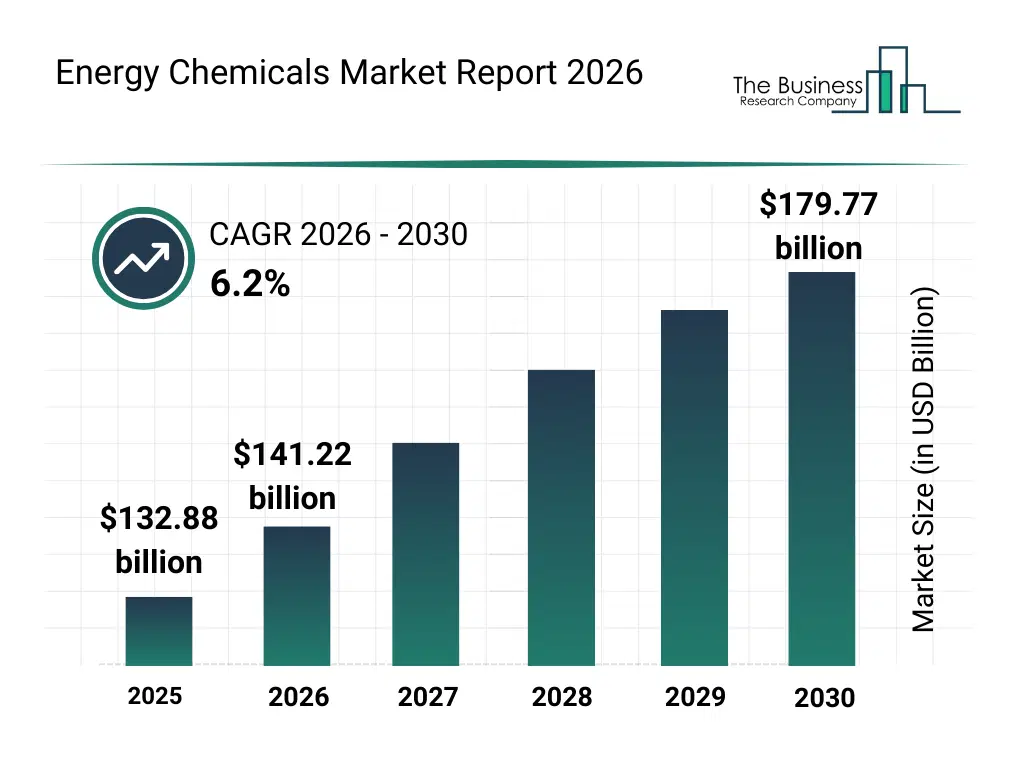
What Is The Energy Chemicals Market Size and Share 2026?
The energy chemicals market size has grown strongly in recent years. It will grow from $132.88 billion in 2025 to $141.22 billion in 2026 at a compound annual growth rate (CAGR) of 6.3%. The growth in the historic period can be attributed to growth in oil and gas exploration, expansion of petrochemical production, increased use of fuel additives, rising power generation capacity, availability of chemical processing technologies.What Is The Energy Chemicals Market Growth Forecast?
The energy chemicals market size is expected to see strong growth in the next few years. It will grow to $179.77 billion in 2030 at a compound annual growth rate (CAGR) of 6.2%. The growth in the forecast period can be attributed to growth of renewable energy projects, increasing demand for cleaner fuels, expansion of electric mobility infrastructure, stricter energy efficiency regulations, advancements in energy chemical formulations. Major trends in the forecast period include increasing use of chemicals in oil and gas processing, rising demand for fuel additives to improve efficiency, growing adoption in renewable energy systems, expansion of specialty polymers for energy applications, increasing focus on performance enhancement chemicals.
Global Energy Chemicals Market Segmentation
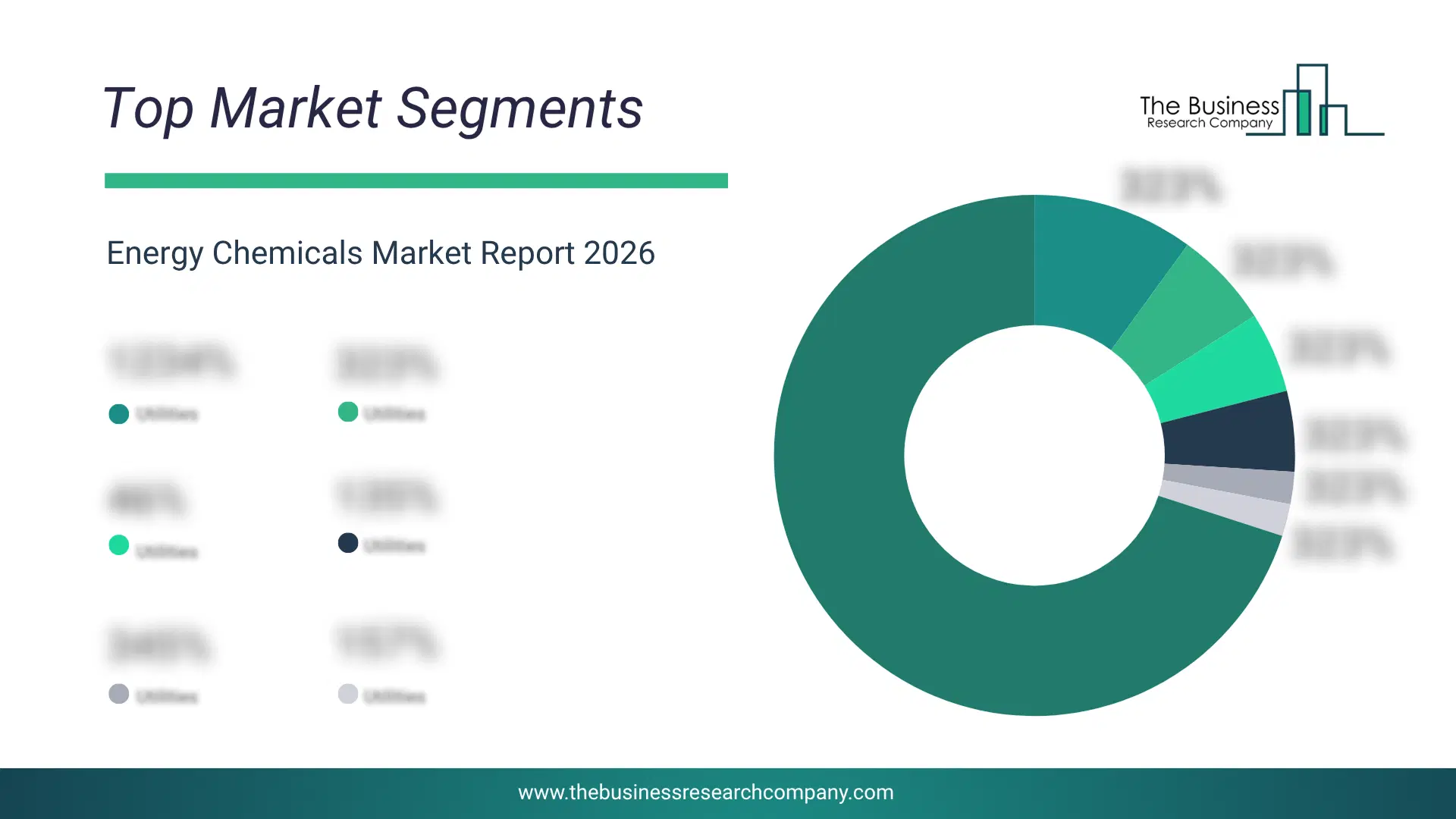
1) By Type: Fuel Additives, Oilfield Chemicals, Refining Chemicals, Power Generation Chemicals, Industrial And Process Solvents 2) By Application: Fuel Production and Blending, Oil & Gas Exploration and Production (E&P), Refining and Petrochemical Processing, Power Plant Operations (Cooling, Water Treatment, Emissions Control), Energy Storage and Transmission Systems, Other Energy-Related Applications 3) By End-Use Industry: Oil and Gas, Power Generation, Petrochemicals and Refineries, Renewable Energy, Other End-Use Industries Subsegments: 1) By Fuel Additives: Octane Improvers, Cetane Improvers, Deposit Control Additives, Antioxidants, Corrosion Inhibitors 2) By Oilfield Chemicals: Drilling Fluids and Additives, Production Chemicals, Enhanced Oil Recovery (EOR) Chemicals, Flow Assurance Chemicals 3) By Refining Chemicals: Catalysts, Hydrogenation Chemicals, Fouling and Corrosion Inhibitors, Process Solvents 4) By Power Generation Chemicals: Boiler Water Treatment Chemicals, Cooling Water Treatment Chemicals, Flue Gas Treatment Chemicals 5) By Industrial And Process Solvents: Hydrocarbon Solvents, Oxygenated Solvents, Specialty Energy SolventsWhat Is The Driver Of The Energy Chemicals Market?
The rising global energy consumption is expected to propel the growth of the energy chemicals market going forward. The adoption of technology, including electronic devices, electric vehicles, and smart appliances, contributes to increased energy consumption. Energy chemicals, such as fuel additives and catalysts, can help to improve energy consumption by enhancing the efficiency of energy production processes, reducing emissions, and improving fuel economy in vehicles and industrial applications. For instance, in April 2024, according to the Department of Climate Change, Energy, the Environment and Water, an Australia-based government administration, Australia's total electricity generation remained stable in 2023, reaching approximately 273,106 gigawatt hours (GWh). Renewable energy sources accounted for an estimated 95,963 GWh, representing 35% of the total generation, an increase of 3 percentage points compared to 2022. Therefore, the rising energy consumption is driving the growth of the energy chemicals industry.Key Players In The Global Energy Chemicals Market
Major companies operating in the energy chemicals market are Exxon Mobil Corporation, Royal Dutch Shell PLC, TotalEnergies SE, Chevron Corporation, Eni S.p.A., Reliance Industries Limited, BASF SE, Repsol S.A., Saudi Basic Industries Corporation, LyondellBasell Industries N.V., Occidental Petroleum Corporation, Mitsubishi Chemical Holdings Corporation, Linde plc, Schlumberger Limited, Baker Hughes Company, Sasol Limited, Ecolab Inc., Air Products and Chemicals Inc., Eastman Chemical Company, Clariant AG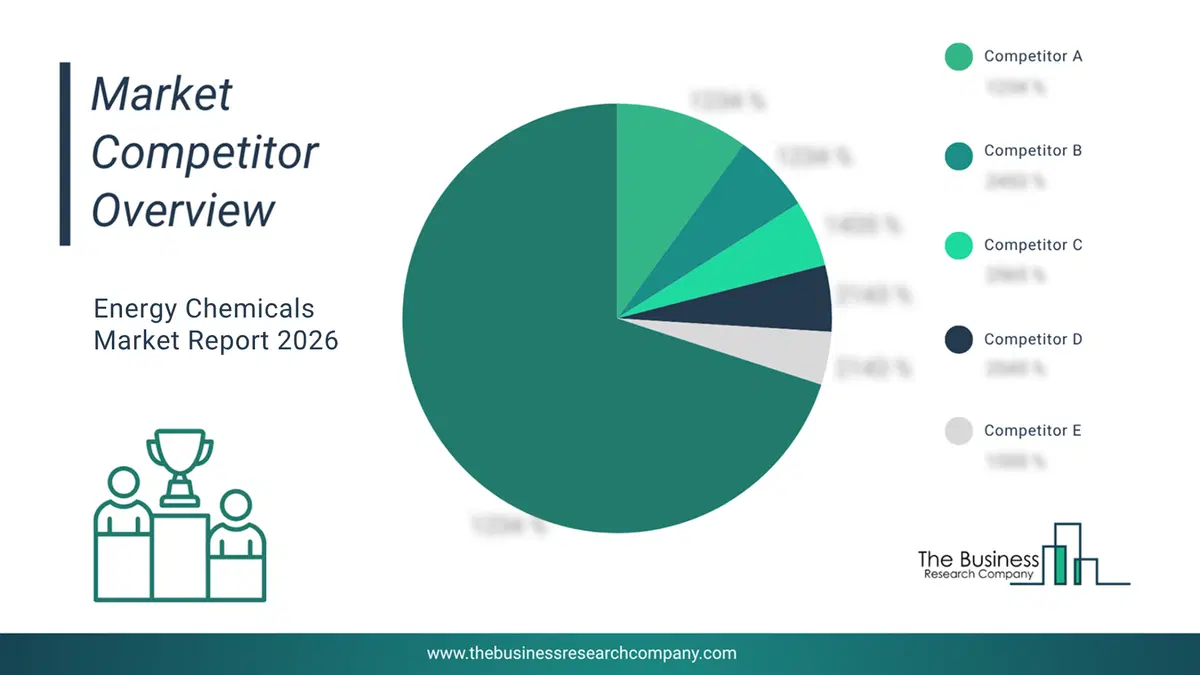
This chart is for illustrative purposes; the full report includes a detailed competitor analysis and comprehensive overview of the top 10 companies in the market.
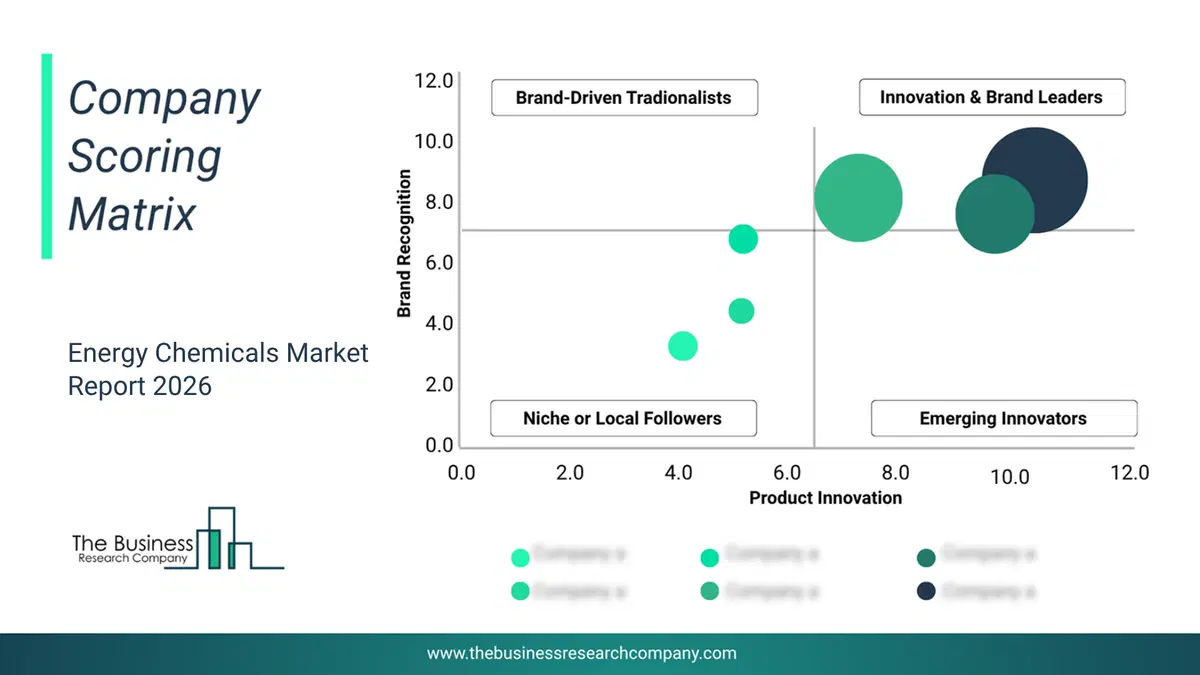
This chart maps companies by product innovation and brand strength, with bubble size indicating relative revenue, helping identify market leaders, challengers, and niche players. This is an illustrative chart; the full report provides a complete and accurate competitive analysis.
Global Energy Chemicals Market Trends and Insights
Major companies operating in the energy chemicals market are focusing on developing sustainable and low-carbon energy solutions, such as biobased ethylene and sustainable aviation fuel (SAF), to reduce greenhouse gas emissions and meet growing market demands. Biobased ethylene and sustainable aviation fuel (SAF) are renewable alternatives derived from biomass that contribute to reducing greenhouse gas emissions in their respective industries. For instance, in March 2024, New Energy Blue LLC, a US-based company focused on developing and commercializing sustainable and low-carbon energy solutions, launched a new subsidiary, New Energy Chemicals, to produce American-sourced biobased ethylene and sustainable aviation fuel (SAF). In its first phase, the subsidiary will focus on producing biobased ethylene to support Dow's low-carbon plastic production. The second phase will expand operations at the Port Lavaca, Texas, facility to produce SAF from agricultural waste.What Are Latest Mergers And Acquisitions In The Energy Chemicals Market?
In July 2023, Saudi Arabian Oil Company, a Saudi Arabia-based oil company, acquired Rongsheng Petrochemical Co. Ltd. for $3.4 billion. This strategic investment positions Aramco to capitalize on the growing demand for petrochemicals in the region while improving its competitive advantage in the global market. Rongsheng Petrochemical Co. Ltd. is a China-based company specializes in the production of petrochemical products, including refined oil and various chemical materials.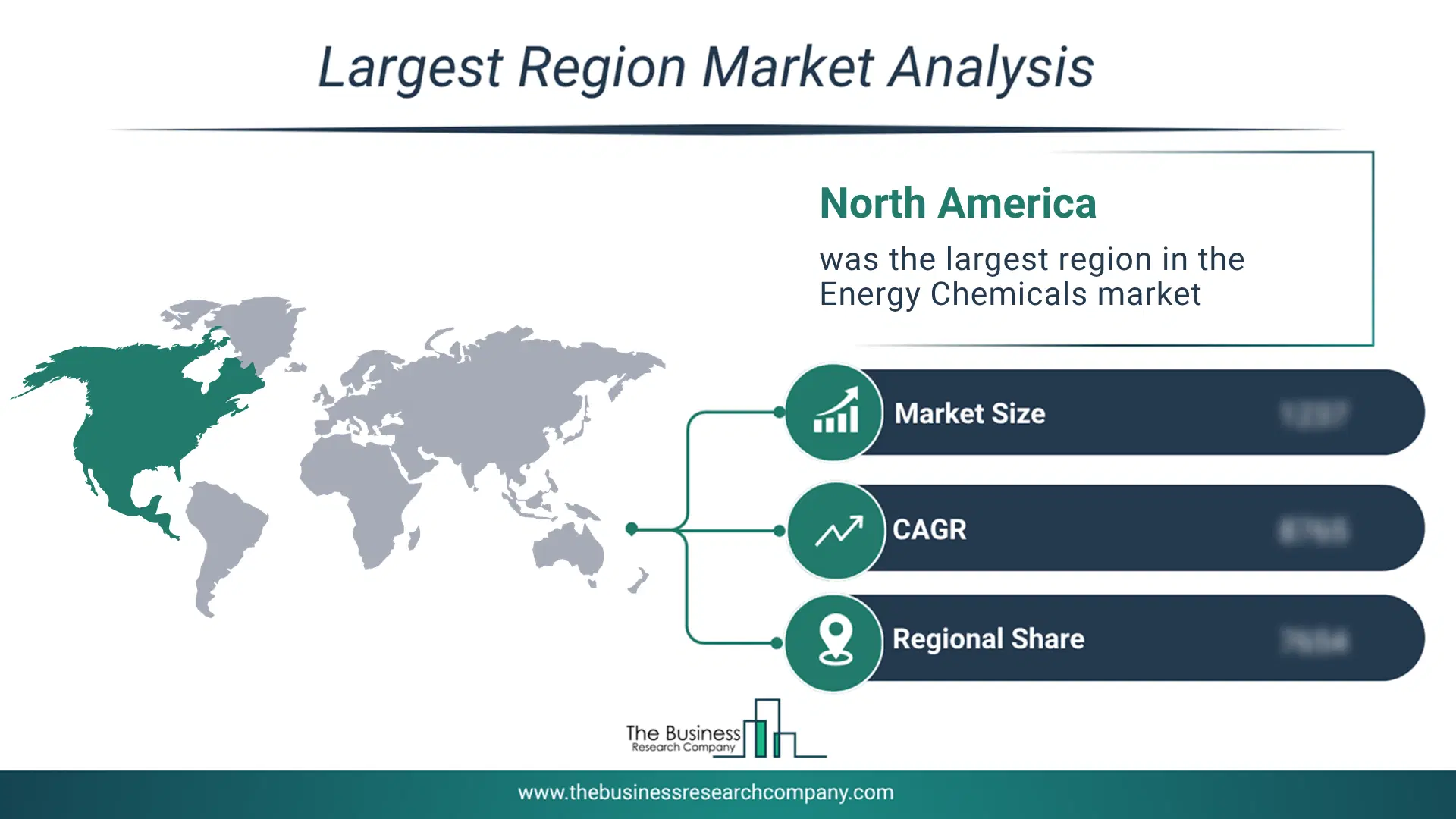
Regional Insights
North America was the largest region in the energy chemicals market in 2025. Asia-Pacific is expected to be the fastest-growing region in the forecast period. The regions covered in this market report are Asia-Pacific, South East Asia, Western Europe, Eastern Europe, North America, South America, Middle East, Africa The countries covered in this market report are Australia, Brazil, China, France, Germany, India, Indonesia, Japan, Taiwan, Russia, South Korea, UK, USA, Canada, Italy, SpainWhat Defines the Energy Chemicals Market?
The energy chemicals market consists of sales of drilling chemicals, refinery chemicals, catalysts, water treatment chemicals, and nuclear chemicals. Values in this market are ‘factory gate’ values, that is the value of goods sold by the manufacturers or creators of the goods, whether to other entities (including downstream manufacturers, wholesalers, distributors and retailers) or directly to end customers. The value of goods in this market includes related services sold by the creators of the goods.How is Market Value Defined and Measured?
The market value is defined as the revenues that enterprises gain from the sale of goods and/or services within the specified market and geography through sales, grants, or donations in terms of the currency (in USD unless otherwise specified). The revenues for a specified geography are consumption values that are revenues generated by organizations in the specified geography within the market, irrespective of where they are produced. It does not include revenues from resales along the supply chain, either further along the supply chain or as part of other products.
This chart presents market attractiveness based on a quantitative evaluation of growth, competition, strategic alignment, and risk, offering a clear view of opportunity areas for decision-making. This chart is for illustrative purposes; the full report contains the complete analysis.

This chart highlights the Total Addressable Market (TAM) by estimating the maximum revenue opportunity using an assumption-driven approach, supporting strategic planning and opportunity sizing across markets. The chart is illustrative; the full report provides a more comprehensive analysis.
What Key Data and Analysis Are Included in the Energy Chemicals Market Report 2026?
The energy chemicals market research report is one of a series of new reports from The Business Research Company that provides market statistics, including industry global market size, regional shares, competitors with the market share, detailed market segments, market trends and opportunities, and any further data you may need to thrive in the energy chemicals industry. The market research report delivers a complete perspective of everything you need, with an in-depth analysis of the current and future state of the industry.Energy Chemicals Market Report Forecast Analysis
| Report Attribute | Details |
|---|---|
| Market Size Value In 2026 | $141.22 billion |
| Revenue Forecast In 2030 | $179.77 billion |
| Growth Rate | CAGR of 6.3% from 2026 to 2030 |
| Base Year For Estimation | 2025 |
| Actual Estimates/Historical Data | 2020-2025 |
| Forecast Period | 2026 - 2030 |
| Market Representation | Revenue in USD Billion and CAGR from 2026 to 2030 |
| Segments Covered | Type, Application, End-Use Industry |
| Regional Scope | Asia-Pacific, Western Europe, Eastern Europe, North America, South America, Middle East, Africa |
| Country Scope | The countries covered in this market report are Australia, Brazil, China, France, Germany, India, Indonesia, Japan, Taiwan, Russia, South Korea, UK, USA, Canada, Italy, Spain |
| Key Companies Profiled | Exxon Mobil Corporation, Royal Dutch Shell PLC, TotalEnergies SE, Chevron Corporation, Eni S.p.A., Reliance Industries Limited, BASF SE, Repsol S.A., Saudi Basic Industries Corporation, LyondellBasell Industries N.V., Occidental Petroleum Corporation, Mitsubishi Chemical Holdings Corporation, Linde plc, Schlumberger Limited, Baker Hughes Company, Sasol Limited, Ecolab Inc., Air Products and Chemicals Inc., Eastman Chemical Company, Clariant AG |
| Customization Scope | Request for Customization |
| Pricing And Purchase Options | Explore Purchase Options |