
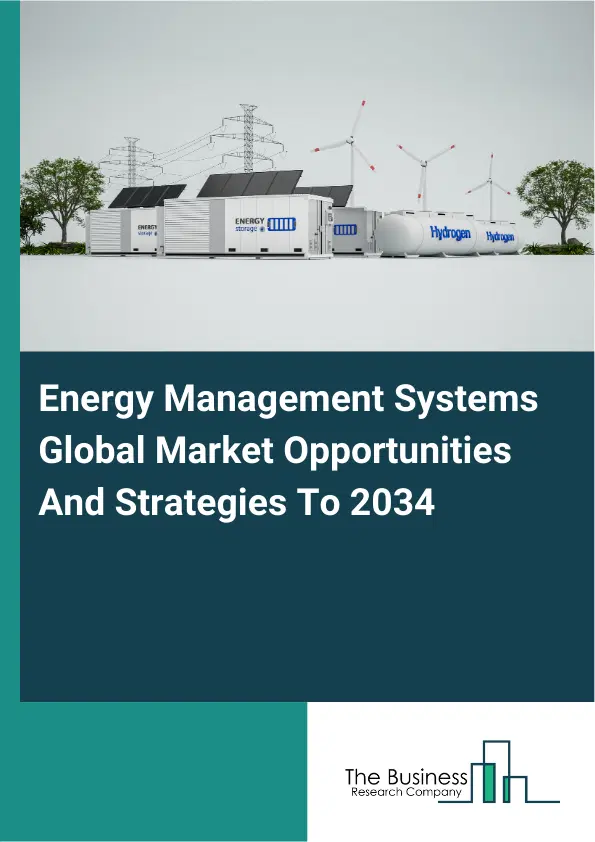
Energy Management Systems Market 2026
By Type (Home Energy Management Systems, Building Energy Management Systems, Industrial Energy Management Systems), By Component (Hardware, Software, Services), By Deployment (On-Premise, Cloud-Based), By End-User (Power And Energy, Telecom And IT, Manufacturing, Residential And Commercial, Food And Beverages, Other End-Users), And By Region, Opportunities And Strategies – Global Forecast To 2035
Energy Management Systems Market Definition
An energy management system (EMS) is a software- and hardware-based platform that monitors, controls, and optimizes the generation, distribution, and consumption of energy within a facility, organization, or grid. EMS integrates data from energy meters, sensors, and control systems to provide real-time insights, automate processes, and support strategic energy decision-making. The primary purpose of an EMS is to improve energy efficiency, reduce costs, and minimize environmental impact. It enables businesses and utilities to optimize resource use, comply with sustainability goals, and enhance operational reliability while contributing to lower carbon emissions and long-term energy savings. The energy management systems market consists of sales, by entities (organizations, sole traders, or partnerships), of solutions designed to optimize, monitor, and control energy consumption across various industries, aiming to improve efficiency and reduce costs. These systems leverage real-time data analytics, automation, and smart technologies to enable organizations to make data-driven decisions about resource usage.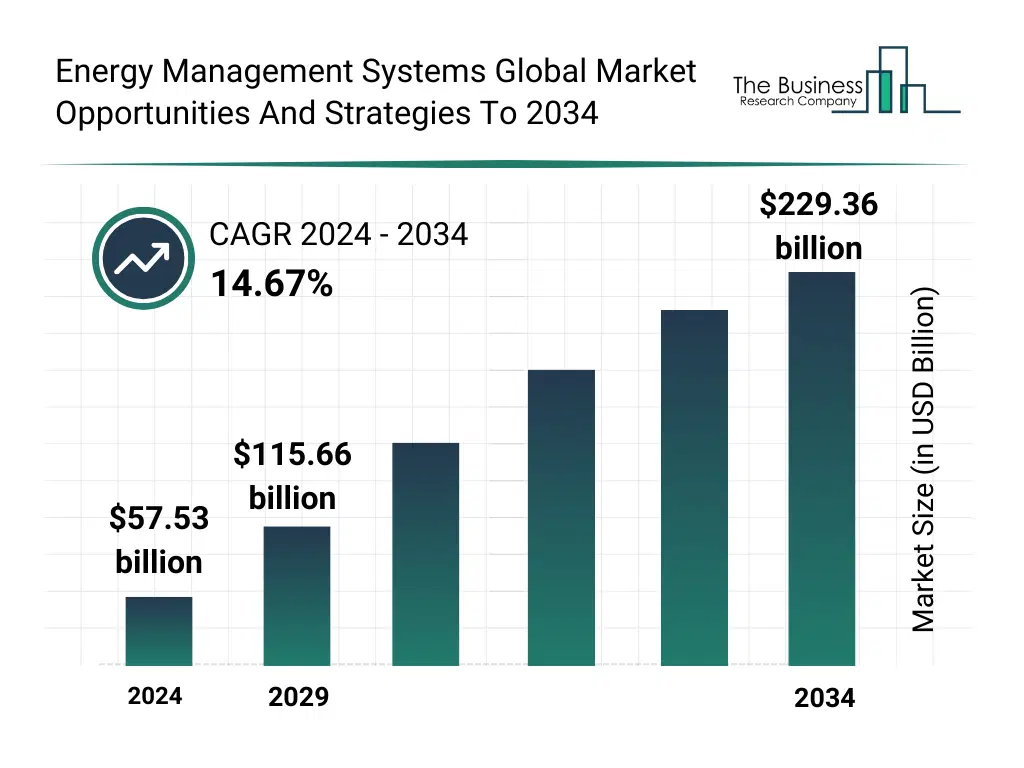
Energy Management Systems Market Size
The global energy management systems market reached a value of nearly $57,532.77 million in 2024, having grown at a compound annual growth rate (CAGR) of 15.68% since 2019. The market is expected to grow from $57,532.77 million in 2024 to $115,659.66 million in 2029 at a rate of 14.99%. The market is then expected to grow at a CAGR of 14.67% from 2029 and reach $229,357.43 million in 2034. Growth in the historic period resulted from increasing electricity demand, growing electric vehicles (EVs) charging infrastructure, incentives, subsidies and government support and rise in smart cities. Factors that negatively affected growth in the historic period were data security and privacy concerns and shortage of skilled workforce. Going forward, growing energy costs, rising deployment of smart grids and smart meters, increasing carbon emission reduction and shift to renewable energy sources will drive the growth. Factors that could hinder the growth of the energy management systems market in the future include competition from alternative energy investments, uneven grid modernization and impact of trade war and tariff.Energy Management Systems Market Drivers
The key drivers of the energy management systems market include: Growing Energy Costs Rising energy costs are expected to drive significant growth in the energy management systems (EMS) market during the forecast period. As global electricity consumption continues to climb—fueled by industrial expansion, urbanization, and the growing adoption of energy-intensive technologies such as data centers and electric vehicles—the demand for power is set to increase substantially. This rising demand, alongside the global shift toward renewable energy, is likely to result in higher electricity prices due to the need for infrastructure upgrades and the integration of intermittent energy sources. In response, both consumers and businesses will increasingly turn to solutions that help them optimize energy use, minimize waste, and control expenses. EMS technologies, offering real-time monitoring, predictive analytics, and automated energy control, will become critical tools for managing consumption and countering the effects of rising energy costs. As a result, the EMS market is well-positioned for robust growth, driven by the urgent need for greater energy efficiency and cost management. The growing energy costs contribution during the forecast period in 2024 is 1.50%.Energy Management Systems Market Restraints
The key restraints on the energy management systems market include: Competition From Alternative Energy Investments During the forecast period, competition from alternative energy investments is expected to restrain the growth of the Energy Management Systems (EMS) market. Substantial capital is being directed toward large-scale renewable energy projects—such as solar, wind, and hybrid energy farms—drawing the attention of governments, private investors, and utilities. These energy generation initiatives often take precedence over optimization technologies, as stakeholders prioritize expanding generation capacity to meet rising electricity demand and sustainability targets. As a result, EMS solutions, which focus on monitoring, controlling, and optimizing energy consumption, struggle to attract funding and achieve widespread adoption. The continued influx of investment into generation-focused ventures is therefore limiting the growth potential of the EMS market. Growth affected by competition from alternative energy investments during the forecast period in 2024 is -2.24%.Energy Management Systems Market Trends
Major trends shaping the energy management systems market include: Hybrid Energy Management Systems with Battery Integration Key companies in the energy management systems market are focusing on the development of hybrid energy management systems that integrate battery storage solutions. These innovations aim to enhance energy reliability, reduce costs, and support renewable energy integration, while also offering customizable solutions for various applications. For instance, in September 2025, Senkron Digital, a Germany-based company specializing in digital energy solutions, unveiled its new hybrid energy management system with battery integration at TÜREK 2025. The system combines real-time energy monitoring, intelligent control algorithms, and battery storage to optimize energy usage and ensure a stable power supply, particularly in areas with intermittent renewable energy sources. By leveraging this integrated approach, Senkron Digital aims to provide a comprehensive solution for modern energy challenges. Blockchain-Enabled Energy Transaction Platforms Major companies in the Energy Management Systemss market are focusing on integrating Energy Management Systemss into smart grid architectures that enable real-time monitoring, automated control and remote diagnostics. These innovations focus on enhancing grid reliability, reducing downtime through predictive maintenance and ensuring compatibility with digital substation and IoT-enabled systems. For instance, in January 2025, Energy Management Systemss, a USA-based company specializing in the production of replacement Energy Management Systemss, introduced the RVI-41A4 (Replacement Energy Management Systems – model 41A4) as a direct fit-and-function replacement for General Electric 41A4 Energy Management Systemss used in PowerVac PVDB1 (PowerVac Vacuum Distribution Breaker – model 1), VB (Vacuum Breaker) and VB1 (Vacuum Breaker – model 1) vacuum circuit breakers. Featuring 2000 A RMS (Root Mean Square) rated current, 8.25 kV (kilovolt) RMS maximum voltage, 95 kV peak impulse withstand and 33 kA RMS (kiloampere Root Mean Square) short-circuit breaking capacity, the RVI-41A4 is engineered to ensure high-voltage insulation, durability and reliable grid performance. By enhancing the operational continuity and automation capability of medium-voltage systems, the company aims to support the growing adoption of smart grid infrastructure for reliable and efficient power distribution.Opportunities And Recommendations In The Energy Management Systems Market
Opportunities – The top opportunities in the energy management systems market segmented by type will arise in the industrial energy management systems segment, which will gain $25,721.59 million of global annual sales by 2029. The top opportunities in the energy management systems market segmented by component will arise in the hardware segment, which will gain $26,764.38 million of global annual sales by 2029. The top opportunities in the energy management systems market segmented by deployment will arise in the cloud based segment, which will gain $46,888.16 million of global annual sales by 2029. The top opportunities in the energy management systems market segmented by end-user will arise in the manufacturing segment, which will gain $15,953.17 million of global annual sales by 2029. The energy management systems market size will gain the most in the USA at $13,147.81 million. Recommendations- To take advantage of the opportunities, The Business Research Company recommends the energy management systems companies to focus on hybrid energy management systems with battery integration, focus on blockchain-enabled energy transaction platforms, focus on AI-driven smart building energy management solutions, focus on smart energy management solutions for the hospitality sector, focus on AI-driven residential energy optimization, focus on AI-powered home energy management solutions, focus on specialized energy management for renewable power plants, focus on predictive analytics for industrial energy management, focus on home energy management systems for growth, focus on energy management software for market growth, expand in emerging markets, continue to focus on developed markets, provide competitively priced offerings, continue to use B2B promotions, participate in trade shows and events and focus on telecom and IT segment for rapid growth.
Energy Management Systems Market Segmentation
The energy management systems market is segmented by type, by component, by deployment and by end-user.By Type –
The energy management systems market is segmented by type into:
- a) Home Energy Management Systems
- b) Building Energy Management Systems
- c) Industrial Energy Management Systems
By Component –
The energy management systems market is segmented by component into:
- a) Hardware
- b) Software
- c) Services
By Deployment –
The energy management systems market is segmented by deployment into:
- a) Cloud-Based
- b) On-Premise
By End User –
The energy management systems market is segmented by end-user into:
- a) Power And Energy
- b) Telecom And IT
- c) Manufacturing
- d) Residential And Commercial
- e) Food And Beverages
- bf Other End-Users
By Geography - The energy management systems market is segmented by geography into:
- • China
- • India
- • Japan
- • Australia
- • Indonesia
- • South Korea
- • USA
- • Canada
- • Brazil
- • France
- • Germany
- • UK
- • Italy
- • Spain
- • Russia
-
o Asia Pacific
o Africa