
eSIM Market Report 2026
Global Outlook – By Solution (Hardware, Connectivity Services), By Application (Connected Cars, Laptops, M2M, Smartphones, Tablets, Wearables, Other Applications), By Vertical (Automotive, Consumer Electronics, Energy And Utilities, Manufacturing, Retail, Transportation And Logistics) – Market Size, Trends, Strategies, and Forecast to 2030
eSIM Market Overview
• eSIM market size has reached to $11.98 billion in 2025 • Expected to grow to $22.23 billion in 2030 at a compound annual growth rate (CAGR) of 13% • Growth Driver: Smartphone Penetration Fuels Exponential Growth In The eSIM Market • Market Trend: Digital 5G Tourist eSIM For Effortless Connectivity • North America was the largest region in 2025.What Is Covered Under eSIM Market?
eSIM refers to an embedded universal integrated circuit card (eUICC) capable of supporting different network carrier profiles that are essentially embedded in it. It enables users to use a cellular plan from carrier without the need for an actual nano-SIM. The main solutions of eSIM are hardware, and connectivity services. Hardware refers to all of a computer system's physical parts, including the devices it is attached to. The various applications involved are connected cars, laptops, M2M, smartphones, tablets, wearables, and others that are used in automotive, consumer electronics, energy and utilities, manufacturing, retail, transportation and logistics verticals.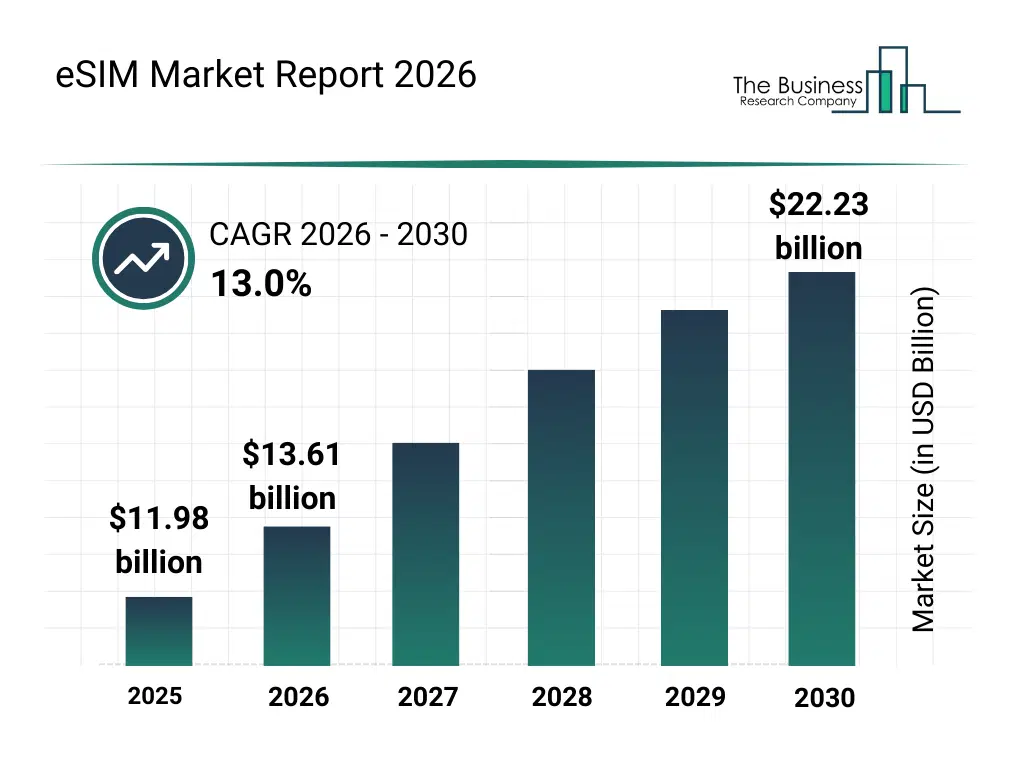
What Is The eSIM Market Size and Share 2026?
The esim market size has grown rapidly in recent years. It will grow from $11.98 billion in 2025 to $13.61 billion in 2026 at a compound annual growth rate (CAGR) of 13.7%. The growth in the historic period can be attributed to expansion of connected device ecosystems, rising smartphone penetration, adoption of M2M communication technologies, growth of global mobile subscriptions, availability of embedded IC technologies.What Is The eSIM Market Growth Forecast?
The esim market size is expected to see rapid growth in the next few years. It will grow to $22.23 billion in 2030 at a compound annual growth rate (CAGR) of 13.0%. The growth in the forecast period can be attributed to increasing adoption of connected vehicles, rising deployment of industrial IoT devices, expansion of wearables and smart devices, growing demand for flexible network provisioning, increasing focus on secure digital identity management. Major trends in the forecast period include increasing adoption of embedded connectivity solutions, rising demand for remote sim provisioning capabilities, growing integration of esim in iot devices, expansion of esim adoption in automotive applications, enhanced focus on secure digital connectivity.
Global eSIM Market Segmentation
1) By Solution: Hardware, Connectivity Services 2) By Application: Connected Cars, Laptops, M2M, Smartphones, Tablets, Wearables, Other Applications 3) By Vertical: Automotive, Consumer Electronics, Energy And Utilities, Manufacturing, Retail, Transportation And Logistics Subsegments: 1) By Hardware: eSIM Chips, eSIM Modules, Integrated Circuits (ICs) 2) By Connectivity Services: Remote SIM Provisioning, Mobile Network Operator (MNO) Services, Data Plans And Subscription ServicesWhat Is The Driver Of The eSIM Market?
The increasing penetration of smartphones is significantly contributing to the growth of the eSIM market going forward. A smartphone refers to a mobile phone with highly advanced functions. eSIMs are built into consumer devices such as smartphones, allowing the user to re-program sim contents such as the international mobile subscriber identifier (IMSI) and network carrier profiles via software, eliminating the requirement for SIM card replacement. For instance, in July 2023, according to Demand Sage, a US-based Google Sheets-based revenue operations platform, in 2023, the global count of smartphone users stood at 6.8 billion, marking an increase from around 6.6 billion users in 2022. Therefore, the increasing penetration of smartphones will drive the eSIM industry.Key Players In The Global eSIM Market
Major companies operating in the esim market are Infineon Technologies AG; NXP Semiconductors N.V; Samsung Group; STMicroelectronics; CEC Huada Electronic Design Co Ltd; Eastcompeace Technology Co Ltd; Valid S.A.; Microchip Technology Incorporated; Sony Group Corporation; EM Microelectronic; Watchdata Technologies Ptd Ltd; CardLogix Corporation; Gemalto (now Thales Digital Identity and Security); IDEMIA; Giesecke+Devrient; Sierra Wireless; Deutsche Telekom AG; Telit; Arm Holdings; Vodafone Group; Telefónica; Cubic Telecom; Truphone; Workz Group; KORE Wireless; Kigen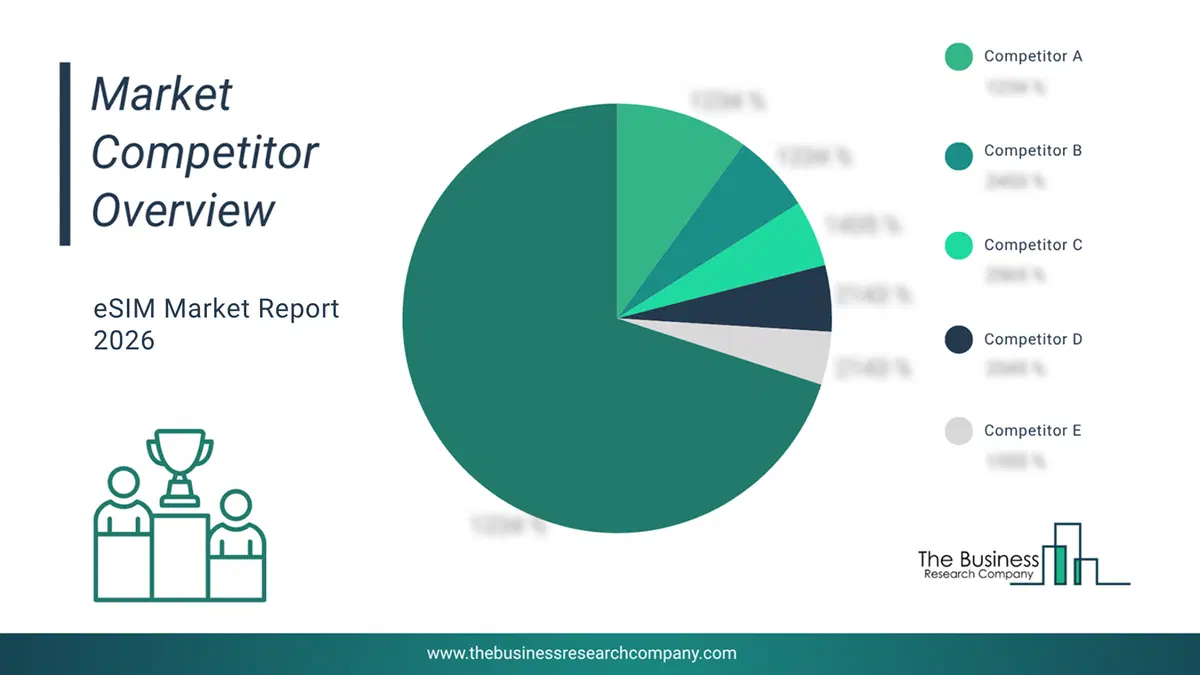
This chart is for illustrative purposes; the full report includes a detailed competitor analysis and comprehensive overview of the top 10 companies in the market.
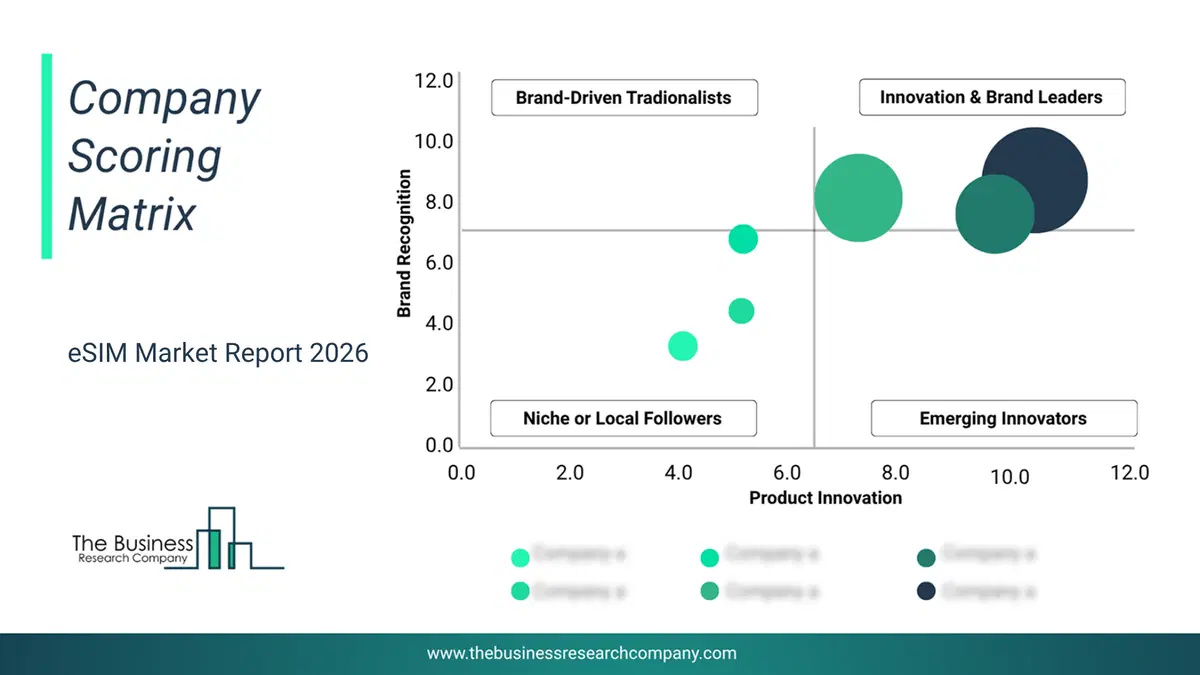
This chart maps companies by product innovation and brand strength, with bubble size indicating relative revenue, helping identify market leaders, challengers, and niche players. This is an illustrative chart; the full report provides a complete and accurate competitive analysis.
Global eSIM Market Trends and Insights
Major companies operating in the eSIM market are focused on developing digital 5G tourist eSIM with unique features such as a digital and convenient activation process to meet the growing demand from international travelers. A digital and convenient activation process refers to a method of initiating and enabling services or functionalities using electronic means, typically through online platforms or applications. For instance, in September 2023, Singtel, a Singapore-based telecommunications company launched 5G Tourist eSIM to meet the growing demand from international travelers. It was aimed to provide enhanced convenience and value, allowing tourists to manage their connectivity needs online before arriving in Singapore. With a focus on the Grand Prix event, the digital 5G Tourist eSIM offers hassle-free activation, saving time spent on traditional SIM card purchases. Singtel seeks to enhance the travel experience, providing seamless connectivity and additional digital experiences with 5G technology.What Are Latest Mergers And Acquisitions In The eSIM Market?
In July 2023, Tata Communications, an India-based telecommunications company acquired a remaining 41.9% equity stake in Oasis Smart SIM for an undisclosed amount. The acquisition adds eSIM technology to the arsenal of Tata Communications. Oasis Smart SIM is a France-based provider of eSIMs for IoT and M2M applications.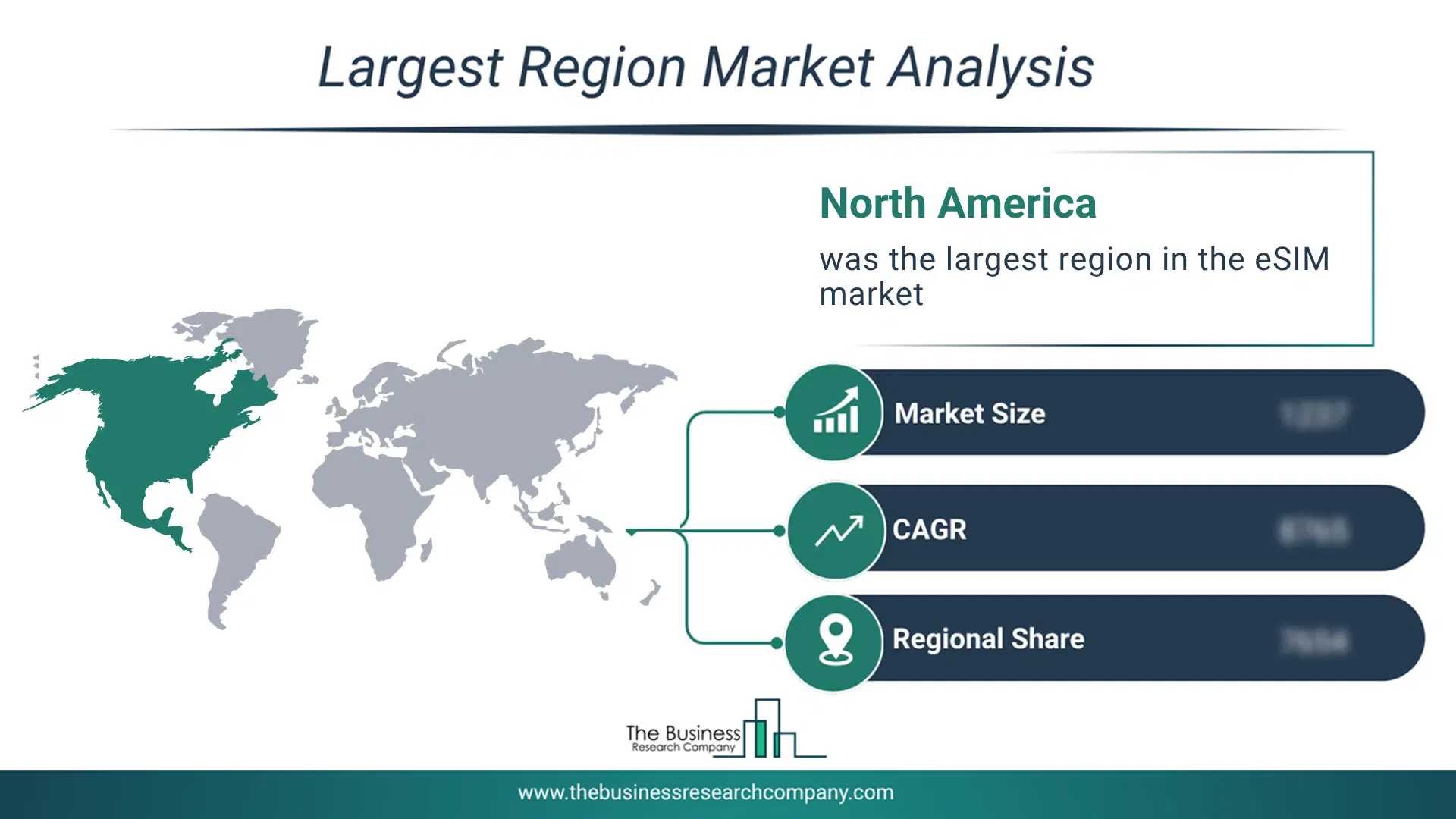
Regional Insights
North America was the largest region in the eSIM market in 2025. The regions covered in this market report are Asia-Pacific, South East Asia, Western Europe, Eastern Europe, North America, South America, Middle East, Africa. The countries covered in this market report are Australia, Brazil, China, France, Germany, India, Indonesia, Japan, Taiwan, Russia, South Korea, UK, USA, Canada, Italy, SpainWhat Defines the eSIM Market?
The eSIM market consists of revenues earned by entities by providing data only and voice, SMS, and data services. The market value includes the value of related goods sold by the service provider or included within the service offering. The eSIM market includes sales of embedded universal integrated circuit card (eUICC) which is used for providing eSIM services. Values in this market are ‘factory gate’ values, that is the value of goods sold by the manufacturers or creators of the goods, whether to other entities (including downstream manufacturers, wholesalers, distributors and retailers) or directly to end customers. The value of goods in this market includes related services sold by the creators of the goods.How is Market Value Defined and Measured?
The market value is defined as the revenues that enterprises gain from the sale of goods and/or services within the specified market and geography through sales, grants, or donations in terms of the currency (in USD unless otherwise specified). The revenues for a specified geography are consumption values that are revenues generated by organizations in the specified geography within the market, irrespective of where they are produced. It does not include revenues from resales along the supply chain, either further along the supply chain or as part of other products.
This chart presents market attractiveness based on a quantitative evaluation of growth, competition, strategic alignment, and risk, offering a clear view of opportunity areas for decision-making. This chart is for illustrative purposes; the full report contains the complete analysis.

This chart highlights the Total Addressable Market (TAM) by estimating the maximum revenue opportunity using an assumption-driven approach, supporting strategic planning and opportunity sizing across markets. The chart is illustrative; the full report provides a more comprehensive analysis.
What Key Data and Analysis Are Included in the eSIM Market Report 2026?
The esim market research report is one of a series of new reports from The Business Research Company that provides market statistics, including industry global market size, regional shares, competitors with the market share, detailed market segments, market trends and opportunities, and any further data you may need to thrive in the esim industry. The market research report delivers a complete perspective of everything you need, with an in-depth analysis of the current and future state of the industry.eSIM Market Report Forecast Analysis
| Report Attribute | Details |
|---|---|
| Market Size Value In 2026 | $13.61 billion |
| Revenue Forecast In 2030 | $22.23 billion |
| Growth Rate | CAGR of 13% from 2026 to 2030 |
| Base Year For Estimation | 2025 |
| Actual Estimates/Historical Data | 2020-2025 |
| Forecast Period | 2026 - 2030 |
| Market Representation | Revenue in USD Billion and CAGR from 2026 to 2030 |
| Segments Covered | Solution, Application, Vertical |
| Regional Scope | Asia-Pacific, Western Europe, Eastern Europe, North America, South America, Middle East, Africa |
| Country Scope | The Countries Covered In This Market Report Are Australia, Brazil, China, France, Germany, India, Indonesia, Japan, Taiwan, Russia, South Korea, Uk, Usa, Canada, Italy, Spain. |
| Key Companies Profiled | Infineon Technologies AG, NXP Semiconductors N.V, Samsung Group, STMicroelectronics, CEC Huada Electronic Design Co Ltd, Eastcompeace Technology Co Ltd, Valid S.A., Microchip Technology Incorporated, Sony Group Corporation, EM Microelectronic, Watchdata Technologies Ptd Ltd, CardLogix Corporation, Gemalto (now Thales Digital Identity and Security), IDEMIA, Giesecke+Devrient, Sierra Wireless, Deutsche Telekom AG, Telit, Arm Holdings, Vodafone Group, Telefónica, Cubic Telecom, Truphone, Workz Group, KORE Wireless, Kigen |
| Customization Scope | Request for Customization |
| Pricing And Purchase Options | Explore Purchase Options |