
Factory Buildings Market Report 2026
Global Outlook – By Type (Heavy Manufacturing Buildings, Light Assembly Buildings, General Warehouses), By Material (Aggregates, Bricks, Cement ), By Construction Type (New Construction, Renovation), By Application (Owned, Rental ), By End User (Private, Public ) – Market Size, Trends, Strategies, and Forecast to 2030
Factory Buildings Market Overview
• Factory Buildings market size has reached to $294.76 billion in 2025 • Expected to grow to $342.8 billion in 2030 at a compound annual growth rate (CAGR) of 3.2% • Growth Driver: Increasing Government Expenditures For Infrastructural Development Propel The Growth Of The Factory Buildings Market • Market Trend: Focus On Technological Advancements To Enhance Manufacturing Efficiency • Asia-Pacific was the largest region in 2025.What Is Covered Under Factory Buildings Market?
A factory building is a place where products are manufactured and put together. These industrial buildings are defined with less than 20% office area structures, available truck loading docks, and at least 10 feet of clear height. It is a single-story building with heavy manufacturing and light assembly production facilities. They feature larger overhead rooms for a given amount of floor space. The main types of factory buildings include heavy manufacturing buildings, light assembly buildings, general warehouses, and others. Heavy manufacturing buildings are designed to support large-scale industrial operations, heavy machinery, and high load-bearing requirements. Different materials are aggregates, bricks, cement. Multiple construction type are new construction and renovation. Various applications are owned and rental, and they are used by several end-users such as private, public.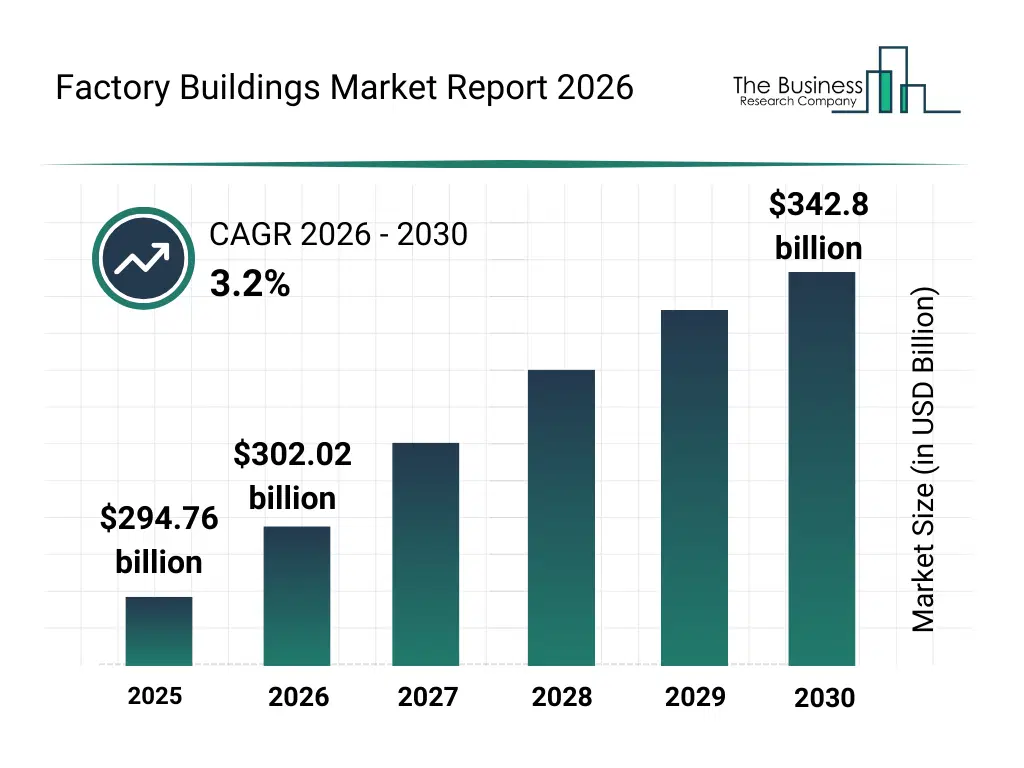
What Is The Factory Buildings Market Size and Share 2026?
The factory buildings market size has grown steadily in recent years. It will grow from $294.76 billion in 2025 to $302.02 billion in 2026 at a compound annual growth rate (CAGR) of 2.5%. The growth in the historic period can be attributed to growth in industrialization, expansion of manufacturing capacity, rising demand for warehouse space, increased investment in production facilities, development of large distribution networks.What Is The Factory Buildings Market Growth Forecast?
The factory buildings market size is expected to see steady growth in the next few years. It will grow to $342.8 billion in 2030 at a compound annual growth rate (CAGR) of 3.2%. The growth in the forecast period can be attributed to rising adoption of smart factories, increasing shift to sustainable construction materials, growth in automated manufacturing facilities, expansion of global logistics infrastructure, increased demand for high-efficiency industrial buildings. Major trends in the forecast period include rising construction of large-scale distribution warehouses, growing development of light assembly and flexible production facilities, increased demand for high-clear-height factory buildings, expansion of heavy manufacturing structures for industrial capacity, growth in renovation of aging industrial plants.
Global Factory Buildings Market Segmentation
1) By Type: Heavy Manufacturing Buildings, Light Assembly Buildings, General Warehouses 2) By Material: Aggregates, Bricks, Cement 3) By Construction Type: New Construction, Renovation 4) By Application: Owned, Rental 5) By End User: Private, Public Subsegments: 1) By Heavy Manufacturing Buildings: Steel And Metal Fabrication Plants, Automotive And Heavy Equipment Manufacturing Plants, Chemical And Petrochemical Processing Facilities, Machinery And Equipment Production Units 2) By Light Assembly Buildings: Electronics Assembly Units, Consumer Goods Assembly Facilities, Medical Device Assembly Plants, Small Component Manufacturing Units 3) By General Warehouses: Raw Material Storage Warehouses, Finished Goods Warehouses, Cold Storage Warehouses, Automated WarehousesWhat Is The Driver Of The Factory Buildings Market?
The increasing government expenditures for infrastructural development are expected to propel the growth of the factory buildings market going forward. The government allots funds to infrastructure development which is meant to increase the level of investment in the country and possibly economic growth. The factory buildings are industrial construction which is a part of infrastructural development. Hence, the increasing government expenditures for infrastructural development will raise the demand for factory buildings. For instance, in July 2024, according to the Office for National Statistics, a UK-based government department, total investment in the infrastructure sector reached $18.0 billion (£13.8 billion) in constant prices in 2023, representing a 3.9% increase from 2022. The estimated net stocks of infrastructure in the market sector were $456.9 billion (£350.2 billion) in constant prices for 2023, reflecting a 0.3% rise compared to the previous year. Therefore, the increase in government expenditure for infrastructural development is driving the growth of the factory buildings industry.Key Players In The Global Factory Buildings Market
Major companies operating in the factory buildings market are Pretorius Structures Ltd., FEG Global Ltd., Tasin Company Ltd., Ajinomoto Engineering Corporation, N.S.L Construction Co. Ltd., Tata Projects Limited, Larsen & Toubro Limited, Hitachi Plant Construction Ltd., Primus Builders Inc., Sika AG, AME Construction Services Ltd., Hindustan Construction Company, Dilip Buildcon Ltd., Turner Construction Co., Bechtel Corporation, Fluor Corporation, AECOM Technology Corporation, Whiting-Turner Contracting Company, Kiewit Corporation, Skanska USA, PCL Construction Enterprises Inc., Leopardo Companies, Layton Construction Company LLC, McGough Construction Company LLC, Hill & Wilkinson Construction Group Ltd., Kraus-Anderson Company, Schimenti Construction Company, LeChase Construction Services LLC, ThermalTech Engineering Inc., W.E. O'Neil Construction Company, Robins & Morton Group, Nabholz Construction Corporation, Plaza Construction LLC, Hunter Roberts Construction Group, Hill International Inc., Hoar Construction LLC, Ghafari Associates LLC, Kitchell Corporation, IMC Construction Inc., KBE Building Corporation, Joeris General Contractors Ltd., STV Group Inc., Batson-Cook Company, Cumming Corporation, HITT Contracting Inc., Holder Construction Group LLC, Brasfield & Gorrie LLC
This chart is for illustrative purposes; the full report includes a detailed competitor analysis and comprehensive overview of the top 10 companies in the market.
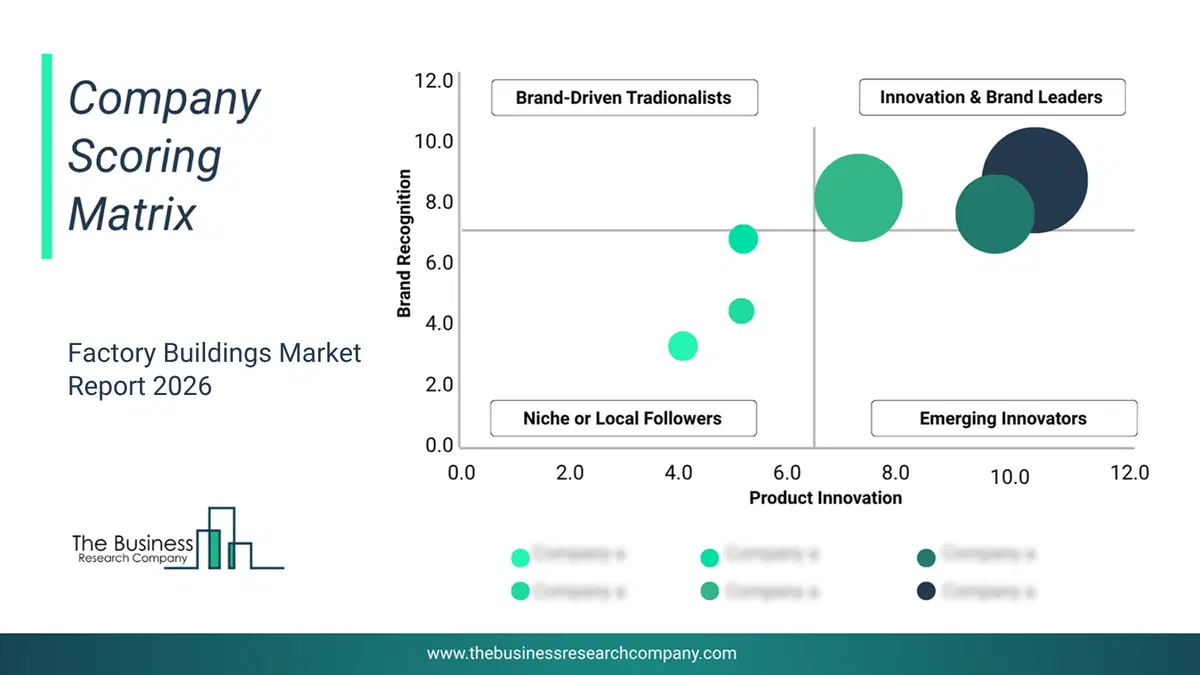
This chart maps companies by product innovation and brand strength, with bubble size indicating relative revenue, helping identify market leaders, challengers, and niche players. This is an illustrative chart; the full report provides a complete and accurate competitive analysis.
Global Factory Buildings Market Trends and Insights
Major companies operating in the factory buildings market are focusing on developing technological advancements such as digital twin orchestration to optimize facility performance, enhance operational efficiency, and enable predictive maintenance across manufacturing infrastructures. Digital twin orchestration refers to the process of integrating and managing multiple digital twins within a manufacturing ecosystem to facilitate seamless data flow, coordinated operations, and improved decision-making through real-time insights and automation. For instance, in October 2025, Accenture Plc, an Ireland-based professional services company, introduced the Physical AI Orchestrator, a cloud-based solution aimed at helping manufacturers transform current and future factories and warehouses into software-defined facilities. It enhances operational efficiency, minimizes design and capital costs, and improves safety through real-time simulations and AI-powered automation. The solution is designed to support agile manufacturing environments that can dynamically adapt to evolving requirements, enabling faster innovation and optimized facility planning.What Are Latest Mergers And Acquisitions In The Factory Buildings Market?
In December 2024, Interarch Building Products, an India-based construction company, partnered with Jindal Steel & Power (JSPL) to develop advanced steel solutions for factory building construction. This partnership aims to transform India’s urban infrastructure by promoting steel as the preferred material for multi-story buildings, data centers, factory buildings, and heavy structures through sustainable and efficient construction practices. Jindal Steel & Power is an India-based steel manufacturer that offers a wide range of steel products, including rails, beams, and plates.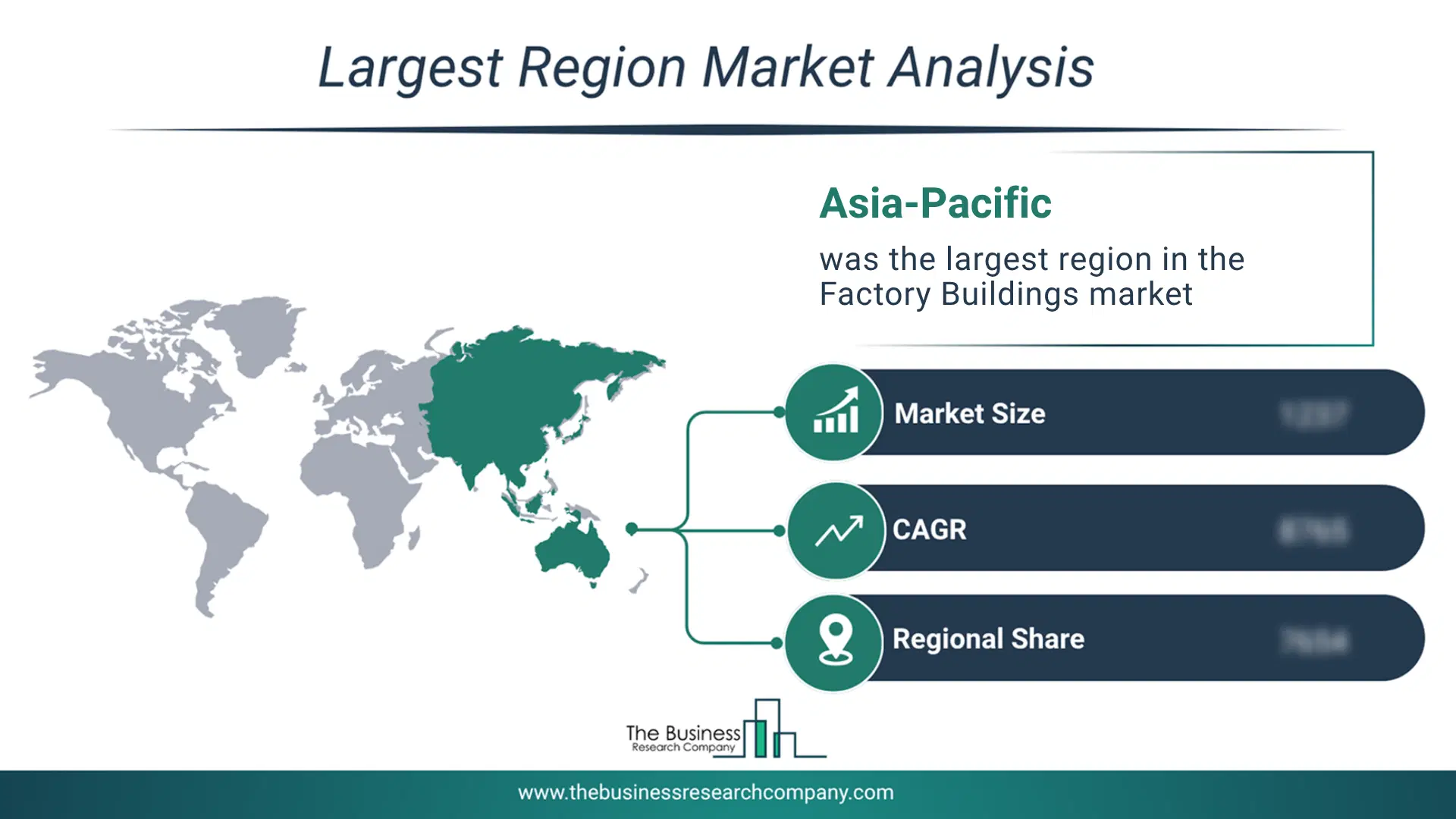
Regional Insights
Asia-Pacific was the largest region in the factory buildings market in 2025. The regions covered in this market report are Asia-Pacific, South East Asia, Western Europe, Eastern Europe, North America, South America, Middle East, Africa. The countries covered in this market report are Australia, Brazil, China, France, Germany, India, Indonesia, Japan, Taiwan, Russia, South Korea, UK, USA, Canada, Italy, Spain.What Defines the Factory Buildings Market?
The factory buildings market includes revenues earned by entities by constructing heavy manufacturing buildings, light assembly buildings, general warehouses and distribution warehouses. The market value includes the value of related goods sold by the service provider or included within the service offering. Only goods and services traded between entities or sold to end consumers are included.How is Market Value Defined and Measured?
The market value is defined as the revenues that enterprises gain from the sale of goods and/or services within the specified market and geography through sales, grants, or donations in terms of the currency (in USD unless otherwise specified). The revenues for a specified geography are consumption values that are revenues generated by organizations in the specified geography within the market, irrespective of where they are produced. It does not include revenues from resales along the supply chain, either further along the supply chain or as part of other products.
This chart presents market attractiveness based on a quantitative evaluation of growth, competition, strategic alignment, and risk, offering a clear view of opportunity areas for decision-making. This chart is for illustrative purposes; the full report contains the complete analysis.

This chart highlights the Total Addressable Market (TAM) by estimating the maximum revenue opportunity using an assumption-driven approach, supporting strategic planning and opportunity sizing across markets. The chart is illustrative; the full report provides a more comprehensive analysis.
What Key Data and Analysis Are Included in theFactory Buildings Market Report 2026?
The factory buildings market research report is one of a series of new reports from The Business Research Company that provides market statistics, including industry global market size, regional shares, competitors with the market share, detailed market segments, market trends and opportunities, and any further data you may need to thrive in the factory buildings industry. The market research report delivers a complete perspective of everything you need, with an in-depth analysis of the current and future state of the industry.Factory Buildings Market Report Forecast Analysis
| Report Attribute | Details |
|---|---|
| Market Size Value In 2026 | $302.02 billion |
| Revenue Forecast In 2030 | $342.8 billion |
| Growth Rate | CAGR of 2.5% from 2026 to 2030 |
| Base Year For Estimation | 2025 |
| Actual Estimates/Historical Data | 2020-2025 |
| Forecast Period | 2026 - 2030 |
| Market Representation | Revenue in USD Billion and CAGR from 2026 to 2030 |
| Segments Covered | Type, Material, Construction Type, Application, End User |
| Regional Scope | Asia-Pacific, Western Europe, Eastern Europe, North America, South America, Middle East, Africa |
| Country Scope | The countries covered in this market report are Australia, Brazil, China, France, Germany, India, Indonesia, Japan, Taiwan, Russia, South Korea, UK, USA, Canada, Italy, Spain |
| Key Companies Profiled | Pretorius Structures Ltd., FEG Global Ltd., Tasin Company Ltd., Ajinomoto Engineering Corporation, N.S.L Construction Co. Ltd., Tata Projects Limited, Larsen & Toubro Limited, Hitachi Plant Construction Ltd., Primus Builders Inc., Sika AG, AME Construction Services Ltd., Hindustan Construction Company, Dilip Buildcon Ltd., Turner Construction Co., Bechtel Corporation, Fluor Corporation, AECOM Technology Corporation, Whiting-Turner Contracting Company, Kiewit Corporation, Skanska USA, PCL Construction Enterprises Inc., Leopardo Companies, Layton Construction Company LLC, McGough Construction Company LLC, Hill & Wilkinson Construction Group Ltd., Kraus-Anderson Company, Schimenti Construction Company, LeChase Construction Services LLC, ThermalTech Engineering Inc., W.E. O'Neil Construction Company, Robins & Morton Group, Nabholz Construction Corporation, Plaza Construction LLC, Hunter Roberts Construction Group, Hill International Inc., Hoar Construction LLC, Ghafari Associates LLC, Kitchell Corporation, IMC Construction Inc., KBE Building Corporation, Joeris General Contractors Ltd., STV Group Inc., Batson-Cook Company, Cumming Corporation, HITT Contracting Inc., Holder Construction Group LLC, Brasfield & Gorrie LLC |
| Customization Scope | Request for Customization |
| Pricing And Purchase Options | Explore Purchase Options |