
Feed Acidifiers Market Report 2026
Global Outlook – By Type (Propionic Acid, Fumaric Acid, Lactic Acid, Formic Acid, Other Types), By Form (Dry, Liquid), By Livestock (Poultry, Swine, Ruminants, Aquaculture, Other Livestocks), By Compound (Blended, Single) – Market Size, Trends, Strategies, and Forecast to 2030
Feed Acidifiers Market Overview
• Feed Acidifiers market size has reached to $3.08 billion in 2025 • Expected to grow to $4.72 billion in 2030 at a compound annual growth rate (CAGR) of 8.8% • Growth Driver: Increasing Meat And Dairy Product Demand Fuelling Growth In The Feed Acidifier Market • Market Trend: Feed Acidifier Market Embracing Strategic Partnerships For Market Expansion • Asia-Pacific was the largest region in 2025 and North America is the fastest growing region.What Is Covered Under Feed Acidifiers Market?
The feed acidifier are used to inhibit the growth of pathogenic bacteria. Feed acidifiers are added to feeds to decrease the pH of the feed, gut, and microbial cytoplasm, preventing harmful intestinal microflora from growing. This inhibits bacteria from competing for host nutrients, resulting in improved development and performance. The main types of feed acidifiers are propionic acid, fumaric acid, lactic acid, formic acid, and others. The propionic feed acidifiers are used to reduce acidogenesis and when propionic acid is added to a glucose-containing growth medium, a random copolymer consisting of 3-hydroxybutyrate and 3-hydroxy valerate is formed. The various forms include dry, and liquid, divided by livestock into poultry, swine, ruminants, aquaculture, pets, and others. The several compounds are blended into singles.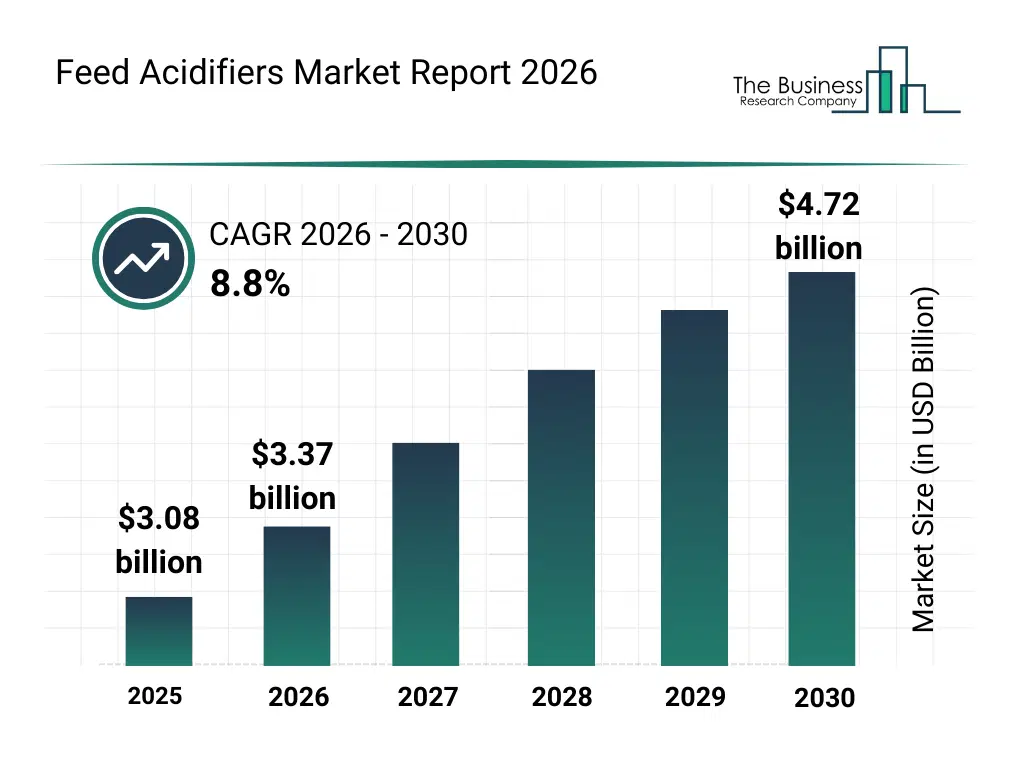
What Is The Feed Acidifiers Market Size and Share 2026?
The feed acidifiers market size has grown strongly in recent years. It will grow from $3.08 billion in 2025 to $3.37 billion in 2026 at a compound annual growth rate (CAGR) of 9.3%. The growth in the historic period can be attributed to increasing concerns over pathogenic bacteria in feed, rising adoption of feed hygiene practices, expansion of commercial livestock production, availability of organic acid compounds, growing awareness of gut health.What Is The Feed Acidifiers Market Growth Forecast?
The feed acidifiers market size is expected to see strong growth in the next few years. It will grow to $4.72 billion in 2030 at a compound annual growth rate (CAGR) of 8.8%. The growth in the forecast period can be attributed to increasing demand for sustainable animal nutrition solutions, rising investments in functional feed additives, expansion of aquaculture feed acidifiers, growing regulatory pressure on antibiotic use, increasing adoption of blended acidifier formulations. Major trends in the forecast period include increasing use of organic acid blends, rising demand for antibiotic-free feed solutions, growing focus on gut microflora management, expansion of liquid feed acidifiers, enhanced emphasis on feed preservation efficiency.
Global Feed Acidifiers Market Segmentation
1) By Type: Propionic Acid, Fumaric Acid, Lactic Acid, Formic Acid, Other Types 2) By Form: Dry, Liquid 3) By Livestock: Poultry, Swine, Ruminants, Aquaculture, Other Livestocks 4) By Compound: Blended, Single Subsegments: 1) By Propionic Acid: Animal Feed Preservative, Grain Preservation 2) By Fumaric Acid: Feed Flavoring Agent, Nutritional Supplement 3) By Lactic Acid: Fermentation Agent, PH Regulator 4) By Formic Acid: Antimicrobial Agent, Feed Preservative 5) By Other Types: Acetic Acid, Butyric Acid, Citric AcidWhat Is The Driver Of The Feed Acidifiers Market?
The rise in the demand for meat and dairy products is expected to propel the growth of the feed acidifier market going forward. Meat and dairy products refer to a healthy, balanced diet that includes protein from meat, as well as from fish and eggs. Acidifiers promote the absorption of minerals from animal meat and dairy products by improving nutrient digestibility. For instance, in March 2023, according to the Australian Bureau of Statistics, an Australia-based government agency, beef production increased to 456.2 tons in 2022 and it further surged to 524.3 tons in 2023, indicating a growing upward trend. Therefore, the growing demand for meat and dairy products is driving the growth of the feed acidifier industry.Key Players In The Global Feed Acidifiers Market
Major companies operating in the feed acidifiers market are BASF SE, Yara International ASA, Kemin Industries, Biomin Holding GmbH, Perstorp Holding AB, Novus International Inc., Corbion NV, Impextraco NV, Addcon Group GmbH, Anpario plc, PeterLabs Holdings Berhad, JEFO Nutrition Inc., Pancosma SA, Nutrex NV, Koninklijke DSM N.V., Diamond V, Bluestar Adisseo Nutrition Group Ltd., Alltech Inc., Borregaard AS, Cargill Inc., Provimi Holding BV, Selko Feed Additives, Trouw Nutrition International, Vetagro S.p.A., Chr. Hansen Holding A/S, Danisco Animal Nutrition, Devenish Nutrition Limited
This chart is for illustrative purposes; the full report includes a detailed competitor analysis and comprehensive overview of the top 10 companies in the market.
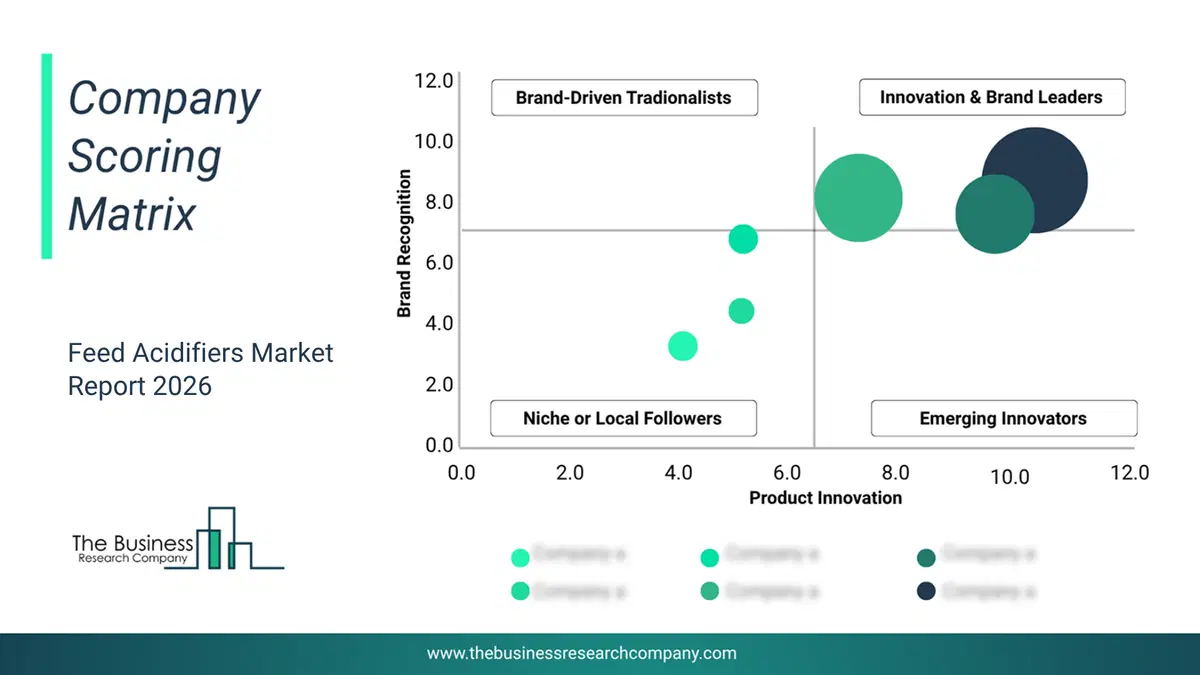
This chart maps companies by product innovation and brand strength, with bubble size indicating relative revenue, helping identify market leaders, challengers, and niche players. This is an illustrative chart; the full report provides a complete and accurate competitive analysis.
Global Feed Acidifiers Market Trends and Insights
Major companies operating in the feed acidifier sector are focused on partnerships to strengthen their position in the market. Which is an advanced feed acidifier aimed at improving swine health and productivity in the U.S. This innovative feed additive combines a proprietary blend of encapsulated calcium formate and citric acid, which helps support intestinal health by fostering a healthy gut environment and combating pathogens such as Escherichia coli. As a non-antibiotic solution, FORMYL enhances swine performance and profitability, offering a safer and more effective approach to pathogen control. For instance, in June 2023, Kemin Industries, an US-based animal nutrition company, launched FORMYL which is an advanced feed acidifier that integrates encapsulated calcium formate and citric acid to promote a healthier gut environment, effectively combating pathogens like Enterobacteriaceae and Escherichia coli. This innovative product serves as a non-antibiotic solution utilizing formic acid to diminish pathogen challenges, while its encapsulation technology guarantees safer handling and optimal effectiveness in animals. Recent research indicates that calcium formate can substantially lower the pH of the gastrointestinal tract, enhancing microbial barriers and improving digestion, especially in post-weaning scenarios, which helps reduce the incidence of diarrhea.What Are Latest Mergers And Acquisitions In The Feed Acidifiers Market?
In November 2023, SAFIC-ALCAN a France-based pharmaceutical company, partnered with ADDCON for an undisclosed amount. The aim of a partnership is to combine strengths and resources to achieve shared objectives and create mutual value. ADDCON is a Germany-based chemicals company that focuses on the production and distribution of various chemical products.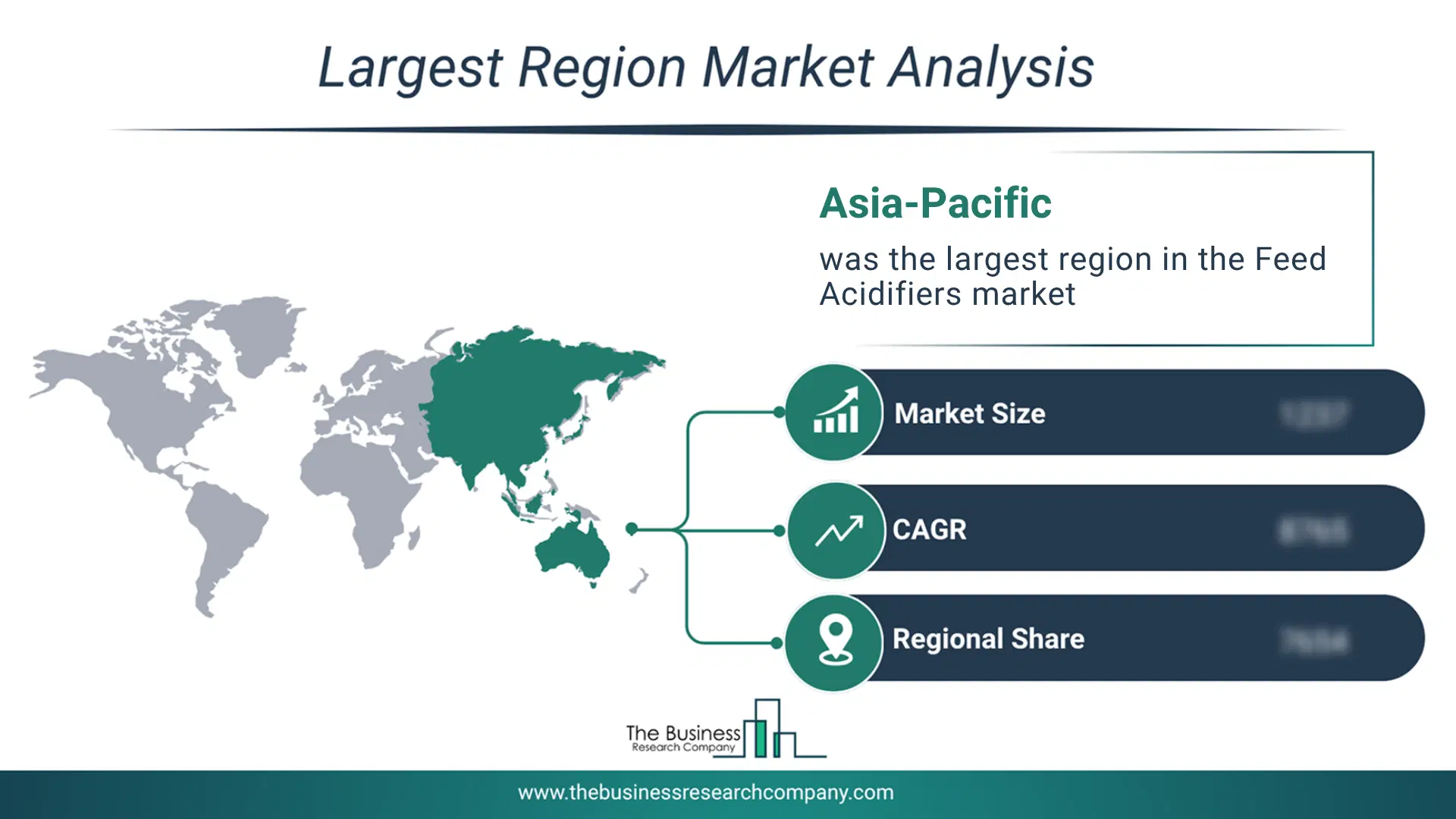
Regional Outlook
Asia-Pacific was the largest region in the feed acidifiers market in 2025. North America is expected to be the fastest-growing region in the forecast period. The regions covered in this market report are Asia-Pacific, South East Asia, Western Europe, Eastern Europe, North America, South America, Middle East and Africa. The countries covered in this market report are Australia, Brazil, China, France, Germany, India, Indonesia, Japan, Taiwan, Russia, South Korea, UK, USA, Italy, Spain, CanadaWhat Defines the Feed Acidifiers Market?
The feed acidifier market consists of sales of formic acid, citric acid, propionic acid, lactic acid, essential oils. Values in this market are ‘factory gate’ values, that is the value of goods sold by the manufacturers or creators of the goods, whether to other entities (including downstream manufacturers, wholesalers, distributors and retailers) or directly to end customers. The value of goods in this market includes related services sold by the creators of the goods.How is Market Value Defined and Measured?
The market value is defined as the revenues that enterprises gain from the sale of goods and/or services within the specified market and geography through sales, grants, or donations in terms of the currency (in USD unless otherwise specified). The revenues for a specified geography are consumption values that are revenues generated by organizations in the specified geography within the market, irrespective of where they are produced. It does not include revenues from resales along the supply chain, either further along the supply chain or as part of other products.
This chart presents market attractiveness based on a quantitative evaluation of growth, competition, strategic alignment, and risk, offering a clear view of opportunity areas for decision-making. This chart is for illustrative purposes; the full report contains the complete analysis.

This chart highlights the Total Addressable Market (TAM) by estimating the maximum revenue opportunity using an assumption-driven approach, supporting strategic planning and opportunity sizing across markets. The chart is illustrative; the full report provides a more comprehensive analysis.
What Key Data and Analysis Are Included in the Feed Acidifiers Market Report 2026?
The feed acidifiers market research report is one of a series of new reports from The Business Research Company that provides market statistics, including industry global market size, regional shares, competitors with the market share, detailed market segments, market trends and opportunities, and any further data you may need to thrive in the feed acidifiers industry. The market research report delivers a complete perspective of everything you need, with an in-depth analysis of the current and future state of the industry.Feed Acidifiers Market Report Forecast Analysis
| Report Attribute | Details |
|---|---|
| Market Size Value In 2026 | $3.37 billion |
| Revenue Forecast In 2030 | $4.72 billion |
| Growth Rate | CAGR of 9.3% from 2026 to 2030 |
| Base Year For Estimation | 2025 |
| Actual Estimates/Historical Data | 2020-2025 |
| Forecast Period | 2026 - 2030 |
| Market Representation | Revenue in USD Billion and CAGR from 2026 to 2030 |
| Segments Covered | Type, Form, Livestock, Compound |
| Regional Scope | Asia-Pacific, Western Europe, Eastern Europe, North America, South America, Middle East, Africa |
| Country Scope | The countries covered in the report are Australia, Brazil, China, France, Germany, India, Indonesia, Japan, Taiwan, Russia, South Korea, UK, USA, Canada, Italy, Spain. |
| Key Companies Profiled | BASF SE, Yara International ASA, Kemin Industries, Biomin Holding GmbH, Perstorp Holding AB, Novus International Inc., Corbion NV, Impextraco NV, Addcon Group GmbH, Anpario plc, PeterLabs Holdings Berhad, JEFO Nutrition Inc., Pancosma SA, Nutrex NV, Koninklijke DSM N.V., Diamond V, Bluestar Adisseo Nutrition Group Ltd., Alltech Inc., Borregaard AS, Cargill Inc., Provimi Holding BV, Selko Feed Additives, Trouw Nutrition International, Vetagro S.p.A., Chr. Hansen Holding A/S, Danisco Animal Nutrition, Devenish Nutrition Limited |
| Customization Scope | Request for Customization |
| Pricing And Purchase Options | Explore Purchase Options |