
Fluid Transfer System Market Report 2026
Global Outlook – By Type (Air Suspension Lines, Fuel Lines, Brake Lines, AC Lines, Diesel Particulate Filter (DPF) Lines, Selective Catalytic Reduction (SCR) Lines, Transmission Oil Cooling Lines, Turbo Coolant Lines), By Material (Nylon, Stainless Steel, Aluminum, Steel, Rubber, Other Materials), By Application (Automotive, Aerospace, Manufacturing, Other Applications) – Market Size, Trends, Strategies, and Forecast to 2030
Fluid Transfer System Market Overview
• Fluid Transfer System market size has reached to $22.39 billion in 2025 • Expected to grow to $32.4 billion in 2030 at a compound annual growth rate (CAGR) of 7.7% • Growth Driver: Globalization Of Trade To Fuel The Fluid Transfer System • Market Trend: Innovative Solenoid Valves Enhance Fluid Control With Efficiency And Compactness • Asia-Pacific was the largest region and fastest growing region.What Is Covered Under Fluid Transfer System Market?
A fluid transfer system consists of the entire group of parts required to move a fluid, frequently, oil or fuel, from one place to another. The fluid transfer system can provide effective and secure loading and offloading in many onshore and offshore applications. These systems employ flexible pipes to transport crude oil or other materials into intricate applications, together with techniques for processing, deploying, and retrieving flexible pipes, as well as integrating power, utility equipment, and control. Abrasion resistance, corrosion resistance, and weight reduction are further benefits they can provide. The main types of fluid transfer systems include air suspension lines, fuel lines, brake lines, AC lines, diesel particulate filter (DPF) lines, selective catalytic reduction (SCR) lines, transmission oil cooling lines, and turbo coolant lines. The air suspension line delivers compressed air that's stored in the air tank, to the bags on each corner of the vehicle. The materials used for fluid transfer systems are nylon, stainless steel, aluminum, steel, rubber, and others used for several applications such as automotive, aerospace, manufacturing, and others.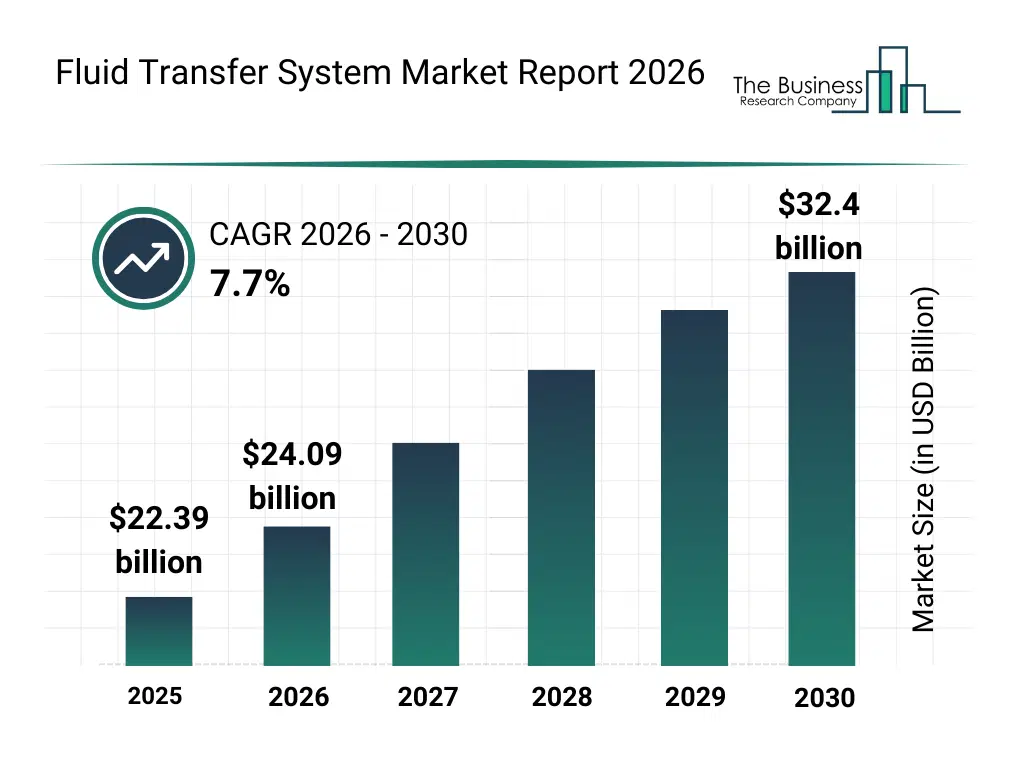
What Is The Fluid Transfer System Market Size and Share 2026?
The fluid transfer system market size has grown strongly in recent years. It will grow from $22.39 billion in 2025 to $24.09 billion in 2026 at a compound annual growth rate (CAGR) of 7.6%. The growth in the historic period can be attributed to automotive production growth, demand for fuel efficiency, expansion of emission control systems, material innovation, vehicle safety requirements.What Is The Fluid Transfer System Market Growth Forecast?
The fluid transfer system market size is expected to see strong growth in the next few years. It will grow to $32.4 billion in 2030 at a compound annual growth rate (CAGR) of 7.7%. The growth in the forecast period can be attributed to electric vehicle thermal management demand, lightweight vehicle design, stricter emission standards, smart fluid routing, advanced material adoption. Major trends in the forecast period include growth of lightweight fluid lines, demand for corrosion-resistant materials, expansion of automotive fluid management, adoption of emission control lines, integration of smart fluid systems.
Global Fluid Transfer System Market Segmentation
1) By Type: Air Suspension Lines, Fuel Lines, Brake Lines, AC Lines, Diesel Particulate Filter (DPF) Lines, Selective Catalytic Reduction (SCR) Lines, Transmission Oil Cooling Lines, Turbo Coolant Lines 2) By Material: Nylon, Stainless Steel, Aluminum, Steel, Rubber, Other Materials 3) By Application: Automotive, Aerospace, Manufacturing, Other Applications Subsegments: 1) By Air Suspension Lines: Air Supply Lines, Air Drain Lines 2) By Fuel Lines: High-Pressure Fuel Lines, Low-Pressure Fuel Lines 3) By Brake Lines: Hydraulic Brake Lines, Pneumatic Brake Lines 4) By AC Lines: High-Pressure AC Lines, Low-Pressure AC Lines 5) By Diesel Particulate Filter (DPF) Lines: DPF Inlet Lines, DPF Outlet Lines 6) By Selective Catalytic Reduction (SCR) Lines: SCR Injection Lines, SCR Return Lines 7) By Transmission Oil Cooling Lines: Transmission Oil Supply Lines, Transmission Oil Return Lines 8) By Turbo Coolant Lines: Turbo Inlet Lines, Turbo Outlet LinesWhat Is The Driver Of The Fluid Transfer System Market?
The globalization of trade is expected to propel the growth of the fluid transfer system going forward. Globalization of trade refers to the interconnectedness and integration of economies worldwide through the exchange of goods, services, information, and capital across national borders. Fluid transfer systems facilitate the globalization of trade by enabling efficient movement of liquids and gases, crucial for industries like energy, manufacturing, and agriculture, promoting seamless international supply chains. For instance, in April 2024, according to the data published by the Bureau of Economic Analysis (BEA), a US-based federal statistical agency, the U.S. experienced a goods and services deficit of $70.4 billion in August 2024, a decrease from $78.9 billion in July, while exports rose by 3.9% year-over-year and imports increased by 4.9%, highlighting the ongoing globalization of trade through robust cross-border economic interactions. Therefore, the globalization of trade is driving the growth of the fluid transfer system.Key Players In The Global Fluid Transfer System Market
Major companies operating in the fluid transfer system market report include Cooper-Standard Automotive Inc., TI Fluid Systems PLC, Gates Industrial Corporation PLC, Tristone Flowtech Group SAS, AGS Automotive Solutions, Kongsberg Automotive Holdings AS, Continental Aktiengesellschaft, Hutchinson S.A., Graco Inc., Sanoh Industrial Co. Ltd., Yamada America Inc., Kros Otomotiv Sanayi ve Ticaret A.S., Balcrank Corporation, MGI Coutier, Parker-Hannifin Corporation, Pirtek Fluid Systems Pty. Ltd., Eaton Corporation, Compagnie de Saint-Gobain S.A., Smiths Group PLC, W. L. Gore & Associates Inc., Festo AG & Co. KG, Swagelok Company, Christian Bürkert GmbH & Co. KG, The Flowserve Corporation, ITT Inc.
This chart is for illustrative purposes; the full report includes a detailed competitor analysis and comprehensive overview of the top 10 companies in the market.
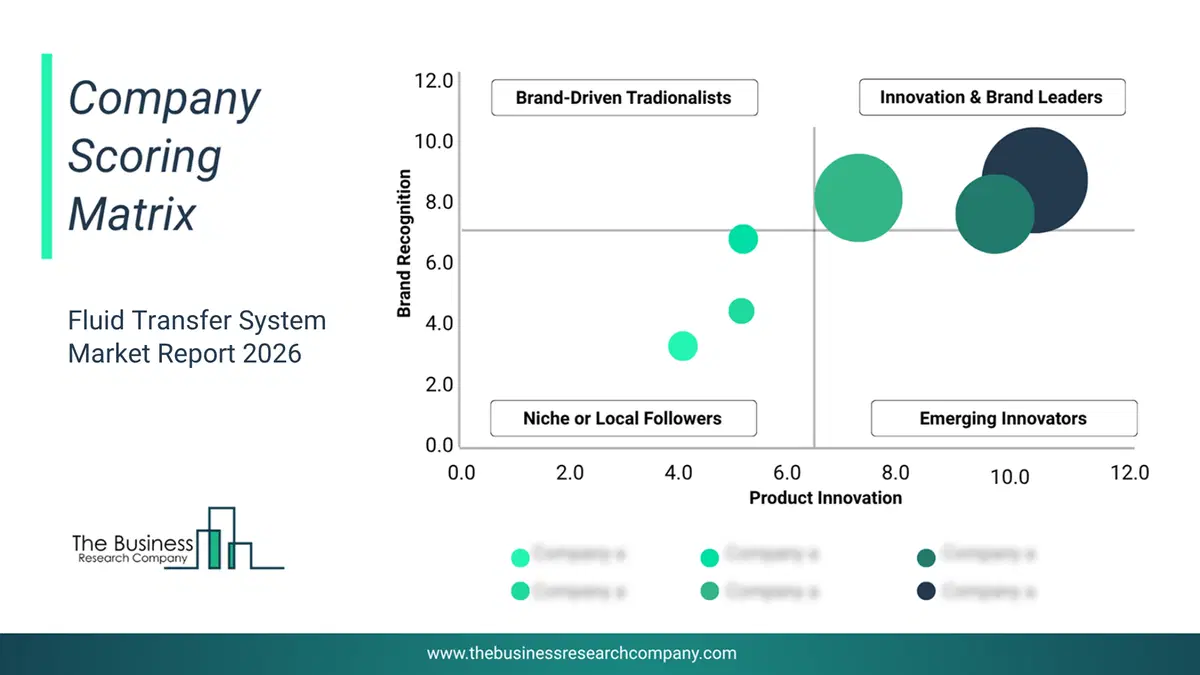
This chart maps companies by product innovation and brand strength, with bubble size indicating relative revenue, helping identify market leaders, challengers, and niche players. This is an illustrative chart; the full report provides a complete and accurate competitive analysis.
Global Fluid Transfer System Market Trends and Insights
Major companies operating in the fluid transfer system market are launching innovative products such as compact energy-efficient solenoid valves to provide OEMs with more efficient, compact, and versatile fluid control solutions that optimize equipment design and performance. Compact energy-efficient solenoid valves are electromechanical devices designed to control fluid flow with minimal power consumption while maintaining a small footprint, making them ideal for applications requiring precise and rapid actuation in confined spaces. For instance, in January 2023, Emerson Electric Co., a US-based engineering company, launched its ASCO Series 256/356 solenoid valves. These valves offer smaller footprints, up to 40% reduced power consumption, and up to 30% higher pressure ratings. The Series 256/356 also offers an expanded selection of body materials, including lead-free brass, stainless steel, and an engineered composite material that is 20% lighter than brass.What Are Latest Mergers And Acquisitions In The Fluid Transfer System Market?
In June 2025, Hydrasun Ltd., a UK-based fluid control and safety solutions company, acquired KC Controls LLP for an undisclosed amount. Through this acquisition, Hydrasun aims to broaden its product portfolio and enhance its footprint in the industrial fluid handling and safety market while driving growth, improving service capabilities, and delivering greater value to customers across the UK and international markets. KC Controls LLP is a UK-based company that specializes in providing industrial fluid handling solutions and related safety products.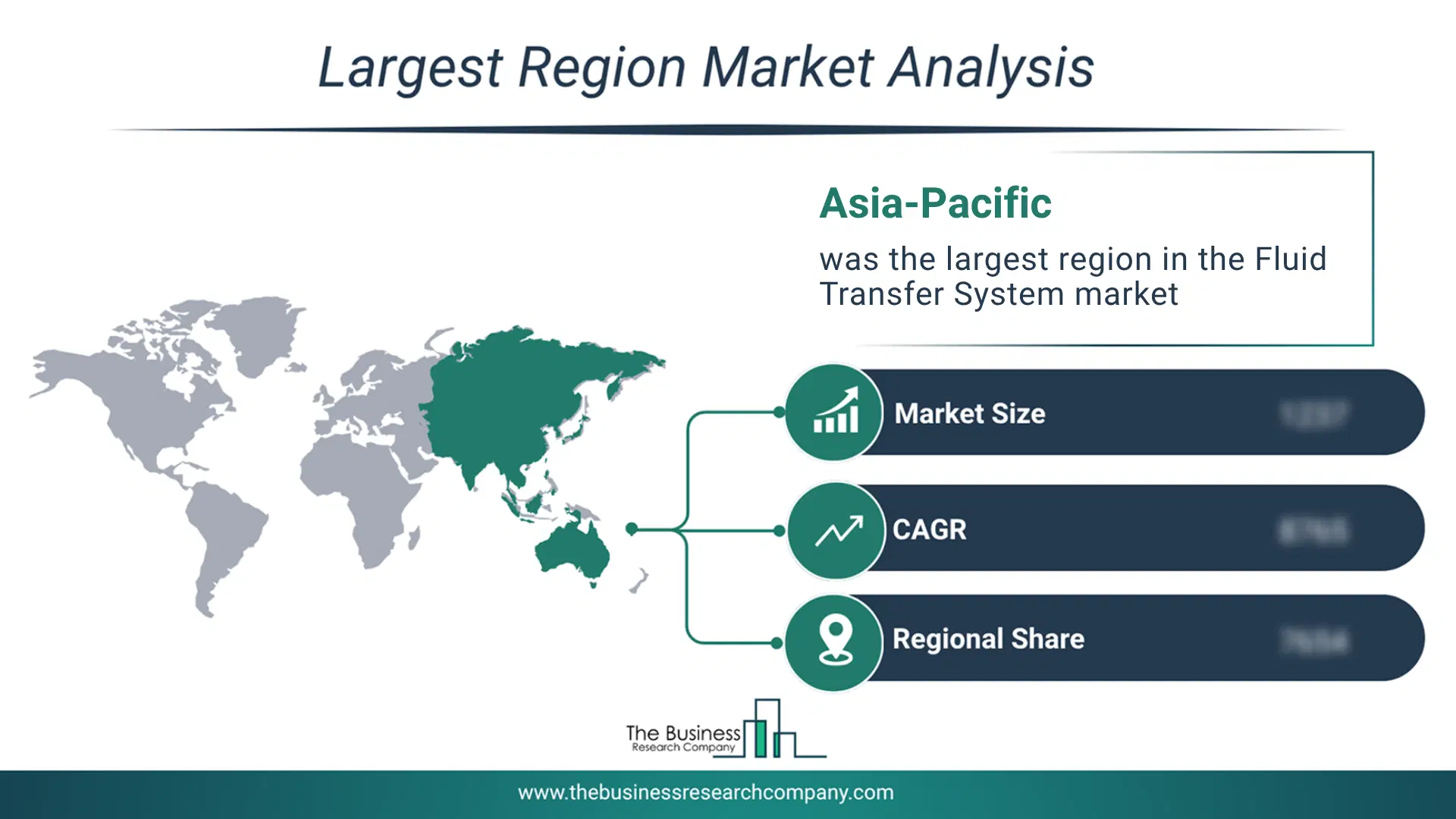
Regional Outlook
Asia-Pacific was the largest region in the fluid transfer system market in 2025 and is expected to be the fastest-growing region in the forecast period. The regions covered in this market report include Asia-Pacific, South East Asia, Western Europe, Eastern Europe, North America, South America, Middle East, Africa. The countries covered in this market report include Australia, Brazil, China, France, Germany, India, Indonesia, Japan, Taiwan, Russia, South Korea, UK, USA, Canada, Italy, SpainWhat Defines the Fluid Transfer System Market?
The fluid transfer system market consists of sales of air suspension lines, selective catalytic reduction lines, brake lines, turbo coolant lines, and related products. Values in this market are ‘factory gate’ values, that is the value of the goods sold by the manufacturers or creator of the goods, whether to other entities (including downstream manufacturers, wholesalers, distributors, and retailers) or directly to end customers. The value of goods in this market includes related services sold by the creators of the goods.How is Market Value Defined and Measured?
The market value is defined as the revenues that enterprises gain from the sale of goods and/or services within the specified market and geography through sales, grants, or donations in terms of the currency (in USD unless otherwise specified). The revenues for a specified geography are consumption values that are revenues generated by organizations in the specified geography within the market, irrespective of where they are produced. It does not include revenues from resales along the supply chain, either further along the supply chain or as part of other products.
This chart presents market attractiveness based on a quantitative evaluation of growth, competition, strategic alignment, and risk, offering a clear view of opportunity areas for decision-making. This chart is for illustrative purposes; the full report contains the complete analysis.

This chart highlights the Total Addressable Market (TAM) by estimating the maximum revenue opportunity using an assumption-driven approach, supporting strategic planning and opportunity sizing across markets. The chart is illustrative; the full report provides a more comprehensive analysis.
What Key Data and Analysis Are Included in the Fluid Transfer System Market Report 2026?
The fluid transfer system market research report is one of a series of new reports from The Business Research Company that provides market statistics, including industry global market size, regional shares, competitors with the market share, detailed market segments, market trends and opportunities, and any further data you may need to thrive in the fluid transfer system industry. The market research report delivers a complete perspective of everything you need, with an in-depth analysis of the current and future state of the industry.Fluid Transfer System Market Report Forecast Analysis
| Report Attribute | Details |
|---|---|
| Market Size Value In 2026 | $24.09 billion |
| Revenue Forecast In 2030 | $32.4 billion |
| Growth Rate | CAGR of 7.6% from 2026 to 2030 |
| Base Year For Estimation | 2025 |
| Actual Estimates/Historical Data | 2020-2025 |
| Forecast Period | 2026 - 2030 - 2030 |
| Market Representation | Revenue in USD Billion and CAGR from 2026 to 2030 |
| Segments Covered | Type, Material, Application |
| Regional Scope | Asia-Pacific, Western Europe, Eastern Europe, North America, South America, Middle East, Africa |
| Country Scope | The countries covered in the report are Australia, Brazil, China, France, Germany, India, Indonesia, Japan, Taiwan, Russia, South Korea, UK, USA, Canada, Italy, Spain. |
| Key Companies Profiled | Cooper-Standard Automotive Inc., TI Fluid Systems PLC, Gates Industrial Corporation PLC, Tristone Flowtech Group SAS, AGS Automotive Solutions, Kongsberg Automotive Holdings AS, Continental Aktiengesellschaft, Hutchinson S.A., Graco Inc., Sanoh Industrial Co. Ltd., Yamada America Inc., Kros Otomotiv Sanayi ve Ticaret A.S., Balcrank Corporation, MGI Coutier, Parker-Hannifin Corporation, Pirtek Fluid Systems Pty. Ltd., Eaton Corporation, Compagnie de Saint-Gobain S.A., Smiths Group PLC, W. L. Gore & Associates Inc., Festo AG & Co. KG, Swagelok Company, Christian Bürkert GmbH & Co. KG, The Flowserve Corporation, ITT Inc. |
| Customization Scope | Request for Customization |
| Pricing And Purchase Options | Explore Purchase Options |