
Food Automation Market Report 2026
Global Outlook – By Type (Motors And Generators, Motor Controls, Discrete Controllers And Visualization, Rotary Products, Linear Products, Other Types), By Operation (Semi Automatic, Fully Automatic), By Component (Plant Instrumentation, Plant-Level Controls), By Application (Bakery Products, Drinks, Candy, Snacks, Fruits And Vegetables, Meat, Other Applications) – Market Size, Trends, Strategies, and Forecast to 2030
Food Automation Market Overview
• Food Automation market size has reached to $16.46 billion in 2025 • Expected to grow to $26.46 billion in 2030 at a compound annual growth rate (CAGR) of 9.9% • Growth Driver: Growing Adoption Of Automation Technology Revolutionizes The Food Automation Market • Market Trend: Investment In Industrial Automation And Digital Transformation Enhances Competitive Edge In The Food Automation Market • Western Europe was the largest region in 2025 and Asia-Pacific is the fastest growing region.What Is Covered Under Food Automation Market?
Food automation aims primarily to improve line efficiencies, increase productivity and production quality, and increase profit. Food automation is used in multiple food processing activities to reduce human input in food processing tasks. It is also used for food packaging, raw material mixing, and preparation area of products for quality and hygiene production. The main types of machines in the food automation market are motors and generators, motor controls, discrete controllers and visualization, rotary products, linear products, and others. The motors and generators are energy conversion machines used in the food industry. Motors and generators are used in food industry machinery for automating processing and other operations. Motors and generators have demand requirements in specific sectors such as fish, poultry, dairy, and baking goods. The food automation machines are either semi-automatic or fully automatic and have consists of components such as plant instrumentation, plant-level controls and enterprise-level controls. Food automation is mostly having applications in bakery products, drinks, candy, snacks, fruits and vegetables, meat and others.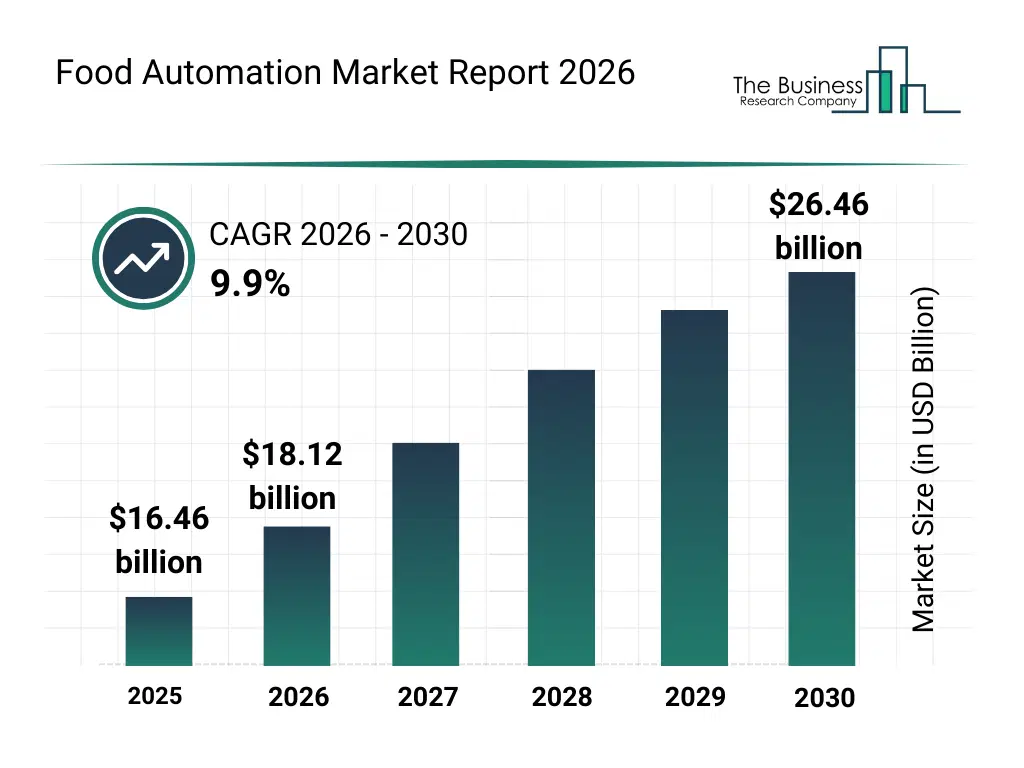
What Is The Food Automation Market Size and Share 2026?
The food automation market size has grown rapidly in recent years. It will grow from $16.46 billion in 2025 to $18.12 billion in 2026 at a compound annual growth rate (CAGR) of 10.1%. The growth in the historic period can be attributed to growing industrialization of food processing, rising labor cost pressures, increasing demand for packaged food products, expansion of large-scale food manufacturing facilities, adoption of mechanized production systems.What Is The Food Automation Market Growth Forecast?
The food automation market size is expected to see strong growth in the next few years. It will grow to $26.46 billion in 2030 at a compound annual growth rate (CAGR) of 9.9%. The growth in the forecast period can be attributed to increasing investments in smart food factories, rising adoption of AI-enabled quality inspection, expansion of ready-to-eat food consumption, growing focus on food safety compliance, increasing demand for flexible automation systems. Major trends in the forecast period include increasing adoption of fully automated food processing lines, rising integration of vision systems and sensors, growing demand for hygienic and contamination-free automation, expansion of robotics in packaging and handling, enhanced focus on operational efficiency.Tariff Impact On Food Automation Market
Tariffs are significantly impacting the food automation market by increasing the cost of imported motors, servo drives, programmable logic controllers, sensors, and industrial control systems that are critical for automated food processing lines. Food manufacturers in North America and Europe are particularly affected due to their reliance on imported automation components, while Asia-Pacific faces pricing pressure on exported automated systems. These tariffs are raising capital expenditure requirements and slowing automation upgrades for small and mid-sized processors. However, they are also encouraging localization of automation manufacturing, regional sourcing of control components, and innovation in cost-efficient automation architectures tailored to domestic food producers.
Global Food Automation Market Segmentation
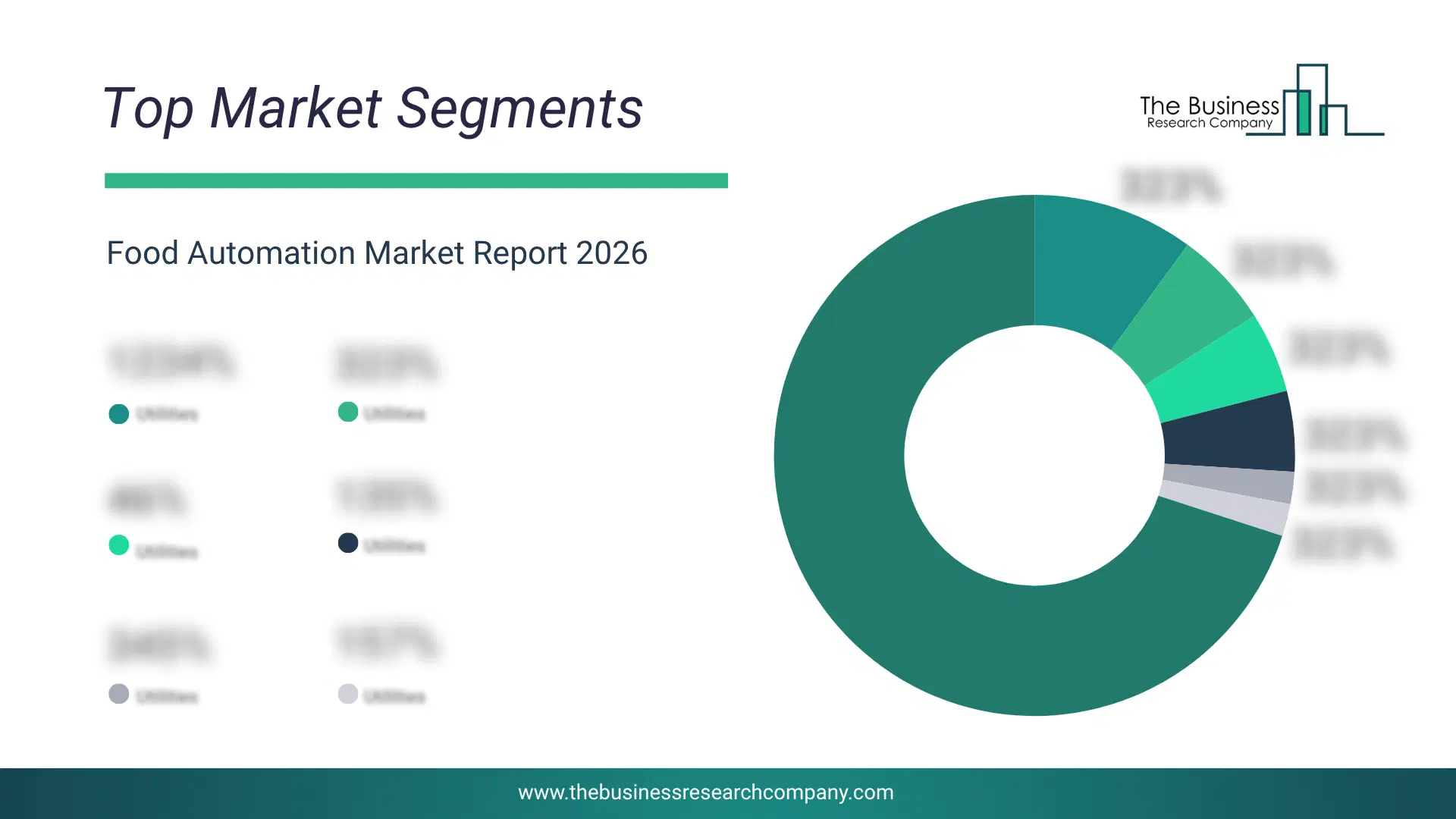
1) By Type: Motors And Generators, Motor Controls, Discrete Controllers And Visualization, Rotary Products, Linear Products, Other Types 2) By Operation: Semi Automatic, Fully Automatic 3) By Component: Plant Instrumentation, Plant-Level Controls 4) By Application: Bakery Products, Drinks, Candy, Snacks, Fruits And Vegetables, Meat, Other Applications Subsegments: 1) By Motors and Generators: AC Motors, DC Motors, Servo Motors, Stepper Motors 2) By Motor Controls: Variable Frequency Drives (VFD), Soft Starters, Motor Protection Relays 3) By Discrete Controllers and Visualization: Programmable Logic Controllers (PLC), Human-Machine Interfaces (HMI), Supervisory Control and Data Acquisition (SCADA) Systems 4) By Rotary Products: Rotary Actuators, Rotary Encoders, Gearboxes 5) By Linear Products: Linear Actuators, Linear Guides, Positioning Systems 6) By Other Types: Sensors and Switches, Safety Relays, Control PanelsWhat Is The Driver Of The Food Automation Market?
The increasing demand for processed foods is expected to drive the growth of food automation market going forward. Processed foods are items that have been modified from their natural form through methods such as canning, freezing, drying, or adding preservatives to enhance shelf life and convenience. The increasing demand for processed foods is driven by several factors, including busy lifestyles, growing urbanization, and the appeal of longer shelf life for convenience and reduced waste. Automated machines guarantee consistent product quality, minimizing the variations that can arise from manual labor. For instance, in July 2023, according to the American Frozen Food Institute (AFFI), a US-based professional organization, frozen fruit rose 8.8% in unit sales during the first half of 2023, while various meats, including processed chicken (+9.6%), breakfast sausage (+7.4%), and beef (+3.1%), and frozen meal solutions, such as pizza (+1.3%), side dishes (+3.2%), and potato products like fries (+0.6%) and tater tots (+8.2%), also saw increases. Therefore, the increasing demand for processed foods will drive the food automation industry growth.Key Players In The Global Food Automation Market
Major companies operating in the food automation market are ABB Group, GEA Group AG, Mitsubishi Electric Corporation, Rexnord Corporation, Rockwell Automation Inc., Schneider Electric SE, Honeywell International Inc., Emerson Electric Company, Siemens AG, Yokogawa Electric Corporation, Yaskawa Electric Corporation, MicroThermics Inc., Semi-Bulk Systems Inc., Atlantic Packaging Products Ltd., Endress+Hauser Group, Krones AG, Tetra Pak International S.A., Robert Bosch GmbH, Duravant LLC, Bühler AG, JBT Corporation, Heat and Control Inc., Key Technology Inc., FANUC Corporation, Kawasaki Heavy Industries Ltd., KUKA AG, Adept Technology Inc., Stäubli International AG, Omron Corporation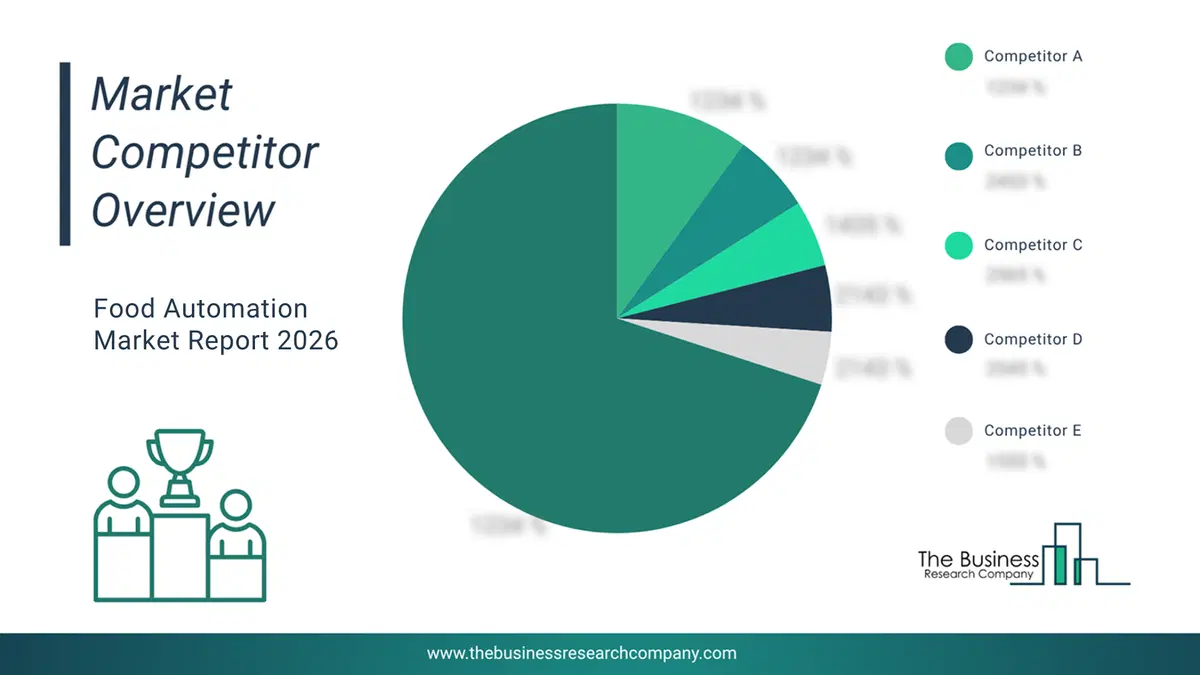
This chart is for illustrative purposes; the full report includes a detailed competitor analysis and comprehensive overview of the top 10 companies in the market.
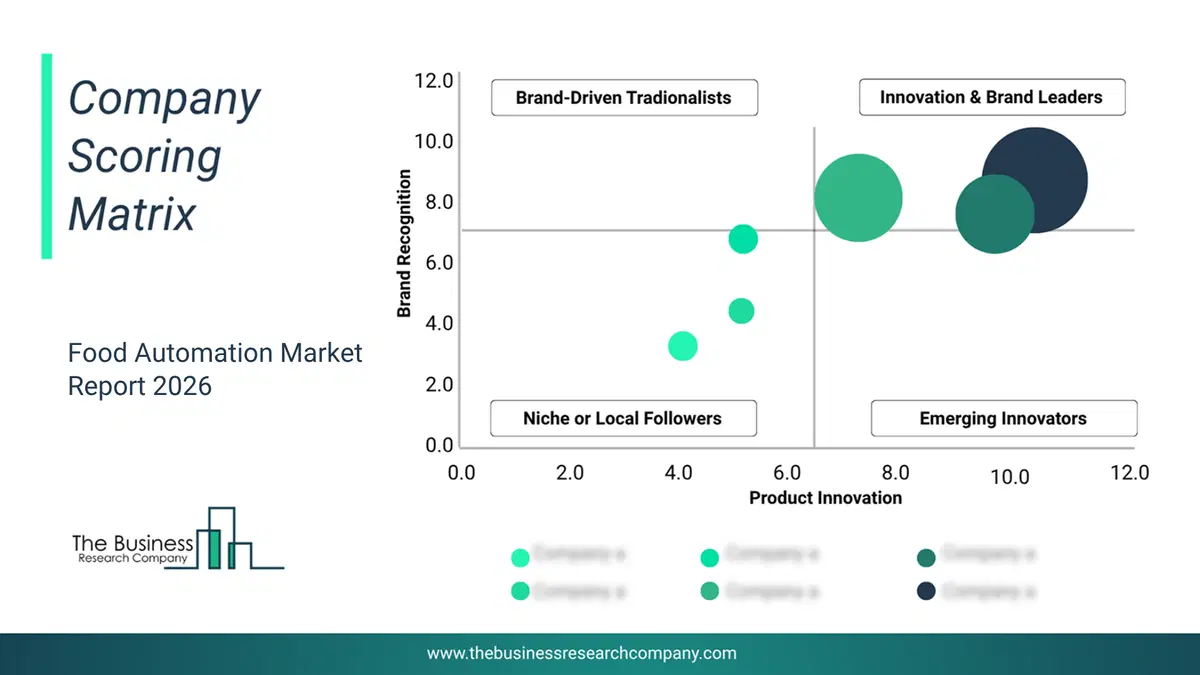
This chart maps companies by product innovation and brand strength, with bubble size indicating relative revenue, helping identify market leaders, challengers, and niche players. This is an illustrative chart; the full report provides a complete and accurate competitive analysis.
Global Food Automation Market Trends and Insights
Major companies operating in the food automation market are focusing on new investment in industrial automation and digital transformation to gain competitive advantage. Investment in industrial automation and digital transformation allow improved and fast implementation of powerful tool and result generation. For instance, in March 2023, ForgeOS integrated with Rockwell’s Logix controllers and design and simulation software by Rockwell, the world’s largest company dedicated to industrial automation including food automation and READY Robotics, a pioneering company in software-defined automation. The combination will make robot integration easier and reduce industrial automation deployment time to market.What Are Latest Mergers And Acquisitions In The Food Automation Market?
In March 2025, Hanwha Foodtech Global Inc., a US-based foodtech company, acquired Stellar Pizza or an undisclosed amount. With this acquisition, Hanwha Foodtech aims to accelerate its presence in automated food production and expand its technological capabilities in robotics-driven food services while leveraging Stellar Pizza’s innovative systems and operational expertise. Stellar Pizza is a US-based company that operates mobile, automated restaurants housed in food trucks that use robotics to make pizzas from scratch.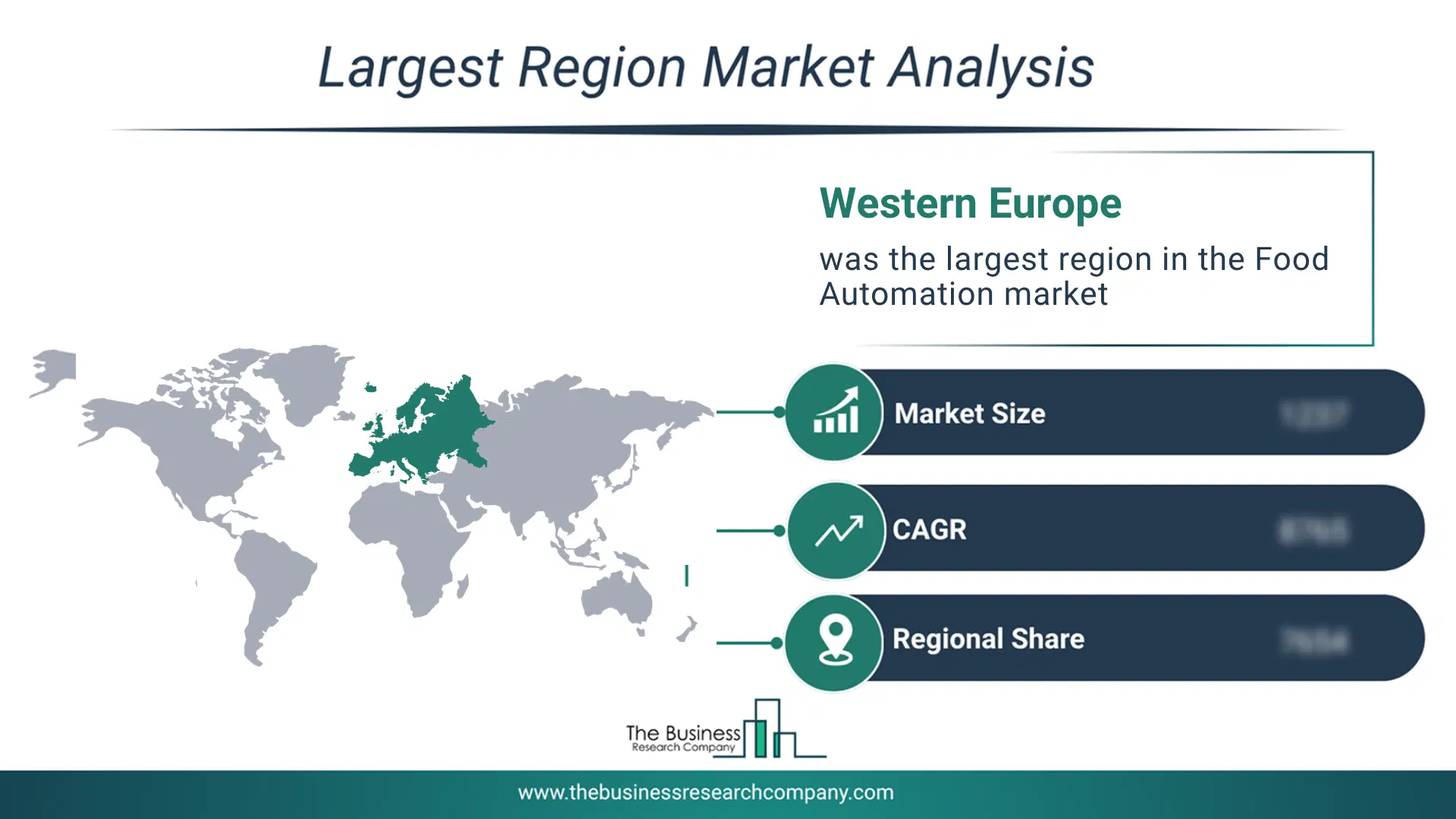
Regional Outlook
Western Europe was the largest region in the food automation market in 2025. Asia-Pacific is expected to be the fastest-growing region in the forecast period. The regions covered in this market report are Asia-Pacific, South East Asia, Western Europe, Eastern Europe, North America, South America, Middle East, Africa The countries covered in this market report are Australia, Brazil, China, France, Germany, India, Indonesia, Japan, Taiwan, Russia, South Korea, UK, USA, Canada, Italy, Spain.What Defines the Food Automation Market?
The food automation market consists of sales of food automation machines including manufacturing execution systems (MES), variable-frequency drive (VFD), valves and actuators, electric motors, sensors, and transmitters among others. Values in this market are ‘factory gate’ values, that is the value of goods sold by the manufacturers or creators of the goods, whether to other entities (including downstream manufacturers, wholesalers, distributors, and retailers) or directly to end customers. The value of goods in this market includes related services sold by the creators of the goods.How is Market Value Defined and Measured?
The market value is defined as the revenues that enterprises gain from the sale of goods and/or services within the specified market and geography through sales, grants, or donations in terms of the currency (in USD unless otherwise specified). The revenues for a specified geography are consumption values that are revenues generated by organizations in the specified geography within the market, irrespective of where they are produced. It does not include revenues from resales along the supply chain, either further along the supply chain or as part of other products.
This chart presents market attractiveness based on a quantitative evaluation of growth, competition, strategic alignment, and risk, offering a clear view of opportunity areas for decision-making. This chart is for illustrative purposes; the full report contains the complete analysis.

This chart highlights the Total Addressable Market (TAM) by estimating the maximum revenue opportunity using an assumption-driven approach, supporting strategic planning and opportunity sizing across markets. The chart is illustrative; the full report provides a more comprehensive analysis.
What Key Data and Analysis Are Included in the Food Automation Market Report 2026?
The food automation market research report is one of a series of new reports from The Business Research Company that provides market statistics, including industry global market size, regional shares, competitors with the market share, detailed market segments, market trends and opportunities, and any further data you may need to thrive in the food automation industry. The market research report delivers a complete perspective of everything you need, with an in-depth analysis of the current and future state of the industry.Food Automation Market Report Forecast Analysis
| Report Attribute | Details |
|---|---|
| Market Size Value In 2026 | $18.12 billion |
| Revenue Forecast In 2030 | $26.46 billion |
| Growth Rate | CAGR of 9.9% from 2026 to 2030 |
| Base Year For Estimation | 2025 |
| Actual Estimates/Historical Data | 2020-2025 |
| Forecast Period | 2026 - 2030 |
| Market Representation | Revenue in USD Billion and CAGR from 2026 to 2030 |
| Segments Covered | Type, Operation, Component, Application |
| Regional Scope | Asia-Pacific, Western Europe, Eastern Europe, North America, South America, Middle East, Africa |
| Key Companies Profiled | ABB Group, GEA Group AG, Mitsubishi Electric Corporation, Rexnord Corporation, Rockwell Automation Inc., Schneider Electric SE, Honeywell International Inc., Emerson Electric Company, Siemens AG, Yokogawa Electric Corporation, Yaskawa Electric Corporation, MicroThermics Inc., Semi-Bulk Systems Inc., Atlantic Packaging Products Ltd., Endress+Hauser Group, Krones AG, Tetra Pak International S.A., Robert Bosch GmbH, Duravant LLC, Bühler AG, JBT Corporation, Heat and Control Inc., Key Technology Inc., FANUC Corporation, Kawasaki Heavy Industries Ltd., KUKA AG, Adept Technology Inc., Stäubli International AG, Omron Corporation |
| Customization Scope | Request for Customization |
| Pricing And Purchase Options | Explore Purchase Options |