
Forestry And Logging Market 2025
By Type (Logging, Timber Tract Operations, Forest Nurseries And Gathering Of Forest Products), By Application (Construction, Industrial Goods, Other Applications), And By Region, Opportunities And Strategies – Global Forecast To 2035
Forestry And Logging Market Definition
Forestry and logging refers to the industry involved in the management, cultivation, and harvesting of forests for timber and other forest products. This market includes activities such as growing and managing forests, harvesting trees, gathering forest products, and related operations. It forms the upstream segment of the broader wood products value chain and provides essential raw materials for construction, manufacturing, and energy sectors. Forestry and logging products are used by construction companies, industrial manufacturers (such as furniture and paper producers), and energy firms, particularly those utilizing biomass. The forestry and logging market consists of revenues earned by entities (organizations, sole traders, or partnerships), by providing hardware, software and services related to the harvesting, collection, and initial processing of timber and other forest products.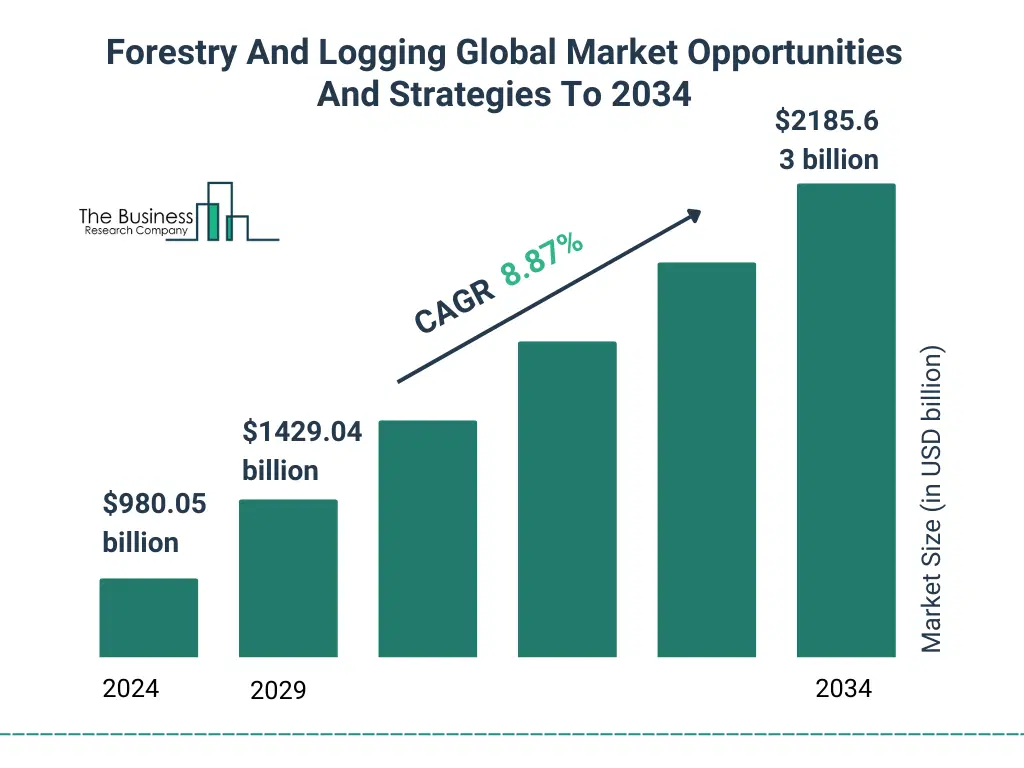
Forestry And Logging Market Size
The global forestry and logging market reached a value of nearly $980.05 billion in 2024, having grown at a compound annual growth rate (CAGR) of 8.17% since 2019. The market is expected to grow from $980.05 billion in 2024 to $1,429.04 billion in 2029 at a rate of 7.83%. The market is then expected to grow at a CAGR of 8.87% from 2029 and reach $2,185.63 billion in 2034. Growth in the historic period resulted from rise in demand from pulp and paper industry, boom in residential and commercial interiors fit-outs, rising popularity of wood-based sustainable building solutions and expansion of packaging industries using wood fiber. Factors that negatively affected growth in the historic period were deforestation regulations and illegal logging and weak enforcement mechanisms. Going forward, growing construction activity, growth of modular and prefabricated housing, government support for reforestation programs and strong demand from woodcraft and furniture manufacturing will drive growth. Factors that could hinder the growth of the forestry and logging market in the future include high operational costs, competition from flexible pouches and vulnerability to climate change and natural disasters.Forestry And Logging Market Drivers
The key drivers of the forestry and logging market include: Growing Construction Activity The anticipated increase in construction activity is expected to be a major driver of growth in the forestry and logging market over the forecast period. As global construction accelerates, demand for timber as a key building material will rise accordingly. This trend will push forestry and logging companies to boost supply, enhance harvesting efficiency, and strengthen their distribution networks. Additionally, the growing alignment between wood usage in construction and sustainability objectives will further solidify timber’s importance in the sector. Over time, forestry is likely to become a more strategic industry, closely linked to infrastructure development and attracting greater investment in sustainable harvesting practices to ensure the long-term availability of wood for construction needs. The growing construction activity growth contribution during the forecast period in 2024 is 1.75%.Forestry And Logging Market Restraints
The key restraints on the forestry and logging market include: High Operational Costs High operational costs are anticipated to constrain the growth of the forestry and logging market during the forecast period. Forestry operations incur substantial expenses related to labor, equipment, fuel, transportation, and compliance with stringent safety and environmental regulations. These rising costs can significantly reduce profit margins, particularly for smaller operators, limiting their capacity to invest in modern technologies or scale up production. Over time, this financial pressure may also deter new market entrants, slowing overall industry expansion. Furthermore, volatility in energy and raw material prices adds to the challenge, making long-term cost planning and management increasingly difficult for forestry businesses. Growth affected by high operational costs during the forecast period in 2024 is -0.75%.Forestry And Logging Market Trends
Major trends shaping the forestry and logging market include: Technological Advancements In Forestry Machinery Major companies in the market are focusing on integrating advanced technologies like automation, GPS tracking, and remote sensing into forestry machinery. These innovations improve operational efficiency, reduce labor costs, and enhance safety in logging activities. Modern equipment such as harvesters and forwarders now offer precision and speed, enabling sustainable forest management. This technological progress is driving growth in the forestry and logging market by increasing productivity and minimizing environmental impact.For example, in June 2025, John Deere, John Deere, a US-based corporation that manufactures agricultural machinery, heavy equipment, forestry machinery, diesel engines, drivetrains used in heavy equipment and lawn care equipment, launched large-size H Series wheeled machines, designed to elevate productivity and operational efficiency. Featuring the all-new 1270H and 1470H Harvesters and 2010H and 2510H Forwarders, these machines integrate enhanced hydraulic systems, advanced automation and ergonomic operator enhancements. By combining powerful performance with sustainability-focused fuel economy, the H Series redefines modern logging operations. Adoption Of Advanced Mechanized And Digital Logging Equipment Major companies in the forestry and logging market are increasingly adopting advanced mechanized and digital logging equipment to improve efficiency, safety, and sustainability in forest operations. Modern harvesters, forwarders, and processors reduce labor intensity, increase precision in tree cutting, and minimize waste compared to traditional manual methods. Digital tools such as GPS tracking, automated sensors, and telematics further enhance monitoring, real-time decision-making, and predictive maintenance, making operations more productive and cost-efficient. For instance, in May 2025, Komatsu, a Sweden-based major global manufacturer of forestry machinery specializing in equipment for logging operations such as harvesters and forwarders, began trial use of forestry machines (harvesters and forwarders) adapted for the Cut-to-Length (CTL) method in Japan, integrating machine data such as GPS (global positioning system) location and forest stand distribution to optimize routing during harvesting and forwarding. This approach enabled improved route planning and resource allocation, helping minimize environmental impact and increase the economic viability of forestry operations in Japan. By leveraging Swedish expertise and Komatsu’s machinery innovations, Japanese forestry operators were able to explore higher-efficiency logging options, aligning with global sustainability trends.Opportunities And Recommendations In The Forestry And Logging Market
Opportunities – The top opportunities in the forestry and logging market segmented by type will arise in the logging segment, which will gain $378.77 billion of global annual sales by 2029. The top opportunities in the forestry and logging market segmented by application will arise in the construction segment, which will gain $263.42 billion of global annual sales by 2029. The forestry and logging market size will gain the most in Philippines at $64.73 billion. Recommendations- To take advantage of the opportunities, The Business Research Company recommends the forestry and logging companies to focus on technology integration and operational efficiency, focus on advanced mechanization and digital forestry tools, focus on scaling precision forestry adoption, focus on expanding plantations and integrating carbon projects, focus on capital deployment for sustainable timberland expansion, focus on sustainable certification to strengthen market access, focus on forest nurseries and gathering of forest products, expand in emerging markets, focus on strengthening multi-channel market access, focus on balanced and value-driven pricing strategies, strengthen value-based messaging and visibility, expand outreach channels and stakeholder engagement and focus on expanding supply for fast-growing diversified applications.
Forestry And Logging Market Segmentation
The forestry and logging market is segmented by type and by application.By Type –
The forestry and logging market is segmented by type into:
- a) Logging
- b) Timber Tract Operations
- c) Forest Nurseries And Gathering Of Forest Products
By Application –
The forestry and logging market is segmented by application into:
- a) Construction
- b) Industrial Goods
- c) Other Applications
By Geography - The forestry and logging market is segmented by geography into:
- • China
- • India
- • Japan
- • Australia
- • Indonesia
- • South Korea
- • Bangladesh
- • Thailand
- • Vietnam
- • Malaysia
- • Singapore
- • Phillipines
- • Hong kong
- • New Zealand
- • USA
- • Canada
- • Mexico
- • Brazil
- • Argentina
- • Chile
- • Colombiia
- • Peru
- • France
- • Germany
- • UK
- • Italy
- • Spain
- • Austria
- • Belgium
- • Denmark
- • Finland
- • Ireland
- • Netherland
- • Norway
- • Portugal
- • Sweden
- • Switzerland
- • Russia
- • Czech Republic
- • Poland
- • Romania
- • Ukraine
- • Saudi Arabia
- • Israel
- • Iran
- • Turkey
- • UAE o Africa
- • Egypt
- • Nigeria
- • South Africa
-
o Asia Pacific