
Generative Design Software Market Report 2026
Global Outlook – By Component (Software, Services), By Deployment (On-Premises, Cloud), By Organization Size (Small And Medium-sized Businesses (SMBs), Large Enterprises), By Application (Automotive, Aerospace And Defense, Industrial Manufacturing, Building, Healthcare, Education, Energy, Electronics And Consumer Goods) – Market Size, Trends, Strategies, and Forecast to 2030
Generative Design Software Market Overview
• Generative Design Software market size has reached to $2.66 billion in 2025 • Expected to grow to $5.64 billion in 2030 at a compound annual growth rate (CAGR) of 15.6% • Growth Driver: Cloud Deployment Boosts Growth In Generative Design Software Market • Market Trend: Generative Design Market Surges as AI-Driven Optimization Tools Gain Momentum • North America was the largest region in 2025 and Asia-Pacific is the fastest growing region.What Is Covered Under Generative Design Software Market?
Generative design software is a computer-aided tool that uses machine intelligence and algorithms to generate and explore a wide range of manufacturing-ready solutions based on specific product cost, materials, and performance constraints, enabling designers and engineers to accelerate the delivery of innovative products. It revolutionizes traditional design processes by leveraging advanced computational capabilities to rapidly iterate through countless design alternatives, ultimately enabling the creation of optimized solutions that may have otherwise remained undiscovered. The main types of components of generative design software are software and services. Software refers to a set of instructions and data that enables a computer or other device to perform specific tasks or functions. Generative design software is deployed on-premises and in the cloud and used by organizations of all sizes, including small and medium-sized businesses (SMBs) and large enterprises. The applications of generative design software include automotive, aerospace and defense, industrial manufacturing, building, healthcare, education, energy, electronics, and consumer goods.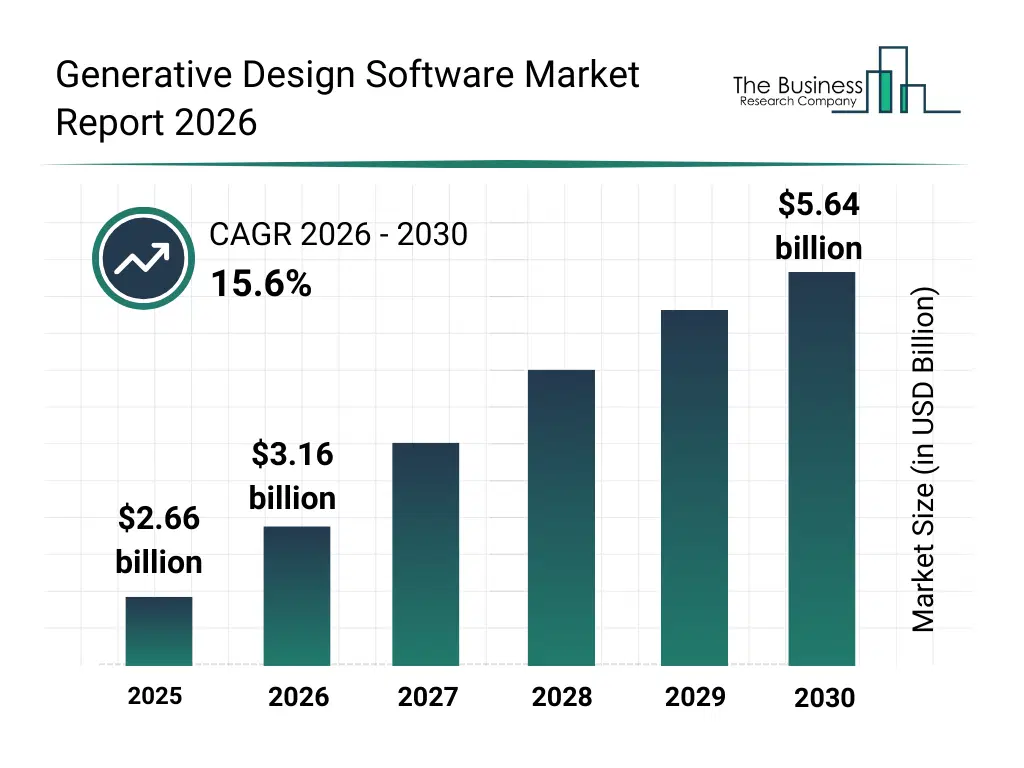
What Is The Generative Design Software Market Size and Share 2026?
The generative design software market size has grown rapidly in recent years. It will grow from $2.66 billion in 2025 to $3.16 billion in 2026 at a compound annual growth rate (CAGR) of 18.5%. The growth in the historic period can be attributed to manual design workflows, reliance on traditional cad tools, limited computational power, growing complexity of product designs, adoption of basic simulation tools.What Is The Generative Design Software Market Growth Forecast?
The generative design software market size is expected to see rapid growth in the next few years. It will grow to $5.64 billion in 2030 at a compound annual growth rate (CAGR) of 15.6%. The growth in the forecast period can be attributed to integration of AI and machine learning in design software, cloud-based generative design platforms, increasing adoption in automotive and aerospace sectors, demand for cost and material optimization, expansion of consulting and integration services. Major trends in the forecast period include topology optimization software and structural design, parametric and geometry-based design tools, simulation and performance analysis software, algorithmic design platforms and pattern generation, 3D modeling and cad integration.
Global Generative Design Software Market Segmentation
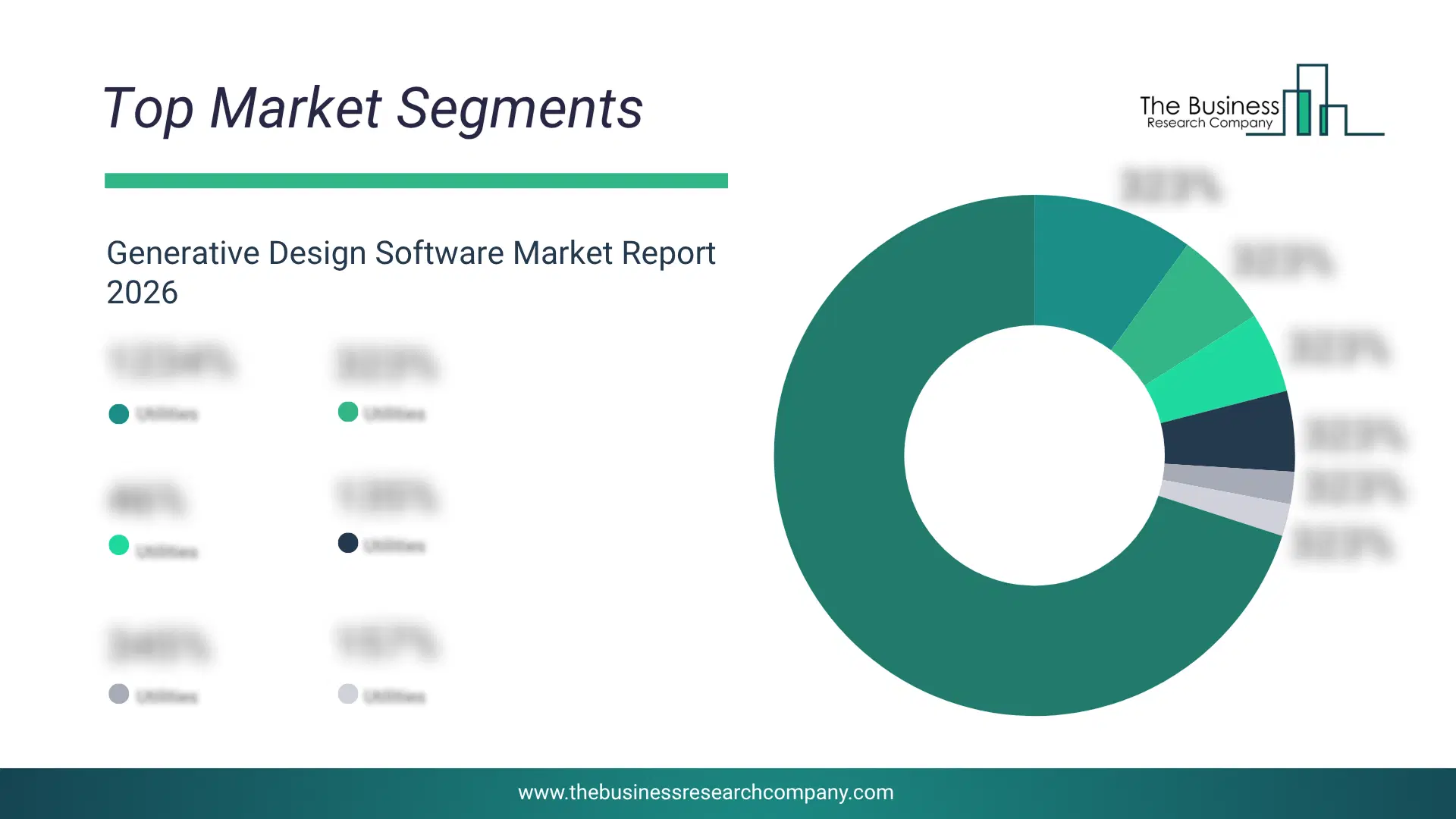
1) By Component: Software, Services 2) By Deployment: On-Premises, Cloud 3) By Organization Size: Small And Medium-sized Businesses (SMBs), Large Enterprises 4) By Application: Automotive, Aerospace And Defense, Industrial Manufacturing, Building, Healthcare, Education, Energy, Electronics And Consumer Goods Subsegments: 1) By Software: Topology Optimization Software, Parametric Design Tools, Simulation And Analysis Software, Algorithmic Design Platforms, 3D Modeling And CAD Integration Software 2) By Services: Generative Design Consulting, Custom Software Development, Implementation And Integration Services, Training And Support ServicesWhat Is The Driver Of The Generative Design Software Market?
The increasing deployment of cloud-based solutions is expected to propel the generative design software market going forward. Cloud-based solutions refer to software, services, or resources that are hosted and accessed remotely via the Internet, offering scalability, flexibility, and accessibility from any device with an Internet connection. The increasing deployment of cloud-based solutions is driven by the demand for scalability, cost-efficiency, flexibility, and accessibility, enabling businesses to adapt to evolving technological needs and enhance operational efficiency. Cloud deployment for generative design software enables scalable computing power and collaborative design processes, facilitating rapid iteration and optimization of complex designs with ease. For instance, in April 2025, according to the American Bar Association, a U.S.-based professional organization, approximately 75% of attorneys reported using cloud computing for work-related tasks, up from 69% in 2023 and about 70% in 2022. Therefore, the increasing deployment of cloud-based solutions is driving the growth of the generative design software industry.Key Players In The Global Generative Design Software Market
Major companies operating in the generative design software market are Siemens AG; Accenture PLC; Dassault Systèmes SE; Hexagon AB; Autodesk Inc.; ANSYS Inc.; PTC Inc.; Bentley Systems Inc.; Altair Engineering Inc.; ESI Group; Caracol AM; nTopology Inc.; Paramatters Inc; MSC Software; Carbon Inc; Bricsys NV (BricsCAD); Hyperganic Group GmbH; Vectorworks Inc.; CORTIME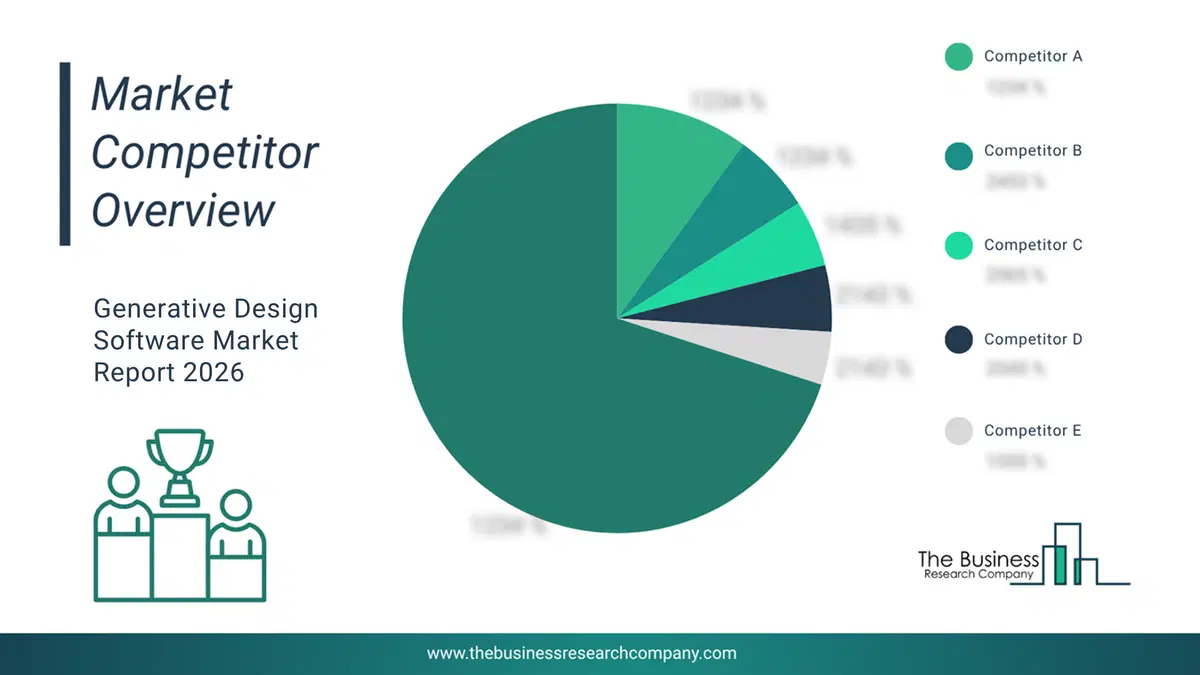
This chart is for illustrative purposes; the full report includes a detailed competitor analysis and comprehensive overview of the top 10 companies in the market.
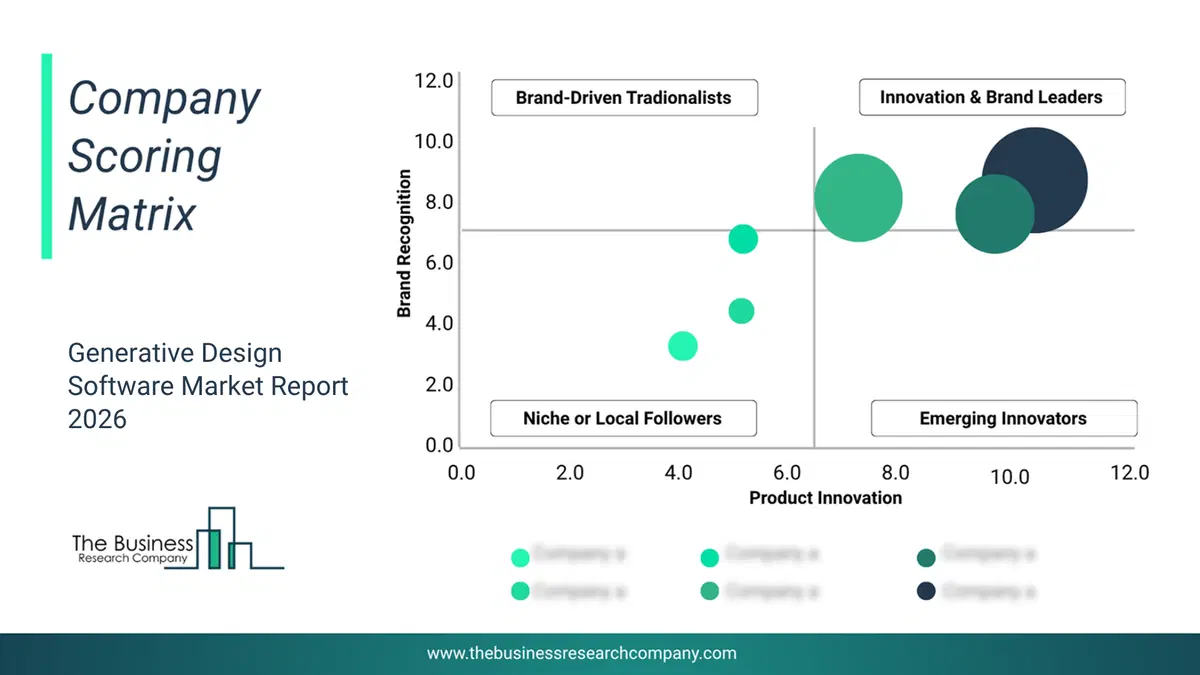
This chart maps companies by product innovation and brand strength, with bubble size indicating relative revenue, helping identify market leaders, challengers, and niche players. This is an illustrative chart; the full report provides a complete and accurate competitive analysis.
Global Generative Design Software Market Trends and Insights
Major companies operating in the generative design software market are focusing on developing innovative solutions, such as field-optimization and AI-assisted generative engines, to meet the rising demand for faster iteration, lighter-weight parts, and manufacturable topologies driven by additive manufacturing and sustainability targets. Field Optimization is a generative-design technology that uses spatially varying fields to guide automated geometry generation and optimization. For instance, in May 2023, nTopology Inc., a United States–based engineering software company, launched nTop 4, which introduced Field Optimization as a new generative design capability to help engineers navigate vast design parameter spaces more intuitively and reproducibly. nTop 4’s Field Optimization is composed of modular computational building blocks and implicit modeling kernels that generate editable, high-fidelity CAD geometry directly from optimized fields; it functions by letting users define multi-objective constraints and field-driven rules, then produces manufacturable lattice and organic structures as outputs; its unique features include reusable workflows, explicit control of local mechanical properties, and tight integration with additive-manufacturing toolchains.What Are Latest Mergers And Acquisitions In The Generative Design Software Market?
In February 2025, Chaos Inc., a Germany-based technology company, acquired EvolveLAB LLC for an undisclosed amount. With this acquisition, Chaos Inc., aims to reinforce and extend its design-to-visualization workflow by integrating EvolveLAB’s AI capabilities to accelerate BIM automation, AI-driven ideation, generative design and documentation across the AEC market. EvolveLAB LLC is a U.S.-based technology company that specializes in AI software for architects.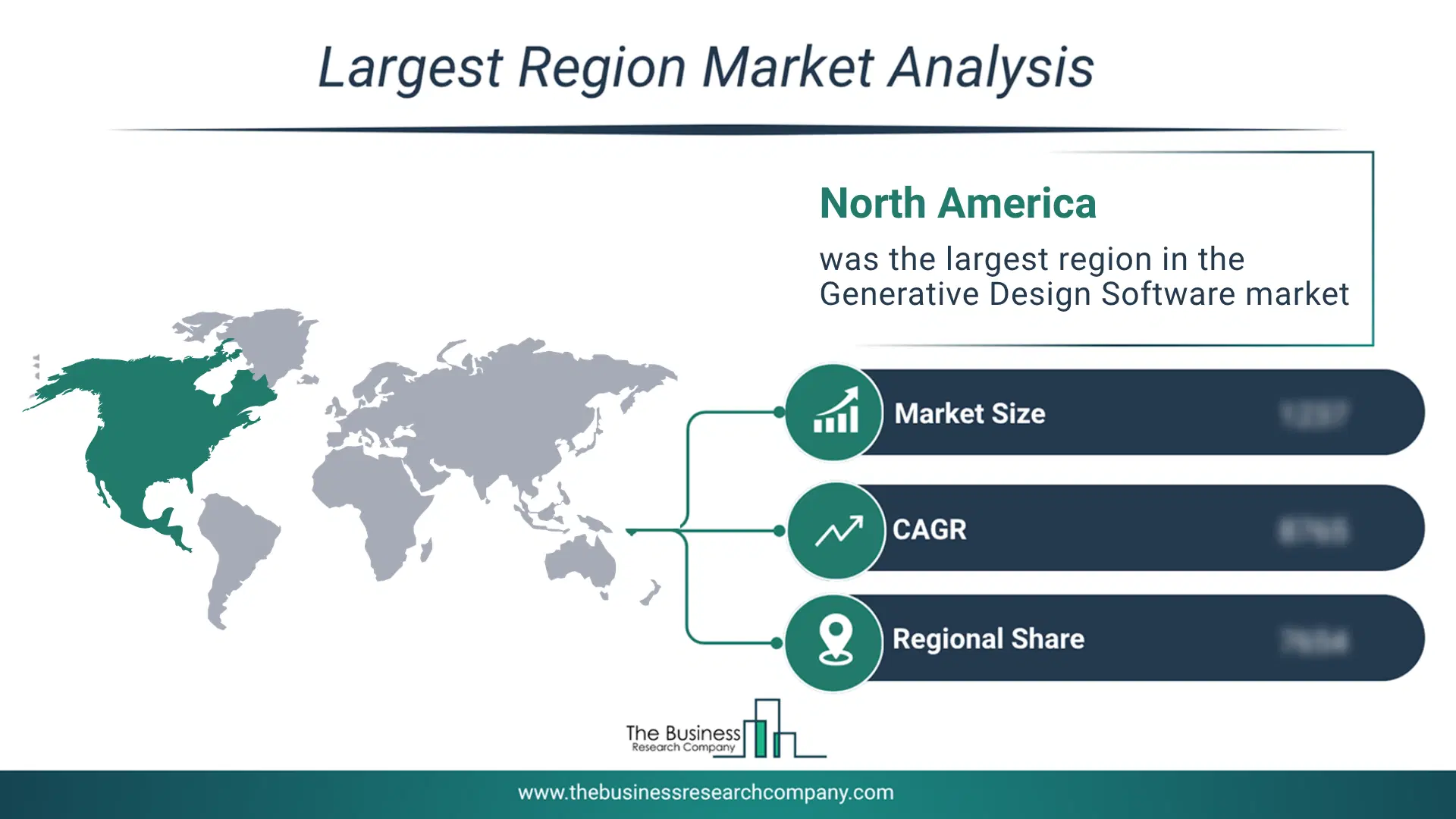
Regional Insights
North America was the largest region in the generative design software market in 2025. Asia-Pacific is expected to be the fastest-growing region in the forecast period. The regions covered in this market report are Asia-Pacific, South East Asia, Western Europe, Eastern Europe, North America, South America, Middle East, Africa. The countries covered in this market report are Australia, Brazil, China, France, Germany, India, Indonesia, Japan, Taiwan, Russia, South Korea, UK, USA, Canada, Italy, SpainWhat Defines the Generative Design Software Market?
The generative design software market includes revenues earned by entities by parametric modeling, topology optimization, lattice structure generation, and design exploration. The market value includes the value of related goods sold by the service provider or included within the service offering. Only goods and services traded between entities or sold to end consumers are included.How is Market Value Defined and Measured?
The market value is defined as the revenues that enterprises gain from the sale of goods and/or services within the specified market and geography through sales, grants, or donations in terms of the currency (in USD unless otherwise specified). The revenues for a specified geography are consumption values that are revenues generated by organizations in the specified geography within the market, irrespective of where they are produced. It does not include revenues from resales along the supply chain, either further along the supply chain or as part of other products.
This chart presents market attractiveness based on a quantitative evaluation of growth, competition, strategic alignment, and risk, offering a clear view of opportunity areas for decision-making. This chart is for illustrative purposes; the full report contains the complete analysis.

This chart highlights the Total Addressable Market (TAM) by estimating the maximum revenue opportunity using an assumption-driven approach, supporting strategic planning and opportunity sizing across markets. The chart is illustrative; the full report provides a more comprehensive analysis.
What Key Data and Analysis Are Included in the Generative Design Software Market Report 2026?
The generative design software market research report is one of a series of new reports from The Business Research Company that provides market statistics, including industry global market size, regional shares, competitors with the market share, detailed market segments, market trends and opportunities, and any further data you may need to thrive in the generative design software industry. The market research report delivers a complete perspective of everything you need, with an in-depth analysis of the current and future state of the industry.Generative Design Software Market Report Forecast Analysis
| Report Attribute | Details |
|---|---|
| Market Size Value In 2026 | $3.16 billion |
| Revenue Forecast In 2030 | $5.64 billion |
| Growth Rate | CAGR of 15.6% from 2026 to 2030 |
| Base Year For Estimation | 2025 |
| Actual Estimates/Historical Data | 2020-2025 |
| Forecast Period | 2026 - 2030 |
| Market Representation | Revenue in USD Billion and CAGR from 2026 to 2030 |
| Segments Covered | Component, Deployment, Organization Size, Application |
| Regional Scope | Asia-Pacific, Western Europe, Eastern Europe, North America, South America, Middle East, Africa |
| Country Scope | The Countries Covered In This Market Report Are Australia, Brazil, China, France, Germany, India, Indonesia, Japan, Taiwan, Russia, South Korea, Uk, Usa, Canada, Italy, Spain. |
| Key Companies Profiled | Siemens AG, Accenture PLC, Dassault Systèmes SE, Hexagon AB, Autodesk Inc., ANSYS Inc., PTC Inc., Bentley Systems Inc., Altair Engineering Inc., ESI Group, Caracol AM, nTopology Inc., Paramatters Inc, MSC Software, Carbon Inc, Bricsys NV (BricsCAD), Hyperganic Group GmbH, Vectorworks Inc., CORTIME |
| Customization Scope | Request for Customization |
| Pricing And Purchase Options | Explore Purchase Options |