
Robotic Welding Cell For Exhaust Fabrication Market Report 2026
Global Outlook – By Component (Robots, Welding Equipment, Controllers, Safety Devices, Other Components), By Welding Type (Metal Inert Gas (MIG) Welding, Tungsten Inert Gas (TIG) Welding, Spot Welding, Laser Welding, Other Welding Types), By Application (Automotive Exhaust Systems, Industrial Exhaust Systems, Other Applications), By End-User (Automotive, Aerospace, Industrial Manufacturing, Other End-Users) – Market Size, Trends, Strategies, and Forecast to 2030
Robotic Welding Cell For Exhaust Fabrication Market Overview
• Robotic Welding Cell For Exhaust Fabrication market size has reached to $1.45 billion in 2025 • Expected to grow to $2.36 billion in 2030 at a compound annual growth rate (CAGR) of 10.1% • Growth Driver: Rising Industrialization Driving The Growth Of The Market Due To Increasing Need For Automated And Scalable Manufacturing Processes • Market Trend: AI-Driven Robotic Systems Redefine Precision And Flexibility In Automated Welding • North America was the largest region in 2025 and Asia-Pacific is the fastest growing region.What Is Covered Under Robotic Welding Cell For Exhaust Fabrication Market?
A robotic welding cell for exhaust fabrication is an automated system designed to perform precise welding operations on exhaust components. It integrates robotic arms, welding equipment, and fixtures to ensure consistent quality and high production efficiency. The system is programmed to handle complex geometries and repetitive tasks, reducing manual labor and minimizing errors. The main components of robotic welding cells for exhaust fabrication are robots, welding equipment, controllers, safety devices, and others. Robots refer to automated systems integrated with advanced welding equipment and controllers to perform precise and consistent welding operations in exhaust system manufacturing. The key welding types include metal inert gas (MIG) welding, tungsten inert gas (TIG) welding, spot welding, laser welding, and others. Major applications include automotive exhaust systems, industrial exhaust systems, and others, with primary end users being automotive, aerospace, industrial manufacturing, and others.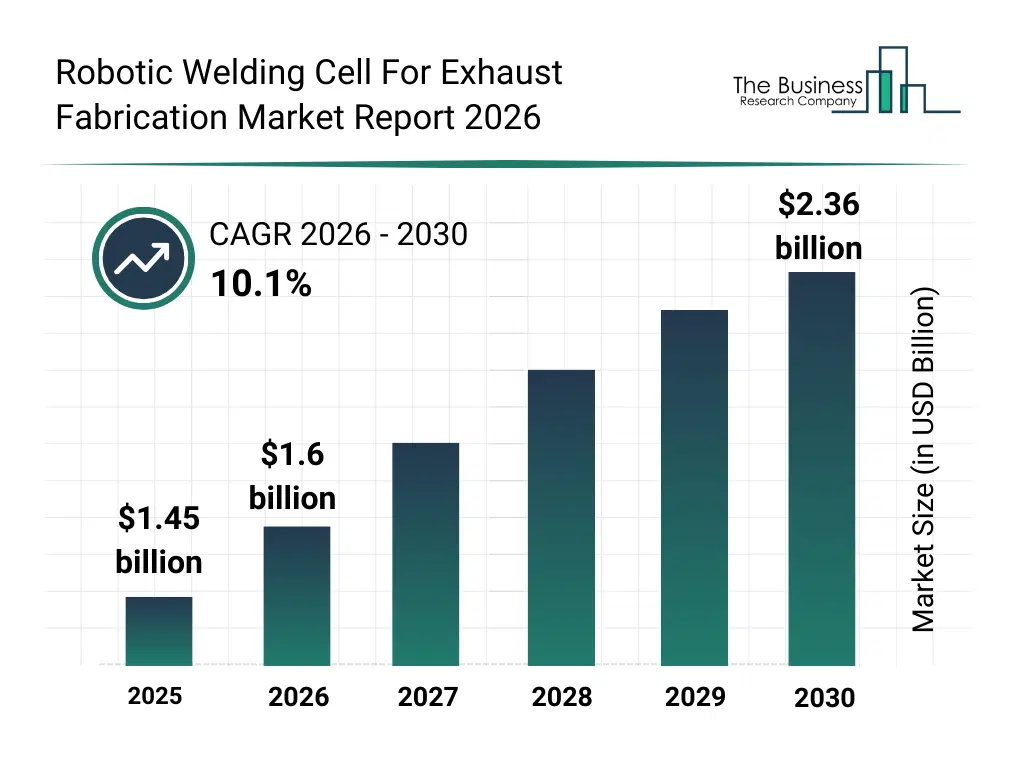
What Is The Robotic Welding Cell For Exhaust Fabrication Market Size and Share 2026?
The robotic welding cell for exhaust fabrication market size has grown rapidly in recent years. It will grow from $1.45 billion in 2025 to $1.6 billion in 2026 at a compound annual growth rate (CAGR) of 10.4%. The growth in the historic period can be attributed to expansion of automotive exhaust manufacturing, growth in emission control component production, increasing use of robotic welding, availability of advanced welding robots, rising focus on production efficiency.What Is The Robotic Welding Cell For Exhaust Fabrication Market Growth Forecast?
The robotic welding cell for exhaust fabrication market size is expected to see rapid growth in the next few years. It will grow to $2.36 billion in 2030 at a compound annual growth rate (CAGR) of 10.1%. The growth in the forecast period can be attributed to transition toward advanced exhaust system designs, increasing demand for precision welding, integration of smart welding analytics, expansion of electric and hybrid vehicle exhaust components, adoption of flexible manufacturing systems. Major trends in the forecast period include increasing adoption of fully automated exhaust welding cells, rising integration of multi-robot welding systems, growing use of laser and hybrid welding techniques, expansion of high-volume exhaust production lines, enhanced weld quality monitoring.Tariff Impact On Robotic Welding Cell For Exhaust Fabrication Market
Tariffs are influencing the robotic welding cell for exhaust fabrication market by increasing costs of imported robots, welding power sources, controllers, sensors, and safety systems. Automotive manufacturing regions in Europe, North America, and Asia-Pacific are most affected due to cross-border sourcing of advanced robotic welding equipment. These tariffs are raising production line investment costs and delaying modernization projects. However, they are also promoting regional robot manufacturing, localized system integration, and innovation in modular and scalable welding cell architectures.
Global Robotic Welding Cell For Exhaust Fabrication Market Segmentation
1) By Component: Robots, Welding Equipment, Controllers, Safety Devices, Other Components 2) By Welding Type: Metal Inert Gas (MIG) Welding, Tungsten Inert Gas (TIG) Welding, Spot Welding, Laser Welding, Other Welding Types 3) By Application: Automotive Exhaust Systems, Industrial Exhaust Systems, Other Applications 4) By End-User: Automotive, Aerospace, Industrial Manufacturing, Other End-Users Subsegments: 1) By Robots: Articulated Robots, SCARA Robots, Collaborative Robots (Cobots), Cartesian Or Gantry Robots, Dual-Arm Robots, Specialized Pipe Welding Robots 2) By Welding Equipment: Metal Inert Gas (MIG) Or Metal Active Gas (MAG) Welders, Tungsten Inert Gas (TIG) Welders, Spot Welders, Laser Welders, Plasma Welders, Arc Welders, Welding Torches, Wire Feeders 3) By Controllers: Robot Controllers, Welding Process Controllers, Programmable Logic Controllers (PLCs), Human-Machine Interfaces (HMIs), Motion Controllers, Teach Pendants 4) By Safety Devices: Light Curtains, Safety Scanners, Interlocked Doors, Emergency Stop Systems, Safety Mats, Area Sensors, Protective Enclosures 5) By Other Components: Positioners And Turntables, Fixtures And Jigs, Manipulators, Vision Systems, Seam Tracking Sensors, Cooling Systems, Fume Extraction Units, Cable AssembliesWhat Is The Driver Of The Robotic Welding Cell For Exhaust Fabrication Market?
The rising industrialization is expected to propel the growth of the robotic welding cell for exhaust fabrication market going forward. Industrialization is increasing due to the growing demand for mass production of goods driven by expanding global populations and urbanization. Robotic welding cells for exhaust fabrication enhance industrialization by automating precise, high-speed welding processes, improving production efficiency, consistency, and scalability in automotive and metal manufacturing. For instance, in September 2025, according to the Federal Reserve Board, a US-based governing body of the U.S. central banking system, industrial production (IP) recorded a modest increase of 0.1% in August compared to the previous month. Therefore, the rising industrialization is driving the growth of the robotic welding cell for exhaust fabrication industry.Key Players In The Global Robotic Welding Cell For Exhaust Fabrication Market
Major companies operating in the robotic welding cell for exhaust fabrication market are Panasonic Corporation, ABB Ltd., Kawasaki Heavy Industries Ltd., FANUC Corporation, Lincoln Electric Holdings Inc., Yaskawa Electric Corporation, Nachi-Fujikoshi Corp., Daihen Corporation, OTC Daihen Inc., Comau S.p.A., IGM Robotersysteme AG, Siasun Robot & Automation Co. Ltd., Miller Electric Mfg. LLC, Fronius International GmbH, Motoman Robotics, Wolf Robotics LLC, T. J. Snow Company Inc., Pemamek Oy, Trumpf Group, Hyundai Robotics, Cloos Robotic Welding Inc.
This chart is for illustrative purposes; the full report includes a detailed competitor analysis and comprehensive overview of the top 10 companies in the market.
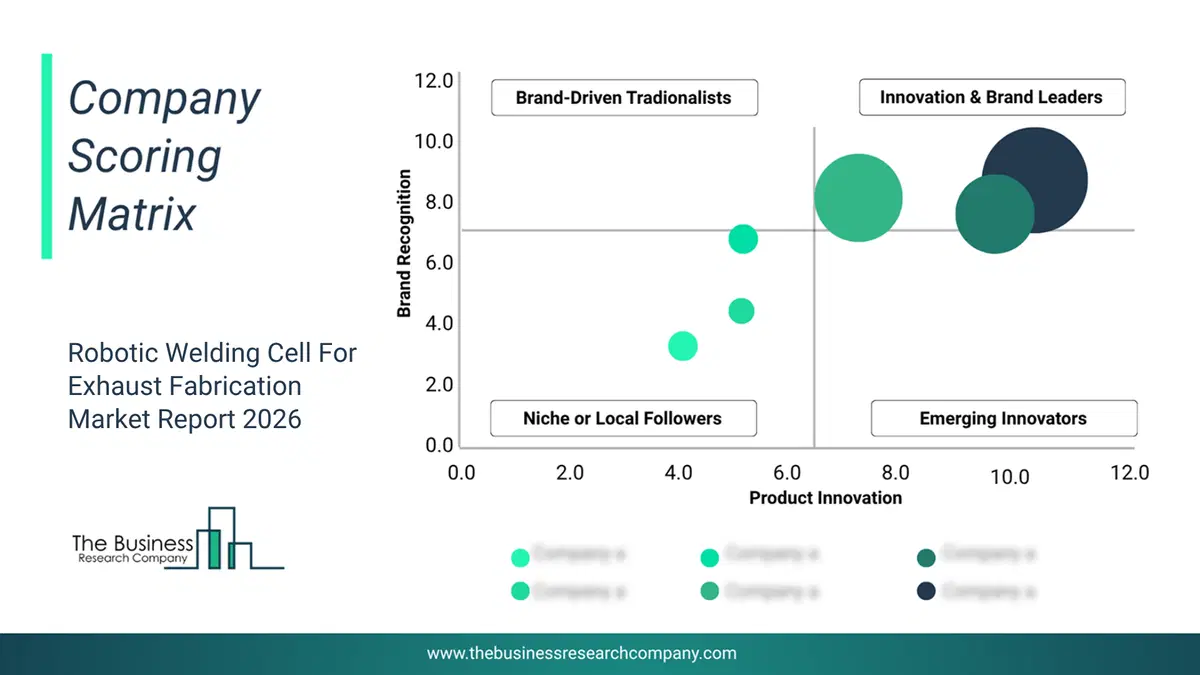
This chart maps companies by product innovation and brand strength, with bubble size indicating relative revenue, helping identify market leaders, challengers, and niche players. This is an illustrative chart; the full report provides a complete and accurate competitive analysis.
Global Robotic Welding Cell For Exhaust Fabrication Market Trends and Insights
Major companies operating in the robotic welding cell for exhaust fabrication market are focusing on new automation technologies, such as AI-powered welding workcells, to enhance production efficiency, reduce dependence on skilled labor, and ensure consistent weld quality in complex, high-variability manufacturing processes. AI-powered welding workcells refer to advanced robotic welding systems that use artificial intelligence and machine vision to autonomously plan, program, and execute welding operations with high precision and minimal human intervention. For instance, in July 2025, Cohesive Robotics Inc., a US-based automation company, introduced the AI-powered Smart Welding Robotic Workcell, a turnkey automation solution designed to optimize productivity in high-mix manufacturing environments by eliminating welding bottlenecks and enhancing overall production efficiency. Powered by the company’s proprietary Argus OS software, the system autonomously generates robot programs through 3D scanning, enabling automated MIG, TIG, and laser welding with up to 90% precision and a 50% improvement in throughput without requiring manual programming. This advancement enables manufacturers to mitigate skilled labor shortages, reduce operator exposure to hazardous tasks, and reallocate workforce resources toward higher-value functions, resulting in streamlined operations and consistently superior weld quality.What Are Latest Mergers And Acquisitions In The Robotic Welding Cell For Exhaust Fabrication Market?
In May 2023, Lincoln Electric Holdings, Inc., a US-based manufacturer of welding and cutting products, acquired Powermig Automacão E Soldagem Ltda. for an undisclosed amount. Through this acquisition, Lincoln Electric aims to strengthen its automation capabilities and accelerate growth in welding automation solutions for the heavy industry and transportation sectors in the Latin American region. Powermig Automação e Soldagem Ltda. is a Brazil-based company specializing in robotic welding and automation solutions for industrial manufacturing applications.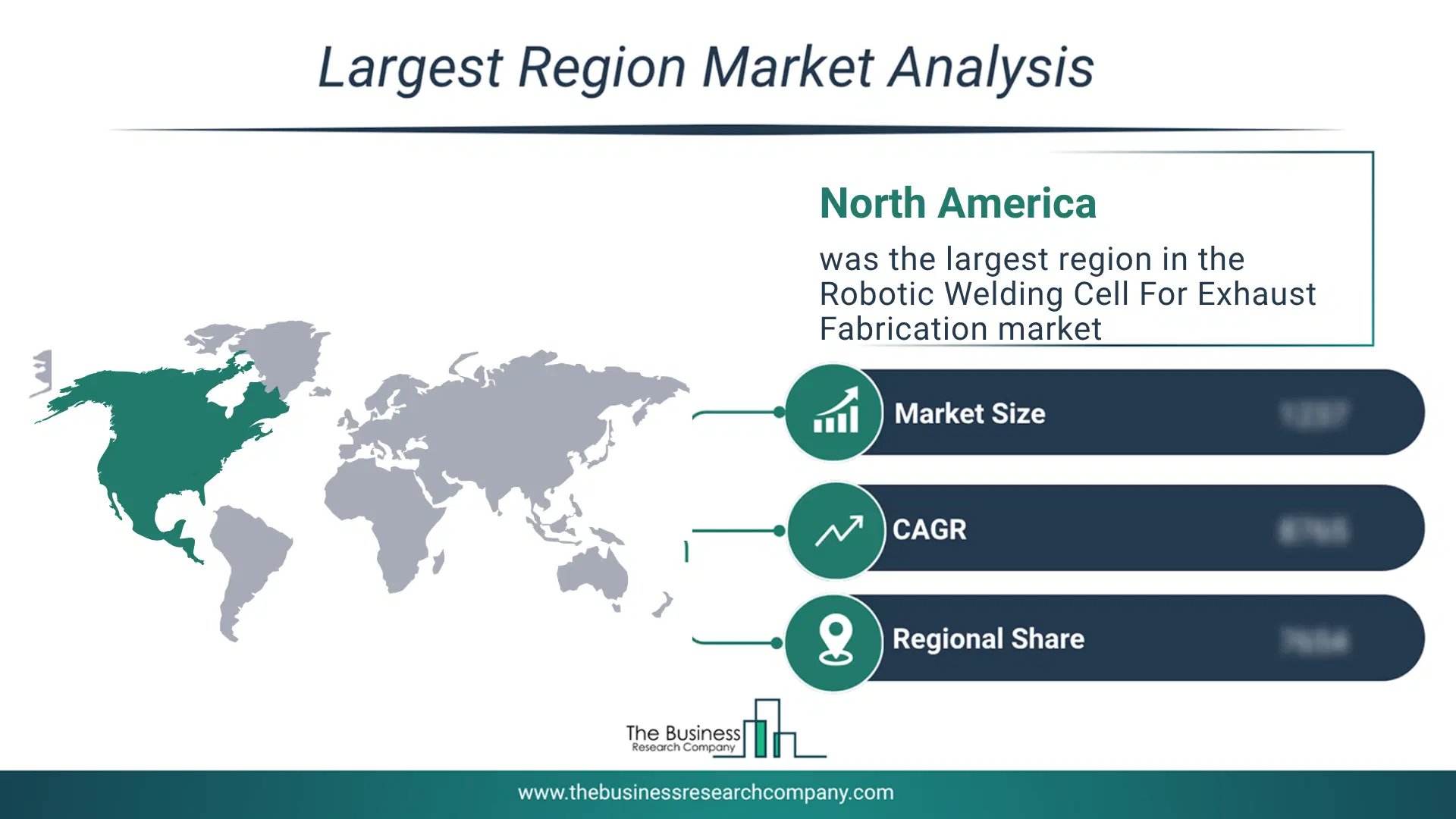
Regional Outlook
North America was the largest region in the robotic welding cell for exhaust fabrication market in 2025. Asia-Pacific is expected to be the fastest-growing region in the forecast period. The regions covered in this market report are Asia-Pacific, South East Asia, Western Europe, Eastern Europe, North America, South America, Middle East, Africa The countries covered in this market report are Australia, Brazil, China, France, Germany, India, Indonesia, Japan, Taiwan, Russia, South Korea, UK, USA, Canada, Italy, Spain.What Defines the Robotic Welding Cell For Exhaust Fabrication Market?
The robotic welding cell for exhaust fabrication market consists of sales of robotic arms, welding torches, welding power sources, positioners, fixtures, conveyor systems, sensors, control panels, safety enclosures, and exhaust component clamps. Values in this market are ‘factory gate’ values, that is, the value of goods sold by the manufacturers or creators of the goods, whether to other entities (including downstream manufacturers, wholesalers, distributors, and retailers) or directly to end customers. The value of goods in this market includes related services sold by the creators of the goods.How is Market Value Defined and Measured?
The market value is defined as the revenues that enterprises gain from the sale of goods and/or services within the specified market and geography through sales, grants, or donations in terms of the currency (in USD unless otherwise specified). The revenues for a specified geography are consumption values that are revenues generated by organizations in the specified geography within the market, irrespective of where they are produced. It does not include revenues from resales along the supply chain, either further along the supply chain or as part of other products.
This chart presents market attractiveness based on a quantitative evaluation of growth, competition, strategic alignment, and risk, offering a clear view of opportunity areas for decision-making. This chart is for illustrative purposes; the full report contains the complete analysis.

This chart highlights the Total Addressable Market (TAM) by estimating the maximum revenue opportunity using an assumption-driven approach, supporting strategic planning and opportunity sizing across markets. The chart is illustrative; the full report provides a more comprehensive analysis.
What Key Data and Analysis Are Included in the Robotic Welding Cell For Exhaust Fabrication Market Report 2026?
The robotic welding cell for exhaust fabrication market research report is one of a series of new reports from The Business Research Company that provides market statistics, including industry global market size, regional shares, competitors with the market share, detailed market segments, market trends and opportunities, and any further data you may need to thrive in the robotic welding cell for exhaust fabrication industry. The market research report delivers a complete perspective of everything you need, with an in-depth analysis of the current and future state of the industry.Robotic Welding Cell For Exhaust Fabrication Market Report Forecast Analysis
| Report Attribute | Details |
|---|---|
| Market Size Value In 2026 | $1.6 billion |
| Revenue Forecast In 2030 | $2.36 billion |
| Growth Rate | CAGR of 10.1% from 2026 to 2030 |
| Base Year For Estimation | 2025 |
| Actual Estimates/Historical Data | 2020-2025 |
| Forecast Period | 2026 - 2030 |
| Market Representation | Revenue in USD Billion and CAGR from 2026 to 2030 |
| Segments Covered | Component, Welding Type, Application, End-User |
| Regional Scope | Asia-Pacific, Western Europe, Eastern Europe, North America, South America, Middle East, Africa |
| Key Companies Profiled | Panasonic Corporation, ABB Ltd., Kawasaki Heavy Industries Ltd., FANUC Corporation, Lincoln Electric Holdings Inc., Yaskawa Electric Corporation, Nachi-Fujikoshi Corp., Daihen Corporation, OTC Daihen Inc., Comau S.p.A., IGM Robotersysteme AG, Siasun Robot & Automation Co. Ltd., Miller Electric Mfg. LLC, Fronius International GmbH, Motoman Robotics, Wolf Robotics LLC, T. J. Snow Company Inc., Pemamek Oy, Trumpf Group, Hyundai Robotics, Cloos Robotic Welding Inc. |
| Customization Scope | Request for Customization |
| Pricing And Purchase Options | Explore Purchase Options |