
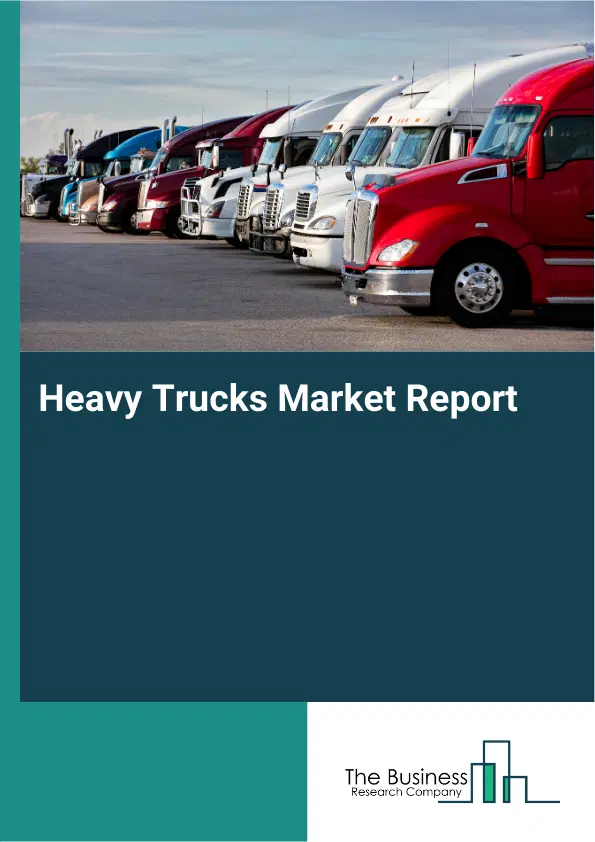
Heavy Trucks Market Report 2026
Global Outlook – By Type (Class 5, Class 6, Class 7, Class 8), By Fuel (Diesel, Natural Gas, Hybrid Electric, Gasoline), By Application (Construction And Mining, Freight And Logistics, Other Applications) – Market Size, Trends, Strategies, and Forecast to 2030
Heavy Trucks Market Overview
• Heavy Trucks market size has reached to $65.72 billion in 2025 • Expected to grow to $80.2 billion in 2030 at a compound annual growth rate (CAGR) of 4.3% • Growth Driver: Rising Regulations On Vehicle Emissions To Drive Market Growth • Market Trend: Momentum Builds Around Low-Emission And High-Performance Trucking Technologies • North America was the largest region in 2025 and Asia-Pacific is the fastest growing region.What Is Covered Under Heavy Trucks Market?
Heavy trucks are defined as commercial motor vehicles used for the transportation of goods with a weight of 2.72 tons or more when empty and 4.54 tons or more when loaded. The main types in the heavy truck market are class 5, class 6, class 7, and class 8. Class 8 trucks refer to the class 8 trucks that are used commercially and have great load capacity. The various fuel types include diesel, natural gas, hybrid electric, and gasoline. These are used in construction and mining, freight and logistics, and other applications.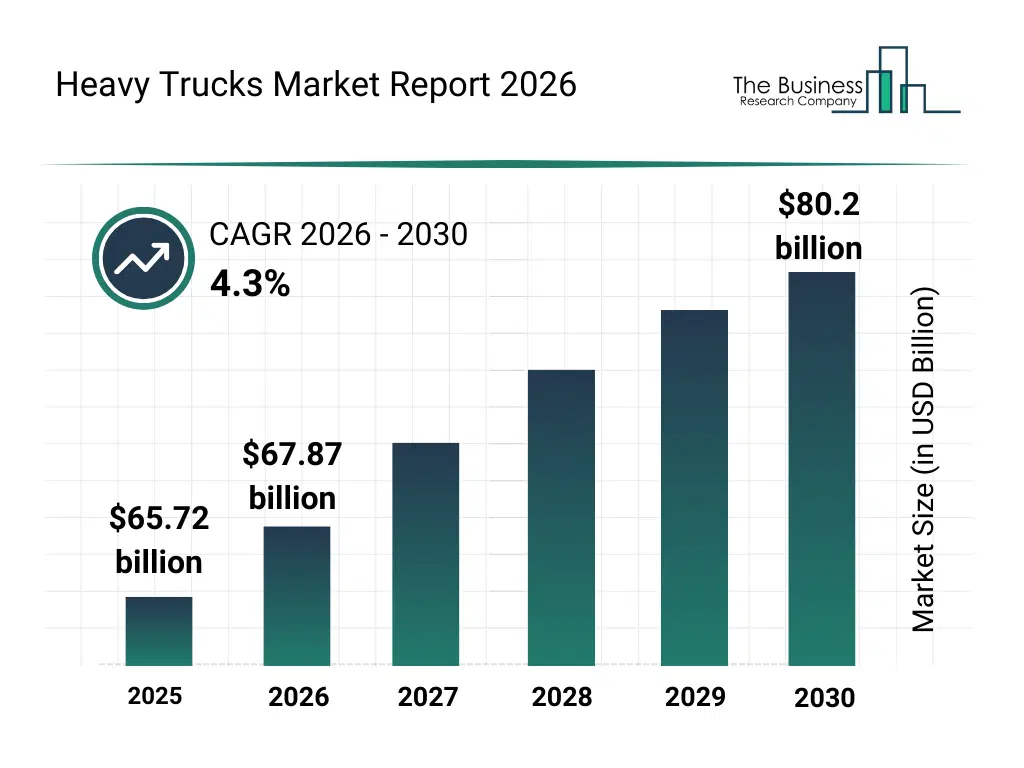
What Is The Heavy Trucks Market Size and Share 2026?
The heavy trucks market size has grown steadily in recent years. It will grow from $65.72 billion in 2025 to $67.87 billion in 2026 at a compound annual growth rate (CAGR) of 3.3%. The growth in the historic period can be attributed to industrialization and urban expansion, growth in goods transportation, diesel engine dominance, highway infrastructure expansion, rise in commercial vehicle financing.What Is The Heavy Trucks Market Growth Forecast?
The heavy trucks market size is expected to see steady growth in the next few years. It will grow to $80.2 billion in 2030 at a compound annual growth rate (CAGR) of 4.3%. The growth in the forecast period can be attributed to adoption of electric and hybrid heavy trucks, demand for fuel cost optimization, stricter emission compliance, growth in e commerce logistics, smart fleet management adoption. Major trends in the forecast period include shift toward alternative fuel heavy trucks, integration of safety and monitoring technologies, growth of long haul freight trucking, demand for higher payload capacity vehicles, fleet modernization and replacement cycles.
Global Heavy Trucks Market Segmentation
1) By Type: Class 5, Class 6, Class 7, Class 8 2) By Fuel: Diesel, Natural Gas, Hybrid Electric, Gasoline 3) By Application: Construction And Mining, Freight And Logistics, Other Applications Subsegments: 1) By Class 5: Vehicles With A Gross Vehicle Weight Rating (GVWR) Of 16,001 To 19,500 Pounds, Medium-Duty Trucks, Delivery Trucks, And Service Vehicles 2) By Class 6: Vehicles With A Gross Vehicle Weight Rating (GVWR) Of 19,501 To 26,000 Pounds, Box Trucks, Dump Trucks, And Some Types Of Tow Trucks 3) By Class 7: Vehicles With A Gross Vehicle Weight Rating (GVWR) Of 26,001 To 33,000 Pounds, Larger Trucks, Buses, And Vocational Vehicles 4) By Class 8: Vehicles With A Gross Vehicle Weight Rating (GVWR) Of Over 33,000 Pounds, Heavy-Duty Trucks, Tractor-Trailers, And Larger BusesWhat Is The Driver Of The Heavy Trucks Market?
The increasing regulations on vehicle emissions are expected to propel the growth of the heavy trucks market going forward. Regulations on vehicle emissions refer to government-imposed rules, standards, and requirements that specify the maximum allowable levels of pollutants and greenhouse gases that vehicles can emit into the environment. Stricter regulations on vehicle emissions compel manufacturers to develop eco-friendly and compliant models. These regulations also prompt end-users to replace older trucks, boosting demand for new, sustainable heavy trucks that meet emissions standards, align with sustainability goals, and reduce carbon footprints. For instance, in March 2025, according to the U.S. Environmental Protection Agency (EPA), a US-based federal agency, the final rule builds on the EPA’s 2023–2026 vehicle emissions standards and uses advancements in clean car technology to reduce pollution, improve public health, cut climate impacts, and save drivers money. The new standards will phase in from model years 2027 to 2032. Therefore, the rising regulations on vehicle emissions are driving the growth of the heavy trucks industry.Key Players In The Global Heavy Trucks Market
Major companies operating in the heavy trucks market report include Volkswagen AG, Kamaz Inc., China National Heavy Duty Truck Group Co. Ltd., Daimler Truck AG, Traton SE, Volvo Group, Paccar Inc., Isuzu Motors Limited, Tata Motors Limited, Dongfeng Motor Corporation, Iveco S.p.A., Hino Motors Ltd., Sinotruk Hong Kong Limited, Oshkosh Corporation, Navistar International Corporation, Fuso Truck and Bus Corporation, Ashok Leyland Limited, Mack Trucks Inc., Eicher Motors Limited, Kenworth Truck Company, Peterbilt Motors Company, Western Star Trucks Sales Inc., UD Trucks Corporation, Freightliner Trucks, MAN SE, Scania AB, First Automotive Works Ltd.
This chart is for illustrative purposes; the full report includes a detailed competitor analysis and comprehensive overview of the top 10 companies in the market.
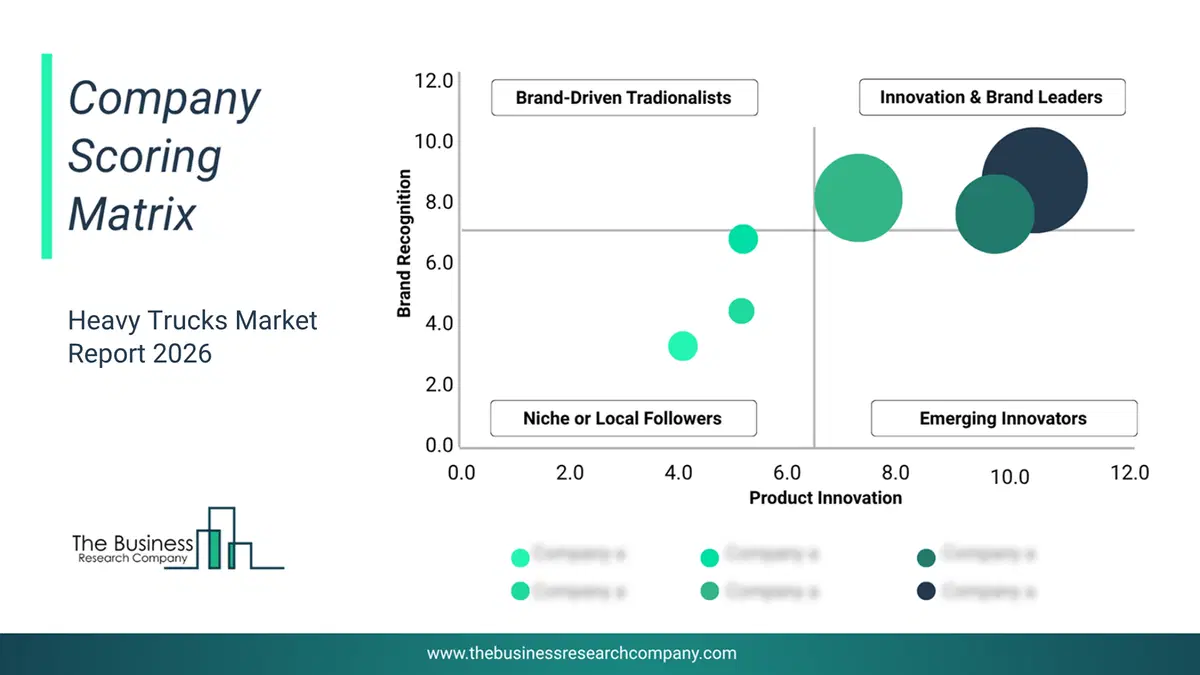
This chart maps companies by product innovation and brand strength, with bubble size indicating relative revenue, helping identify market leaders, challengers, and niche players. This is an illustrative chart; the full report provides a complete and accurate competitive analysis.
Global Heavy Trucks Market Trends and Insights
Major companies operating in the heavy-trucks market are focusing on developing innovative solutions, such as battery-electric and renewable-fuel heavy-duty trucks, to improve fleet efficiency, cut emissions, and meet tightening global sustainability regulations. Battery-electric and renewable-fuel heavy-duty trucks are advanced alternatives to traditional diesel trucks, using either electric batteries or engines powered by renewable fuels (like HVO or biogas) to significantly reduce emissions, lower operating costs, and improve energy efficiency while supporting cleaner, more sustainable freight transport. For instance, in January 2024, Volvo Group, a Sweden-based multinational commercial vehicle manufacturing company, launched its new heavy-duty truck platform. This includes models like the Volvo VNL and Volvo FH Aero, combining energy-efficient engines with electrification and renewable-fuel options to enhance fuel economy, lower emissions, and support Volvo’s goal of a net-zero product range by 2040. The new platform integrates advanced aerodynamics, upgraded powertrains, and modular electrification capabilities, resulting in reduced operating costs, quieter performance, and improved long-haul productivity compared to traditional diesel-only alternatives. These innovations position manufacturers to address fleet operators’ increasing expectations for sustainable, high-performance heavy-truck solutions that meet both environmental and operational targets.What Are Latest Mergers And Acquisitions In The Heavy Trucks Market?
In March 2024, Hyundai Motor Company, a South Korea-based automotive manufacturing company, that specializes in providing heavy trucks, partnered with Iveco Group. The partnership aims to enhance the development of electric heavy-duty trucks in Europe by focusing on battery and fuel cell technologies. By combining their strengths, Hyundai Motor and Iveco Group seek to foster innovation and accelerate the transition to sustainable transport solutions. Iveco Group is an Italy-based sales financing company.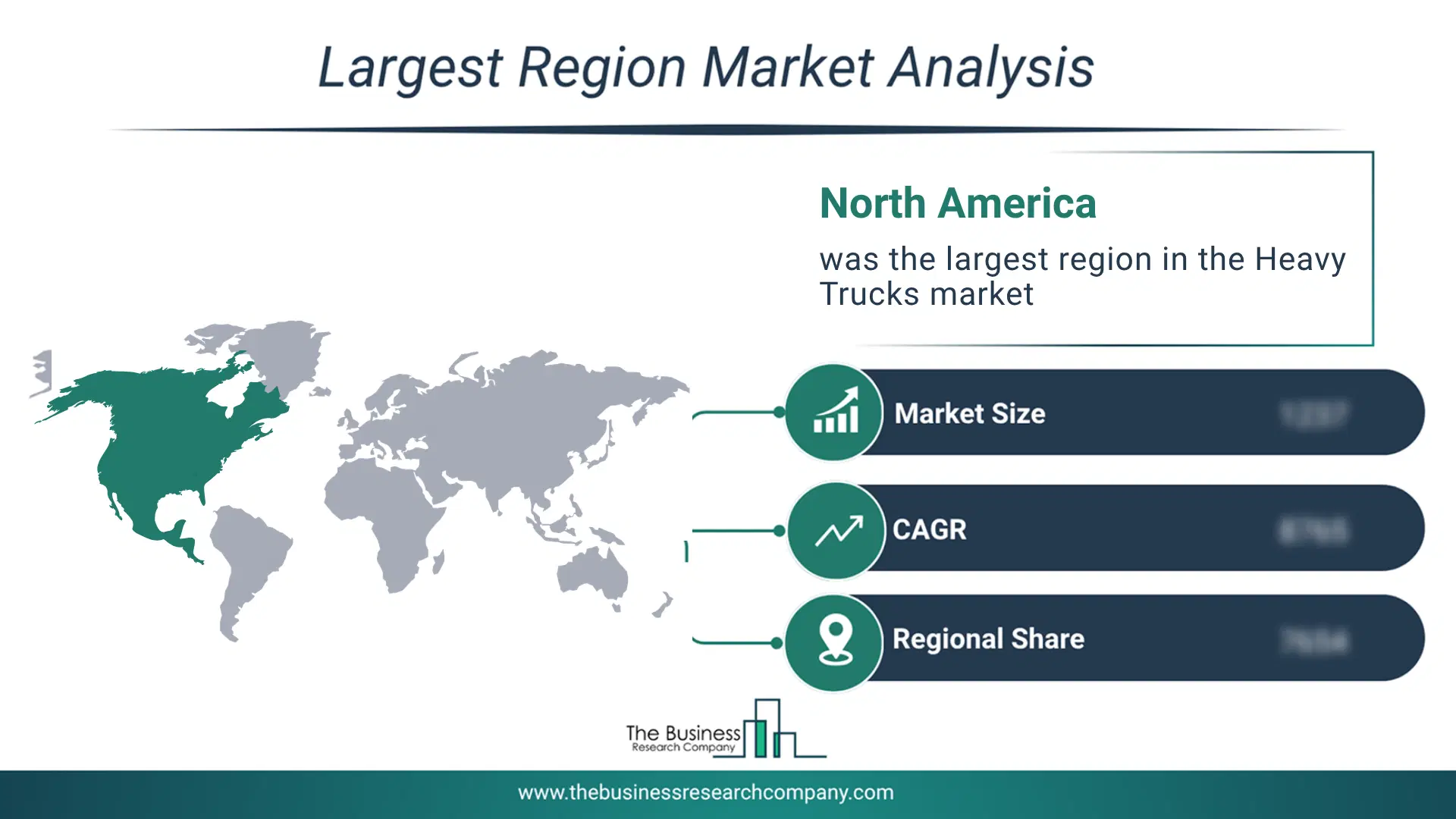
Regional Outlook
North America was the largest region in the heavy trucks market in 2025. Asia-Pacific was the second-largest region in the heavy trucks market share. The regions covered in this market report include Asia-Pacific, South East Asia, Western Europe, Eastern Europe, North America, South America, Middle East, Africa. The countries covered in this market report include Australia, Brazil, China, France, Germany, India, Indonesia, Japan, Taiwan, Russia, South Korea, UK, USA, Canada, Italy, SpainWhat Defines the Heavy Trucks Market?
The heavy trucks market consists of sales of 18-wheeler truck, refrigerator truck, dump truck, garbage truck, logging truck, concrete transport truck, tractor unit and tanker truck. Values in this market are factory gate values, that is the value of goods sold by the manufacturers or creators of the goods, whether to other entities (including downstream manufacturers, wholesalers, distributors, and retailers) or directly to end customers. The value of goods in this market includes related services sold by the creators of the goods.How is Market Value Defined and Measured?
The market value is defined as the revenues that enterprises gain from the sale of goods and/or services within the specified market and geography through sales, grants, or donations in terms of the currency (in USD unless otherwise specified). The revenues for a specified geography are consumption values that are revenues generated by organizations in the specified geography within the market, irrespective of where they are produced. It does not include revenues from resales along the supply chain, either further along the supply chain or as part of other products.
This chart presents market attractiveness based on a quantitative evaluation of growth, competition, strategic alignment, and risk, offering a clear view of opportunity areas for decision-making. This chart is for illustrative purposes; the full report contains the complete analysis.

This chart highlights the Total Addressable Market (TAM) by estimating the maximum revenue opportunity using an assumption-driven approach, supporting strategic planning and opportunity sizing across markets. The chart is illustrative; the full report provides a more comprehensive analysis.
What Key Data and Analysis Are Included in the Heavy Trucks Market Report 2026?
The heavy trucks market research report is one of a series of new reports from The Business Research Company that provides market statistics, including industry global market size, regional shares, competitors with the market share, detailed market segments, market trends and opportunities, and any further data you may need to thrive in the heavy trucks industry. The market research report delivers a complete perspective of everything you need, with an in-depth analysis of the current and future state of the industry.Heavy Trucks Market Report Forecast Analysis
| Report Attribute | Details |
|---|---|
| Market Size Value In 2026 | $67.87 billion |
| Revenue Forecast In 2030 | $80.2 billion |
| Growth Rate | CAGR of 3.3% from 2026 to 2030 |
| Base Year For Estimation | 2025 |
| Actual Estimates/Historical Data | 2020-2025 |
| Forecast Period | 2026 - 2030 - 2030 |
| Market Representation | Revenue in USD Billion and CAGR from 2026 to 2030 |
| Segments Covered | Type, Fuel, Application |
| Regional Scope | Asia-Pacific, Western Europe, Eastern Europe, North America, South America, Middle East, Africa |
| Country Scope | The countries covered in the report are Australia, Brazil, China, France, Germany, India, Indonesia, Japan, Taiwan, Russia, South Korea, UK, USA, Canada, Italy, Spain. |
| Key Companies Profiled | Volkswagen AG, Kamaz Inc., China National Heavy Duty Truck Group Co. Ltd., Daimler Truck AG, Traton SE, Volvo Group, Paccar Inc., Isuzu Motors Limited, Tata Motors Limited, Dongfeng Motor Corporation, Iveco S.p.A., Hino Motors Ltd., Sinotruk Hong Kong Limited, Oshkosh Corporation, Navistar International Corporation, Fuso Truck and Bus Corporation, Ashok Leyland Limited, Mack Trucks Inc., Eicher Motors Limited, Kenworth Truck Company, Peterbilt Motors Company, Western Star Trucks Sales Inc., UD Trucks Corporation, Freightliner Trucks, MAN SE, Scania AB, First Automotive Works Ltd. |
| Customization Scope | Request for Customization |
| Pricing And Purchase Options | Explore Purchase Options |