
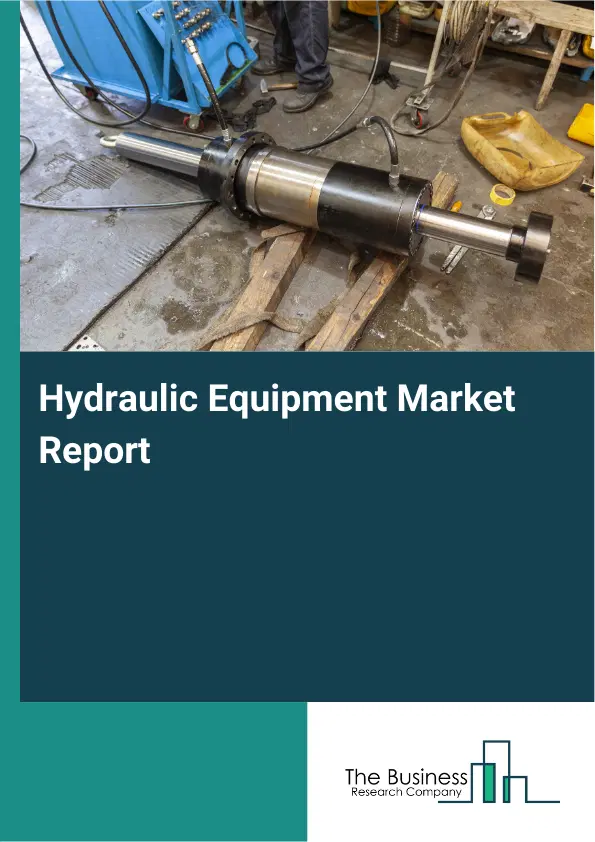
Hydraulic Equipment Market Report 2026
Global Outlook – By Component (Motors, Pumps, Cylinders, Valves, Filters, Accumulators, Transmissions, Other Components), By Application (Mobile, Industries), By End User (Mining And Construction, Agriculture And Mining, Packaging, Material Handling, Other Applications) – Market Size, Trends, Strategies, and Forecast to 2030
Hydraulic Equipment Market Overview
• Hydraulic Equipment market size has reached to $46.86 billion in 2025 • Expected to grow to $55.7 billion in 2030 at a compound annual growth rate (CAGR) of 3.5% • Growth Driver: Construction Industry Driving Growth In Hydraulic Equipment Market • Market Trend: Increasing Focus On Efficiency With SP 6-Inch Energy-Efficient Hydraulic Pump • North America was the largest region in 2025 and Asia-Pacific is the fastest growing region.Market Gains By 2030 – Top Opportunities By Segment
Market Gain identifies the most promising market opportunities by highlighting the segments or products expected to generate the highest incremental revenue growth over the next five years.
What Is Covered Under Hydraulic Equipment Market?
Hydraulic equipment refers to machinery or devices that use pressurized fluid to perform various tasks. This equipment works by applying liquid pressure, usually with the help of hydraulic cylinders to move pistons. These are primarily used to produce motion or force, which makes them an effective and adaptable instrument for a variety of industrial uses. The main types of components included in hydraulic equipment are motors, pumps, cylinders, valves, filters, accumulators, transmissions, and others. A hydraulic motor is a mechanical actuator that produces a rotating shaft by converting hydraulic pressure and flow into torque and angular displacement. These are used for several applications, including mobile and industries, and are used by various end users, such as mining and construction, agriculture and mining, packaging, material handling, and others.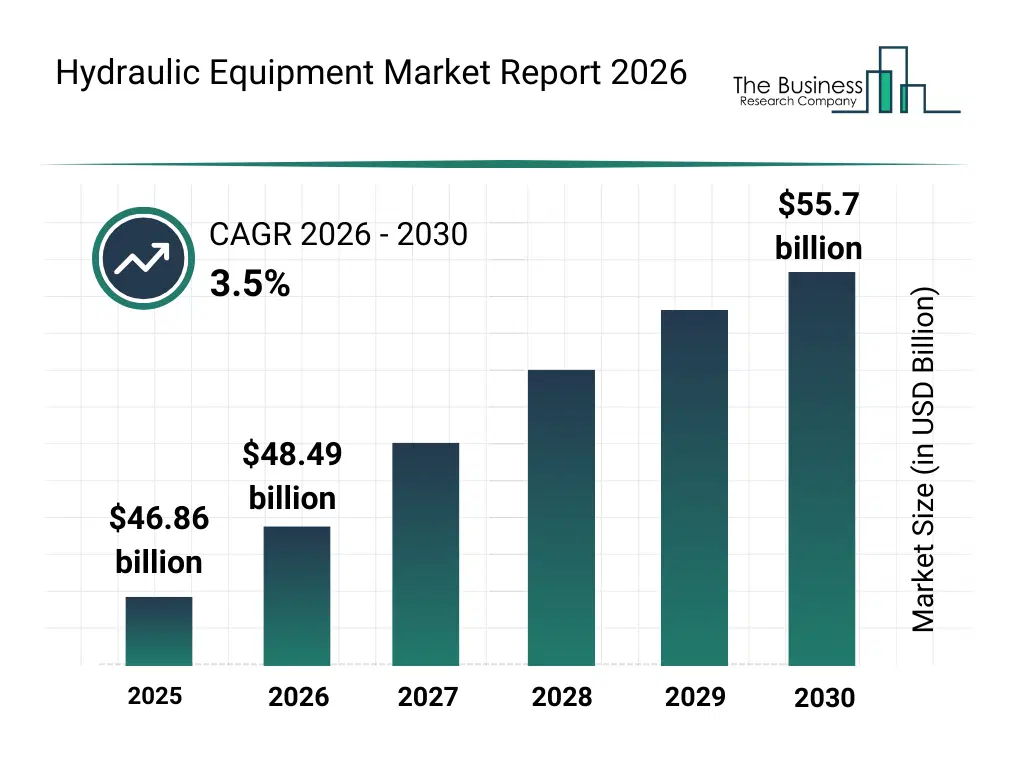
What Is The Hydraulic Equipment Market Size and Share 2026?
The hydraulic equipment market size has grown steadily in recent years. It will grow from $46.86 billion in 2025 to $48.49 billion in 2026 at a compound annual growth rate (CAGR) of 3.5%. The growth in the historic period can be attributed to industrial mechanization, construction equipment demand, mining sector expansion, traditional fluid power systems, infrastructure development.What Is The Hydraulic Equipment Market Growth Forecast?
The hydraulic equipment market size is expected to see steady growth in the next few years. It will grow to $55.7 billion in 2030 at a compound annual growth rate (CAGR) of 3.5%. The growth in the forecast period can be attributed to smart hydraulic systems adoption, automation in industrial processes, growth of mobile machinery, predictive maintenance demand, energy efficient hydraulic designs. Major trends in the forecast period include increasing system integration across industries, demand for high pressure hydraulic solutions, expansion of mobile hydraulic equipment, focus on reliability and safety, growth of aftermarket services.
Global Hydraulic Equipment Market Segmentation
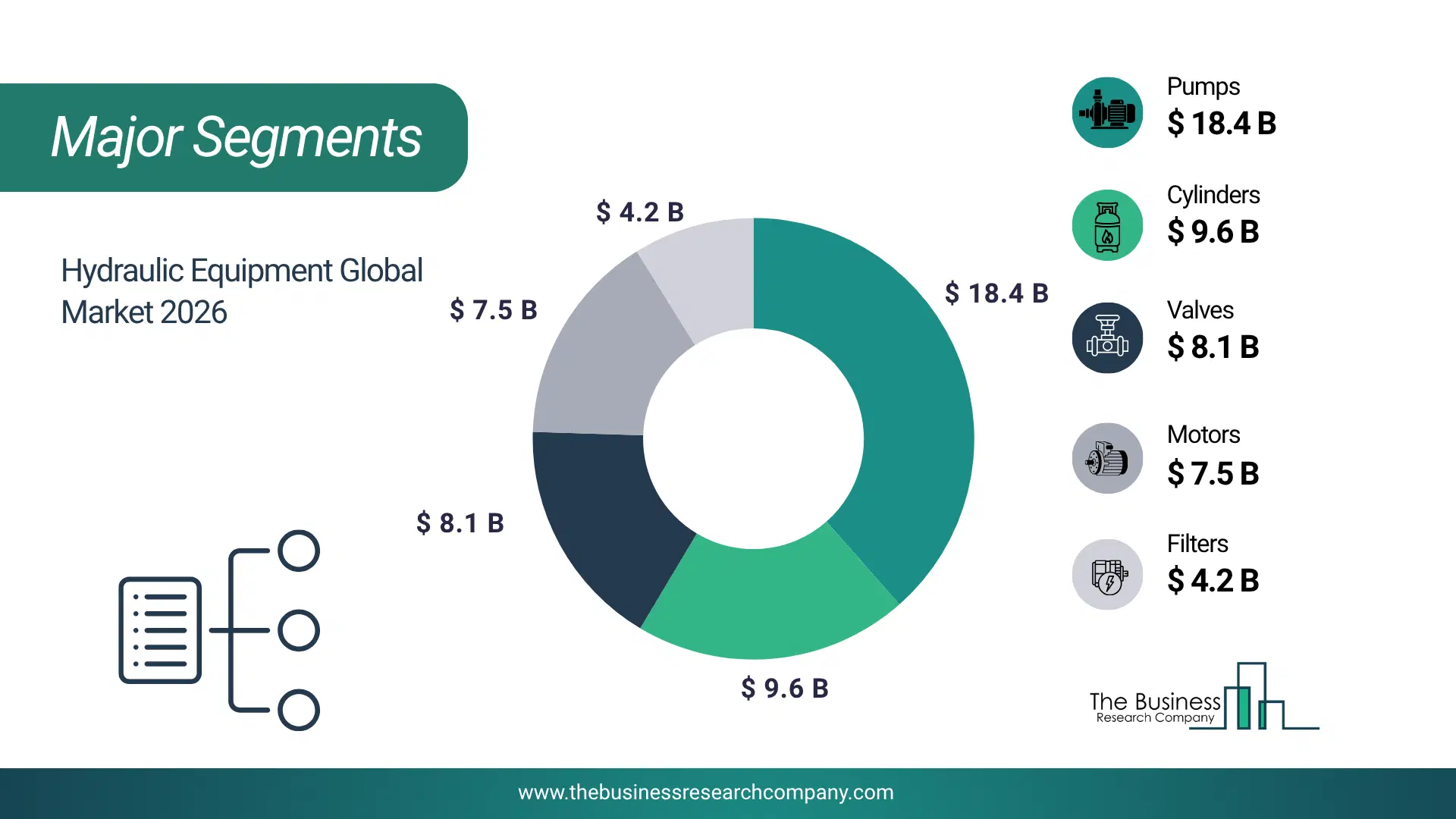
1) By Component: Motors, Pumps, Cylinders, Valves, Filters, Accumulators, Transmissions, Other Components 2) By Application: Mobile, Industries 3) By End User: Mining And Construction, Agriculture And Mining, Packaging, Material Handling, Other Applications Subsegments: 1) By Motors: Hydraulic Motors, Gear Motors, Piston Motors 2) By Pumps: Gear Pumps, Vane Pumps, Piston Pumps, Screw Pumps 3) By Cylinders: Double-Acting Cylinders, Single-Acting Cylinders, Telescopic Cylinders 4) By Valves: Directional Control Valves, Pressure Control Valves, Flow Control Valves, Check Valves 5) By Filters: Hydraulic Filters, Inline Filters, Return Line Filters 6) By Accumulators: Bladder Accumulators, Piston Accumulators, Spring Accumulators 7) By Transmissions: Hydraulic Transmissions, Hydrostatic Transmissions 8) By Other Components: Hoses And Fittings, Seals And O-Rings, Coolers And Heat Exchangers The top segments in the hydraulic equipment market will be: • Pumps will reach $18.4 billion by 2030. • Cylinders will reach $9.56 billion by 2030. • Valves will reach $8.06 billion by 2030. • Motors will reach $7.48 billion by 2030. • Filters will reach $4.21 billion by 2030.What Is The Driver Of The Hydraulic Equipment Market?
The expanding construction industry is expected to propel the growth of the hydraulic equipment market going forward. The construction industry encompasses all activities related to the planning, design, construction, and maintenance of buildings, infrastructure, and other physical structures. Growth in the construction industry can be attributed to government spending on building projects, rising infrastructure investments, and stabilization in the real estate market. Hydraulic systems can produce immense force with relatively small components, making them ideal for heavy lifting, pushing, and pulling tasks required in construction, such as operating cranes, excavators, and bulldozers. For instance, in August 2023, according to a report published by the Office for National Statistics, a UK-based producer of official statistics, the estimated monthly construction output saw a 1.6% increase in volume in June 2023, attributed to rises in both new construction work (2.0%) and repair and maintenance activities (1.1%). The output of construction increased by 0.3% from Quarter 1 (January to March) 2023 to Quarter 2 (April to June) 2023. Therefore, the expanding construction industry is driving the growth of the hydraulic equipment industry.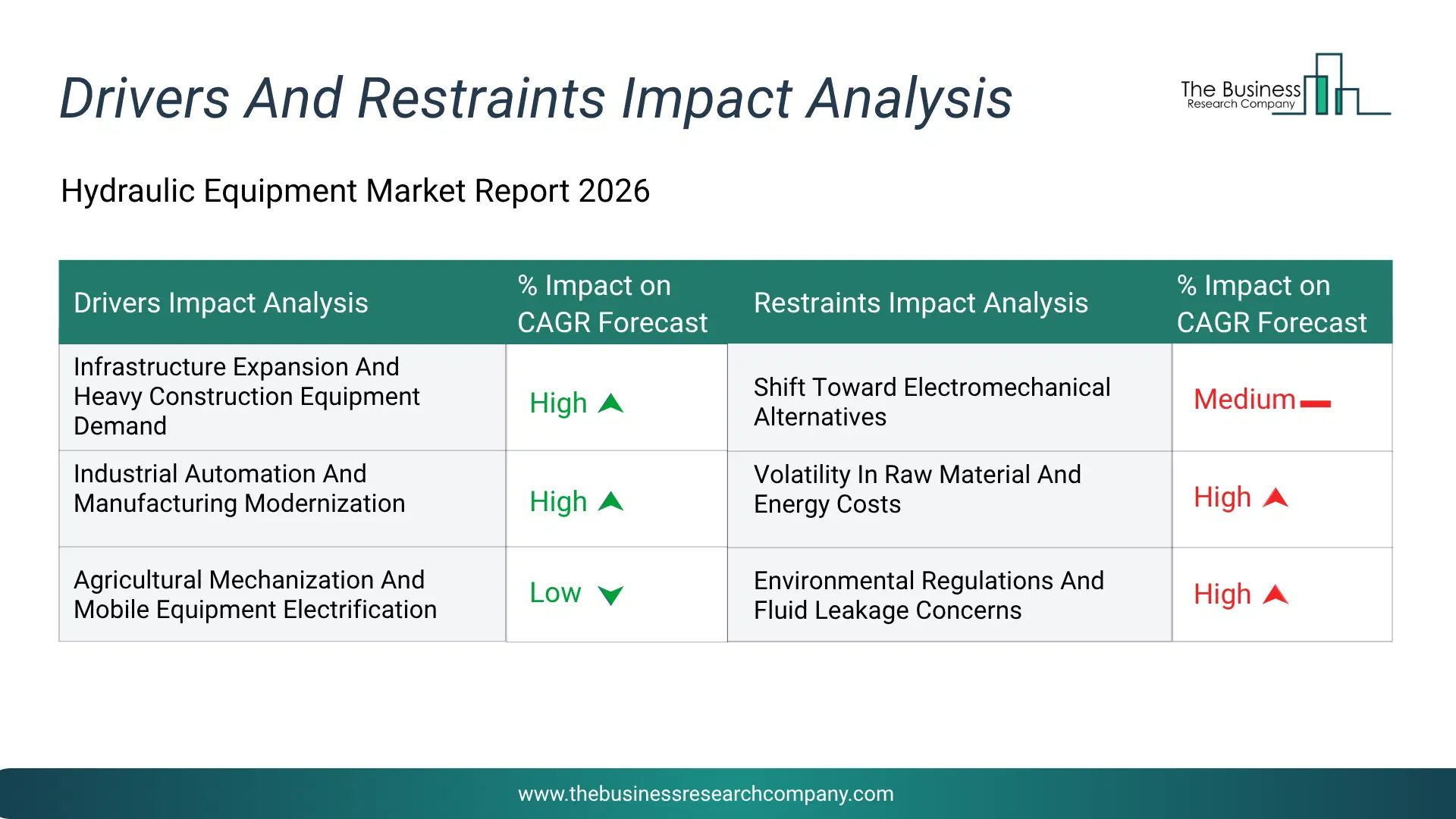
Infographic Chart Showing Key Market Drivers Analysis And Restraints For Hydraulic Equipment Market
The chart presents an impact analysis of key drivers and restraints, quantifying their relative influence on the market's growth rate and helping assess the balance between growth enablers and limiting factors. This chart offers a high-level perspective; the full report contains more detailed insights.
How Will The Drivers Impact Growth In The Global Hydraulic Equipment Market?
• Infrastructure Expansion And Heavy Construction Equipment Demand (High) – During the forecast period, the expansion of large -scale infrastructure projects and rising heavy construction equipment demand is expected to become a primary growth driver for the hydraulic equipment market by 2030. Increasing investments in transportation networks, smart cities, renewable energy installations, mining projects, and urban development are accelerating procurement of excavators, loaders, cranes, and road -building machinery. Hydraulic pumps, cylinders, and valves remain critical for high -force lifting, digging, and material handling applications across these platforms. Emerging economies are witnessing rapid mechanization, while developed markets are upgrading fleets with higher -efficiency systems. Additionally, government -backed infrastructure stimulus programs continue to sustain capital equipment spending cycles. • Industrial Automation And Manufacturing Modernization (High) – During the forecast period, industrial automation and manufacturing modernization are expected to become significant growth drivers for the hydraulic equipment market by 2030. The increasing adoption of industry 4.0 technologies, smart factories, and automated production lines is strengthening demand for precision -controlled hydraulic systems in presses, injection moulding machines, and heavy industrial equipment. Manufacturers are integrating digitally monitored, energy -efficient hydraulic solutions to enhance productivity, reduce downtime, and improve operational accuracy. Upgrades of aging industrial infrastructure across automotive, metal fabrication, and process industries are further supporting replacement demand. Additionally, the incorporation of iot -enabled diagnostics and predictive maintenance solutions enhances lifecycle performance and system reliability. • Agricultural Mechanization And Mobile Equipment Electrification (Low) – During the forecast period, agricultural mechanization and mobile equipment electrification are expected to emerge as important growth drivers for the hydraulic equipment market by 2030. Rising global food demand, declining rural labor availability, and the need for productivity enhancement are accelerating adoption of hydraulic -powered tractors, harvesters, sprayers, and precision farming equipment. Simultaneously, the transition toward hybrid and electric off -highway machinery is driving the development of compact, modular, and energy -efficient hydraulic subsystems. Advanced hydraulic technologies enable improved load control, fuel efficiency, and operational flexibility in modern agricultural machinery. Growing investments in smart farming practices and high -performance mobile platforms are further strengthening demand.How Will The Restraints Impact Growth In The Global Hydraulic Equipment Market?
• Shift Toward Electromechanical Alternatives (Medium) – During the forecast period, the in certain light- and medium-duty applications, electromechanical actuators are gradually replacing hydraulic systems due to lower maintenance requirements, improved energy efficiency, and cleaner operation. Industries such as factory automation and precision equipment manufacturing are increasingly evaluating electric actuation systems. This substitution trend limits growth potential in specific low-force and indoor industrial applications. • Volatility In Raw Material And Energy Costs (High) – During the forecast period, the hydraulic equipment manufacturing relies heavily on steel, aluminum, specialty alloys, and petroleum-based sealing materials. Fluctuations in raw material prices, supply chain disruptions, and energy cost instability directly impact production margins and capital investment cycles. These uncertainties can delay oem procurement decisions and infrastructure project timelines, creating short-term demand fluctuations. • Environmental Regulations And Fluid Leakage Concerns (High) – During the forecast period, the environmental regulations and fluid leakage concerns act as a restraint for the hydraulic equipment market by increasing compliance requirements and operational challenges for manufacturers and end users. Strict environmental norms related to oil leakage, disposal of hydraulic fluids, and contamination risks require the adoption of eco-friendly hydraulic fluids and improved sealing technologies. These upgrades often increase system cost and maintenance complexity. Additionally, industries face stricter monitoring and penalties for non-compliance, which raises operational risks. Overall, these regulatory and environmental concerns limit adoption and increase the cost of hydraulic system deployment.Key Players In The Global Hydraulic Equipment Market
Major companies operating in the hydraulic equipment market are Robert Bosch GmbH, Siemens AG, Komatsu Ltd., Motion Industries Inc., Parker Hannifin Corporation, Emerson Electric Co., Kawasaki Heavy Industries Ltd., Danfoss AS, SMC Corporation, Festo SE, Moog Inc., Concentric AB, HAWE Hydraulik SE, Linde Hydraulics Corp, Wipro Infrastructure Engineering, Casappa Corp, Norgren Limited, Hydac International GmbH, Dantal Hydraulics Pvt. Ltd., Daikin Industries Ltd., Bucher Hydraulics Inc., Hannon Hydraulics Inc., Fluitronics GmbH, American Design & Manufacturing Inc., Nachi-Fujikoshi Corp.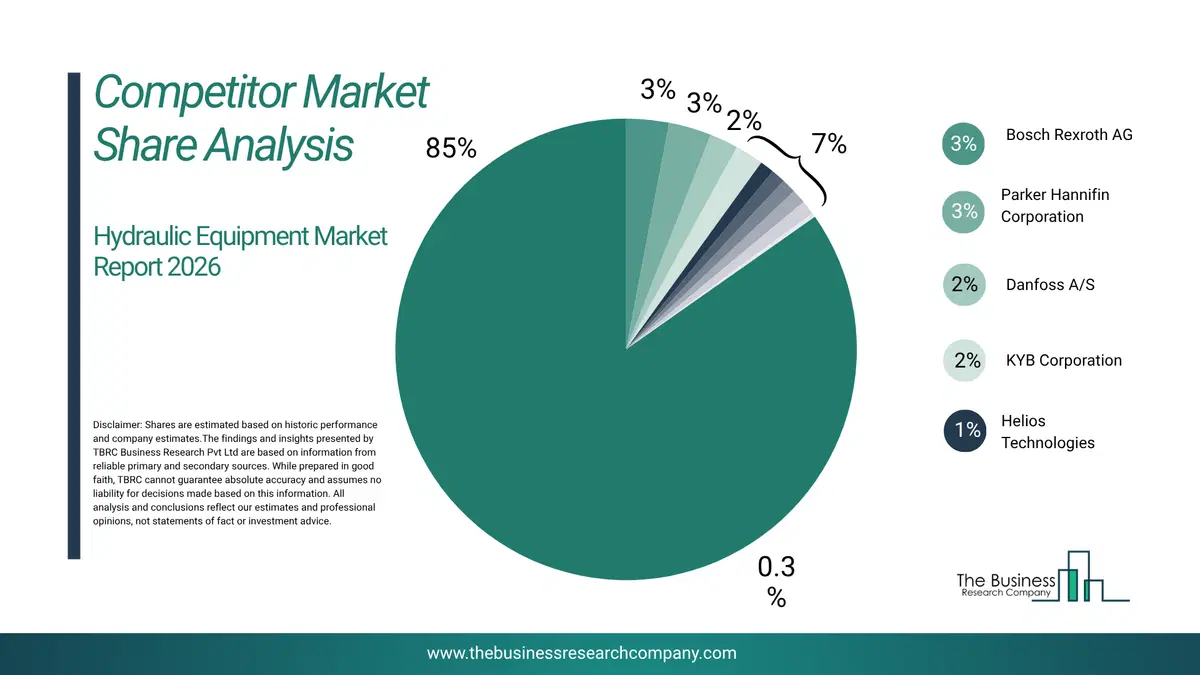
This chart is for illustrative purposes; the full report includes a detailed competitor analysis and comprehensive overview of the top 10 companies in the market.
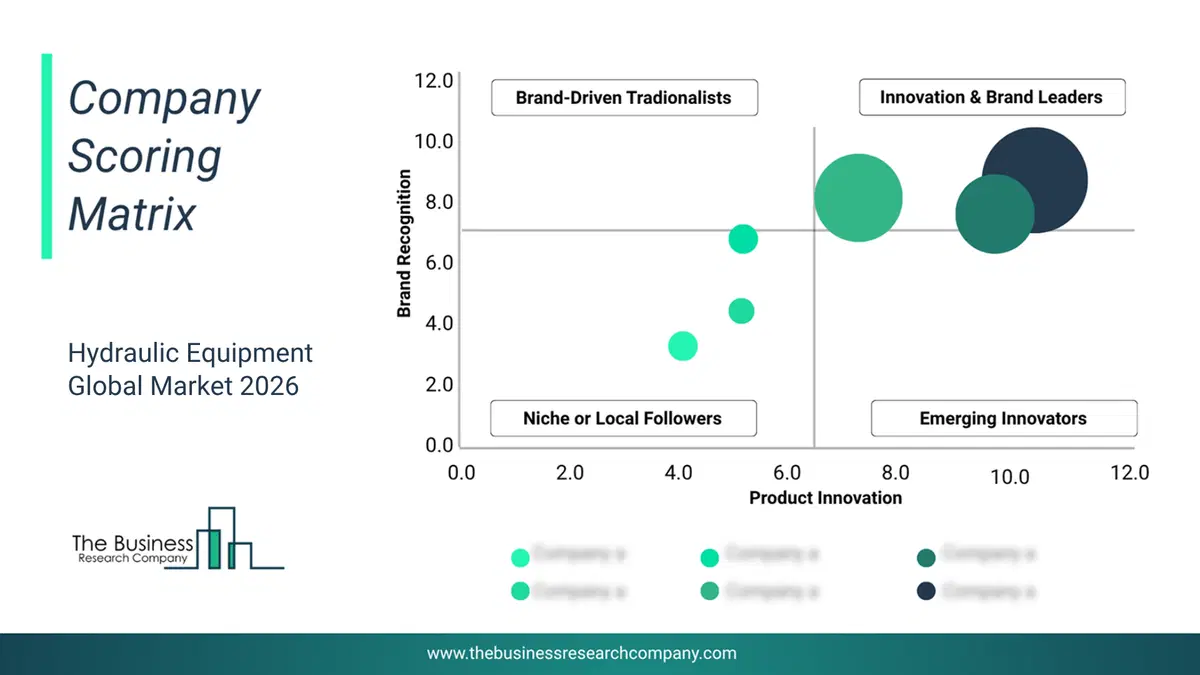
This chart maps companies by product innovation and brand strength, with bubble size indicating relative revenue, helping identify market leaders, challengers, and niche players. This is an illustrative chart; the full report provides a complete and accurate competitive analysis.
Global Hydraulic Equipment Market Trends and Insights
Major companies operating in the hydraulic equipment market are developing innovative products, such as energy-efficient hydraulic pumps, to better serve customers with advanced features and gain a competitive edge in the market. An energy-efficient hydraulic pump is a device designed to transfer mechanical energy into hydraulic energy while minimizing energy losses. For instance, in January 2024, Grundfos, a Denmark-based pump manufacturer, launched the SP 6-inch hydraulic pump for groundwater pumping. The SP 6-inch hydraulic pump stands out with its key features, including superior energy efficiency achieved through upgraded hydraulics, resulting in significant energy savings. It incorporates a high-efficiency permanent magnet motor, ensuring reliable performance while maximizing overall efficiency. Its robust stainless-steel rotor design, featuring a durable stainless-steel-clad canned rotor, ensures optimized operations and longevity. Additionally, the pump offers an expanded temperature range of up to 140°F, making it versatile and suitable for a wide range of applications.What Are Latest Mergers And Acquisitions In The Hydraulic Equipment Market?
In January 2024, Atlas Copco, a Sweden-based manufacturing company, acquired Kracht GmbH for an undisclosed amount. This acquisition is expected to expand Atlas' portfolio within positive displacement pumps and further strengthen its position in the industrial pump segment. Kracht GmbH is a Germany-based manufacturer of hydraulic pumps primarily used in oil hydraulic systems.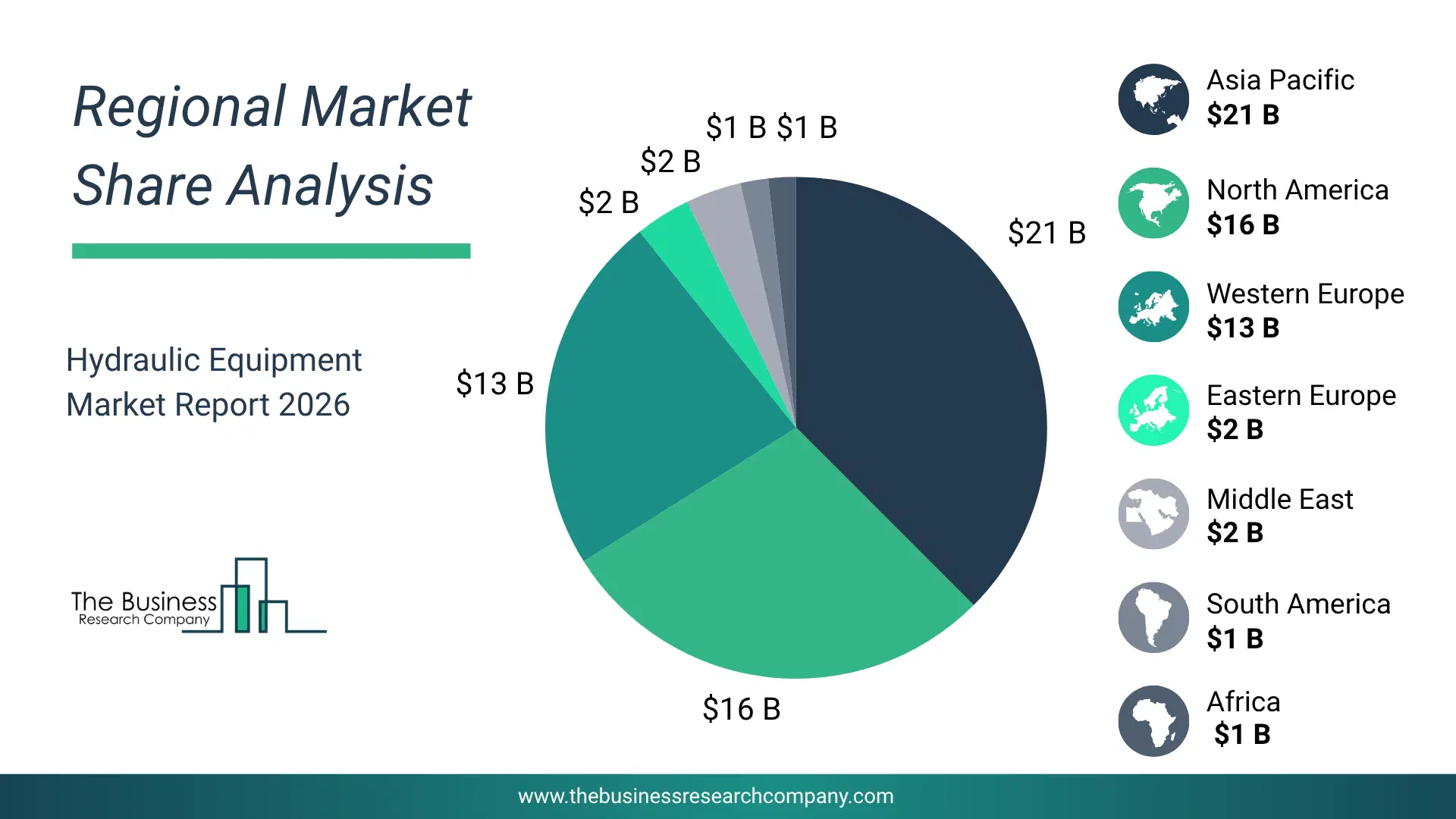
Regional Outlook
North America was the largest region in the hydraulic equipment market in 2025. Asia-Pacific is expected to be the fastest-growing region in the forecast period. The regions covered in this market report are Asia-Pacific, South East Asia, Western Europe, Eastern Europe, North America, South America, Middle East, Africa The countries covered in this market report are Australia, Brazil, China, France, Germany, India, Indonesia, Japan, Taiwan, Russia, South Korea, UK, USA, Canada, Italy, Spain.What Defines the Hydraulic Equipment Market?
The hydraulic equipment market consists of sales of hydraulic presses, lifts, fittings and hydraulic power units. Values in this market are ‘factory gate’ values, that is the value of goods sold by the manufacturers or creators of the goods, whether to other entities (including downstream manufacturers, wholesalers, distributors and retailers) or directly to end customers. The value of goods in this market includes related services sold by the creators of the goods.How is Market Value Defined and Measured?
The market value is defined as the revenues that enterprises gain from the sale of goods and/or services within the specified market and geography through sales, grants, or donations in terms of the currency (in USD unless otherwise specified). The revenues for a specified geography are consumption values that are revenues generated by organizations in the specified geography within the market, irrespective of where they are produced. It does not include revenues from resales along the supply chain, either further along the supply chain or as part of other products.
This chart presents market attractiveness based on a quantitative evaluation of growth, competition, strategic alignment, and risk, offering a clear view of opportunity areas for decision-making. This chart is for illustrative purposes; the full report contains the complete analysis.

This chart highlights the Total Addressable Market (TAM) by estimating the maximum revenue opportunity using an assumption-driven approach, supporting strategic planning and opportunity sizing across markets. The chart is illustrative; the full report provides a more comprehensive analysis.
What Key Data and Analysis Are Included in the Hydraulic Equipment Market Report 2026?
The hydraulic equipment market research report is one of a series of new reports from The Business Research Company that provides market statistics, including industry global market size, regional shares, competitors with the market share, detailed market segments, market trends and opportunities, and any further data you may need to thrive in the hydraulic equipment industry. The market research report delivers a complete perspective of everything you need, with an in-depth analysis of the current and future state of the industry.Hydraulic Equipment Market Report Forecast Analysis
| Report Attribute | Details |
|---|---|
| Market Size Value In 2026 | $48.49 billion |
| Revenue Forecast In 2030 | $55.7 billion |
| Growth Rate | CAGR of 3.5% from 2026 to 2030 |
| Base Year For Estimation | 2025 |
| Actual Estimates/Historical Data | 2020-2025 |
| Forecast Period | 2026 - 2030 |
| Market Representation | Revenue in USD Billion and CAGR from 2026 to 2030 |
| Segments Covered | Component, Application, End User |
| Regional Scope | Asia-Pacific, Western Europe, Eastern Europe, North America, South America, Middle East, Africa |
| Country Scope | The countries covered in the report are Australia, Brazil, China, France, Germany, India, Indonesia, Japan, Taiwan, Russia, South Korea, UK, USA, Canada, Italy, Spain. |
| Key Companies Profiled | Robert Bosch GmbH, Siemens AG, Komatsu Ltd., Motion Industries Inc., Parker Hannifin Corporation, Emerson Electric Co., Kawasaki Heavy Industries Ltd., Danfoss AS, SMC Corporation, Festo SE, Moog Inc., Concentric AB, HAWE Hydraulik SE, Linde Hydraulics Corp, Wipro Infrastructure Engineering, Casappa Corp, Norgren Limited, Hydac International GmbH, Dantal Hydraulics Pvt. Ltd., Daikin Industries Ltd., Bucher Hydraulics Inc., Hannon Hydraulics Inc., Fluitronics GmbH, American Design & Manufacturing Inc., Nachi-Fujikoshi Corp. |
| Customization Scope | Request for Customization |
| Pricing And Purchase Options | Explore Purchase Options |