

Hyperconnectivity Market Report 2026
Global Outlook – By Product (Enterprise Wearable Devices, Middleware Software, Cloud Platforms, Business Solutions), By Component (Services, Software), By Connectivity Type (Internet Of Things (IoT), Cloud Computing, Fifth Generation (5G), Artificial Intelligence (AI), Augmented Reality (AR)), By Organizational Size (Large Enterprises, Small And Medium-Sized Enterprises), By Industry Vertical (Banking, Financial Services, And Insurance (BFSI), Healthcare And Life Sciences, Telecommunications And Information Technology, Government And Public Sector, Manufacturing, Consumer Goods And Retail, Media And Entertainment, Other Industry Verticals) – Market Size, Trends, Strategies, and Forecast to 2030
Hyperconnectivity Market Overview
• Hyperconnectivity market size has reached to $723.35 billion in 2025 • Expected to grow to $2115.34 billion in 2030 at a compound annual growth rate (CAGR) of 23.8% • Growth Driver: Expansion Of 5G Technology Drives The Market Due To Rising Demand For High-Speed Connectivity • Market Trend: AI-Driven Connectivity Advancing Real-Time Computing And Automation • North America was the largest region in 2025 and Asia-Pacific is the fastest growing region.What Is Covered Under Hyperconnectivity Market?
Hyperconnectivity is the widespread integration of people, devices, and systems via the internet and digital networks. It facilitates smooth data sharing, instant communication, and automation across multiple domains. The goal of hyperconnectivity is to boost efficiency, support informed decision-making, and drive innovation across various industries. The main product types of hyperconnectivity are enterprise wearable devices, middleware software, cloud platforms, and business solutions. Enterprise wearable devices enhance productivity, safety, and communication through smart eyewear, wristbands, and helmets with sensors for monitoring and efficiency. The components are services and software with various connectivity types such as the internet of things (IoT), cloud computing, fifth-generational intelligence (AI), and augmented reality (AR). It is applicable for different organizational sizes, such as large enterprises and small and medium-sized enterprises, and is used in several industry verticals, including banking, financial services, and insurance (BFSI), healthcare and life sciences, telecommunications and information technology, government and public sector, manufacturing, consumer goods and retail, media and entertainment, and others.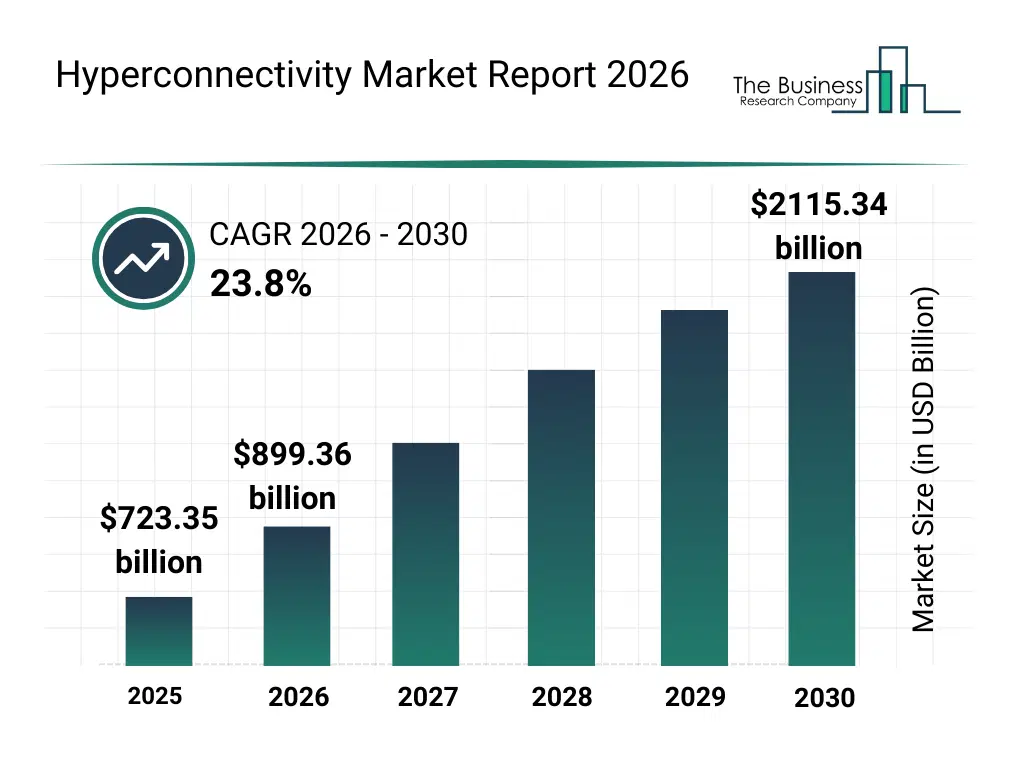
What Is The Hyperconnectivity Market Size and Share 2026?
The hyperconnectivity market size has grown exponentially in recent years. It will grow from $723.35 billion in 2025 to $899.36 billion in 2026 at a compound annual growth rate (CAGR) of 24.3%. The growth in the historic period can be attributed to growth of internet penetration, expansion of mobile networks, early cloud adoption, rise of connected devices, digital transformation initiatives.What Is The Hyperconnectivity Market Growth Forecast?
The hyperconnectivity market size is expected to see exponential growth in the next few years. It will grow to $2115.34 billion in 2030 at a compound annual growth rate (CAGR) of 23.8%. The growth in the forecast period can be attributed to 5G and beyond connectivity expansion, proliferation of smart devices, AI driven automation growth, increasing data driven decision making, demand for seamless digital experiences. Major trends in the forecast period include always connected digital ecosystems, real time data exchange networks, cross platform system integration, ubiquitous device connectivity, automation driven network intelligence.
Global Hyperconnectivity Market Segmentation
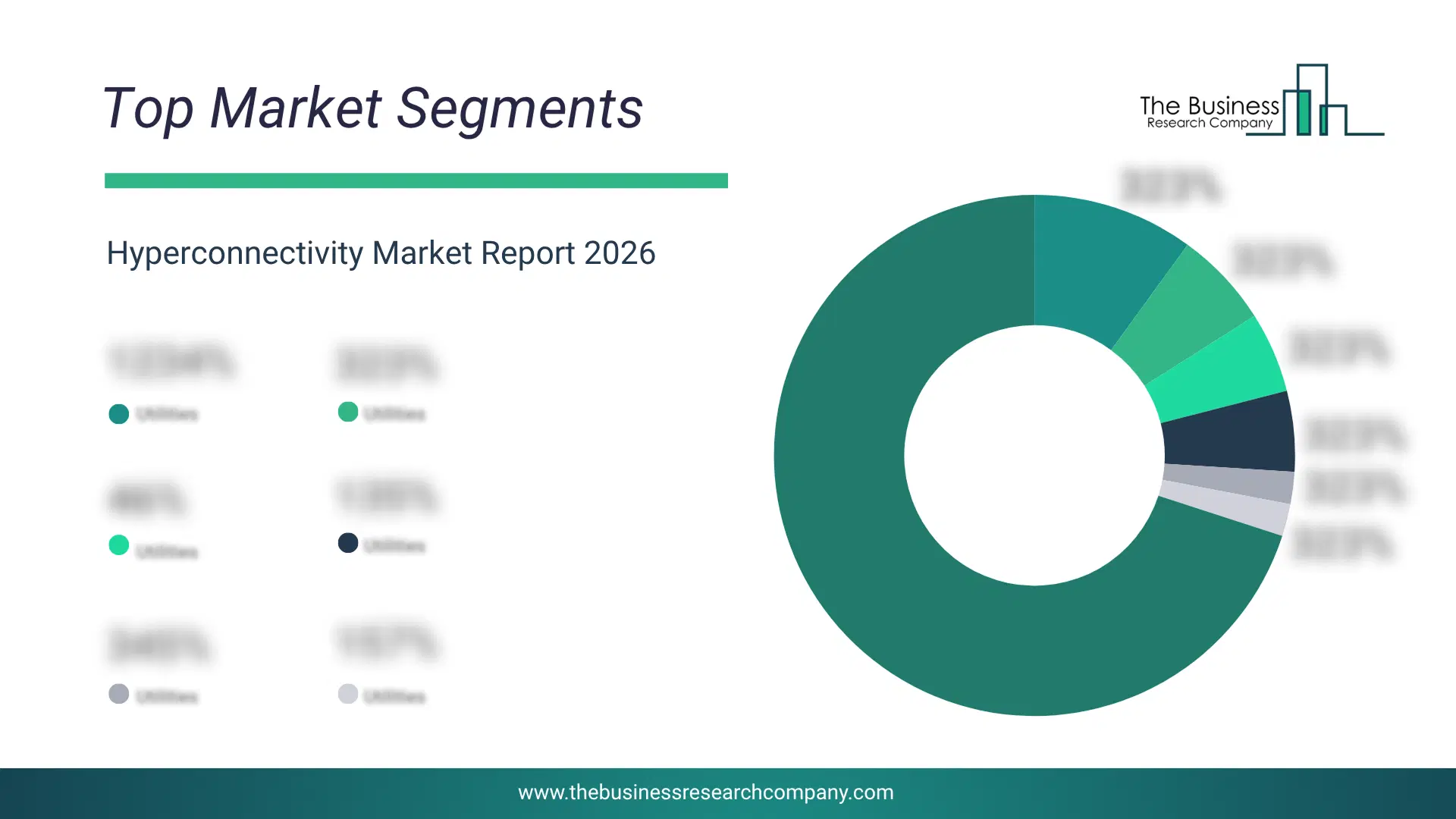
1) By Product: Enterprise Wearable Devices, Middleware Software, Cloud Platforms, Business Solutions 2) By Component: Services, Software 3) By Connectivity Type: Internet Of Things (IoT), Cloud Computing, Fifth Generation (5G), Artificial Intelligence (AI), Augmented Reality (AR) 4) By Organizational Size: Large Enterprises, Small And Medium-Sized Enterprises 5) By Industry Vertical: Banking, Financial Services, And Insurance (BFSI), Healthcare And Life Sciences, Telecommunications And Information Technology, Government And Public Sector, Manufacturing, Consumer Goods And Retail, Media And Entertainment, Other Industry Verticals Subsegments: 1) By Enterprise Wearable Devices: Smart Glasses, Smartwatches, Augmented Reality (AR)/Virtual Reality (VR) Headsets, Smart Clothing, Body Sensors 2) By Middleware Software: Application Programming Interface (API) Management Platforms, Internet of Things (IoT) Middleware, Cloud Integration Middleware, Artificial Intelligence (AI) and Analytics Middleware, Enterprise Service Bus (ESB) 3) By Cloud Platforms: Public Cloud, Private Cloud, Hybrid Cloud, Edge Computing Platforms, AI-As-A-Service 4) By Business Solutions: Unified Communication and Collaboration (UCC), Customer Relationship Management (CRM), Enterprise Resource Planning (ERP), Supply Chain Management (SCM), Cybersecurity SolutionsWhat Is The Driver Of The Hyperconnectivity Market?
The rise of 5G technology is expected to propel the growth of the hyperconnectivity market going forward. 5G technology is the fifth-generation wireless network that delivers ultra-fast speeds, low latency, and massive connectivity, enabling advanced applications. The rising demand for high-speed internet, driven by the proliferation of smartphones, connected devices, and data-intensive services, accelerates the deployment of 5G networks. Hyperconnectivity is helpful for 5G technology by allowing advanced innovations such as self-driving cars, remote healthcare, and industrial automation. For instance, in May 2025, according to Telefonaktiebolaget LM Ericsson, a Sweden-based information and communication technology company, 5G adoption is rapidly growing, with subscriptions expected to reach nearly 2.9 billion by the end of 2025 and 6.3 billion globally by 2030. Therefore, the rise in 5G technology is driving the growth of the hyperconnectivity industry.Key Players In The Global Hyperconnectivity Market
Major companies operating in the hyperconnectivity market are Microsoft Corporation, Samsung Electronics Co. Ltd., Meta Platforms Inc., Siemens AG, International Business Machines Corporation, Oracle Corporation, Telefonica S.A., Broadcom Inc., Fujitsu Limited, Tata Consultancy Services, Nokia Corporation, CommScope Holding Company Inc., Syensqo, Zoom Communications, NTT Docomo, Avaya Holdings Corp., Extreme Networks, CoreSite, Hanwha Systems, Orange Business.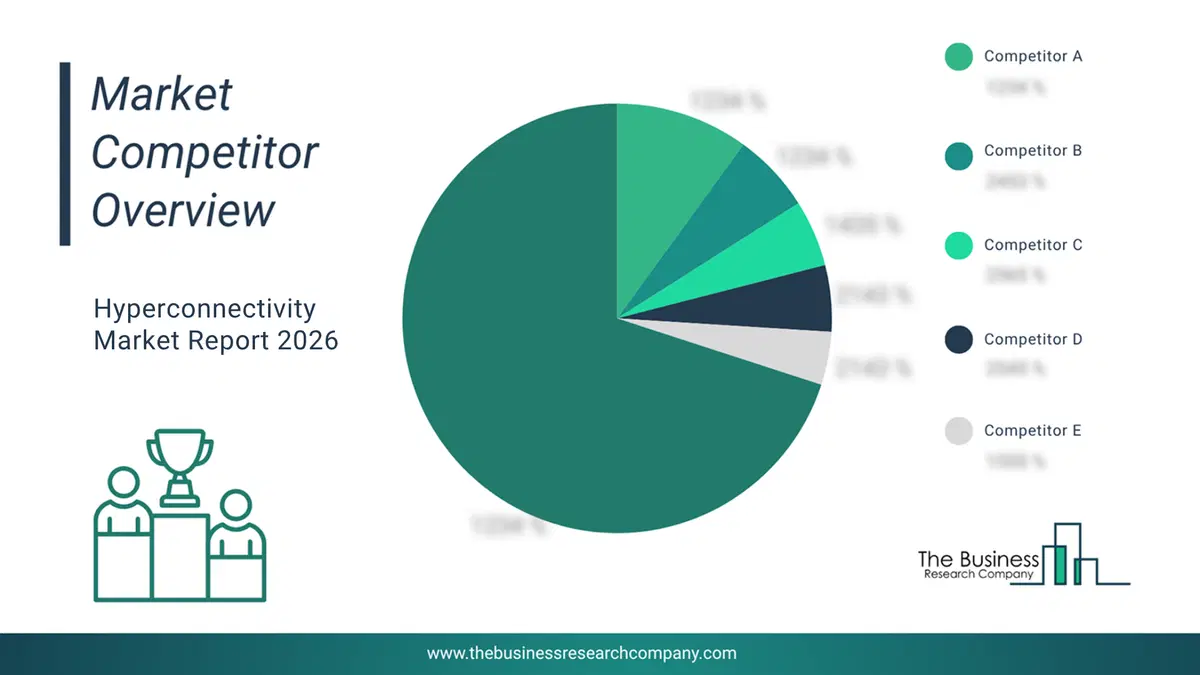
This chart is for illustrative purposes; the full report includes a detailed competitor analysis and comprehensive overview of the top 10 companies in the market.
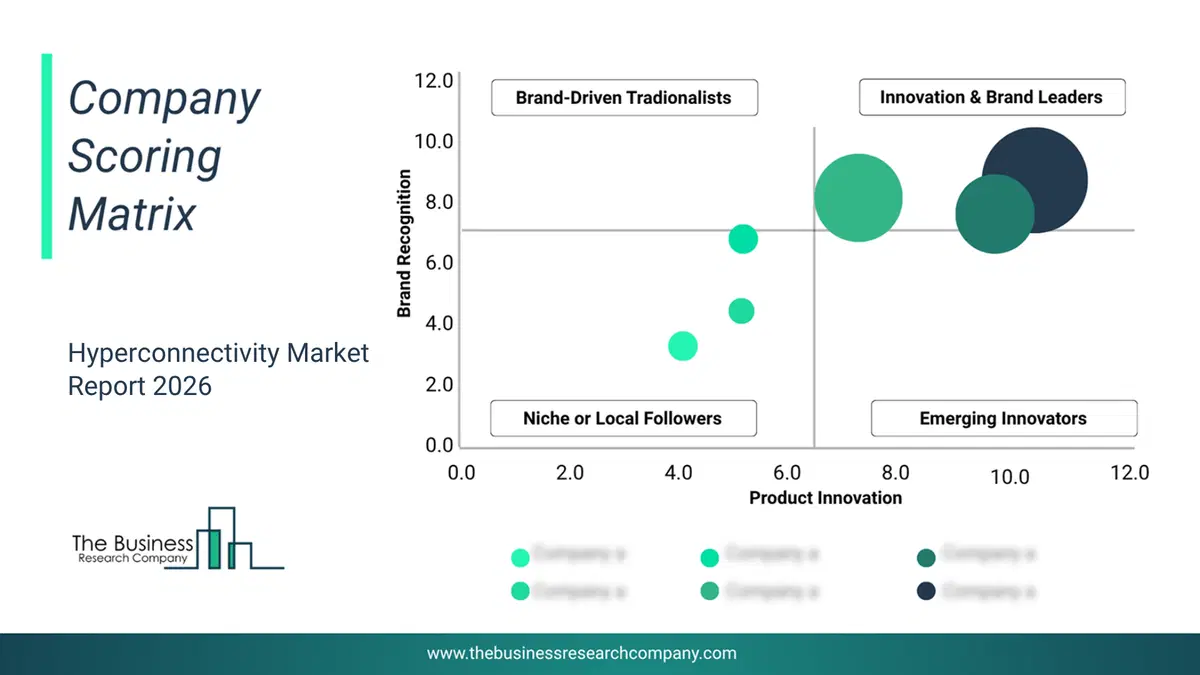
This chart maps companies by product innovation and brand strength, with bubble size indicating relative revenue, helping identify market leaders, challengers, and niche players. This is an illustrative chart; the full report provides a complete and accurate competitive analysis.
Global Hyperconnectivity Market Trends and Insights
Major companies operating in the hyperconnectivity market are focused on developing advanced solutions such as artificial intelligence (AI)-driven connectivity to enhance AI-driven computing and improve real-time data processing. AI-driven connectivity involves incorporating artificial intelligence (AI) into communication networks and digital infrastructure to improve efficiency, automate processes, and enable real-time decision-making. For instance, in January 2025, Advanced Micro Devices Inc., a US-based technology company, launched new Ryzen AI Max, Ryzen AI 300, and Ryzen AI 200 Series processors, an expanded consumer and commercial AI PC portfolio. It leverages Zen 5 and Zen 4 architectures for high-performance AI-enabled PCs. These processors cater to premium thin-and-light notebooks, everyday productivity tasks, and enterprise-grade systems with enhanced security and manageability through AMD PRO Technologies. AMD emphasized its leadership in AI computing, aiming to bring workstation-level power to lightweight laptops for both consumer and business users.What Are Latest Mergers And Acquisitions In The Hyperconnectivity Market?
In March 2023, Wireless Logic Group Ltd., a UK-based Internet of Things (IoT) connectivity platform provider, acquired Blue Wireless for an undisclosed amount. This acquisition aims to enhance Wireless Logic's presence in the Asia Pacific and US markets while expanding its product offerings in fixed wireless access. Blue Wireless is a Singapore-based provider of managed wireless solutions.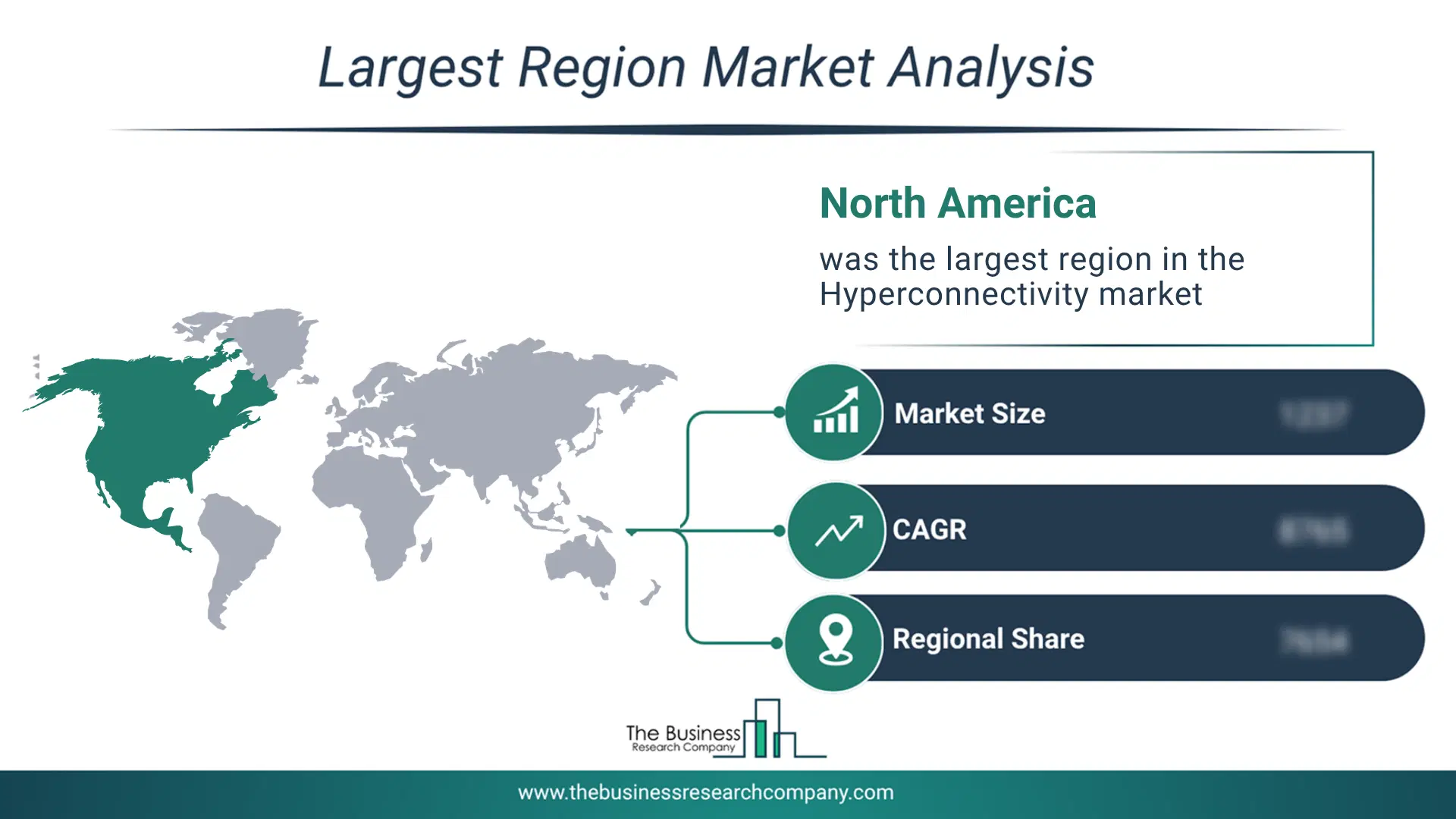
Regional Insights
North America was the largest region in the hyperconnectivity market in 2025. Asia-Pacific is expected to be the fastest-growing region in the forecast period. The regions covered in this market report are Asia-Pacific, South East Asia, Western Europe, Eastern Europe, North America, South America, Middle East, Africa. The countries covered in this market report are Australia, Brazil, China, France, Germany, India, Indonesia, Japan, Taiwan, Russia, South Korea, UK, USA, Canada, Italy, Spain.What Defines the Hyperconnectivity Market?
The hyperconnectivity market consists of revenues earned by entities by providing services such as real-time communication, big data and analytics, smart infrastructure, and edge computing. The market value includes the value of related goods sold by the service provider or included within the service offering. The hyperconnectivity market includes sales of smart sensors and actuators, edge servers and gateways, connected home devices, and content delivery networks. Values in this market are ‘factory gate’ values, that is the value of goods sold by the manufacturers or creators of the goods, whether to other entities (including downstream manufacturers, wholesalers, distributors and retailers) or directly to end customers. The value of goods in this market includes related services sold by the creators of the goods.How is Market Value Defined and Measured?
The market value is defined as the revenues that enterprises gain from the sale of goods and/or services within the specified market and geography through sales, grants, or donations in terms of the currency (in USD unless otherwise specified). The revenues for a specified geography are consumption values that are revenues generated by organizations in the specified geography within the market, irrespective of where they are produced. It does not include revenues from resales along the supply chain, either further along the supply chain or as part of other products.
This chart presents market attractiveness based on a quantitative evaluation of growth, competition, strategic alignment, and risk, offering a clear view of opportunity areas for decision-making. This chart is for illustrative purposes; the full report contains the complete analysis.

This chart highlights the Total Addressable Market (TAM) by estimating the maximum revenue opportunity using an assumption-driven approach, supporting strategic planning and opportunity sizing across markets. The chart is illustrative; the full report provides a more comprehensive analysis.
What Key Data and Analysis Are Included in the Hyperconnectivity Market Report 2026?
The hyperconnectivity market research report is one of a series of new reports from The Business Research Company that provides market statistics, including industry global market size, regional shares, competitors with the market share, detailed market segments, market trends and opportunities, and any further data you may need to thrive in the hyperconnectivity industry. The market research report delivers a complete perspective of everything you need, with an in-depth analysis of the current and future state of the industry.Hyperconnectivity Market Report Forecast Analysis
| Report Attribute | Details |
|---|---|
| Market Size Value In 2026 | $899.36 billion |
| Revenue Forecast In 2030 | $2115.34 billion |
| Growth Rate | CAGR of 23.8% from 2026 to 2030 |
| Base Year For Estimation | 2025 |
| Actual Estimates/Historical Data | 2020-2025 |
| Forecast Period | 2026 - 2030 |
| Market Representation | Revenue in USD Billion and CAGR from 2026 to 2030 |
| Segments Covered | Product, Component, Connectivity Type, Organizational Size, Industry Vertical |
| Regional Scope | Asia-Pacific, Western Europe, Eastern Europe, North America, South America, Middle East, Africa |
| Country Scope | The Countries Covered In This Market Report Are Australia, Brazil, China, France, Germany, India, Indonesia, Japan, Taiwan, Russia, South Korea, Uk, Usa, Canada, Italy, Spain. |
| Key Companies Profiled | Microsoft Corporation, Samsung Electronics Co. Ltd., Meta Platforms Inc., Siemens AG, International Business Machines Corporation, Oracle Corporation, Telefonica S.A., Broadcom Inc., Fujitsu Limited, Tata Consultancy Services, Nokia Corporation, CommScope Holding Company Inc., Syensqo, Zoom Communications, NTT Docomo, Avaya Holdings Corp., Extreme Networks, CoreSite, Hanwha Systems, Orange Business. |
| Customization Scope | Request for Customization |
| Pricing And Purchase Options | Explore Purchase Options |