
Industrial Brakes Market Report 2026
Global Outlook – By Type (Mechanically Applied Brakes, Hydraulically Applied Brakes, Pneumatically Applied Brakes, Electrically Applied Brakes), By Application (Holding Brakes, Dynamic And Emergency Brakes, Tension Brakes), By End-User (Marine And Shipping, Mining, Manufacturing, Construction, Entertainments, Other End-Users) – Market Size, Trends, Strategies, and Forecast to 2030
Industrial Brakes Market Overview
• Industrial Brakes market size has reached to $1.38 billion in 2025 • Expected to grow to $1.83 billion in 2030 at a compound annual growth rate (CAGR) of 5.6% • Growth Driver: Increasing Automation Drives Industrial Brakes Market Growth Through Essential Functions • Market Trend: Advancements In Industrial Brakes Next-Generation Technologies And Industry Innovations • North America was the largest region in 2025 and Asia-Pacific is the fastest growing region.What Is Covered Under Industrial Brakes Market?
Industrial brakes refer to braking systems used in machinery and equipment to control motion and ensure the safety of the industrial environment. These brakes are designed for high performance and durability, handling heavy loads, and frequent use. Industrial brakes are crucial in manufacturing, transportation, and material handling applications. The main types of industrial brakes are mechanically applied brakes, hydraulically applied brakes, pneumatically applied brakes, and electrically applied brakes. Mechanically applied brakes, which use mechanical force such as a lever or pedal to generate braking action, are commonly used in applications requiring simple, direct control, such as bicycles, manual vehicles, and some industrial machinery. These brakes find applications in holding brakes, dynamic and emergency brakes, and tension brakes. The end-user segments include marine and shipping, mining, manufacturing, construction, entertainment, and others.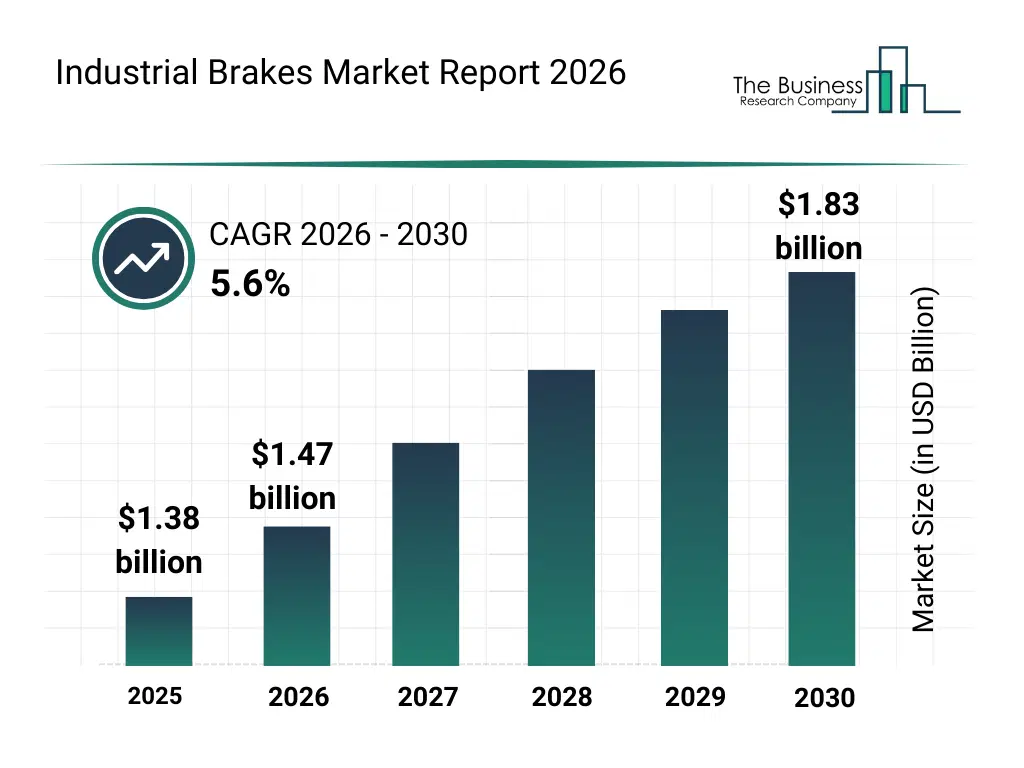
What Is The Industrial Brakes Market Size and Share 2026?
The industrial brakes market size has grown strongly in recent years. It will grow from $1.38 billion in 2025 to $1.47 billion in 2026 at a compound annual growth rate (CAGR) of 5.9%. The growth in the historic period can be attributed to manufacturing equipment growth, mining industry expansion, material handling demand, maritime industry development, heavy machinery usage.What Is The Industrial Brakes Market Growth Forecast?
The industrial brakes market size is expected to see strong growth in the next few years. It will grow to $1.83 billion in 2030 at a compound annual growth rate (CAGR) of 5.6%. The growth in the forecast period can be attributed to automation in industrial equipment, renewable energy installations, safety compliance requirements, logistics infrastructure growth, advanced motion control demand. Major trends in the forecast period include high load braking systems, electromagnetic brake adoption, safety oriented brake design, automated braking solutions, enhanced brake durability.Tariff Impact On Industrial Brakes Market
Tariffs have increased costs of steel components, friction materials, and electronic brake systems, especially in europe and asia pacific. Manufacturers are responding through localized production and alternative material sourcing.
Global Industrial Brakes Market Segmentation
1) By Type: Mechanically Applied Brakes, Hydraulically Applied Brakes, Pneumatically Applied Brakes, Electrically Applied Brakes 2) By Application: Holding Brakes, Dynamic And Emergency Brakes, Tension Brakes 3) By End-User: Marine And Shipping, Mining, Manufacturing, Construction, Entertainments, Other End-Users Subsegments: 1) By Mechanically Applied Brakes: Spring Applied Brakes, Band Brakes, Drum Brakes, Disc Brakes 2) By Hydraulically Applied Brakes: Hydraulic Disc Brakes, Hydraulic Drum Brakes, Oil-Immersed Brakes 3) By Pneumatically Applied Brakes: Pneumatic Disc Brakes, Pneumatic Drum Brakes, Spring-Actuated Pneumatic Brakes 4) By Electrically Applied Brakes: Electromagnetic Brakes, Electric Disc Brakes, Electric Drum BrakesWhat Is The Driver Of The Industrial Brakes Market?
The increasing automation in manufacturing is expected to propel the growth of the industrial brakes market going forward. Automation in manufacturing refers to using technology, such as robots and control systems, to perform tasks and processes with minimal human intervention, aiming to enhance efficiency, precision, and productivity. The increasing automation in manufacturing is driven by factors such as the need for greater efficiency, cost reduction, improved accuracy, enhanced safety, and the ability to meet high production demands. Industrial brakes contribute to increasing automation in manufacturing by providing essential functions such as precise motion control, reliable emergency stopping, consistent performance under varying loads, and enhanced safety measures, all of which are crucial for maintaining the efficiency and reliability of automated systems. For instance, in September 2024, according to the World Robotics Report published by the International Federation of Robotics, a Germany-based non-profit organization, approximately 4,281,585 industrial robots were operating in factories worldwide in 2023, marking a 10% increase from the previous year. Annual installations exceeded 541,302 units in 2023, with 70% of newly deployed robots in Asia, 17% in Europe, and 10% in the Americas, highlighting the global scale and regional concentration of automation growth. Therefore, increasing automation in manufacturing is driving the growth of the industrial brakes industry.Key Players In The Global Industrial Brakes Market
Major companies operating in the industrial brakes market are Eaton Corporation plc, Parker Hannifin Corporation, Altra Industrial Motion Corp., Dellner Bubenzer, Hilliard Corporation, SIBRE Siegerland Bremsen GmbH, Carlisle Brake & Friction, Coremo Ocmea S.p.A., Emco Precima Engineering Pvt. Ltd., KTR Systems GmbH, Nabtesco Corporation, Haldex AB, Kobelt Manufacturing Co. Ltd., Antec SA, Kor-Pak Corporation, Jiaozuo Changjiang Brake Co. Ltd., Jiangxi Huawu Brake Co. Ltd., Shanghai Borui Electric Co. Ltd., Warner Electric, Stromag GmbH, Wichita Clutch
This chart is for illustrative purposes; the full report includes a detailed competitor analysis and comprehensive overview of the top 10 companies in the market.
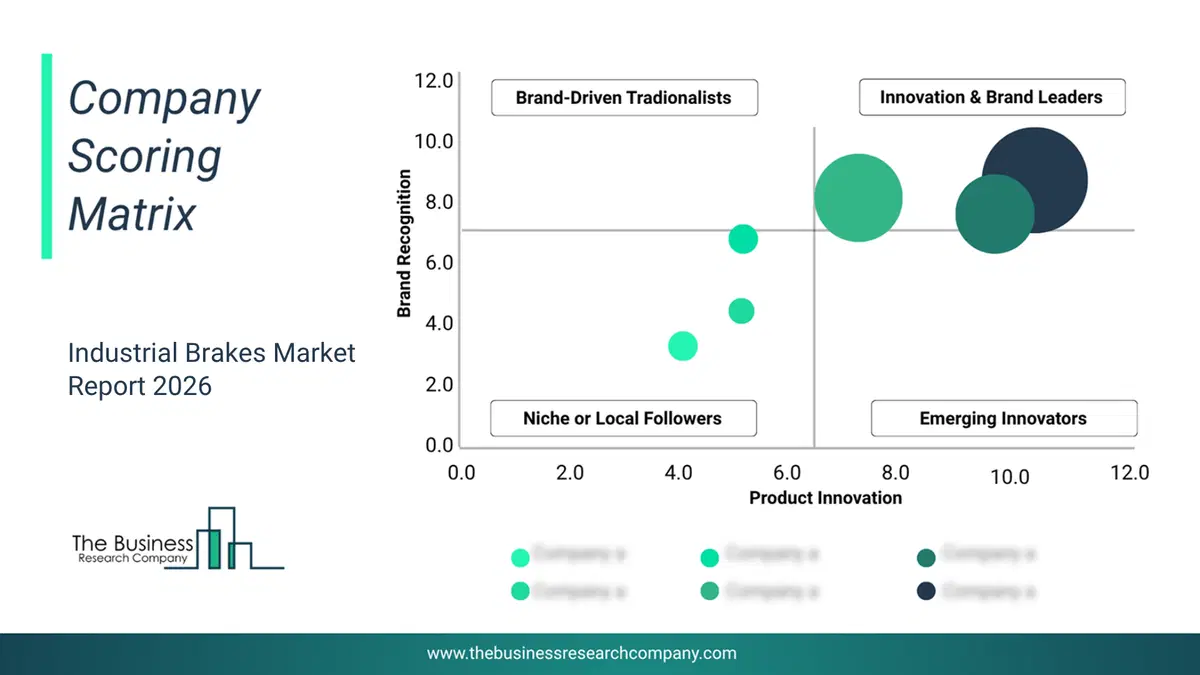
This chart maps companies by product innovation and brand strength, with bubble size indicating relative revenue, helping identify market leaders, challengers, and niche players. This is an illustrative chart; the full report provides a complete and accurate competitive analysis.
Global Industrial Brakes Market Trends and Insights
Major companies operating in the industrial brakes market are focusing on developing advanced products, such as next-generation braking technologies, to improve performance, enhance safety, and increase efficiency in various industrial applications. Next-generation braking technologies are advanced braking systems incorporating innovative technologies and materials to enhance performance, safety, and efficiency. For instance, in March 2023, ZF Friedrichshafen AG, a Germany-based technology company, launched the Advanced Brake-by-Wire Solutions tailored for the global construction industry. The new brake system operates through an electronic signal that adjusts brake pressure as needed, eliminating the requirement for hydraulic lines within the cab. This transition supports the evolution towards electric and autonomous vehicle operations.What Are Latest Mergers And Acquisitions In The Industrial Brakes Market?
In December 2023, AEQUITA, a Germany-based private equity company, acquired TMD Friction Group GmbH for an undisclosed amount. This acquisition ensures TMD's operational independence, integrates AEQUITA's management expertise for growth, and leverages AEQUITA's resources for global expansion and innovation, significantly enhancing TMD's competitive position, fostering research and development, and facilitating market expansion within the industrial brakes sector. TMD Friction Group GmbH is a Germany-based company that manufactures industrial braking solutions.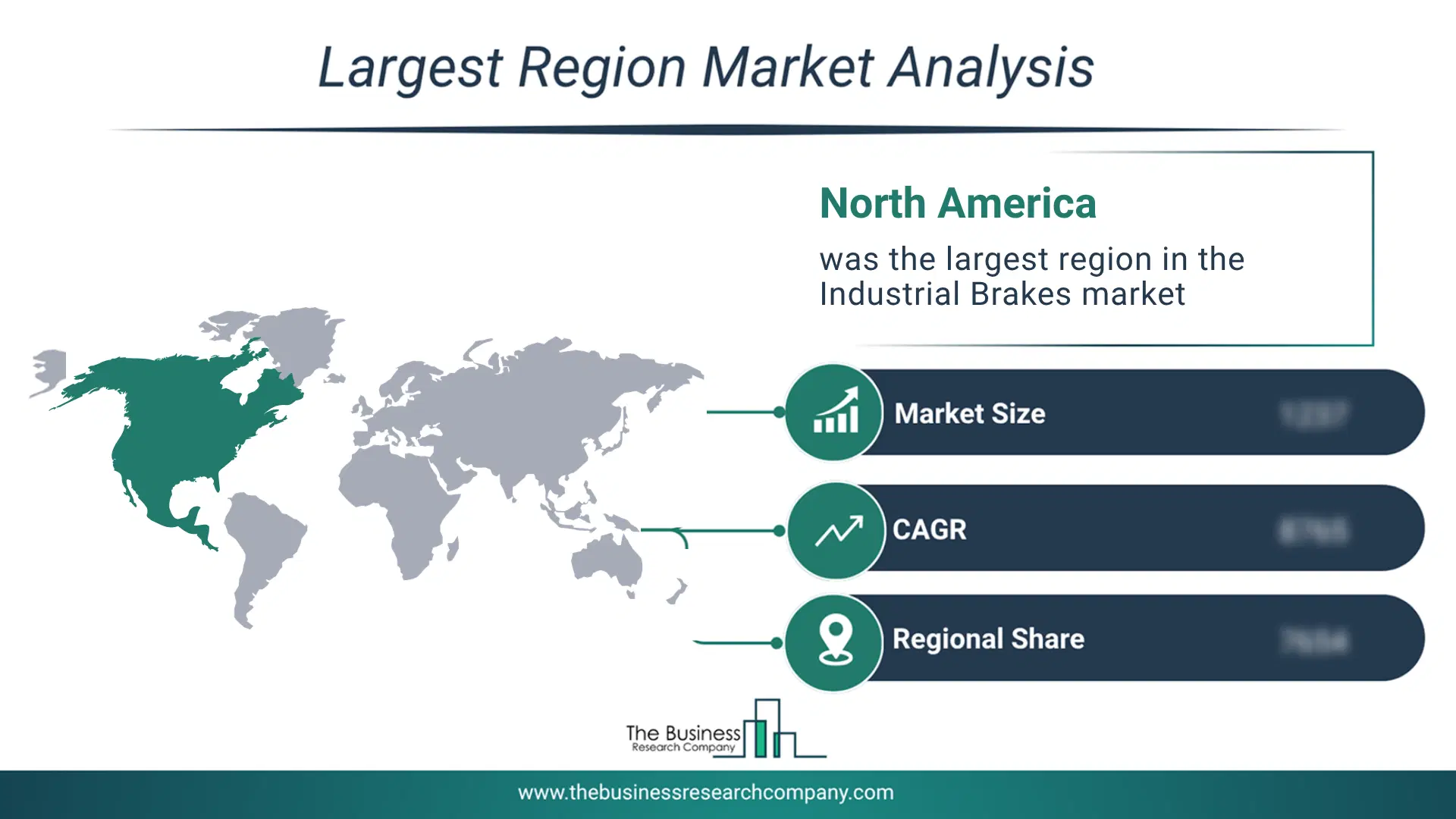
Regional Outlook
North America was the largest region in the industrial brakes market in 2025. Asia-Pacific is expected to be the fastest-growing region in the forecast period. The regions covered in this market report are Asia-Pacific, South East Asia, Western Europe, Eastern Europe, North America, South America, Middle East, Africa The countries covered in this market report are Australia, Brazil, China, France, Germany, India, Indonesia, Japan, Taiwan, Russia, South Korea, UK, USA, Canada, Italy, Spain.What Defines the Industrial Brakes Market?
The industrial brakes market consists of sales of spring-applied brakes, regenerative brakes, pneumatic brakes, hydraulic brakes, railway brakes, and cranes and hoist brakes. Values in this market are ‘factory gate’ values, that is, the value of goods sold by the manufacturers or creators of the goods, whether to other entities (including downstream manufacturers, wholesalers, distributors, and retailers) or directly to end customers. The value of goods in this market includes related services sold by the creators of the goods.How is Market Value Defined and Measured?
The market value is defined as the revenues that enterprises gain from the sale of goods and/or services within the specified market and geography through sales, grants, or donations in terms of the currency (in USD unless otherwise specified). The revenues for a specified geography are consumption values that are revenues generated by organizations in the specified geography within the market, irrespective of where they are produced. It does not include revenues from resales along the supply chain, either further along the supply chain or as part of other products.
This chart presents market attractiveness based on a quantitative evaluation of growth, competition, strategic alignment, and risk, offering a clear view of opportunity areas for decision-making. This chart is for illustrative purposes; the full report contains the complete analysis.

This chart highlights the Total Addressable Market (TAM) by estimating the maximum revenue opportunity using an assumption-driven approach, supporting strategic planning and opportunity sizing across markets. The chart is illustrative; the full report provides a more comprehensive analysis.
What Key Data and Analysis Are Included in the Industrial Brakes Market Report 2026?
The industrial brakes market research report is one of a series of new reports from The Business Research Company that provides market statistics, including industry global market size, regional shares, competitors with the market share, detailed market segments, market trends and opportunities, and any further data you may need to thrive in the industrial brakes industry. The market research report delivers a complete perspective of everything you need, with an in-depth analysis of the current and future state of the industry.Industrial Brakes Market Report Forecast Analysis
| Report Attribute | Details |
|---|---|
| Market Size Value In 2026 | $1.47 billion |
| Revenue Forecast In 2030 | $1.83 billion |
| Growth Rate | CAGR of 5.6% from 2026 to 2030 |
| Base Year For Estimation | 2025 |
| Actual Estimates/Historical Data | 2020-2025 |
| Forecast Period | 2026 - 2030 |
| Market Representation | Revenue in USD Billion and CAGR from 2026 to 2030 |
| Segments Covered | Type, Application, End-User |
| Regional Scope | Asia-Pacific, Western Europe, Eastern Europe, North America, South America, Middle East, Africa |
| Key Companies Profiled | Eaton Corporation plc, Parker Hannifin Corporation, Altra Industrial Motion Corp., Dellner Bubenzer, Hilliard Corporation, SIBRE Siegerland Bremsen GmbH, Carlisle Brake & Friction, Coremo Ocmea S.p.A., Emco Precima Engineering Pvt. Ltd., KTR Systems GmbH, Nabtesco Corporation, Haldex AB, Kobelt Manufacturing Co. Ltd., Antec SA, Kor-Pak Corporation, Jiaozuo Changjiang Brake Co. Ltd., Jiangxi Huawu Brake Co. Ltd., Shanghai Borui Electric Co. Ltd., Warner Electric, Stromag GmbH, Wichita Clutch |
| Customization Scope | Request for Customization |
| Pricing And Purchase Options | Explore Purchase Options |