

Industrial X-Ray Market Report 2026
Global Outlook – By Product Type (X-Ray Instruments, X-Ray Consumables, X-Ray Services), By Imaging Technique (Digital Radiography, Film-Based Radiography), By Range (Micro Focus X-Ray, High Energy X-Ray, Other Ranges), By Application (Aerospace Industries, Defense And Military, Power Generation Industry, Automotive Industry, Manufacturing Industry, Food And Beverages Industry, Other Applications), By Distribution Channel (Direct Channel, Indirect Channel) – Market Size, Trends, Strategies, and Forecast to 2030
Industrial X-Ray Market Overview
• Industrial X-Ray market size has reached to $3.17 billion in 2025 • Expected to grow to $4.32 billion in 2030 at a compound annual growth rate (CAGR) of 6.3% • Growth Driver: Increasing Food And Beverages Sector Fuels Industrial X-Ray Market • Market Trend: Next-Generation X-Ray Technology Enhances Pipeline And Weld Evaluation • North America was the largest region in 2025.Market Gains By 2030 – Top Opportunities By Segment
Market Gain identifies the most promising market opportunities by highlighting the segments or products expected to generate the highest incremental revenue growth over the next five years.
What Is Covered Under Industrial X-Ray Market?
Industrial X-ray refers to the use of X-rays to inspect and analyze materials and products in various industries. It enables non-destructive testing (NDT) to detect defects, inconsistencies, or internal structures without damaging the inspected item. It is widely employed in sectors such as manufacturing, automotive, aerospace, electronics, and healthcare. The main product types of industrial X-rays are X-ray instruments, X-ray consumables, and X-ray services. X-ray instruments refer to the devices used to generate and control X-rays for various industrial applications, such as the inspection and testing of materials and products for defects or quality assurance purposes. The imaging technique includes digital radiography and film-based radiography, and the range is microfocus X-ray, high-energy X-ray, and others. It is used in various applications, such as aerospace industries, defense and military industries, power generation industries, automotive industries, manufacturing industries, food and beverage industries, and others, and is distributed by various channels, including direct channel and indirect channels.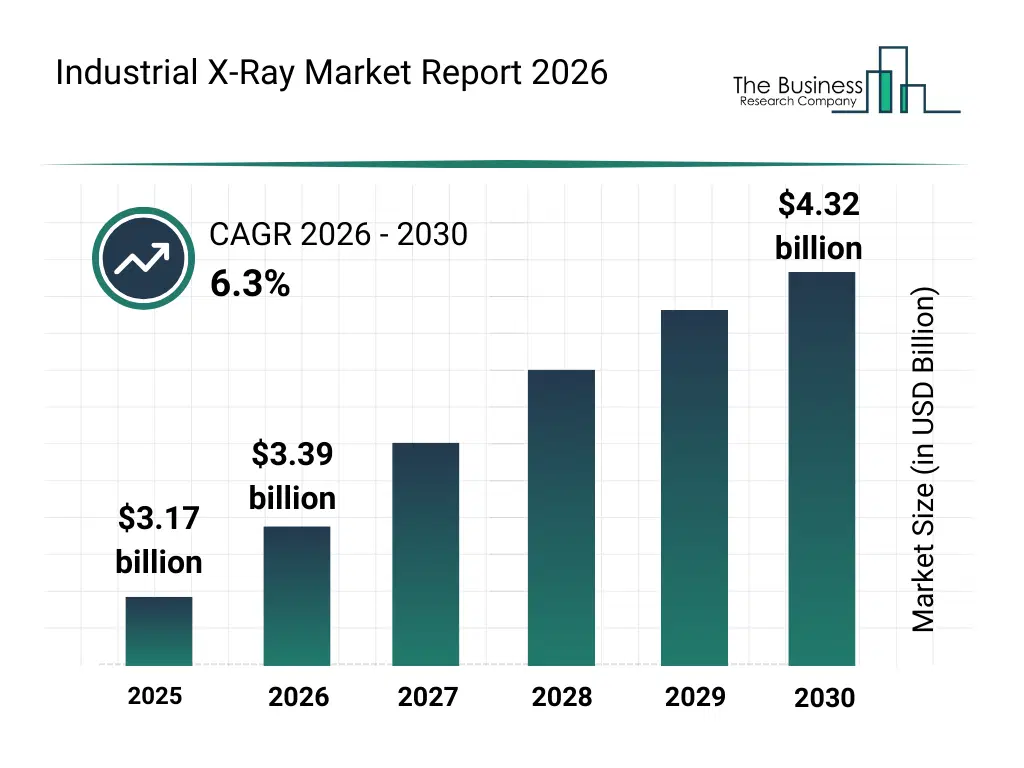
What Is The Industrial X-Ray Market Size and Share 2026?
The industrial x-ray market size has grown strongly in recent years. It will grow from $3.17 billion in 2025 to $3.39 billion in 2026 at a compound annual growth rate (CAGR) of 6.9%. The growth in the historic period can be attributed to industrial quality assurance needs, safety certification requirements, growth of manufacturing output, reliance on film-based radiography, defense inspection demand.What Is The Industrial X-Ray Market Growth Forecast?
The industrial x-ray market size is expected to see strong growth in the next few years. It will grow to $4.32 billion in 2030 at a compound annual growth rate (CAGR) of 6.3%. The growth in the forecast period can be attributed to automation of inspection processes, ai-driven defect analysis, infrastructure safety investments, growth of advanced manufacturing, digital imaging adoption. Major trends in the forecast period include adoption of digital radiography systems, growth of non-destructive testing applications, integration of ai-based defect detection, expansion in aerospace and automotive inspection, demand for high-resolution imaging.
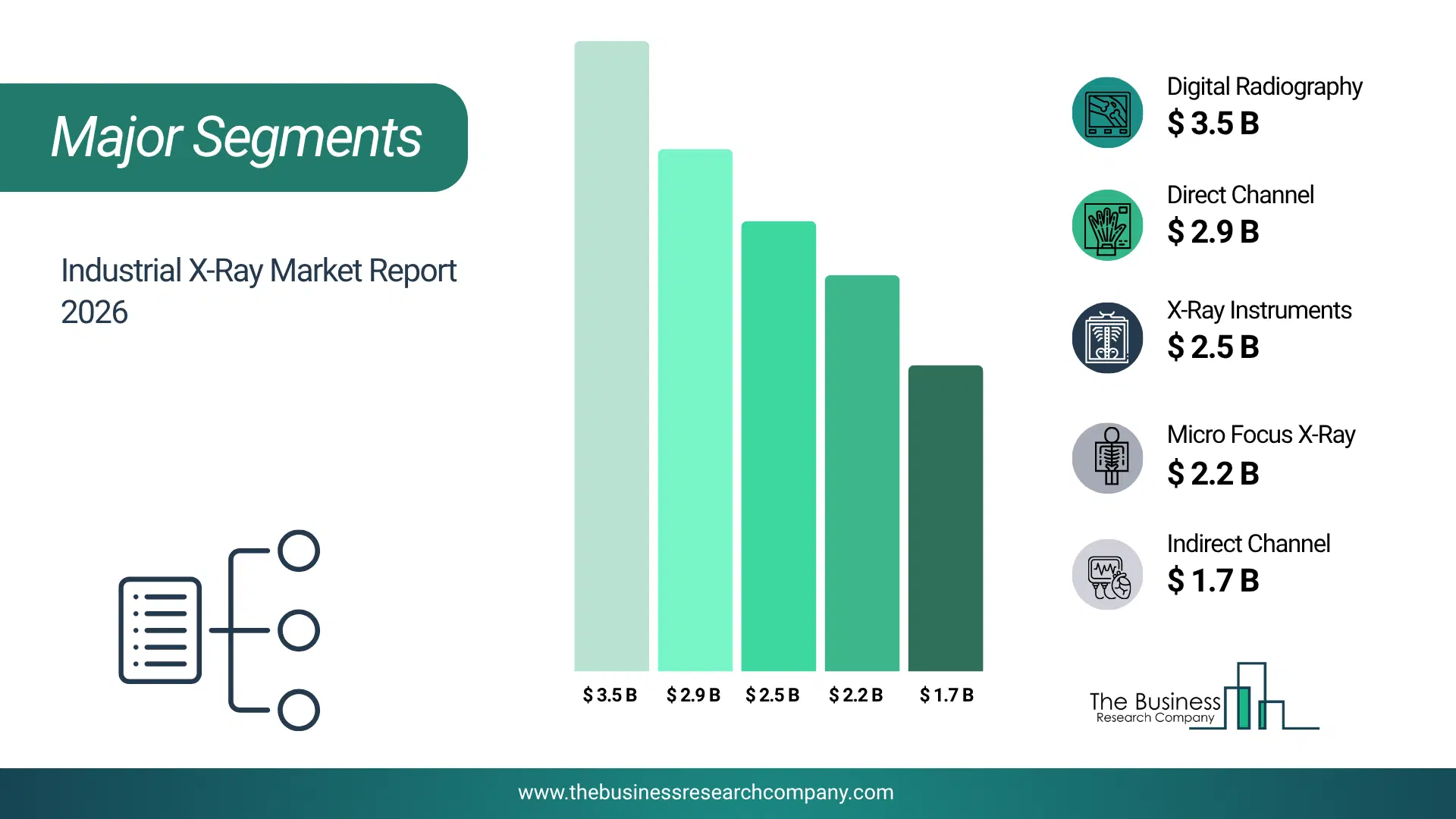
Global Industrial X-Ray Market Segmentation
1) By Product Type: X-Ray Instruments, X-Ray Consumables, X-Ray Services 2) By Imaging Technique: Digital Radiography, Film-Based Radiography 3) By Range: Micro Focus X-Ray, High Energy X-Ray, Other Ranges 4) By Application: Aerospace Industries, Defense And Military, Power Generation Industry, Automotive Industry, Manufacturing Industry, Food And Beverages Industry, Other Applications 5) By Distribution Channel: Direct Channel, Indirect Channel Subsegments: 1) By X-Ray Instruments: X-Ray Inspection Systems, X-Ray Detectors, X-Ray Tubes, Portable X-Ray Machines 2) By X-Ray Consumables: X-Ray Films, X-Ray Fluorescent Screens, Film Processing Chemicals, X-Ray Cassettes 3) By X-Ray Services: X-Ray Inspection Services, X-Ray Maintenance Services, X-Ray Testing And Certification Services The top segments in the industrial x-ray market will be: • Digital Radiography will reach $3585.88 Million by 2030. • Direct Channel will reach $2921.77 Million by 2030. • X-Ray Instruments will reach $2494.14 Million by 2030. • Micro Focus X-Ray will reach $2280.28 Million by 2030. • Indirect Channel will reach $1704.04 Million by 2030.What Is The Driver Of The Industrial X-Ray Market?
The increasing food and beverage sector is expected to propel the growth of the industrial X-ray market going forward. The food and beverage industry encompasses the production, processing, distribution, and sale of edible goods and non-alcoholic drinks. The expansion of the food and beverage industry is driven by factors such as changing consumer preferences, population growth, globalization, and technological advancements. Industrial X-rays in the food and beverage sector are used for quality control, detecting foreign objects, and ensuring product safety without damaging the items. For instance, in March 2024, according to the Australian Bureau of Statistics, an Australia-based national statistical agency, in the 2023–24 period, supermarkets, grocery outlets, and convenience retailers collectively recorded an estimated 15.3 million tonnes in food and non-alcoholic beverage sales. Therefore, the increasing food and beverage sector is driving the growth of the industrial X-ray industry.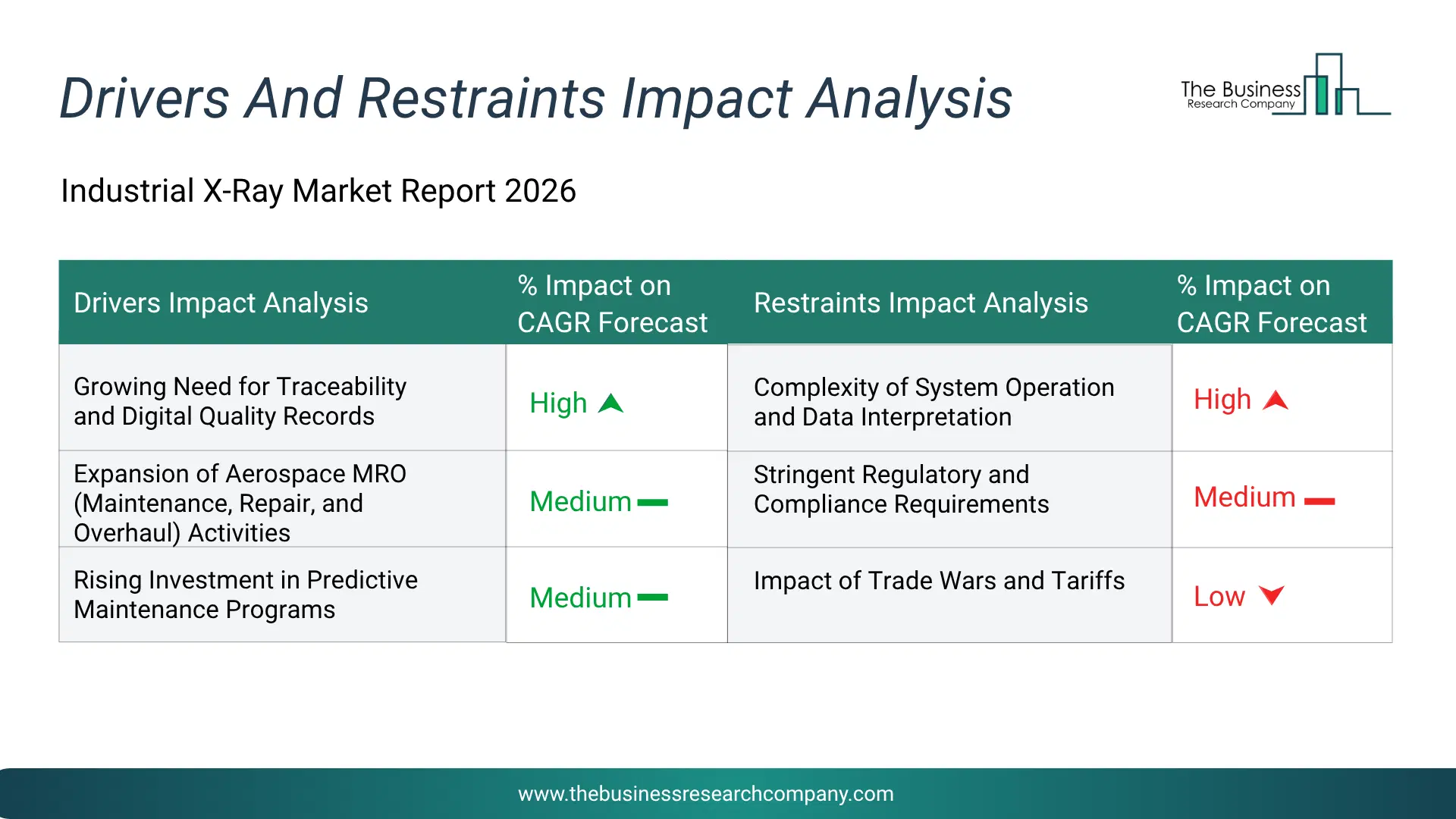
Infographic Chart Showing Key Market Drivers Analysis And Restraints For Industrial X-Ray Market
The chart presents an impact analysis of key drivers and restraints, quantifying their relative influence on the market's growth rate and helping assess the balance between growth enablers and limiting factors. This chart offers a high-level perspective; the full report contains more detailed insights.
How Will The Drivers Impact Growth In The Global Industrial X-Ray Market?
• Growing Need for Traceability and Digital Quality Records (High) – During the forecast period, the growing need for traceability and digital quality records is driving demand for industrial x-ray. industries such as aerospace, automotive, energy, defense, and advanced manufacturing must now demonstrate full lifecycle traceability of parts, from raw materials to final assembly, including proof of internal defect-free integrity. digital radiography and industrial ct systems generate high-resolution digital images and structured inspection data that can be stored, indexed, and linked to specific serial numbers, production batches, and compliance certificates. this capability is essential for meeting regulatory audits, customer quality requirements, warranty claims, and product liability protection. as manufacturers move away from paper records and film-based radiography toward fully digital quality management systems, investment in industrial x-ray instruments, detectors, and software platforms increases. the growing need for traceability and digital quality records growth contribution during the forecast period in 2025 is 2.1%. • Expansion of Aerospace MRO (Maintenance, Repair, and Overhaul) Activities (Medium) – During the forecast period, the expansion of aerospace mro (maintenance, repair, and overhaul) activities is driving increased demand for industrial x-ray. as global aircraft fleets age and flight volumes increase, airlines and mro providers must conduct more frequent inspections of engines, landing gear, fuselage structures, turbine blades, and composite airframe parts. industrial x-ray radiography and ct are indispensable tools for detecting internal cracks, corrosion, delamination, and manufacturing defects without disassembling complex assemblies. mro facilities increasingly invest in fixed and mobile x-ray systems to perform on-site inspections, reduce aircraft downtime, and accelerate turnaround times. the growing complexity of modern aircraft materials, including composites and additive-manufactured parts, further increases reliance on high-resolution radiography and ct. the expansion of aerospace mro (maintenance, repair, and overhaul) activities growth contribution during the forecast period in 2025 is 1.6%. • Rising Investment in Predictive Maintenance Programs (Medium) – During the forecast period, the rising investment in predictive maintenance programs is accelerating the adoption of industrial x-ray. industries such as power generation, oil and gas, aviation, railways, and heavy manufacturing increasingly rely on condition-based monitoring strategies that use inspection data to forecast component degradation before catastrophic breakdowns occur. industrial x-ray radiography and ct play a critical role in predictive maintenance by enabling internal inspection of turbine blades, pressure vessels, pipelines, welded joints, bearings, and composite structures without dismantling equipment. these systems allow maintenance teams to detect early-stage cracks, corrosion, voids, and structural fatigue that are invisible to surface inspection methods. the rising investment in predictive maintenance programs growth contribution during the forecast period in 2025 is 1.1%. • Increasing AI-Driven Defect Analysis (Low) – During the forecast period, increasing AI-driven defect analysis are accelerating the adoption of industrial x-ray. manufacturers and inspection service providers are integrating machine learning and computer vision algorithms with digital radiography and ct platforms to automatically detect porosity, cracks, inclusions, misalignments, and weld defects with higher speed and consistency than human inspectors. this reduces inspection bottlenecks, minimizes human error, and enables real-time decision-making on production lines. ai-enabled x-ray inspection systems also lower labor dependency, improve repeatability, and support 24/7 automated operations in smart factories. as defect detection software becomes a standard feature in next-generation inspection platforms, customers increasingly invest in premium industrial x-ray systems bundled with analytics software, image-processing tools, and cloud-based data platforms. the increasing ai-driven defect analysis growth contribution during the forecast period in 2025 is 0.6%.How Will The Restraints Impact Growth In The Global Industrial X-Ray Market?
• Complexity of System Operation and Data Interpretation (High) – During the forecast period, the complexity of system operation and data interpretation remains a significant barrier to market expansion. operating industrial radiography and ct systems requires technical expertise in radiation physics, image optimization, equipment calibration, and safety procedures. interpreting radiographic and ct images to distinguish real defects from artifacts, noise, or material variations demands advanced analytical skills and extensive experience. inconsistent image interpretation can lead to false positives, unnecessary rework, or missed defects, undermining confidence in inspection outcomes. this complexity raises training costs, increases labor dependency, and limits scalability in high-volume production environments. growth affected by complexity of system operation and data interpretation during the forecast period in 2025 is -2.0%. • Stringent Regulatory and Compliance Requirements (Medium) – During the forecast period, the stringent regulatory and compliance requirements a significant barrier to market expansion. industrial x-ray use is governed by strict radiation safety laws, licensing requirements, personnel certification standards, and periodic equipment inspections. companies must maintain detailed documentation, conduct regular safety audits, and ensure continuous compliance with occupational exposure limits. any regulatory non-compliance can result in fines, shutdowns, or license revocations, creating significant legal and financial risks. these regulatory complexities discourage new entrants, delay system deployments, and increase the cost of ownership, particularly for small firms and service providers operating across multiple jurisdictions. growth affected by stringent regulatory and compliance requirements during the forecast period in 2025 is -1.5%. • Impact of Trade Wars and Tariffs (Medium) – During the forecast period, the impact of trade war and tariffs remains a significant barrier to market expansion. industrial x-ray systems rely on globally sourced components such as x-ray tubes, detectors, sensors, semiconductors, and imaging electronics. tariffs on imported components or finished systems raise production costs for equipment manufacturers and result in higher selling prices for customers. trade restrictions also cause delivery delays, limit supplier options, and complicate after-sales service and spare-parts availability. these cost pressures and uncertainties reduce capital spending willingness among industrial buyers, slow procurement decisions, and weaken near-term demand for industrial x-ray instruments and services. growth affected by impact of trade war and tariffs during the forecast period in 2025 is -0.3%.Key Players In The Global Industrial X-Ray Market
Major companies operating in the industrial x-ray market are Hitachi Ltd., Siemens AG, General Electric Company, Fujifilm Holdings Corporation, Mettler-Toledo International Inc., Varian Medical Systems Inc., PerkinElmer Inc., Bruker Corporation, Agfa-Gevaert Group, ZEISS Group, Carestream Health, Varex Imaging, Comet Group, Rigaku Corporation, CANON MEDICAL SYSTEMS CORPORATION, Gulmay, Metrix NDT, Krystalvision Image Systems Pvt. Ltd., Vision Medicaid Equipment Private Limited, X-Innovations Technologies Ltd., Lucky Healthcare Co. Ltd., PROTEC GmbH & Co. KG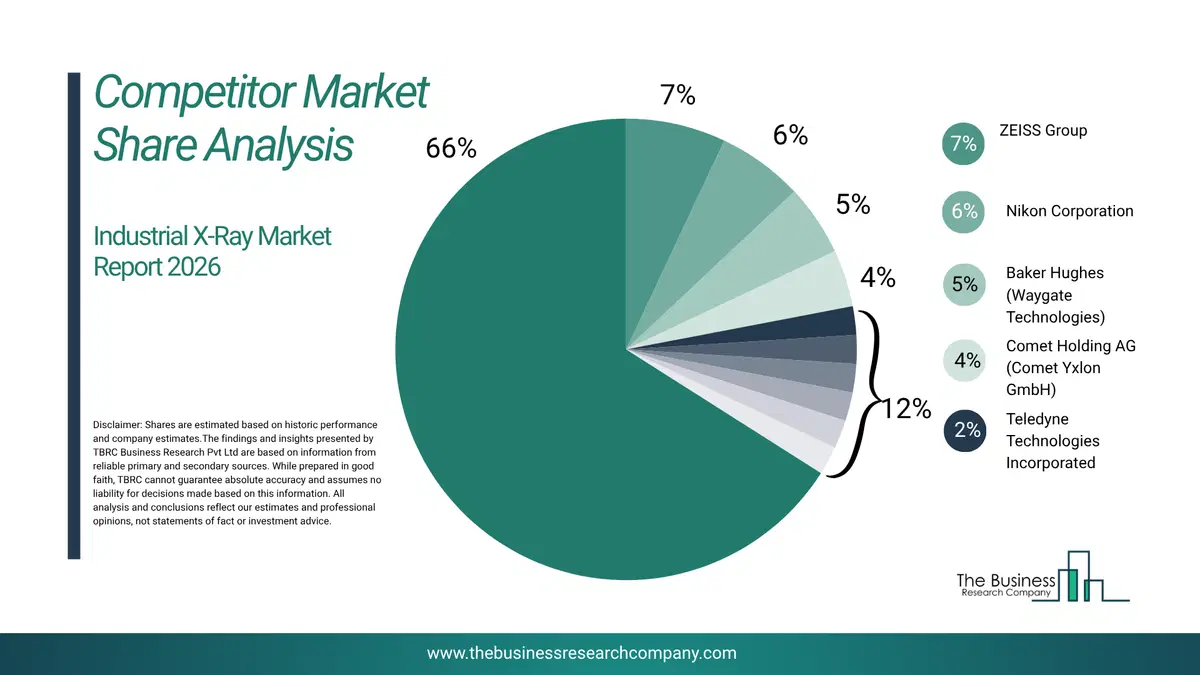
This chart is for illustrative purposes; the full report includes a detailed competitor analysis and comprehensive overview of the top 10 companies in the market.
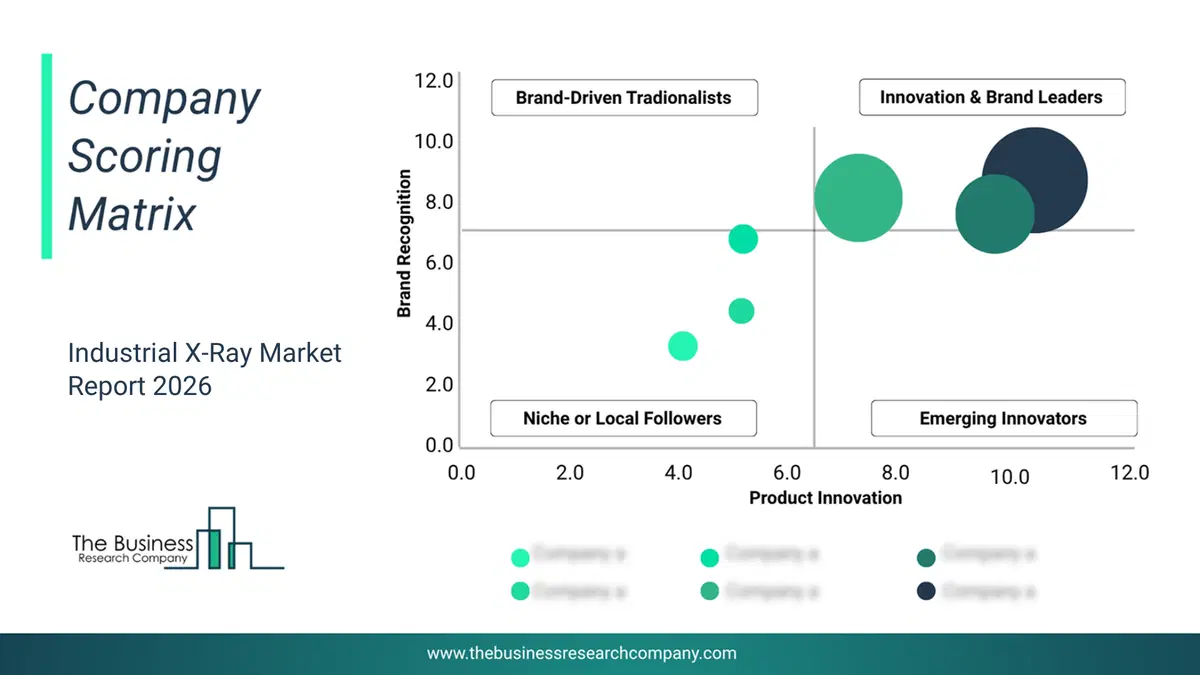
This chart maps companies by product innovation and brand strength, with bubble size indicating relative revenue, helping identify market leaders, challengers, and niche players. This is an illustrative chart; the full report provides a complete and accurate competitive analysis.
Global Industrial X-Ray Market Trends and Insights
Major companies operating in the industrial x-ray market are focusing on developing innovative products, such as bendable digital x-ray detectors detectors that physically conform to curved surfaces (e.g., pipes or weld seams), enabling more comprehensive and efficient radiographic inspections. For instance, in October 2024, Waygate Technologies, a Germany-based nondestructive-testing solutions company, introduced the DXR Flex 1025/1043 bendable detector. This detector offers a flexible design for double-sided exposures on curved surfaces, supports both wired and wireless communication, features a rugged protective housing for field durability, and is battery-operated for mobile use. This innovation improves inspection flexibility and efficiency, reduces handling complexity, and broadens applicability across pipelines, pressure vessels, and weld inspection, though the flexible form factor may pose durability challenges in harsh industrial settings.What Are Latest Mergers And Acquisitions In The Industrial X-Ray Market?
In February 2024, Pinnacle X-Ray Solutions LLC, a US-based provider of imaging equipment services, acquired Willick Engineering Co. Inc. for an undisclosed amount. The aim of this strategic acquisition is to expand its capacity and West Coast presence, leveraging Willick's customer service reputation and diverse customer base. Willick Engineering Co. Inc. is a US-based company that provides non-destructive testing (NDT) X-ray equipment and related services to the military, aerospace, and medical device sectors.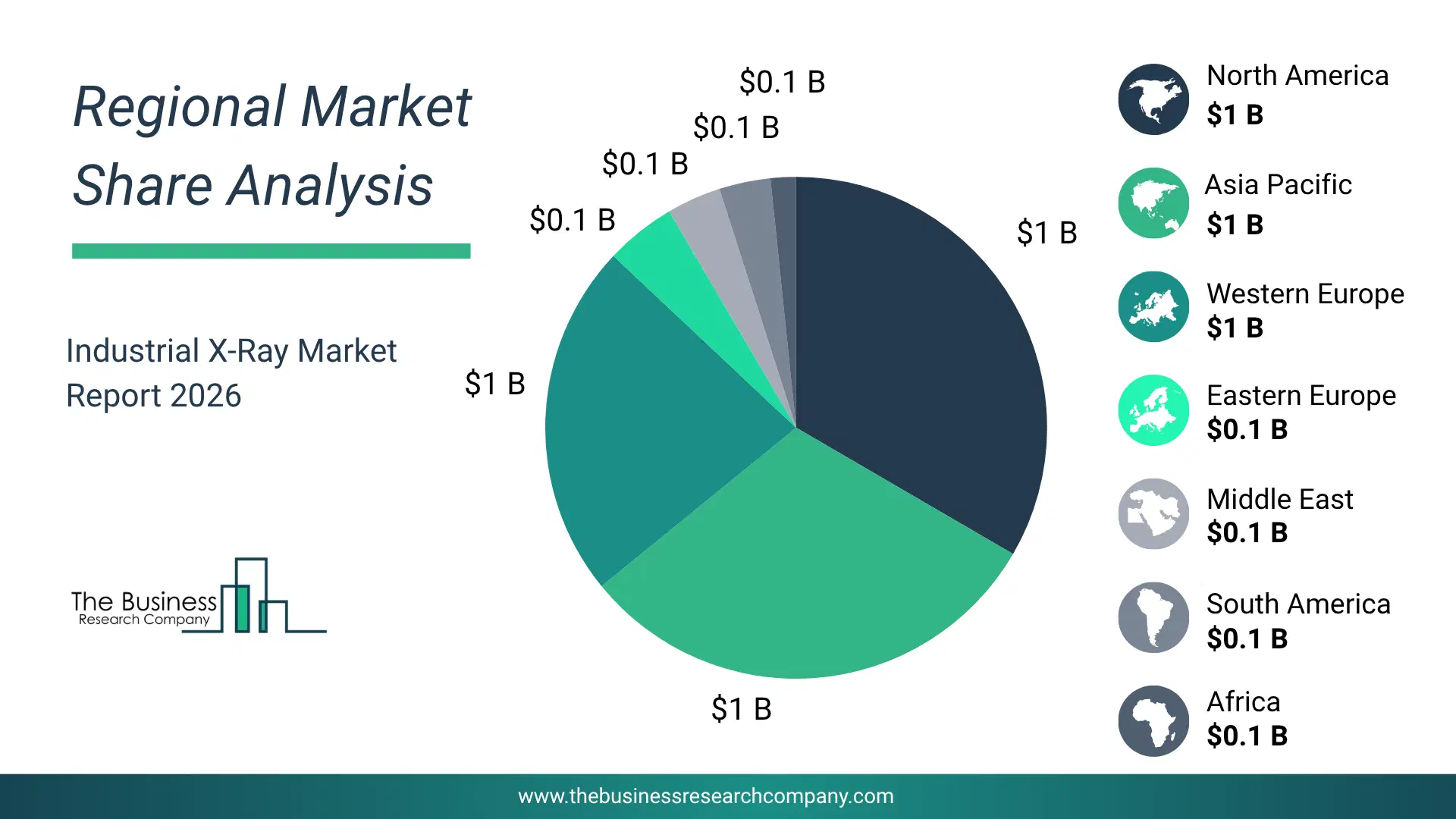
Regional Outlook
North America was the largest region in the industrial X-ray market in 2025. The regions covered in this market report are Asia-Pacific, South East Asia, Western Europe, Eastern Europe, North America, South America, Middle East, Africa The countries covered in this market report are Australia, Brazil, China, France, Germany, India, Indonesia, Japan, Taiwan, Russia, South Korea, UK, USA, Canada, Italy, Spain.What Defines the Industrial X-Ray Market?
The industrial X-ray market consists of revenues earned by entities by providing services such as computed tomography scanners, X-ray inspection and testing services, calibration and maintenance of X-ray equipment, rental and leasing of X-ray equipment, and imaging plates and films. The market value includes the value of related goods sold by the service provider or included within the service offering. The industrial X-ray market also includes sales of industrial X-ray machines, digital radiography systems, and portable X-ray devices. Values in this market are ‘factory gate’ values, that is, the value of goods sold by the manufacturers or creators of the goods, whether to other entities (including downstream manufacturers, wholesalers, distributors, and retailers) or directly to end customers. The value of goods in this market includes related services sold by the creators of the goods.How is Market Value Defined and Measured?
The market value is defined as the revenues that enterprises gain from the sale of goods and/or services within the specified market and geography through sales, grants, or donations in terms of the currency (in USD unless otherwise specified). The revenues for a specified geography are consumption values that are revenues generated by organizations in the specified geography within the market, irrespective of where they are produced. It does not include revenues from resales along the supply chain, either further along the supply chain or as part of other products.
This chart presents market attractiveness based on a quantitative evaluation of growth, competition, strategic alignment, and risk, offering a clear view of opportunity areas for decision-making. This chart is for illustrative purposes; the full report contains the complete analysis.

This chart highlights the Total Addressable Market (TAM) by estimating the maximum revenue opportunity using an assumption-driven approach, supporting strategic planning and opportunity sizing across markets. The chart is illustrative; the full report provides a more comprehensive analysis.
What Key Data and Analysis Are Included in the Industrial X-Ray Market Report 2026?
The industrial x-ray market research report is one of a series of new reports from The Business Research Company that provides market statistics, including industry global market size, regional shares, competitors with the market share, detailed market segments, market trends and opportunities, and any further data you may need to thrive in the industrial x-ray industry. The market research report delivers a complete perspective of everything you need, with an in-depth analysis of the current and future state of the industry.Industrial X Ray Market Report Forecast Analysis
| Report Attribute | Details |
|---|---|
| Market Size Value In 2026 | $3.39 billion |
| Revenue Forecast In 2030 | $4.32 billion |
| Growth Rate | CAGR of 6.9% from 2026 to 2030 |
| Base Year For Estimation | 2025 |
| Actual Estimates/Historical Data | 2020-2025 |
| Forecast Period | 2026 - 2030 - 2035 |
| Market Representation | Revenue in USD Billion and CAGR from 2026 to 2030 |
| Segments Covered | Product Type, Imaging Technique, Range, Application, Distribution Channel |
| Regional Scope | Asia-Pacific, Western Europe, Eastern Europe, North America, South America, Middle East, Africa |
| Country Scope | The countries covered in the report are Australia, Brazil, China, France, Germany, India, Indonesia, Japan, Taiwan, Russia, South Korea, UK, USA, Canada, Italy, Spain. |
| Key Companies Profiled | Hitachi Ltd., Siemens AG, General Electric Company, Fujifilm Holdings Corporation, Mettler-Toledo International Inc., Varian Medical Systems Inc., PerkinElmer Inc., Bruker Corporation, Agfa-Gevaert Group, ZEISS Group, Carestream Health, Varex Imaging, Comet Group, Rigaku Corporation, CANON MEDICAL SYSTEMS CORPORATION, Gulmay, Metrix NDT, Krystalvision Image Systems Pvt. Ltd., Vision Medicaid Equipment Private Limited, X-Innovations Technologies Ltd., Lucky Healthcare Co. Ltd., PROTEC GmbH & Co. KG |
| Customization Scope | Request for Customization |
| Pricing And Purchase Options | Explore Purchase Options |