
Label-Free Array Systems Market Report 2026
Global Outlook – By Technology (Surface Plasmon Resonance, Bio Layer Interferometry, Cellular Dielectric Spectroscopy, Other Technologies), By Accessories (Sensor Chips, Reagents, Consumables, Other Accessories), By Application (Drug Discovery, Protein-Protein Interactions, Receptor Ligand Assays, Thermodynamics, Kinetics Or Affinity Mapping, Other Applications), By End-User (Pharmaceutical And Biotechnology Companies, Academic And Research Institutes, Contract Research Organizations, Other End Users) – Market Size, Trends, Strategies, and Forecast to 2030
Label-Free Array Systems Market Overview
• Label-Free Array Systems market size has reached to $1.48 billion in 2025 • Expected to grow to $2.1 billion in 2030 at a compound annual growth rate (CAGR) of 7.2% • Growth Driver: Rising Lifestyle-Related Chronic Diseases Driving The Growth Of The Market Due To Increasing Demand For Rapid, Non-Invasive Biomarker Analysis • Market Trend: Advancements In Label-Free Biosensor Technology Simplifying High-Throughput Proteomic Analysis • North America was the largest region in 2025 and Asia-Pacific is the fastest growing region.What Is Covered Under Label-Free Array Systems Market?
Label-free array systems are analytical platforms that detect and measure molecular interactions without the need for chemical or fluorescent labeling. These systems rely on monitoring changes in physical properties such as mass, refractive index, or electrical impedance to identify the presence or behavior of biomolecules. The main technologies of label-free array systems include surface plasmon resonance, biolayer interferometry, cellular dielectric spectroscopy, and others. Surface plasmon resonance (SPR) is an optical detection method used to measure real-time interactions between biomolecules without the need for labels. It uses various accessories such as sensor chips, reagents, consumables, and others and is applied for drug discovery, protein-protein interactions, receptor ligand assays, thermodynamics, kinetics or affinity mapping, and others. It is used by several end-users, including pharmaceutical and biotechnology companies, academic and research institutes, contract research organizations, and others.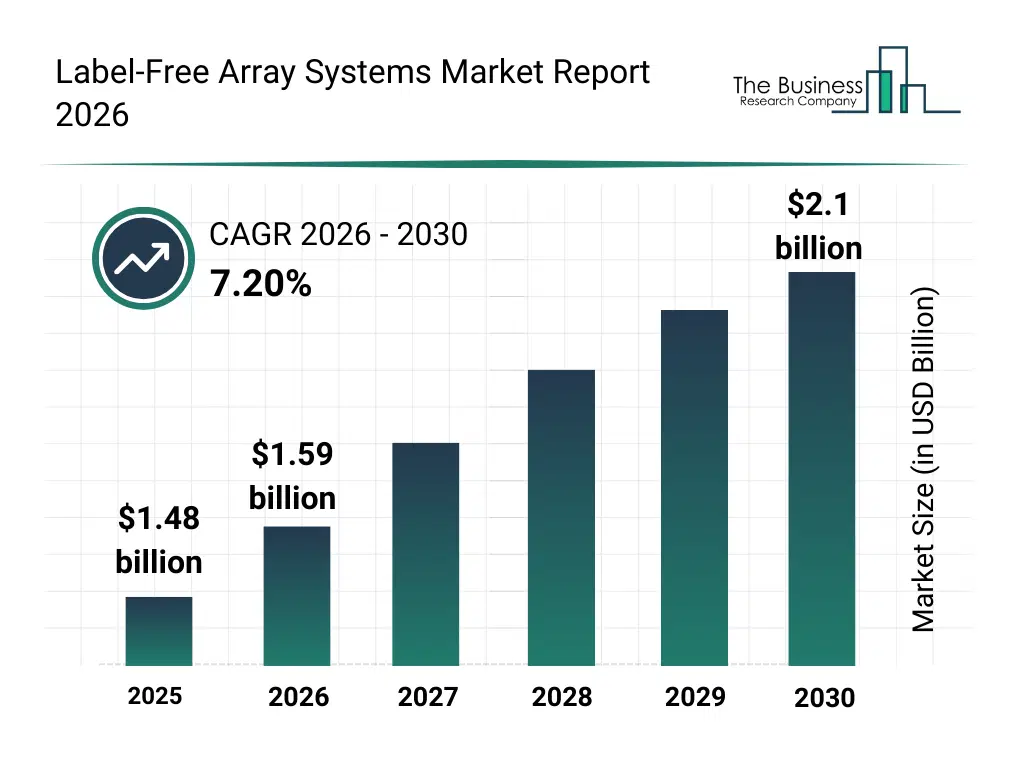
What Is The Label-Free Array Systems Market Size and Share 2026?
The label-free array systems market size has grown strongly in recent years. It will grow from $1.48 billion in 2025 to $1.59 billion in 2026 at a compound annual growth rate (CAGR) of 7.6%. The growth in the historic period can be attributed to limited availability of label-free platforms, reliance on traditional labeling methods, growing pharmaceutical R&D, expansion of academic and research institutes, adoption of conventional biosensors.What Is The Label-Free Array Systems Market Growth Forecast?
The label-free array systems market size is expected to see strong growth in the next few years. It will grow to $2.1 billion in 2030 at a compound annual growth rate (CAGR) of 7.2%. The growth in the forecast period can be attributed to advancements in surface plasmon resonance and bio-layer interferometry, increasing contract research organizations (CROs) adoption, rising demand for high-throughput and automated systems, growing focus on kinetics and affinity mapping, integration with AI and big data analytics. Major trends in the forecast period include rising adoption of label-free detection technologies, increasing demand for real-time molecular interaction analysis, integration of high-throughput screening capabilities, growing use in drug discovery and protein-protein interaction studies, enhanced focus on sensitivity and accuracy of assays.
Global Label-Free Array Systems Market Segmentation
1) By Technology: Surface Plasmon Resonance, Bio Layer Interferometry, Cellular Dielectric Spectroscopy, Other Technologies 2) By Accessories: Sensor Chips, Reagents, Consumables, Other Accessories 3) By Application: Drug Discovery, Protein-Protein Interactions, Receptor Ligand Assays, Thermodynamics, Kinetics Or Affinity Mapping, Other Applications 4) By End-User: Pharmaceutical And Biotechnology Companies, Academic And Research Institutes, Contract Research Organizations, Other End Users Subsegments: 1) By Surface Plasmon Resonance: Imaging SPR, SPR Microscopy, Multi-Parametric SPR, Localized SPR 2) By Bio Layer Interferometry: Fiber Optic-Based BLI, Plate-Based BLI, High-Throughput BLI Systems 3) By Cellular Dielectric Spectroscopy: Real-Time Impedance-Based Systems, Multi-Well Plate CDS Platforms, Label-Free Cytotoxicity Assays 4) By Other Technologies: Microcantilever-Based Systems, Optical Waveguide Grating Sensors, Quartz Crystal Microbalance (QCM), Field-Effect Transistor (FET)-Based BiosensorsWhat Is The Driver Of The Label-Free Array Systems Market?
The increasing risk of lifestyle-related chronic diseases is anticipated to fuel the growth of the label-free array systems market in the coming years. Lifestyle-related chronic diseases are long-term conditions caused mainly by unhealthy behaviors like poor diet, lack of exercise, smoking, and excessive drinking. Lifestyle-related chronic diseases are rising due to increasing sedentary behavior, as more people engage in desk-bound jobs and screen-based leisure activities that reduce physical activity and negatively impact metabolic health. Label-free array systems are advanced biosensing technologies that allow the real-time, high-throughput detection of biomolecular interactions without fluorescent or radioactive labels. These systems play a growing role in reducing the risk of lifestyle-related chronic diseases by enabling early detection, risk assessment, and personalized prevention strategies. For instance, in April 2025, according to the Centers for Disease Control and Prevention, a US-based federal government agency, which reported in 2023, 76.4% (representing 194 million) of US adults reported 1 or more chronic conditions, including 59.5%, 78.4%, and 93.0% of young, midlife, and older adults, respectively. Moreover, 51.4% (representing 130 million) of US adults reported MCC, including 27.1%, 52.7%, and 78.8% of young, midlife, and older adults, respectively. Therefore, the increasing risk of lifestyle-related chronic diseases will boost the growth of the label-free array systems industry.Key Players In The Global Label-Free Array Systems Market
Major companies operating in the label-free array systems market are Merck KGaA, Thermo Fisher Scientific Inc, Agilent Technologies Inc, Cytiva, PerkinElmer Inc, Sartorius AG, Bruker Corporation, Horiba Instruments Incorporated, Malvern Panalytical Ltd, Reichert Inc, Attana AB, NanoSPR Devices, BioNavis Ltd, Biosensing Instrument Inc, GeSiM Co, Plexera LLC, Plasmetrix, Nicoya Lifesciences Inc, Creoptix AG, Sierra Sensors GmbH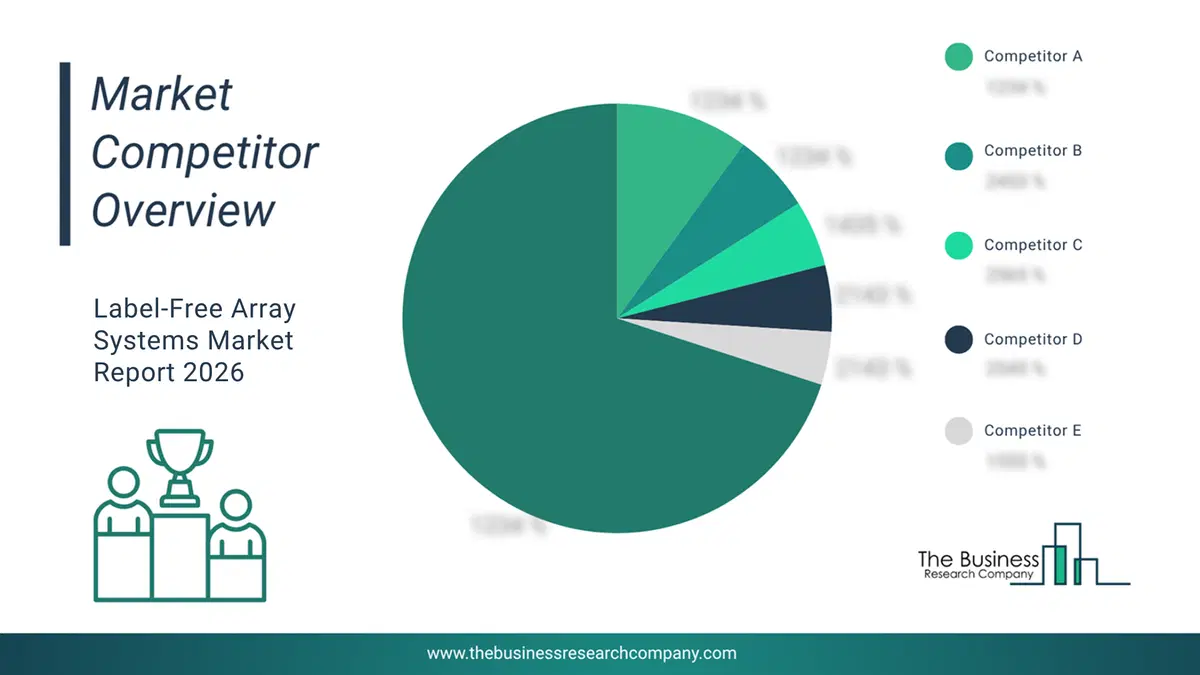
This chart is for illustrative purposes; the full report includes a detailed competitor analysis and comprehensive overview of the top 10 companies in the market.
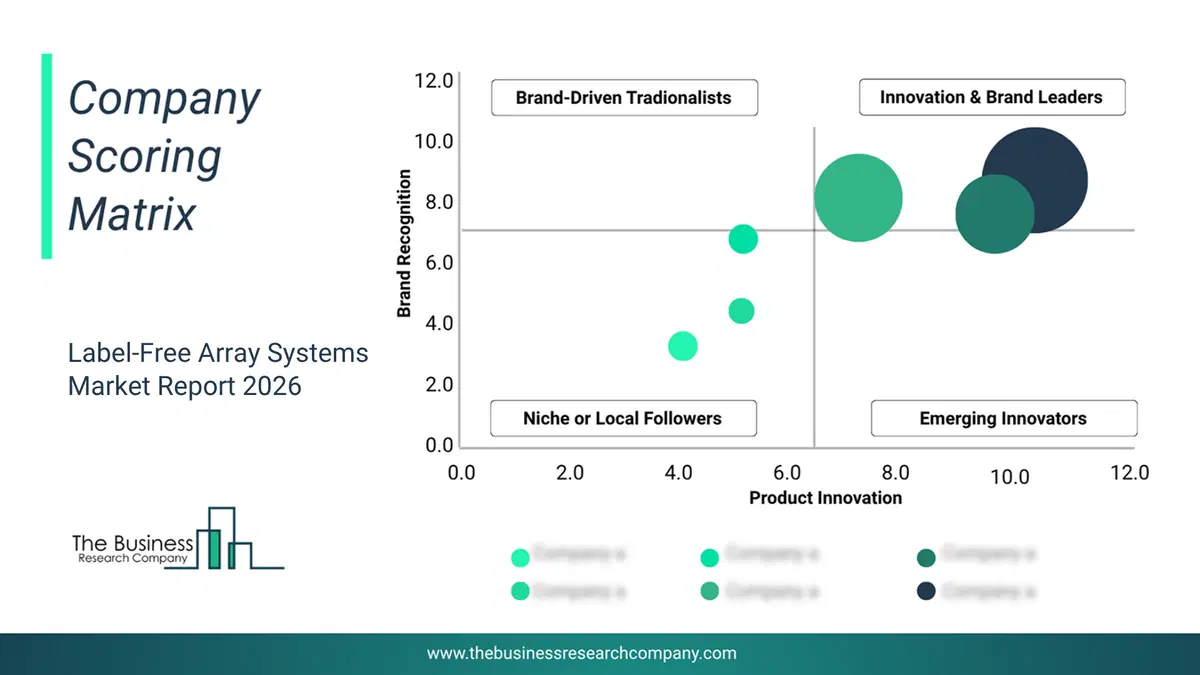
This chart maps companies by product innovation and brand strength, with bubble size indicating relative revenue, helping identify market leaders, challengers, and niche players. This is an illustrative chart; the full report provides a complete and accurate competitive analysis.
Global Label-Free Array Systems Market Trends and Insights
Major companies operating in the label-free array systems market are focusing on developing advanced solutions, such as label-free biosensors, to simplify the testing process. Label-free biosensors are analytical devices that detect biological interactions directly without the need for fluorescent or radioactive tags. For instance, in February 2024, SPOC Proteomics Inc., a US-based life science company, launched the customizable SPOC protein biosensor chips. It offers real-time, label-free biosensing for up to 1,000 fully folded proteins on a small 1.5 cm² SPR chip. It uses a unique technique that produces proteins directly from DNA in tiny nanoliter wells while simultaneously capturing and purifying these proteins on the sensor surface. This approach bypasses the traditional recombinant protein production process, cutting costs by 10 to 100 times compared to standard methods. Moreover, SPOC protein biosensor chips uniquely provide large-scale qualitative, quantitative, and kinetic data, making them ideal for high-throughput proteomic studies.What Are Latest Mergers And Acquisitions In The Label-Free Array Systems Market?
In January 2023, Charles River Laboratories International Inc., a US-based biotechnology company, acquired SAMDI Tech Inc. for $50 million. The acquisition enables Charles River to strengthen its drug discovery services by combining its scientific expertise with SAMDI Tech’s mass spectrometry-based, label-free screening technology. SAMDI Tech Inc. is a US-based manufacturer of label-free array systems.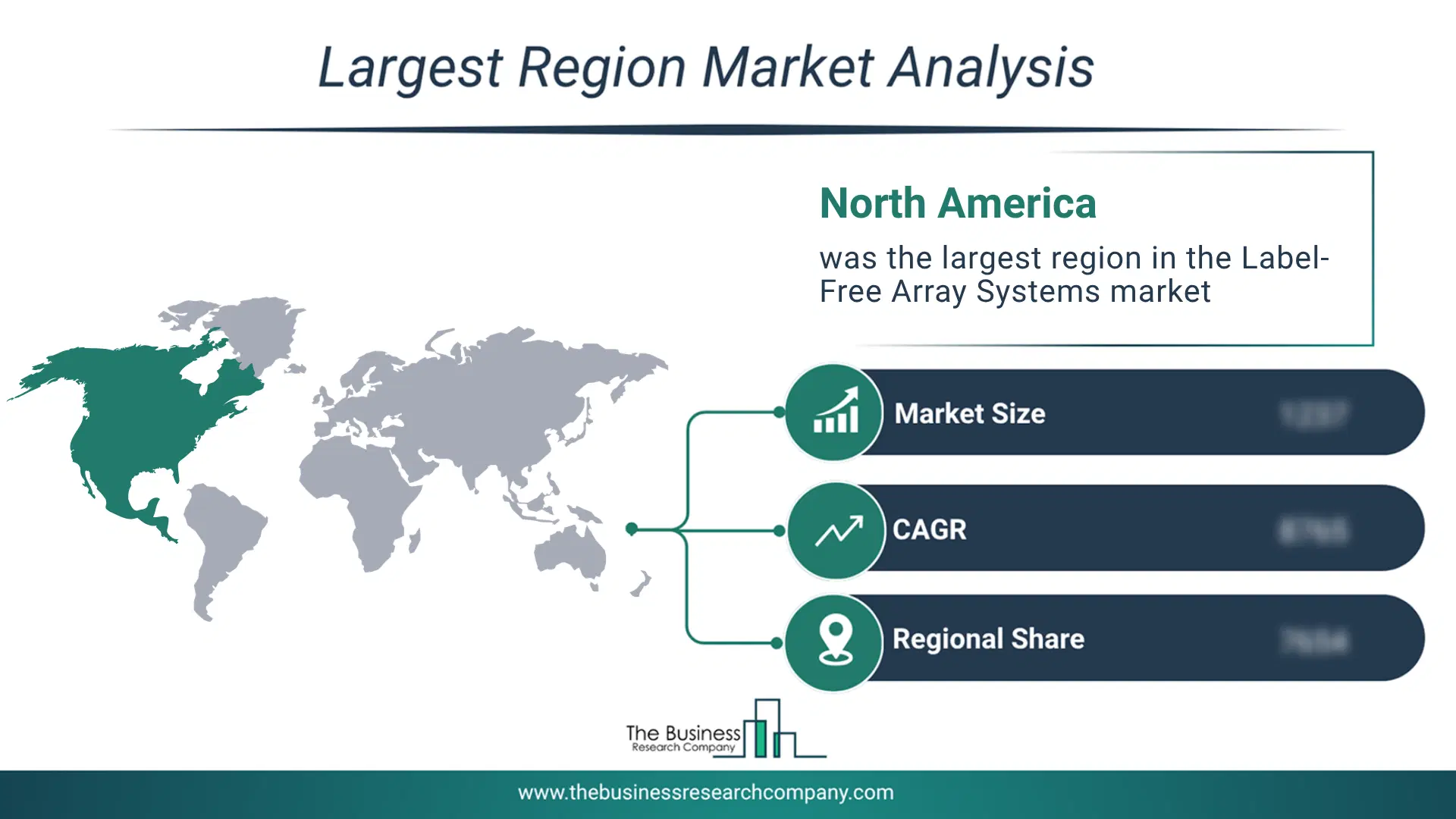
Regional Outlook
North America was the largest region in the label-free array systems market in 2025. Asia-Pacific is expected to be the fastest-growing region in the forecast period. The regions covered in this market report are Asia-Pacific, South East Asia, Western Europe, Eastern Europe, North America, South America, Middle East, Africa. The countries covered in this market report are Australia, Brazil, China, France, Germany, India, Indonesia, Japan, Taiwan, Russia, South Korea, UK, USA, Canada, Italy, SpainWhat Defines the Label-Free Array Systems Market?
The label-free array systems market consists of revenues earned by entities by providing services such as custom assay development, contract research services, surface chemistry consulting, and method validation services. The market value includes the value of related goods sold by the service provider or included within the service offering. The label-free array systems market also includes sales of microarray slides, detection instruments, and sample preparation kits. Values in this market are ‘factory gate’ values, that is the value of goods sold by the manufacturers or creators of the goods, whether to other entities (including downstream manufacturers, wholesalers, distributors and retailers) or directly to end customers. The value of goods in this market includes related services sold by the creators of the goods.How is Market Value Defined and Measured?
The market value is defined as the revenues that enterprises gain from the sale of goods and/or services within the specified market and geography through sales, grants, or donations in terms of the currency (in USD unless otherwise specified). The revenues for a specified geography are consumption values that are revenues generated by organizations in the specified geography within the market, irrespective of where they are produced. It does not include revenues from resales along the supply chain, either further along the supply chain or as part of other products.
This chart presents market attractiveness based on a quantitative evaluation of growth, competition, strategic alignment, and risk, offering a clear view of opportunity areas for decision-making. This chart is for illustrative purposes; the full report contains the complete analysis.

This chart highlights the Total Addressable Market (TAM) by estimating the maximum revenue opportunity using an assumption-driven approach, supporting strategic planning and opportunity sizing across markets. The chart is illustrative; the full report provides a more comprehensive analysis.
What Key Data and Analysis Are Included in the Label-Free Array Systems Market Report 2026?
The label-free array systems market research report is one of a series of new reports from The Business Research Company that provides market statistics, including industry global market size, regional shares, competitors with the market share, detailed market segments, market trends and opportunities, and any further data you may need to thrive in the label-free array systems industry. The market research report delivers a complete perspective of everything you need, with an in-depth analysis of the current and future state of the industry.Label-Free Array Systems Market Report Forecast Analysis
| Report Attribute | Details |
|---|---|
| Market Size Value In 2026 | $1.59 billion |
| Revenue Forecast In 2030 | $2.1 billion |
| Growth Rate | CAGR of 7.2% from 2026 to 2030 |
| Base Year For Estimation | 2025 |
| Actual Estimates/Historical Data | 2020-2025 |
| Forecast Period | 2026 - 2030 |
| Market Representation | Revenue in USD Billion and CAGR from 2026 to 2030 |
| Segments Covered | Technology, Accessories, Application, End-User |
| Regional Scope | Asia-Pacific, Western Europe, Eastern Europe, North America, South America, Middle East, Africa |
| Country Scope | The countries covered in the report are Australia, Brazil, China, France, Germany, India, Indonesia, Japan, Taiwan, Russia, South Korea, UK, USA, Canada, Italy, Spain. |
| Key Companies Profiled | Merck KGaA, Thermo Fisher Scientific Inc, Agilent Technologies Inc, Cytiva, PerkinElmer Inc, Sartorius AG, Bruker Corporation, Horiba Instruments Incorporated, Malvern Panalytical Ltd, Reichert Inc, Attana AB, NanoSPR Devices, BioNavis Ltd, Biosensing Instrument Inc, GeSiM Co, Plexera LLC, Plasmetrix, Nicoya Lifesciences Inc, Creoptix AG, Sierra Sensors GmbH |
| Customization Scope | Request for Customization |
| Pricing And Purchase Options | Explore Purchase Options |