
Smart Label Market Report 2026
Global Outlook – By Label Type (Passive Smart Labels, Active Smart Labels, Semi-Passive Smart Labels), By Labeling Technology (RFID Labels, NFC Labels, Electronic Article Surveillance (EAS) Labels, Sensing Labels), By Application (Retail Inventory Management, Perishable Goods Monitoring, Anti-Counterfeiting And Authentication, Product Information And Consumer Engagement, Asset Tracking And Traceability), By End-User (Retail, Food And Beverages, Healthcare And Pharmaceuticals, Supply Chain And Logistics, Consumer Electronics, Other End Users) – Market Size, Trends, Strategies, and Forecast to 2030
Smart Label Market Overview
• Smart Label market size has reached to $12.45 billion in 2025 • Expected to grow to $25 billion in 2030 at a compound annual growth rate (CAGR) of 15% • Growth Driver: Surging Demand From The Food And Beverage Industry Propels The Smart Label Market • Market Trend: Smart Labeling Solutions To Address The Complexities In Global Label Management • North America was the largest region in 2025 and Asia-Pacific is the fastest growing region.What Is Covered Under Smart Label Market?
Smart labels are special labels that contain advanced technology to provide additional information beyond a traditional label. It is used as directions for using or preparing the product, tips for recycling the packaging, warnings about safety and handling, and scrumptious recipes. The main components of the smart label are batteries, transceivers, microprocessors, memories, and others. Batteries refer to the power source used to operate electronic components in the label, such as sensors, microprocessors, and wireless communication modules. The various labeling technology includes Radio Frequency Identification (RFID), NFC tags, Electronic article surveillance (EAS), sensing labels, and electronics shelf labels, that uses various printing technology such as flexographic smart labels, digital smart labels, gravure smart labels, and screen smart labels. These are used in various applications such as retail inventory, and perishable goods, and are used in retail, healthcare and pharmaceuticals, food and beverages, consumer electronics, supply chain and logistics, transportation, and others.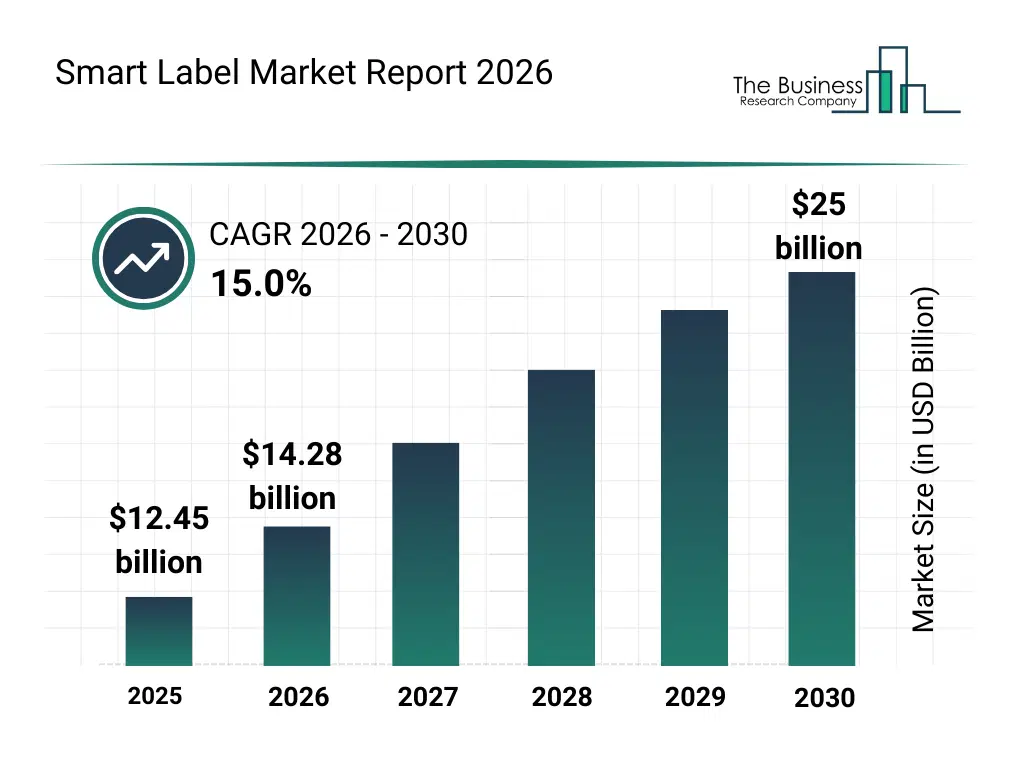
What Is The Smart Label Market Size and Share 2026?
The smart label market size has grown rapidly in recent years. It will grow from $12.45 billion in 2025 to $14.28 billion in 2026 at a compound annual growth rate (CAGR) of 14.7%. The growth in the historic period can be attributed to increasing packaging innovation, rising retail automation needs, growing product tracking requirements, early integration of electronic labeling, expansion of digital packaging solutions.What Is The Smart Label Market Growth Forecast?
The smart label market size is expected to see rapid growth in the next few years. It will grow to $25 billion in 2030 at a compound annual growth rate (CAGR) of 15.0%. The growth in the forecast period can be attributed to growing demand for smart inventory systems, rising need for real time product visibility, increasing emphasis on consumer information access, strengthening supply chain management needs, expanding applications across industries. Major trends in the forecast period include rising demand for intelligent product identification, growing use of labels for enhanced information delivery, increasing adoption of trackable packaging solutions, rising focus on product transparency and safety, growing application of smart labels in retail and logistics.
Global Smart Label Market Segmentation
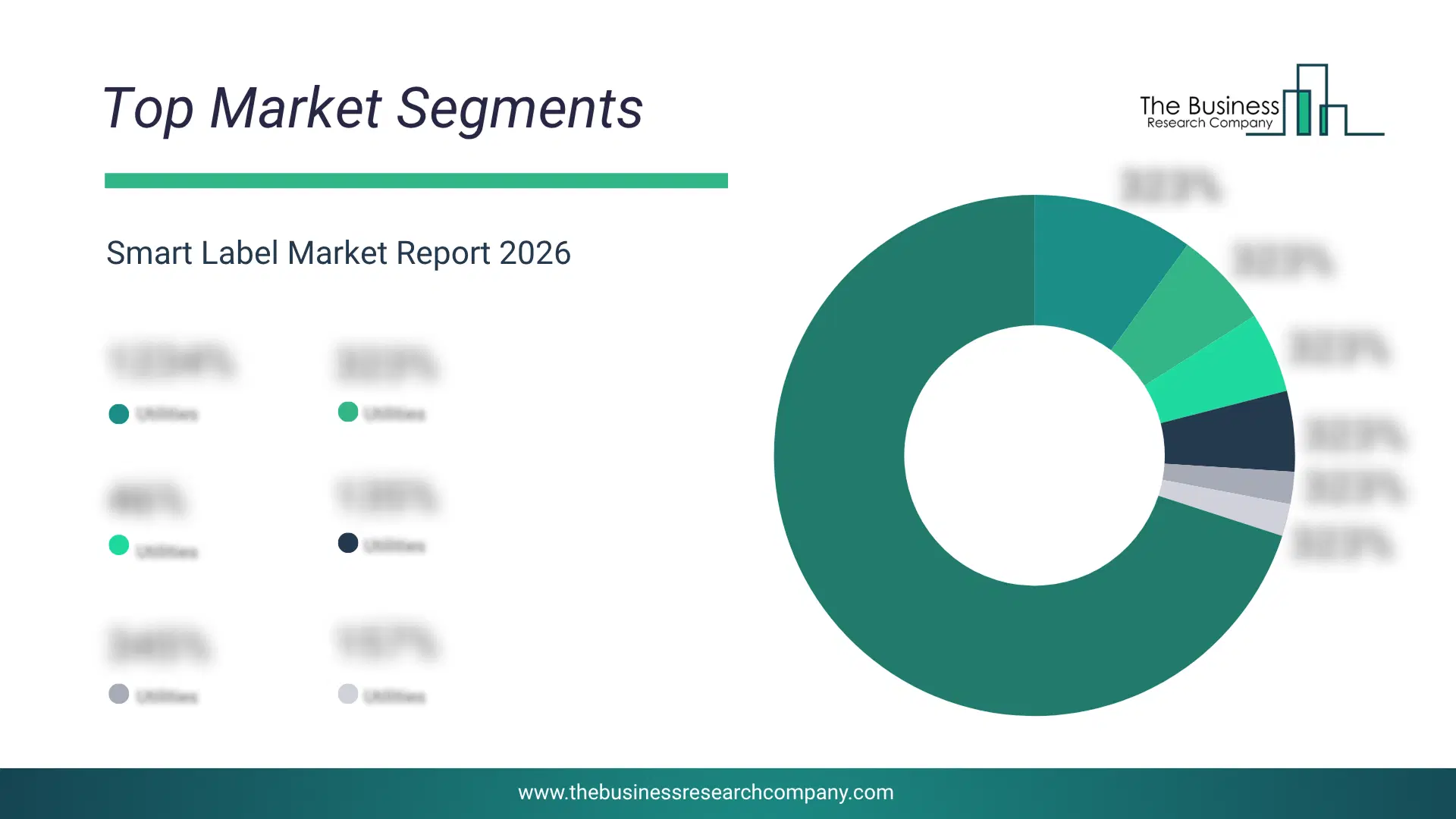
1) By Label Type: Passive Smart Labels, Active Smart Labels, Semi-Passive Smart Labels 2) By Labeling Technology: RFID Labels, NFC Labels, Electronic Article Surveillance (EAS) Labels, Sensing Labels 3) By Application: Retail Inventory Management, Perishable Goods Monitoring, Anti-Counterfeiting And Authentication, Product Information And Consumer Engagement, Asset Tracking And Traceability 4) By End-User: Retail, Food And Beverages, Healthcare And Pharmaceuticals, Supply Chain And Logistics, Consumer Electronics, Other End Users Subsegments: 1) By Passive Smart Labels: UHF RFID Labels, HF RFID Labels, NFC Labels, Electronic Article Surveillance (EAS) Labels 2) By Active Smart Labels: Battery-Powered RFID Labels, Bluetooth Low Energy (BLE) Smart Labels, Real-Time Location Tracking Labels, Environmental Sensing Active Labels 3) By Semi-Passive Smart Labels: Battery-Assisted Passive (BAP) RFID Labels, Sensor-Enabled Semi-Passive Labels, Temperature Monitoring Labels, Humidity Monitoring Labels, Condition Monitoring LabelsWhat Is The Driver Of The Smart Label Market?
The increasing demand from end users such as the food and beverage industry is expected to boost the growth of the smart label market going forward. The food and beverage industry refers to all businesses that handle the processing, packaging, and distribution of uncooked food. Smart labels add traceability to the product which is important for tracing the source of the food that helps in preventing fake goods, as a result, increasing demand from end users such as the food and beverage industry increases the demand for the smart label market. For instance, in July 2025, according to the Agriculture and Agri-Food Department Canada, a Canada-based government department, in 2024, the food and beverage processing sector remained Canada’s largest manufacturing industry by production value, generating $173.4 billion in goods. This represented 20.3% of all manufacturing sales and contributed 1.6% to the national GDP. Exports of processed food and beverage products reached a record $59.8 billion, an increase of 3.8% from 2023, and accounted for 34.5% of the industry’s total production value. Therefore, the increasing demand from end users such as the food and beverage industry is driving the growth of the smart labels industry.Key Players In The Global Smart Label Market
Major companies operating in the smart label market report are Avery Dennison Corporation, CCL Industries Inc., Checkpoint Systems Inc., Thinfilm Electronics ASA, Alien Technology Inc., Zebra Technologies Corporation, SATO Holdings Corporation, Invengo Technology Pte Ltd, Muehlbauer Holding AG and Co KGaA, Smartrac N V, SML Group Limited, Pragmatic Semiconductor Limited, Smart Planet Technologies Inc., William Frick and Company, Scanbuy Inc., Identiv Inc., Paragon ID, Confidex Ltd, Farsens Srl, InPlay Inc.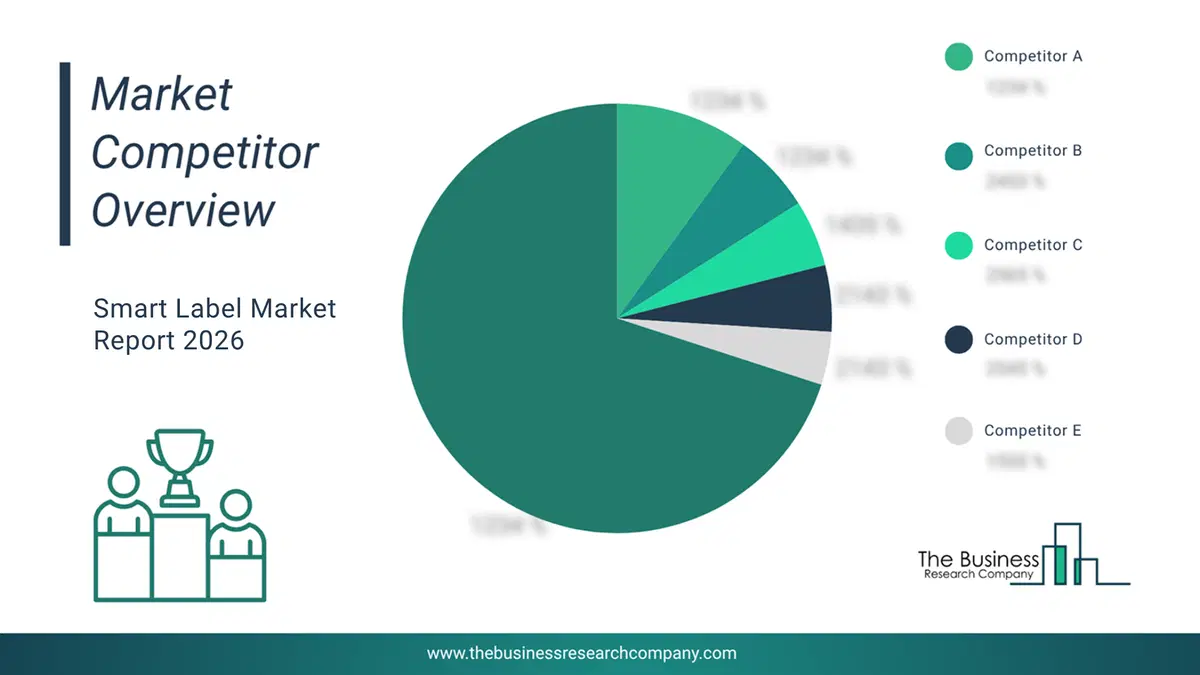
This chart is for illustrative purposes; the full report includes a detailed competitor analysis and comprehensive overview of the top 10 companies in the market.
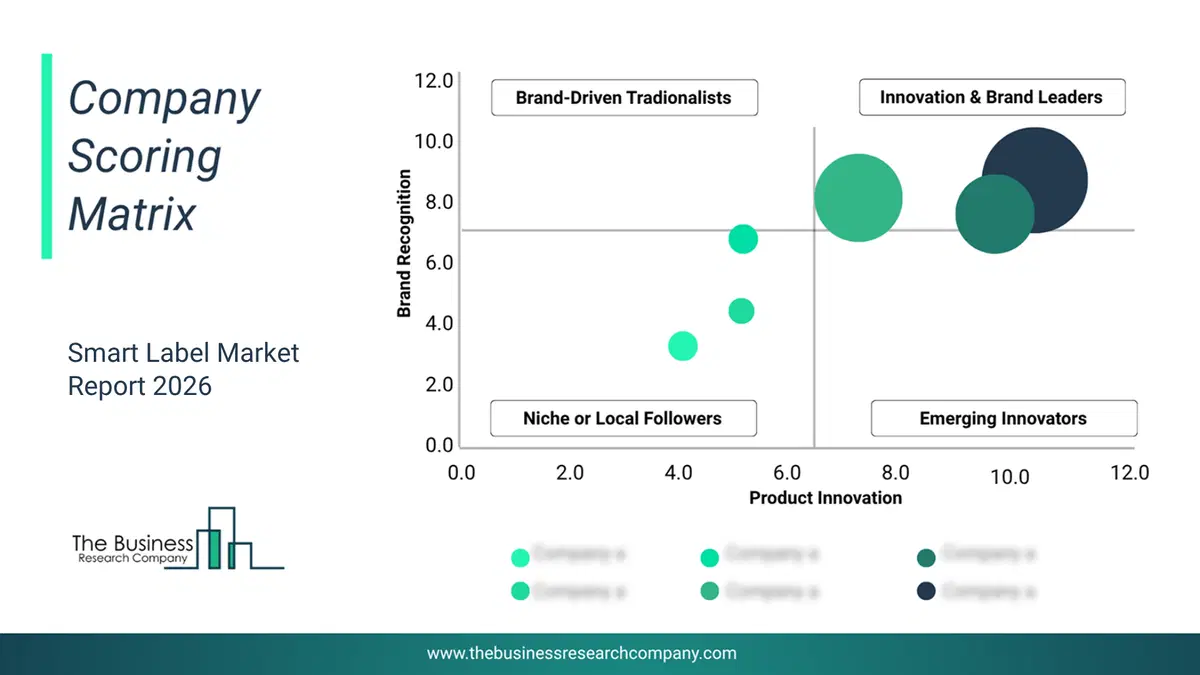
This chart maps companies by product innovation and brand strength, with bubble size indicating relative revenue, helping identify market leaders, challengers, and niche players. This is an illustrative chart; the full report provides a complete and accurate competitive analysis.
Global Smart Label Market Trends and Insights
Major companies operating in the smart labels market are focused on developing smart labeling solutions, such as intelligence-driven labeling solutions, to address the complexities in global label management and maximize their profits in the market. An intelligence-driven labeling solution refers to a system or platform that utilizes advanced technologies to enhance and optimize the processes involved in labeling products or information. For instance, in June 2023, IQVIA, a US-based provider of advanced analytics, launched RIM Smart Labeling, an intelligence-driven labeling solution for the life sciences industry, streamlining global label management. The system consolidates regulatory label planning, tracking, and execution into a single platform, simplifying workflows and ensuring compliance. RIM Smart Labeling is used for the label change process, utilizes regulatory intelligence for global and country-specific labels, facilitates structured content management, and integrates reporting for end-to-end visibility. This solution enables life sciences companies to reduce costs, complexity, and manual efforts.What Are Latest Mergers And Acquisitions In The Smart Label Market?
In April 2023, CCL Industries Inc., a Canada based packaging solution, acquired eAgile Inc. for an undisclosed amount. With this acquisition, CCL Industries Inc. aimed to enhance its technological capabilities in RFID enabled labelling and expand its footprint in the healthcare & speciality packaging segment. eAgile Inc. is a US-based company that provides radio frequency identification (RFID) smart labels, tags, and intelligent packaging solutions.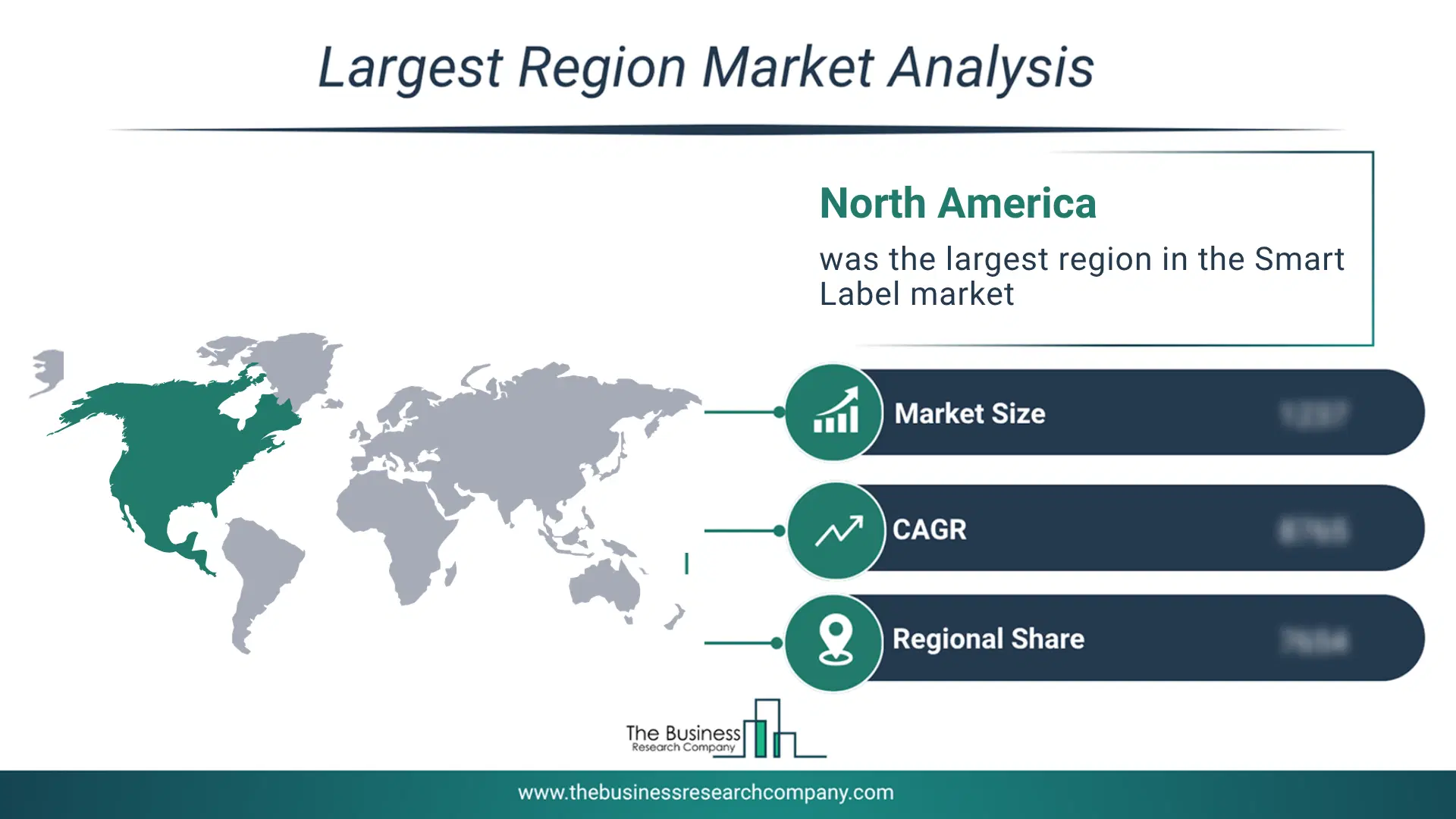
Regional Outlook
North America was the largest region in the smart labels market in 2025. Asia-Pacific is expected to be the fastest-growing region in the global smart label market during the forecast period. The regions covered in this market report are Asia-Pacific, South East Asia, Western Europe, Eastern Europe, North America, South America, Middle East, Africa. The countries covered in this market report are Australia, Brazil, China, France, Germany, India, Indonesia, Japan, Taiwan, Russia, South Korea, UK, USA, Canada, Italy, SpainWhat Defines the Smart Label Market?
The smart label market consists of revenues earned by entities by providing Dynamic Display Labeling, and electronic article surveillance labeling. The market value includes the value of related goods sold by the service provider or included within the service offering. The smart label market also includes sales of quick response codes, data-embedded barcodes, radio-frequency identification, and time temperature indicators which are used for providing smart label services. Values in this market are ‘factory gate’ values, that is the value of goods sold by the manufacturers or creators of the goods, whether to other entities (including downstream manufacturers, wholesalers, distributors, and retailers) or directly to end customers. The value of goods in this market includes related services sold by the creators of the goods.How is Market Value Defined and Measured?
The market value is defined as the revenues that enterprises gain from the sale of goods and/or services within the specified market and geography through sales, grants, or donations in terms of the currency (in USD unless otherwise specified). The revenues for a specified geography are consumption values that are revenues generated by organizations in the specified geography within the market, irrespective of where they are produced. It does not include revenues from resales along the supply chain, either further along the supply chain or as part of other products.
This chart presents market attractiveness based on a quantitative evaluation of growth, competition, strategic alignment, and risk, offering a clear view of opportunity areas for decision-making. This chart is for illustrative purposes; the full report contains the complete analysis.

This chart highlights the Total Addressable Market (TAM) by estimating the maximum revenue opportunity using an assumption-driven approach, supporting strategic planning and opportunity sizing across markets. The chart is illustrative; the full report provides a more comprehensive analysis.
What Key Data and Analysis Are Included in the Smart Label Market Report 2026?
The smart label market research report is one of a series of new reports from The Business Research Company that provides market statistics, including industry global market size, regional shares, competitors with the market share, detailed market segments, market trends and opportunities, and any further data you may need to thrive in the smart label industry. The market research report delivers a complete perspective of everything you need, with an in-depth analysis of the current and future state of the industry.Smart Label Market Report Forecast Analysis
| Report Attribute | Details |
|---|---|
| Market Size Value In 2026 | $14.28 billion |
| Revenue Forecast In 2030 | $25 billion |
| Growth Rate | CAGR of 14.7% from 2026 to 2030 |
| Base Year For Estimation | 2025 |
| Actual Estimates/Historical Data | 2020-2025 |
| Forecast Period | 2026 - 2030 - 2030 |
| Market Representation | Revenue in USD Billion and CAGR from 2026 to 2030 |
| Segments Covered | Label Type, Labeling Technology, Application, End-User |
| Regional Scope | Asia-Pacific, Western Europe, Eastern Europe, North America, South America, Middle East, Africa |
| Country Scope | The countries covered in the report are Australia, Brazil, China, France, Germany, India, Indonesia, Japan, Taiwan, Russia, South Korea, UK, USA, Canada, Italy, Spain. |
| Key Companies Profiled | Avery Dennison Corporation, CCL Industries Inc., Checkpoint Systems Inc., Thinfilm Electronics ASA, Alien Technology Inc., Zebra Technologies Corporation, SATO Holdings Corporation, Invengo Technology Pte Ltd, Muehlbauer Holding AG and Co KGaA, Smartrac N V, SML Group Limited, Pragmatic Semiconductor Limited, Smart Planet Technologies Inc., William Frick and Company, Scanbuy Inc., Identiv Inc., Paragon ID, Confidex Ltd, Farsens Srl, InPlay Inc. |
| Customization Scope | Request for Customization |
| Pricing And Purchase Options | Explore Purchase Options |