
Low-Carbon Copper Market Report 2026
Global Outlook – By Product Type (Wires, Plates, Sheets And Strips, Tubes, Bars And Sections, Other Product Types), By Technology (Electrowinning, Electrolytic), By Source (Recycled Copper, Virgin Copper), By End-User (Power Generation and Distribution, Building and Construction, Consumer Electronics, Automotive, Other End-Use Applications) – Market Size, Trends, Strategies, and Forecast to 2030
Low-Carbon Copper Market Overview
• Low-Carbon Copper market size has reached to $84.47 billion in 2025 • Expected to grow to $133.84 billion in 2030 at a compound annual growth rate (CAGR) of 9.5% • Growth Driver: Electric Vehicle Adoption Fuels Growth In The Low-Carbon Copper Market • Market Trend: Commercial Launches Of Low Carbon Copper Products Driving Sustainable Metal Supply • Asia-Pacific was the largest region in 2025.Market Gains By 2030 – Top Opportunities By Segment
Market Gain identifies the most promising market opportunities by highlighting the segments or products expected to generate the highest incremental revenue growth over the next five years.
What Is Covered Under Low-Carbon Copper Market?
Low-carbon copper refers to a type of copper that has been mined, processed, and manufactured with a significantly reduced carbon footprint compared to the industry standard. This involves adopting more sustainable and energy-efficient practices throughout the entire lifecycle of copper production, from extraction to refinement. The main types of low-carbon copper products are wires, plates, sheets and strips, tubes, bars and sections, and others. Wires refer to conductive materials, usually copper or aluminum, that are used in electrical or electronic systems to transfer data, signals, or electricity between various locations. Various technologies are involved such as electrowinning and electrolytic technologies, with several types of sources available such as recycled copper and virgin copper. It is used by several end-user industries, including power generation and distribution, building and construction, consumer electronics, automotive, and others.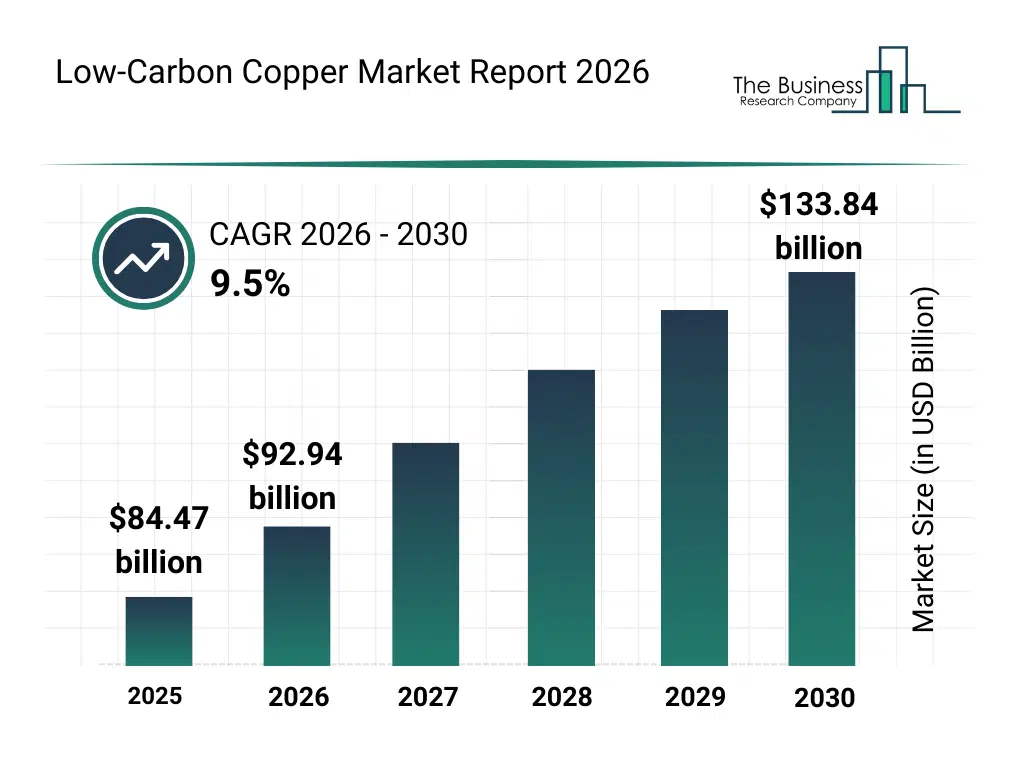
What Is The Low-Carbon Copper Market Size and Share 2026?
The low-carbon copper market size has grown rapidly in recent years. It will grow from $84.47 billion in 2025 to $92.94 billion in 2026 at a compound annual growth rate (CAGR) of 10.0%. The growth in the historic period can be attributed to expansion of global copper demand, growth in construction activities, rising use of copper in power infrastructure, development of electrolytic refining technologies, availability of recycled copper sources.What Is The Low-Carbon Copper Market Growth Forecast?
The low-carbon copper market size is expected to see strong growth in the next few years. It will grow to $133.84 billion in 2030 at a compound annual growth rate (CAGR) of 9.5%. The growth in the forecast period can be attributed to increasing demand from electric vehicles and renewable energy systems, rising investments in low-carbon manufacturing, expansion of smart grid infrastructure, growing regulatory pressure on emission reduction, increased adoption of circular economy practices. Major trends in the forecast period include increasing adoption of low-emission copper production methods, rising use of recycled copper inputs, growing integration of renewable energy in copper processing, expansion of traceable and certified copper supply chains, enhanced focus on energy-efficient refining.

Global Low-Carbon Copper Market Segmentation
1) By Product Type: Wires, Plates, Sheets And Strips, Tubes, Bars And Sections, Other Product Types 2) By Technology: Electrowinning, Electrolytic 3) By Source: Recycled Copper, Virgin Copper 4) By End-User: Power Generation And Distribution, Building And Construction, Consumer Electronics, Automotive, Other End-Use Applications Subsegments: 1) By Wires: Electrical Wires, Telecommunication Wires, Automotive Wires, Magnet Wires 2) By Plates: Copper Sheets for Roofing And Cladding, Copper Plates for Industrial Applications, Decorative Copper Plates 3) By Sheets And Strips: Rolled Copper Sheets, Electrolytic Tough Pitch (ETP) Copper Sheets, Copper Strips for Electronics And PCB, Laminated Copper Sheets 4) By Tubes: Seamless Copper Tubes, Welded Copper Tubes, Heat Exchanger Tubes 5) By Bars and Sections: Round Copper Bars, Square And Rectangular Copper Bars, Copper Rods for Electrical Applications 6) By Other Product Types: Copper Foils, Copper Powder, Copper Pellets The top segments in the low-carbon copper market will be: • Electrolytic will reach $77678.12 Million by 2030. • Virgin Copper will reach $75767.2 Million by 2030. • Recycled Copper will reach $41579.78 Million by 2030. • Electrowinning will reach $39668.86 Million by 2030. • Power Generation and Distribution will reach $36960.68 Million by 2030.What Is The Driver Of The Low-Carbon Copper Market?
The increasing adoption of electric vehicles is expected to propel the growth of the low-carbon copper market going forward. An electric vehicle (EV) refers to a vehicle that is powered by one or more electric motors and runs on electrical energy stored in rechargeable batteries or other energy storage devices. The increasing adoption of electric vehicles is due to several factors, including growing interest in sustainable transportation, environmental concerns, and the cost of ownership. Low-carbon copper significantly reduces the lifecycle emissions of electric vehicles, making them more attractive to consumers and more compliant with sustainability. For instance, in July 2023, according to the International Energy Agency, a France-based government agency, sales of electric cars surged in the initial quarter of 2023, with over 2.3 million units sold, marking a 25% uptick compared to the previous year. Projections indicate an estimated 14 million sales by the close of 2023, reflecting a 35% year-over-year surge. Therefore, an increasing adoption of electric vehicles is driving the growth of the low-carbon copper industry.
Infographic Chart Showing Key Market Drivers Analysis And Restraints For Low-Carbon Copper Market
The chart presents an impact analysis of key drivers and restraints, quantifying their relative influence on the market's growth rate and helping assess the balance between growth enablers and limiting factors. This chart offers a high-level perspective; the full report contains more detailed insights.
How Will The Drivers Impact Growth In The Global Low-Carbon Copper Market?
• Expansion Of Renewable Energy Infrastructure (High) – During the forecast period, expansion of renewable energy infrastructure is expected to be a key driver of the growth of the low-carbon copper market in the forecast period. renewable energy systems such as wind, solar and energy storage installations rely heavily on copper for power transmission, electrical connections and energy management components. as renewable capacity expands at scale, demand for copper is expected to rise in parallel, while sustainability requirements across clean energy value chains will intensify. developers and utilities are increasingly focused on reducing lifecycle emissions, creating stronger demand for copper produced with lower carbon intensity. this alignment between clean energy expansion and sustainable material sourcing will reinforce the adoption of low-carbon copper across renewable infrastructure projects. the expansion of renewable energy infrastructure growth contribution during the forecast period in 2025 is 2.0%. • Infrastructure Modernization And Grid Upgrades (Medium) – During the forecast period, the infrastructure modernization and grid upgrades will propel the growth of the low-carbon copper market. Aging power transmission and distribution networks require replacement and reinforcement to support higher electricity loads, distributed energy resources and digital grid management systems. Copper remains a core material for these upgrades due to its efficiency, reliability and conductivity. At the same time, infrastructure planners are increasingly integrating environmental performance criteria into project design and procurement decisions. This shift will drive preference toward low-carbon copper, enabling utilities and governments to modernize grids while aligning infrastructure investment with long-term decarbonization objectives. The infrastructure modernization and grid upgrades growth contribution during the forecast period in 2025 is 1.5%. • Growing Preference For Certified And Traceable Low-Carbon Materials (Low) – During the forecast period, growing preference for certified and traceable low-carbon materials is expected to be a key driver of the growth of the low-carbon copper market in the forecast period. buyers across energy, construction and manufacturing sectors are placing greater emphasis on verified carbon intensity, responsible sourcing and supply chain traceability. certification frameworks and digital tracking systems are enabling differentiation between conventional copper and low-carbon alternatives, increasing the commercial value of verified low-emission copper products. as sustainability reporting requirements and customer expectations evolve, demand for certified low-carbon copper is likely to increase, encouraging producers to invest in traceability, auditing and low-carbon production pathways. the growing preference for certified and traceable low-carbon materials growth contribution during the forecast period in 2025 is 0.8%. • Rising Adoption Of Carbon Pricing And Emissions Trading Mechanisms (Low) – During the forecast period, the rising adoption of carbon pricing and emissions trading mechanisms will propel the growth of the low-carbon copper market. By assigning a financial cost to carbon emissions, these regulatory tools increase the relative competitiveness of copper produced through energy-efficient and low-emission processes. Producers with higher emissions footprints may face rising compliance costs, while low-carbon producers gain economic and strategic advantages. This dynamic is likely to influence investment decisions across the copper value chain, encouraging wider adoption of recycling, renewable energy integration and process optimization. As carbon pricing mechanisms expand across regions, they will reinforce market demand for low-carbon copper as a cost-effective and compliant material choice. The rising adoption of carbon pricing and emissions trading mechanisms growth contribution during the forecast period in 2025 is 0.8%.How Will The Restraints Impact Growth In The Global Low-Carbon Copper Market?
• High Capital Expenditure Requirements (High) – During the forecast period, high capital expenditure requirements are restricting the growth of the low-carbon copper market during the forecast period. low-carbon copper production often requires significant upfront investment in energy-efficient equipment, renewable power integration, advanced refining technologies, recycling infrastructure and emissions-control systems. these capital-intensive requirements can create financial barriers, particularly for smaller producers or operations in emerging markets, slowing market entry and capacity expansion. as a result, the high cost of initial investment may delay project timelines and reduce the number of producers able to transition toward low-carbon production pathways. growth affected by high capital expenditure requirements across regions during the forecast period in 2025 is -2.0%. • Higher Production Costs Compared To Conventional Copper (Medium) – During the forecast period, higher production costs compared to conventional copper is restricting the growth of the low-carbon copper market during the forecast period. producing copper with reduced carbon intensity often involves higher operational costs related to cleaner energy sources, process optimization, recycled material handling and compliance with environmental standards. these additional costs can lead to premium pricing compared to conventional copper, making low-carbon alternatives less competitive where sustainability requirements are not mandatory. this cost differential may limit widespread adoption, particularly in markets where procurement decisions are driven primarily by cost rather than environmental performance. growth affected by higher production costs compared to conventional copper across regions during the forecast period in 2025 is -1.3%. • Impact Of Trade War And Tariffs (Low) – During the forecast period, the impact of the trade war and tariffs restricting the growth of the low-carbon copper market during the forecast period. higher tariffs on raw materials, refined copper, or intermediate products can raise input costs and reduce the economic viability of low-carbon production and trade. inconsistent trade policies may also discourage long-term investment in low-carbon copper facilities, particularly those reliant on international sourcing or export markets. these geopolitical and trade-related risks can limit market stability, slow global supply chain integration and constrain the expansion of low-carbon copper availability. growth affected by trade war and tariffs across regions during the forecast period in 2025 is -0.3%.Key Players In The Global Low-Carbon Copper Market
Major companies operating in the low-carbon copper market are Jiangxi Copper Corporation, BHP Group, Rio Tinto Plc, Vale S.A., Zijin Mining Group Co. Ltd., Glencore Plc, Freeport-McMoRan Inc., Codelco, Aurubis AG, Mitsubishi Materials Corporation, Teck Resources Limited, Sumitomo Metal Mining Co. Ltd., KGHM Polska Miedź S.A., Antofagasta Plc, Boliden Group, Taseko Mines Ltd., Luvata Company Ltd., Elcowire Group, Fedral Metal Co., ASM Metal Recycling Ltd., Pan Pacific Copper Co. Ltd.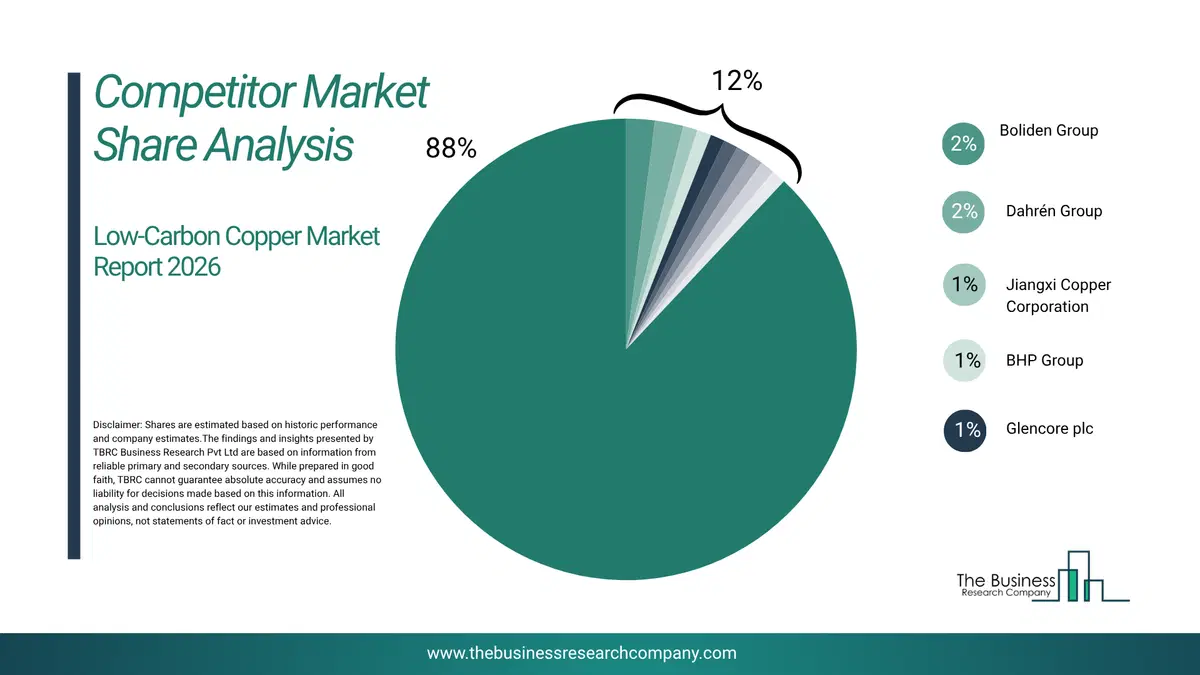
This chart is for illustrative purposes; the full report includes a detailed competitor analysis and comprehensive overview of the top 10 companies in the market.
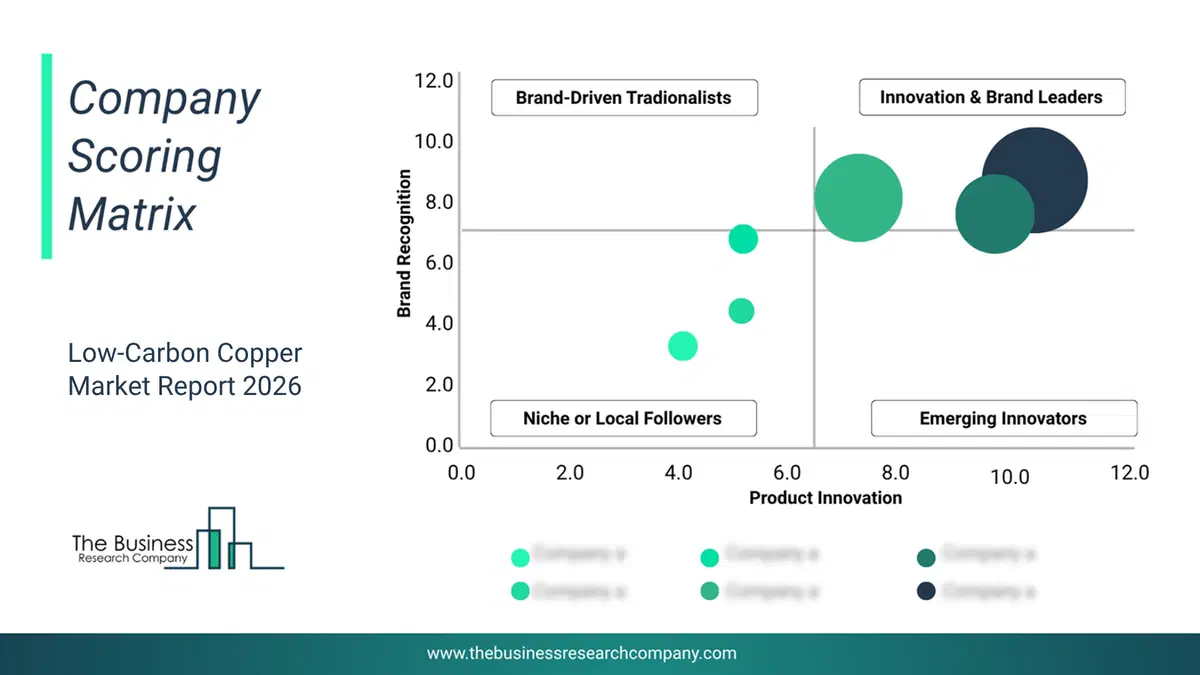
This chart maps companies by product innovation and brand strength, with bubble size indicating relative revenue, helping identify market leaders, challengers, and niche players. This is an illustrative chart; the full report provides a complete and accurate competitive analysis.
Global Low-Carbon Copper Market Trends and Insights
Major companies operating in the low carbon copper market are developing advanced solutions such as low carbon footprint copper products to drive revenues in the market. Low carbon footprint copper products are produced with significantly minimized CO₂ emissions across the production process, typically through mine electrification, use of renewable energy, and increased reliance on recycled feedstocks, creating a sustainable alternative to conventionally refined copper. For instance, in November 2025, multiple major copper producers commercially launched verified low carbon copper products with a carbon intensity benchmark of approximately 1.5 kg CO₂e per kilogram, representing roughly a 67 % reduction versus the global industry average and establishing a new, tiered commodity market for low carbon critical metals. This commercially launched low carbon copper product has begun to influence supply chain procurement decisions in the electric vehicle and renewable energy sectors by providing a verified benchmark for embodied carbon that directly supports Scope 3 emissions reduction targets.What Are Latest Mergers And Acquisitions In The Low-Carbon Copper Market?
In September 2024, Schneider Electric S.E., a France based provider of energy management, industrial automation, and digital transformation solutions, entered into a strategic partnership with Glencore plc to advance decarbonization and circularity in Glencore’s copper supply chain. With this collaboration, Schneider Electric aims to support Glencore in reducing greenhouse gas emissions, enhancing energy efficiency, and promoting higher recycled content copper products, reinforcing sustainability and lower carbon intensity across the copper value chain. Glencore plc is a Switzerland based global diversified natural resources company and one of the world’s largest copper producers, supplying copper critical for electrification and low carbon infrastructure applications.
Regional Outlook
Asia-Pacific was the largest region in the low-carbon copper market in 2025. The regions covered in this market report are Asia-Pacific, South East Asia, Western Europe, Eastern Europe, North America, South America, Middle East, Africa. The countries covered in this market report are Australia, Brazil, China, France, Germany, India, Indonesia, Japan, Taiwan, Russia, South Korea, UK, USA, Canada, Italy, SpainWhat Defines the Low-Carbon Copper Market?
The low-carbon copper market consists of revenues earned by entities by providing services such as production, supply of recycled copper products, and development. The market value includes the value of related goods sold by the service provider or included within the service offering. The low-carbon copper market also includes sales of copper powders, alloys, and copper products from recycled materials. Values in this market are ‘factory gate’ values, that is the value of goods sold by the manufacturers or creators of the goods, whether to other entities (including downstream manufacturers, wholesalers, distributors, and retailers) or directly to end customers. The value of goods in this market includes related services sold by the creators of the goods.How is Market Value Defined and Measured?
The market value is defined as the revenues that enterprises gain from the sale of goods and/or services within the specified market and geography through sales, grants, or donations in terms of the currency (in USD unless otherwise specified). The revenues for a specified geography are consumption values that are revenues generated by organizations in the specified geography within the market, irrespective of where they are produced. It does not include revenues from resales along the supply chain, either further along the supply chain or as part of other products.
This chart presents market attractiveness based on a quantitative evaluation of growth, competition, strategic alignment, and risk, offering a clear view of opportunity areas for decision-making. This chart is for illustrative purposes; the full report contains the complete analysis.

This chart highlights the Total Addressable Market (TAM) by estimating the maximum revenue opportunity using an assumption-driven approach, supporting strategic planning and opportunity sizing across markets. The chart is illustrative; the full report provides a more comprehensive analysis.
What Key Data and Analysis Are Included in the Low-Carbon Copper Market Report 2026?
The low-carbon copper market research report is one of a series of new reports from The Business Research Company that provides market statistics, including industry global market size, regional shares, competitors with the market share, detailed market segments, market trends and opportunities, and any further data you may need to thrive in the low-carbon copper industry. The market research report delivers a complete perspective of everything you need, with an in-depth analysis of the current and future state of the industry.Low-Carbon Copper Market Report Forecast Analysis
| Report Attribute | Details |
|---|---|
| Market Size Value In 2026 | $92.94 billion |
| Revenue Forecast In 2030 | $133.84 billion |
| Growth Rate | CAGR of 9.5% from 2026 to 2030 |
| Base Year For Estimation | 2025 |
| Actual Estimates/Historical Data | 2020-2025 |
| Forecast Period | 2026 - 2030 - 2035 |
| Market Representation | Revenue in USD Billion and CAGR from 2026 to 2030 |
| Segments Covered | Product Type, Technology, Source, End-User |
| Regional Scope | Asia-Pacific, Western Europe, Eastern Europe, North America, South America, Middle East, Africa |
| Country Scope | The countries covered in the report are Australia, Brazil, China, France, Germany, India, Indonesia, Japan, Taiwan, Russia, South Korea, UK, USA, Canada, Italy, Spain. |
| Key Companies Profiled | Jiangxi Copper Corporation, BHP Group, Rio Tinto Plc, Vale S.A., Zijin Mining Group Co. Ltd., Glencore Plc, Freeport-McMoRan Inc., Codelco, Aurubis AG, Mitsubishi Materials Corporation, Teck Resources Limited, Sumitomo Metal Mining Co. Ltd., KGHM Polska Miedź S.A., Antofagasta Plc, Boliden Group, Taseko Mines Ltd., Luvata Company Ltd., Elcowire Group, Fedral Metal Co., ASM Metal Recycling Ltd., Pan Pacific Copper Co. Ltd. |
| Customization Scope | Request for Customization |
| Pricing And Purchase Options | Explore Purchase Options |