
Magnesium Automotive Parts Market Report 2026
Global Outlook – By Type (Die-Cast Magnesium Parts, Extruded Magnesium Components), By Manufacturing Process (Cold Chamber Die Casting, Hot Chamber Die Casting), By Vehicle Type (Passenger Vehicles, Commercial Vehicles, Electric Vehicles, Sport Utility Vehicle (SUVs) And Crossovers), By Application (Structural Components, Interior And Exterior Trim), By End-User Industry (Original Equipment Manufacturers (OEMs), Product Manufacturers,) – Market Size, Trends, Strategies, and Forecast to 2030
Magnesium Automotive Parts Market Overview
• Magnesium Automotive Parts market size has reached to $2.73 billion in 2025 • Expected to grow to $4.26 billion in 2030 at a compound annual growth rate (CAGR) of 9.2% • Growth Driver: Rising Demand For Electric Vehicles (EVs) Driving The Market Growth Due To Environmental Regulations And Technological Advances • Market Trend: Semi-Solid Processing Sets New Benchmark For Lightweight, Sustainable Mobility • Asia-Pacific was the largest region and fastest growing region.What Is Covered Under Magnesium Automotive Parts Market?
Magnesium automotive parts are components manufactured from magnesium or its alloys, prized for being lightweight yet strong. They contribute to lowering vehicle weight, enhancing fuel efficiency and handling performance. These parts are also favored for their excellent heat dissipation properties, resistance to wear, and ability to maintain durability under high-stress and high-temperature conditions, making them suitable for demanding automotive applications. The main types of magnesium automotive parts are die-cast magnesium parts, extruded magnesium components, sheet magnesium parts, and magnesium alloys. Die-cast magnesium parts are precision-molded components made from molten magnesium alloys, prized for their lightweight, high strength, and dimensional accuracy, ideal for automotive and industrial applications. They follow manufacturing processes such as sand casting, investment casting, cold chamber die casting, and hot chamber die casting, and are used in vehicle types including passenger vehicles, commercial vehicles, electric vehicles, sport utility vehicles (SUVs), and crossovers. They are used for applications such as structural components, engine components, transmission parts, and interior and exterior trim, and are utilized by end-user industries including original equipment manufacturers (OEMs), aftermarket suppliers, product manufacturers, and automotive parts distributors.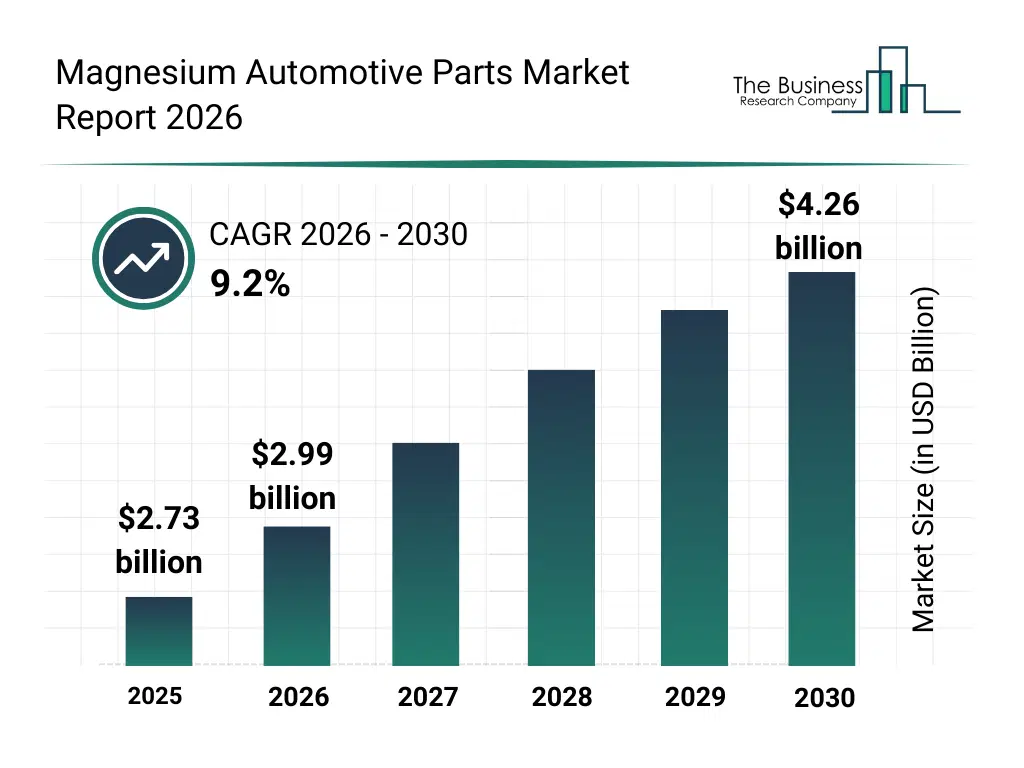
What Is The Magnesium Automotive Parts Market Size and Share 2026?
The magnesium automotive parts market size has grown strongly in recent years. It will grow from $2.73 billion in 2025 to $2.99 billion in 2026 at a compound annual growth rate (CAGR) of 9.5%. The growth in the historic period can be attributed to growth in automotive lightweighting initiatives, rising use of magnesium alloys in vehicles, expansion of die casting capabilities, increasing OEM demand for fuel efficiency, availability of advanced alloy formulations.What Is The Magnesium Automotive Parts Market Growth Forecast?
The magnesium automotive parts market size is expected to see strong growth in the next few years. It will grow to $4.26 billion in 2030 at a compound annual growth rate (CAGR) of 9.2%. The growth in the forecast period can be attributed to increasing penetration of electric and hybrid vehicles, rising demand for high-strength lightweight materials, expansion of sustainable automotive manufacturing, growing investment in magnesium recycling, increasing adoption of advanced casting automation. Major trends in the forecast period include increasing adoption of lightweight magnesium components, rising use in electric vehicle platforms, growing focus on structural weight reduction, expansion of advanced die casting technologies, enhanced emphasis on thermal performance.Tariff Impact On Magnesium Automotive Parts Market
Tariffs are affecting the magnesium automotive parts market by increasing costs of imported magnesium alloys, die casting equipment, and specialized heat treatment technologies. Automotive manufacturing regions in North America and Europe are particularly impacted due to heavy reliance on imported magnesium raw materials, while Asia-Pacific suppliers face export pricing pressure. These tariffs have increased component costs and influenced material selection strategies among OEMs. At the same time, they are driving investments in domestic magnesium production, recycling infrastructure, and localized component manufacturing, supporting long-term supply security.
Global Magnesium Automotive Parts Market Segmentation
1) By Type: Die-Cast Magnesium Parts, Extruded Magnesium Components 2) By Manufacturing Process: Cold Chamber Die Casting, Hot Chamber Die Casting 3) By Vehicle Type: Passenger Vehicles, Commercial Vehicles, Electric Vehicles, Sport Utility Vehicle (SUVs) And Crossovers 4) By Application: Structural Components, Interior And Exterior Trim 5) By End-User Industry: Original Equipment Manufacturers (OEMs), Product Manufacturers, Subsegments: 1) By Die-Cast Magnesium Parts: Gearbox Housings, Steering Components, Electronic Housings, Cooling System Components 2) By Extruded Magnesium Components: Structural Reinforcement Beams, Crash Management Components, Battery Enclosure Frames and Supports, Interior Structural Frames, Thermal Management ProfilesWhat Is The Driver Of The Magnesium Automotive Parts Market?
The rising demand for electric vehicles (EVs) is expected to propel the growth of the magnesium automotive parts market going forward. Electric vehicles are automobiles powered by electric motors using energy stored in rechargeable batteries, offering an environmentally friendly alternative to traditional internal combustion engines. The demand for EVs is growing due to stringent government environmental regulations and declining battery costs, as policymakers worldwide set emissions reduction targets and technological improvements make EVs more affordable and accessible to consumers. Magnesium automotive parts support electric vehicles by reducing overall vehicle weight, which improves energy efficiency and extends driving range, while also enhancing performance, supporting battery longevity, and contributing to more sustainable and cost-effective EV production. For instance, in February 2024, according to the U.S. Department of Energy, a US-based federal agency, a comparison of monthly EV sales over the past three years shows that sales in each month grew significantly compared to the same month in the previous year. The peak monthly sales reached around 80,000 in 2022, and exceeded 100,000 in 2023. Therefore, the rising demand for electric vehicles is driving the growth of the magnesium automotive parts industry.Key Players In The Global Magnesium Automotive Parts Market
Major companies operating in the magnesium automotive parts market are Georg Fischer AG, Linamar Corporation, Nemak S.A.B. de C.V., Rheinmetall AG, Handtmann Metallgusswerk GmbH, Spartan Light Metal Products Inc., Pace Industries Inc., Dynacast International Inc., Meridian Lightweight Technologies Inc., Ryobi Limited, Endurance Technologies Limited, Rockman Industries Limited, Sandhar Technologies Limited, Mag Specialties Inc., Chicago White Metal Casting Inc., Twin City Die Casting Company, MRT Castings Limited, Zhejiang Wanfeng Auto Wheel Co. Ltd., Zibo Deyuan Metal Materials Co. Ltd., Kobe Steel Ltd., Minda Corporation Limited, Harrison Castings Limited
This chart is for illustrative purposes; the full report includes a detailed competitor analysis and comprehensive overview of the top 10 companies in the market.
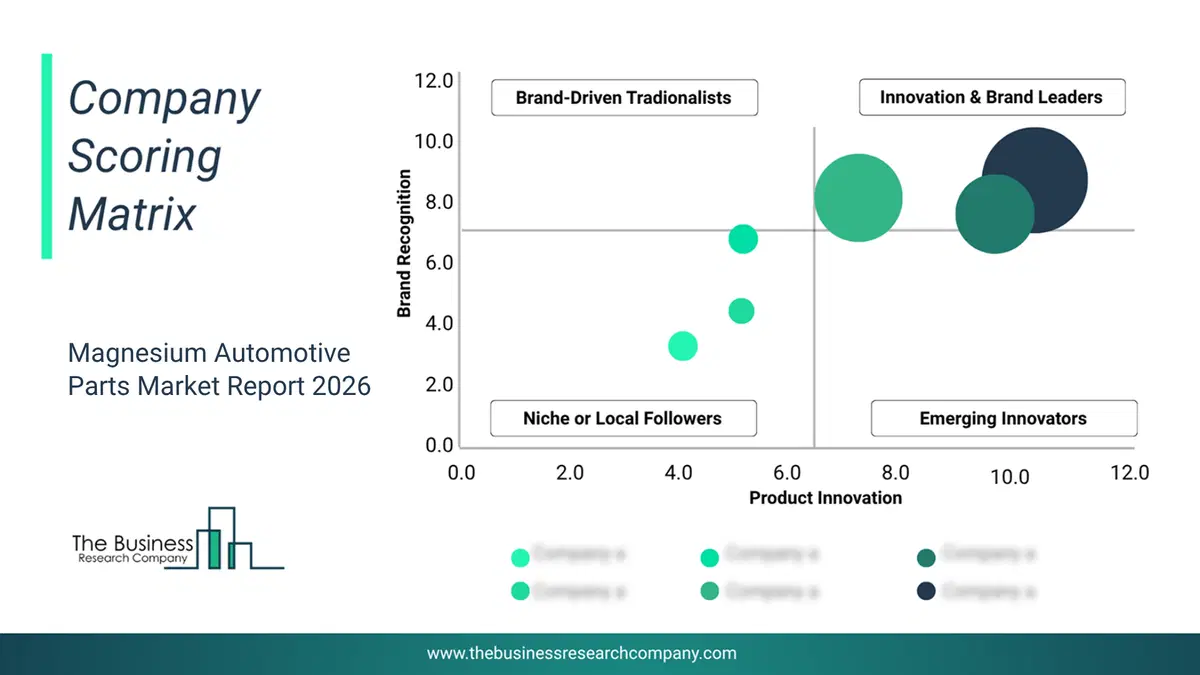
This chart maps companies by product innovation and brand strength, with bubble size indicating relative revenue, helping identify market leaders, challengers, and niche players. This is an illustrative chart; the full report provides a complete and accurate competitive analysis.
Global Magnesium Automotive Parts Market Trends and Insights
Major companies operating in the magnesium automotive parts market are focusing on leveraging innovative techniques such as semi-solid processing to enhance strength, reduce weight, and improve sustainability. Semi-solid processing technique is a manufacturing method that shapes metal alloys in a partially solid and partially liquid state, helping improve flowability, casting quality, mechanical strength, and energy efficiency. For instance, in December 2024, SAIC Motor Corp. Ltd., a China-based automotive manufacturing company, launched its second-generation magnesium alloy case for electric drive assemblies, which is the world’s first mass-produced magnesium alloy case using semi-solid processing. The innovation significantly reduces weight, enhances strength, ductility, and corrosion resistance, and supports large-scale application in new energy vehicles, reinforcing the company’s push toward lightweight, sustainable, and energy-efficient mobility solutions. The adoption of semi-solid processing also eliminates the need for protective gases and lowers overall energy consumption during production, aligning with global green manufacturing principles. Moreover, this breakthrough not only accelerates the lightweighting of electric vehicles but also sets new standards for the magnesium alloy industry, positioning China at the forefront of magnesium material innovation and strengthening its leadership in the global automotive supply chain.What Are Latest Mergers And Acquisitions In The Magnesium Automotive Parts Market?
In April 2023, Teknia Manufacturing Group SLU, a Spain-based manufacturing company, acquired Svensk Tryckgjutning AB (STG) for an undisclosed amount. With this acquisition, Teknia aims to strengthen its aluminium and magnesium injection moulding capabilities, crucial for manufacturing lightweight, high-precision components for electric vehicles, while expanding its production footprint, enhancing its multi-material expertise, and positioning itself as a benchmark company in the evolving mobility industry. Svensk Tryckgjutning AB (STG), a Sweden-based aluminium and magnesium injection moulding company, specializes in providing magnesium automotive parts.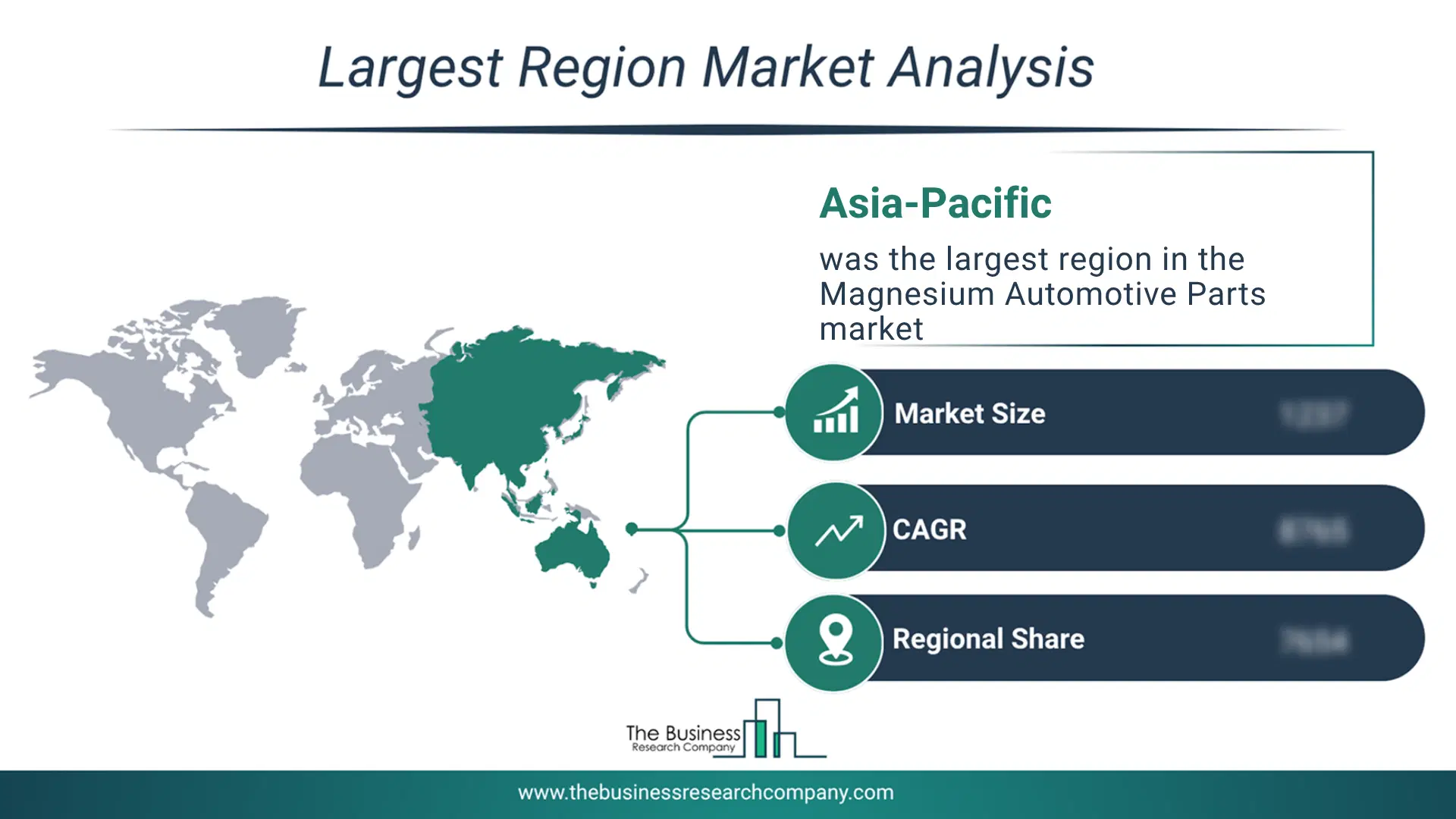
Regional Outlook
Asia-Pacific was the largest region in the magnesium automotive parts in 2025. Asia-Pacific is expected to be the fastest-growing region in the forecast period. The regions covered in this market report are Asia-Pacific, South East Asia, Western Europe, Eastern Europe, North America, South America, Middle East, Africa The countries covered in this market report are Australia, Brazil, China, France, Germany, India, Indonesia, Japan, Taiwan, Russia, South Korea, UK, USA, Canada, Italy, Spain.What Defines the Magnesium Automotive Parts Market?
The magnesium automotive parts market consists of sales of brake components, suspension parts, fuel system components, body brackets, heat shields, and dashboard supports. Values in this market are ‘factory gate’ values, that is the value of goods sold by the manufacturers or creators of the goods, whether to other entities (including downstream manufacturers, wholesalers, distributors and retailers) or directly to end customers. The value of goods in this market includes related services sold by the creators of the goods.How is Market Value Defined and Measured?
The market value is defined as the revenues that enterprises gain from the sale of goods and/or services within the specified market and geography through sales, grants, or donations in terms of the currency (in USD unless otherwise specified). The revenues for a specified geography are consumption values that are revenues generated by organizations in the specified geography within the market, irrespective of where they are produced. It does not include revenues from resales along the supply chain, either further along the supply chain or as part of other products.
This chart presents market attractiveness based on a quantitative evaluation of growth, competition, strategic alignment, and risk, offering a clear view of opportunity areas for decision-making. This chart is for illustrative purposes; the full report contains the complete analysis.

This chart highlights the Total Addressable Market (TAM) by estimating the maximum revenue opportunity using an assumption-driven approach, supporting strategic planning and opportunity sizing across markets. The chart is illustrative; the full report provides a more comprehensive analysis.
What Key Data and Analysis Are Included in the Magnesium Automotive Parts Market Report 2026?
The magnesium automotive parts market research report is one of a series of new reports from The Business Research Company that provides market statistics, including industry global market size, regional shares, competitors with the market share, detailed market segments, market trends and opportunities, and any further data you may need to thrive in the magnesium automotive parts industry. The market research report delivers a complete perspective of everything you need, with an in-depth analysis of the current and future state of the industry.Magnesium Automotive Parts Market Report Forecast Analysis
| Report Attribute | Details |
|---|---|
| Market Size Value In 2026 | $2.99 billion |
| Revenue Forecast In 2030 | $4.26 billion |
| Growth Rate | CAGR of 9.2% from 2026 to 2030 |
| Base Year For Estimation | 2025 |
| Actual Estimates/Historical Data | 2020-2025 |
| Forecast Period | 2026 - 2030 |
| Market Representation | Revenue in USD Billion and CAGR from 2026 to 2030 |
| Segments Covered | Type, Manufacturing Process, Vehicle Type, Application, End-User Industry |
| Regional Scope | Asia-Pacific, Western Europe, Eastern Europe, North America, South America, Middle East, Africa |
| Key Companies Profiled | Georg Fischer AG, Linamar Corporation, Nemak S.A.B. de C.V., Rheinmetall AG, Handtmann Metallgusswerk GmbH, Spartan Light Metal Products Inc., Pace Industries Inc., Dynacast International Inc., Meridian Lightweight Technologies Inc., Ryobi Limited, Endurance Technologies Limited, Rockman Industries Limited, Sandhar Technologies Limited, Mag Specialties Inc., Chicago White Metal Casting Inc., Twin City Die Casting Company, MRT Castings Limited, Zhejiang Wanfeng Auto Wheel Co. Ltd., Zibo Deyuan Metal Materials Co. Ltd., Kobe Steel Ltd., Minda Corporation Limited, Harrison Castings Limited |
| Customization Scope | Request for Customization |
| Pricing And Purchase Options | Explore Purchase Options |