

Managed Service Providers Market Report 2026
Global Outlook – By Service Provider Type (Managed Network Service Providers, Managed Security Service Providers, Managed Cloud Service Providers, Managed IT Service Providers), By Deployment Mode (On-Premises, Cloud), By Organization Size (Small And Medium-Sized Enterprises (SMEs), Large Enterprises), By End-User (Banking, Financial Services, And Insurance (BFSI), Healthcare, Information Technology (IT) And Telecommunications, Retail, Manufacturing, Government, Other End Users) – Market Size, Trends, Strategies, and Forecast to 2030
Managed Service Providers Market Overview
• Managed Service Providers market size has reached to $406.74 billion in 2025 • Expected to grow to $1015.53 billion in 2030 at a compound annual growth rate (CAGR) of 20% • Growth Driver: Increasing Cyber Threats Fueling The Growth Of The Market Due To Rising Need For Continuous Security Monitoring And Risk Mitigation • Market Trend: Integration Of AI-Driven Unified Platforms To Enhance Managed Service Efficiency • North America was the largest region in 2025 and Asia-Pacific is the fastest growing region.Market Gains By 2030 – Top Opportunities By Segment
Market Gain identifies the most promising market opportunities by highlighting the segments or products expected to generate the highest incremental revenue growth over the next five years.
What Is Covered Under Managed Service Providers Market?
Managed service providers are firms that deliver ongoing IT management and support services for businesses. They oversee and maintain systems, networks, and applications remotely to ensure smooth operations, enhance security, and lower overall IT expenses through a subscription-based approach. The main service providers types in managed service providers are managed network service providers, managed security service providers, managed cloud service providers, and managed IT service providers. Managed network service providers are companies that offer outsourced management of enterprise communication networks, encompassing design, deployment, and continuous monitoring. These are deployed through on-premises and cloud. These services cater to organizations sizes, including small and medium-sized enterprises (SMEs) and large enterprises, and are widely used across various sectors such as banking, financial services and insurance (BFSI), healthcare, information technology (IT) and telecommunications, retail, manufacturing, government, and others.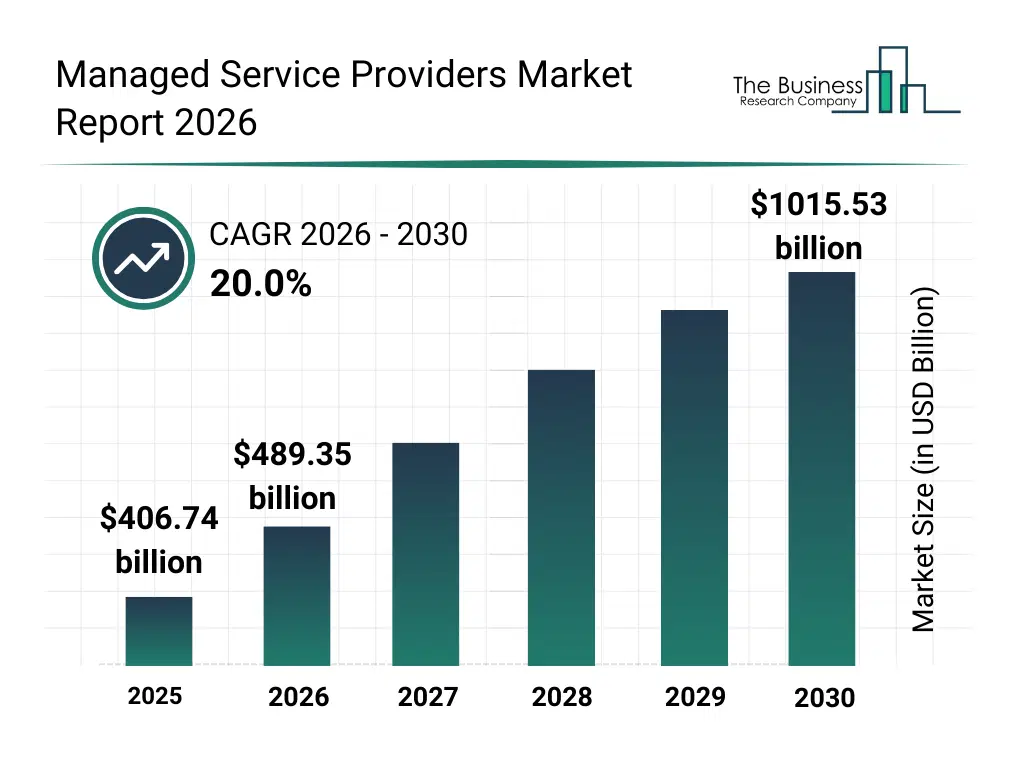
What Is The Managed Service Providers Market Size and Share 2026?
The managed service providers market size has grown exponentially in recent years. It will grow from $406.74 billion in 2025 to $489.35 billion in 2026 at a compound annual growth rate (CAGR) of 20.3%. The growth in the historic period can be attributed to rising cybersecurity threats and compliance needs, outsourcing to reduce internal it operational costs, growth of remote work and distributed endpoints, increasing complexity of enterprise networks, adoption of itil and itsm service models.What Is The Managed Service Providers Market Growth Forecast?
The managed service providers market size is expected to see exponential growth in the next few years. It will grow to $1015.53 billion in 2030 at a compound annual growth rate (CAGR) of 20.0%. The growth in the forecast period can be attributed to AI copilots for msp ticket triage and remediation, industry-specific managed service bundles, finops services for cloud cost governance, managed kubernetes and container operations, continuous compliance monitoring as a service. Major trends in the forecast period include managed detection and response as a standard offering, multi-cloud and hybrid management services expansion, automation-led it service desk and noc operations, zero trust and identity-centric managed security, subscription-based bundled managed services for smes.
Global Managed Service Providers Market Segmentation
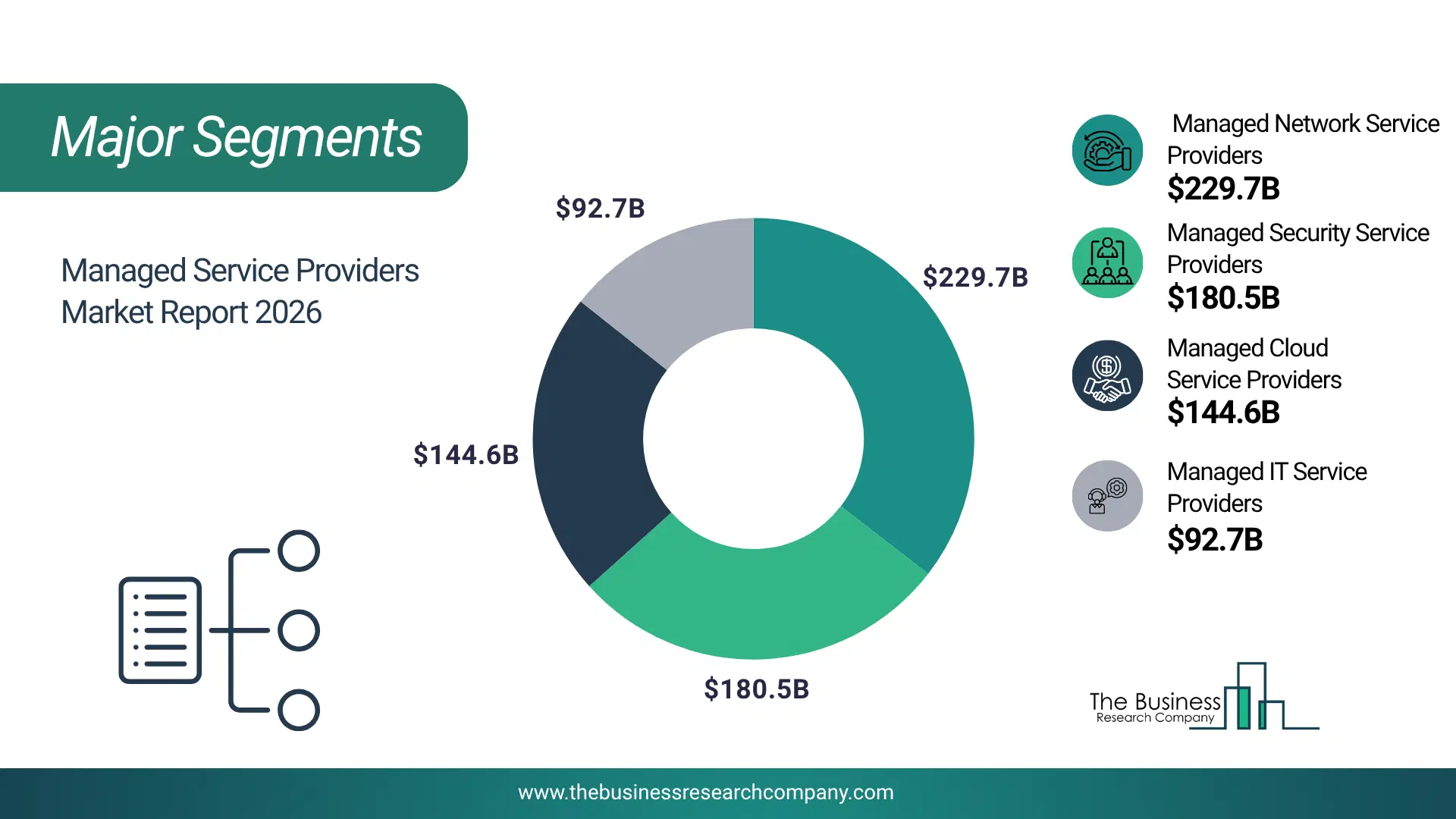
1) By Service Provider Type: Managed Network Service Providers, Managed Security Service Providers, Managed Cloud Service Providers, Managed IT Service Providers 2) By Deployment Mode: On-Premises, Cloud 3) By Organization Size: Small And Medium-Sized Enterprises (SMEs), Large Enterprises 4) By End-User: Banking, Financial Services, And Insurance (BFSI), Healthcare, Information Technology (IT) And Telecommunications, Retail, Manufacturing, Government, Other End Users Subsegments: 1) By Managed Network Service Providers: SD-WAN, MPLS Or WAN Services, LAN Or WLAN Management, VPN And Remote-Access Services, Network Monitoring And Performance Management, Voice Or VoIP And UC Management, Network Equipment Provisioning And Maintenance, Network Consulting And Integration 2) By Managed Security Service Providers: Security Operations Center (SOC) As A Service, Managed Detection And Response (MDR), Firewall Or IDS-IPS Management, Endpoint Detection And Response (EDR), Identity And Access Management (IAM), Vulnerability Management And Pen Testing, Threat Intelligence And Hunting, Compliance, SIEM And Log Management, Data Loss Prevention (DLP) And Encryption 3) By Managed Cloud Service Providers: IaaS Management, PaaS Management, SaaS Management And Integration, Cloud Migration And Onboarding, Multi-Cloud Or Hybrid Cloud Management, Cloud Security (CSPM Or CASB), Cost Optimization Or FinOps, Backup And Disaster Recovery For Cloud, Container Or Kubernetes Management 4) By Managed IT Service Providers: IT Helpdesk Or Service Desk (NOC), Desktop Or Endpoint Management (MDM), Server And Infrastructure Management, Patch And Update Management, Managed Backup And Disaster Recovery, IT Asset Lifecycle Management, Application Management And Maintenance, ITSM Or Process Management, Compliance And Policy Management The top segments in the managed service providers market will be: • Managed Network Service Providers will reach $229.65 billion by 2030. • Managed Security Service Providers will reach $180.49 billion by 2030. • Managed Cloud Service Providers will reach $144.55 billion by 2030. • Managed IT Service Providers will reach $92.69 billion by 2030.What Is The Driver Of The Managed Service Providers Market?
The increasing cyber threats is expected to propel the growth of the managed service providers market going forward. Cyber threats encompass malicious activities such as ransomware, phishing, and data breaches that target digital systems, networks, or devices, causing financial, operational, and reputational harm. Cyber threats are rising due to the increase in digitalization of businesses and reliance on interconnected systems. Managed service providers help counter cyber threats by continuously monitoring, detecting, and responding to security risks in real time. For instance, in November 2024, according to the Australian Cyber Security Centre, an Australia-based government agency, reported that in the financial year 2023–24, the Australian Cybersecurity Hotline operated by ASD received more than 36,700 calls, marking a 12% rise compared to the previous year, and ASD handled over 1,100 cybersecurity incidents during the same period. Therefore, the increasing cyber threats is driving the growth of managed service providers industry.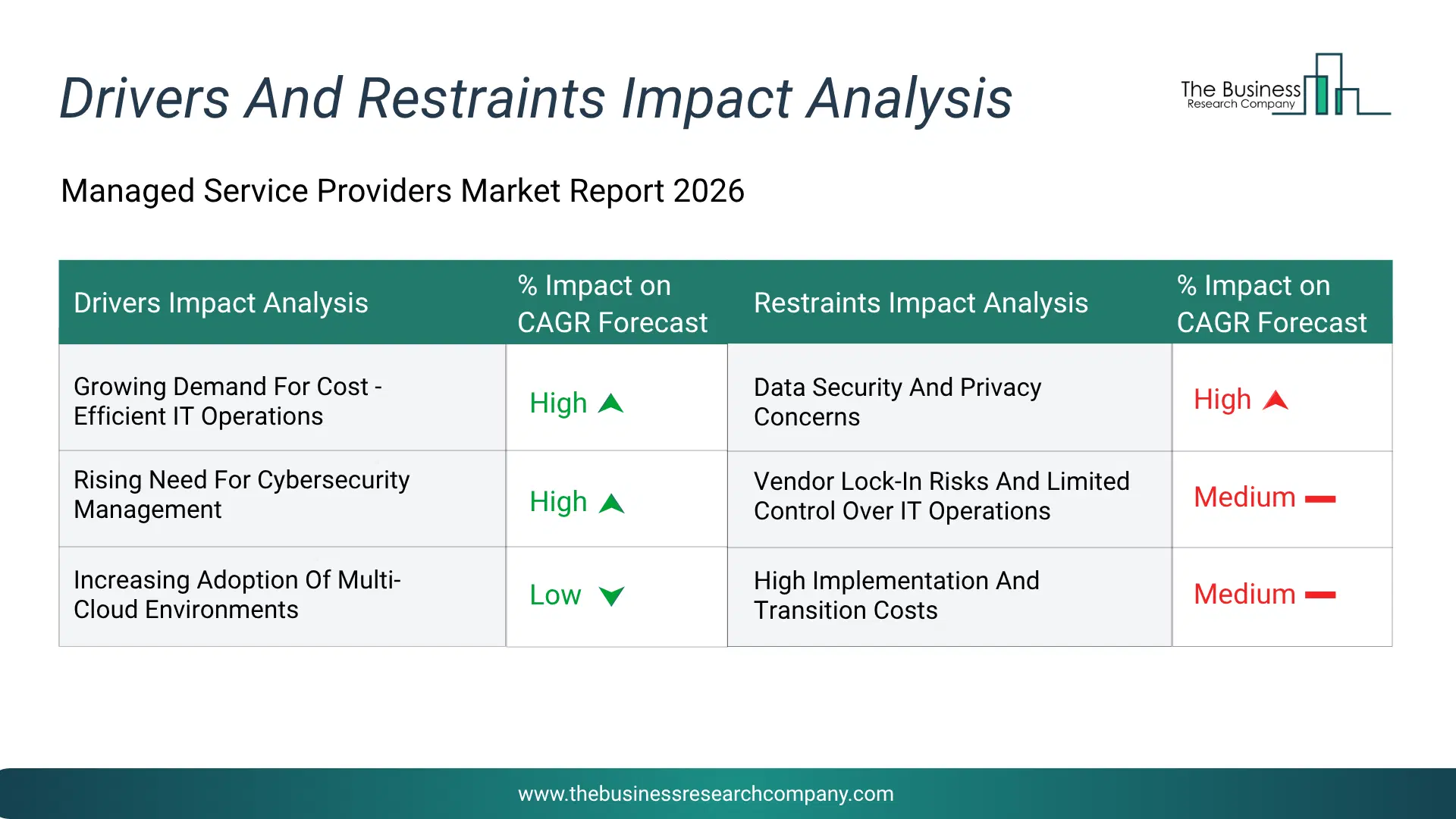
Infographic Chart Showing Key Market Drivers Analysis And Restraints For Managed Service Providers Market
The chart presents an impact analysis of key drivers and restraints, quantifying their relative influence on the market's growth rate and helping assess the balance between growth enablers and limiting factors. This chart offers a high-level perspective; the full report contains more detailed insights.
How Will The Drivers Impact Growth In The Global Managed Service Providers Market?
• Growing Demand For Cost -Efficient IT Operations (High) – During the forecast period, the growing need for cost -efficient it operations is expected to become a key growth driver for the managed service provider market by 2030. Organizations are increasingly seeking ways to optimize it spending while maintaining strong performance and reliability. Managed service providers help reduce capital expenditure by offering predictable subscription -based models that lower infrastructure and maintenance costs. They also provide access to skilled it professionals without requiring large in -house teams, ensuring continuous monitoring and rapid issue resolution. This operational efficiency allows companies to focus more on strategic initiatives rather than routine it management. As a result, enterprises are increasingly adopting msp solutions to improve operational agility and financial sustainability. • Rising Need For Cybersecurity Management (High) – During the forecast period, the rising need for cybersecurity management is expected to emerge as a major factor driving the expansion of the managed service provider market by 2030. Organizations are facing increasingly sophisticated and frequent cyber threats, prompting greater reliance on managed service providers for advanced security capabilities. Msps deliver comprehensive cybersecurity services, including continuous monitoring, proactive threat detection, and rapid incident response that many businesses cannot efficiently maintain in-house. With the rise in data breaches and stricter regulatory requirements, msps offer cost-effective protection supported by specialized expertise. Their ability to ensure data security and maintain system integrity strengthens overall business resilience. As cybersecurity becomes a strategic priority across industries, demand for msp services continues to grow. • Increasing Adoption Of Multi-Cloud Environments (Low) – During the forecast period, the increasing adoption of multi-cloud environments is expected to act as a key growth catalyst for the managed service provider market by 2030. Many organizations are deploying multiple cloud platforms to improve flexibility, enhance performance, and avoid dependence on a single vendor. However, managing diverse cloud infrastructures introduces challenges related to integration, security, and cost optimization. Managed service providers address these complexities by offering centralized monitoring, governance, and automation across different cloud environments. They enable seamless workload management, efficient data movement, and stronger compliance across cloud ecosystems. As enterprises continue to expand their multi-cloud strategies, reliance on msp expertise is increasing.How Will The Restraints Impact Growth In The Global Managed Service Providers Market?
• Data Security And Privacy Concerns (High) – During the forecast period, the data security and privacy concerns act as major restraints for managed service providers because clients must trust them with sensitive business information and critical it operations. Any breach, unauthorized access, or data misuse can lead to financial losses, reputational damage, and regulatory penalties. Strict compliance requirements such as gdpr and data residency laws further increase operational complexity. Many organizations hesitate to outsource due to fears of losing control over their data. Consequently, these concerns slow msp adoption and limit potential market growth. • Vendor Lock-In Risks And Limited Control Over IT Operations (Medium) – During the forecast period, the vendor lock-in risks and limited control over it operations act as major restraints for the managed service provider (msp) market because businesses become heavily dependent on a single provider’s tools, platforms, and service models. This dependency makes it difficult and costly to switch providers or integrate new technologies. Organizations may also feel a loss of control over their data, systems, and decision-making processes. Such limitations can reduce flexibility in managing it strategies and adapting to changing business needs. As a result, many enterprises hesitate to fully adopt msp solutions, slowing market growth. • High Implementation And Transition Costs (Medium) – During the forecast period, the high implementation and transition costs act as a restraint for the managed service provider (msp) market because organizations often face significant upfront expenses when migrating their it infrastructure to an external provider. These costs include system integration, data migration, staff training, and potential downtime during the transition period. Smaller businesses, in particular, may find these expenses prohibitive, delaying or limiting adoption. Additionally, customizing msp solutions to fit existing legacy systems can further increase costs and complexity. As a result, the high initial investment can discourage enterprises from shifting to managed services despite their long-term benefits.Key Players In The Global Managed Service Providers Market
Major companies operating in the managed service providers market are Accenture plc, International Business Machines Corporation (IBM), NTT DATA Corporation, Fujitsu Limited, Capgemini SE, CDW Corporation, Cognizant Technology Solutions Corporation, Infosys Limited, SHI International Corp., DXC Technology Company, HCL Technologies Limited, Wipro Limited, Insight Enterprises Inc., Tech Mahindra Limited, Presidio Inc., Logicalis Group Limited, Atos SE, Rackspace Technology Inc., CompuCom SystemsInc., Softchoice Corporation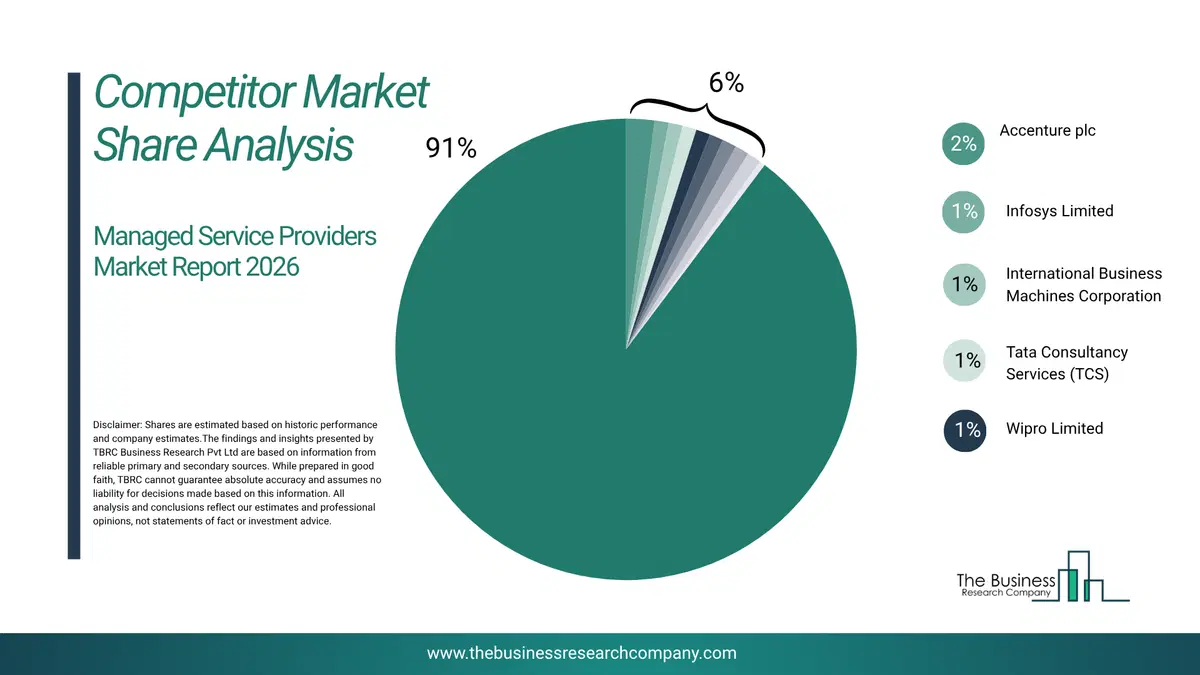
This chart is for illustrative purposes; the full report includes a detailed competitor analysis and comprehensive overview of the top 10 companies in the market.
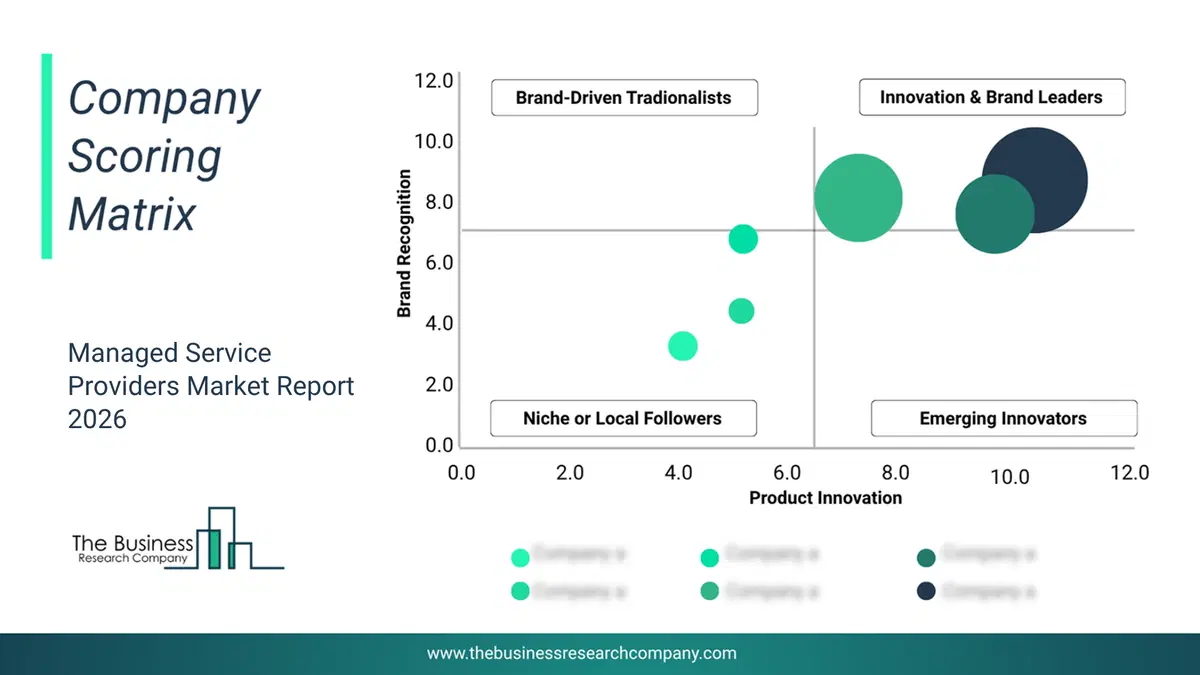
This chart maps companies by product innovation and brand strength, with bubble size indicating relative revenue, helping identify market leaders, challengers, and niche players. This is an illustrative chart; the full report provides a complete and accurate competitive analysis.
Global Managed Service Providers Market Trends and Insights
Major companies operating in the managed service providers market are focusing on developing unified, AI-driven, and cloud-native platforms to enhance service automation, cybersecurity, and operational efficiency for multi-client environments. A unified, AI-driven platform brings various IT operations together under one system and uses AI to automate workflows, boost efficiency, and enable smarter management. For instance, in June 2025, ManageEngine, a US-based IT management software company, launched MSP Central, a unified platform designed to enhance the efficiency and scalability of managed service providers (MSPs). The solution consolidates service delivery, device management, threat protection, and infrastructure monitoring into a single, AI-driven interface. Built with a modular, cloud-native architecture, it supports multi-tenancy, role-based access, and integration with Zoho and third-party tools. Key features include RMM, PSA, advanced server monitoring, and endpoint security. MSP Central aims to reduce operational complexity, improve technician productivity, and help MSPs deliver secure, streamlined IT services while minimizing tool fragmentation.What Are Latest Mergers And Acquisitions In The Managed Service Providers Market?
In August 2025, Kinly, a Netherlands-based IT services and IT consulting company, merged with Yorktel for an undisclosed amount. With this merger, Kinly aims to expand its global footprint, strengthen its managed services portfolio, and enhance its AV and workplace collaboration capabilities. Yorktel is a US-based IT service management company that specializes in providing AV systems integrator and managed services.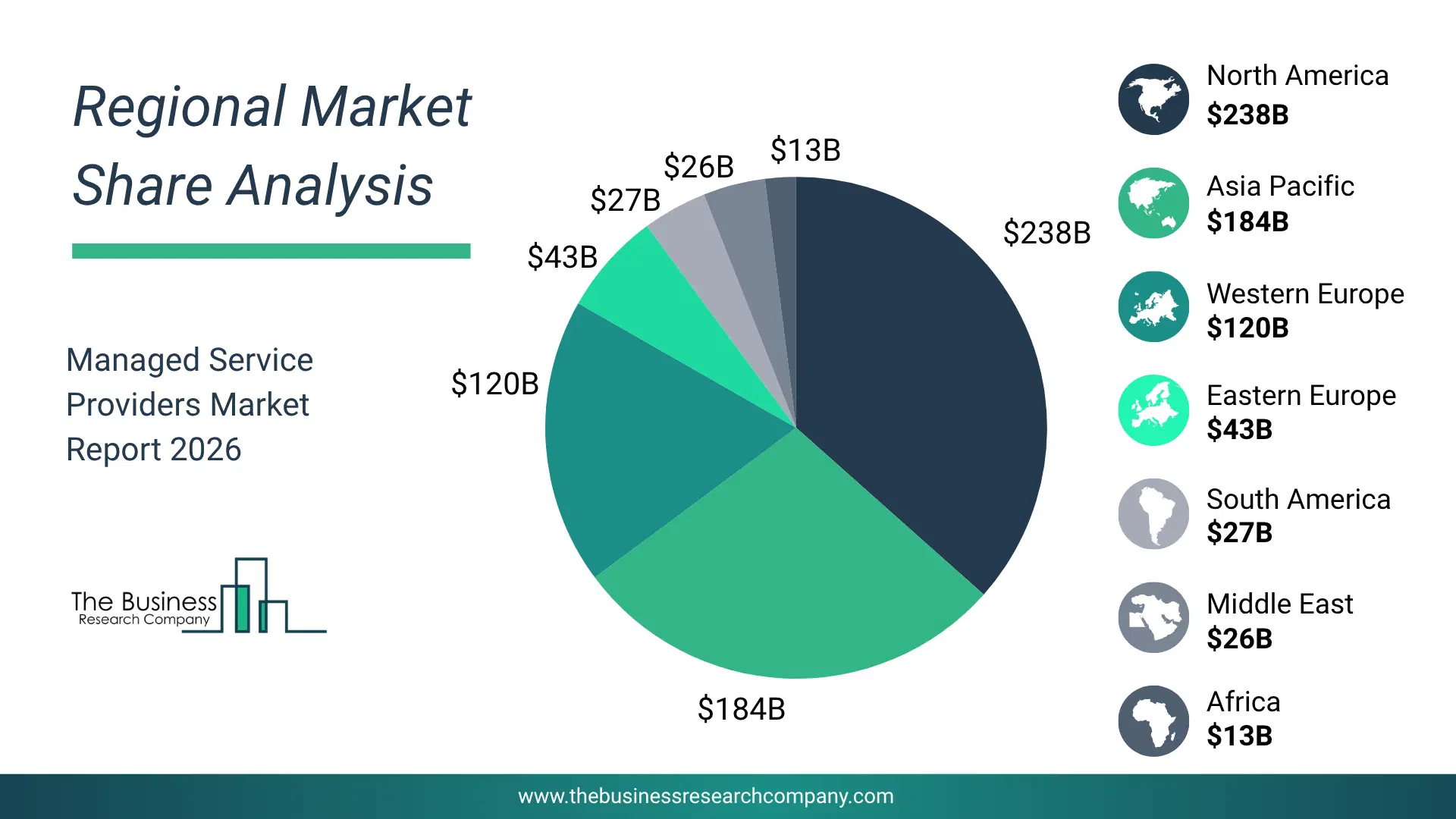
Regional Insights
North America was the largest region in the managed service providers market in 2025. Asia-Pacific is expected to be the fastest-growing region in the forecast period. The regions covered in this market report are Asia-Pacific, South East Asia, Western Europe, Eastern Europe, North America, South America, Middle East, Africa. The countries covered in this market report are Australia, Brazil, China, France, Germany, India, Indonesia, Japan, Taiwan, Russia, South Korea, UK, USA, Canada, Italy, Spain.What Defines the Managed Service Providers Market?
The managed service providers market includes revenues earned by entities by providing services such as IT infrastructure management, cloud operations, cybersecurity, monitoring, and data backup. The market value includes the value of related goods sold by the service provider or included within the service offering. Only goods and services traded between entities or sold to end consumers are included.How is Market Value Defined and Measured?
The market value is defined as the revenues that enterprises gain from the sale of goods and/or services within the specified market and geography through sales, grants, or donations in terms of the currency (in USD unless otherwise specified). The revenues for a specified geography are consumption values that are revenues generated by organizations in the specified geography within the market, irrespective of where they are produced. It does not include revenues from resales along the supply chain, either further along the supply chain or as part of other products.
This chart presents market attractiveness based on a quantitative evaluation of growth, competition, strategic alignment, and risk, offering a clear view of opportunity areas for decision-making. This chart is for illustrative purposes; the full report contains the complete analysis.

This chart highlights the Total Addressable Market (TAM) by estimating the maximum revenue opportunity using an assumption-driven approach, supporting strategic planning and opportunity sizing across markets. The chart is illustrative; the full report provides a more comprehensive analysis.
What Key Data and Analysis Are Included in the Managed Service Providers Market Report 2026?
The managed service providers market research report is one of a series of new reports from The Business Research Company that provides market statistics, including industry global market size, regional shares, competitors with the market share, detailed market segments, market trends and opportunities, and any further data you may need to thrive in the managed service providers industry. The market research report delivers a complete perspective of everything you need, with an in-depth analysis of the current and future state of the industry.Managed Service Providers Market Report Forecast Analysis
| Report Attribute | Details |
|---|---|
| Market Size Value In 2026 | $489.35 billion |
| Revenue Forecast In 2030 | $1015.53 billion |
| Growth Rate | CAGR of 20% from 2026 to 2030 |
| Base Year For Estimation | 2025 |
| Actual Estimates/Historical Data | 2020-2025 |
| Forecast Period | 2026 - 2030 |
| Market Representation | Revenue in USD Billion and CAGR from 2026 to 2030 |
| Segments Covered | Service Provider Type, Deployment Mode, Organization Size, End-User |
| Regional Scope | Asia-Pacific, Western Europe, Eastern Europe, North America, South America, Middle East, Africa |
| Country Scope | The countries covered in the report are Australia, Brazil, China, France, Germany, India, ... |
| Key Companies Profiled | Accenture plc, International Business Machines Corporation (IBM), NTT DATA Corporation, Fujitsu Limited, Capgemini SE, CDW Corporation, Cognizant Technology Solutions Corporation, Infosys Limited, SHI International Corp., DXC Technology Company, HCL Technologies Limited, Wipro Limited, Insight Enterprises Inc., Tech Mahindra Limited, Presidio Inc., Logicalis Group Limited, Atos SE, Rackspace Technology Inc., CompuCom SystemsInc., Softchoice Corporation |
| Customization Scope | Request for Customization |
| Pricing And Purchase Options | Explore Purchase Options |