
Medical Imaging Workstations Market Report 2026
Global Outlook – By Modality (Magnetic Resonance Imaging, Computed Tomography, Ultrasound, Mammography, Other Modalities), By Component (Visualization Software, Display Units, Display Controller Cards, Central Processing Units), By Usage (Thick Client Workstations, Thin Client Workstations ), By Application (Diagnostic Imaging, Clinical Review, Advanced Imaging), By End-User (Hospitals, Diagnostic Centers, Ambulatory Centers, Other End-Users) - Market Size, Trends, Strategies, and Forecast to 2030
Medical Imaging Workstations Market Overview
• Medical Imaging Workstations market size has reached to $5.87 billion in 2025 • Expected to grow to $9.7 billion in 2030 at a compound annual growth rate (CAGR) of 10.6% • Growth Driver: Rising Number Of Outpatient Fuels Growth In The Medical Imaging Workstations Market • Market Trend: Revolutionizing Diagnostic Imaging Through Autonomous Systems • North America was the largest region in 2025 and Asia-Pacific is the fastest growing region.What Is Covered Under Medical Imaging Workstations Market?
Medical imaging workstations refer to systems and software used in the radiology departments of hospitals or diagnostic centers to provide diagnostic information of patients based on imaging. Medical imaging workstations are primarily used to view and interpret pictures for patient diagnosis. It is a component of digital imaging systems that aids in accurate diagnosis and clear visualization of abnormalities. The main modality of medical imaging workstations are magnetic resonance imaging, computed tomography, ultrasound, mammography and other modalities. The magnetic resonance imaging modality of medical imaging workstations are used to examine patients’ brains, spinal cords, nerves, muscles, and ligaments through high-resolution images of the patient’s body. Magnetic resonance imaging (MRI) is a non-invasive imaging tool that produces three-dimensional, intricate anatomical images. The medical imaging workstation component are visualization software, display units, display controller cards, and central processing units which are used at thick client workstations and thin client workstations that are applied in diagnostic imaging, clinical review and advanced imaging, used by hospitals, diagnostic centers, ambulatory centers and other end-users.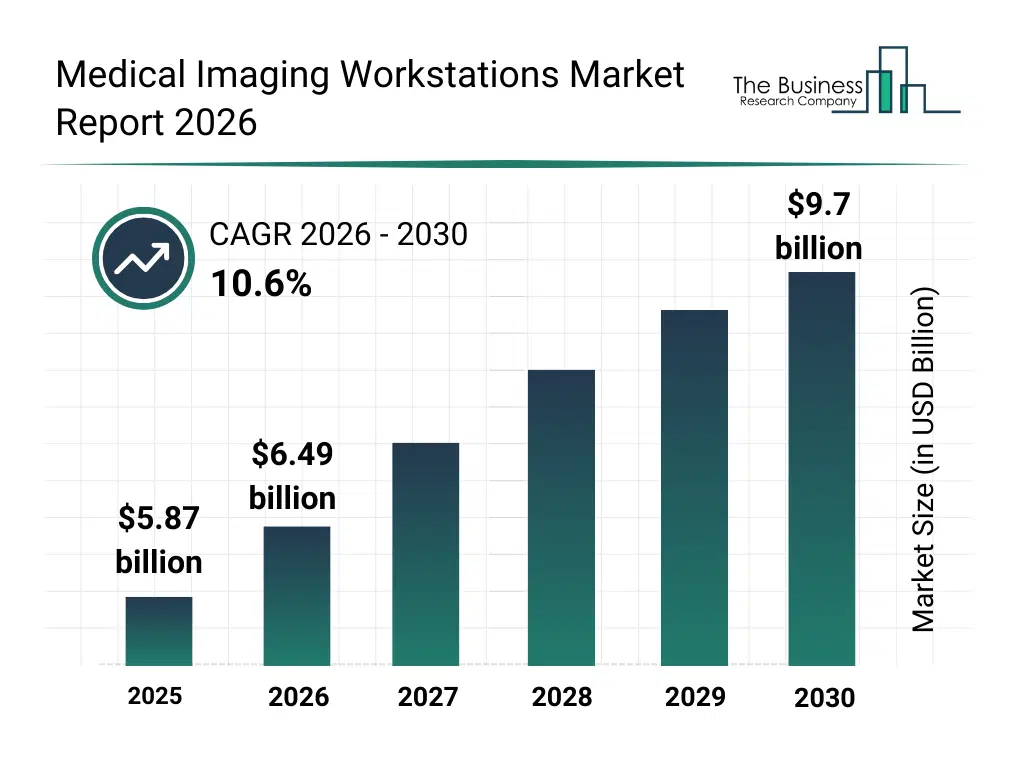
What Is The Medical Imaging Workstations Market Size and Share 2026?
The medical imaging workstations market size has grown rapidly in recent years. It will grow from $5.87 billion in 2025 to $6.49 billion in 2026 at a compound annual growth rate (CAGR) of 10.6%. The growth in the historic period can be attributed to transition from analog to digital imaging systems, growth in hospital radiology departments, rising use of CT and MRI scans, increasing diagnostic imaging volumes, investments in healthcare IT infrastructure.What Is The Medical Imaging Workstations Market Growth Forecast?
The medical imaging workstations market size is expected to see rapid growth in the next few years. It will grow to $9.7 billion in 2030 at a compound annual growth rate (CAGR) of 10.6%. The growth in the forecast period can be attributed to growing demand for early and accurate diagnosis, rising chronic and lifestyle disease burden, expansion of diagnostic centers, increasing adoption of advanced imaging modalities, need for faster clinical decision support. Major trends in the forecast period include rising adoption of advanced diagnostic imaging platforms, growing demand for high-performance visualization workstations, increased focus on workflow efficiency in radiology departments, expansion of multimodality imaging interpretation, higher preference for ergonomic and user-centric workstation design.
Global Medical Imaging Workstations Market Segmentation
1) By Modality: Magnetic Resonance Imaging, Computed Tomography, Ultrasound, Mammography, Other Modalities 2) By Component: Visualization Software, Display Units, Display Controller Cards, Central Processing Units 3) By Usage: Thick Client Workstations, Thin Client Workstations 4) By Application: Diagnostic Imaging, Clinical Review, Advanced Imaging 5) By End-User: Hospitals, Diagnostic Centers, Ambulatory Centers, Other End-Users Subsegments: 1) By Magnetic Resonance Imaging (MRI): Closed MRI Workstations, Open MRI Workstations, MRI Post-Processing Workstations 2) By Computed Tomography (CT): Standard CT Workstations, Advanced CT Post-Processing Workstations, Mobile CT Workstations 3) By Ultrasound: Portable Ultrasound Workstations, Cart-Based Ultrasound Workstations, Ultrasound Image Processing Workstations 4) By Mammography: Digital Mammography Workstations, Stereotactic Biopsy Workstations, 3D Mammography Workstations 5) By Other Modalities: X-Ray Workstations, Nuclear Medicine Workstations, Fluoroscopy WorkstationsWhat Is The Driver Of The Medical Imaging Workstations Market?
The rising number of outpatients is expected to propel the growth of the medical imaging workstations market. Outpatients refer to patients who require medical care without staying in the hospital overnight. In recent years, outpatient visits have significantly increased while inpatient discharges have decreased, especially for imaging. Imaging services have been shifting from the inpatient setting to the outpatient one. Due to new payer demands and patient preferences, there has been a considerable impetus for these outpatient services as standalone facilities. For instance, in March 2023, according to Becker's Hospital Review, a US-based medical industry trade magazine, 95% of health leaders expect an increase in outpatient volumes in 2023, with 40% of them anticipating jumps of 10% or more. Therefore, the rising number of outpatients will drive the growth of the medical imaging workstation industry.Key Players In The Global Medical Imaging Workstations Market
Major companies operating in the medical imaging workstations market are General Electric Company, Koninklijke Philips NV, Siemens Medical Systems Inc., Fujifilm Healthcare Corporation, Canon Medical Systems Corporation, PaxeraHealth, Hologic Inc., Carestream Health India Pvt. Ltd., Esaote SpA, Medicor Imaging, Hitachi Medical Systems, Toshiba Medical Systems Corporation, Samsung Medison Co. Ltd., Shimadzu Corporation, Agfa-Gevaert NV, Sectra AB, Merge Healthcare Inc., Intelerad Medical Systems Incorporated, McKesson Corporation, Analogic Corporation, Barco NV, ContextVision AB, Infinitt Healthcare Co. Ltd., Mirada Medical Limited
This chart is for illustrative purposes; the full report includes a detailed competitor analysis and comprehensive overview of the top 10 companies in the market.
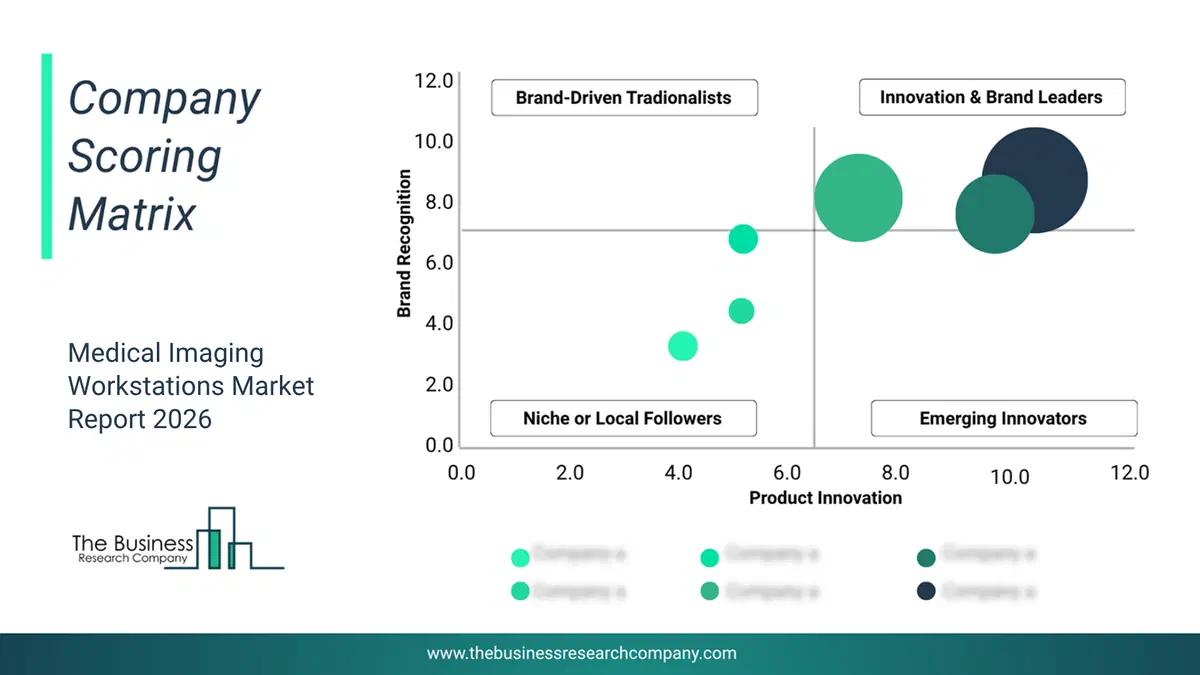
This chart maps companies by product innovation and brand strength, with bubble size indicating relative revenue, helping identify market leaders, challengers, and niche players. This is an illustrative chart; the full report provides a complete and accurate competitive analysis.
Global Medical Imaging Workstations Market Trends and Insights
Major companies operating in the medical imaging workstation market are increasingly leveraging advanced technologies such as autonomous imaging to enhance workflow efficiency, improve diagnostic accuracy, and reduce technologist workload. Autonomous imaging refers to AI-driven systems that can guide patients, acquire images, and perform preliminary analyses with minimal human intervention, enabling faster, more consistent, and higher-quality imaging results. For instance, in March 2025, GE HealthCare, a US-based medical technology company, partnered with NVIDIA, a US-based AI computing company, to launch autonomous X-ray and ultrasound imaging solutions designed to transform diagnostic imaging workflows. These next-generation workstations use AI-powered imaging protocols, automated patient positioning, and real-time image enhancement to obtain high-quality diagnostic images with minimal manual input while also generating preliminary assessments. Their key features include autonomous operation, AI-based dose optimization, and seamless integration with hospital PACS systems. These advancements support a wide range of applications, including radiology, point-of-care ultrasound, and mobile imaging units, helping improve efficiency, enhance diagnostic confidence, reduce operator fatigue, and increase patient throughput.What Are Latest Mergers And Acquisitions In The Medical Imaging Workstations Market?
In April 2024, GE HealthCare Technologies Inc., a US-based medical technology company, acquired MIM Software Inc. for an undisclosed amount. Through this acquisition, GE HealthCare Technologies Inc. aims to provide clinicians and healthcare systems with increasingly integrated and automated solutions, enhance hospital efficiency, and deliver precision care across multiple disease areas. MIM Software Inc. is a US-based company providing AI-enabled medical image analysis and workflow solutions across oncology, urology, neurology, and cardiology.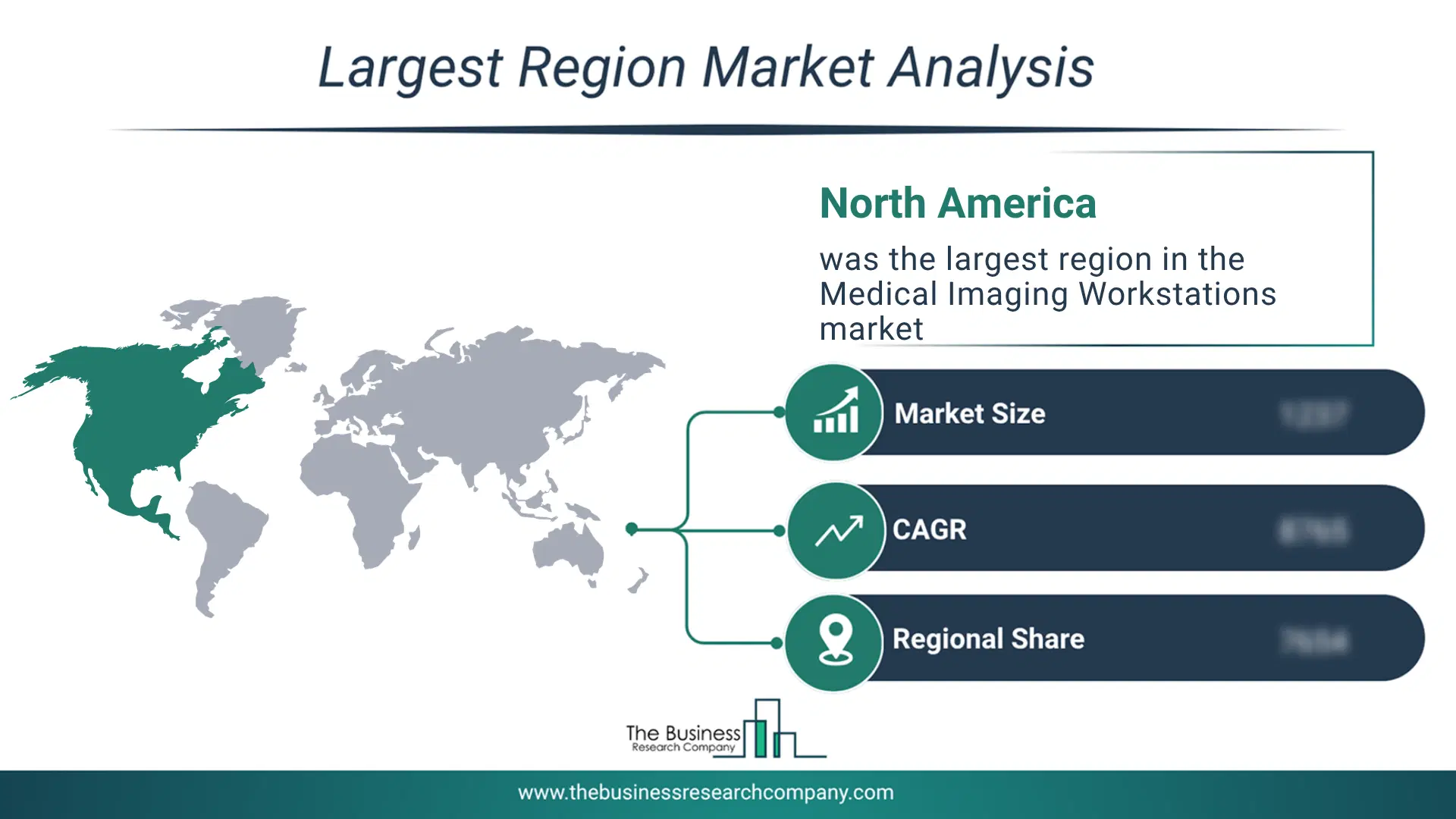
Regional Outlook
North America was the largest region in the medical imaging workstations market in 2025. Asia-Pacific is expected to be the fastest-growing region in the forecast period. The regions covered in this market report are Asia-Pacific, South East Asia, Western Europe, Eastern Europe, North America, South America, Middle East, Africa. The countries covered in this market report are Australia, Brazil, China, France, Germany, India, Indonesia, Japan, Taiwan, Russia, South Korea, UK, USA, Canada, Italy, Spain.What Defines the Medical Imaging Workstations Market?
The medical imaging workstations market consists of sales of CRTs or flat panel displays, calibration hardware and software. Values in this market are ‘factory gate’ values, that is the value of goods sold by the manufacturers or creators of the goods, whether to other entities (including downstream manufacturers, wholesalers, distributors and retailers) or directly to end customers.How is Market Value Defined and Measured?
The market value is defined as the revenues that enterprises gain from the sale of goods and/or services within the specified market and geography through sales, grants, or donations in terms of the currency (in USD unless otherwise specified). The revenues for a specified geography are consumption values that are revenues generated by organizations in the specified geography within the market, irrespective of where they are produced. It does not include revenues from resales along the supply chain, either further along the supply chain or as part of other products.
This chart presents market attractiveness based on a quantitative evaluation of growth, competition, strategic alignment, and risk, offering a clear view of opportunity areas for decision-making. This chart is for illustrative purposes; the full report contains the complete analysis.

This chart highlights the Total Addressable Market (TAM) by estimating the maximum revenue opportunity using an assumption-driven approach, supporting strategic planning and opportunity sizing across markets. The chart is illustrative; the full report provides a more comprehensive analysis.
What Key Data and Analysis Are Included in the Medical Imaging Workstations Market Report 2026?
The medical imaging workstations market research report is one of a series of new reports from The Business Research Company that provides market statistics, including industry global market size, regional shares, competitors with the market share, detailed market segments, market trends and opportunities, and any further data you may need to thrive in the medical imaging workstations industry. The market research report delivers a complete perspective of everything you need, with an in-depth analysis of the current and future state of the industry.Medical Imaging Workstations Market Report Forecast Analysis
| Report Attribute | Details |
|---|---|
| Market Size Value In 2026 | $6.49 billion |
| Revenue Forecast In 2030 | $9.7 billion |
| Growth Rate | CAGR of 10.6% from 2026 to 2030 |
| Base Year For Estimation | 2025 |
| Actual Estimates/Historical Data | 2020-2025 |
| Forecast Period | 2026 - 2030 |
| Market Representation | Revenue in USD Billion and CAGR from 2026 to 2030 |
| Segments Covered | Modality, Component, Usage, Application, End-User |
| Regional Scope | Asia-Pacific, Western Europe, Eastern Europe, North America, South America, Middle East, Africa |
| Country Scope | The countries covered in the report are Australia, Brazil, China, France, Germany, India, Indonesia, Japan, Taiwan, Russia, South Korea, UK, USA, Canada, Italy, Spain |
| Key Companies Profiled | General Electric Company, Koninklijke Philips NV, Siemens Medical Systems Inc., Fujifilm Healthcare Corporation, Canon Medical Systems Corporation, PaxeraHealth, Hologic Inc., Carestream Health India Pvt. Ltd., Esaote SpA, Medicor Imaging, Hitachi Medical Systems, Toshiba Medical Systems Corporation, Samsung Medison Co. Ltd., Shimadzu Corporation, Agfa-Gevaert NV, Sectra AB, Merge Healthcare Inc., Intelerad Medical Systems Incorporated, McKesson Corporation, Analogic Corporation, Barco NV, ContextVision AB, Infinitt Healthcare Co. Ltd., Mirada Medical Limited |
| Customization Scope | Request for Customization |
| Pricing And Purchase Options | Explore Purchase Options |