
Medical Skin Adhesion Sensors Market Report 2026
Global Outlook – By Product Type (Adhesive Tapes, Adhesive Dressings, Adhesive Sensors, Adhesive Strips, Other Product Types), By Technology (Conductive Adhesives, Hydrocolloid Technologies, Silicone Adhesives, Smart Adhesive Sensors, Other Technologies), By Distribution Channel (Direct Sales, Pharmaceutical Retailers, Online Medical Supply Stores, Institutional Sales, Other Distribution Channels), By Application (Wound Management, Monitoring Chronic Conditions, Post Surgical Care, Sports Medicine, Other Applications), By End-User (Hospitals, Clinics, Home Care Settings, Other End-Users) – Market Size, Trends, Strategies, and Forecast to 2030
Medical Skin Adhesion Sensors Market Overview
• Medical Skin Adhesion Sensors market size has reached to $1.63 billion in 2025 • Expected to grow to $3.3 billion in 2030 at a compound annual growth rate (CAGR) of 15.1% • Growth Driver: The Increasing Number Of Surgical Procedures Is Fueling The Growth Of The Market Due To The Rising Demand For Real-Time Patient Monitoring During Operations • Market Trend: Advancements In Medical Skin Adhesion Sensors For Enhanced Patient Monitoring And Comfort • North America was the largest region in 2025 and Asia-Pacific is the fastest growing region.What Is Covered Under Medical Skin Adhesion Sensors Market?
Medical skin adhesion sensors are wearable, skin-friendly devices that continuously monitor vital physiological parameters such as temperature, heart rate, or hydration. It is designed to be lightweight, flexible, and biocompatible, and to offer comfort during extended use. These sensors enable real-time, non-invasive health tracking, supporting prompt clinical decisions and personalized patient care. The main product types of medical skin adhesion sensors are adhesive tapes, adhesive dressings, adhesive sensors, adhesive strips, and others. Adhesive tapes are flexible, medical-grade strips used to secure dressings or devices to the skin, offering stability, protection, and versatility across clinical and home care settings. It utilizes various technologies such as conductive adhesives, hydrocolloid technologies, silicone adhesives, smart adhesive sensors, and others. It is distributed through several distribution channels, including direct sales, pharmaceutical retailers, online medical supply stores, institutional sales, and others, for various applications such as wound management, monitoring chronic conditions, postsurgical care, sports medicine and others, and is used by several end-users including hospitals, clinics, home settings.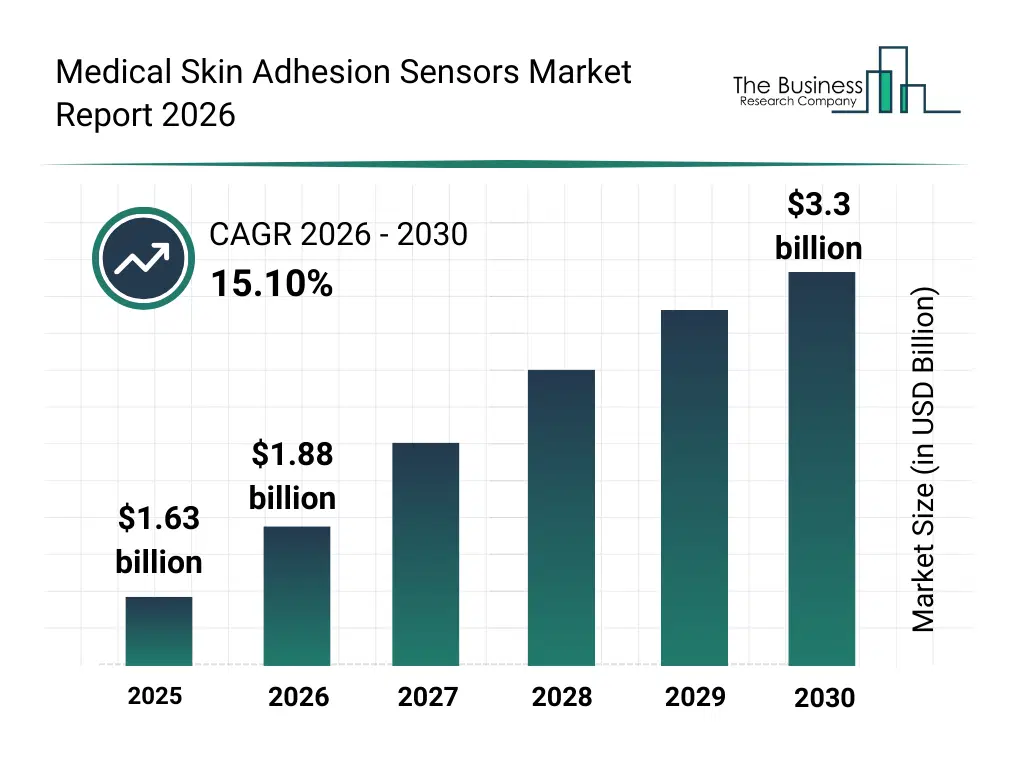
What Is The Medical Skin Adhesion Sensors Market Size and Share 2026?
The medical skin adhesion sensors market size has grown rapidly in recent years. It will grow from $1.63 billion in 2025 to $1.88 billion in 2026 at a compound annual growth rate (CAGR) of 15.3%. The growth in the historic period can be attributed to increasing prevalence of chronic conditions, rising demand for non-invasive monitoring, growth in wearable medical devices, expansion of home healthcare services, advancements in sensor miniaturization.What Is The Medical Skin Adhesion Sensors Market Growth Forecast?
The medical skin adhesion sensors market size is expected to see rapid growth in the next few years. It will grow to $3.3 billion in 2030 at a compound annual growth rate (CAGR) of 15.1%. The growth in the forecast period can be attributed to increasing investments in digital health platforms, rising adoption of personalized medicine, expansion of remote diagnostics, growing integration of AI in patient monitoring, increasing focus on preventive healthcare technologies. Major trends in the forecast period include increasing adoption of continuous wearable health monitoring, rising use of flexible and biocompatible sensor materials, growing integration of real-time data analytics, expansion of remote patient monitoring solutions, enhanced focus on long-term skin comfort.
Global Medical Skin Adhesion Sensors Market Segmentation
1) By Product Type: Adhesive Tapes, Adhesive Dressings, Adhesive Sensors, Adhesive Strips, Other Product Types 2) By Technology: Conductive Adhesives, Hydrocolloid Technologies, Silicone Adhesives, Smart Adhesive Sensors, Other Technologies 3) By Distribution Channel: Direct Sales, Pharmaceutical Retailers, Online Medical Supply Stores, Institutional Sales, Other Distribution Channels 4) By Application: Wound Management, Monitoring Chronic Conditions, Post Surgical Care, Sports Medicine, Other Applications 5) By End-User: Hospitals, Clinics, Home Care Settings, Other End-Users Subsegments: 1) By Adhesive Tapes: Silicone-Based Tapes, Acrylic-Based Tapes, Hydrocolloid Tapes, Polyurethane Tapes, Paper-Based Tapes 2) By Adhesive Dressings: Foam Adhesive Dressings, Hydrocolloid Adhesive Dressings, Alginate Adhesive Dressings, Transparent Film Dressings, Antimicrobial Adhesive Dressings 3) By Adhesive Sensors: Electrocardiogram (ECG) Monitoring Sensors, Electromyography (EMG) Sensors, Temperature Sensors, Hydration Sensors, Sweat And Electrolyte Sensors 4) By Adhesive Strips: Wound Closure Strips, Nasal Strips, Steri-Strips, Custom Medical Adhesive Strips, Drug Delivery Adhesive Strips 5) By Other Product Types: Adhesive Skin Patches, Transdermal Drug Delivery Systems, Biosensor Patches, Cosmetic Adhesive Products, Diagnostic Adhesive DevicesWhat Are The Drivers Of The Medical Skin Adhesion Sensors Market?
The increasing number of surgical procedures is expected to propel the growth of the medical skin adhesion sensors market going forward. Surgical procedures are medical operations using manual or instrument-based techniques to diagnose, treat, or correct diseases, injuries, or abnormalities. Surgical procedures are increasing mainly due to the aging population, as older individuals are more prone to conditions needing surgery. Medical skin adhesion sensors provide real-time monitoring of vital signs during surgery, ensuring continuous patient assessment. Their flexible, skin-friendly design allows secure placement without disrupting surgical procedures. For instance, in September 2023, according to NHS England, a UK-based public healthcare organization, 4,854,125 elective inpatient and outpatient appointments were completed, compared with 4,014,730 in the previous 12-month period. Therefore, the increasing number of surgical procedures is driving the growth of the medical skin adhesion sensors industry. The expansion of remote patient monitoring (RPM) is expected to propel the growth of the medical skin adhesion sensors market going forward. Remote patient monitoring (RPM) uses digital technologies to collect and transmit a patient’s health data from outside clinical settings, enabling continuous oversight of their condition. Remote patient monitoring is increasing due to the rising prevalence of chronic diseases, which require continuous tracking to prevent complications and reduce hospital visits. Medical skin adhesion sensors support remote patient monitoring by providing continuous, real-time measurement of vital signs directly from the patient’s skin, enabling accurate data collection without frequent clinical visits. For instance, in August 2023, according to Vivalink, a US-based healthcare technology company, a recent survey revealed that 84% of existing RPM users expect to boost their utilization of the technology in 2024. Therefore, the expansion of remote patient monitoring (RPM) is driving the growth of the medical skin adhesion sensors industry.Key Players In The Global Medical Skin Adhesion Sensors Market
Major companies operating in the medical skin adhesion sensors market are Johnson & Johnson, Abbott Laboratories, 3M Company, Koninklijke Philips N.V., GE Healthcare, TE Connectivity, Molex LLC, Avery Dennison, Dexcom Inc., Resonetics, Linxens, Scapa Healthcare, Tapecon Inc., LifeSignals Group, Innovize, MC10, Medtrum Technologies Inc., GENTAG Inc., Hudson Medical Innovations, VivaChek Laboratories, Senseonics Holdings, Nemaura Medical, VitalConnect, BioSticker (MC10), Zymtronix
This chart is for illustrative purposes; the full report includes a detailed competitor analysis and comprehensive overview of the top 10 companies in the market.
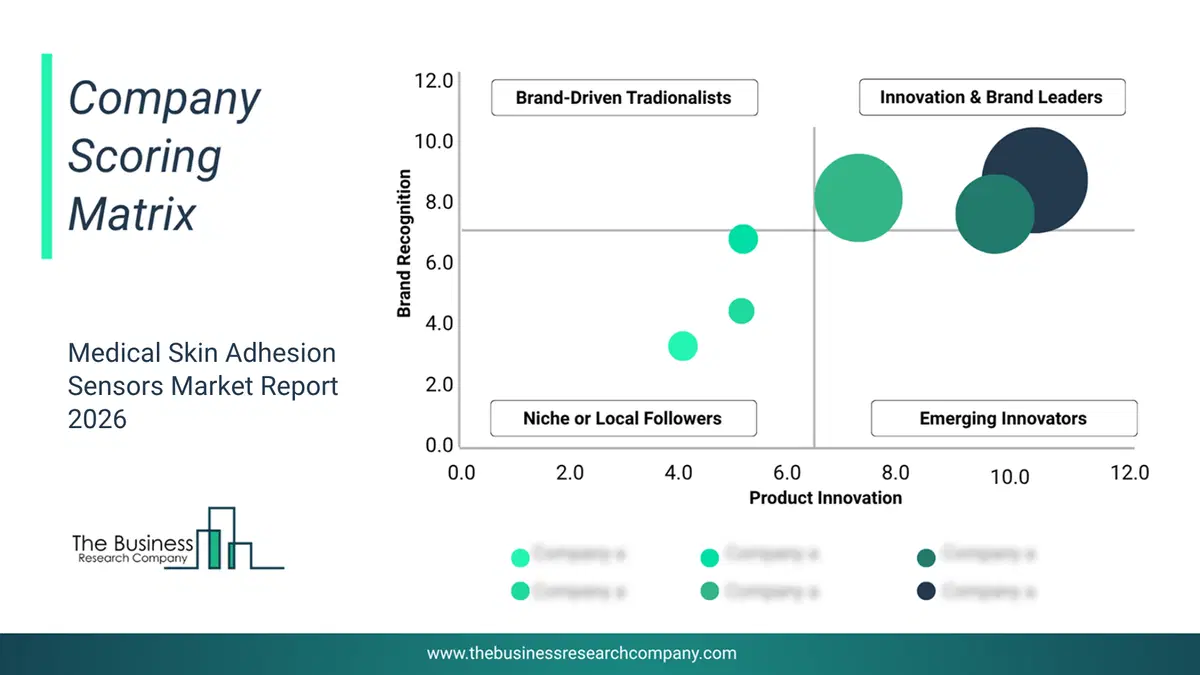
This chart maps companies by product innovation and brand strength, with bubble size indicating relative revenue, helping identify market leaders, challengers, and niche players. This is an illustrative chart; the full report provides a complete and accurate competitive analysis.
Global Medical Skin Adhesion Sensors Market Trends and Insights
Major companies operating in the medical skin adhesion sensors market are focusing on developing advanced products, such as adhesive tapes, to enhance patient monitoring and comfort. Adhesive tapes are high-quality, medical-grade materials used to firmly secure sensors to the skin, ensuring consistent sensor placement for reliable, continuous monitoring of physiological parameters, all while enhancing comfort and reducing skin irritation. For instance, in February 2023, 3M Company, a US-based manufacturer of skin sensors and equipment for medical use, launched the 3M Medical Tape 4578. It offers a premium wear time of up to 28 days, doubling the previous industry standard of 14 days for extended medical adhesives. This innovation is designed for long-term use with health monitors, sensors, and medical wearables, aiming to improve patient care by reducing device changes, lowering costs, and enabling more continuous data collection.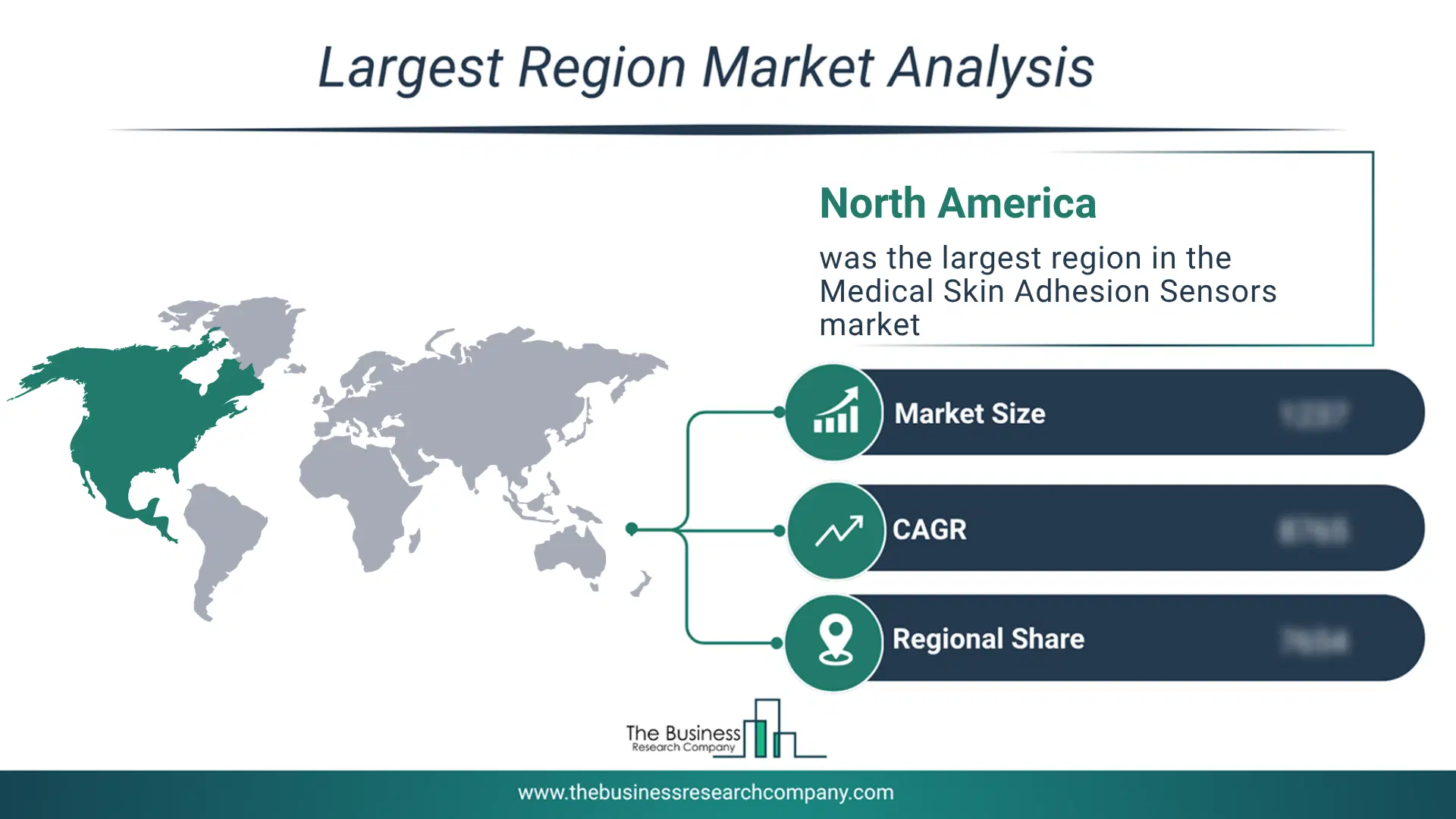
Regional Outlook
North America was the largest region in the medical skin adhsion sensors market in 2025. Asia-Pacific is expected to be the fastest-growing region in the forecast period. The regions covered in this market report are Asia-Pacific, South East Asia, Western Europe, Eastern Europe, North America, South America, Middle East, Africa. The countries covered in this market report are Australia, Brazil, China, France, Germany, India, Indonesia, Japan, Taiwan, Russia, South Korea, UK, USA, Canada, Italy, SpainWhat Defines the Medical Skin Adhesion Sensors Market?
The medical skin adhesion sensors market consists of revenues earned by entities by providing services such as sleep apnea monitoring, diabetes management, cardiac monitoring, and personalized health tracking. The market value includes the value of related goods sold by the service provider or included within the service offering. The medical skin adhesion sensors market also includes sales of hydrogel-based adhesives, bio-adhesive films, and thermal adhesive pads. Values in this market are ‘factory gate’ values, that is, the value of goods sold by the manufacturers or creators of the goods, whether to other entities (including downstream manufacturers, wholesalers, distributors, and retailers) or directly to end customers. The value of goods in this market includes related services sold by the creators of the goods.How is Market Value Defined and Measured?
The market value is defined as the revenues that enterprises gain from the sale of goods and/or services within the specified market and geography through sales, grants, or donations in terms of the currency (in USD unless otherwise specified). The revenues for a specified geography are consumption values that are revenues generated by organizations in the specified geography within the market, irrespective of where they are produced. It does not include revenues from resales along the supply chain, either further along the supply chain or as part of other products.
This chart presents market attractiveness based on a quantitative evaluation of growth, competition, strategic alignment, and risk, offering a clear view of opportunity areas for decision-making. This chart is for illustrative purposes; the full report contains the complete analysis.

This chart highlights the Total Addressable Market (TAM) by estimating the maximum revenue opportunity using an assumption-driven approach, supporting strategic planning and opportunity sizing across markets. The chart is illustrative; the full report provides a more comprehensive analysis.
What Key Data and Analysis Are Included in the Medical Skin Adhesion Sensors Market Report 2026?
The medical skin adhesion sensors market research report is one of a series of new reports from The Business Research Company that provides market statistics, including industry global market size, regional shares, competitors with the market share, detailed market segments, market trends and opportunities, and any further data you may need to thrive in the medical skin adhesion sensors industry. The market research report delivers a complete perspective of everything you need, with an in-depth analysis of the current and future state of the industry.Medical Skin Adhesion Sensors Market Report Forecast Analysis
| Report Attribute | Details |
|---|---|
| Market Size Value In 2026 | $1.88 billion |
| Revenue Forecast In 2030 | $3.3 billion |
| Growth Rate | CAGR of 15.1% from 2026 to 2030 |
| Base Year For Estimation | 2025 |
| Actual Estimates/Historical Data | 2020-2025 |
| Forecast Period | 2026 - 2030 |
| Market Representation | Revenue in USD Billion and CAGR from 2026 to 2030 |
| Segments Covered | Product Type, Technology, Distribution Channel, Application, End-User |
| Regional Scope | Asia-Pacific, Western Europe, Eastern Europe, North America, South America, Middle East, Africa |
| Country Scope | The countries covered in the report are Australia, Brazil, China, France, Germany, India, Indonesia, Japan, Taiwan, Russia, South Korea, UK, USA, Canada, Italy, Spain. |
| Key Companies Profiled | Johnson & Johnson, Abbott Laboratories, 3M Company, Koninklijke Philips N.V., GE Healthcare, TE Connectivity, Molex LLC, Avery Dennison, Dexcom Inc., Resonetics, Linxens, Scapa Healthcare, Tapecon Inc., LifeSignals Group, Innovize, MC10, Medtrum Technologies Inc., GENTAG Inc., Hudson Medical Innovations, VivaChek Laboratories, Senseonics Holdings, Nemaura Medical, VitalConnect, BioSticker (MC10), Zymtronix |
| Customization Scope | Request for Customization |
| Pricing And Purchase Options | Explore Purchase Options |