
Medication Adherence Devices Market Report 2026
Global Outlook – By Type (Hardware Centric, Software Centric), By Medication (Cardiovascular, Central Nervous System, Diabetes, Oncology, Gastrointestinal, Musculoskeletal, Other Medications), By End User (Hospitals, Homecare Settings, Pharmacies, Long-Term Care Facilities, Clinics) – Market Size, Trends, Strategies, and Forecast to 2030
Medication Adherence Devices Market Overview
• Medication Adherence Devices market size has reached to $3.4 billion in 2025 • Expected to grow to $4.58 billion in 2030 at a compound annual growth rate (CAGR) of 6.1% • Growth Driver: Rising Cardiovascular Disease Prevalence Fueling The Growth Of The Market Due To Increasing Need For Consistent Treatment Management • Market Trend: LTE-Enabled Smart Pill Organizer For Real-Time Medication Adherence Monitoring • North America was the largest region in 2025.What Is Covered Under Medication Adherence Devices Market?
Medication adherence devices are specialized tools or technologies designed to help patients consistently take their medications as prescribed by providing timely reminders, tracking usage, and sometimes automatically dispensing doses. These devices aim to reduce missed or incorrect medication intake, thereby improving overall treatment effectiveness and patient health outcomes. The main types of medication adherence devices are hardware-centric and software-centric. Hardware-centric devices are physical tools such as smart pillboxes, dispensers, and packaging systems that track medication intake and send data to caregivers. It is used for various medications, including cardiovascular, central nervous system, diabetes, oncology, gastrointestinal, musculoskeletal, and others, and serves a range of end users, including hospitals, homecare settings, pharmacies, long-term care facilities, and clinics.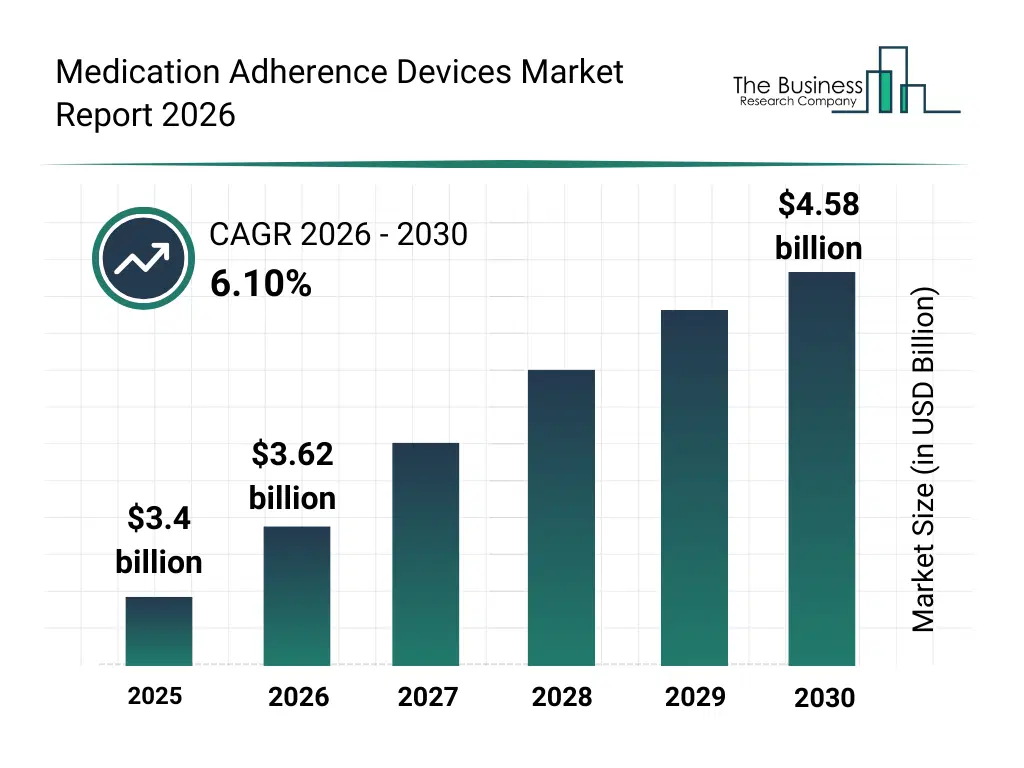
What Is The Medication Adherence Devices Market Size and Share 2026?
The medication adherence devices market size has grown strongly in recent years. It will grow from $3.4 billion in 2025 to $3.62 billion in 2026 at a compound annual growth rate (CAGR) of 6.4%. The growth in the historic period can be attributed to limited awareness of medication adherence solutions, reliance on manual pill management, growing prevalence of chronic diseases, increasing hospital and pharmacy involvement, emergence of mobile health technologies.What Is The Medication Adherence Devices Market Growth Forecast?
The medication adherence devices market size is expected to see strong growth in the next few years. It will grow to $4.58 billion in 2030 at a compound annual growth rate (CAGR) of 6.1%. The growth in the forecast period can be attributed to advancements in smart pill dispensers and ingestible sensors, expansion of cloud-based medication management platforms, rising investment in digital health infrastructure, integration of ai-driven adherence analytics, growing homecare and long-term care market. Major trends in the forecast period include rising adoption of smart medication adherence devices, integration with mobile health apps and ehr systems, increasing focus on chronic disease management, growth of homecare and remote patient monitoring, enhanced patient engagement and compliance tracking.
Global Medication Adherence Devices Market Segmentation
1) By Type: Hardware Centric, Software Centric 2) By Medication: Cardiovascular, Central Nervous System, Diabetes, Oncology, Gastrointestinal, Musculoskeletal, Other Medications 3) By End User: Hospitals, Homecare Settings, Pharmacies, Long-Term Care Facilities, Clinics Subsegments: 1) By Hardware Centric: Smart Pill Bottles, Smart Pill Dispensers, Wearable Medication Reminders, Smart Packaging, Ingestible Sensors 2) By Software Centric: Mobile Health Apps, SMS Or IVR Reminders, Web-Based Platforms, Electronic Health Record (EHR)-Integrated Adherence Systems, Cloud-Based Medication Management PlatformsWhat Is The Driver Of The Medication Adherence Devices Market?
The growing prevalence of cardiovascular diseases is expected to propel the growth of the medication adherence devices market going forward. Cardiovascular diseases refer to a group of conditions that affect the heart and blood vessels, often leading to serious health complications such as heart attacks, strokes, and heart failure. The prevalence of cardiovascular diseases is rising due to increasingly sedentary lifestyles, as more people engage in desk jobs and spend long hours in front of screens with minimal physical activity. Medication adherence devices help manage cardiovascular diseases by ensuring patients take their medications consistently and on time, reducing the risk of complications such as heart attacks and strokes. For instance, in January 2024, according to the American Heart Association, a US-based nonprofit organization, the age-adjusted death rate from cardiovascular disease rose to 233.3 per 100,000, marking a 4.0% increase from last year’s rate of 224.4 per 100,000, compared to a 4.6% rise in 2023. Therefore, the growing prevalence of cardiovascular diseases is driving the growth of the medication adherence devices industry.Key Players In The Global Medication Adherence Devices Market
Major companies operating in the medication adherence devices market are Becton Dickinson and Company, Koninklijke Philips N V, AptarGroup Inc, Insulet Corporation, Omnicell Inc, Ypsomed Holding AG, MedMinder Systems Inc, Propeller Health Inc, Bigfoot Biomedical Inc, Information Mediary Corp, AARDEX Group SA, Hero Health Inc, CareRight Technologies, Adherium Limited, Popit Oy, SMRxT Inc, Wisepill Technologies Inc, MedAdvisor Solutions Ltd, Pillsy Inc, Livi Technologies Inc, AdhereTech Inc, RxSafe LLC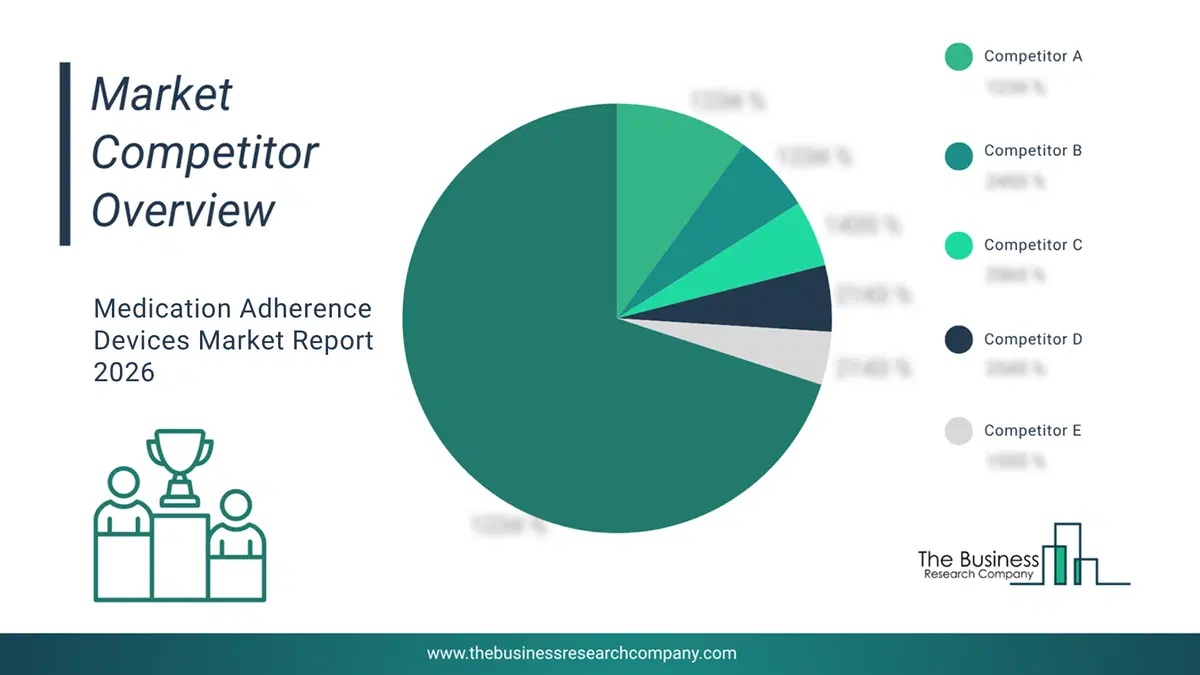
This chart is for illustrative purposes; the full report includes a detailed competitor analysis and comprehensive overview of the top 10 companies in the market.
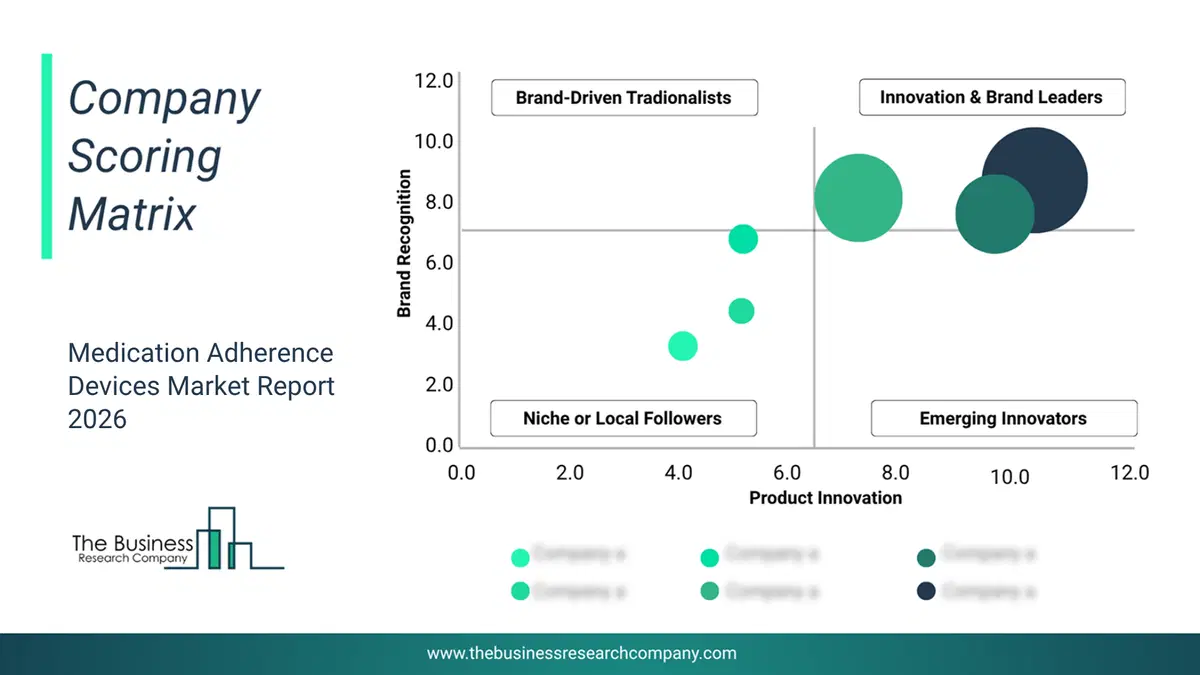
This chart maps companies by product innovation and brand strength, with bubble size indicating relative revenue, helping identify market leaders, challengers, and niche players. This is an illustrative chart; the full report provides a complete and accurate competitive analysis.
Global Medication Adherence Devices Market Trends and Insights
Major companies operating in the medication adherence devices market are focusing on developing innovative solutions, such as smart pill organizers, to enable real-time remote monitoring of medication adherence. A smart pill organizer is an electronic device that helps users manage their medication by providing automated reminders, dispensing pills at scheduled times, and syncing with mobile apps for tracking and alerts. For instance, in April 2025, Centor Inc., a US-based manufacturer of prescription containers for medication dispensing, introduced a new smart weekly pill organizer that leverages LTE and cloud technology to support medication adherence. The device tracks medication intake in real time and transmits data directly to pharmacies and clinical partners, eliminating the need for patients to install or pair a smartphone app, making it especially suitable for elderly or less tech-savvy users. Co-developed with RxCap, the organizer is user-friendly and integrates seamlessly with Centor’s remote monitoring services, enabling pharmacies to offer reimbursable adherence programs and provide timely interventions when needed.What Are Latest Mergers And Acquisitions In The Medication Adherence Devices Market?
In April 2024, Gerresheimer AG, a Germany-based manufacturer of drug delivery systems and medical devices, partnered with RxCap to offer connected adherence solutions. This partnership aims to enable pharmacies to offer connected adherence solutions for remote therapeutic monitoring, thereby improving patient health outcomes and supporting efficient medication management through smart packaging and cloud-based software. RxCap Inc. is a US-based healthcare technology company that focuses on prescription adherence and remote therapeutic monitoring (RPM) solutions.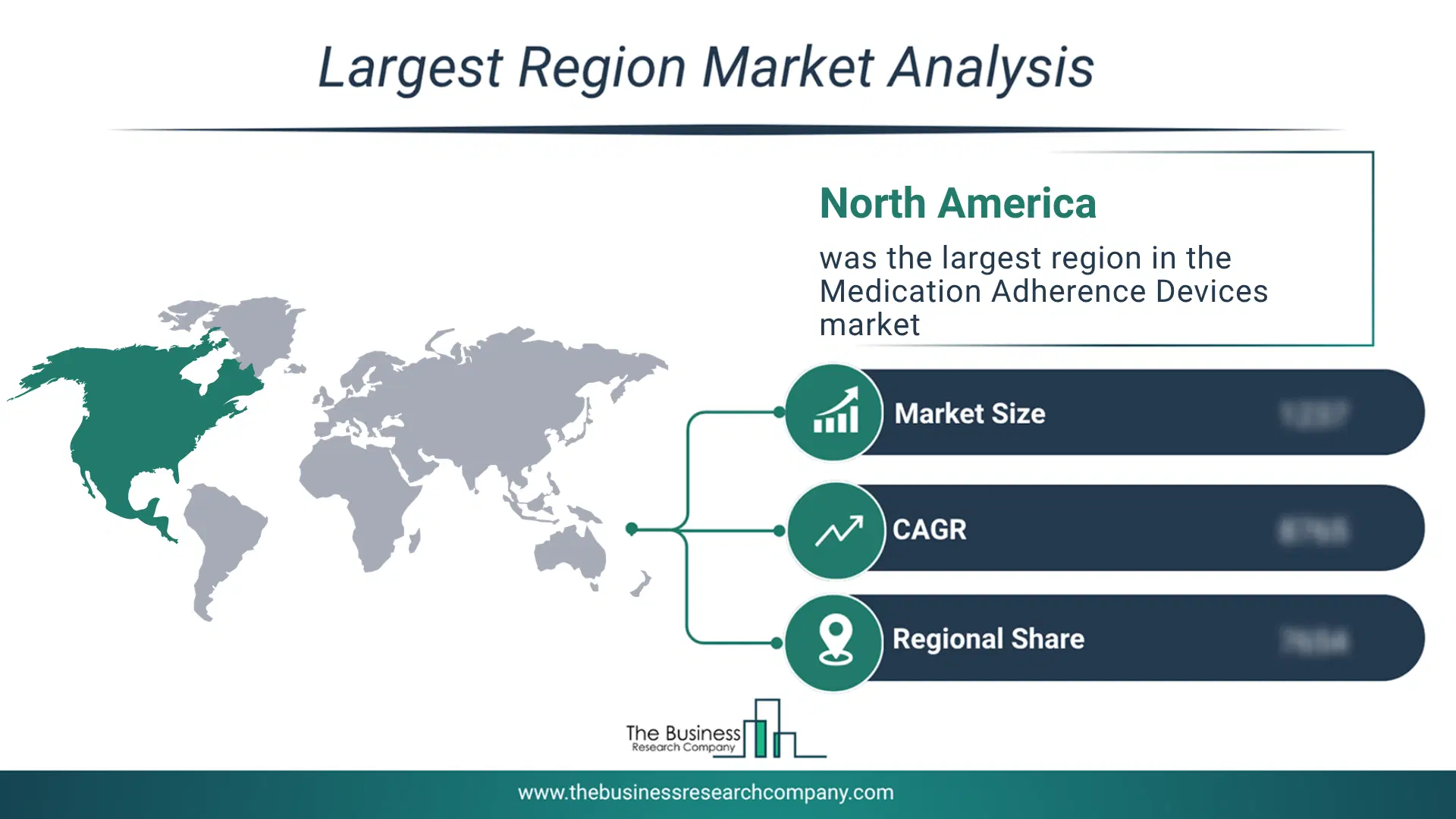
Regional Outlook
North America was the largest region in the medication adherence devices market in 2025. The regions covered in this market report are Asia-Pacific, South East Asia, Western Europe, Eastern Europe, North America, South America, Middle East, Africa. The countries covered in this market report are Australia, Brazil, China, France, Germany, India, Indonesia, Japan, Taiwan, Russia, South Korea, UK, USA, Canada, Italy, SpainWhat Defines the Medication Adherence Devices Market?
The medication adherence devices market consists of revenues earned by entities by providing services, such as medication reminder services, remote monitoring services, refill reminders, customizable schedules, data analytics, and reporting. The market value includes the value of related goods sold by the service provider or included within the service offering. The medication adherence devices market also includes sales of smart pill bottles, smart pill dispensers, connected inhalers, remote monitoring systems, and automatic pill crushers. Values in this market are ‘factory gate’ values, that is the value of goods sold by the manufacturers or creators of the goods, whether to other entities (including downstream manufacturers, wholesalers, distributors and retailers) or directly to end customers. The value of goods in this market includes related services sold by the creators of the goods.How is Market Value Defined and Measured?
The market value is defined as the revenues that enterprises gain from the sale of goods and/or services within the specified market and geography through sales, grants, or donations in terms of the currency (in USD unless otherwise specified). The revenues for a specified geography are consumption values that are revenues generated by organizations in the specified geography within the market, irrespective of where they are produced. It does not include revenues from resales along the supply chain, either further along the supply chain or as part of other products.
This chart presents market attractiveness based on a quantitative evaluation of growth, competition, strategic alignment, and risk, offering a clear view of opportunity areas for decision-making. This chart is for illustrative purposes; the full report contains the complete analysis.

This chart highlights the Total Addressable Market (TAM) by estimating the maximum revenue opportunity using an assumption-driven approach, supporting strategic planning and opportunity sizing across markets. The chart is illustrative; the full report provides a more comprehensive analysis.
What Key Data and Analysis Are Included in the Medication Adherence Devices Market Report 2026?
The medication adherence devices market research report is one of a series of new reports from The Business Research Company that provides market statistics, including industry global market size, regional shares, competitors with the market share, detailed market segments, market trends and opportunities, and any further data you may need to thrive in the medication adherence devices industry. The market research report delivers a complete perspective of everything you need, with an in-depth analysis of the current and future state of the industry.Medication Adherence Devices Market Report Forecast Analysis
| Report Attribute | Details |
|---|---|
| Market Size Value In 2026 | $3.62 billion |
| Revenue Forecast In 2030 | $4.58 billion |
| Growth Rate | CAGR of 6.1% from 2026 to 2030 |
| Base Year For Estimation | 2025 |
| Actual Estimates/Historical Data | 2020-2025 |
| Forecast Period | 2026 - 2030 |
| Market Representation | Revenue in USD Billion and CAGR from 2026 to 2030 |
| Segments Covered | Type, Medication, End User |
| Regional Scope | Asia-Pacific, Western Europe, Eastern Europe, North America, South America, Middle East, Africa |
| Country Scope | The countries covered in the report are Australia, Brazil, China, France, Germany, India, Indonesia, Japan, Taiwan, Russia, South Korea, UK, USA, Canada, Italy, Spain. |
| Key Companies Profiled | Becton Dickinson and Company, Koninklijke Philips N V, AptarGroup Inc, Insulet Corporation, Omnicell Inc, Ypsomed Holding AG, MedMinder Systems Inc, Propeller Health Inc, Bigfoot Biomedical Inc, Information Mediary Corp, AARDEX Group SA, Hero Health Inc, CareRight Technologies, Adherium Limited, Popit Oy, SMRxT Inc, Wisepill Technologies Inc, MedAdvisor Solutions Ltd, Pillsy Inc, Livi Technologies Inc, AdhereTech Inc, RxSafe LLC |
| Customization Scope | Request for Customization |
| Pricing And Purchase Options | Explore Purchase Options |