
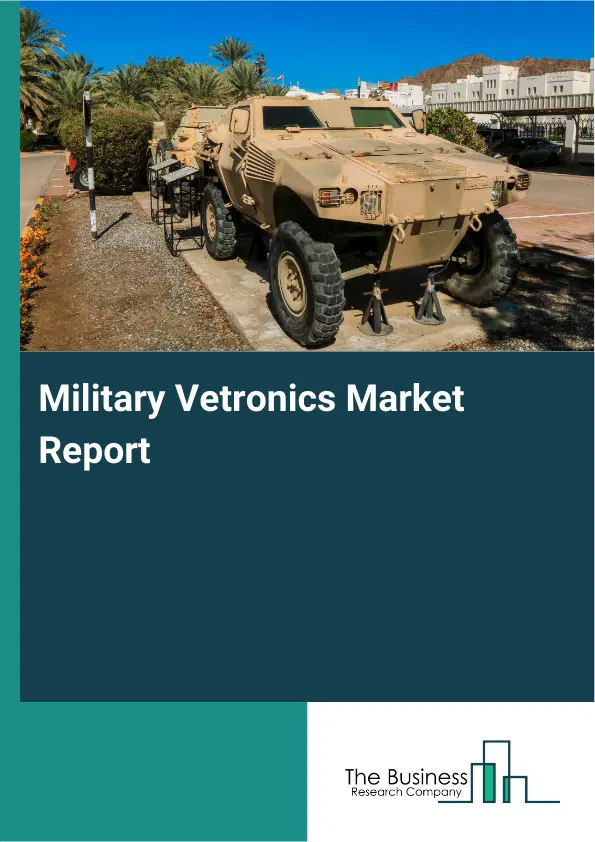
Military Vetronics Market Report 2026
Global Outlook – By Type (Navigation System, Communication System, Power System, Control And Data Distribution System, C4 System, Display System, Other Types), By Fit (Line-Fit, Retrofit), By Application (Unmanned Ground Vehicles, Light Protected Vehicles, Special Purpose Vehicles, Armored Amphibious Vehicles, Other Applications), By End-User (Defense, Homeland Security) – Market Size, Trends, Strategies, and Forecast to 2030
Military Vetronics Market Overview
• Military Vetronics market size has reached to $5.55 billion in 2025 • Expected to grow to $6.86 billion in 2030 at a compound annual growth rate (CAGR) of 4.3% • Growth Driver: Rising Defense Expenditure Fuels Military Vetronics Market Growth • Market Trend: Technological Advancements in Military Vetronics: Granta Autonomy’s Hornet XR UAV Launch • North America was the largest region in 2025.What Is Covered Under Military Vetronics Market?
Military vetronics is the integration of electronics and computer systems into military vehicles to improve situational awareness, survivability, and lethality. It is utilized in military vehicles for navigation, observation, communications, energy, motorization, and weaponry systems. The main types of military electronics are navigation systems, communication systems, power systems, control, and data distribution systems, C4 systems, display systems, and others. A navigation system is an electronic device that delivers information about a vehicle’s position, speed, and direction. They are available in line-fit and retrofit versions, which are used in various applications, such as unmanned ground vehicles, light-protected vehicles, special-purpose vehicles, armored amphibious vehicles, and others. They are utilized by defense and homeland security.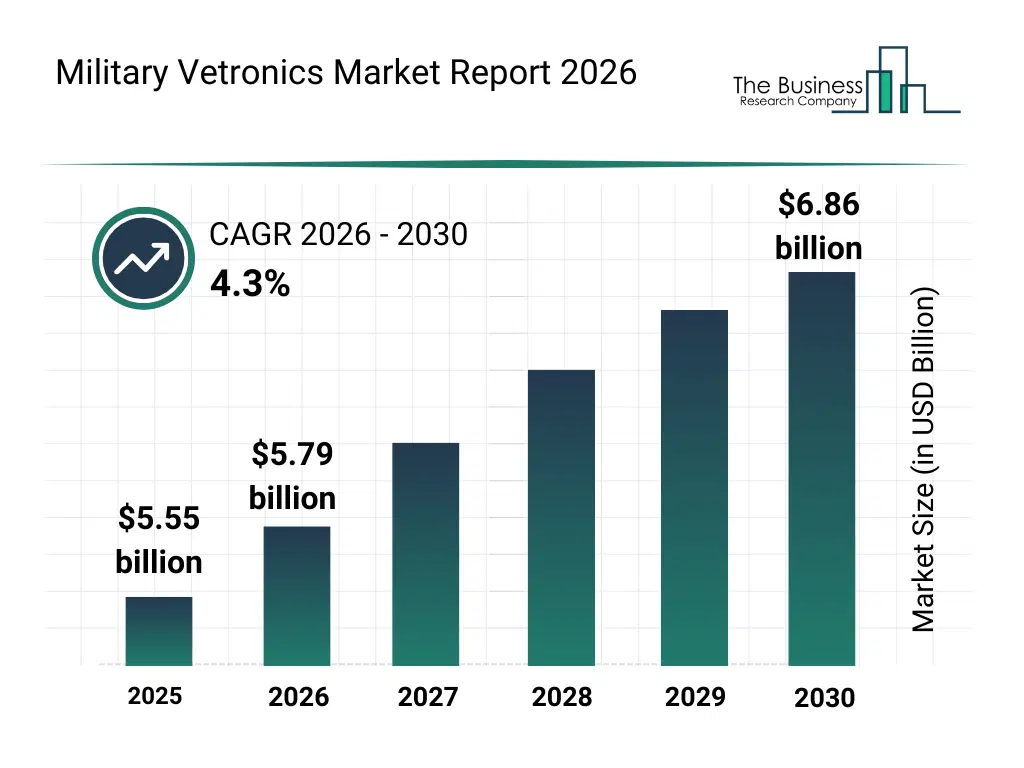
What Is The Military Vetronics Market Size and Share 2026?
The military vetronics market size has grown steadily in recent years. It will grow from $5.55 billion in 2025 to $5.79 billion in 2026 at a compound annual growth rate (CAGR) of 4.3%. The growth in the historic period can be attributed to increased integration of advanced navigation and communication systems enhancing vehicle situational awareness, rising adoption of vehicle optronics improving target detection and recognition capabilities, growth in deployment of joint fire support systems strengthening coordinated battlefield operations, expansion of vehicle radar sensor usage improving threat monitoring and survivability, modernization of armored vehicle fleets driving demand for upgraded vetronics architectures.What Is The Military Vetronics Market Growth Forecast?
The military vetronics market size is expected to see steady growth in the next few years. It will grow to $6.86 billion in 2030 at a compound annual growth rate (CAGR) of 4.3%. The growth in the forecast period can be attributed to development of ai-enabled vetronics platforms enhancing autonomous decision-making and system interoperability, rising demand for modular and scalable electronic architectures supporting next-generation vehicle upgrades, increasing adoption of sensor fusion technologies improving real-time battlefield awareness, growth in unmanned ground vehicle deployment driving advanced vetronics integration, expanding investment in cyber-secure vetronics systems ensuring resilience against electronic warfare threats. Major trends in the forecast period include integration of joint fire support systems, advanced vehicle optronics and sensor fusion, real-time radar and situational awareness systems, modular vetronics architecture for rapid upgrades, enhanced survivability and electronic countermeasure capabilities.
Global Military Vetronics Market Segmentation
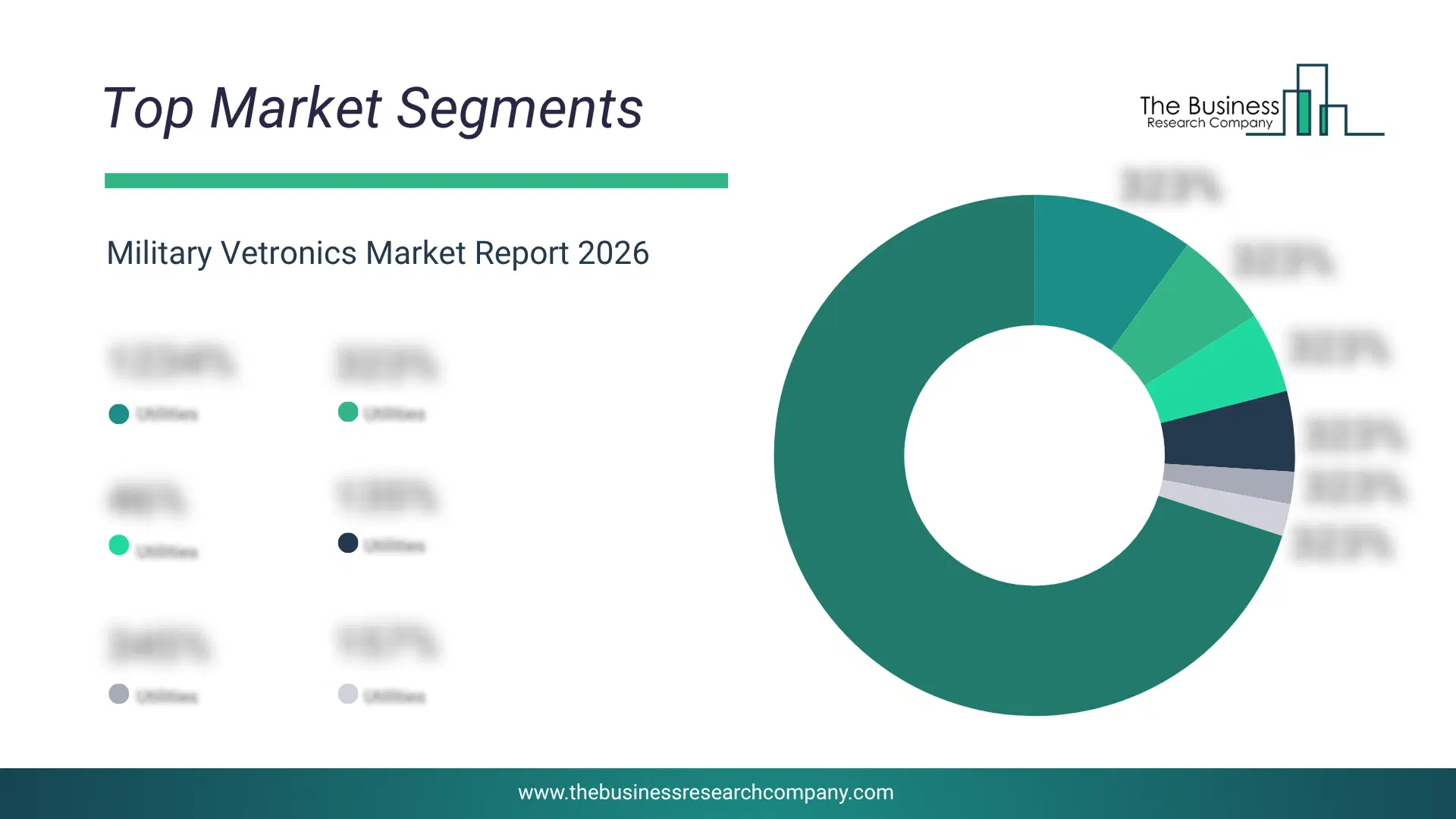
1) By Type: Navigation System, Communication System, Power System, Control And Data Distribution System, C4 System, Display System, Other Types 2) By Fit: Line-Fit, Retrofit 3) By Application: Unmanned Ground Vehicles, Light Protected Vehicles, Special Purpose Vehicles, Armored Amphibious Vehicles, Other Applications 4) By End-User: Defense, Homeland Security Subsegments: 1) By Navigation System: Global Positioning System (GPS), Inertial Navigation System (INS), Terrain Navigation System 2) By Communication System: Tactical Communication Systems, Satellite Communication Systems, Intercom Systems 3) By Power System: Power Generation Systems, Power Distribution Systems, Energy Storage Systems 4) By Control And Data Distribution System: Data Bus Systems, Control Management Systems 5) By C4 System: Command And Control Systems, Computer Systems, Communication Systems For C4 6) By Display System: Multi-Functional Displays (MFD), Head-Up Displays (HUD), Helmet-Mounted Displays (HMD) 7) By Other Types: Sensor Systems, Surveillance Systems, Electronic Warfare SystemsWhat Is Driver Of The Military Vetronics Market?
An increase in defense expenditure is expected to propel the growth of the military vetronics market going forward. Defense expenditure encompasses all current and capital spending on the armed forces, including peacekeeping troops of defense ministries and other government organizations involved in defense initiatives and paramilitary forces. With higher defense budgets, military organizations can allocate more resources to research, develop, and acquire state-of-the-art vetronic systems. This increased investment enables the military to adopt cutting-edge technologies such as advanced sensors, communication systems, unmanned systems, and integrated command and control systems. For instance, in April 2024, according to the Stockholm International Peace Research Institute, a Sweden-based international institute, global military spending reached approximately $2.29 trillion in 2022. This amount increased to $2.44 trillion in 2023, reflecting a 6.8% year-over-year growth. Therefore, an increase in defense expenditure will drive the military vetronics industry.Key Players In The Global Military Vetronics Market
Major companies operating in the military vetronics market are General Electric Co, Raytheon Company, The Boeing Company, Lockheed Martin Corporation, Rheinmetall AG, Elbit Systems Ltd., Saab AB, General Dynamics Corporation, Northrop Grumman, Kongsberg Gruppen ASA, Cummins Inc., BAE Systems Inc., Collins Aerospace, Curtiss-Wright Corp, Cobham Limited, Safran SA, Thales SA, L3Harris Technologies Inc., TE Connectivity Ltd., Leonardo-Finmeccanica SPA, Oshkosh Defense LLC, KVH Industries Inc., C4 Advanced Tactical Systems LLC.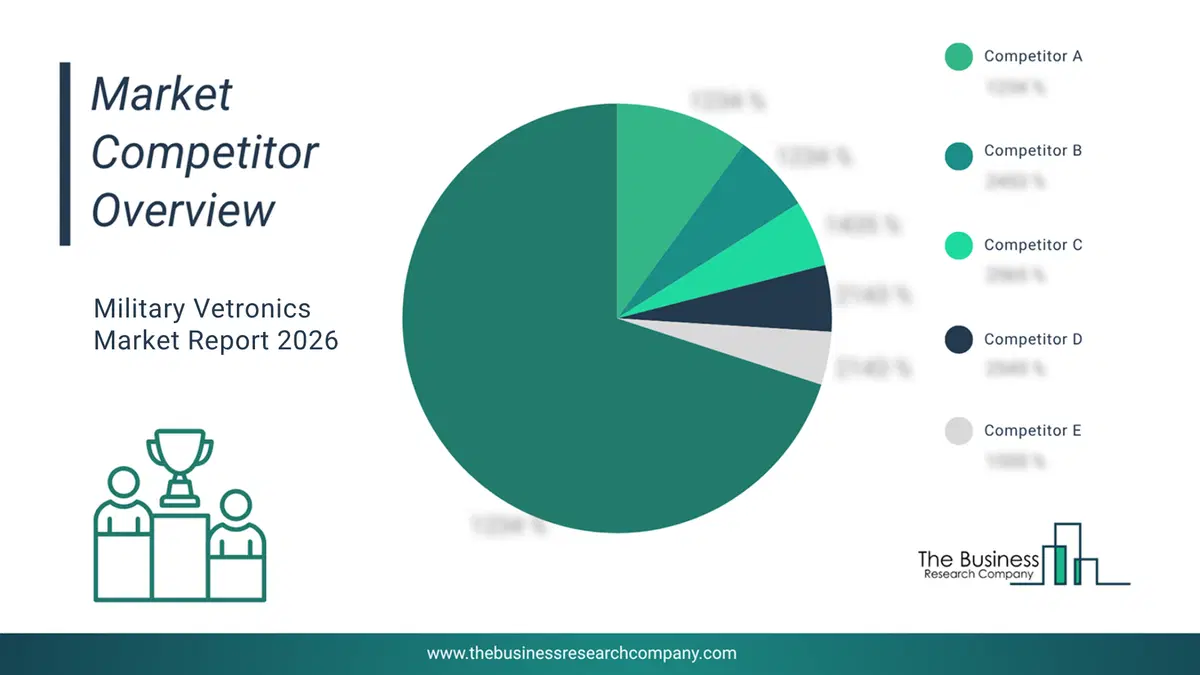
This chart is for illustrative purposes; the full report includes a detailed competitor analysis and comprehensive overview of the top 10 companies in the market.
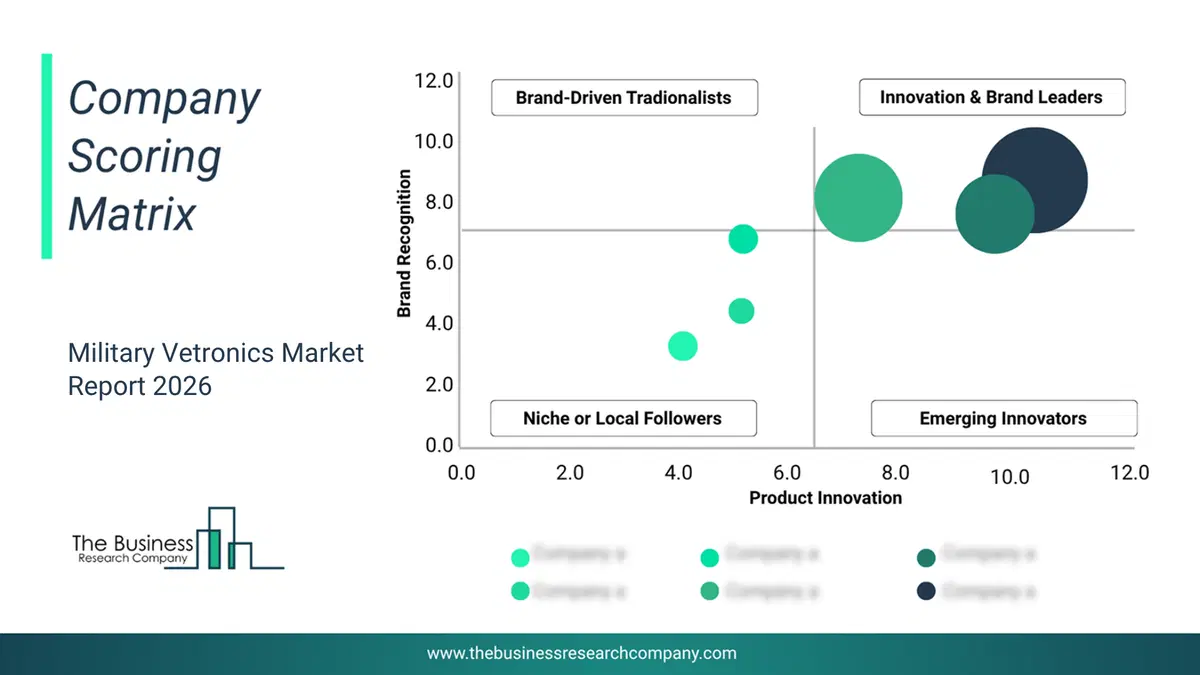
This chart maps companies by product innovation and brand strength, with bubble size indicating relative revenue, helping identify market leaders, challengers, and niche players. This is an illustrative chart; the full report provides a complete and accurate competitive analysis.
Global Military Vetronics Market Trends and Insights
Major companies operating in the military vetronics market are focused on developing technologically advanced products, such as non-ITAR vehicular navigation systems, to sustain their position in the market. A non-ITAR vehicular navigation system refers to a navigation technology integrated into vehicles that don't fall under the regulations and restrictions of the International Traffic in Arms Regulations (ITAR). For instance, In June 2024, Granta Autonomy, a Lithuania-based defense technology company, introduced the Hornet XR, a hand-launched reconnaissance UAV, at Eurosatory 2024. Weighing just 2.9 kg, the Hornet XR is designed for covert operations, offering silent flight for up to 3 hours and covering distances up to 160 km. Its autonomous capabilities enable operation in GNSS-denied and jamming-prone environments, ensuring mission success even under electronic warfare conditions. The UAV's modular design allows for easy transport and rapid deployment, making it a versatile tool for front-line intelligence gathering.What Are Latest Mergers And Acquisitions In The Military Vetronics Market? Rheinmetall Strengthens U.S. Presence with $950 Million Acquisition of Loc Performance Products
In December 2024, Rheinmetall, a Germany-based provider of defense technology and military vehicle systems, acquired Loc Performance Products for $950 million. With this acquisition, Rheinmetall aimed to strengthen its presence in the U.S. defense market and enhance its land vehicle production capabilities for high-volume military programs. Loc Performance Products is a US-based manufacturer specializing in advanced vehicle systems, including large-scale welding, composite rubber track production, and support for major U.S. Army programs.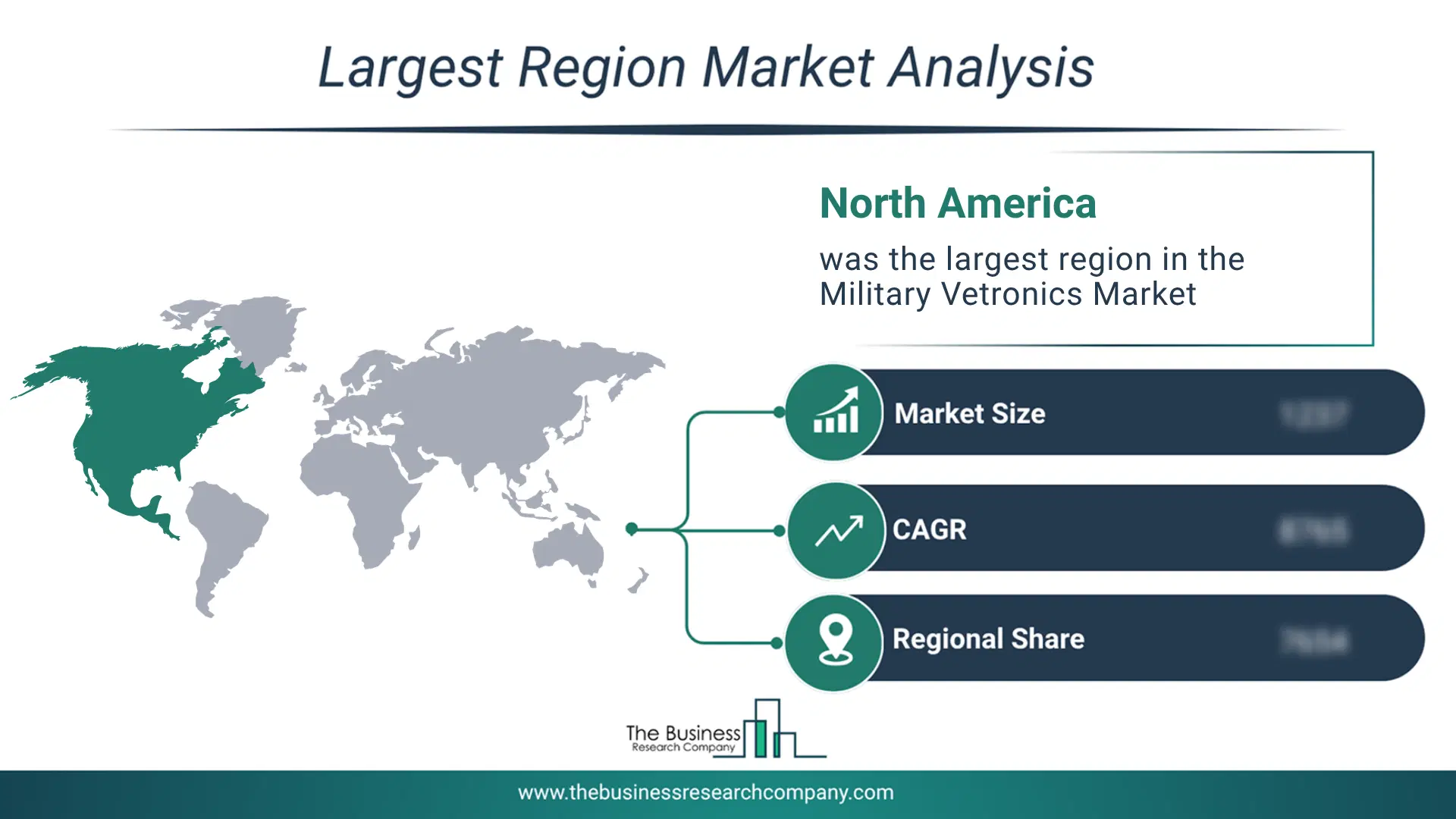
Regional Insights
North America was the largest region in the military vetronics market in 2025. The regions covered in this market report are Asia-Pacific, South East Asia, Western Europe, Eastern Europe, North America, South America, Middle East, Africa. The countries covered in this market report are Australia, Brazil, China, France, Germany, India, Indonesia, Japan, Taiwan, Russia, South Korea, UK, USA, Canada, Italy, SpainWhat Defines the Military Vetronics Market?
The military vetronics market consists includes revenues earned by entities by joint fire support systems and vehicle optronics, and vehicle radar sensors. The market value includes the value of related goods sold by the service provider or included within the service offering. Only goods and services traded between entities or sold to end consumers are included.How is Market Value Defined and Measured?
The market value is defined as the revenues that enterprises gain from the sale of goods and/or services within the specified market and geography through sales, grants, or donations in terms of the currency (in USD unless otherwise specified). The revenues for a specified geography are consumption values that are revenues generated by organizations in the specified geography within the market, irrespective of where they are produced. It does not include revenues from resales along the supply chain, either further along the supply chain or as part of other products.
This chart presents market attractiveness based on a quantitative evaluation of growth, competition, strategic alignment, and risk, offering a clear view of opportunity areas for decision-making. This chart is for illustrative purposes; the full report contains the complete analysis.

This chart highlights the Total Addressable Market (TAM) by estimating the maximum revenue opportunity using an assumption-driven approach, supporting strategic planning and opportunity sizing across markets. The chart is illustrative; the full report provides a more comprehensive analysis.
What Key Data and Analysis Are Included in the Military Vetronics Market Report 2026?
The military vetronics market research report is one of a series of new reports from The Business Research Company that provides market statistics, including industry global market size, regional shares, competitors with the market share, detailed market segments, market trends and opportunities, and any further data you may need to thrive in the military vetronics industry. The market research report delivers a complete perspective of everything you need, with an in-depth analysis of the current and future state of the industry.Military Vetronics Market Report Forecast Analysis
| Report Attribute | Details |
|---|---|
| Market Size Value In 2026 | $5.79 billion |
| Revenue Forecast In 2030 | $6.86 billion |
| Growth Rate | CAGR of 4.3% from 2026 to 2030 |
| Base Year For Estimation | 2025 |
| Actual Estimates/Historical Data | 2020-2025 |
| Forecast Period | 2026 - 2030 |
| Market Representation | Revenue in USD Billion and CAGR from 2026 to 2030 |
| Segments Covered | Type, Fit, Application, End-User |
| Regional Scope | Asia-Pacific, Western Europe, Eastern Europe, North America, South America, Middle East, Africa |
| Country Scope | The countries covered in the military vetronics market report are Australia, Brazil, China, France, Germany, India, Indonesia, Japan, Taiwan, Russia, South Korea, UK, USA, Canada, Italy, Spain |
| Key Companies Profiled | General Electric Co, Raytheon Company, The Boeing Company, Lockheed Martin Corporation, Rheinmetall AG, Elbit Systems Ltd., Saab AB, General Dynamics Corporation, Northrop Grumman, Kongsberg Gruppen ASA, Cummins Inc., BAE Systems Inc., Collins Aerospace, Curtiss-Wright Corp, Cobham Limited, Safran SA, Thales SA, L3Harris Technologies Inc., TE Connectivity Ltd., Leonardo-Finmeccanica SPA, Oshkosh Defense LLC, KVH Industries Inc., C4 Advanced Tactical Systems LLC. |
| Customization Scope | Request for Customization |
| Pricing And Purchase Options | Explore Purchase Options |