
Next Generation Batteries Market Report 2026
Global Outlook – By Battery Type ( Lithium-Sulfur Batteries, Sodium-Ion Batteries, Solid-State Batteries, Aluminum-Ion Batteries, Flow Batteries), By Form Factor ( Cylindrical Batteries, Prismatic Batteries, Pouch Batteries, Stacked Batteries, Flexible Batteries), By Application ( Electric Vehicles (EVs), Consumer Electronics, Grid Energy Storage, Industrial Applications, Portable Power Tools), By End User ( Aerospace And Defense, Automotive, Telecommunications, Healthcare, Consumer Electronics Manufacturers) – Market Size, Trends, Strategies, and Forecast to 2030
Next Generation Batteries Market Overview
• Next Generation Batteries market size has reached to $4.94 billion in 2025 • Expected to grow to $6.45 billion in 2030 at a compound annual growth rate (CAGR) of 5.5% • Growth Driver: Surge In Electric Vehicle Demand Fueling The Growth Of The Market Due To Economic Benefits And Enhanced Performance Features • Market Trend: Revolutionary Next-Generation Super E-Platform For Ultra-Fast EV Charging • Asia-Pacific was the largest region in 2025.What Is Covered Under Next Generation Batteries Market?
Next generation batteries refer to advanced energy storage technologies designed to overcome the limitations of current lithium-ion batteries by offering improvements in energy density, safety, cost, sustainability, and lifespan. These batteries incorporate novel materials, chemistries, and innovative designs to enhance performance and address environmental and resource challenges associated with existing technologies. The main types of next generation batteries include lithium-sulfur batteries, sodium-ion batteries, solid-state batteries, aluminum-ion batteries, and flow batteries. Lithium-sulfur (Li-S) batteries are a type of rechargeable battery that uses sulfur as the cathode material and lithium as the anode. It includes various form factors, such as cylindrical batteries, prismatic batteries, pouch batteries, stacked batteries, and flexible batteries, and is used for various applications, such as electric vehicles (EVs), consumer electronics, grid energy storage, industrial applications, and portable power tools. These batteries cater to various end users, including aerospace and defense, automotive, telecommunications, healthcare, and consumer electronics manufacturers.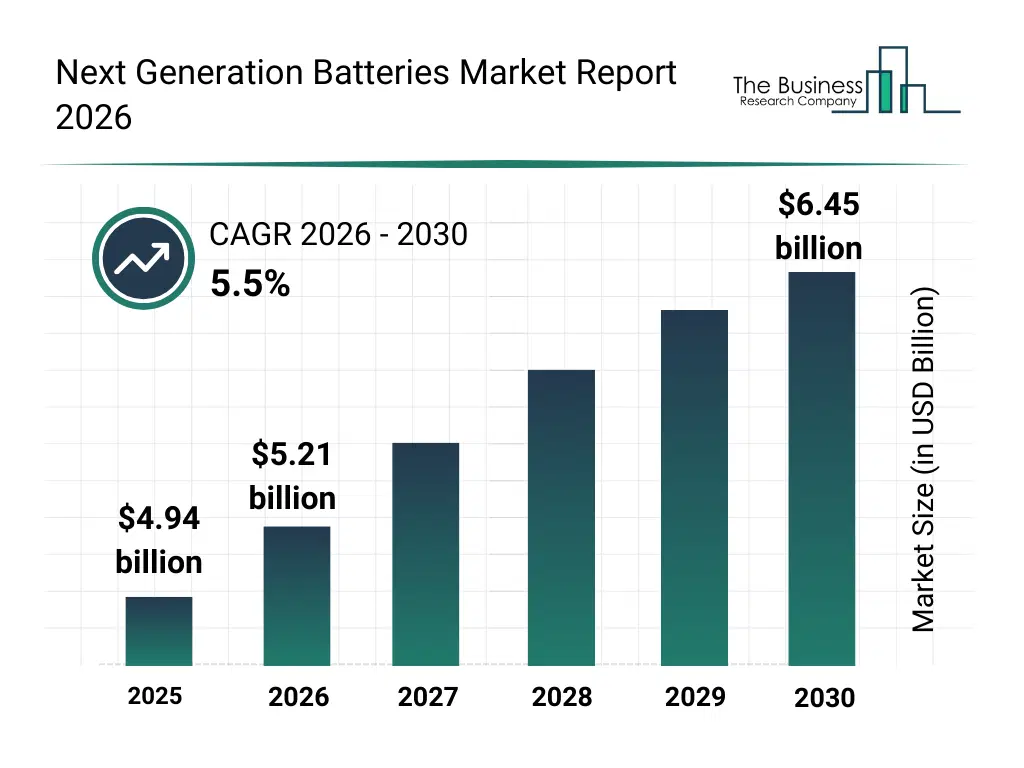
What Is The Next Generation Batteries Market Size 2026 And Growth Rate?
The next generation batteries market size has grown strongly in recent years. It will grow from $4.94 billion in 2025 to $5.21 billion in 2026 at a compound annual growth rate (CAGR) of 5.4%. The growth in the historic period can be attributed to ev adoption growth, lithium-ion performance limitations, renewable energy integration, consumer electronics power demand, declining battery production costs.What Is The Next Generation Batteries Market Growth Forecast?
The next generation batteries market size is expected to see strong growth in the next few years. It will grow to $6.45 billion in 2030 at a compound annual growth rate (CAGR) of 5.5%. The growth in the forecast period can be attributed to solid-state battery commercialization, grid-scale energy storage demand, raw material diversification, government electrification mandates, advancements in battery recycling technologies. Major trends in the forecast period include next-generation ev battery innovation, sustainable battery materials adoption, smart manufacturing for advanced batteries, connected energy storage ecosystems, AI-driven battery design and optimization.
Global Next Generation Batteries Market Segmentation
1) By Battery Type: Lithium-Sulfur Batteries, Sodium-Ion Batteries, Solid-State Batteries, Aluminum-Ion Batteries, Flow Batteries 2) By Form Factor: Cylindrical Batteries, Prismatic Batteries, Pouch Batteries, Stacked Batteries, Flexible Batteries 3) By Application: Electric Vehicles (EVs), Consumer Electronics, Grid Energy Storage, Industrial Applications, Portable Power Tools 4) By End User: Aerospace And Defense, Automotive, Telecommunications, Healthcare, Consumer Electronics Manufacturers Subsegments: 1) By Lithium-Sulfur Batteries: High-Energy Density Lithium-Sulfur Batteries, Flexible Lithium-Sulfur Batteries 2) By Sodium-Ion Batteries: Sodium-Ion Batteries For Grid Storage, High-Capacity Sodium-Ion Batteries, Sodium-Ion Batteries For Consumer Electronics 3) By Solid-State Batteries: All-Solid-State Batteries, Thin-Film Solid-State Batteries 4) By Aluminum-Ion Batteries: Aluminum-Ion Batteries For Grid Storage, Lightweight Aluminum-Ion Batteries 5) By Flow Batteries: Vanadium Flow Batteries, Zinc-Bromine Flow Batteries, Iron-Chromium Flow Batteries, All-Vanadium Flow BatteriesWhat Is The Driver Of The Next Generation Batteries Market?
Rising demand for electric vehicles is expected to propel the growth of the next generation batteries market going forward. Electric vehicles (EVs) refer to automobiles that are powered entirely or partially by electricity, typically using batteries instead of internal combustion engines. The rising demand for electric vehicles is largely driven by economic benefits, as EVs offer lower operating costs compared to traditional vehicles, making them an attractive option for consumers looking to save money in the long term. Next-generation batteries, such as solid-state and lithium-sulfur, enhance electric vehicles by offering higher energy densities, faster charging, longer lifespans, and improved safety, making EVs more practical and efficient for consumers. For instance, in April 2025, according to the European Automobile Manufacturers Association, a Belgium-based trade association, in the first quarter of 2025, sales of battery-electric cars increased by 23.9%, reaching 412,997 units, and accounted for 15.2% of the total market share in the EU. Therefore, rising demand for electric vehicles is driving the growth of the next generation batteries industry.Key Players In The Global Next Generation Batteries Market
Major companies operating in the next generation batteries market are Toyota Motor Corporation, Volkswagen AG, Samsung Electronics Co. Ltd., Ford Motor Company, General Motors Company, Bayerische Motoren Werke, Honda Motor Co. Ltd., Panasonic Holdings Corporation, LG Energy Solution Ltd., QuantumScape Corporation, SK On Co. Ltd., Build Your Dreams, ProLogium Technology Co. Ltd., Northvolt AB, Natron Energy Inc., ZincFive Inc., StoreDot Ltd., Factorial Energy Inc., Sion Power, Amprius Technologies Inc., Enovix Corporation, Showa Denko Materials, Blue Current Inc., Solid Power Inc.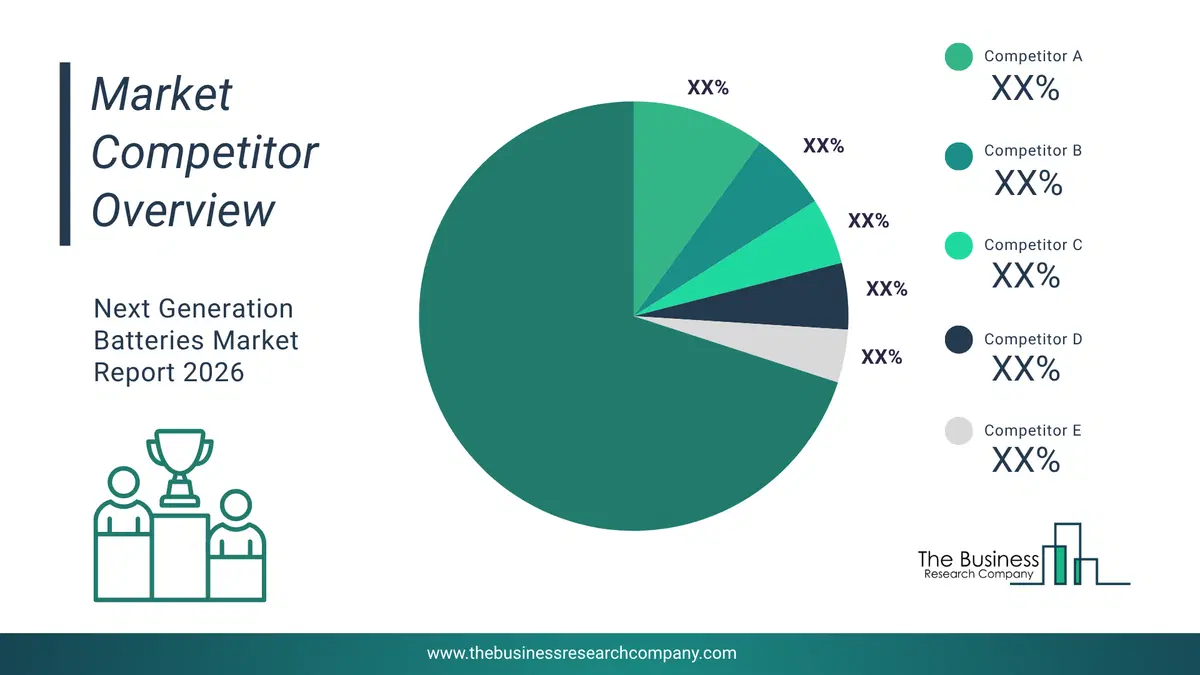
This chart is for illustrative purposes; the full report includes a detailed competitor analysis and comprehensive overview of the top 10 companies in the market.
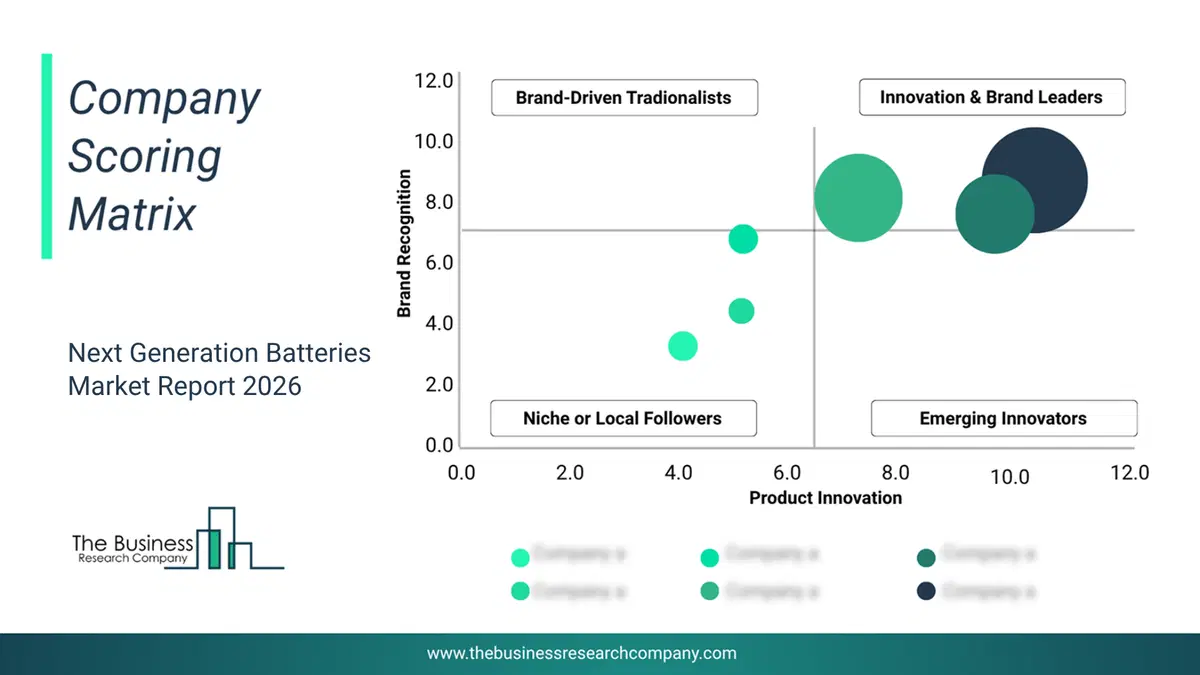
This chart maps companies by product innovation and brand strength, with bubble size indicating relative revenue, helping identify market leaders, challengers, and niche players. This is an illustrative chart; the full report provides a complete and accurate competitive analysis.
Global Next Generation Batteries Market Trends and Insights
Major companies operating in the next generation batteries market are focusing on developing technologically advanced solutions, such as electric vehicle (EV) battery systems, to address key challenges, including charging time, energy density, and cost efficiency. Electric vehicle (EV) battery systems are integrated energy storage units that supply power to an electric vehicle’s motor, enabling propulsion and supporting overall vehicle performance. For instance, in March 2025, BYD Auto Co. Ltd., a China-based automotive company, launched the Next-Gen EV Battery System, which can charge electric vehicles (EVs) to provide up to 400 km of range in just five minutes. This revolutionary system operates at 1,000 volts, delivering ultra-fast charging speeds of up to 1,000 kW, thanks to advanced lithium iron phosphate (LFP) battery technology. This innovation, combined with sophisticated thermal and battery management systems, allows EVs including the BYD Han L and Tang L to recharge rapidly and safely, significantly reducing charging time and enhancing convenience.What Are Latest Mergers And Acquisitions In The Next Generation Batteries Market?
In April 2024, Arkema S.A., a France-based adhesive manufacturing company, acquired Proionic for an undisclosed amount. With this acquisition, Arkema aims to strengthen its portfolio of high-value materials for next-generation batteries, leveraging Proionic's expertise in ionic liquids to enhance energy density, safety, and sustainability, while driving synergies in biomass processing and metal treatment to solidify Arkema's leadership in advanced battery solutions. Proionic is an Austria-based company that specializes in the production and development of ionic liquids, which are key components for the next generation of lithium-ion batteries.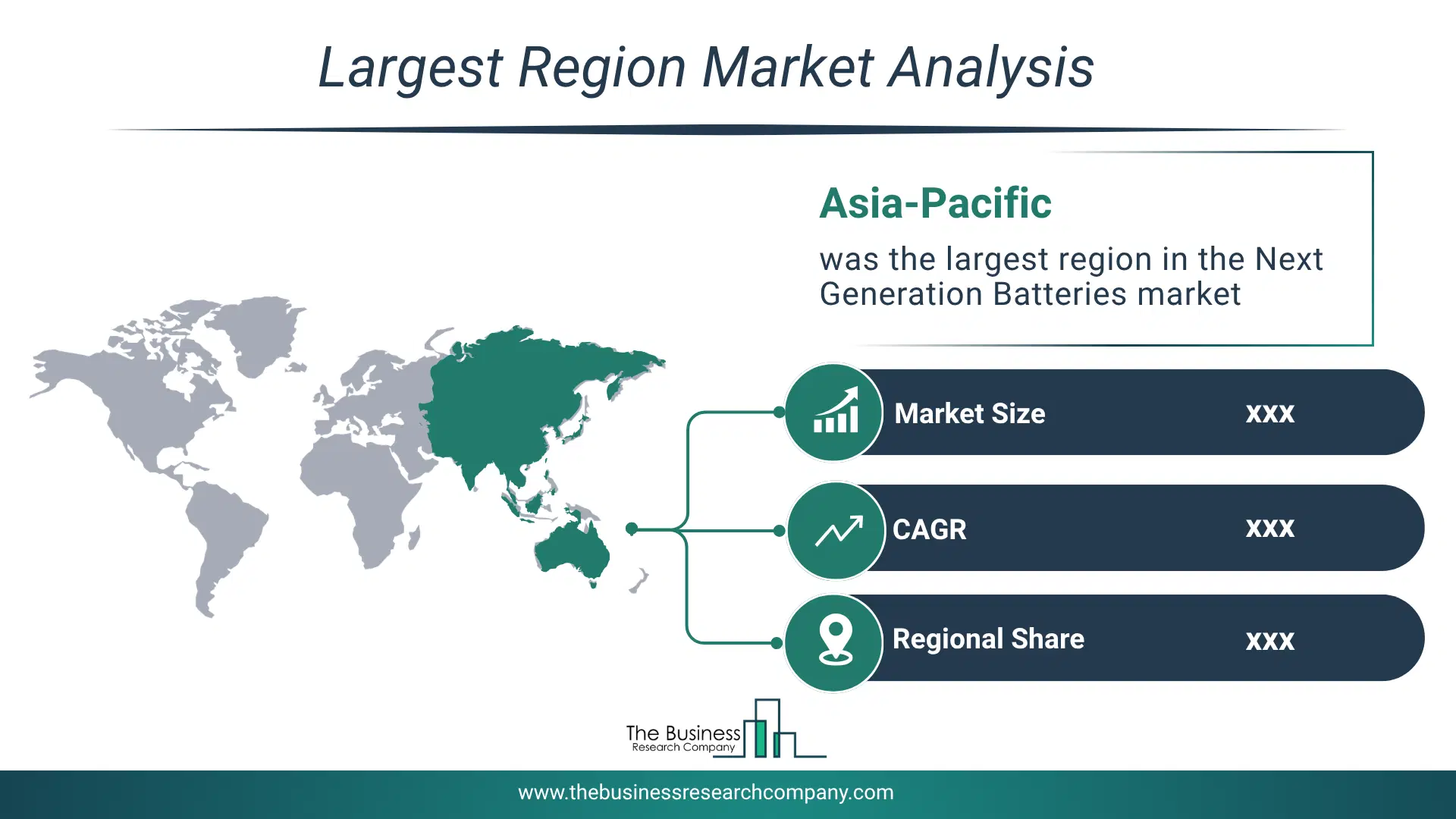
Regional Outlook
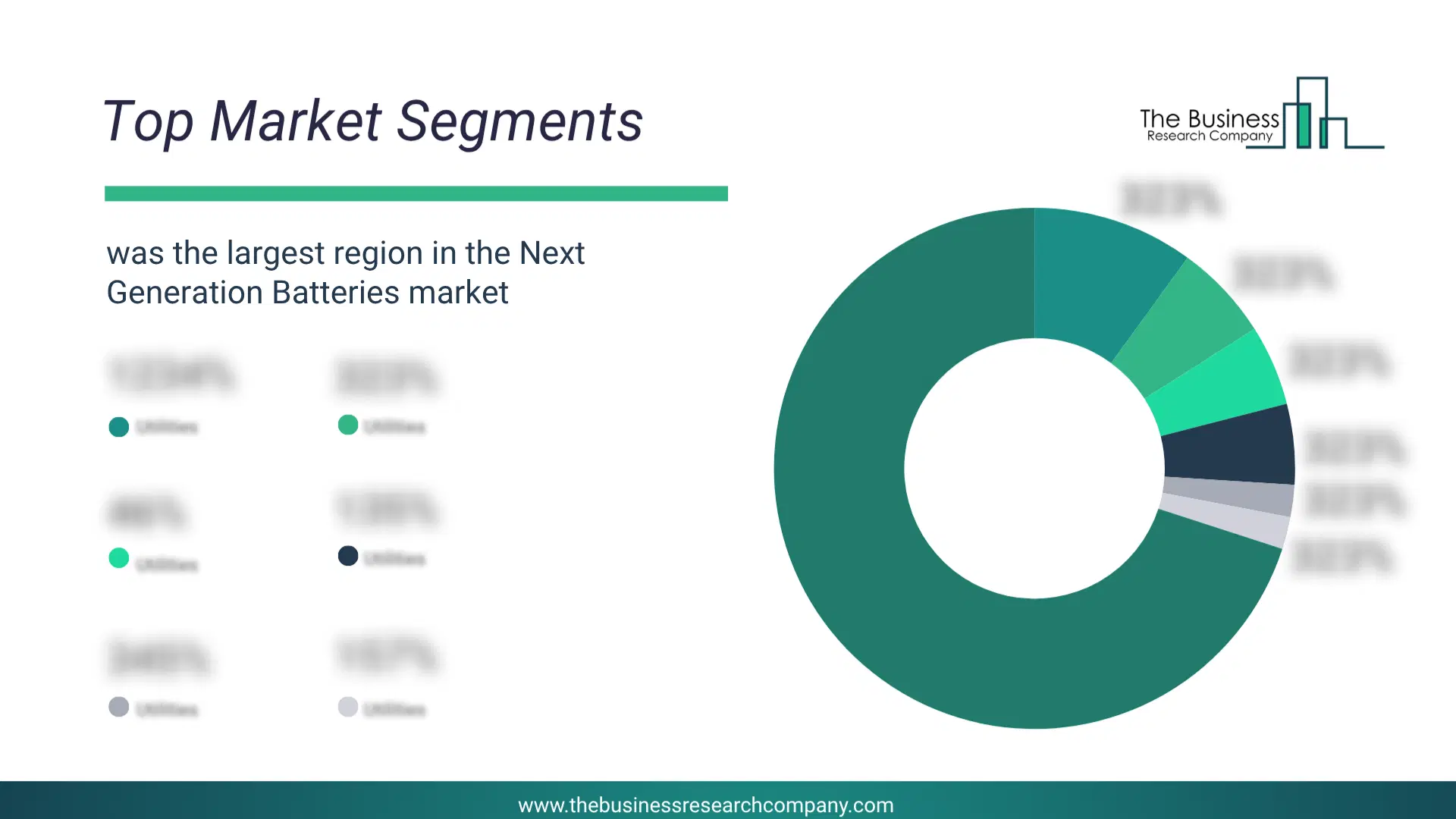
Asia-Pacific was the largest region in the next generation batteries market in 2025. The regions covered in this market report are Asia-Pacific, South East Asia, Western Europe, Eastern Europe, North America, South America, Middle East, Africa. The countries covered in this market report are Australia, Brazil, China, France, Germany, India, Indonesia, Japan, Taiwan, Russia, South Korea, UK, USA, Canada, Italy, Spain.What Defines the Next Generation Batteries Market?
The next generation batteries market consists of sales of battery packs or modules, portable energy storage devices, and smart battery systems. Values in this market are ‘factory gate’ values, that is the value of goods sold by the manufacturers or creators of the goods, whether to other entities (including downstream manufacturers, wholesalers, distributors and retailers) or directly to end customers. The value of goods in this market includes related services sold by the creators of the goods.How is Market Value Defined and Measured?
The market value is defined as the revenues that enterprises gain from the sale of goods and/or services within the specified market and geography through sales, grants, or donations in terms of the currency (in USD unless otherwise specified). The revenues for a specified geography are consumption values that are revenues generated by organizations in the specified geography within the market, irrespective of where they are produced. It does not include revenues from resales along the supply chain, either further along the supply chain or as part of other products.
This chart presents market attractiveness based on a quantitative evaluation of growth, competition, strategic alignment, and risk, offering a clear view of opportunity areas for decision-making. This chart is for illustrative purposes; the full report contains the complete analysis.

This chart highlights the Total Addressable Market (TAM) by estimating the maximum revenue opportunity using an assumption-driven approach, supporting strategic planning and opportunity sizing across markets. The chart is illustrative; the full report provides a more comprehensive analysis.
What Key Data and Analysis Are Included in the Next Generation Batteries Market Report 2026?
The next generation batteries market research report is one of a series of new reports from The Business Research Company that provides market statistics, including industry global market size, regional shares, competitors with the market share, detailed market segments, market trends and opportunities, and any further data you may need to thrive in the next generation batteries industry. The market research report delivers a complete perspective of everything you need, with an in-depth analysis of the current and future state of the industry.Next Generation Batteries Market Report Forecast Analysis
| Report Attribute | Details |
|---|---|
| Market Size Value In 2026 | $5.21 billion |
| Revenue Forecast In 2030 | $6.45 billion |
| Growth Rate | CAGR of 5.5% from 2026 to 2030 |
| Base Year For Estimation | 2025 |
| Actual Estimates/Historical Data | 2020-2025 |
| Forecast Period | 2026 - 2030 |
| Market Representation | Revenue in USD Billion and CAGR from 2026 to 2030 |
| Segments Covered | Battery Type, Form Factor, Application, End User |
| Regional Scope | Asia-Pacific, Western Europe, Eastern Europe, North America, South America, Middle East, Africa |
| Country Scope | The countries covered in the report are Australia, Brazil, China, France, Germany, India, Indonesia, Japan, Taiwan, Russia, South Korea, UK, USA, Canada, Italy, Spain. |
| Key Companies Profiled | Toyota Motor Corporation, Volkswagen AG, Samsung Electronics Co. Ltd., Ford Motor Company, General Motors Company, Bayerische Motoren Werke, Honda Motor Co. Ltd., Panasonic Holdings Corporation, LG Energy Solution Ltd., QuantumScape Corporation, SK On Co. Ltd., Build Your Dreams, ProLogium Technology Co. Ltd., Northvolt AB, Natron Energy Inc., ZincFive Inc., StoreDot Ltd., Factorial Energy Inc., Sion Power, Amprius Technologies Inc., Enovix Corporation, Showa Denko Materials, Blue Current Inc., Solid Power Inc. |
| Customization Scope | Request for Customization |
| Pricing And Purchase Options | Explore Purchase Options |