
Octyl Salicylate Market Report 2026
Global Outlook – By Type (Colorless, Light Yellow), By Application (Perfume, Soap, Cosmetics, Sunscreens, Other Applications), By Distribution Channel (Online, Offline ), By End-User (Personal Care, Consumer Goods) – Market Size, Trends, Strategies, and Forecast to 2030
Octyl Salicylate Market Overview
• Octyl Salicylate market size has reached to $1.26 billion in 2025 • Expected to grow to $1.75 billion in 2030 at a compound annual growth rate (CAGR) of 6.8% • Growth Driver: Rising Demand For Personal Care Products To Drive Market Growth • Market Trend: Breakthrough Product In The Octyl Salicylate Market Catering To Sensitive Skin And Offering Sun Protection • Asia-Pacific was the largest region and fastest growing region.What Is Covered Under Octyl Salicylate Market?
Octyl salicylate is a colorless, oily liquid ester formed by condensing salicylic acid with 2-ethyl hexanol. It is an organic compound used as an ingredient in sunscreens and cosmetics to absorb ultraviolet B rays from the sun. The main types of octyl salicylate are colorless and light yellow. Colorless refers to a substance that has no color at all. The various applications are perfume, soap, cosmetics, sunscreens, and others, and are distributed through online, and offline channels. It is used in personal care, pharmaceutical, and consumer goods.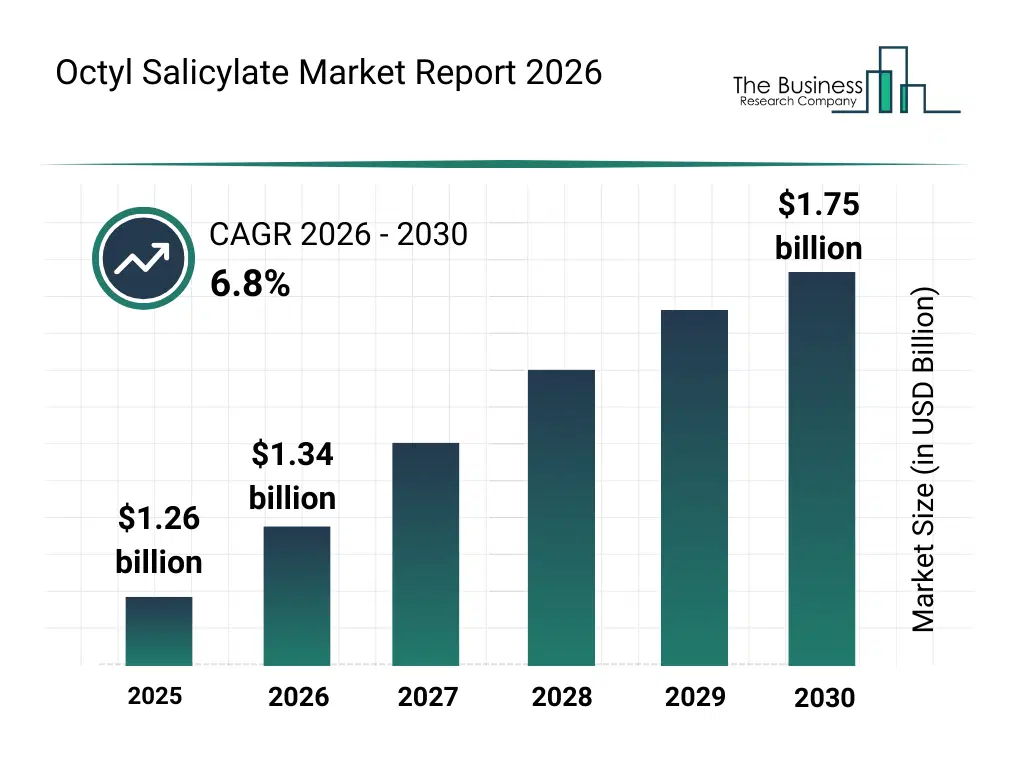
What Is The Octyl Salicylate Market Size and Share 2026?
The octyl salicylate market size has grown strongly in recent years. It will grow from $1.26 billion in 2025 to $1.34 billion in 2026 at a compound annual growth rate (CAGR) of 6.5%. The growth in the historic period can be attributed to growth of cosmetics and personal care industry, rising awareness of sun protection benefits, expansion of skincare product portfolios, availability of organic uv filters, increasing consumer spending on beauty products.What Is The Octyl Salicylate Market Growth Forecast?
The octyl salicylate market size is expected to see strong growth in the next few years. It will grow to $1.75 billion in 2030 at a compound annual growth rate (CAGR) of 6.8%. The growth in the forecast period can be attributed to increasing demand for multifunctional cosmetic ingredients, rising adoption of reef-safe sunscreens, expansion of premium skincare products, growing focus on clean-label formulations, innovation in cosmetic ingredient chemistry. Major trends in the forecast period include increasing use of UV-B absorbing ingredients, rising demand for cosmetic sun protection, growing adoption in personal care formulations, expansion of skin-friendly sunscreen products, enhanced focus on regulatory compliance.
Global Octyl Salicylate Market Segmentation
1) By Type: Colorless, Light Yellow 2) By Application: Perfume, Soap, Cosmetics, Sunscreens, Other Applications 3) By Distribution Channel: Online, Offline 4) By End-User: Personal Care, Consumer Goods Subsegments: 1) By Colorless: Pure Octyl Salicylate, Synthetic Formulations 2) By Light Yellow: Standard Light Yellow Octyl Salicylate, Modified Light Yellow FormulationsWhat Are The Drivers Of The Octyl Salicylate Market?
The increasing demand for personal care products is expected to propel the growth of the octyl salicylate market going forward. A personal care product refers to a group of self-care items used for personal hygiene, cleaning, and grooming. They consist of shampoos, conditioners, toothpaste, creams, coloring products for hair, lipsticks, beauty products, bath soaps, detergents, sunscreens, scents, and home items. Octyl salicylate is used in personal care goods, such as sunscreens, lotions, and other personal care products, to protect skin primarily from UVB rays. For instance, in December 2024, according to the Bureau of Labor Statistics, a US-based government agency, in 2023, expenditure on personal care products and services rose by 9.7%, while spending on personal insurance and pensions grew by 9.3%. Therefore, the increasing demand for personal care products is driving the growth of the octyl salicylate industry. The increasing incidence of skin cancer is expected to propel the growth of octyl salicylate market going forward. Skin cancer is a type of cancer that originates in the skin cells. It occurs when unrepaired DNA damage to skin cells (most often caused by ultraviolet or UV radiation from the sun or tanning beds) triggers mutations, leading the skin cells to multiply rapidly and form malignant tumors. The growing awareness of the risks associated with skin cancer has heightened the emphasis on sun protection. Octyl salicylate, possessing UV-absorbing properties, becomes more relevant as a component in sunscreens, contributing to the prevention of skin damage caused by exposure to harmful ultraviolet rays. For instance, in January 2023, according to the American Cancer Society, a US-based voluntary organization, In the United States, a projected 97,610 new melanoma cases will be diagnosed in 2023, with about 58,120 in men and 39,490 in women. Therefore, the increasing incidence of skin cancer is driving the growth of octyl salicylate industry.Key Players In The Global Octyl Salicylate Market
Major companies operating in the octyl salicylate market are Symrise AG, BASF SE, DSM-Firmenich AG, Ashland Global Holdings Inc., Croda International Plc, Evonik Industries AG, Merck KGaA, Clariant AG, Givaudan SA, Lubrizol Corporation, Solvay SA, LANXESS AG, Kao Corporation, SEPPIC SA, Galaxy Surfactants Ltd., Vantage Specialty Chemicals, Inc., Aarti Industries Limited, Atul Ltd., Alpha Chemical Services Inc., Haihang Industry Co., Ltd.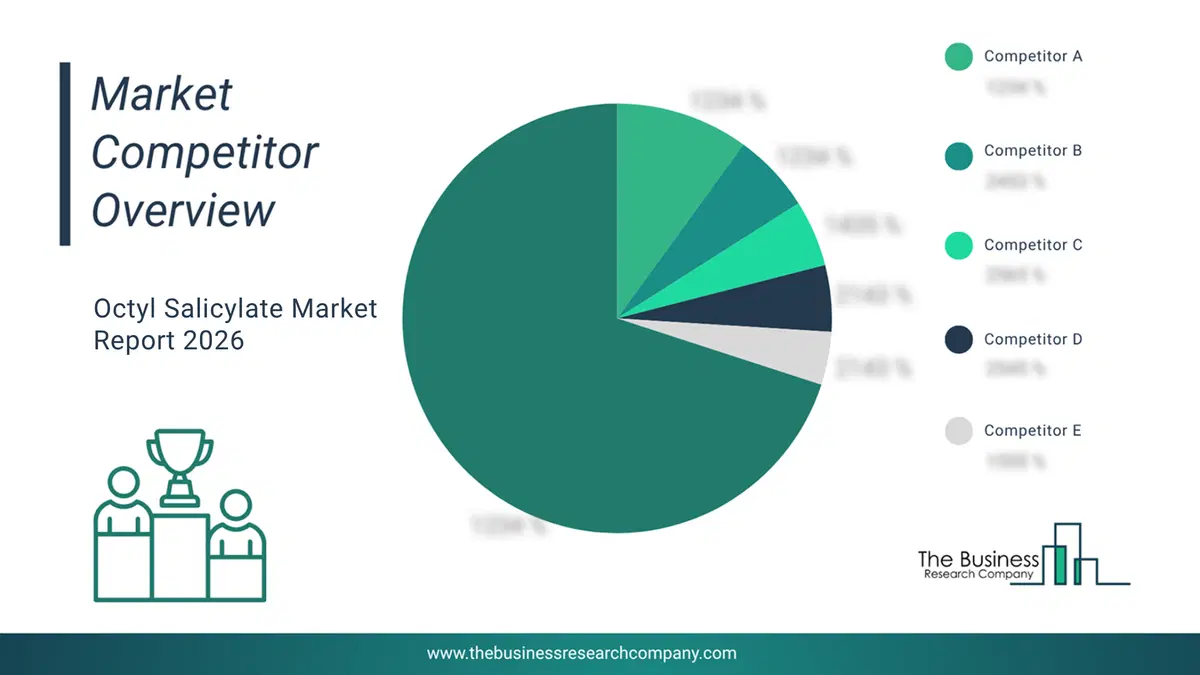
This chart is for illustrative purposes; the full report includes a detailed competitor analysis and comprehensive overview of the top 10 companies in the market.
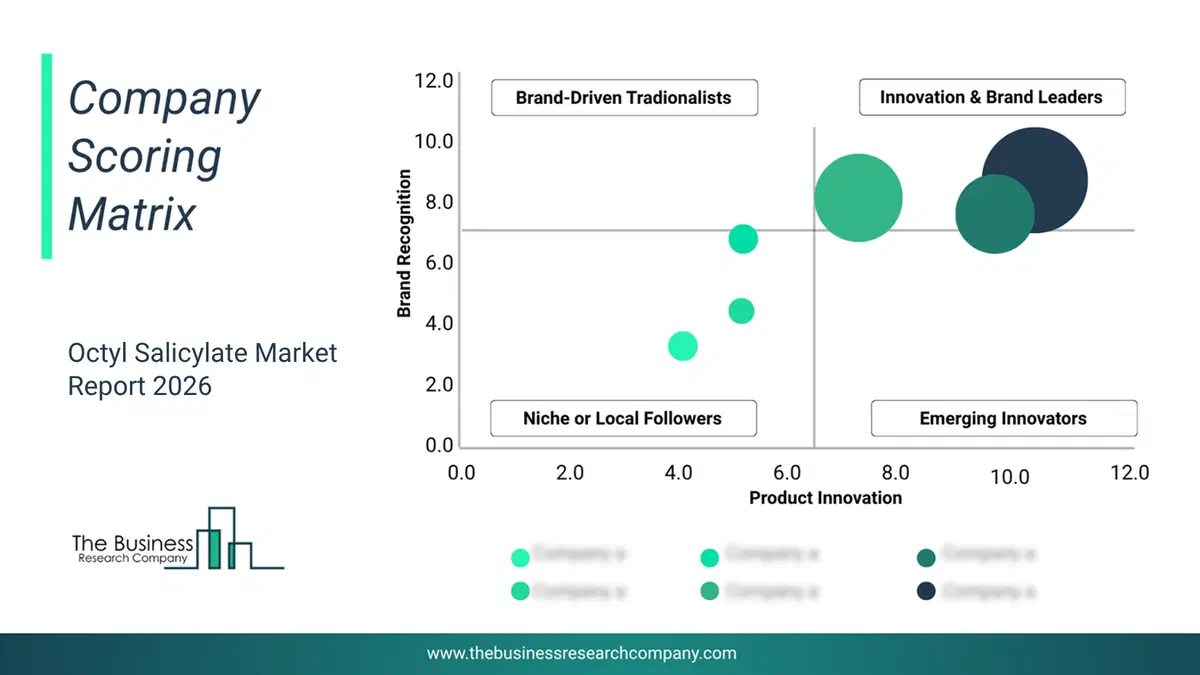
This chart maps companies by product innovation and brand strength, with bubble size indicating relative revenue, helping identify market leaders, challengers, and niche players. This is an illustrative chart; the full report provides a complete and accurate competitive analysis.
Global Octyl Salicylate Market Trends and Insights
Major companies operating in the octyl salicylate market are focused on developing innovative products, such as oil-free sunscreen, to gain a competitive edge in the market. An oil-free sunscreen is a type of sunscreen specifically formulated to not contain oils or oil-based ingredients. For instance, in March 2023, Coopera, a US-based cosmetics company, launched Oil-free Sunscreen. The oil-free formulation and potentially hypoallergenic ingredients can minimize irritation and discomfort for sensitive individuals. Its primary ingredients, 3% Avobenzone, 2.7% Oliclin, 5% Octyl Salicylate, and 10% Homosalate, give consumers with sensitive and oily skin more options when it comes to sunscreen solutions.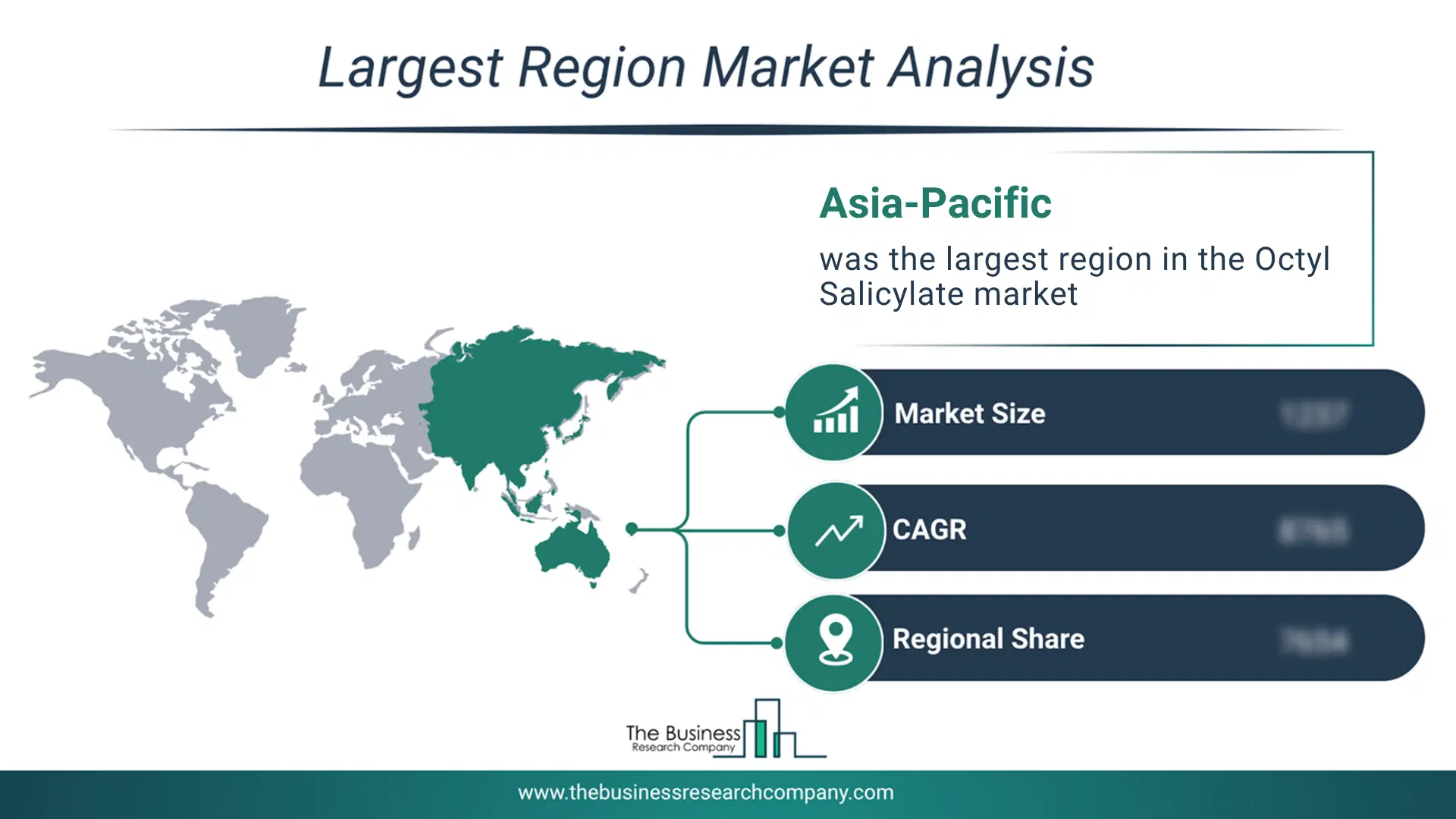
Regional Insights
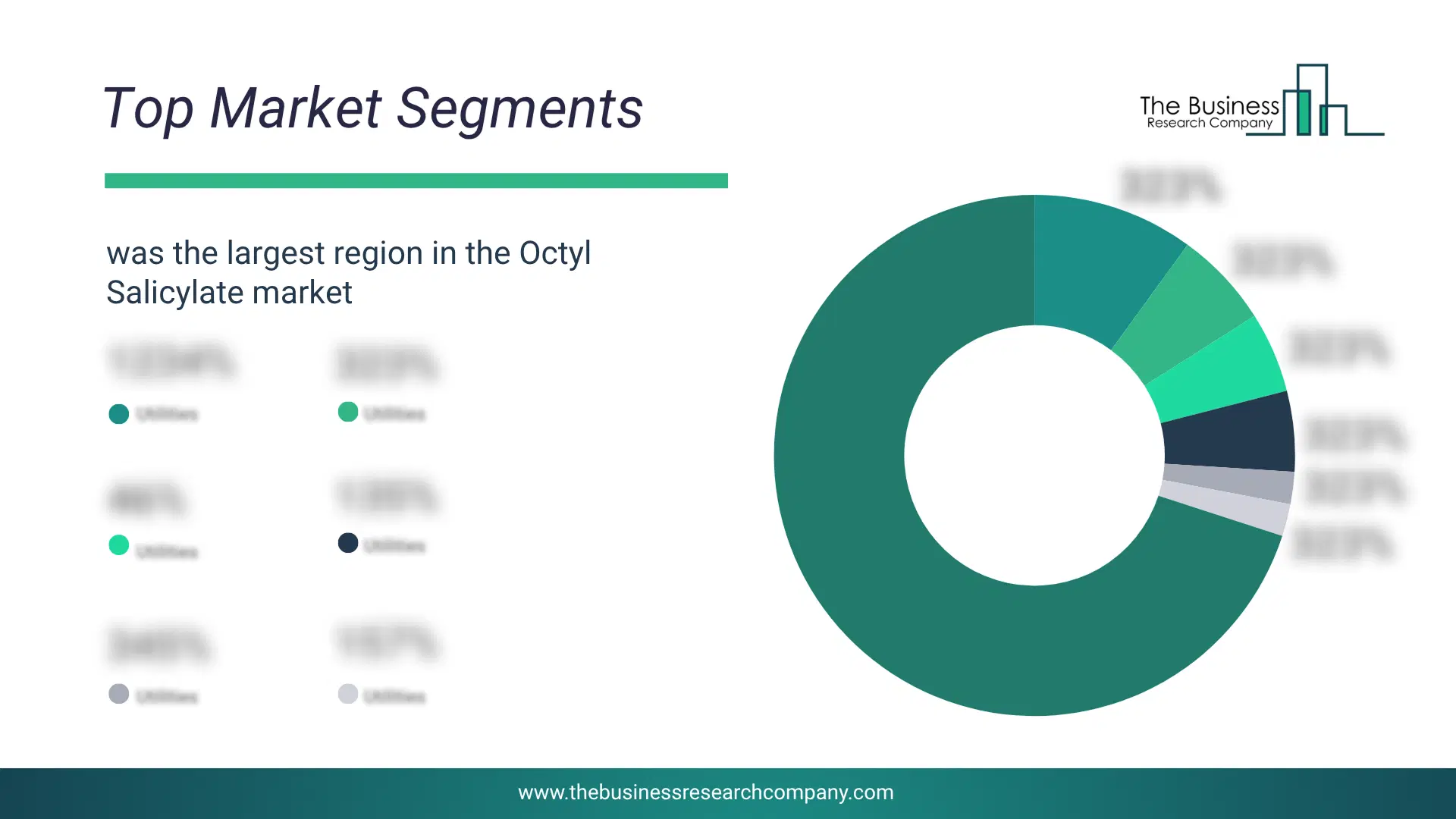
Asia-Pacific was the largest region in the octyl salicylate market in 2025. The regions covered in this market report are Asia-Pacific, South East Asia, Western Europe, Eastern Europe, North America, South America, Middle East, Africa The countries covered in this market report are Australia, Brazil, China, France, Germany, India, Indonesia, Japan, Taiwan, Russia, South Korea, UK, USA, Canada, Italy, SpainWhat Defines the Octyl Salicylate Market?
The octyl salicylate market consists of sales of salicylic acid and 2-ethylhexanol. Values in this market are ‘factory gate’ values, that is, the value of goods sold by the manufacturers or creators of the goods, whether to other entities (including downstream manufacturers, wholesalers, distributors, and retailers) or directly to end customers. The value of goods in this market includes related services sold by the creators of the goods.How is Market Value Defined and Measured?
The market value is defined as the revenues that enterprises gain from the sale of goods and/or services within the specified market and geography through sales, grants, or donations in terms of the currency (in USD unless otherwise specified). The revenues for a specified geography are consumption values that are revenues generated by organizations in the specified geography within the market, irrespective of where they are produced. It does not include revenues from resales along the supply chain, either further along the supply chain or as part of other products.
This chart presents market attractiveness based on a quantitative evaluation of growth, competition, strategic alignment, and risk, offering a clear view of opportunity areas for decision-making. This chart is for illustrative purposes; the full report contains the complete analysis.

This chart highlights the Total Addressable Market (TAM) by estimating the maximum revenue opportunity using an assumption-driven approach, supporting strategic planning and opportunity sizing across markets. The chart is illustrative; the full report provides a more comprehensive analysis.
What Key Data and Analysis Are Included in the Octyl Salicylate Market Report 2026?
The octyl salicylate market research report is one of a series of new reports from The Business Research Company that provides market statistics, including industry global market size, regional shares, competitors with the market share, detailed market segments, market trends and opportunities, and any further data you may need to thrive in the octyl salicylate industry. The market research report delivers a complete perspective of everything you need, with an in-depth analysis of the current and future state of the industry.Octyl Salicylate Market Report Forecast Analysis
| Report Attribute | Details |
|---|---|
| Market Size Value In 2026 | $1.34 billion |
| Revenue Forecast In 2030 | $1.75 billion |
| Growth Rate | CAGR of 6.5% from 2026 to 2030 |
| Base Year For Estimation | 2025 |
| Actual Estimates/Historical Data | 2020-2025 |
| Forecast Period | 2026 - 2030 |
| Market Representation | Revenue in USD Billion and CAGR from 2026 to 2030 |
| Segments Covered | Type, Application, Distribution Channel, End-User |
| Regional Scope | Asia-Pacific, Western Europe, Eastern Europe, North America, South America, Middle East, Africa |
| Country Scope | The countries covered in this market report are Australia, Brazil, China, France, Germany, India, Indonesia, Japan, Taiwan, Russia, South Korea, UK, USA, Canada, Italy, Spain |
| Key Companies Profiled | Symrise AG, BASF SE, DSM-Firmenich AG, Ashland Global Holdings Inc., Croda International Plc, Evonik Industries AG, Merck KGaA, Clariant AG, Givaudan SA, Lubrizol Corporation, Solvay SA, LANXESS AG, Kao Corporation, SEPPIC SA, Galaxy Surfactants Ltd., Vantage Specialty Chemicals, Inc., Aarti Industries Limited, Atul Ltd., Alpha Chemical Services Inc., Haihang Industry Co., Ltd. |
| Customization Scope | Request for Customization |
| Pricing And Purchase Options | Explore Purchase Options |