

Oilfield Communications Market Report 2026
Global Outlook – By Communication Network (Cellular Communication Network, VSAT Communication Network, Fiber Optic-Based Communication Network, Microwave Communication Network, Tetra Network), By Component (Solutions, Services), By Technology (Cellular Network, VoIP, Unified Communications, M2M, Microwave Communication, WiMAX, VSAT, TETRA, Fiber Optics, WAN, LAN), By Field Site (Onshore, Offshore) – Market Size, Trends, Strategies, and Forecast to 2030
Oilfield Communications Market Overview
• Oilfield Communications market size has reached to $3.9 billion in 2025 • Expected to grow to $5.65 billion in 2030 at a compound annual growth rate (CAGR) of 7.7% • Growth Driver: IOT Integration Propels The Oilfield Communications Market • Market Trend: Integrated Connectivity Innovations Strengthen Safety And Digital Transformation For Field Operations • North America was the largest region and fastest growing region.What Is Covered Under Oilfield Communications Market?
Oilfield communications refer to technologies that integrate and automate oilfield operations to provide information and decrease the supply and demand gap. The oilfield communications are used to boost equipment productivity, optimize infrastructure operations, and keep personnel safe. The main communications for oilfield communications are cellular communication networks, VSAT communication networks, fiber optic-based communication networks, microwave communication networks, and tetra networks. A microwave communication network refers to a line-of-sight wireless communication technology that uses high-frequency beams of radio waves to provide high-speed wireless connections that can send and receive voice, video, and data information. The components are solutions and services. The various technologies involved cellular networks, VoIP, unified communications, M2M, microwave communication, WiMAX, VSAT, TETRA, fiber optics, WAN, and LAN. The field sites are onshore and offshore.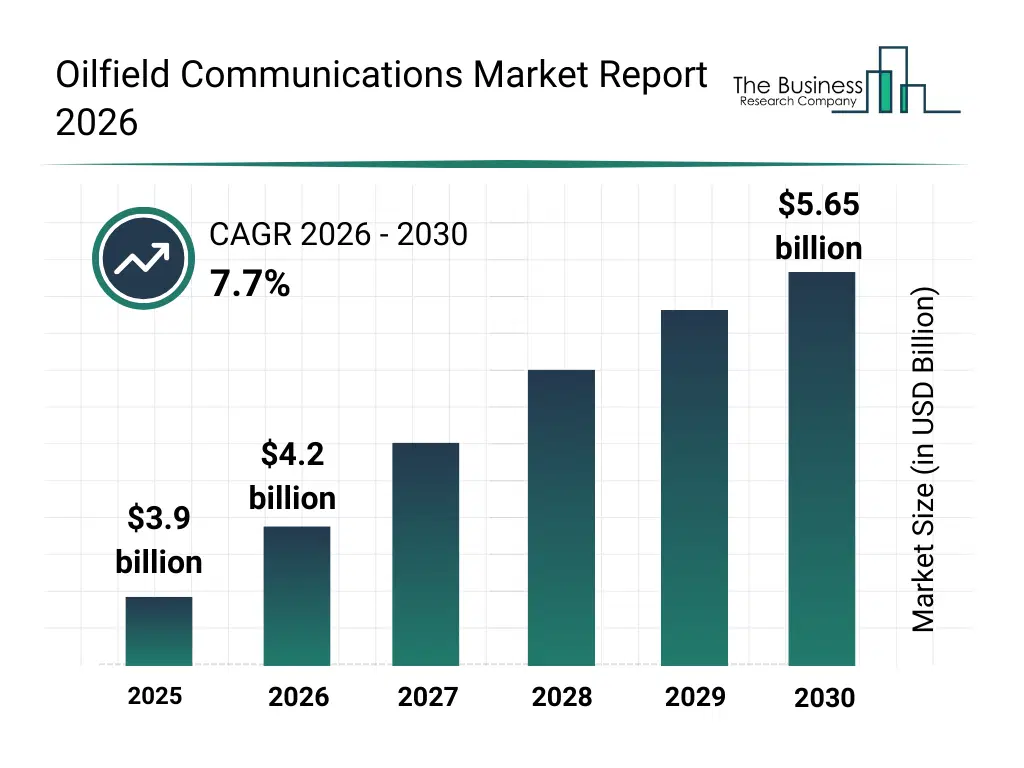
What Is The Oilfield Communications Market Size and Share 2026?
The oilfield communications market size has grown strongly in recent years. It will grow from $3.9 billion in 2025 to $4.2 billion in 2026 at a compound annual growth rate (CAGR) of 7.8%. The growth in the historic period can be attributed to expansion of upstream oil and gas operations, increasing offshore exploration activities, adoption of digital oilfield concepts, rising need for operational efficiency, availability of satellite-based communication systems.What Is The Oilfield Communications Market Growth Forecast?
The oilfield communications market size is expected to see strong growth in the next few years. It will grow to $5.65 billion in 2030 at a compound annual growth rate (CAGR) of 7.7%. The growth in the forecast period can be attributed to increasing investments in smart oilfield infrastructure, rising adoption of 5G and private lte networks, expansion of autonomous field operations, growing focus on cybersecurity for oilfield networks, increasing demand for low-latency communications. Major trends in the forecast period include increasing deployment of real-time oilfield data networks, rising adoption of integrated communication platforms, growing use of remote monitoring and control systems, expansion of high-bandwidth offshore communication solutions, enhanced focus on personnel safety and asset connectivity.
Global Oilfield Communications Market Segmentation
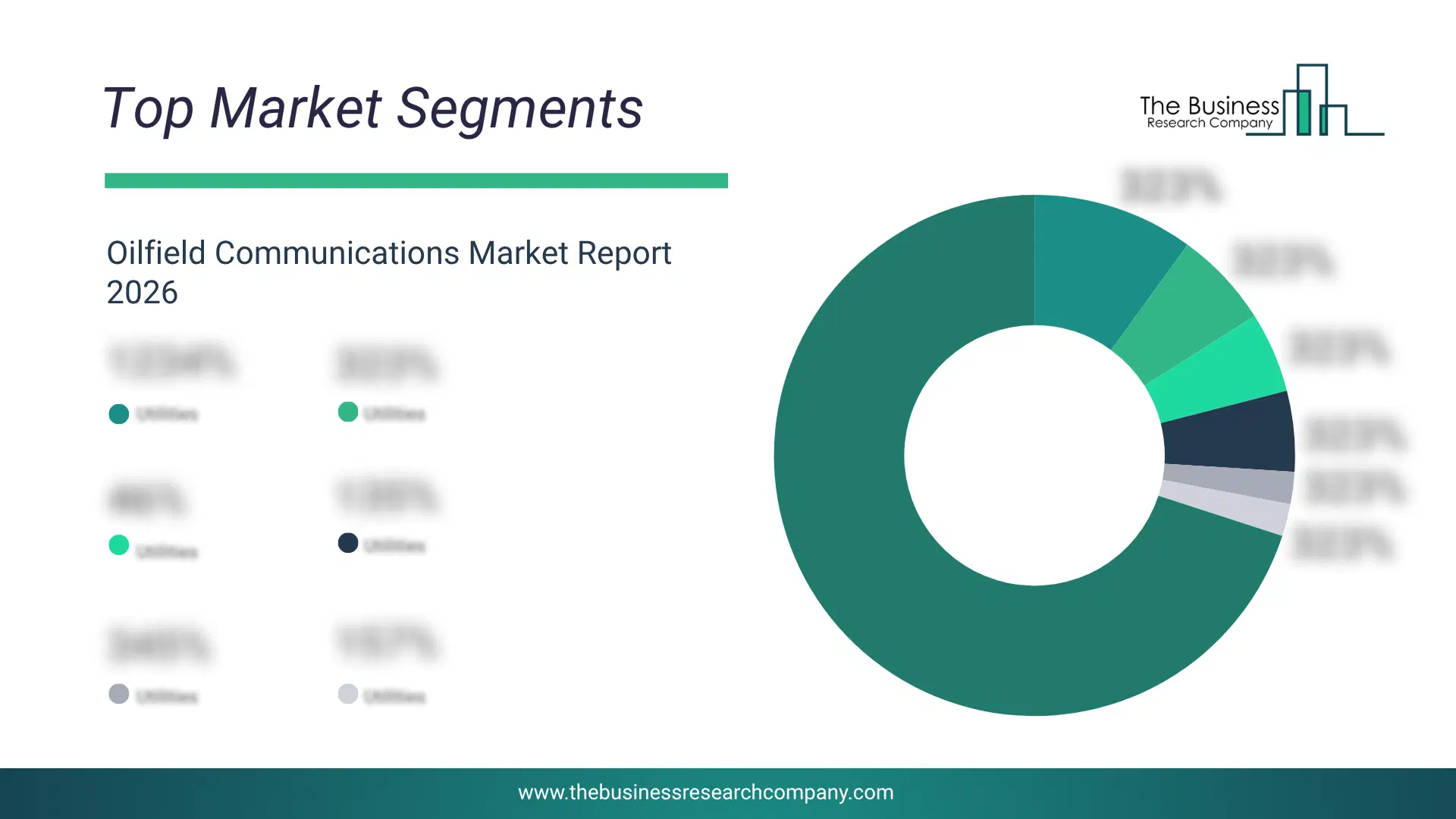
1) By Communication Network: Cellular Communication Network, VSAT Communication Network, Fiber Optic-Based Communication Network, Microwave Communication Network, Tetra Network 2) By Component: Solutions, Services 3) By Technology: Cellular Network, VoIP, Unified Communications, M2M, Microwave Communication, WiMAX, VSAT, TETRA, Fiber Optics, WAN, LAN 4) By Field Site: Onshore, Offshore Subsegments: 1) By Cellular Communication Network: 3G Networks, 4G Or LTE Networks, 5G Networks 2) By VSAT Communication Network: Ku-Band VSAT, Ka-Band VSAT, C-Band VSAT 3) By Fiber Optic-Based Communication Network: Onshore Fiber Optic Networks, Offshore Fiber Optic Networks, Hybrid Fiber Optic Networks 4) By Microwave Communication Network: Point-To-Point Microwave Links, Point-To-Multipoint Microwave Systems, Millimeter Wave Communication 5) By Tetra Network: Tetra Voice Communication, Tetra Data Communication, Tetra Radio SystemsWhat Is The Driver Of The Oilfield Communications Market?
The rise is IoT integration is expected to propel the growth of the oilfield communications market going forward. IoT stands for the 'Internet of Things. ' It is a concept that refers to the network of physical objects, devices, vehicles, buildings, and other items that are embedded with sensors, software, and network connectivity, allowing them to collect and exchange data. Oilfield communications are pivotal for the successful integration of the Internet of Things (IoT) in the oil and gas industry. By providing reliable connectivity in remote and challenging environments, these communication solutions enable seamless data exchange between IoT sensors, devices, and control systems. For instance, in July 2023, CompTIA, a US-based non-profit trade association published an article that said, the global IoT market size reached $399.41 billion in 2022 and is expected to grow to $486 billion in 2023 and connected IoT devices are expected to reach $15.9 billion by 2030. Therefore, the rise in IoT platforms is driving the oilfield communications industry.Key Players In The Global Oilfield Communications Market
Major companies operating in the oilfield communications market are Huawei Technologies Co. Ltd; Siemens AG; Speedcast International Limited; ABB Ltd; Commscope Inc; Inmarsat Plc; Tait Communications; Baker Hughes Incorporated; Rad Data Communications; Hughes Network Systems LLC; Ceragon Networks Ltd; RigNet Inc; Airspan Networks; Commtel Networks Pvt. Ltd; GE Digital; Mostar Oilfield Communications; Redline Communications; Hitachi ABB Power Grids; Weatherford; ALE International; MR Control Systems; HP Co; SAP AG; Oracle Corp; Dell EMC; International Business Machines Corporation; Microsoft Corp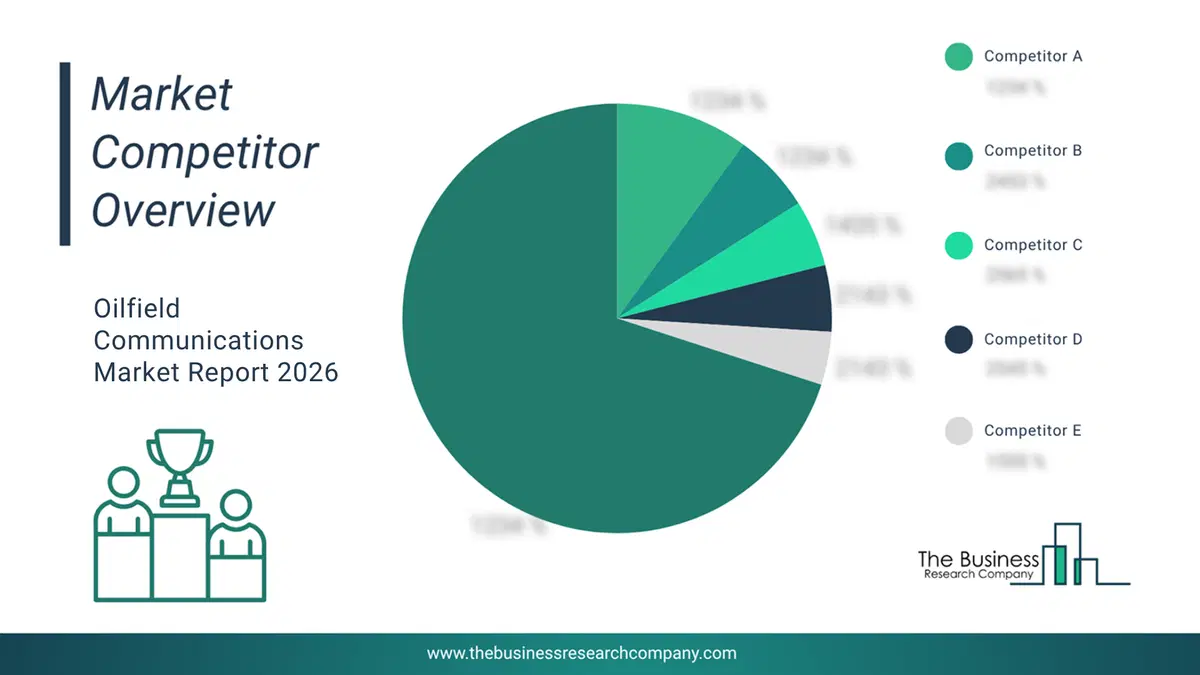
This chart is for illustrative purposes; the full report includes a detailed competitor analysis and comprehensive overview of the top 10 companies in the market.
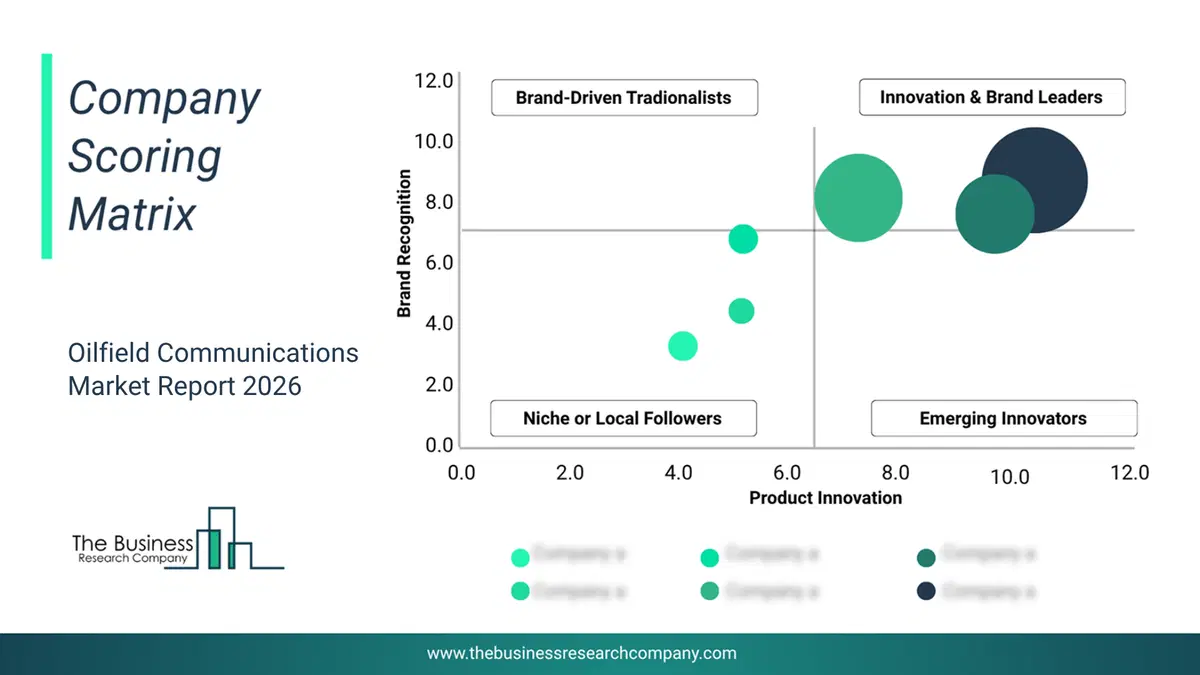
This chart maps companies by product innovation and brand strength, with bubble size indicating relative revenue, helping identify market leaders, challengers, and niche players. This is an illustrative chart; the full report provides a complete and accurate competitive analysis.
Global Oilfield Communications Market Trends and Insights
Major companies operating in the oilfield communications market are focusing on developing innovative solutions, such as satellite-based communication services, to meet the rising demand for reliable connectivity in remote oil and gas operations. Satellite-based communication services provide robust, high-speed communication links via satellites, enabling real-time data transfer, voice communication, and monitoring in areas where traditional terrestrial networks are unavailable or unreliable. Unlike conventional wired or cellular networks, these solutions ensure continuous connectivity in remote offshore platforms, desert drilling sites, and other inaccessible locations. For instance, in June 2024, Viasat Inc., a UK-based technology company, launched Viasat Energy Services’ enhanced hybrid network service, an innovative solution specifically designed for remote oil and gas customers. The service leverages advanced satellite technology to deliver seamless internet access, secure data transfer, and voice communications, while supporting remote monitoring and operational management. Key features include scalable bandwidth options, rapid deployment without infrastructure requirements, and high resilience against environmental disruptions, making it ideal for field operations in challenging locations.What Are Latest Mergers And Acquisitions In The Oilfield Communications Market?
In August 2023, Trimac, a UK-based company, specializes in thermal management solutions, including oil accumulators and other related technologies for various industrial applications acquired Jacknife Oilfield for an undisclosed amount. Trimac aims to expand its operations and enhance its service offerings by acquiring Jacknife Oilfield Services, thereby strengthening its position in the oil and gas industry and increasing its capabilities in drilling and completions. Jacknife Oilfield Services is a Canada-based company that specializes in providing various services for the oil and gas industry, including drilling and completions.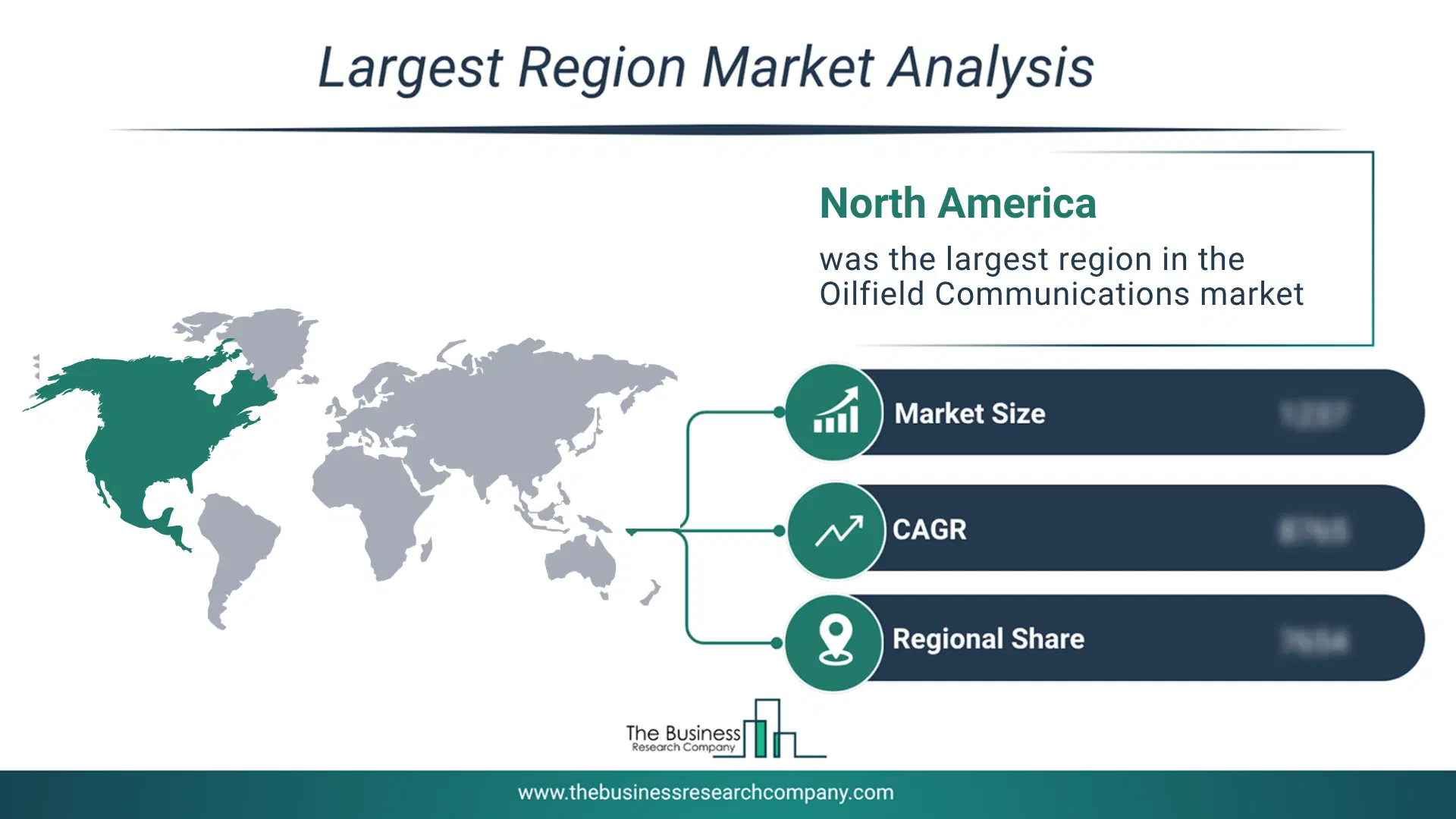
Regional Insights
North America will be the largest region in the oilfield communications market in 2025.North America is expected to be the fastest-growing region in the forecast period. The regions covered in this market report are Asia-Pacific, South East Asia, Western Europe, Eastern Europe, North America, South America, Middle East, Africa. The countries covered in this market report are Australia, Brazil, China, France, Germany, India, Indonesia, Japan, Taiwan, Russia, South Korea, UK, USA, Canada, Italy, SpainWhat Defines the Oilfield Communications Market?
The oilfield communications market consists of revenues earned by entities by providing cellular communication network. Values in this market are ‘factory gate’ values, that is the value of goods sold by the manufacturers or creators of the goods, whether to other entities (including downstream manufacturers, wholesalers, distributors, and retailers) or directly to end customers. The value of goods in this market includes related services sold by the creators of the goods.How is Market Value Defined and Measured?
The market value is defined as the revenues that enterprises gain from the sale of goods and/or services within the specified market and geography through sales, grants, or donations in terms of the currency (in USD unless otherwise specified). The revenues for a specified geography are consumption values that are revenues generated by organizations in the specified geography within the market, irrespective of where they are produced. It does not include revenues from resales along the supply chain, either further along the supply chain or as part of other products.
This chart presents market attractiveness based on a quantitative evaluation of growth, competition, strategic alignment, and risk, offering a clear view of opportunity areas for decision-making. This chart is for illustrative purposes; the full report contains the complete analysis.

This chart highlights the Total Addressable Market (TAM) by estimating the maximum revenue opportunity using an assumption-driven approach, supporting strategic planning and opportunity sizing across markets. The chart is illustrative; the full report provides a more comprehensive analysis.
What Key Data and Analysis Are Included in the Oilfield Communications Market Report 2026?
The oilfield communications market research report is one of a series of new reports from The Business Research Company that provides market statistics, including industry global market size, regional shares, competitors with the market share, detailed market segments, market trends and opportunities, and any further data you may need to thrive in the oilfield communications industry. The market research report delivers a complete perspective of everything you need, with an in-depth analysis of the current and future state of the industry.Oilfield Communications Market Report Forecast Analysis
| Report Attribute | Details |
|---|---|
| Market Size Value In 2026 | $4.2 billion |
| Revenue Forecast In 2030 | $5.65 billion |
| Growth Rate | CAGR of 7.7% from 2026 to 2030 |
| Base Year For Estimation | 2025 |
| Actual Estimates/Historical Data | 2020-2025 |
| Forecast Period | 2026 - 2030 |
| Market Representation | Revenue in USD Billion and CAGR from 2026 to 2030 |
| Segments Covered | Communication Network, Component, Technology, Field Site |
| Regional Scope | Asia-Pacific, Western Europe, Eastern Europe, North America, South America, Middle East, Africa |
| Country Scope | The Countries Covered In This Market Report Are Australia, Brazil, China, France, Germany, India, Indonesia, Japan, Taiwan, Russia, South Korea, Uk, Usa, Canada, Italy, Spain. |
| Key Companies Profiled | Huawei Technologies Co. Ltd, Siemens AG, Speedcast International Limited, ABB Ltd, Commscope Inc, Inmarsat Plc, Tait Communications, Baker Hughes Incorporated, Rad Data Communications, Hughes Network Systems LLC, Ceragon Networks Ltd, RigNet Inc, Airspan Networks, Commtel Networks Pvt. Ltd, GE Digital, Mostar Oilfield Communications, Redline Communications, Hitachi ABB Power Grids, Weatherford, ALE International, MR Control Systems, HP Co, SAP AG, Oracle Corp, Dell EMC, International Business Machines Corporation, Microsoft Corp |
| Customization Scope | Request for Customization |
| Pricing And Purchase Options | Explore Purchase Options |