
Pet Food Testing Market Report 2026
Global Outlook – By Type (Label Validation And Marketability Testing, Nutritional Analysis, Packaging Leak Detection, Stability Study, Other Types), By Form (Wet Food, Dry Food), By Application (Dog Food, Cat Food, Other Applications) – Market Size, Trends, Strategies, and Forecast to 2030
Pet Food Testing Market Overview
• Pet Food Testing market size has reached to $8.74 billion in 2025 • Expected to grow to $11.98 billion in 2030 at a compound annual growth rate (CAGR) of 6.4% • Growth Driver: Increasing Pet Ownership Propels The Pet Food Testing Market • Market Trend: Advancements In Rapid Molecular Serotyping Technologies Driving Enhanced Food Safety And Efficient Pathogen Detection • North America was the largest region in 2025 and Asia-Pacific is the fastest growing region.What Is Covered Under Pet Food Testing Market?
Pet food testing refers to the process of evaluating pet food products to ensure their safety, quality, and nutritional adequacy. This involves a series of tests and analyses conducted in laboratories to assess various aspects of pet food. The purpose of pet food testing is to guarantee that pet food is safe for consumption, meets quality standards, and provides the necessary nutrients for the health and well-being of pets. The main types of pet food testing are label validation and marketability testing, nutritional analysis, packaging leak detection, stability studies, and others. Label validation ensures compliance with regulatory requirements and accuracy in product representation, while marketability testing assesses consumer response and readiness for product launch. It is used for wet food and dry food, and it is applied to dog food, cat food, and others.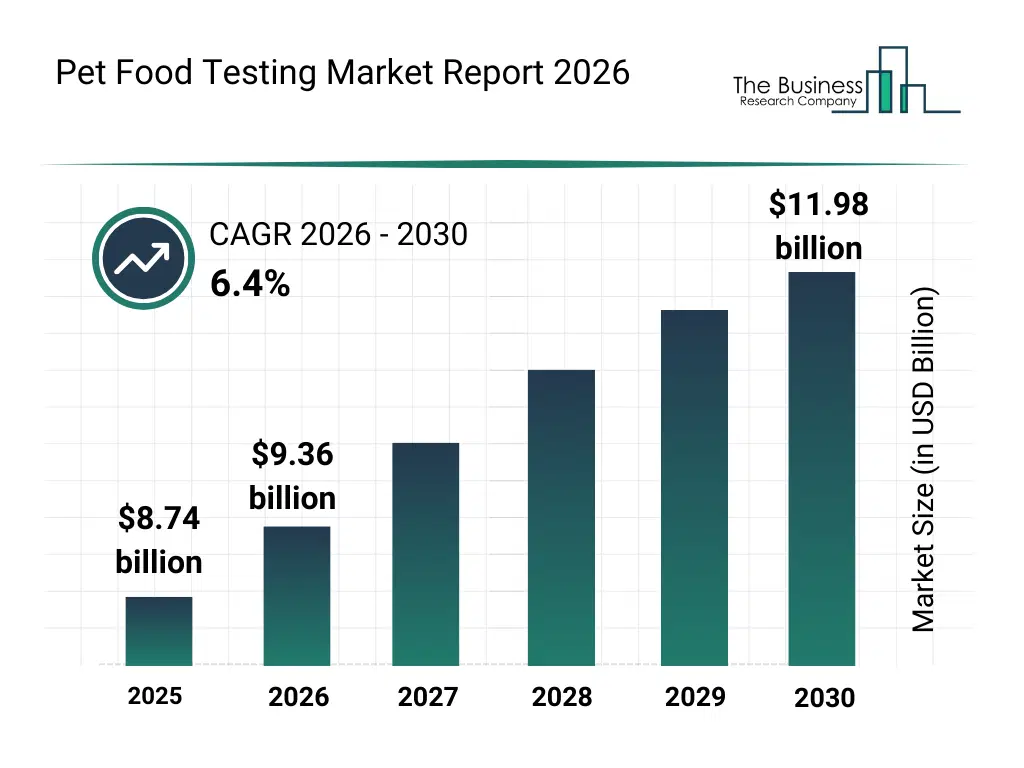
What Is The Pet Food Testing Market Size and Share 2026?
The pet food testing market size has grown strongly in recent years. It will grow from $8.74 billion in 2025 to $9.36 billion in 2026 at a compound annual growth rate (CAGR) of 7.1%. The growth in the historic period can be attributed to expansion of commercial pet food production, rising pet ownership rates, growing awareness of pet nutrition, regulatory enforcement of pet food standards, increased outsourcing of laboratory testing services.What Is The Pet Food Testing Market Growth Forecast?
The pet food testing market size is expected to see strong growth in the next few years. It will grow to $11.98 billion in 2030 at a compound annual growth rate (CAGR) of 6.4%. The growth in the forecast period can be attributed to growing demand for premium and specialized pet foods, expansion of regulatory scrutiny globally, increasing adoption of digital lab technologies, rising focus on allergen-free formulations, growth in functional pet nutrition products. Major trends in the forecast period include increasing adoption of advanced nutritional testing methods, rising demand for label accuracy and compliance testing, expansion of microbial and contaminant testing services, growing use of automated laboratory systems, enhanced focus on pet food safety standards.
Global Pet Food Testing Market Segmentation
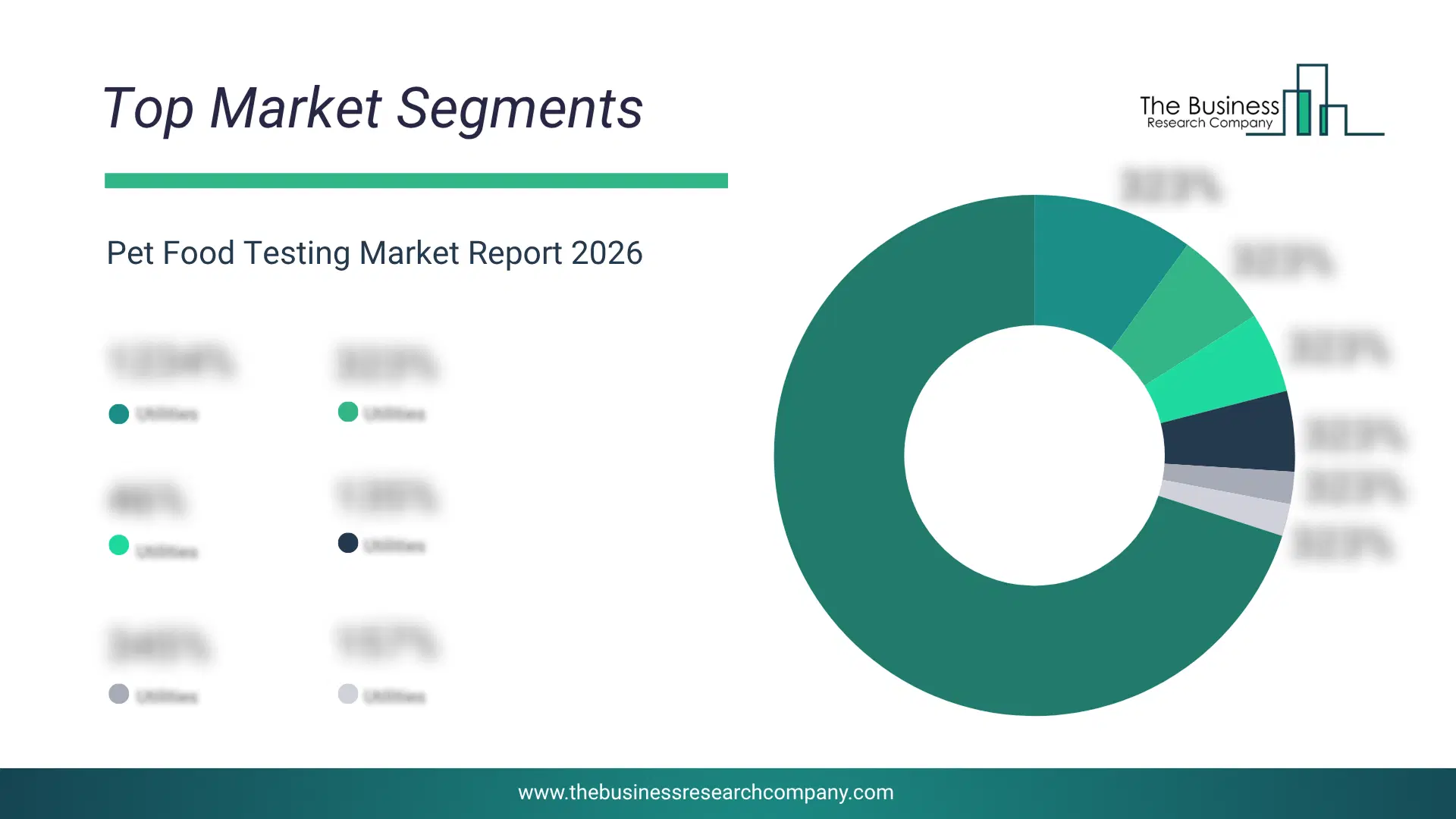
1) By Type: Label Validation And Marketability Testing, Nutritional Analysis, Packaging Leak Detection, Stability Study, Other Types 2) By Form: Wet Food, Dry Food 3) By Application: Dog Food, Cat Food, Other Applications Subsegments: 1) By Label Validation And Marketability Testing: Ingredient Labeling Verification, Nutrient Content Labeling Compliance, Claims Verification 2) By Nutritional Analysis: Protein And Fat Content Analysis, Vitamin And Mineral Analysis, Carbohydrate And Fiber Analysis, Amino Acid Profiling 3) By Packaging Leak Detection: Vacuum Leak Detection, Gas Leak Detection, Seal Integrity Testing 4) By Stability Study: Shelf-Life Testing, Packaging Durability And Protection Testing, Microbial Stability Testing 5) By Other Types: Palatability Testing, Contaminant Testing, Allergen TestingWhat Is The Driver Of The Pet Food Testing Market?
The rising pet ownership is expected to propel the growth of the pet food testing market going forward. Pets are domesticated animals kept by humans for companionship, entertainment, and sometimes for assistance in specific tasks. The rise is due to growing awareness of the emotional and health benefits pets provide, along with changing social and demographic trends that favor companionship and support from animals. Pet food testing is required to ensure the safety, nutritional adequacy, and quality of pet food, protecting pets from harmful substances and ensuring they receive essential nutrients for their health and well-being. For instance, in March 2025, according to the American Pet Products Association, a US-based non-profit association, in 2024, the total U.S. pet industry expenditures reached $152 billion and are projected for $157 billion in sales in 2025. Further, pet ownership has increased for both dogs and cats, with 51% of U.S. households (68 million) owning a dog and 37% of U.S. households (49 million) owning a cat. Therefore, the rising pet ownership is driving the growth of the pet food testing industry.Key Players In The Global Pet Food Testing Market
Major companies operating in the pet food testing market are NSF International, ALS Limited, TÜV SÜD, Eurofins Scientific SE, SGS SA, Bureau Veritas, Intertek Group Plc, Mérieux NutriSciences Corporation, AGROLAB, Microbac Laboratories, Neogen Corporation, Romer Labs, Covance Food Solutions, Bio-Check UK, FoodChain ID, QIMA, R-Biopharm, Food Safety Net Services, Charm Sciences, Tentamus Group GmbH, Alex Stewart Agriculture Ltd.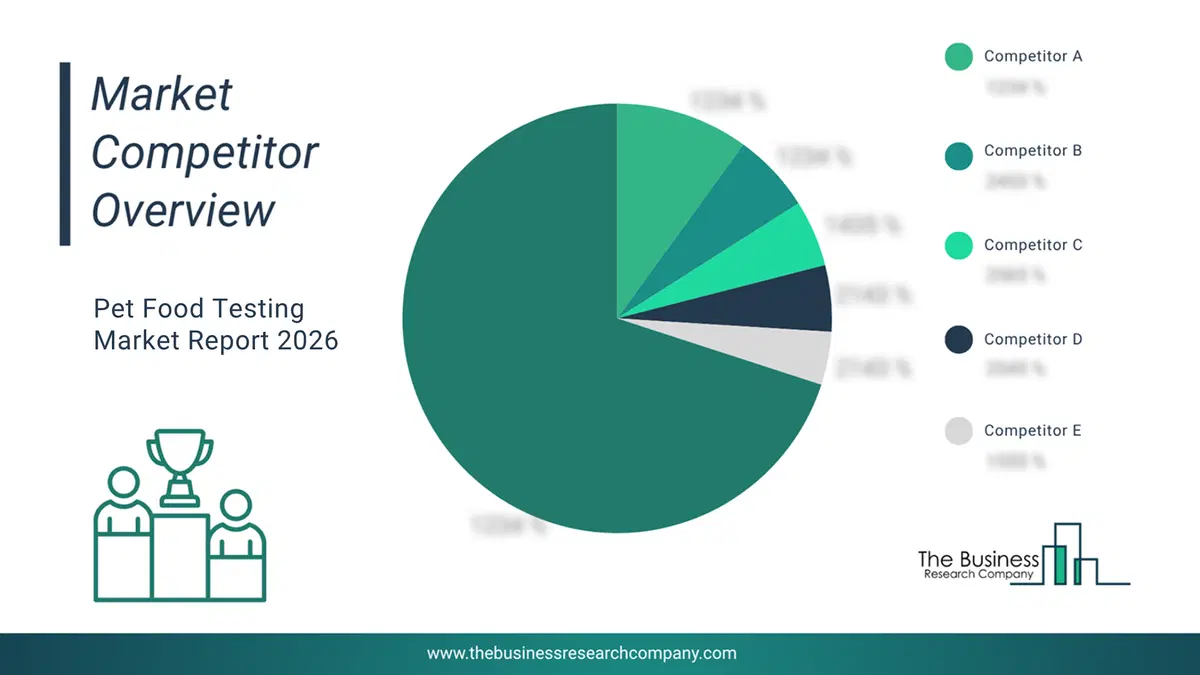
This chart is for illustrative purposes; the full report includes a detailed competitor analysis and comprehensive overview of the top 10 companies in the market.
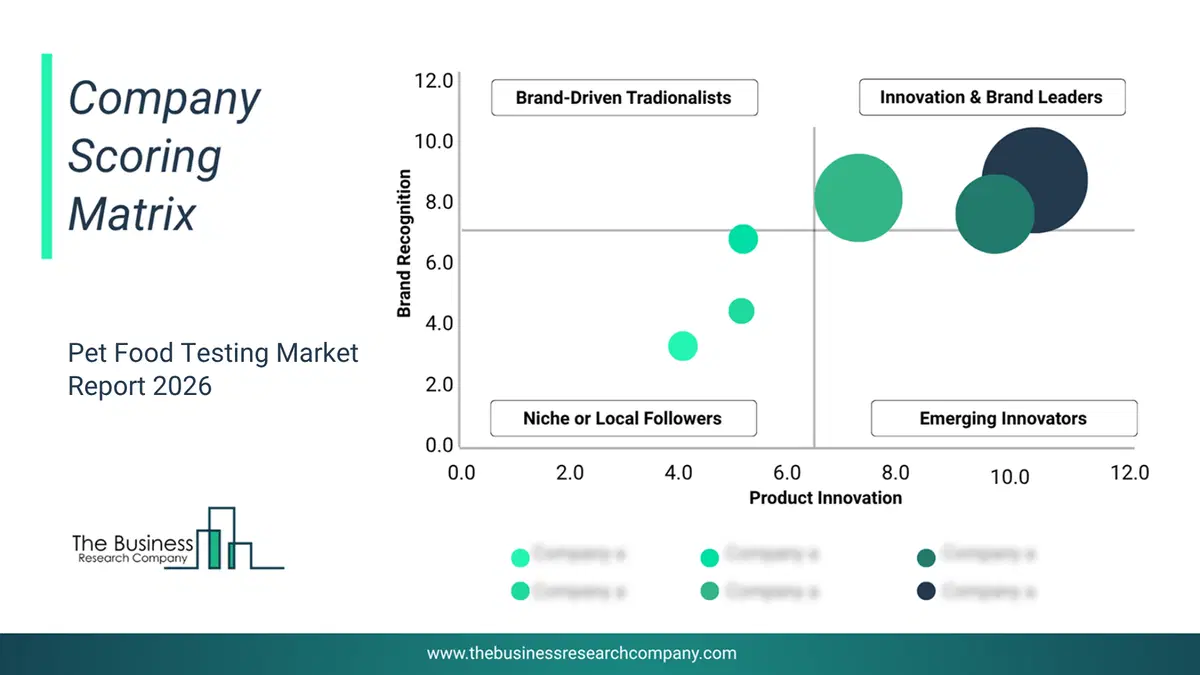
This chart maps companies by product innovation and brand strength, with bubble size indicating relative revenue, helping identify market leaders, challengers, and niche players. This is an illustrative chart; the full report provides a complete and accurate competitive analysis.
Global Pet Food Testing Market Trends and Insights
Major companies operating in the pet food testing market are focusing on developing innovative solutions, such as molecular serotyping assays, to meet the rising demand for rapid and accurate detection of foodborne pathogens and enhanced pet food safety compliance. Molecular serotyping assays use real-time polymerase chain reaction (PCR) technology to amplify and detect specific DNA sequences of target pathogens, providing faster and more precise identification compared to traditional culture-based methods, which are often time-consuming and less specific. For instance, in March 2025, Bio-Rad Laboratories Inc., a US-based life science research and diagnostics company, launched the XP-Design Assay Salmonella Serotyping Solution, an advanced product designed for rapid detection and precise characterization of Salmonella spp. in food and environmental samples. The XP-Design Assay contains ready-to-use oligonucleotides (primers and fluorescent probes) specific to target serotypes, ensuring high specificity and reducing cross-reactivity, while enabling quick decision-making during contamination events.What Are Latest Mergers And Acquisitions In The Pet Food Testing Market?
In November 2023, Eurofins Scientific SE, a Luxembourg-based provider of laboratory testing services for food, feed, environment, and pharmaceuticals, acquired Labor 3 for an undisclosed amount. Through this acquisition, Eurofins aims to strengthen its Food and Feed Testing network in Brazil, expanding its capabilities to serve pet-food and feed testing clients. Labor 3 is a Brazil-based laboratory that provides food-testing and food-safety consultancy services.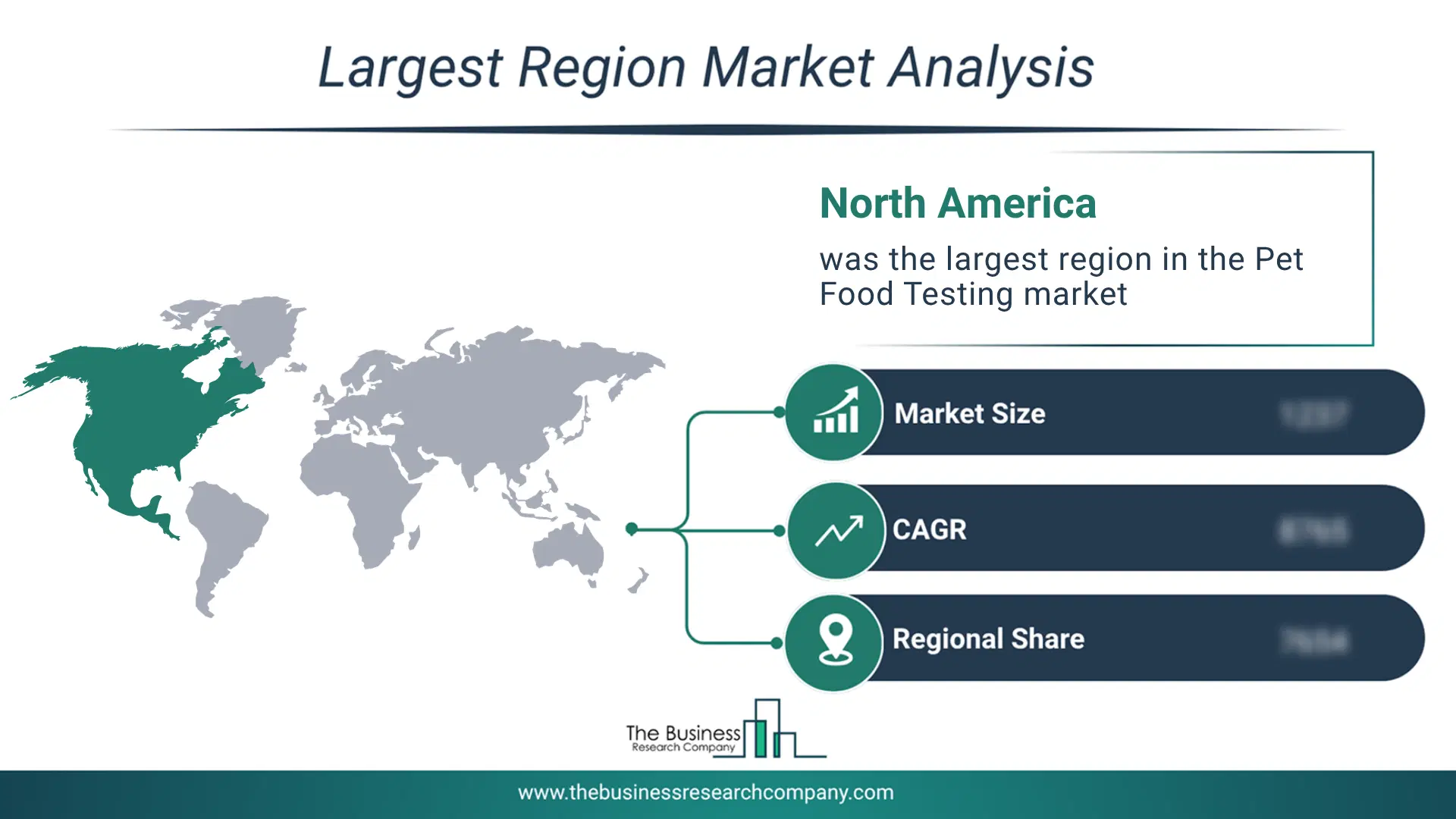
Regional Outlook
North America was the largest region in the pet food testing market in 2025. Asia-Pacific is expected to be the fastest-growing region in the forecast period. The regions covered in this market report are Asia-Pacific, South East Asia, Western Europe, Eastern Europe, North America, South America, Middle East and Africa. The countries covered in this market report are Australia, Brazil, China, France, Germany, India, Indonesia, Japan, Taiwan, Russia, South Korea, UK, USA, Italy, Spain, CanadaWhat Defines the Pet Food Testing Market?
The pet food testing market includes revenues earned by entities by palatability testing, microbiological testing, contaminant testing and related services. The market value includes the value of related goods sold by the service provider or included within the service offering. Only goods and services traded between entities or sold to end consumers are included.How is Market Value Defined and Measured?
The market value is defined as the revenues that enterprises gain from the sale of goods and/or services within the specified market and geography through sales, grants, or donations in terms of the currency (in USD unless otherwise specified). The revenues for a specified geography are consumption values that are revenues generated by organizations in the specified geography within the market, irrespective of where they are produced. It does not include revenues from resales along the supply chain, either further along the supply chain or as part of other products.
This chart presents market attractiveness based on a quantitative evaluation of growth, competition, strategic alignment, and risk, offering a clear view of opportunity areas for decision-making. This chart is for illustrative purposes; the full report contains the complete analysis.

This chart highlights the Total Addressable Market (TAM) by estimating the maximum revenue opportunity using an assumption-driven approach, supporting strategic planning and opportunity sizing across markets. The chart is illustrative; the full report provides a more comprehensive analysis.
What Key Data and Analysis Are Included in the Pet Food Testing Market Report 2026?
The pet food testing market research report is one of a series of new reports from The Business Research Company that provides market statistics, including industry global market size, regional shares, competitors with the market share, detailed market segments, market trends and opportunities, and any further data you may need to thrive in the pet food testing industry. The market research report delivers a complete perspective of everything you need, with an in-depth analysis of the current and future state of the industry.Pet Food Testing Market Report Forecast Analysis
| Report Attribute | Details |
|---|---|
| Market Size Value In 2026 | $9.36 billion |
| Revenue Forecast In 2030 | $11.98 billion |
| Growth Rate | CAGR of 7.1% from 2026 to 2030 |
| Base Year For Estimation | 2025 |
| Actual Estimates/Historical Data | 2020-2025 |
| Forecast Period | 2026 - 2030 |
| Market Representation | Revenue in USD Billion and CAGR from 2026 to 2030 |
| Segments Covered | Type, Form, Application |
| Regional Scope | Asia-Pacific, Western Europe, Eastern Europe, North America, South America, Middle East, Africa |
| Country Scope | The countries covered in the report are Australia, Brazil, China, France, Germany, India, Indonesia, Japan, Taiwan, Russia, South Korea, UK, USA, Canada, Italy, Spain. |
| Key Companies Profiled | NSF International, ALS Limited, TÜV SÜD, Eurofins Scientific SE, SGS SA, Bureau Veritas, Intertek Group Plc, Mérieux NutriSciences Corporation, AGROLAB, Microbac Laboratories, Neogen Corporation, Romer Labs, Covance Food Solutions, Bio-Check UK, FoodChain ID, QIMA, R-Biopharm, Food Safety Net Services, Charm Sciences, Tentamus Group GmbH, Alex Stewart Agriculture Ltd. |
| Customization Scope | Request for Customization |
| Pricing And Purchase Options | Explore Purchase Options |