

Photoresist & Photoresist Ancillaries Market Report 2026
Global Outlook – By Type ( ArF Immersion, KrF, ArF Dry, g- and i-line ), By Ancillaries Type ( Anti-Reflective Coatings, Remover, Developer, Other Ancillaries Types), By Application ( Semiconductors And ICS, LCDs, Printed Circuit Boards, Other Applications) – Market Size, Trends, Strategies, and Forecast to 2035
Photoresist & Photoresist Ancillaries Market Overview
• Photoresist & Photoresist Ancillaries market size has reached to $4.28 billion in 2025 • Expected to grow to $6.07 billion in 2030 at a compound annual growth rate (CAGR) of 7.2% • Growth Driver: Semiconductor Industry Growth Fuels Photoresist And Photoresist Ancillaries Market Expansion • Market Trend: Strategic Partnership To Enhance Distribution Of Photoresist • Asia-Pacific was the largest region in 2025 and North America is the fastest growing region.
What Is Covered Under Photoresist & Photoresist Ancillaries Market?
A photoresist is a natural polymer that improves its biochemical structure when exposed to ultraviolet light. Photoresist ancillary materials are used simultaneously with photoresists such as anti-reflective coatings, developers, photoresist strippers, and edge bead removers. Photoresist & photoresist ancillaries are used in wiring configuration in multi-layered semiconductors for manufacturing laptops, music players, mobile phones, servers, and household machines among others. The main types of photoresist and photoresist ancillaries are ArF immersion, KrF, ArF Dry, g- and i-line. ArF immersion uses the wavelengths for patterning critical layers during IC production and for multi-patterning applications that support the advanced semiconductor production nodes. The different type of ancillaries includes anti-reflective coatings, remover, developer, others and is used in semiconductors and ICS, LCDs, printed circuit boards, others.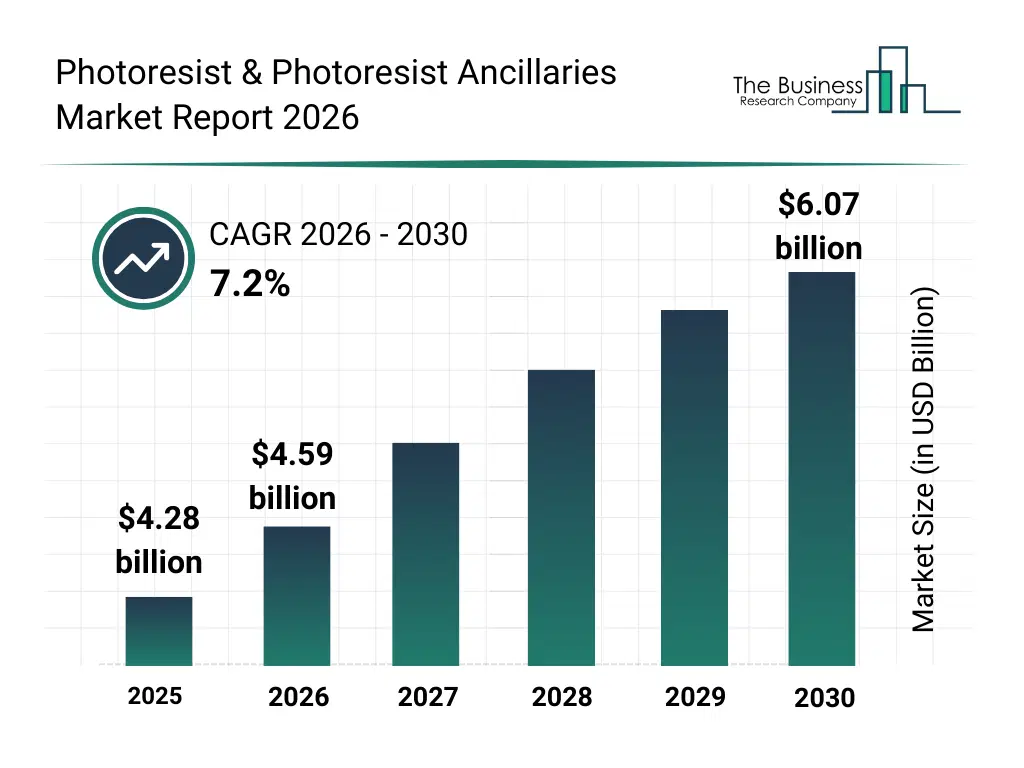
What Is The Photoresist & Photoresist Ancillaries Market Size 2026 And Growth Rate?
The photoresist & photoresist ancillaries market size has grown strongly in recent years. It will grow from $4.28 billion in 2025 to $4.59 billion in 2026 at a compound annual growth rate (CAGR) of 7.2%. The growth in the historic period can be attributed to rising demand for multilayer ic fabrication, early adoption of uv-based photoresist technologies, growth in consumer electronics manufacturing, reliance on traditional lithography chemistries, expansion of pcb production.What Is The Photoresist & Photoresist Ancillaries Market Growth Forecast?
The photoresist & photoresist ancillaries market size is expected to see strong growth in the next few years. It will grow to $6.07 billion in 2030 at a compound annual growth rate (CAGR) of 7.2%. The growth in the forecast period can be attributed to increasing need for high-resolution resists, expansion of advanced node semiconductor manufacturing, development of eco-friendly resist formulations, rising adoption of 3d packaging, growth in global fab capacity expansion. Major trends in the forecast period include expansion of advanced semiconductor lithography platforms, adoption of digital process control in photoresist manufacturing, integration of IoT-enabled material tracking systems, development of AI-assisted patterning optimization, growth of robotics-enhanced cleanroom production.Global Photoresist & Photoresist Ancillaries Market Segmentation
1) By Type: ArF Immersion, KrF, ArF Dry, g- and i-line 2) By Ancillaries Type: Anti-Reflective Coatings, Remover, Developer, Other Ancillaries Types 3) By Application: Semiconductors And ICS, LCDs, Printed Circuit Boards, Other Applications Subsegments: 1) By ArF Immersion: Chemically Amplified ArF Photoresists, Non-Chemically Amplified ArF Photoresists 2) By KrF: Chemically Amplified KrF Photoresists, Non-Chemically Amplified KrF Photoresists 3) By ArF Dry: Chemically Amplified ArF Dry Photoresists, Non-Chemically Amplified ArF Dry Photoresists 4) By g- and i-line: g-line Photoresists, i-line Photoresists, Negative Photoresists For g- and i-lineWhat Is The Driver Of The Photoresist & Photoresist Ancillaries Market?
The growing semiconductor sector is expected to propel the growth of the photoresist and photoresist ancillaries market in the coming years. Semiconductors, also known as integrated circuits (ICs) or microchips, are produced from pure elements such as silicon or germanium, as well as compounds like gallium arsenide. Semiconductors are a vital component of electronic equipment, allowing for advancements in communications, computers, healthcare, defense systems, transportation, clean energy, and a variety of other fields. In the manufacture of printed circuit boards (PCBs) and integrated chips, photoresists are being used to identify the circuit elements in the chip or PCB. For instance, in February 2025, according to the Semiconductor Industry Association (SIA), a U.S.-based trade association, global semiconductor sales hit US $627.6 billion in 2024, up 19.1% compared to US $526.8 billion in 2023. Therefore, the growing semiconductor sector drives the growth of the photoresist and photoresist ancillaries market.Key Players In The Global Photoresist & Photoresist Ancillaries Market
Major companies operating in the photoresist & photoresist ancillaries market are Tokyo Ohka Kogyo Co. Ltd., JSR Corporation, DuPont de Nemours Inc., Shin-Etsu Chemical Co. Ltd., Sumitomo Chemical America Inc., FUJIFILM Hunt Chemicals U.S.A. Inc., Merck KGaA, Allresist GmbH, Micro Resist Technology GmbH, Avantor Performance Materials Inc., KemLab Inc., DJ MicroLaminates, LG Chem Ltd., The Dow Chemical Company, AZ Electronic Materials, Sumika Electronic Materials Inc., Brewer Science Inc., Chemtronics, Dynaloy LLC, EMD Performance Materials, Entegris Inc., KMG Chemicals Inc., Photronics Inc., E. I. du Pont de Nemours and CompanyGlobal Photoresist & Photoresist Ancillaries Market Trends and Insights
Major companies operating in the photoresist and photoresist ancillaries market are adopting a strategic partnership approach to enhance distribution of photoresist. Strategic partnerships refer to a process in which companies leverage each other's strengths and resources to achieve mutual benefits and success. For instance, in September 2023, DuPont Interconnect Solutions, a part of DuPont's Electronics & Industrial (E&I) business segment, a US-based chemical company, partnered with YMT, a Korean printed circuit board materials manufacturer, to enhance Riston Dry Film Photoresist distribution and service in Korea. Through the partnership, DuPont's experience with circuit imaging materials and YMT's local network will be combined to better serve local customers' needs with a comprehensive solution, improved reaction times, and better service.What Are Latest Mergers And Acquisitions In The Photoresist & Photoresist Ancillaries Market?
In October 2023, Fujifilm Holdings Corporation, a Japan-based company that develops, produces, and markets products in the imaging and information businesses, acquired Entegris, Inc. for $700 million. With this acquisition, Fujifilm Holdings Corporation aims to enhance its leadership in semiconductor materials by expanding its product offerings, increasing manufacturing capabilities, and driving innovation in electronic chemicals. Entegris, Inc., a US-based manufacturing company, supplies advanced materials and solutions, including photoresists and ancillaries, for semiconductor manufacturing.Regional Outlook
Asia-Pacific was the largest region in the photoresist and photoresist ancillaries market in 2025. North America was the second-largest region in the photoresist and photoresist ancillaries market share during the forecast period. The regions covered in this market report are Asia-Pacific, South East Asia, Western Europe, Eastern Europe, North America, South America, Middle East, Africa. The countries covered in this market report are Australia, Brazil, China, France, Germany, India, Indonesia, Japan, Taiwan, Russia, South Korea, UK, USA, Canada, Italy, Spain.What Defines the Photoresist & Photoresist Ancillaries Market?
The photoresist and photoresist ancillaries market consists of sales of argon fluoride (ArF) Immersion photoresist, krypton fluoride (KrF) photoresist, and other photoresist & photoresist ancillaries. Values in this market are ‘factory gate’ values, that is the value of goods sold by the manufacturers or creators of the goods, whether to other entities (including downstream manufacturers, wholesalers, distributors and retailers) or directly to end customers. The value of goods in this market includes related services sold by the creators of the goods.How is Market Value Defined and Measured?
The market value is defined as the revenues that enterprises gain from the sale of goods and/or services within the specified market and geography through sales, grants, or donations in terms of the currency (in USD unless otherwise specified). The revenues for a specified geography are consumption values that are revenues generated by organizations in the specified geography within the market, irrespective of where they are produced. It does not include revenues from resales along the supply chain, either further along the supply chain or as part of other products.What Key Data and Analysis Are Included in the Photoresist & Photoresist Ancillaries Market Report 2026?
The photoresist & photoresist ancillaries market research report is one of a series of new reports from The Business Research Company that provides market statistics, including industry global market size, regional shares, competitors with the market share, detailed market segments, market trends and opportunities, and any further data you may need to thrive in the photoresist & photoresist ancillaries industry. The market research report delivers a complete perspective of everything you need, with an in-depth analysis of the current and future state of the industry.Photoresist & Photoresist Ancillaries Market Report 2026 Market Report Forecast Analysis
| Report Attribute | Details |
|---|---|
| Market Size Value In 2026 | $4.59 billion |
| Revenue Forecast In 2035 | $6.07 billion |
| Growth Rate | CAGR of 7.2% from 2026 to 2035 |
| Base Year For Estimation | 2025 |
| Actual Estimates/Historical Data | 2020-2025 |
| Forecast Period | 2026 - 2030 - 2035 |
| Market Representation | Revenue in USD Billion and CAGR from 2026 to 2035 |
| Segments Covered | Type, Ancillaries Type, Application |
| Regional Scope | Asia-Pacific, Western Europe, Eastern Europe, North America, South America, Middle East, Africa |
| Country Scope | The countries covered in the report are Australia, Brazil, China, France, Germany, India, ... |
| Key Companies Profiled | Tokyo Ohka Kogyo Co. Ltd., JSR Corporation, DuPont de Nemours Inc., Shin-Etsu Chemical Co. Ltd., Sumitomo Chemical America Inc., FUJIFILM Hunt Chemicals U.S.A. Inc., Merck KGaA, Allresist GmbH, Micro Resist Technology GmbH, Avantor Performance Materials Inc., KemLab Inc., DJ MicroLaminates, LG Chem Ltd., The Dow Chemical Company, AZ Electronic Materials, Sumika Electronic Materials Inc., Brewer Science Inc., Chemtronics, Dynaloy LLC, EMD Performance Materials, Entegris Inc., KMG Chemicals Inc., Photronics Inc., E. I. du Pont de Nemours and Company |
| Customization Scope | Request for Customization |
| Pricing And Purchase Options | Explore Purchase Options |