
Pork Market Report 2026
Global Outlook – By Type (Chilled, Frozen), By Packaging (Store Wrap, Modified Atmosphere Packaging, Vacuum Packaging, Shrink Bags), By Application (Household, Commercial) – Market Size, Trends, Strategies, and Forecast to 2030
Pork Market Overview
• Pork market size has reached to $149.71 billion in 2025 • Expected to grow to $167.25 billion in 2030 at a compound annual growth rate (CAGR) of 2.4% • Growth Driver: Global Pork Market Surges The Driving Force Behind Rising Meat Consumption Worldwide • Market Trend: BASF Se And Danish Crown Forge Strategic Partnership For Sustainable Agriculture • Asia-Pacific was the largest region in 2025.Market Gains By 2030 – Top Opportunities By Segment
Market Gain identifies the most promising market opportunities by highlighting the segments or products expected to generate the highest incremental revenue growth over the next five years.
What Is Covered Under Pork Market?
Pork refers to pig flesh that is typically fresh and has not been salted or smoked. The body requires iron and zInc., two vitamins and minerals that are abundant in pork. The high-quality protein it provides is also great. When added to diet, lean pork that has undergone minimal processing and has been completely cooked can offer several advantages. The main pork types are chilled and frozen. Chilled refers to food that has been completely cooled in a refrigerator but has not yet been frozen. Food must typically be properly chilled between the ranges of 33°F and 42°F. The various packaging types are store wrap, modified atmosphere packaging, vacuum packaging, shrink bags, and others. It is used by household and commercial.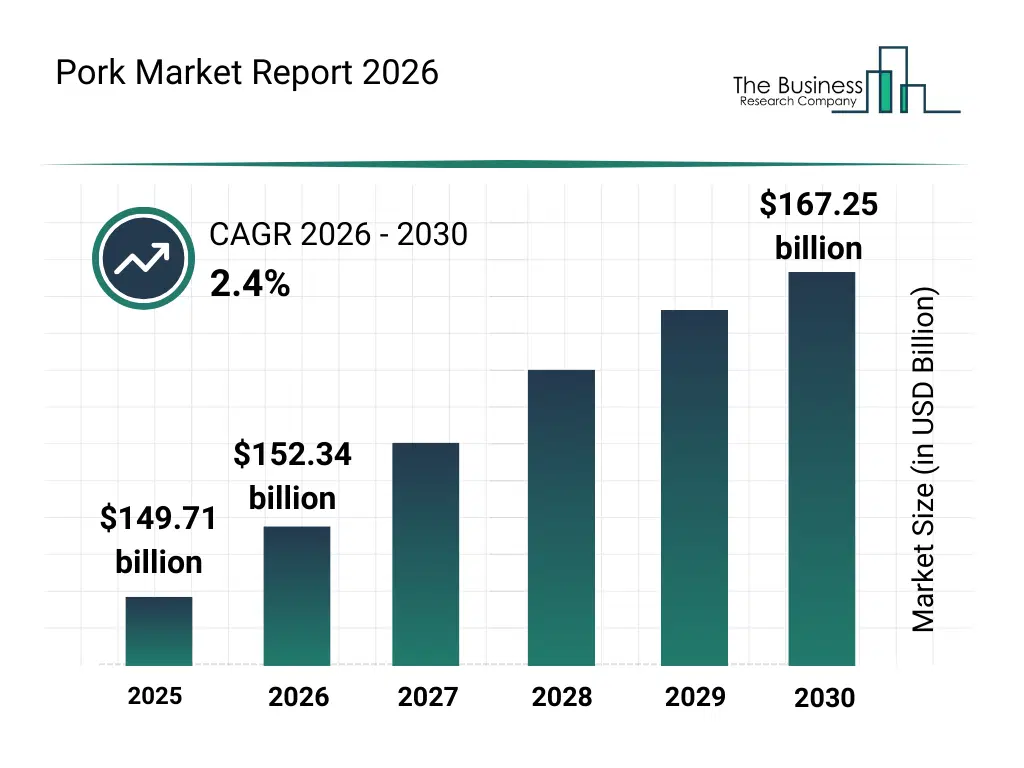
What Is The Pork Market Size and Share 2026?
The pork market size has grown marginally in recent years. It will grow from $149.71 billion in 2025 to $152.34 billion in 2026 at a compound annual growth rate (CAGR) of 1.8%. The growth in the historic period can be attributed to expansion of commercial pig farming operations, rising pork consumption in urban populations, improvements in meat processing infrastructure, growing availability of chilled and frozen pork products, increasing retail penetration of packaged meat.What Is The Pork Market Growth Forecast?
The pork market size is expected to see steady growth in the next few years. It will grow to $167.25 billion in 2030 at a compound annual growth rate (CAGR) of 2.4%. The growth in the forecast period can be attributed to increasing demand for protein-rich diets, rising focus on animal welfare standards, expansion of processed meat consumption, growing adoption of advanced packaging technologies, increasing regulatory oversight on meat quality. Major trends in the forecast period include increasing adoption of sustainable livestock farming practices, rising demand for traceable and quality-certified pork, growing use of advanced cold chain packaging, expansion of value-added pork products, enhanced focus on food safety compliance.

Global Pork Market Segmentation
1) By Type: Chilled, Frozen 2) By Packaging: Store Wrap, Modified Atmosphere Packaging, Vacuum Packaging, Shrink Bags 3) By Application: Household, Commercial Subsegments: 1) By Chilled: Fresh Chilled Pork Cuts, Fresh Chilled Pork Primal Cuts, Fresh Chilled Pork Offal 2) By Frozen: Frozen Pork Cuts, Frozen Pork Primal Cuts, Frozen Pork Offal The top segments in the pork market will be: • Chilled will reach $211201.54 Million by 2030. • Household will reach $203406.11 Million by 2030. • Shrink Bags will reach $102585.48 Million by 2030. • Commercial will reach $91893.56 Million by 2030. • Frozen will reach $84098.14 Million by 2030.What Is The Driver Of The Pork Market?
The increase in consumption of meat around the globe is driving the pork market going forward. Meat refers to the meat or other edible components of animals (often domesticated cattle, swine, and sheep) used for food, which may also include tendons, ligaments, and muscles. Pork is an excellent option for meals and consumption since it is an affordable meat to produce, has high protein content, and is adaptable. For instance, in October 2025 according to the Meat And Livestock Australia Limited, an Australia-based non-profit organization in 2024, Australia’s red meat and livestock exports increased by 3.2% year-on-year, reaching a value of $19.5 billion. Therefore, the increase in the consumption of meat across the globe is driving the market for pork.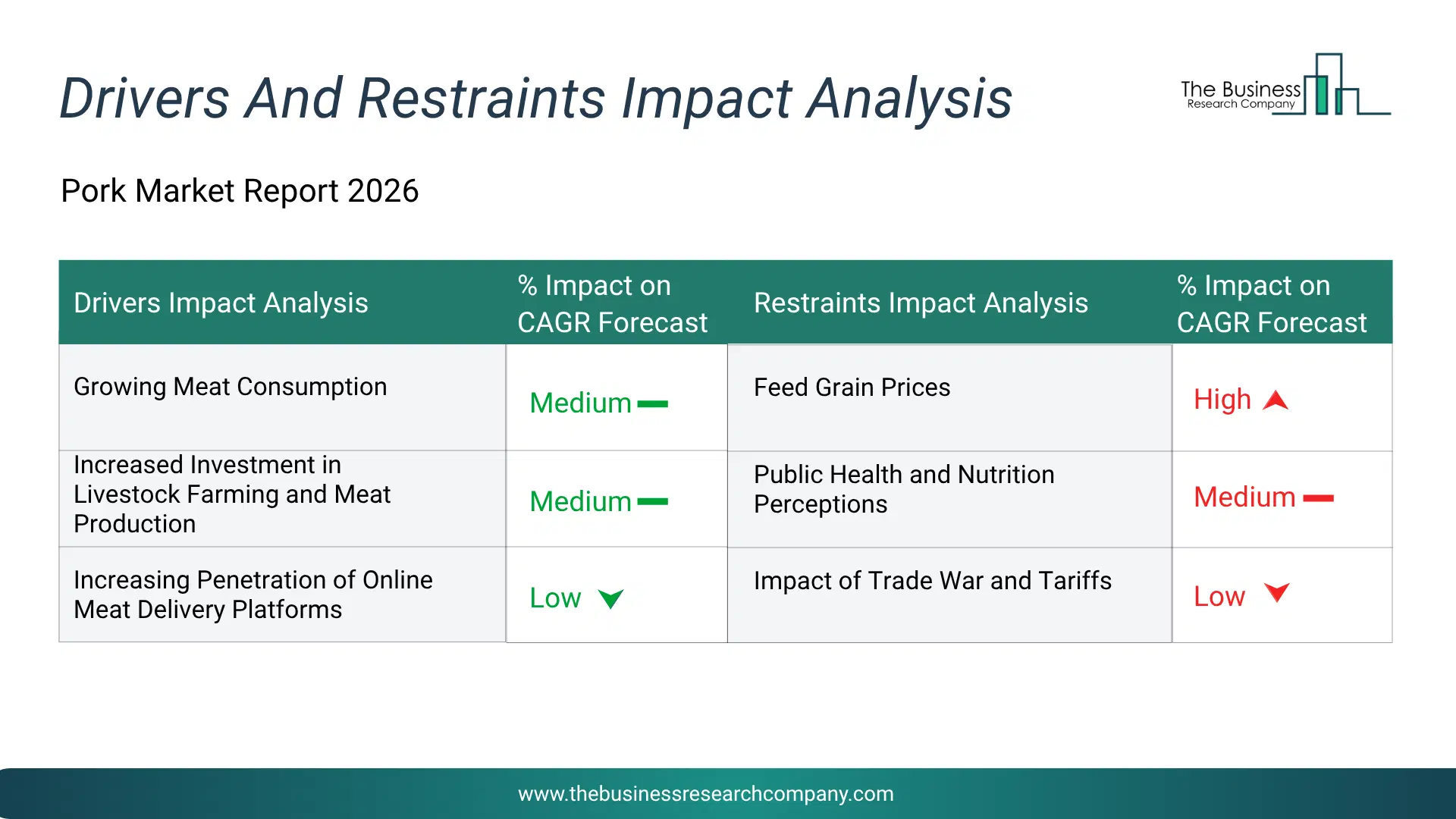
Infographic Chart Showing Key Market Drivers Analysis And Restraints For Pork Market
The chart presents an impact analysis of key drivers and restraints, quantifying their relative influence on the market's growth rate and helping assess the balance between growth enablers and limiting factors. This chart offers a high-level perspective; the full report contains more detailed insights.
How Will The Drivers Impact Growth In The Global Pork Market?
• Growing Meat Consumption (Medium) – During the forecast period, the growing consumption of meat will propel the growth of the pork market. rising incomes, urbanization, and shifting dietary preferences are driving consumers toward higher protein intake, increasing demand for a wide range of animal-source foods. pork, being one of the most widely consumed and versatile meats worldwide, is well positioned to benefit from this trend, particularly in regions where population growth and economic development support greater meat purchasing power. as households expand their protein consumption and incorporate more meat into daily diets, the need for reliable, affordable, and high-quality pork products rises correspondingly. this ongoing shift toward meat-centric eating patterns strengthens demand across fresh, chilled, and processed pork categories. as a result, growing consumption of meat is anticipated to contributing to a is 1.5% annual growth in the market. • Increased Investment in Livestock Farming and Meat Production (Medium) – During the forecast period, increased investment in livestock farming and meat production will propel the growth of the pork market. As producers and governments channel more capital into farm infrastructure, improved breeding systems, feed supply, and animal-health measures, pork production capacity will expand and become more efficient. Such investments help raise productivity, reduce costs, and support scale-up of pig farms and processing units, making pork more available and affordable to meet rising demand. With improved farming practices and supply-chain capabilities, producers will be better positioned to supply fresh, chilled, and frozen pork to both domestic and international markets. As a result of these investments, the pork market is expected to grow steadily. An increased investment in livestock farming and meat production growth contribution during the forecast period in 2025 is 0.5%. • Increasing Penetration of Online Meat Delivery Platforms (Low) – During the forecast period, the increasing penetration of online meat-delivery platforms will propel the growth of the pork market. as consumers increasingly rely on digital channels for grocery and fresh-food purchases, online platforms offer convenience, assured quality, and rapid delivery that align with shifting lifestyle preferences. the integration of cold-chain logistics, real-time tracking, and hygienic handling protocols enhances consumer confidence in purchasing fresh pork online. moreover, quick-commerce growth enables wider access to pork products across urban and semi-urban areas, expanding market reach beyond traditional retail outlets. as these platforms continue to scale and diversify their product assortments, the availability of fresh, chilled, and processed pork becomes more consistent and accessible, thereby driving the growth of the pork market. therefore, increasing penetration of online meat-delivery platforms is projected to contributing to a 1.0% annual growth in the market. • Government Support for Pork Breeding (Low) – During the forecast period, government support for pork breeding will propel the growth of the pork market. as policymakers strengthen incentives for livestock development, including subsidies, preferential credit access, and agricultural-equivalent status for animal husbandry activities, pork breeding becomes more financially attractive and scalable for producers. these supportive measures encourage investment in improved breeding facilities, better feed systems, and upgraded farm infrastructure, ultimately enhancing productivity and herd quality. additionally, the expansion of government-backed programs aimed at modernizing livestock management and promoting rural economic development increases the capacity of breeders to meet rising demand for high-quality pork. as more regions implement favorable policies to boost domestic meat production and reduce reliance on imports, government-led support will play a central role in expanding pork supply, improving production efficiency, and driving the growth of the pork market. consequently, government support for pork breeding is projected to contributing to a 1.3% annual growth in the market.How Will The Restraints Impact Growth In The Global Pork Market?
• Feed Grain Prices (Medium) – During the forecast period, rising feed grain prices are restricting the growth of the pork market during the forecast period. feed accounts for one of the largest operating costs in pork production, and increases in the prices of grains such as maize, wheat, and barley directly raise the cost of raising pigs. elevated grain prices also reduce profit margins for producers, making herd expansion less attractive and limiting overall production growth. in addition, fluctuations in global grain markets create uncertainty for pork producers, who depend on stable feed costs to maintain consistent supply and competitive pricing. higher feed costs ultimately translate to higher retail pork prices, which may drive consumers toward more affordable protein alternatives such as poultry or plant-based products. as a result, rising feed grain prices are gradually weakening demand for pork, particularly in markets where affordability, predictable pricing, and production efficiency are major purchasing factors. growth affected by the rising feed grain prices during the forecast period in 2025 is -2.6%. • Public Health and Nutrition Perceptions (Medium) – During the forecast period, public health and nutrition perceptions are restricting the growth of the pork market during the forecast period. increasing consumer awareness about the potential health risks associated with processed and red meat is shifting dietary preferences toward alternatives perceived as healthier. concerns surrounding links between pork consumption, particularly processed varieties such as bacon and ham, and conditions like cancer, heart disease, and obesity are prompting many consumers to reduce or avoid pork in their diets. these perceptions are reinforced by growing advocacy from scientists, public-health organizations, and nutrition experts who emphasize the benefits of plant-based proteins, poultry, and minimally processed foods. as a result, retailers and food manufacturers are responding to evolving consumer expectations by promoting “health-forward” products, further diverting attention away from traditional pork. this shift is gradually reducing the demand for pork, particularly in markets where health consciousness, clean-label preferences, and disease-prevention awareness strongly influence purchasing behavior. growth affected by the public health and nutrition perceptions during the forecast period in 2025 is -1.3%. • Impact of Trade War and Tariffs (Low) – During the forecast period, impact of trade war and tariff policies is restricting the growth of the pork market during the forecast period. tariff impositions raise the cost of international pork trade, making exports less competitive and increasing price volatility across global supply chains. these trade barriers also reduce market access for major pork-exporting countries, creating uncertainty for producers who rely heavily on overseas demand. in addition, retaliatory duties imposed by trading partners can further elevate import prices, discouraging buyers and prompting shifts toward alternative protein sources such as poultry or plant-based products. as a result, fluctuations in trade relations, especially between large importing and exporting nations, limit the stability and growth potential of the pork industry. this environment of elevated tariffs and shifting trade policies is gradually constraining pork demand in markets where affordability, consistent supply, and predictable trade conditions are essential purchasing factors. growth affected by trade war and tariffs across regions during the forecast period in 2025 is -0.2%.Key Players In The Global Pork Market
Major companies operating in the pork market are JBS SA, Tyson Foods Inc., Danish Crown A S, Vion Food Group Ltd., WH Group Limited, Hormel Foods Corporation, Muyuan Foods Co. Ltd., China Yurun Food Group Co. Ltd., Craig Mostyn Group, Tonnies Group, Cargill Inc., Seaboard Foods LLC, Triumph Foods LLC, Prestage Farms Inc., The Maschhoffs LLC, Clemens Food Group LLC, Indiana Packers Corporation, Maple Leaf Foods Inc., BRF S A, Marfrig Global Foods S A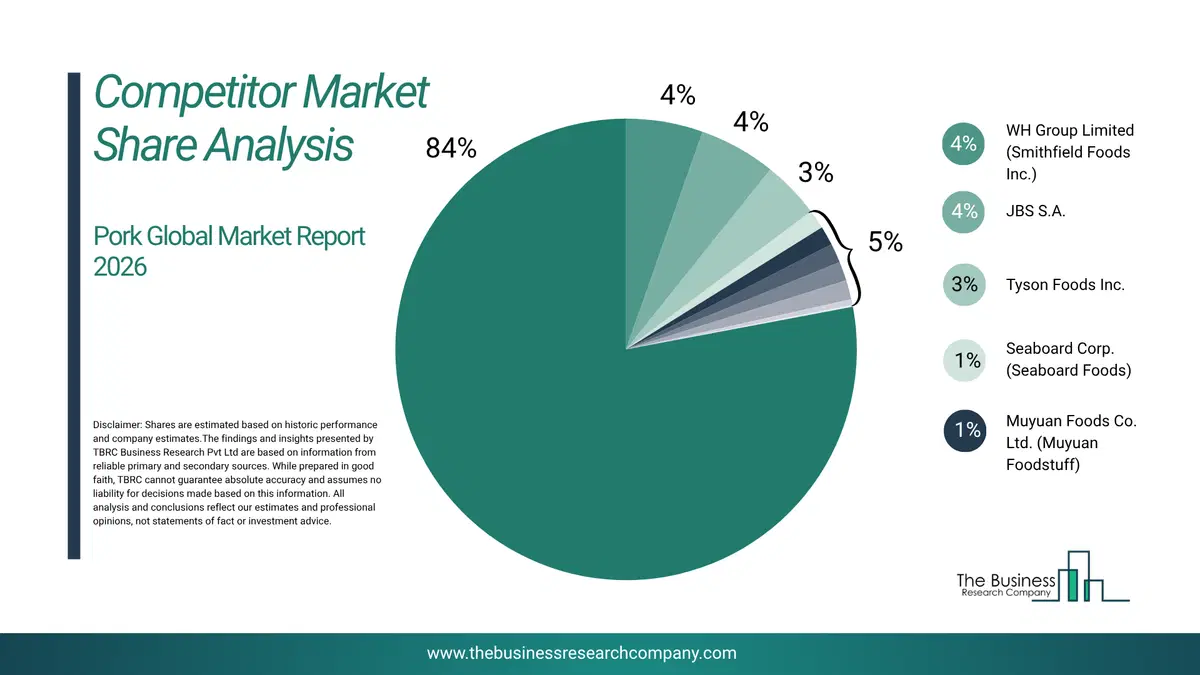
This chart is for illustrative purposes; the full report includes a detailed competitor analysis and comprehensive overview of the top 10 companies in the market.
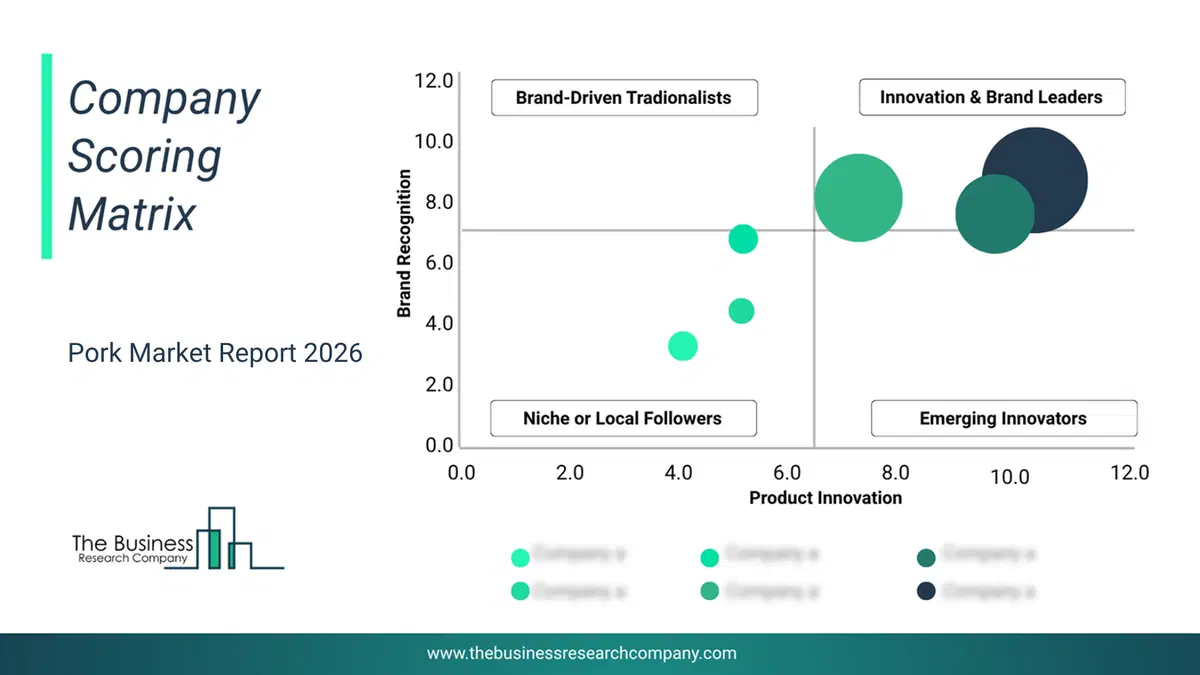
This chart maps companies by product innovation and brand strength, with bubble size indicating relative revenue, helping identify market leaders, challengers, and niche players. This is an illustrative chart; the full report provides a complete and accurate competitive analysis.
Global Pork Market Trends and Insights
Major companies operating in the pork market are adopting a strategic partnership approach, aiming to reduce pork's carbon footprint. Strategic partnerships refer to a process in which companies leverage each other's strengths and resources to achieve mutual benefits and success. For instance, in May 2023, BASF SE, a Germany-based energy management company, announced a partnership with the Danish Crown, a Denmark-based pork manufacturing company, to illustrate those nitrification inhibitors can cut nitrous oxide emissions by up to 50% when fertilizers are used to cultivate feed crops. The initiative is also funded by DLG Group, an association owned by 25,000 Danish farmers, and SEGES Innovation, a privately held, independent, non-profit Danish agricultural research and development company. BASF and the Danish Crown are collaborating to offer large-scale documentation of the enhanced climatic effect of BASF's nitrification inhibitors in the field. These are substances that may be simply added to manure when it is spread on the field. The active components have the potential to cut nitrous oxide emissions in half by delaying the process by which certain bacteria in the field transform ammonium to nitrate.What Are Latest Mergers And Acquisitions In The Pork Market?
In May 2024, Clemens Food Group, a US-based food processing company, acquired Kunzler & Company Inc. for an undisclosed amount. The acquisition will boost the company’s product range and market presence, enhancing production capacity and operational efficiency. It’s a strategic step to combine strengths and deliver better products and services, expanding its reach. Kunzler & Company Inc. is a US-based meat packaging company specializes in processing all types of meat including pork meat.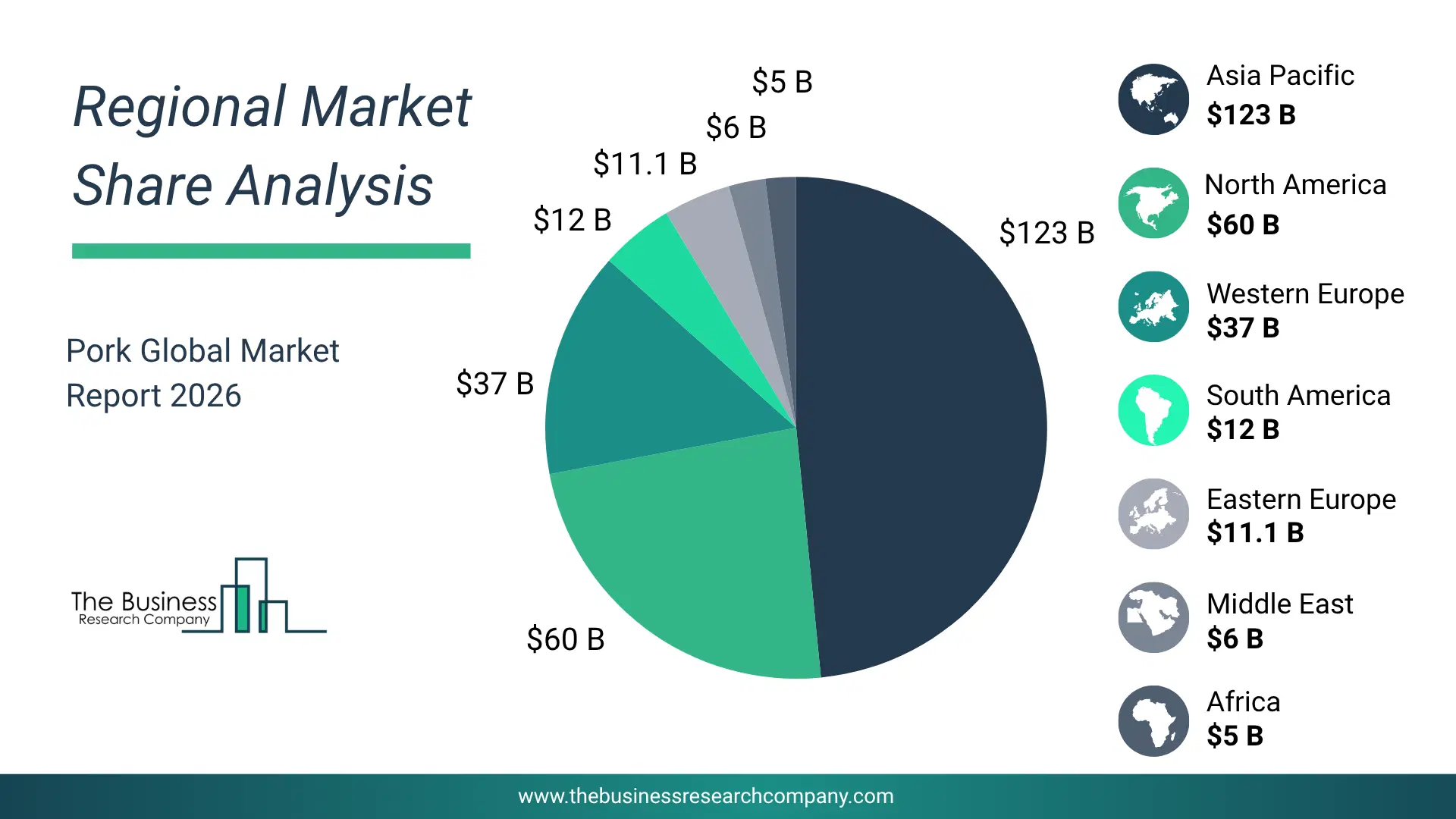
Regional Outlook
Asia-Pacific was the largest region in the pork market in 2025. The regions covered in this market report are Asia-Pacific, South East Asia, Western Europe, Eastern Europe, North America, South America, Middle East and Africa. The countries covered in this market report are Australia, Brazil, China, France, Germany, India, Indonesia, Japan, Taiwan, Russia, South Korea, UK, USA, Italy, Spain, CanadaWhat Defines the Pork Market?
The pork market consists of sales of bacon, ham, pork belly, pork ribs, pork steak, and pork tenderloin. Values in this market are ‘factory gate’ values, that is, the value of goods sold by the manufacturers or creators of the goods, whether to other entities (including downstream manufacturers, wholesalers, distributors, and retailers) or directly to end customers. The value of goods in this market includes related services sold by the creators of the goods.How is Market Value Defined and Measured?
The market value is defined as the revenues that enterprises gain from the sale of goods and/or services within the specified market and geography through sales, grants, or donations in terms of the currency (in USD unless otherwise specified). The revenues for a specified geography are consumption values that are revenues generated by organizations in the specified geography within the market, irrespective of where they are produced. It does not include revenues from resales along the supply chain, either further along the supply chain or as part of other products.
This chart presents market attractiveness based on a quantitative evaluation of growth, competition, strategic alignment, and risk, offering a clear view of opportunity areas for decision-making. This chart is for illustrative purposes; the full report contains the complete analysis.

This chart highlights the Total Addressable Market (TAM) by estimating the maximum revenue opportunity using an assumption-driven approach, supporting strategic planning and opportunity sizing across markets. The chart is illustrative; the full report provides a more comprehensive analysis.
What Key Data and Analysis Are Included in the Pork Market Report 2026?
The pork market research report is one of a series of new reports from The Business Research Company that provides market statistics, including industry global market size, regional shares, competitors with the market share, detailed market segments, market trends and opportunities, and any further data you may need to thrive in the pork industry. The market research report delivers a complete perspective of everything you need, with an in-depth analysis of the current and future state of the industry.Pork Market Report Forecast Analysis
| Report Attribute | Details |
|---|---|
| Market Size Value In 2026 | $152.34 billion |
| Revenue Forecast In 2030 | $167.25 billion |
| Growth Rate | CAGR of 1.8% from 2026 to 2030 |
| Base Year For Estimation | 2025 |
| Actual Estimates/Historical Data | 2020-2025 |
| Forecast Period | 2026 - 2030 - 2035 |
| Market Representation | Revenue in USD Billion and CAGR from 2026 to 2030 |
| Segments Covered | Type, Packaging, Application |
| Regional Scope | Asia-Pacific, Western Europe, Eastern Europe, North America, South America, Middle East, Africa |
| Country Scope | The countries covered in the report are Australia, Brazil, China, France, Germany, India, Indonesia, Japan, Taiwan, Russia, South Korea, UK, USA, Canada, Italy, Spain. |
| Key Companies Profiled | JBS SA, Tyson Foods Inc., Danish Crown A S, Vion Food Group Ltd., WH Group Limited, Hormel Foods Corporation, Muyuan Foods Co. Ltd., China Yurun Food Group Co. Ltd., Craig Mostyn Group, Tonnies Group, Cargill Inc., Seaboard Foods LLC, Triumph Foods LLC, Prestage Farms Inc., The Maschhoffs LLC, Clemens Food Group LLC, Indiana Packers Corporation, Maple Leaf Foods Inc., BRF S A, Marfrig Global Foods S A |
| Customization Scope | Request for Customization |
| Pricing And Purchase Options | Explore Purchase Options |