
Porous Ceramics Market Report 2026
Global Outlook – By Product Type (Oxides Ceramics, Non-Oxides Ceramics), By Raw Material (Alumina Ceramics, Titanate Ceramics, Zirconate Ceramics, Ferrite Ceramics, Aluminum Nitride, Other Raw Materials), By Application (Filtration, Insulation, High Purity Materials, Structural Components, Other Applications) – Market Size, Trends, Strategies, and Forecast to 2030
Porous Ceramics Market Overview
• Porous Ceramics market size has reached to $9.79 billion in 2025 • Expected to grow to $17 billion in 2030 at a compound annual growth rate (CAGR) of 11.6% • Growth Driver: Fulfilling Healthcare Needs The Surging Demand For Porous Ceramics In Medical Equipment • Market Trend: Sustainable Porous Bricks Transform Urban Water Management • Asia-Pacific was the largest region and fastest growing region.What Is Covered Under Porous Ceramics Market?
Porous ceramics refer to ceramic materials that contain interconnected voids, resulting in a lightweight and permeable structure. They are used in various applications, including filtration, catalysts, and biomedical implants, where their porosity allows for fluid or gas flow. Additionally, their thermal and mechanical properties make them suitable for thermal insulation and structural applications. The main types of products in porous ceramics are oxide ceramics, and non-oxide ceramics. The minerals used to make the ceramic materials are referred to as oxide ceramics. They are smashed or ground into a fine powder that is filtered by adding it to a solution and allowing a chemical precipitate to form. The different raw materials include alumina ceramics, titanate ceramics, zirconate ceramics, ferrite ceramics, aluminum nitride, and others and are used in filtration, insulation, high purity materials, structural components, and other applications.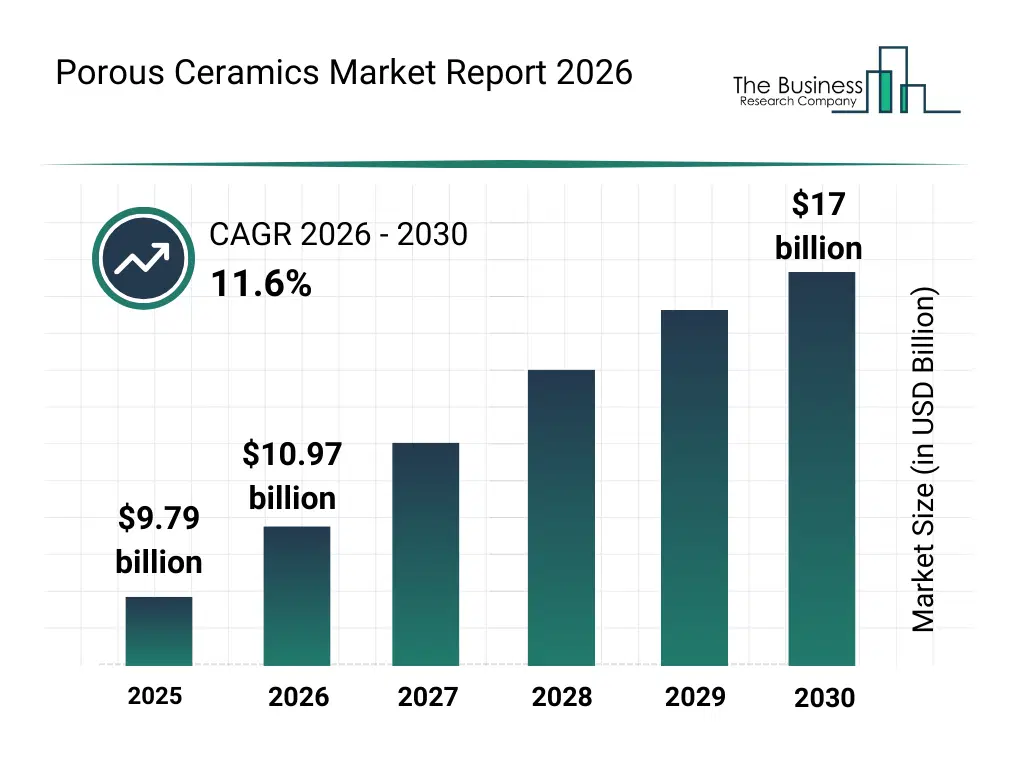
What Is The Porous Ceramics Market Size and Share 2026?
The porous ceramics market size has grown rapidly in recent years. It will grow from $9.79 billion in 2025 to $10.97 billion in 2026 at a compound annual growth rate (CAGR) of 12.1%. The growth in the historic period can be attributed to advancements in ceramic processing technologies, growth of industrial filtration demand, expansion of high-temperature insulation applications, increasing use in chemical processing, availability of advanced ceramic raw materials.What Is The Porous Ceramics Market Growth Forecast?
The porous ceramics market size is expected to see rapid growth in the next few years. It will grow to $17 billion in 2030 at a compound annual growth rate (CAGR) of 11.6%. The growth in the forecast period can be attributed to rising demand for energy-efficient materials, expansion of biomedical engineering applications, growing adoption in emission control systems, increasing focus on lightweight structural components, rising investments in advanced ceramics manufacturing. Major trends in the forecast period include growing use of porous ceramics in filtration applications, rising demand for lightweight thermal insulation materials, expansion of biomedical implant usage, increasing adoption in catalyst supports, enhanced structural performance optimization.
Global Porous Ceramics Market Segmentation
1) By Product Type: Oxides Ceramics, Non-Oxides Ceramics 2) By Raw Material: Alumina Ceramics, Titanate Ceramics, Zirconate Ceramics, Ferrite Ceramics, Aluminum Nitride, Other Raw Materials 3) By Application: Filtration, Insulation, High Purity Materials, Structural Components, Other Applications Subsegments: 1) By Oxides Ceramics: Alumina Ceramics, Zirconia Ceramics, Silica Ceramics, Titania Ceramics 2) By Non-Oxides Ceramics: Silicon Carbide Ceramics, Boron Carbide Ceramics, Nitrides Ceramics, Carbides CeramicsWhat Are The Drivers Of The Porous Ceramics Market?
The increasing demand for medical equipment will propel the growth of the porous ceramic equipment market. Medical equipment refers to the devices used for different medical purposes. Porous ceramics are used in medical devices for total hip replacement, dental implants and restorations, bone fillers, and scaffolds for tissue engineering. As a result, increasing demand for medical equipment increases the demand for porous ceramics. For instance, in June 2025, according to the International Trade Administration (ITA), a US-based government agency, India’s medical device industry is projected to grow from $12 billion in 2023–24 to $50 billion by 2030, driven by population growth, rising health needs, and supportive government initiatives. Therefore, the increasing demand for medical equipment in the healthcare sector is driving the growth of the porous ceramic industry. The increasing demand for natural gas and oil is expected to propel the growth of the porous ceramics market going forward. Natural gas and oil refer to hydrocarbon resources that are extracted from beneath the earth's surface and have various applications in the energy and industrial sectors. Porous ceramics are used in the gas and oil industries due to their unique properties, which include high-temperature resistance, corrosion resistance, and the ability to control the flow of fluids. For instance, in June 2024, according to the Energy Information Administration, a US-based government agency In our forecast, U.S. crude oil production is expected to rise by 2% from its 2023 level, reaching an average of 13.2 million barrels per day (b/d) in 2024. Following this, a further 4% increase is anticipated for 2025, bringing production to 13.7 million b/d. Therefore, increasing demand for natural gas and oil is driving the growth of the porous ceramics industry.Key Players In The Global Porous Ceramics Market
Major companies operating in the porous ceramics market are Rauschert GmbH, Noritake Co. Limited, Selee Corporation, CoorsTek Inc., Innovacera Advanced Material Co. Ltd., Nishimura Advanced Ceramics Co. Ltd., Morgan Advanced Materials plc, Superior Technical Ceramics Corp., NGK Spark Plug Co. Ltd., Refractron Technologies Corp., Lianyungang Henka Ceramics Technology Co. Ltd., Kyocera Corporation, Saint-Gobain Company, Corning Incorporated, CeramTec Ltd., Ibiden Co. Ltd., Pingxiang Chemshun Ceramics Co. Ltd., Sentro Tech Corporation, SCHOTT AG, Mantec Technical Ceramics Ltd., Alumina Products Inc., Teceram Ltd., Advanced Ceramics Manufacturing, Precision Ferrites & Ceramics Inc.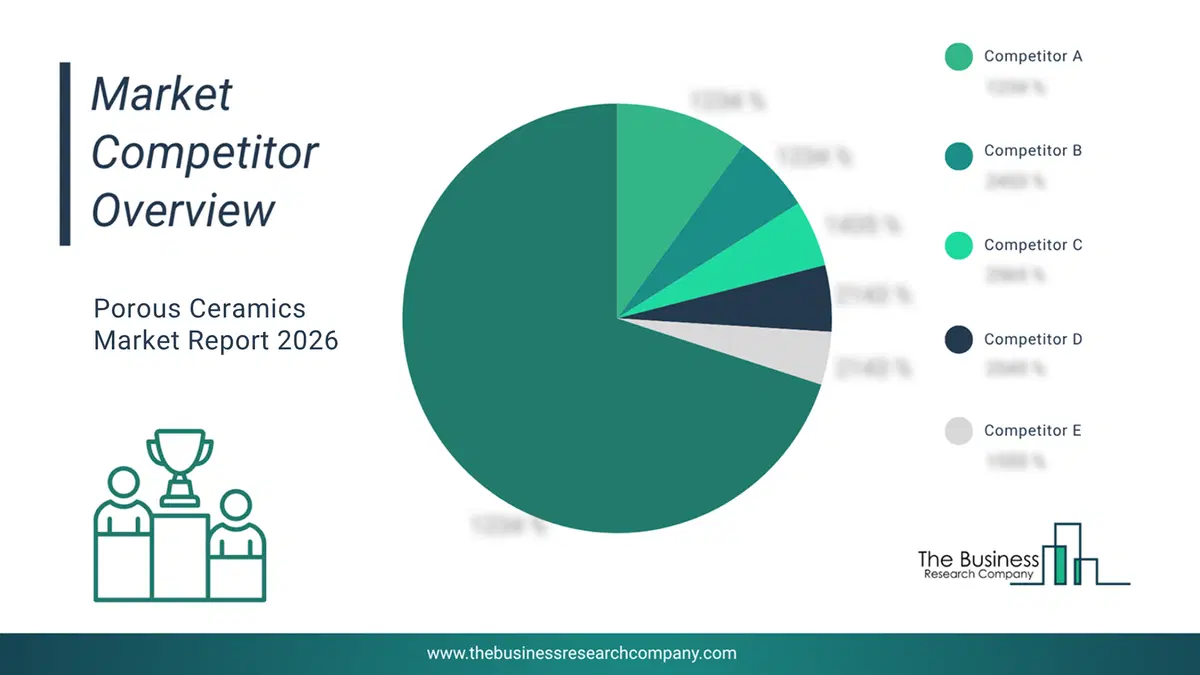
This chart is for illustrative purposes; the full report includes a detailed competitor analysis and comprehensive overview of the top 10 companies in the market.
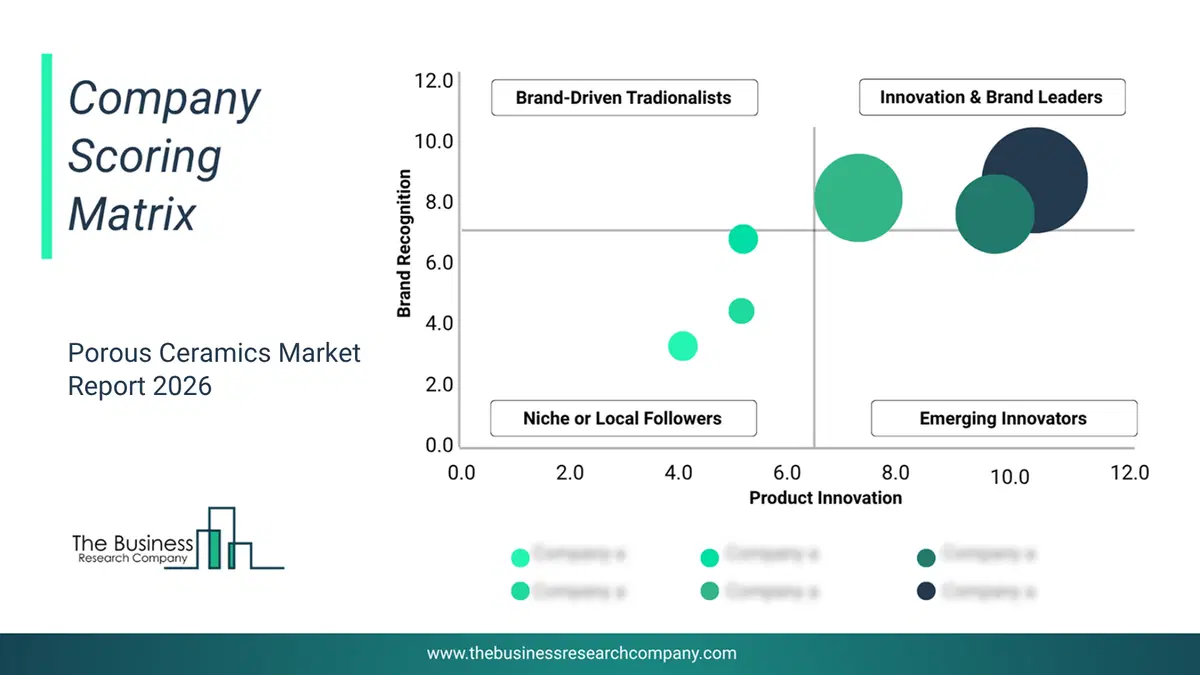
This chart maps companies by product innovation and brand strength, with bubble size indicating relative revenue, helping identify market leaders, challengers, and niche players. This is an illustrative chart; the full report provides a complete and accurate competitive analysis.
Global Porous Ceramics Market Trends and Insights
Major companies operating in the porous ceramics market are focusing on developing innovative advancements such as porous ceramic bricks to improve water management, reduce flooding risks, and support environmentally responsible construction. A porous ceramic brick is a structural building component made with controlled porosity that enables water infiltration while maintaining strength and durability. For instance, in November 2023, Yi Design, a China-based sustainable materials company, introduced the Permeable YiBrick as part of its efforts to transform recycled ceramic waste into functional, water-permeable building materials. The brick is manufactured using up to 97 percent recycled ceramic waste and features a highly porous structure that absorbs and redirects rainwater into the ground. Its durability and permeability make it suitable for sponge-city planning, paving, outdoor landscapes, and architectural applications that prioritize low-impact, water-management solutions.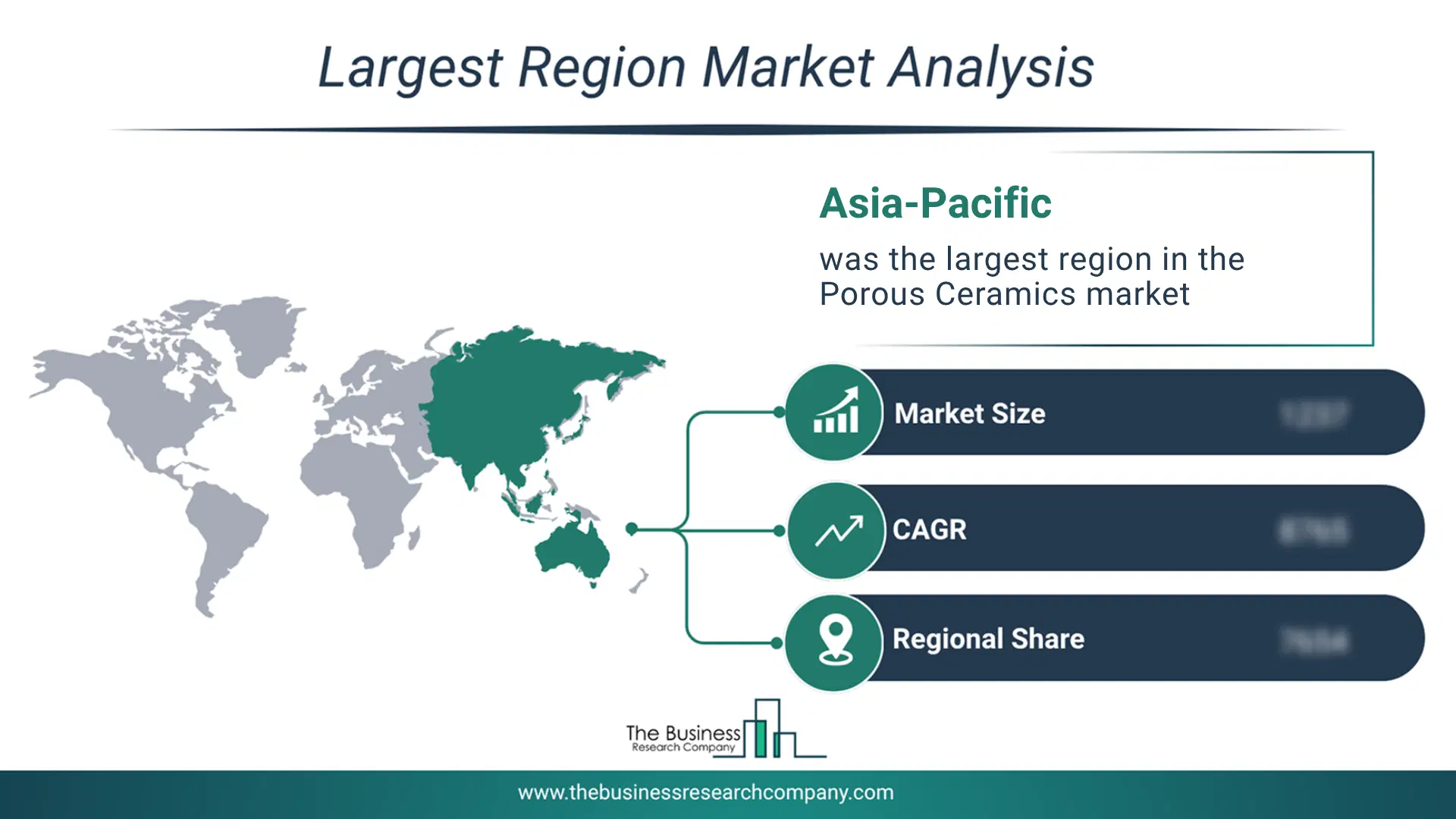
Regional Insights
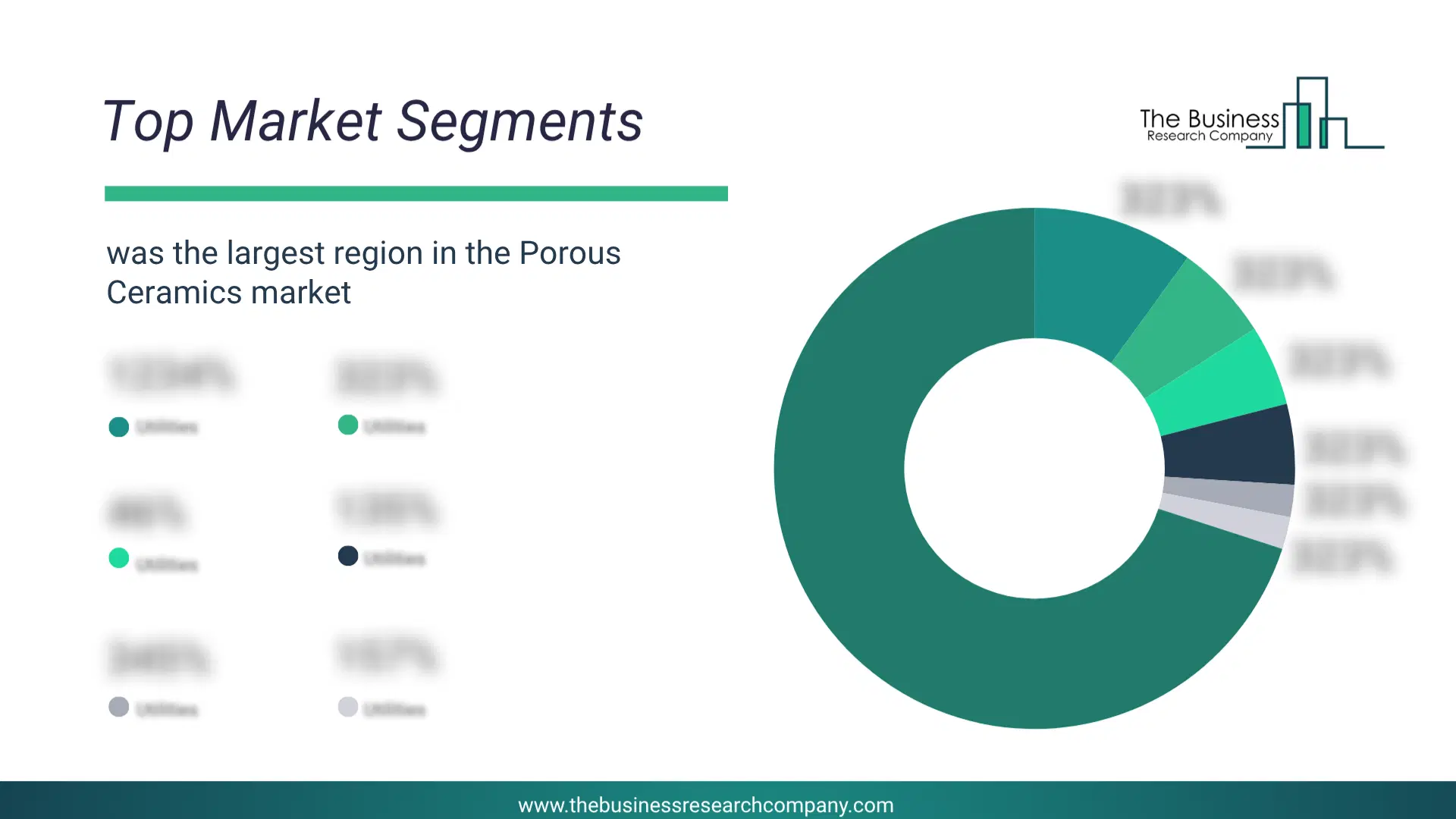
Asia-Pacific was the largest region in the porous ceramics market in 2025. Asia-Pacific is expected to be the fastest-growing region in the market. The regions covered in this market report are Asia-Pacific, South East Asia, Western Europe, Eastern Europe, North America, South America, Middle East, Africa The countries covered in this market report are Australia, Brazil, China, France, Germany, India, Indonesia, Japan, Taiwan, Russia, South Korea, UK, USA, Canada, Italy, SpainWhat Defines the Porous Ceramics Market?
The porous ceramics market consists of sales of cordierite and silica. Values in this market are ‘factory gate’ values, that is the value of goods sold by the manufacturers or creators of the goods, whether to other entities (including downstream manufacturers, wholesalers, distributors, and retailers) or directly to end customers. The value of goods in this market includes related services sold by the creators of the goods.How is Market Value Defined and Measured?
The market value is defined as the revenues that enterprises gain from the sale of goods and/or services within the specified market and geography through sales, grants, or donations in terms of the currency (in USD unless otherwise specified). The revenues for a specified geography are consumption values that are revenues generated by organizations in the specified geography within the market, irrespective of where they are produced. It does not include revenues from resales along the supply chain, either further along the supply chain or as part of other products.
This chart presents market attractiveness based on a quantitative evaluation of growth, competition, strategic alignment, and risk, offering a clear view of opportunity areas for decision-making. This chart is for illustrative purposes; the full report contains the complete analysis.

This chart highlights the Total Addressable Market (TAM) by estimating the maximum revenue opportunity using an assumption-driven approach, supporting strategic planning and opportunity sizing across markets. The chart is illustrative; the full report provides a more comprehensive analysis.
What Key Data and Analysis Are Included in the Porous Ceramics Market Report 2026?
The porous ceramics market research report is one of a series of new reports from The Business Research Company that provides market statistics, including industry global market size, regional shares, competitors with the market share, detailed market segments, market trends and opportunities, and any further data you may need to thrive in the porous ceramics industry. The market research report delivers a complete perspective of everything you need, with an in-depth analysis of the current and future state of the industry.Porous Ceramics Market Report Forecast Analysis
| Report Attribute | Details |
|---|---|
| Market Size Value In 2026 | $10.97 billion |
| Revenue Forecast In 2030 | $17 billion |
| Growth Rate | CAGR of 12.1% from 2026 to 2030 |
| Base Year For Estimation | 2025 |
| Actual Estimates/Historical Data | 2020-2025 |
| Forecast Period | 2026 - 2030 |
| Market Representation | Revenue in USD Billion and CAGR from 2026 to 2030 |
| Segments Covered | Product Type, Raw Material, Application |
| Regional Scope | Asia-Pacific, Western Europe, Eastern Europe, North America, South America, Middle East, Africa |
| Country Scope | The countries covered in this market report are Australia, Brazil, China, France, Germany, India, Indonesia, Japan, Taiwan, Russia, South Korea, UK, USA, Canada, Italy, Spain |
| Key Companies Profiled | Rauschert GmbH, Noritake Co. Limited, Selee Corporation, CoorsTek Inc., Innovacera Advanced Material Co. Ltd., Nishimura Advanced Ceramics Co. Ltd., Morgan Advanced Materials plc, Superior Technical Ceramics Corp., NGK Spark Plug Co. Ltd., Refractron Technologies Corp., Lianyungang Henka Ceramics Technology Co. Ltd., Kyocera Corporation, Saint-Gobain Company, Corning Incorporated, CeramTec Ltd., Ibiden Co. Ltd., Pingxiang Chemshun Ceramics Co. Ltd., Sentro Tech Corporation, SCHOTT AG, Mantec Technical Ceramics Ltd., Alumina Products Inc., Teceram Ltd., Advanced Ceramics Manufacturing, Precision Ferrites & Ceramics Inc. |
| Customization Scope | Request for Customization |
| Pricing And Purchase Options | Explore Purchase Options |