
Precision Harvesting Market Report 2026
Global Outlook – By Product (Combine Harvesters, Harvesting Robots, Self-propelled Forage Harvesters), By Offering (Hardware, Software, Services), By Application (Crop Harvesting, Greenhouse, Horticulture, Other Applications) – Market Size, Trends, Strategies, and Forecast to 2030
Precision Harvesting Market Overview
• Precision Harvesting market size has reached to $17.22 billion in 2025 • Expected to grow to $24.71 billion in 2030 at a compound annual growth rate (CAGR) of 7.3% • Growth Driver: Rising Demand For High Crop Yields To Drive Precision Harvesting Market Growth • Market Trend: Case IH Launches Axial-Flow 260 Series Combine With Advanced Harvest Command Automation • North America was the largest region in 2025.What Is Covered Under Precision Harvesting Market?
Precision harvesting refers to using advanced technologies and data analytics to improve agricultural harvesting processes' efficiency, accuracy, and sustainability. This approach integrates various modern tools such as GPS, sensors, drones, and data management systems to monitor and optimize every aspect of the harvesting operation. Precision harvesting aims to maximize yield, reduce waste, and minimize environmental impact. The main products of precision harvesting are combined harvesters, harvesting robots, and self-propelled forage harvesters. Combine harvesters are advanced agricultural machines that combine the functions of reaping, threshing, and cleaning to harvest crops efficiently. They are a key component of precision harvesting, as they integrate technologies such as GPS, sensors, and data analytics to optimize the harvesting process and maximize crop yields. The various offerings include hardware, software, and services, and are used for various applications such as crop harvesting, greenhouse, horticulture, and others.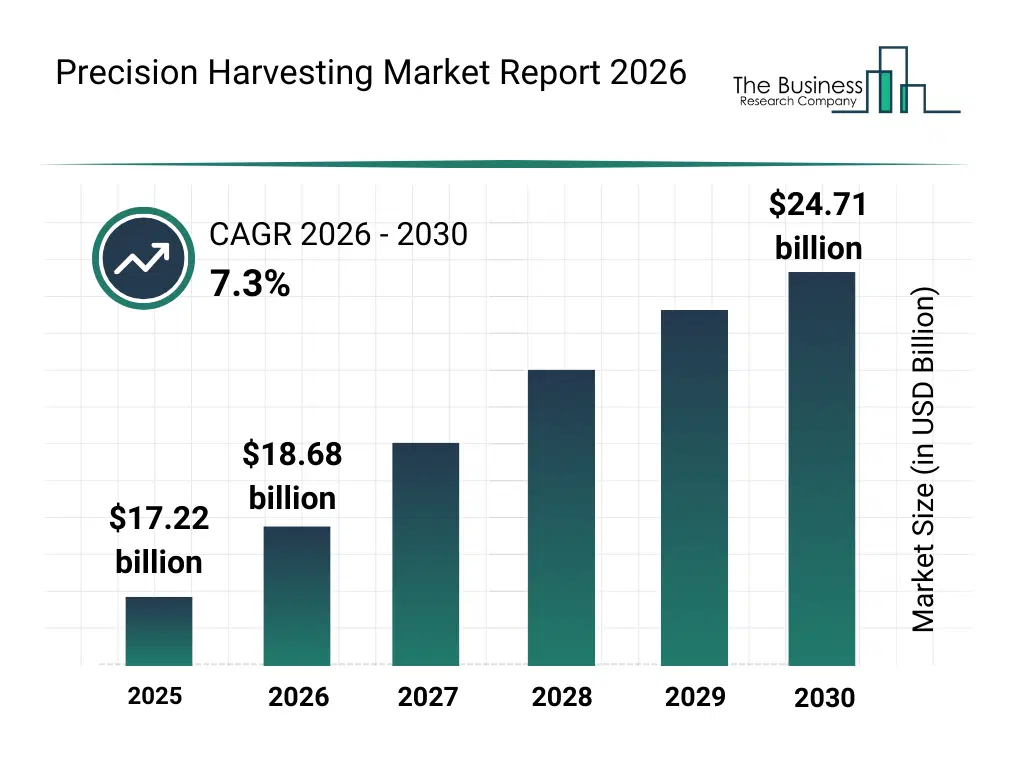
What Is The Precision Harvesting Market Size and Share 2026?
The precision harvesting market size has grown strongly in recent years. It will grow from $17.22 billion in 2025 to $18.68 billion in 2026 at a compound annual growth rate (CAGR) of 8.4%. The growth in the historic period can be attributed to rise in mechanized harvesting adoption, increasing need for higher crop recovery rates, early use of gps-enabled combine harvesters, growing labor shortages in agriculture, adoption of semi-automated fruit picking tools.What Is The Precision Harvesting Market Growth Forecast?
The precision harvesting market size is expected to see strong growth in the next few years. It will grow to $24.71 billion in 2030 at a compound annual growth rate (CAGR) of 7.3%. The growth in the forecast period can be attributed to growth in AI-driven crop maturity prediction, rising adoption of autonomous harvesting robots, expansion of big data analytics for harvest planning, increasing integration of smart sensors in harvesting systems, demand for sustainable and low-waste harvesting practices. Major trends in the forecast period include rising adoption of automated harvesting machinery, increased use of sensor-based crop readiness assessment, expansion of gps-enabled harvest optimization, growing integration of real-time yield monitoring tools, higher demand for waste-reducing harvesting techniques.
Global Precision Harvesting Market Segmentation
1) By Product: Combine Harvesters, Harvesting Robots, Self-propelled Forage Harvesters 2) By Offering: Hardware, Software, Services 3) By Application: Crop Harvesting, Greenhouse, Horticulture, Other Applications Subsegments: 1) By Combine Harvesters: Grain Combine Harvesters, Corn Combine Harvesters, Rice Combine Harvesters, Multi-Crop Combine Harvesters 2) By Harvesting Robots: Fruit-Picking Robots, Vegetable-Picking Robots, Automated Grape Harvesters, Autonomous Berry Harvesters 3) By Self-Propelled Forage Harvesters: Corn Forage Harvesters, Grass Forage Harvesters, Sugarcane Forage Harvesters, Whole-Crop Forage HarvestersWhat Is Driver Of The Precision Harvesting Market?
The rising demand for high crop yields is expected to propel the growth of the precision harvesting market going forward. High crop yield refers to the quantity of agricultural produce harvested per unit of cultivated land area, typically measured in weight or volume. The demand for high crop yields is influenced by several factors, such as urbanization, climate change, food security, rising incomes, shifting dietary habits, global trade, and market demands. Precision harvesting technologies and practices enable farmers to maximize crop yields by improving efficiency, reducing losses, enhancing quality, and making informed decisions based on real-time data and analytics. For instance, In July 2024, according to the Department for Environment, Food & Rural Affairs (UK), a UK-based report, the value of fruit production increased by 2.2% to just over $1.25 billion (£1.0 billion). Barley exports increased to 937 thousand tonnes in 2023 from 898 tonnes in 2022. Sugar beet production increased by 39% to 7.7 million tonnes. The value of production rose by 82% to $460 million (£368 million), with prices increasing by 31% to $59.38 USD (£47.5) per tonne per hectare. Therefore, the rising demand for high crop yields is driving the growth of the precision harvesting industry.Key Players In The Global Precision Harvesting Market
Major companies operating in the precision harvesting market are Deere & Company, CNH Industrial NV, KUBOTA Corporation, AGCO Corporation, Trimble Inc., Topcon Corporation, Raven Industries Inc., Precision Planting LLC, TeeJet Technologies, CLAAS KGAA mbH, Kinze Manufacturing Inc., Ag Leader Technology, FarmWise Labs Inc., Clearpath Robotics Inc., Sentera Inc., Farmers Edge Inc., DICKEY-john Corporation, Taranis Visual Ltd., senseFly SA, PrecisionHawk Inc., Octinion NV, VineView Sciences Inc.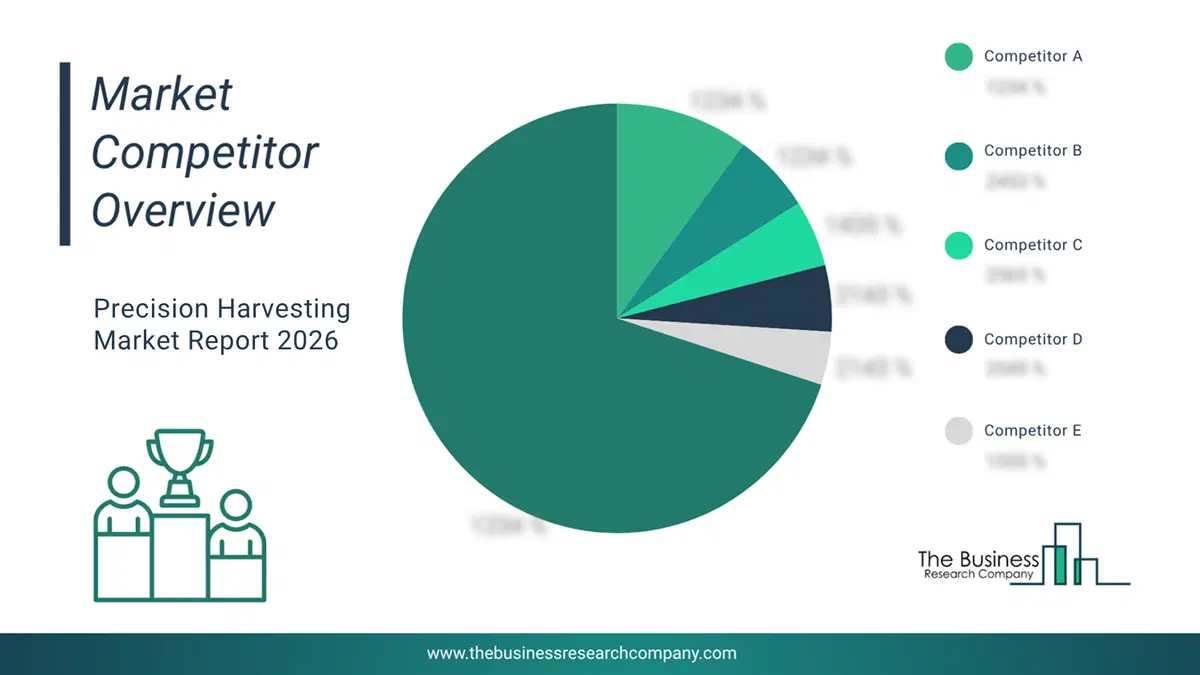
This chart is for illustrative purposes; the full report includes a detailed competitor analysis and comprehensive overview of the top 10 companies in the market.
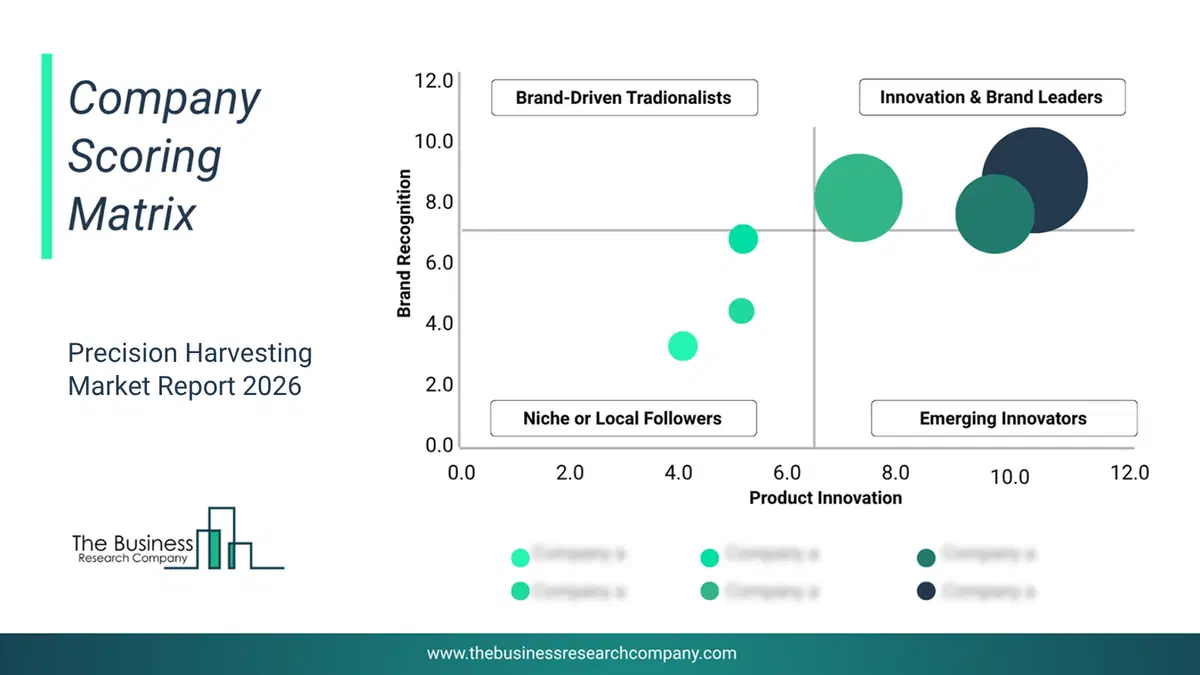
This chart maps companies by product innovation and brand strength, with bubble size indicating relative revenue, helping identify market leaders, challengers, and niche players. This is an illustrative chart; the full report provides a complete and accurate competitive analysis.
Global Precision Harvesting Market Trends and Insights
Major companies operating in the precision harvesting market are focused on developing advanced products, such as automated harvesting systems, to help farmers increase productivity and profitability during the busy harvest season. An automation harvesting system refers to using advanced technologies and machinery to perform harvesting tasks with minimal human intervention. These systems leverage robotics, sensors, artificial intelligence, and other technologies to efficiently and accurately harvest crops. For instance, in June 2024, Case IH, a US-based company that manufactures machinery for agriculture, launched the new Axial-Flow 260 series combine, featuring a subscription-free, integrated technology designed to meet the unique needs of growers. The Axial-Flow 260 series features harvest command combine automation, which automatically adjusts settings to maximize throughput and grain quality. It includes high-resolution Pro 1200 Dual Displays, allowing operators to easily monitor machine metrics, field performance, and grain quality in real time. The 260 series features dual Pro1200 displays that provide intuitive Harvest Command automation technology, advanced guidance, mapping capabilities, and connectivity with other Pro700-enabled machines. The premium technology built within the combine maximizes throughput and grain handling with single-rotor Case IH harvesting technology.What Are Latest Mergers And Acquisitions In The Precision Harvesting Market? CNH Industrial Acquires Hemisphere GNSS To Strengthen Precision Harvesting And Guidance Capabilities
In October 2023, CNH Industrial N.V., a US-based provider of agricultural and construction equipment and precision agriculture technology, acquired Hemisphere GNSS, Inc. for USD $175 million. With this acquisition, CNH Industrial sought to enhance its in-house precision, automation, and autonomy capabilities particularly in guidance and connectivity technologies critical to the precision harvesting market. Hemisphere GNSS is a US-based provider of satellite navigation positioning systems and machine-control hardware and software for agriculture, construction, and machine-automation applications.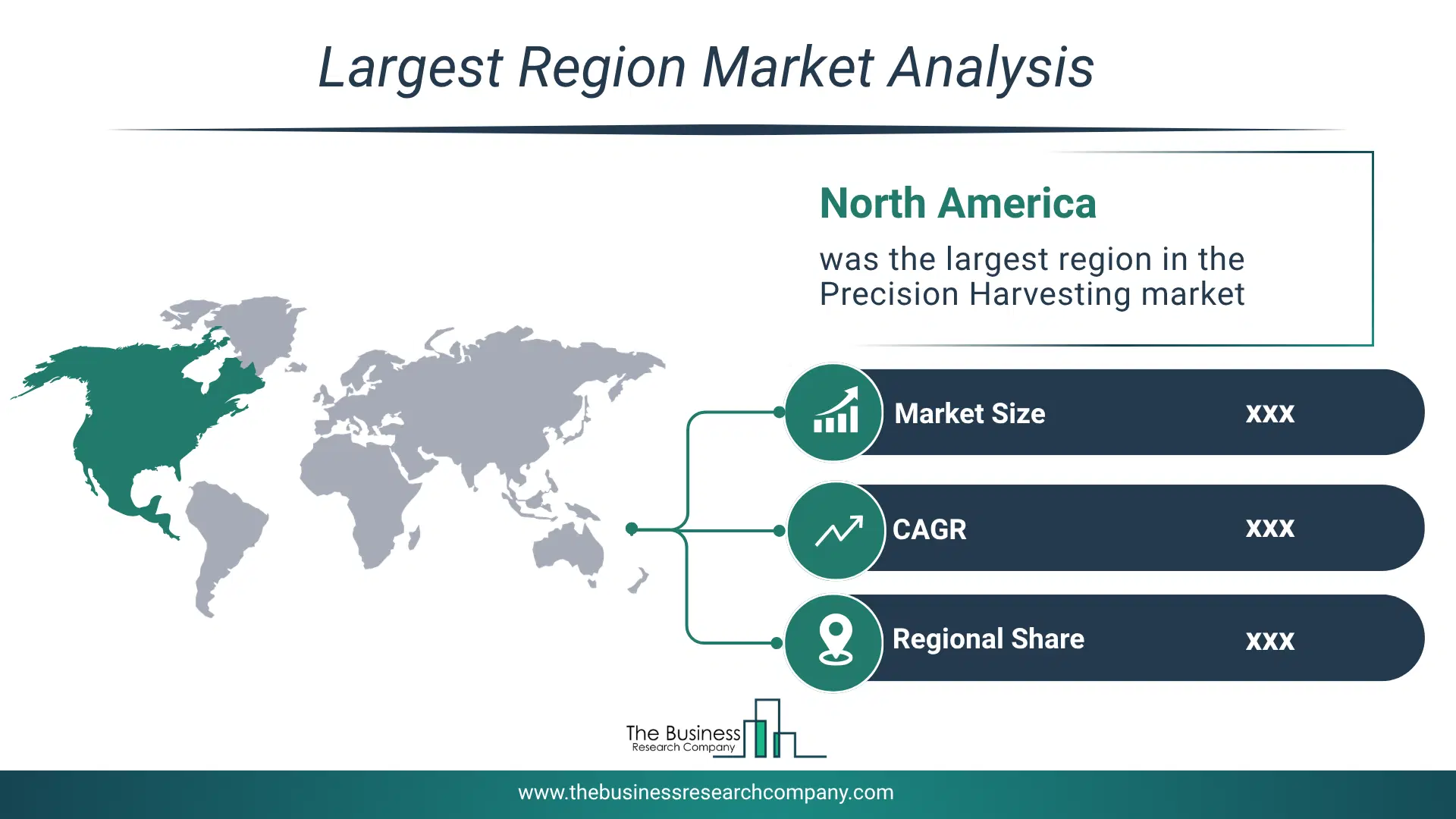
Regional Outlook
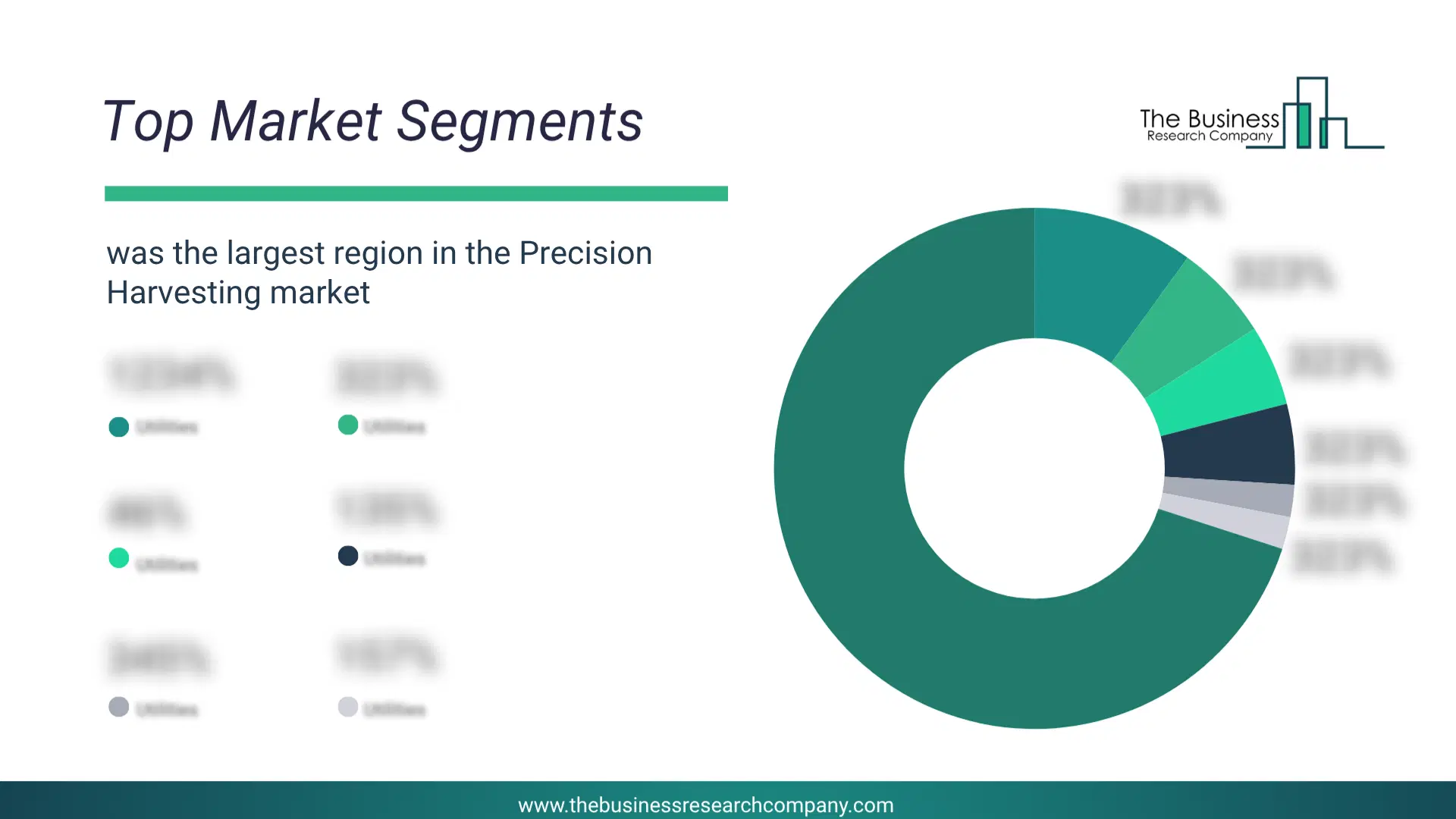
North America was the largest region in the precision harvesting market in 2025. The regions covered in this market report are Asia-Pacific, South East Asia, Western Europe, Eastern Europe, North America, South America, Middle East, Africa. The countries covered in this market report are Australia, Brazil, China, France, Germany, India, Indonesia, Japan, Taiwan, Russia, South Korea, UK, USA, Canada, Italy, SpainWhat Defines the Precision Harvesting Market?
The precision harvesting market consist of revenues earned by entities by providing services such as logistics and supply chain management, field services and maintenance, precision technology installation, and remote sensing and imaging. The market value includes the value of related goods sold by the service provider or included within the service offering. The precision harvesting market also includes sales of GNSS guidance systems, automated harvesters, yield monitors, and climate control and preservation systems. Values in this market are ‘factory gate’ values, that is the value of goods sold by the manufacturers or creators of the goods, whether to other entities (including downstream manufacturers, wholesalers, distributors and retailers) or directly to end customers. The value of goods in this market includes related services sold by the creators of the goods.How is Market Value Defined and Measured?
The market value is defined as the revenues that enterprises gain from the sale of goods and/or services within the specified market and geography through sales, grants, or donations in terms of the currency (in USD unless otherwise specified). The revenues for a specified geography are consumption values that are revenues generated by organizations in the specified geography within the market, irrespective of where they are produced. It does not include revenues from resales along the supply chain, either further along the supply chain or as part of other products.
This chart presents market attractiveness based on a quantitative evaluation of growth, competition, strategic alignment, and risk, offering a clear view of opportunity areas for decision-making. This chart is for illustrative purposes; the full report contains the complete analysis.

This chart highlights the Total Addressable Market (TAM) by estimating the maximum revenue opportunity using an assumption-driven approach, supporting strategic planning and opportunity sizing across markets. The chart is illustrative; the full report provides a more comprehensive analysis.
What Key Data and Analysis Are Included in the Precision Harvesting Market Report 2026?
The precision harvesting market research report is one of a series of new reports from The Business Research Company that provides market statistics, including industry global market size, regional shares, competitors with the market share, detailed market segments, market trends and opportunities, and any further data you may need to thrive in the precision harvesting industry. The market research report delivers a complete perspective of everything you need, with an in-depth analysis of the current and future state of the industry.Precision Harvesting Market Report Forecast Analysis
| Report Attribute | Details |
|---|---|
| Market Size Value In 2026 | $18.68 billion |
| Revenue Forecast In 2030 | $24.71 billion |
| Growth Rate | CAGR of 7.3% from 2026 to 2030 |
| Base Year For Estimation | 2025 |
| Actual Estimates/Historical Data | 2020-2025 |
| Forecast Period | 2026 - 2030 |
| Market Representation | Revenue in USD Billion and CAGR from 2026 to 2030 |
| Segments Covered | Product, Offering, Application |
| Regional Scope | Asia-Pacific, Western Europe, Eastern Europe, North America, South America, Middle East, Africa |
| Country Scope | The countries covered in the report are Australia, Brazil, China, France, Germany, India, Indonesia, Japan, Taiwan, Russia, South Korea, UK, USA, Canada, Italy, Spain |
| Key Companies Profiled | Deere & Company, CNH Industrial NV, KUBOTA Corporation, AGCO Corporation, Trimble Inc., Topcon Corporation, Raven Industries Inc., Precision Planting LLC, TeeJet Technologies, CLAAS KGAA mbH, Kinze Manufacturing Inc., Ag Leader Technology, FarmWise Labs Inc., Clearpath Robotics Inc., Sentera Inc., Farmers Edge Inc., DICKEY-john Corporation, Taranis Visual Ltd., senseFly SA, PrecisionHawk Inc., Octinion NV, VineView Sciences Inc. |
| Customization Scope | Request for Customization |
| Pricing And Purchase Options | Explore Purchase Options |