
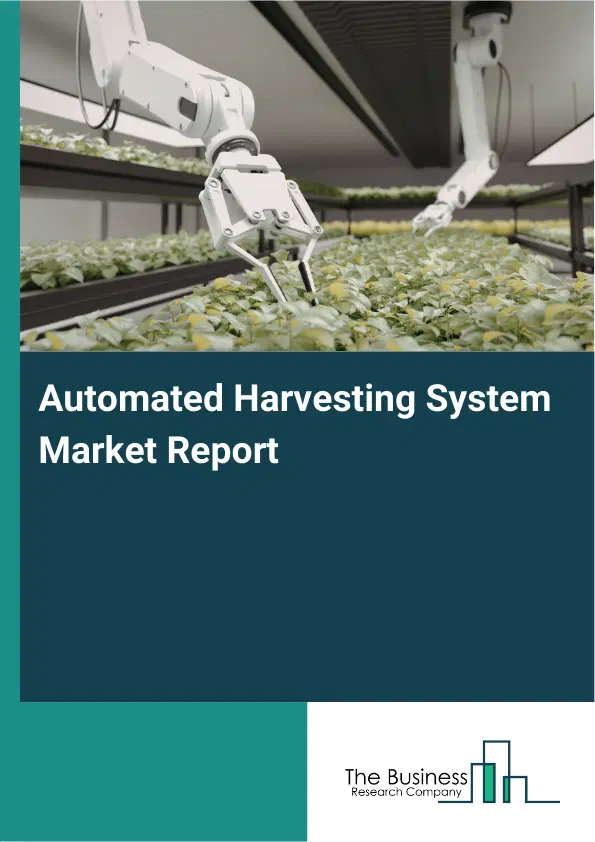
Automated Harvesting System Market Report 2026
Global Outlook – By Component (Fruit Harvesting Robots, Vegetable Harvesting Robots, Row Crop Harvesters, Greenhouse Harvesting Robots, Nut And Orchard Harvesting Machines), By Technology (Vision And Sensing Technologies, Robotic Manipulation And End-Effectors, Autonomous Navigation And Mobility Technologies, Artificial Intelligence And Data Analytics, Automation And Control Systems, Mechatronics And Actuation Technologies, Harvest-Specific Technologies), By Application (Horticulture, Greenhouse, Crops, Other Applications) – Market Size, Trends, Strategies, and Forecast to 2030
Automated Harvesting System Market Overview
• Automated Harvesting System market size has reached to $2.19 billion in 2025 • Expected to grow to $3.15 billion in 2030 at a compound annual growth rate (CAGR) of 7.6% • Growth Driver: Rising Demand For Industrial Crops Fuels Automated Harvesting Systems Growth • Market Trend: Innovative Autonomous Robot for Efficient Soft Fruit Harvesting • North America was the largest region in 2025.What Is Covered Under Automated Harvesting System Market?
An automated harvesting system is an agricultural harvesting equipment that uses various technologies to automate agricultural operations more efficiently. Farmers can save money on labor by using these harvesters. These machines can harvest more fruits and vegetables in less time than an entire team of employees. The main components of an automated harvesting system are energy harvesting transducers, power management integrated circuits (PMIC), and storage systems. Energy harvesting transducers refer to a piece of electronic equipment that transforms energy from one form to another. They are utilized to collect energy from the environment, such as light, heat, and vibration, and use it to power wireless sensor nodes. The technologies of automated harvesting system include light energy harvesting, vibration energy harvesting, radio frequency energy harvesting, thermal energy harvesting and frequency energy harvesting that are applied in horticulture, greenhouse, crops, and others.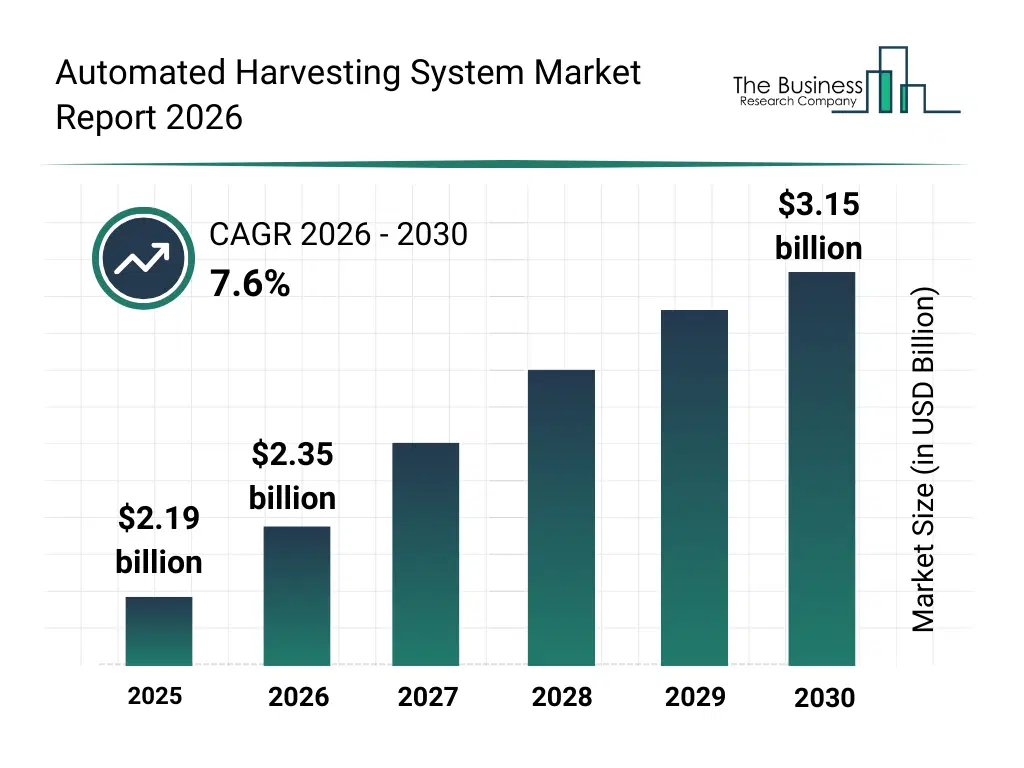
What Is The Automated Harvesting System Market Size and Share 2026?
The automated harvesting system market size has grown strongly in recent years. It will grow from $2.19 billion in 2025 to $2.35 billion in 2026 at a compound annual growth rate (CAGR) of 7.0%. The growth in the historic period can be attributed to rising agricultural labor shortages, expansion of high-value crop farming, increasing mechanization of harvesting operations, adoption of precision farming techniques, improved reliability of agricultural robotics.What Is The Automated Harvesting System Market Growth Forecast?
The automated harvesting system market size is expected to see strong growth in the next few years. It will grow to $3.15 billion in 2030 at a compound annual growth rate (CAGR) of 7.6%. The growth in the forecast period can be attributed to increasing investments in autonomous farming technologies, rising demand for cost-efficient harvesting solutions, expansion of automation in specialty crop harvesting, growing adoption in greenhouse and controlled environments, increasing focus on yield optimization. Major trends in the forecast period include increasing adoption of vision-guided harvesting machines, rising deployment of robotic fruit and vegetable harvesters, growing integration of sensor-based crop detection, expansion of autonomous field operation capabilities, enhanced focus on harvest speed and accuracy.Tariff Impact On Automated Harvesting System Market
Tariffs are impacting the automated harvesting system market by increasing costs of imported sensors, robotic arms, electric actuators, control units, and precision components used in harvesting machines. Horticulture and greenhouse operations in North America and Europe are most affected due to dependence on advanced imported robotics hardware, while Asia-Pacific faces cost pressures in manufacturing and export-oriented production. These tariffs are raising system prices and slowing adoption among small and mid-sized farms. However, they are also encouraging local assembly, regional supplier development, and innovation in cost-optimized automated harvesting solutions.
Global Automated Harvesting System Market Segmentation
1) By Component: Fruit Harvesting Robots, Vegetable Harvesting Robots, Row Crop Harvesters, Greenhouse Harvesting Robots, Nut And Orchard Harvesting Machines 2) By Technology: Vision And Sensing Technologies, Robotic Manipulation And End-Effectors, Autonomous Navigation And Mobility Technologies, Artificial Intelligence And Data Analytics, Automation And Control Systems, Mechatronics And Actuation Technologies, Harvest-Specific Technologies 3) By Application: Horticulture, Greenhouse, Crops, Other Applications Subsegments: 1) By Fruit Harvesting Robots: Apple Harvesting Robots, Citrus Harvesting Robots, Berry Harvesting Robots (Strawberries, Raspberries, Blueberries), Grape Harvesting Robots 2) By Vegetable Harvesting Robots: Tomato Harvesting Robots, Lettuce And Leafy Green Harvesters, Pepper Harvesting Robots, Cucumber Harvesting Robots 3) By Row Crop Harvesters: Automated Wheat Harvesters, Automated Corn Harvesters, Automated Soybean Harvesters, Automated Potato Harvesters 4) By Greenhouse Harvesting Robots: Robotic Arm Pickers, Autonomous Mobile Picking Robots, Automated Vertical Farming Harvesters 5) By Nut And Orchard Harvesting Machines: Almond Shakers, Walnut Harvesters, Pistachio Harvesters, Robotic Tree Fruit PickersWhat Is The Driver Of The Automated Harvesting System Market?
Increased demand for industrial crops is expected to propel the growth of automated harvesting systems. Industrial crops are crops that are often not offered directly for eating because they must be processed industrially before use, and they include sugarcane, tea, pepper, and coconut. Automated harvesting systems are used to remove crops from the vine. Before removing crops from the vine, the harvesting robot employs computer vision to detect and gauge the ripeness of the fruit. Automated harvesting systems for industrial crops can help increase efficiency and productivity in agriculture. For instance, in June 2024, according to the Department for Environment Food and Rural Affairs, a US-based governmental department, in 2023, the total factor productivity of the UK's agriculture industry reached 241, up from 235 the previous year, marking a 2.70%. Therefore, increased demand for industrial crops is driving the growth of the automated harvesting systems industry going forward.Key Players In The Global Automated Harvesting System Market
Major companies operating in the automated harvesting system market are ABB Ltd., Honeywell International Inc., CNH Industrial N.V., Robert Bosch GmbH, DeepField Robotics (a Bosch startup), Clearpath Robotics Inc., AgEagle Aerial Systems Inc., BouMatic Robotics B.V., Deere & Company, Blue River Technology Inc., Abundant Robotics Inc., Grownetics Inc., YANMAR Holdings Co., Ltd., Kubota Agricultural Machinery India Pvt. Ltd., AGCO Corporation, Trimble Inc., DJI (SZ DJI Technology Co., Ltd.), Lely International N.V., DeLaval International AB, Kistler Group (Kistler Holding AG).
This chart is for illustrative purposes; the full report includes a detailed competitor analysis and comprehensive overview of the top 10 companies in the market.
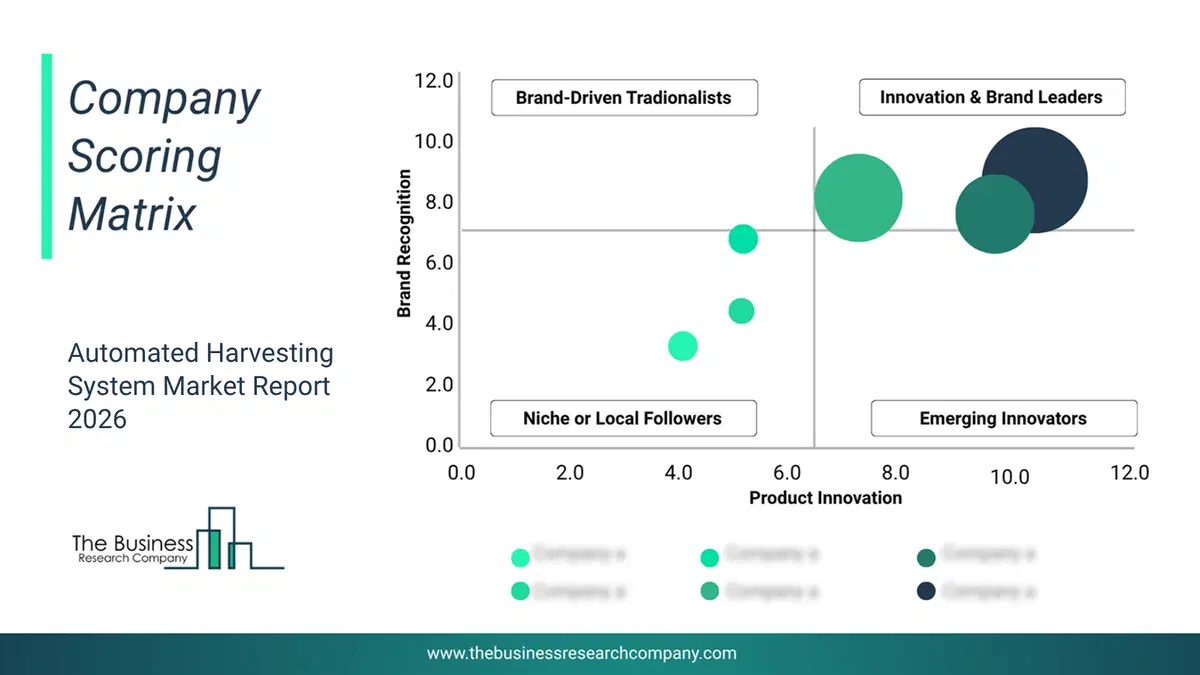
This chart maps companies by product innovation and brand strength, with bubble size indicating relative revenue, helping identify market leaders, challengers, and niche players. This is an illustrative chart; the full report provides a complete and accurate competitive analysis.
Global Automated Harvesting System Market Trends and Insights
Major companies operating in the automated harvesting systems market are developing advanced technology such as autonomous robot models to enhance efficiency, reduce labor costs, and improve the precision of agricultural harvesting. Autonomous robot models refer to robotic systems designed to operate independently in performing tasks without human intervention. For instance, in August 2024, Fieldwork Robotics, a UK-based agricultural technology company, launched Fieldworker 1, an autonomous robot model. Fieldworker 1 is an innovative autonomous robot designed specifically for harvesting soft fruit, such as strawberries. Equipped with advanced sensors and machine learning algorithms, this robot can navigate fields, identify ripe fruit, and carefully pick it without damaging the plants. Its deployment aims to streamline the harvesting process, significantly reduce labor costs, and enhance overall efficiency in agricultural operations.What Are Latest Mergers And Acquisitions In The Automated Harvesting System Market?
In April 2023, Bosch BASF Smart Farming, a Germany-based farming technology company, acquired AGCO Corporation for an undisclosed amount. Through this acquisition, Bosch BASF Smart Farming aimed to accelerate the expansion of the farming and harvesting solutions provider and capitalize on its track record of delivering superior products, thereby enhancing customer satisfaction. Through this acquisition, within the same solution, farmers will also be able to benefit from customized agronomic recommendations and reliable documentation. AGCO Corporation is a US-based manufacturer of agricultural machinery.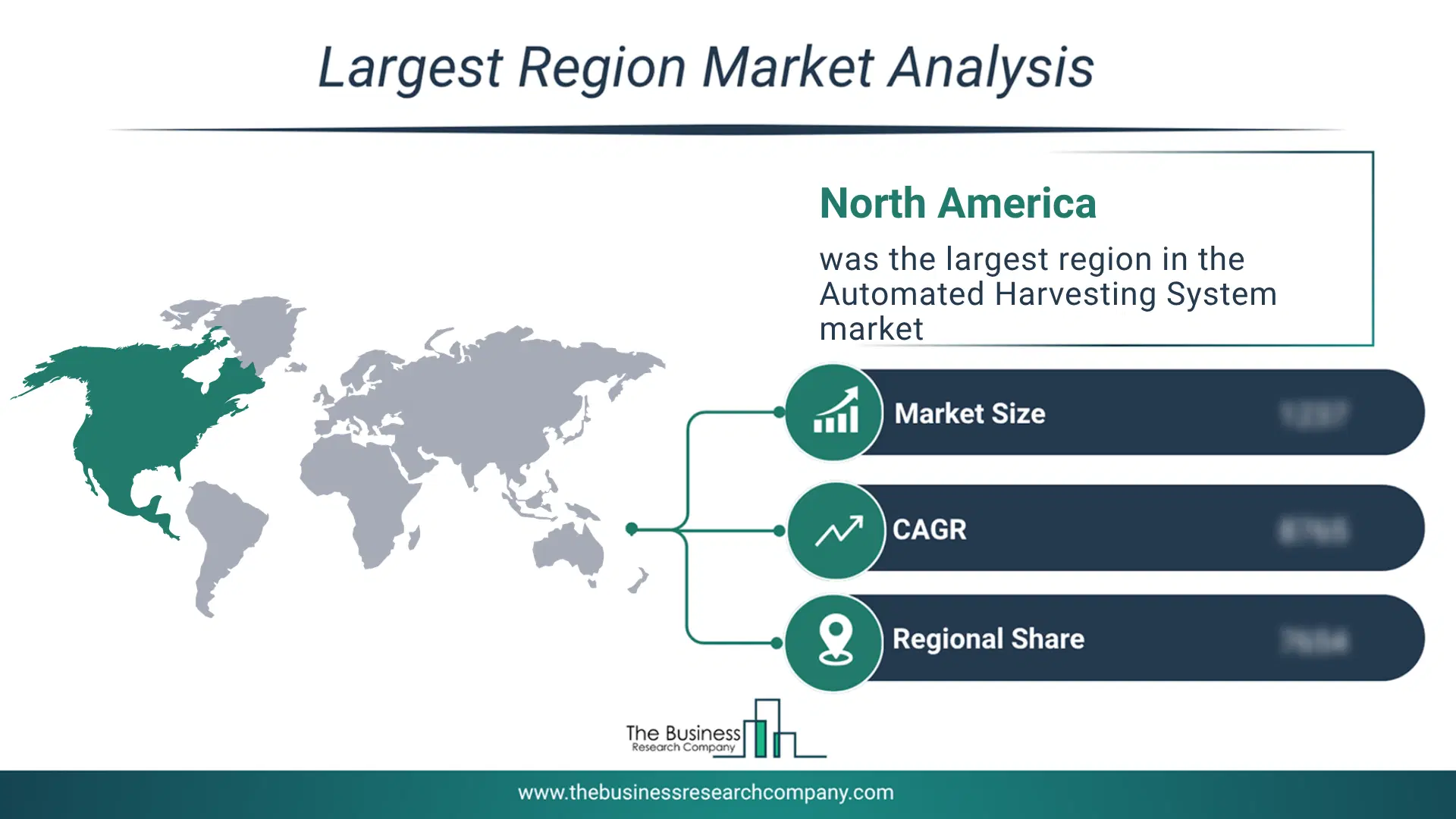
Regional Outlook
North America was the largest region in the automated harvesting system market in 2025. The regions covered in this market report are Asia-Pacific, South East Asia, Western Europe, Eastern Europe, North America, South America, Middle East, Africa The countries covered in this market report are Australia, Brazil, China, France, Germany, India, Indonesia, Japan, Taiwan, Russia, South Korea, UK, USA, Canada, Italy, Spain.What Defines the Automated Harvesting System Market?
The automated harvesting systems market consists of revenues earned by entities by providing services such as planting, harvesting, automatic watering, seeding, and cutting crops using an automated harvesting system. The market value includes the value of related goods sold by the service provider or included within the service offering. The automated harvesting systems market consists of sales of robotic vacuum apple peckers, energetic citrus picking systems, and others. Values in this market are ‘factory gate’ values, that is, the value of goods sold by the manufacturers or creators of the goods, whether to other entities (including downstream manufacturers, wholesalers, distributors, and retailers) or directly to end customers. The value of goods in this market includes related services sold by the creators of the goods.How is Market Value Defined and Measured?
The market value is defined as the revenues that enterprises gain from the sale of goods and/or services within the specified market and geography through sales, grants, or donations in terms of the currency (in USD unless otherwise specified). The revenues for a specified geography are consumption values that are revenues generated by organizations in the specified geography within the market, irrespective of where they are produced. It does not include revenues from resales along the supply chain, either further along the supply chain or as part of other products.
This chart presents market attractiveness based on a quantitative evaluation of growth, competition, strategic alignment, and risk, offering a clear view of opportunity areas for decision-making. This chart is for illustrative purposes; the full report contains the complete analysis.

This chart highlights the Total Addressable Market (TAM) by estimating the maximum revenue opportunity using an assumption-driven approach, supporting strategic planning and opportunity sizing across markets. The chart is illustrative; the full report provides a more comprehensive analysis.
What Key Data and Analysis Are Included in the Automated Harvesting System Market Report 2026?
The automated harvesting system market research report is one of a series of new reports from The Business Research Company that provides market statistics, including industry global market size, regional shares, competitors with the market share, detailed market segments, market trends and opportunities, and any further data you may need to thrive in the automated harvesting system industry. The market research report delivers a complete perspective of everything you need, with an in-depth analysis of the current and future state of the industry.Automated Harvesting System Market Report Forecast Analysis
| Report Attribute | Details |
|---|---|
| Market Size Value In 2026 | $2.35 billion |
| Revenue Forecast In 2030 | $3.15 billion |
| Growth Rate | CAGR of 7.6% from 2026 to 2030 |
| Base Year For Estimation | 2025 |
| Actual Estimates/Historical Data | 2020-2025 |
| Forecast Period | 2026 - 2030 |
| Market Representation | Revenue in USD Billion and CAGR from 2026 to 2030 |
| Segments Covered | Component, Technology, Application |
| Regional Scope | Asia-Pacific, Western Europe, Eastern Europe, North America, South America, Middle East, Africa |
| Key Companies Profiled | ABB Ltd., Honeywell International Inc., CNH Industrial N.V., Robert Bosch GmbH, DeepField Robotics (a Bosch startup), Clearpath Robotics Inc., AgEagle Aerial Systems Inc., BouMatic Robotics B.V., Deere & Company, Blue River Technology Inc., Abundant Robotics Inc., Grownetics Inc., YANMAR Holdings Co., Ltd., Kubota Agricultural Machinery India Pvt. Ltd., AGCO Corporation, Trimble Inc., DJI (SZ DJI Technology Co., Ltd.), Lely International N.V., DeLaval International AB, Kistler Group (Kistler Holding AG). |
| Customization Scope | Request for Customization |
| Pricing And Purchase Options | Explore Purchase Options |