
Smart Harvest Market Report 2026
Global Outlook – By Component (Hardware, Software ), By Crop Type (Fruits, Vegetables), By Site Of Operation (On-Field, Greenhouse, Indoor), By End User (Agriculture, Horticulture, Floriculture, Vertical Farming) – Market Size, Trends, Strategies, and Forecast to 2030
Smart Harvest Market Overview
• Smart Harvest market size has reached to $19.71 billion in 2025 • Expected to grow to $36.23 billion in 2030 at a compound annual growth rate (CAGR) of 13.1% • Growth Driver: Meeting Rising Food Demand With The Growth Of The Smart Harvest Market • Market Trend: Technological Advancements In Smart Harvesting • Western Europe was the largest region in 2025 and North America is the fastest growing region.What Is Covered Under Smart Harvest Market?
Smart harvest refers to the use of advanced technologies, such as machine learning, and artificial intelligence to automate and optimize agricultural harvesting processes. It is commonly used to increase the efficiency of harvest processes, reduce labor costs, and improve overall crop quality. The main types of crops in smart harvest are fruits and vegetables. Fruits are the edible products of plants that contain seeds, such as apples, strawberries, and oranges. They are segmented into hardware and software components. They are operated at various sites, such as on-field, in greenhouses, and indoors, which are used for various applications such as agriculture, horticulture, floriculture, vertical farming, and others.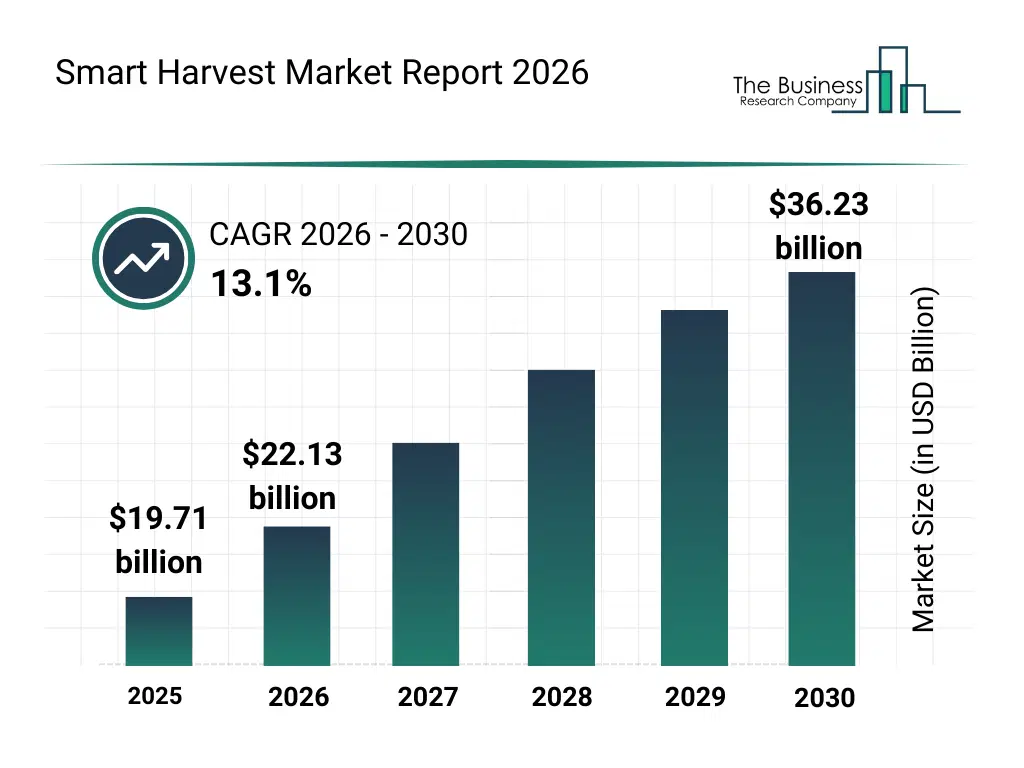
What Is The Smart Harvest Market Size and Share 2026?
The smart harvest market size has grown rapidly in recent years. It will grow from $19.71 billion in 2025 to $22.13 billion in 2026 at a compound annual growth rate (CAGR) of 12.3%. The growth in the historic period can be attributed to labor shortages in agriculture, rising demand for improved harvesting efficiency, increasing mechanization in farming operations, growth of large scale commercial agriculture, need to reduce harvest time and crop wastage.What Is The Smart Harvest Market Growth Forecast?
The smart harvest market size is expected to see rapid growth in the next few years. It will grow to $36.23 billion in 2030 at a compound annual growth rate (CAGR) of 13.1%. The growth in the forecast period can be attributed to advancements in ai and machine learning technologies, increased investment in smart agriculture solutions, growing adoption of sustainable farming practices, expansion of connected farm infrastructure, rising focus on data driven decision making in agriculture. Major trends in the forecast period include ai enabled vision based harvesting, autonomous robotic harvesters, real time crop monitoring integration, precision harvesting for quality optimization, automation driven labor efficiency.Tariff Impact On Smart Harvest Market
Tariffs have increased costs in the smart harvest market by raising prices of imported sensors, robotics components, drones, and automated machinery used in harvesting systems. These cost pressures have slowed adoption among small and mid scale farms, especially in regions dependent on imported agri technology such as Asia Pacific and parts of Europe. Hardware intensive segments including robotic harvesters and drone based solutions are most affected, while software platforms remain less impacted. At the same time, tariffs are encouraging local manufacturing, regional sourcing, and development of cost efficient smart harvest technologies.
Global Smart Harvest Market Segmentation
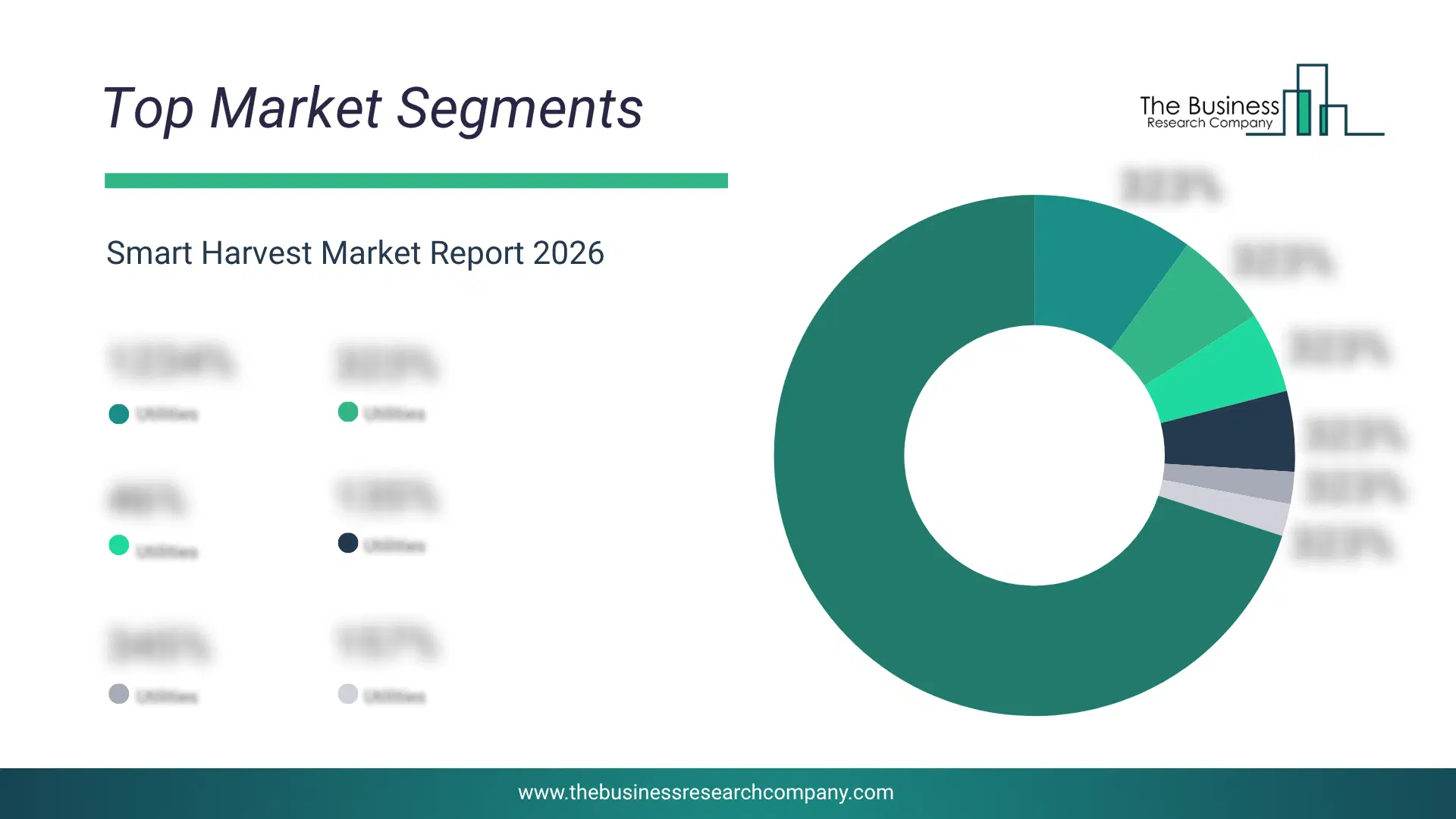
1) By Component: Hardware, Software 2) By Crop Type: Fruits, Vegetables 3) By Site Of Operation: On-Field, Greenhouse, Indoor 4) By End User: Agriculture, Horticulture, Floriculture, Vertical Farming Subsegments: 1) By Hardware: Sensors, Drones, Automated Machinery, Robotics, GPS Systems 2) By Software: Farm Management Software, Data Analytics Software, Crop Monitoring Applications, Yield Prediction SoftwareWhat Is The Driver Of The Smart Harvest Market?
The increasing demand for food is expected to propel the growth of the smart harvest market going forward. Food demand is the amount of food that people are willing and able to buy at a particular price and period. Smart harvesting can help fulfill rising food demand by enhancing agricultural production and efficiency. Smart farming techniques enable farmers to monitor individual plants and alter their nutrition, which helps prevent conditions and improve crop health. It also integrates several advanced technologies that can assist in raising agricultural output and efficiency. For instance, in December 2024, according to the FoodNavigator, a UK-based online B2B digital media platform, total “CPG” (consumer-packaged-goods) store‐sales volumes for food & beverage rose 1.1% in 2024 the first increase in three years. Therefore, the increasing food demand is driving the growth of the smart harvest industry.Key Players In The Global Smart Harvest Market
Major companies operating in the smart harvest market are Agrobot SL, Deere and Company, Harvest Automation Inc., Root Al Inc., Abundant Robotics Inc., Harvest CROO Robotics LLC, FFRobotics Ltd., Iron Ox Inc., Vision Robotics Corp., Metomotion Ltd., Smart Harvest Agritech Ltd., Dogtooth Technologies Ltd., Octinion, Ripe Robotics Pty Ltd., Agrobotix LLC, Fieldwork Robotics Ltd., Naio Technologies, FarmWise Labs, Inc., Green Robot Machinery Private Limited, Saga Robotics AS, Harvesting Inc., Octagrow Ltd., Yanmar Co. Ltd.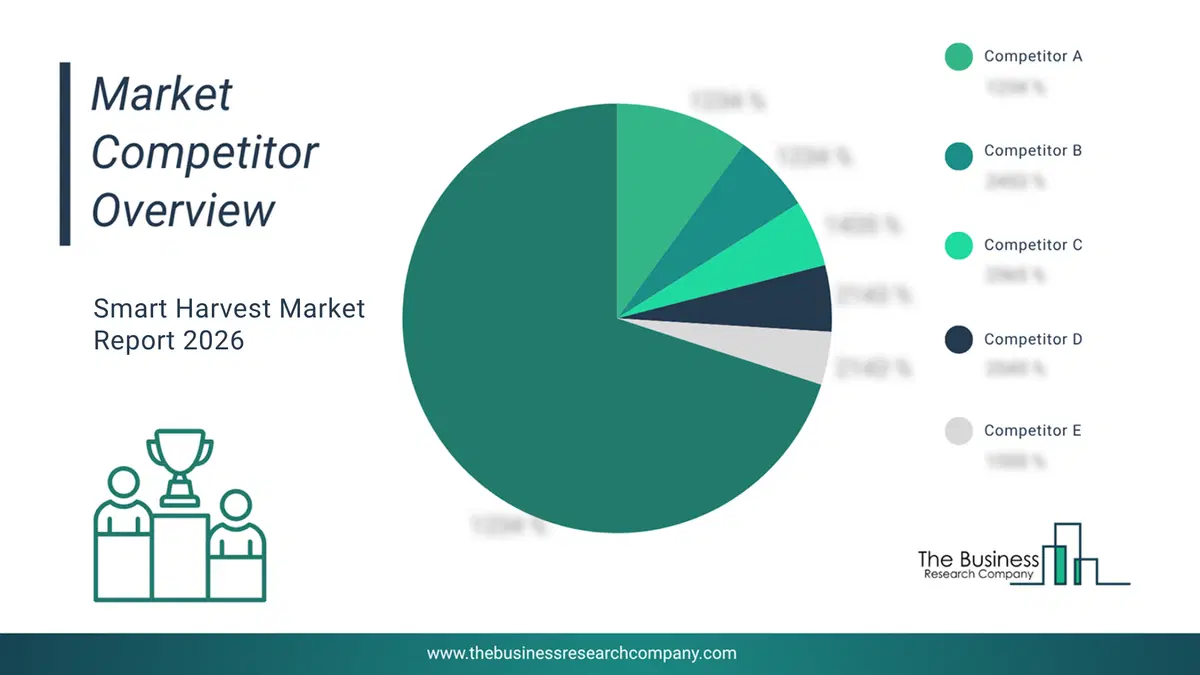
This chart is for illustrative purposes; the full report includes a detailed competitor analysis and comprehensive overview of the top 10 companies in the market.
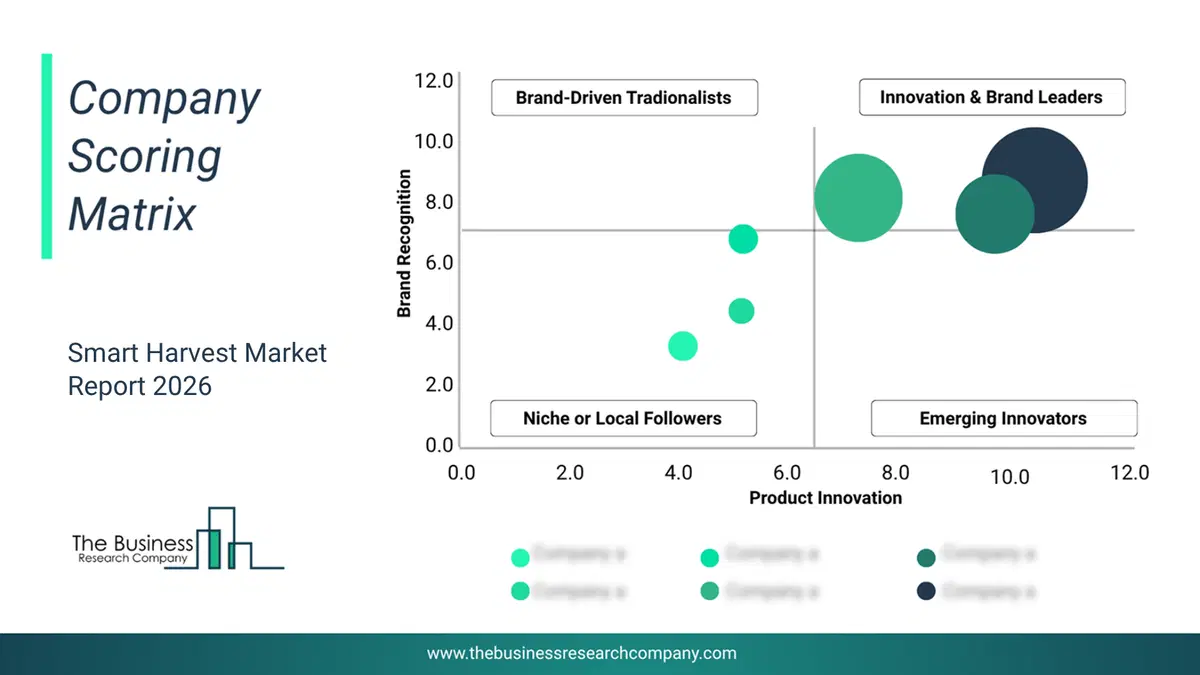
This chart maps companies by product innovation and brand strength, with bubble size indicating relative revenue, helping identify market leaders, challengers, and niche players. This is an illustrative chart; the full report provides a complete and accurate competitive analysis.
Global Smart Harvest Market Trends and Insights
Major companies operating in the smart harvest market are focused on developing technological innovations, such as AI-driven farming solutions, to gain a competitive edge in the market. An AI-driven farming solution is a technology-based system that uses artificial intelligence (AI) to analyze data, make predictions, and automate tasks in the agricultural sector. For instance, in June 2023, Aigen, a US-based agricultural technology startup, launched Aigen Element. It is an autonomous and scalable robotics platform for crop management. This innovative service leverages solar and wind energy, eliminating reliance on fossil fuels and reducing environmental impact. AI-powered technology enables precise identification and targeted weed removal, eliminating the need for harmful herbicides. The robots can navigate and operate independently, covering large areas efficiently and reducing labor costs.What Are Latest Mergers And Acquisitions In The Smart Harvest Market?
In September 2024, Kubota Corporation, a Japan-based manufacturing company, acquired Bloomfield Robotics Inc. for an undisclosed amount. With this acquisition, Kubota Corporation aims to enhance its technological capabilities in precision agriculture by integrating Bloomfield Robotics' advanced robotic systems and data analytics solutions, thereby improving crop monitoring and yield optimization for farmers. Bloomfield Robotics Inc. is a US-based agricultural technology company that specializes in developing advanced robotic solutions for crop management and precision agriculture.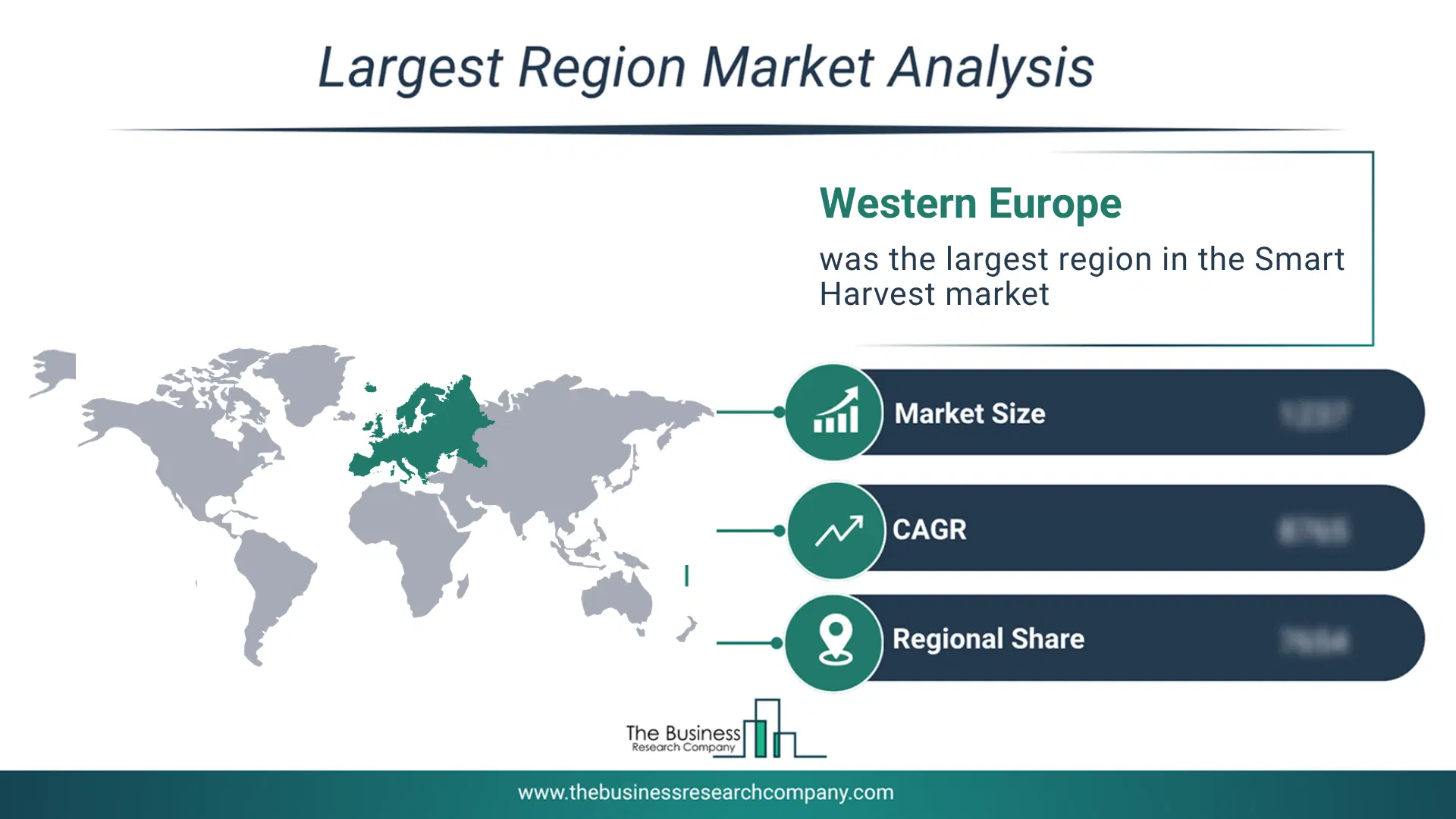
Regional Outlook
Western Europe was the largest region in the smart harvest market in 2025. North America is expected to be the fastest-growing region in the global smart harvest market during the forecast period. The regions covered in this market report are Asia-Pacific, South East Asia, Western Europe, Eastern Europe, North America, South America, Middle East, Africa The countries covered in this market report are Australia, Brazil, China, France, Germany, India, Indonesia, Japan, Taiwan, Russia, South Korea, UK, USA, Canada, Italy, Spain.What Defines the Smart Harvest Market?
The smart harvest market consists of revenues earned by entities by providing harvesting robots, automation and control systems, imaging systems, and softwires. The market value includes the value of related goods sold by the service provider or included within the service offering. The smart harvest market also includes sales of soil sensors, tractors, and drones. Values in this market are ‘factory gate’ values, that is the value of goods sold by the manufacturers or creators of the goods, whether to other entities (including downstream manufacturers, wholesalers, distributors, and retailers) or directly to end customers. The value of goods in this market includes related services sold by the creators of the goods.How is Market Value Defined and Measured?
The market value is defined as the revenues that enterprises gain from the sale of goods and/or services within the specified market and geography through sales, grants, or donations in terms of the currency (in USD unless otherwise specified). The revenues for a specified geography are consumption values that are revenues generated by organizations in the specified geography within the market, irrespective of where they are produced. It does not include revenues from resales along the supply chain, either further along the supply chain or as part of other products.
This chart presents market attractiveness based on a quantitative evaluation of growth, competition, strategic alignment, and risk, offering a clear view of opportunity areas for decision-making. This chart is for illustrative purposes; the full report contains the complete analysis.

This chart highlights the Total Addressable Market (TAM) by estimating the maximum revenue opportunity using an assumption-driven approach, supporting strategic planning and opportunity sizing across markets. The chart is illustrative; the full report provides a more comprehensive analysis.
What Key Data and Analysis Are Included in the Smart Harvest Market Report 2026?
The smart harvest market research report is one of a series of new reports from The Business Research Company that provides market statistics, including industry global market size, regional shares, competitors with the market share, detailed market segments, market trends and opportunities, and any further data you may need to thrive in the smart harvest industry. The market research report delivers a complete perspective of everything you need, with an in-depth analysis of the current and future state of the industry.Smart Harvest Market Report Forecast Analysis
| Report Attribute | Details |
|---|---|
| Market Size Value In 2026 | $22.13 billion |
| Revenue Forecast In 2030 | $36.23 billion |
| Growth Rate | CAGR of 13.1% from 2026 to 2030 |
| Base Year For Estimation | 2025 |
| Actual Estimates/Historical Data | 2020-2025 |
| Forecast Period | 2026 - 2030 |
| Market Representation | Revenue in USD Billion and CAGR from 2026 to 2030 |
| Segments Covered | Component, Crop Type, Site Of Operation, End User |
| Regional Scope | Asia-Pacific, Western Europe, Eastern Europe, North America, South America, Middle East, Africa |
| Key Companies Profiled | Agrobot SL, Deere and Company, Harvest Automation Inc., Root Al Inc., Abundant Robotics Inc., Harvest CROO Robotics LLC, FFRobotics Ltd., Iron Ox Inc., Vision Robotics Corp., Metomotion Ltd., Smart Harvest Agritech Ltd., Dogtooth Technologies Ltd., Octinion, Ripe Robotics Pty Ltd., Agrobotix LLC, Fieldwork Robotics Ltd., Naio Technologies, FarmWise Labs, Inc., Green Robot Machinery Private Limited, Saga Robotics AS, Harvesting Inc., Octagrow Ltd., Yanmar Co. Ltd. |
| Customization Scope | Request for Customization |
| Pricing And Purchase Options | Explore Purchase Options |