
Remanufactured Automotive Parts Market Report 2026
Global Outlook – By Part Type (Engine Parts, Transmission Parts, Electrical Parts), By Vehicle Type (Passenger Cars, Commercial Vehicles, Sport Utility Vehicle (SUVs)), By Material Sources (Reused Components, Refurbished Parts), By Remanufacturing Process (Core Return, Exchange), By Sales Channel (Aftermarket, Original Equipment Manufacturer (OEM), Online) – Market Size, Trends, Strategies, and Forecast to 2030
Remanufactured Automotive Parts Market Overview
• Remanufactured Automotive Parts market size has reached to $66.11 billion in 2025 • Expected to grow to $92.04 billion in 2030 at a compound annual growth rate (CAGR) of 6.9% • Growth Driver: Surge In Growth Of The Used Car Trade Propelled The Growth Of The Market Due To Increased Demand For Affordable And Reliable Vehicle Maintenance • Market Trend: Advanced Remanufactured Automotive Components Boost Sustainability And Efficiency • North America was the largest region in 2025 and Asia-Pacific is the fastest growing region.Market Gains By 2030 – Top Opportunities By Segment
Market Gain identifies the most promising market opportunities by highlighting the segments or products expected to generate the highest incremental revenue growth over the next five years.
What Is Covered Under Remanufactured Automotive Parts Market?
Remanufactured automotive parts are used vehicle components that have been disassembled, cleaned, repaired, and restored to meet or exceed original equipment manufacturer (OEM) specifications. These parts offer a cost-effective and environmentally friendly alternative to new components while ensuring reliable performance and safety. The main part types of remanufactured automotive parts are engine parts, transmission parts, electrical parts, and body parts. Engine parts refer to the individual components that make up an engine, each performing specific functions to ensure the engine operates efficiently and effectively. These serve various vehicle types such as passenger cars, commercial vehicles, and sport utility vehicles (SUVs), while sourcing materials from recycled metals, reused components, and refurbished parts. The remanufacturing processes primarily include core return, exchange, and repair, and are distributed through multiple sales channels, including the aftermarket, original equipment manufacturers (OEM), and online.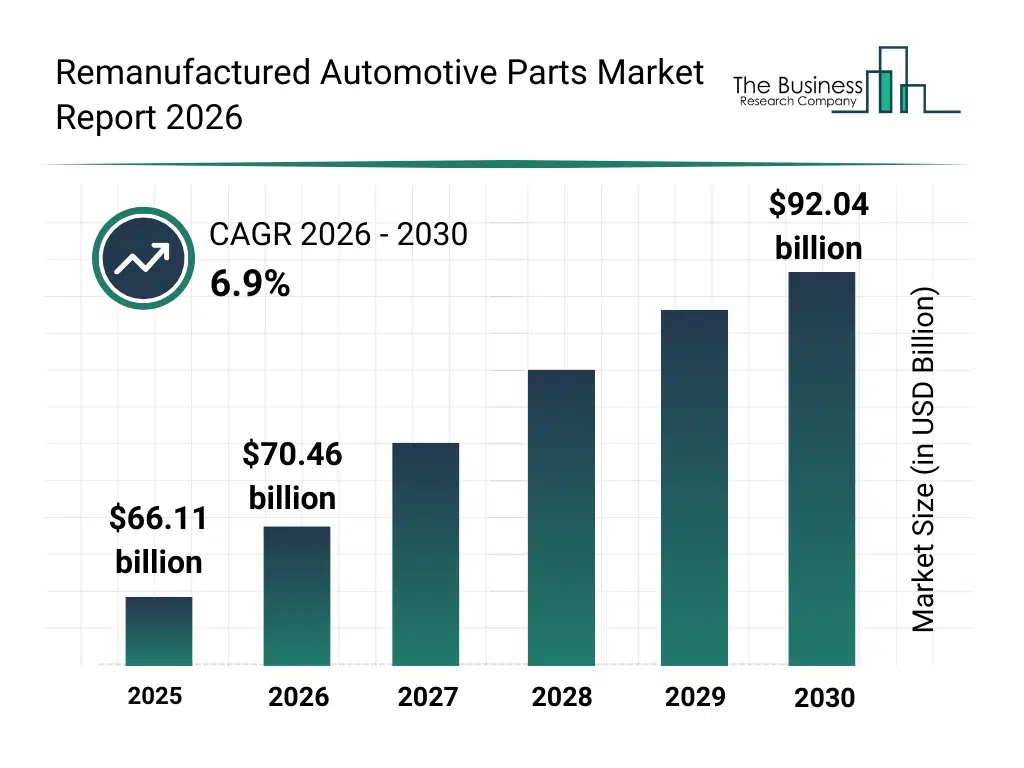
What Is The Remanufactured Automotive Parts Market Size and Share 2026?
The remanufactured automotive parts market size has grown strongly in recent years. It will grow from $66.11 billion in 2025 to $70.46 billion in 2026 at a compound annual growth rate (CAGR) of 6.6%. The growth in the historic period can be attributed to growth in vehicle parc size, rising demand for cost-effective repair solutions, expansion of aftermarket services, availability of reusable automotive cores, increasing environmental awareness.What Is The Remanufactured Automotive Parts Market Growth Forecast?
The remanufactured automotive parts market size is expected to see strong growth in the next few years. It will grow to $92.04 billion in 2030 at a compound annual growth rate (CAGR) of 6.9%. The growth in the forecast period can be attributed to increasing adoption of remanufactured parts in electric vehicles, rising investments in automated remanufacturing facilities, expansion of online aftermarket sales channels, growing regulatory support for sustainable parts, increasing consumer acceptance. Major trends in the forecast period include increasing adoption of circular economy practices, rising use of advanced remanufacturing technologies, growing acceptance of oem-certified remanufactured parts, expansion of digital core tracking systems, enhanced quality assurance standards.
Global Remanufactured Automotive Parts Market Segmentation
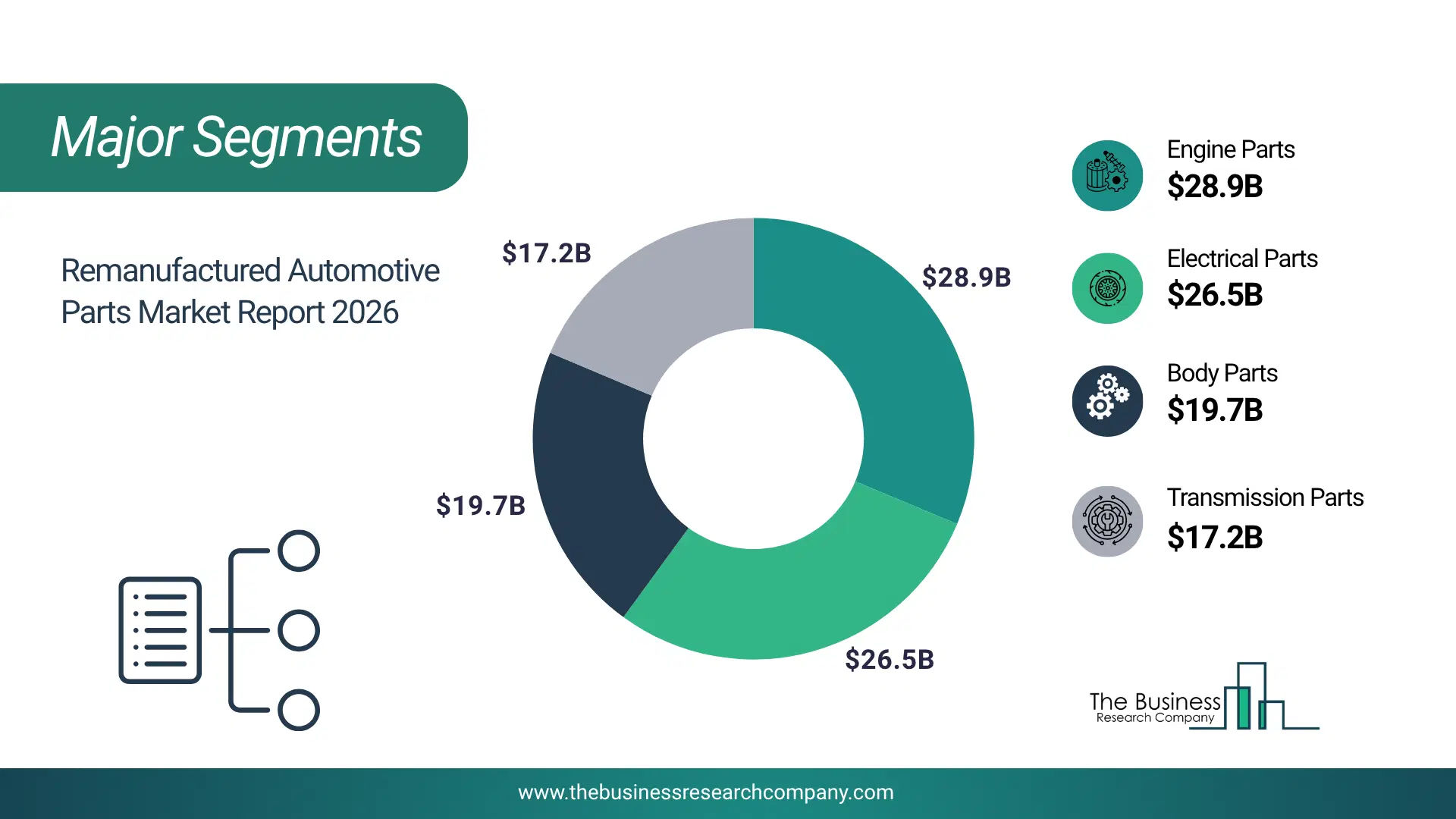
1) By Part Type: Engine Parts, Transmission Parts, Electrical Parts 2) By Vehicle Type: Passenger Cars, Commercial Vehicles, Sport Utility Vehicle (SUVs) 3) By Material Sources: Reused Components, Refurbished Parts 4) By Remanufacturing Process: Core Return, Exchange 5) By Sales Channel: Aftermarket, Original Equipment Manufacturer (OEM), Online Subsegments: 1) By Engine Parts: Cylinder Heads, Pistons, Crankshafts, Camshafts, Engine Blocks, Turbochargers 2) By Transmission Parts: Gearboxes, Clutches, Torque Converters, Drive Shafts, Differentials 3) By Electrical Parts: Alternators, Starters, Ignition Systems, Electronic Control Units (ECUs) The top segments in the remanufactured automotive parts market will be: • Engine Parts will reach $28.83 billion by 2030. • Electrical Parts will reach $26.44 billion by 2030. • Body Parts will reach $19.61 billion by 2030. • Transmission Parts will reach $17.17 billion by 2030.What Is The Driver Of The Remanufactured Automotive Parts Market?
The growth of the used car trade is expected to propel the growth of the remanufactured automotive parts market going forward. Used car trade refers to the buying and selling of pre-owned vehicles between individuals or dealers, forming the secondary automotive market influenced by vehicle age, condition, and demand. The increase in used car trade is driven by cost savings, as pre-owned vehicles are more affordable than new ones, enabling consumers to access reliable transportation at lower prices. Remanufactured automotive parts help the growth of the used car trade by providing affordable, high-quality replacements that maintain vehicle performance and reliability, making pre-owned cars more attractive to buyers. For instance, in February 2025, according to Cox Automotive, a US-based automotive services and technology provider, retail sales of used vehicles reached 1.41 million units in January, marking an 8% year-on-year increase. Therefore, growth of the used car trade is driving the growth of the remanufactured automotive parts industry.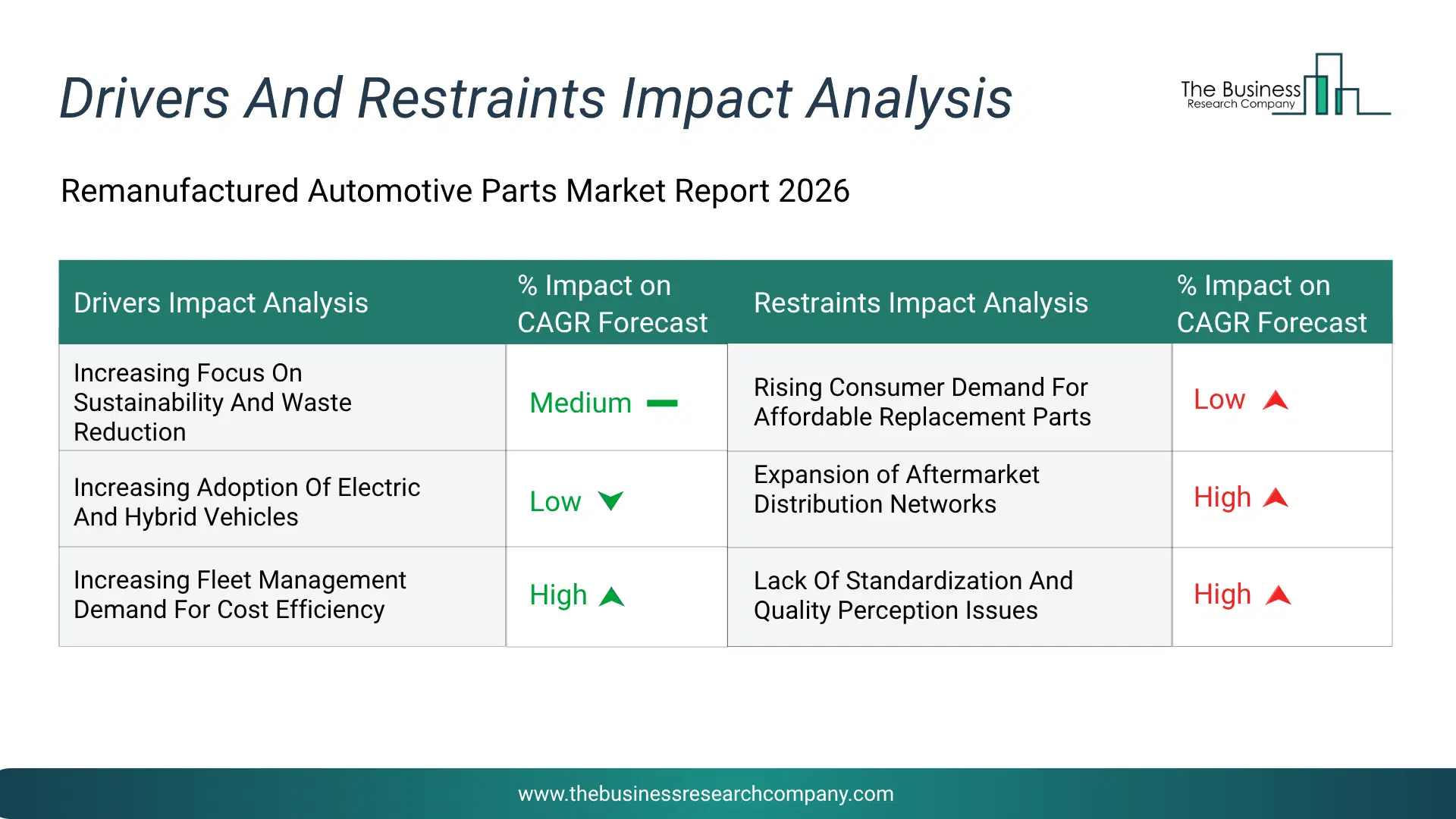
Infographic Chart Showing Key Market Drivers Analysis And Restraints For Remanufactured Automotive Parts Market
The chart presents an impact analysis of key drivers and restraints, quantifying their relative influence on the market's growth rate and helping assess the balance between growth enablers and limiting factors. This chart offers a high-level perspective; the full report contains more detailed insights.
How Will The Drivers Impact Growth In The Global Remanufactured Automotive Parts Market?
• Increasing Focus On Sustainability And Waste Reduction (Medium) – During the forecast period, the increasing focus on sustainability and waste reduction is expected to become a key growth driver for the remanufactured automotive parts market by 2030. The growing emphasis on circular economy principles is encouraging automakers, suppliers, and consumers to adopt remanufactured components instead of discarding used parts. Remanufacturing extends product lifecycles, conserves raw materials, and significantly reduces landfill waste and carbon emissions. This approach supports environmental sustainability goals while providing a cost-effective alternative to new components. Additionally, regulatory pressure and corporate sustainability initiatives are encouraging the adoption of environmentally responsible manufacturing practices. Collectively, these factors support steady market growth by directly linking sustainability initiatives with increased adoption of remanufactured automotive parts. • Increasing Adoption Of Electric And Hybrid Vehicles (Low) – During the forecast period, the increasing adoption of electric and hybrid vehicles is expected to emerge as a major factor driving the expansion of the remanufactured automotive parts market by 2030. As the global fleet of electric and hybrid vehicles continues to grow, the demand for specialized components such as batteries, electric motors, and power electronics is increasing. Remanufacturing provides a cost-effective and sustainable alternative to replacing these high-value components with new ones. This approach helps reduce electronic waste while ensuring affordability and availability of essential vehicle parts. Furthermore, the long-term maintenance needs of aging electric and hybrid vehicles are expected to accelerate demand for reliable remanufactured components. • Increasing Fleet Management Demand For Cost Efficiency (High) – During the forecast period, the increasing fleet management demand for cost efficiency is expected to act as a key growth catalyst for the remanufactured automotive parts market by 2030. Fleet operators manage large vehicle volumes, making maintenance and repair costs a critical operational concern. Remanufactured parts provide a reliable and affordable alternative to new components, helping fleet operators reduce maintenance expenses while maintaining vehicle performance and reliability. These components help extend vehicle lifespans and improve overall operational efficiency. Additionally, increasing pressure on fleet operators to optimize budgets and improve cost efficiency is accelerating the adoption of remanufactured parts.How Will The Restraints Impact Growth In The Global Remanufactured Automotive Parts Market?
• Rising Consumer Demand For Affordable Replacement Parts (Low) – During the forecast period, the rising consumer demand for affordable replacement parts acts as a restraint for the remanufactured automotive parts market because many price-sensitive buyers often prefer cheaper new aftermarket or counterfeit parts over remanufactured ones. While reman parts offer quality and sustainability benefits, their prices are still higher than some low-cost alternatives available in the market. This preference limits the wider adoption of remanufactured components, especially in developing regions. The availability of inexpensive substitutes also creates intense price competition, making it harder for remanufacturers to scale. As a result, strong demand for the lowest-cost options slows the growth potential of the remanufactured parts segment. • Expansion of Aftermarket Distribution Networks (High) – During the forecast period, the expansion of aftermarket distribution networks acts as a restraint for remanufactured automotive parts because it increases the availability of low-cost new components from independent suppliers and global imports. These parts are often marketed aggressively and positioned as affordable alternatives, drawing price-sensitive customers away from remanufactured options. With broader reach and faster delivery, aftermarket networks can overshadow remanufacturers who rely on more specialized supply chains. This creates intense competition and puts pressure on margins in the remanufacturing sector. As a result, the rapid growth of aftermarket distribution limits the pace of adoption for remanufactured parts. • Lack Of Standardization And Quality Perception Issues (High) – During the forecast period, the lack of standardization and quality perception issues act as a restraint for the remanufactured automotive parts market by creating uncertainty among end users regarding product reliability and performance consistency. In many regions, remanufactured parts are not governed by uniform quality standards, leading to variations in durability and safety across suppliers. This inconsistency reduces customer confidence and limits acceptance, especially among oems and professional repair networks. Additionally, negative perception that remanufactured parts are inferior to new components further restricts demand. As a result, weak standardization frameworks slow market expansion and hinder broader industry adoption.Key Players In The Global Remanufactured Automotive Parts Market
Major companies operating in the remanufactured automotive parts market are Robert Bosch GmbH, BorgWarner Inc., ZF Friedrichshafen AG, Denso Corporation, Valeo SA, Eaton Corporation, Cummins Inc., Caterpillar Inc., Schaeffler Group, Cardone Industries Inc., BBB Industries LLC, Dana Incorporated, Marelli S.p.A., Remy International Inc., Motorcar Parts of America Inc., Jasper Engines & Transmissions, ATC Drivetrain Inc., Borg Automotive A/S, Carwood Group, Marshall Engines Inc., Aer Manufacturing Inc., Monark Automotive GmbH, Teamec BVBA, Maval Industries LLC, Meritor Inc.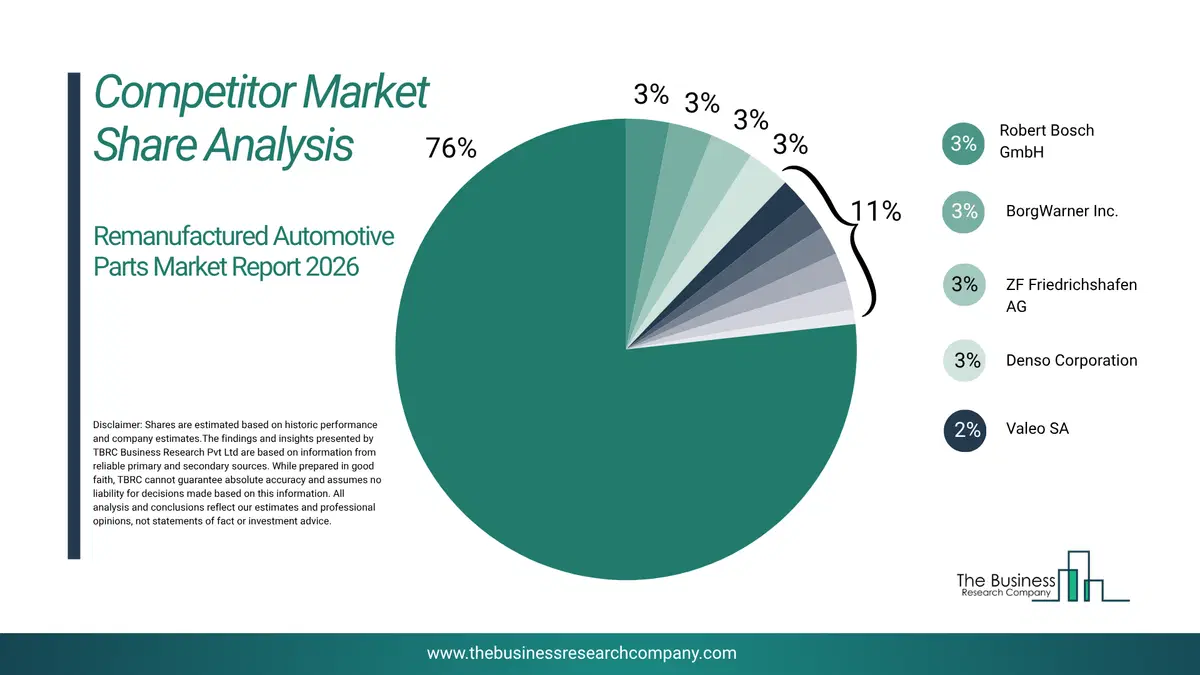
This chart is for illustrative purposes; the full report includes a detailed competitor analysis and comprehensive overview of the top 10 companies in the market.

This chart maps companies by product innovation and brand strength, with bubble size indicating relative revenue, helping identify market leaders, challengers, and niche players. This is an illustrative chart; the full report provides a complete and accurate competitive analysis.
Global Remanufactured Automotive Parts Market Trends and Insights
Major companies operating in the remanufactured automotive parts market are focusing on developing advanced products, such as remanufactured infotainment display screens, to enhance vehicle functionality and reduce environmental impact. Remanufactured infotainment display screens are vehicle screens that have been fully restored, tested, and upgraded to function like new, offering a cost-effective and sustainable alternative to new units. For instance, in April 2025, Stellantis N.V., a Netherlands-based automobile corporation, partnered with Valeo SA, a France-based automaker company, and launched the remanufactured LED headlamp along with a remanufactured infotainment display screen, reflecting their commitment to sustainable automotive manufacturing and circular economy practices. These headlamps reuse up to 50% of raw materials from end-of-life LED headlamps, particularly the valuable LED modules, and cut CO₂ emissions by up to 70% compared to new production. They meet original equipment manufacturer (OEM) standards, offering the same performance and warranty as new parts, thereby advancing sustainability and circular economy initiatives in the automotive sector.What Are Latest Mergers And Acquisitions In The Remanufactured Automotive Parts Market?
In August 2024, BBB Industries LLC, a US-based remanufacturing company, acquired All Star Auto Parts Inc. for an undisclosed amount. Through this acquisition, BBB Industries aims to strengthen its electronics offering, expand its product and service options, and continue spreading sustainable manufacturing at scale to deliver greater value to its markets. All Star Auto Parts Inc. is a US-based remanufacturing company that offers remanufactured automotive parts.
Regional Outlook
North America was the largest region in the remanufactured automotive parts market in 2025. Asia-Pacific is expected to be the fastest-growing region in the forecast period. The regions covered in this market report are Asia-Pacific, South East Asia, Western Europe, Eastern Europe, North America, South America, Middle East, Africa The countries covered in this market report are Australia, Brazil, China, France, Germany, India, Indonesia, Japan, Taiwan, Russia, South Korea, UK, USA, Canada, Italy, Spain.What Defines the Remanufactured Automotive Parts Market?
The remanufactured automotive parts market consists of sales of alternators, brake components, fuel injection systems, steering components, and suspension parts. Values in this market are ‘factory gate’ values, that is, the value of goods sold by the manufacturers or creators of the goods, whether to other entities (including downstream manufacturers, wholesalers, distributors, and retailers) or directly to end customers. The value of goods in this market includes related services sold by the creators of the goods.How is Market Value Defined and Measured?
The market value is defined as the revenues that enterprises gain from the sale of goods and/or services within the specified market and geography through sales, grants, or donations in terms of the currency (in USD unless otherwise specified). The revenues for a specified geography are consumption values that are revenues generated by organizations in the specified geography within the market, irrespective of where they are produced. It does not include revenues from resales along the supply chain, either further along the supply chain or as part of other products.
This chart presents market attractiveness based on a quantitative evaluation of growth, competition, strategic alignment, and risk, offering a clear view of opportunity areas for decision-making. This chart is for illustrative purposes; the full report contains the complete analysis.

This chart highlights the Total Addressable Market (TAM) by estimating the maximum revenue opportunity using an assumption-driven approach, supporting strategic planning and opportunity sizing across markets. The chart is illustrative; the full report provides a more comprehensive analysis.
What Key Data and Analysis Are Included in the Remanufactured Automotive Parts Market Report 2026?
The remanufactured automotive parts market research report is one of a series of new reports from The Business Research Company that provides market statistics, including industry global market size, regional shares, competitors with the market share, detailed market segments, market trends and opportunities, and any further data you may need to thrive in the remanufactured automotive parts industry. The market research report delivers a complete perspective of everything you need, with an in-depth analysis of the current and future state of the industry.Remanufactured Automotive Parts Market Report Forecast Analysis
| Report Attribute | Details |
|---|---|
| Market Size Value In 2026 | $70.46 billion |
| Revenue Forecast In 2030 | $92.04 billion |
| Growth Rate | CAGR of 6.9% from 2026 to 2030 |
| Base Year For Estimation | 2025 |
| Actual Estimates/Historical Data | 2020-2025 |
| Forecast Period | 2026 - 2030 |
| Market Representation | Revenue in USD Billion and CAGR from 2026 to 2030 |
| Segments Covered | Part Type, Vehicle Type, Material Sources, Remanufacturing Process, Sales Channel |
| Regional Scope | Asia-Pacific, Western Europe, Eastern Europe, North America, South America, Middle East, Africa |
| Country Scope | The countries covered in the report are Australia, Brazil, China, France, Germany, India, ... |
| Key Companies Profiled | Robert Bosch GmbH, BorgWarner Inc., ZF Friedrichshafen AG, Denso Corporation, Valeo SA, Eaton Corporation, Cummins Inc., Caterpillar Inc., Schaeffler Group, Cardone Industries Inc., BBB Industries LLC, Dana Incorporated, Marelli S.p.A., Remy International Inc., Motorcar Parts of America Inc., Jasper Engines & Transmissions, ATC Drivetrain Inc., Borg Automotive A/S, Carwood Group, Marshall Engines Inc., Aer Manufacturing Inc., Monark Automotive GmbH, Teamec BVBA, Maval Industries LLC, Meritor Inc. |
| Customization Scope | Request for Customization |
| Pricing And Purchase Options | Explore Purchase Options |