

Ride Hailing Market Report 2026
Global Outlook – By Vehicle Type (Two Wheeler; Three Wheeler; Four Wheeler; Other Vehicle Types), By Service Type (E-Hailing; Car Sharing; Station Based Mobility; Car Rental ), By End-User (Commercial; Personal) – Market Size, Trends, Strategies, and Forecast to 2030
Ride Hailing Market Overview
• Ride Hailing market size has reached to $163.55 billion in 2025 • Expected to grow to $252.14 billion in 2030 at a compound annual growth rate (CAGR) of 9% • Growth Driver: Millennials And On-Demand Transportation Services Fueling Ride-Hailing Market Growth • Market Trend: Innovative Features And Safety Initiatives In The Ride-Hailing Market • Asia-Pacific was the largest region in 2025 and Western Europe is the fastest growing region.Market Gains By 2030 – Top Opportunities By Segment
Market Gain identifies the most promising market opportunities by highlighting the segments or products expected to generate the highest incremental revenue growth over the next five years.
What Is Covered Under Ride Hailing Market?
Ride-hailing refers to transportation services in which the passengers are connected with the vehicle drivers through a smartphone-based app to provide passenger transportation by automobile or van, not operated over regular routes and on regular schedules, to improve the customer experience by reducing time of travel, operational cost, and ease of riding. The ride hailing market covered in this report is segmented by vehicle type into two-wheelers, three-wheelers, four-wheelers, and others. A two-wheeler refers to a vehicle, mainly a bicycle, having two wheels. The different types of services include e-hailing, car sharing, station-based mobility, and car rental, and are used by various sectors such as commercial, personal.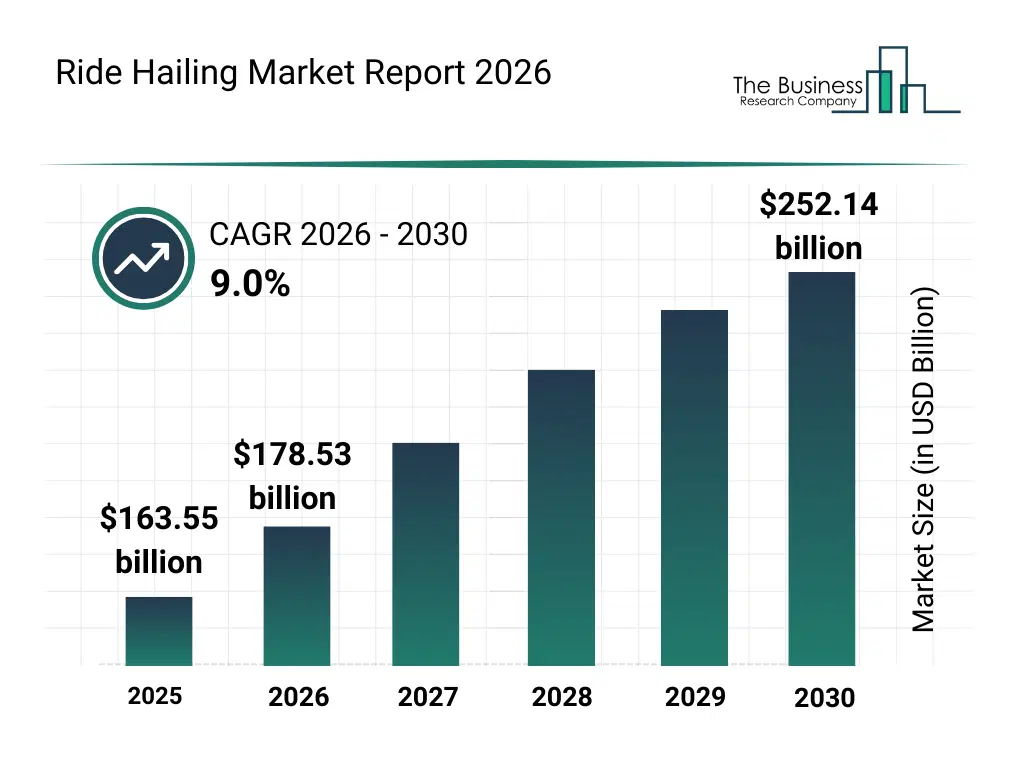
What Is The Ride Hailing Market Size and Share 2026?
The ride hailing market size has grown strongly in recent years. It will grow from $163.55 billion in 2025 to $178.53 billion in 2026 at a compound annual growth rate (CAGR) of 9.2%. The growth in the historic period can be attributed to increasing smartphone penetration, urban congestion challenges, growth of on-demand mobility preferences, expansion of gig economy workforce, availability of GPS-enabled navigation technologies.What Is The Ride Hailing Market Growth Forecast?
The ride hailing market size is expected to see strong growth in the next few years. It will grow to $252.14 billion in 2030 at a compound annual growth rate (CAGR) of 9.0%. The growth in the forecast period can be attributed to increasing adoption of autonomous ride services, expansion of electric vehicle ride fleets, rising integration with public transport systems, growing focus on sustainable urban mobility, increasing investments in mobility platforms. Major trends in the forecast period include expansion of app-based ride booking platforms, rising adoption of electric ride-hailing vehicles, growing integration of dynamic pricing algorithms, increased focus on driver and passenger safety features, expansion of multi-modal mobility services.
Global Ride Hailing Market Segmentation
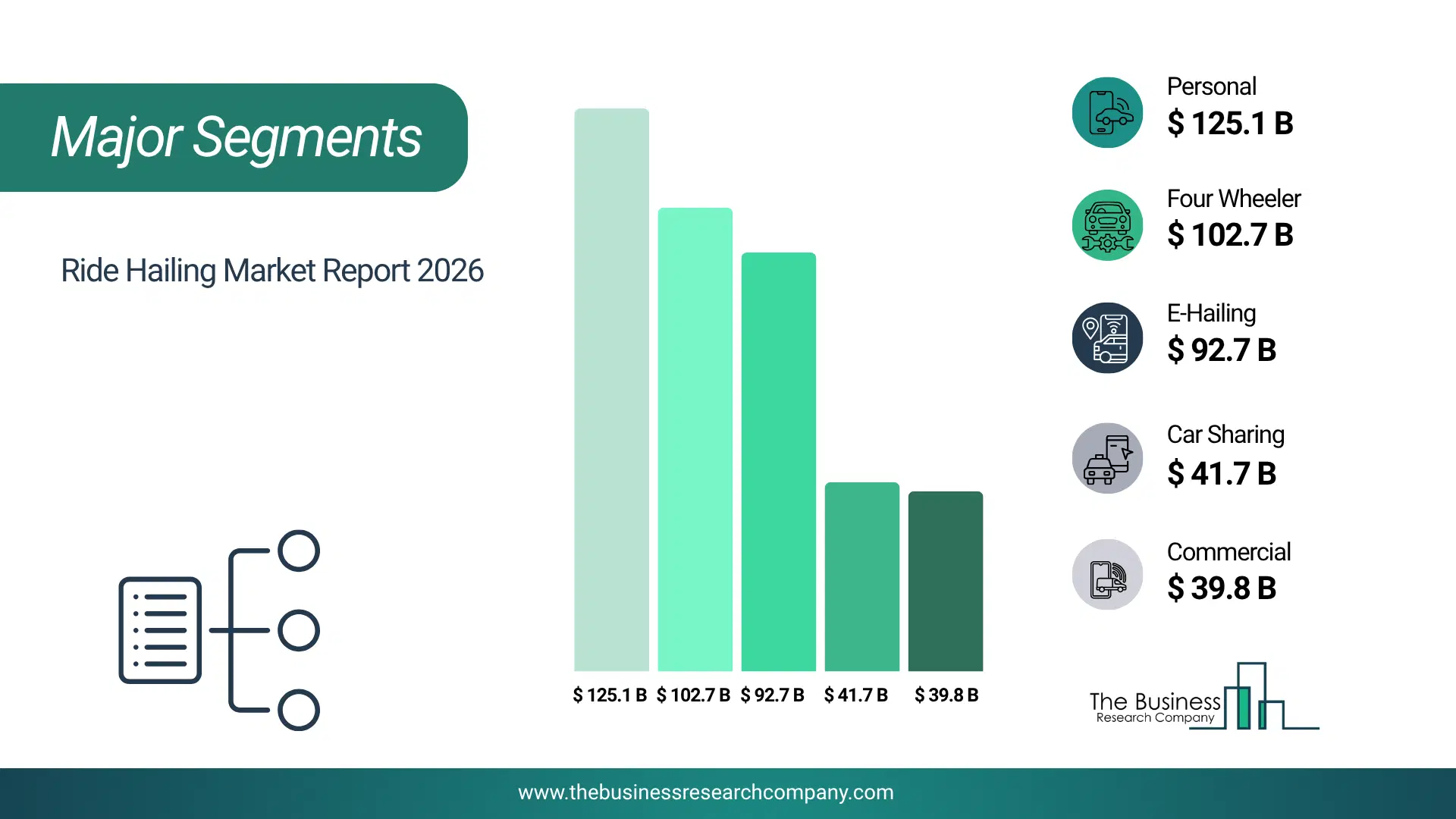
1) By Vehicle Type: Two Wheeler, Three Wheeler, Four Wheeler, Other Vehicle Types 2) By Service Type: E-Hailing, Car Sharing, Station Based Mobility, Car Rental 3) By End-User: Commercial, Personal Subsegments: 1) By Two Wheeler: Motorcycles, Scooters 2) By Three Wheeler: Auto Rickshaws, Cycle Rickshaws 3) By Four Wheeler: Sedans, SUVs, Vans 4) By Other Vehicle Types: Bicycles, Electric Vehicles The top segments in the ride hailing market will be: • Personal will reach $125177.77 Million by 2025. • Four Wheeler will reach $102754.15 Million by 2025. • E-Hailing will reach $92799.35 Million by 2025. • Car Sharing will reach $41731.15 Million by 2025. • Commercial will reach $39839.63 Million by 2025.What Is The Driver Of The Ride Hailing Market?
On-demand transportation services and a lower rate of car ownership among millennials are driving the growth of the ride-hailing market. On-demand transportation services are characterized by flexible routing and ad-hoc scheduling of private vehicles, offering a personal transport experience to the general public by picking up or dropping off at locations of the passenger’s choice. On-demand ride-hailing services ensure that customers can accurately locate the vehicles, track their journey, and offer safety to the occupants, and this factor is expected to significantly drive the market's growth. Additionally, a lower rate of car ownership among millennials due to the high maintenance cost of personal cars is resulting in a rise in demand for ride-hailing services. Millennials are choosing practical, smartphone-accessible transport options that are simple, flexible, and inexpensive over car ownership. Also, buying a new car and maintaining it are more expensive than renting a vehicle every year. For instance, in February 2024, according to the Bureau of Transportation Statistics, a US-based part of the Department of Transportation (DOT), for-hire freight shipments rose by 1.8% in December 2023 compared to December 2022, while the Freight Transportation Services Index increased from 136.6 in December 2022 to 139.1 in December 2023. Therefore, rising on-demand transportation services and a lower rate of car ownership among millennials drive the growth of the ride-hailing market.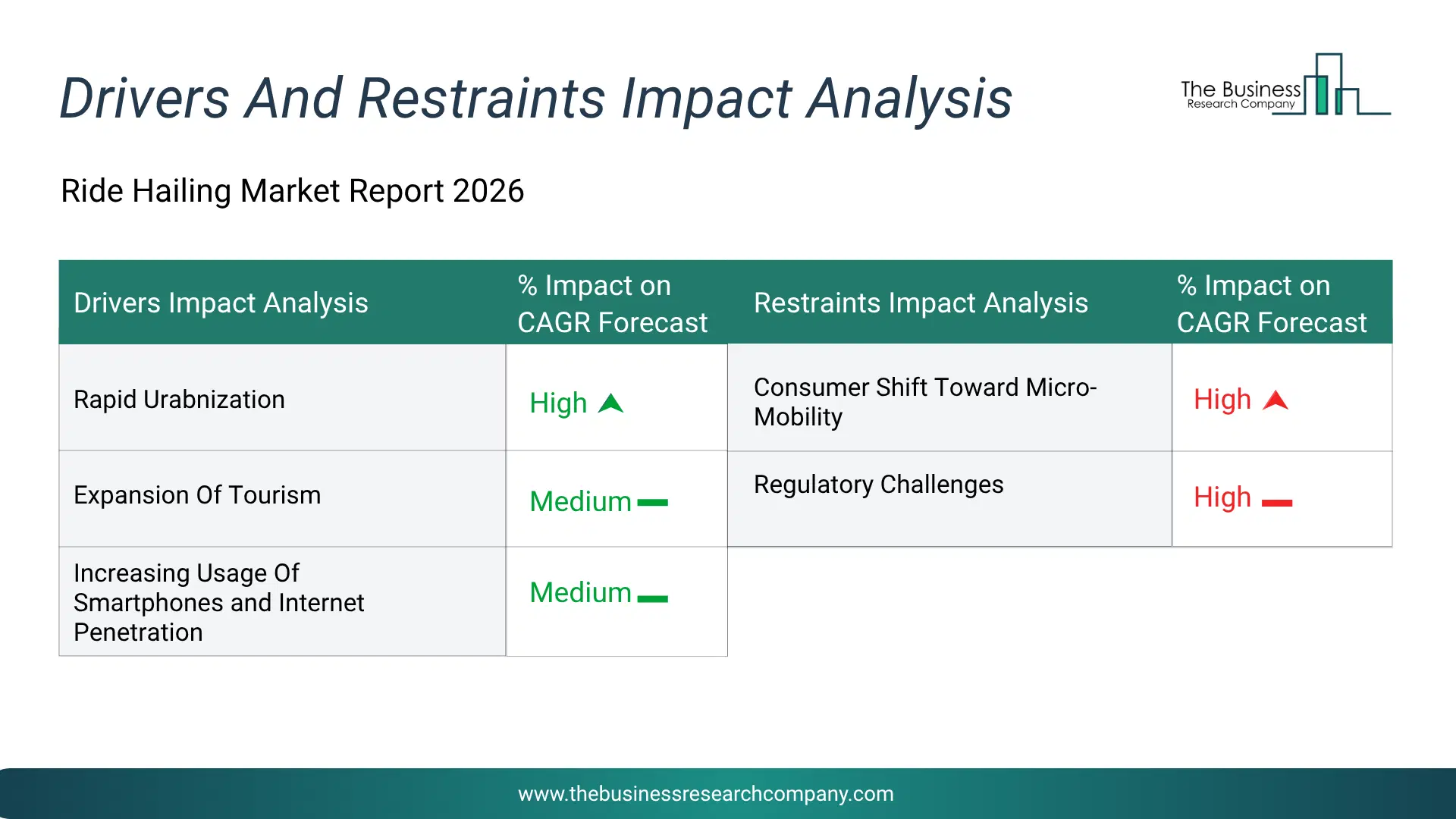
Infographic Chart Showing Key Market Drivers Analysis And Restraints For Ride Hailing Market
The chart presents an impact analysis of key drivers and restraints, quantifying their relative influence on the market's growth rate and helping assess the balance between growth enablers and limiting factors. This chart offers a high-level perspective; the full report contains more detailed insights.
How Will The Drivers Impact Growth In The Global Ride Hailing Market?
• Rapid Urabnization (High) – The rising urbanization will emerge as a major factor driving the expansion of the market by 2030. Urban infrastructure improvements, such as smart city initiatives and better road networks, further support ride-hailing adoption. Additionally, traffic congestion and limited parking spaces encourage commuters to opt for shared mobility services. As a result, the rising urbanization is anticipated to contributing to annual growth in the market. • Expansion Of Tourism (Medium) – The expansion of tourism will serve as a key growth catalyst for the market by 2030. Ride-hailing services offer a dependable, app-based solution for airport transfers, hotel pickups and city exploration, effectively replacing traditional taxis and shuttles. These platforms streamline navigation with automated fare calculations, route tracking and cashless payments, addressing language and currency barriers. As a result, the expansion of tourism is anticipated to contributing to annual growth in the market. • Increasing Usage Of Smartphones and Internet Penetration (Medium) – The increasing usage of smartphones and internet penetration will become a key driver of growth in the ride hailing market by 2030. Smartphones enable users to access ride-hailing services through mobile apps, streamlining booking, payment, and navigation. Expanding internet connectivity, especially in emerging markets, allows more consumers to adopt these services, increasing the user base. Higher smartphone adoption also facilitates real-time tracking, route optimization, and enhanced safety features, improving user experience. As a result, the increasing usage of smartphones and internet penetration is anticipated to contributing to annual growth in the market. • Declining Car Ownership (Low) – The declining car ownership will become a significant driver contributing to the growth of the market by 2030. The appeal of ride-hailing lies in its convenience and flexibility, offering both immediate and scheduled rides that reduce the necessity of personal vehicle ownership. Whether for daily commutes, late-night travel, or special occasions, consumers increasingly favor ride-hailing over traditional taxis or public transportation. The rise of integrated mobility solutions such as combining ride-hailing, bike-sharing and public transportation has further reduced the necessity of personal vehicle ownership. As a result, the declining car ownership is anticipated to contributing to annual growth in the market.How Will The Restraints Impact Growth In The Global Ride Hailing Market?
• Consumer Shift Toward Micro-Mobility (High) – Consumer Shift Toward Micro-Mobility will restrict the growth of the Ride Hailing market during the forecast period. Growing consumer preference for micro-mobility options including e-scooters and bicycles reduces demand for ride-hailing services for short-distance trips. The convenience, lower cost, and environmental appeal of micro-mobility alternatives may shift consumer behavior away from ride-hailing for certain use cases. This shift in consumer preferences can limit the growth of the ride-hailing market. • Regulatory Challenges (Medium) – Regulatory Challenges will restrict the growth of the Ride Hailing market during the forecast period. Ride-hailing platforms face complex regulatory environments across different cities and countries. Regulations on driver licensing, vehicle standards, surge pricing, and insurance create operational challenges. Regulatory restrictions and licensing requirements can limit market entry, service availability, and platform growth. Changes in regulations can affect operating models and profitability, creating uncertainty for ride-hailing providers.Key Players In The Global Ride Hailing Market
Major companies operating in the ride hailing market are Uber Technologies Inc., Lyft Inc., DiDi Chuxing Technology Co., Grab Holdings Inc., Ola Cabs, Bolt Technology OÜ, BlaBlaCar, Gett Inc., Curb Mobility, Gojek, Via Transportation Inc., Cabify, Wingz Inc., Addison Lee Ltd., Yandex.Taxi, Easy Taxi, LeCab, Zūm Services Inc., T3 Mobility, Heetch, Beat, Meru Cabs, Ryde Technologies, FastGo, GoCatch, Liftango, Blacklane GmbH, Shohoz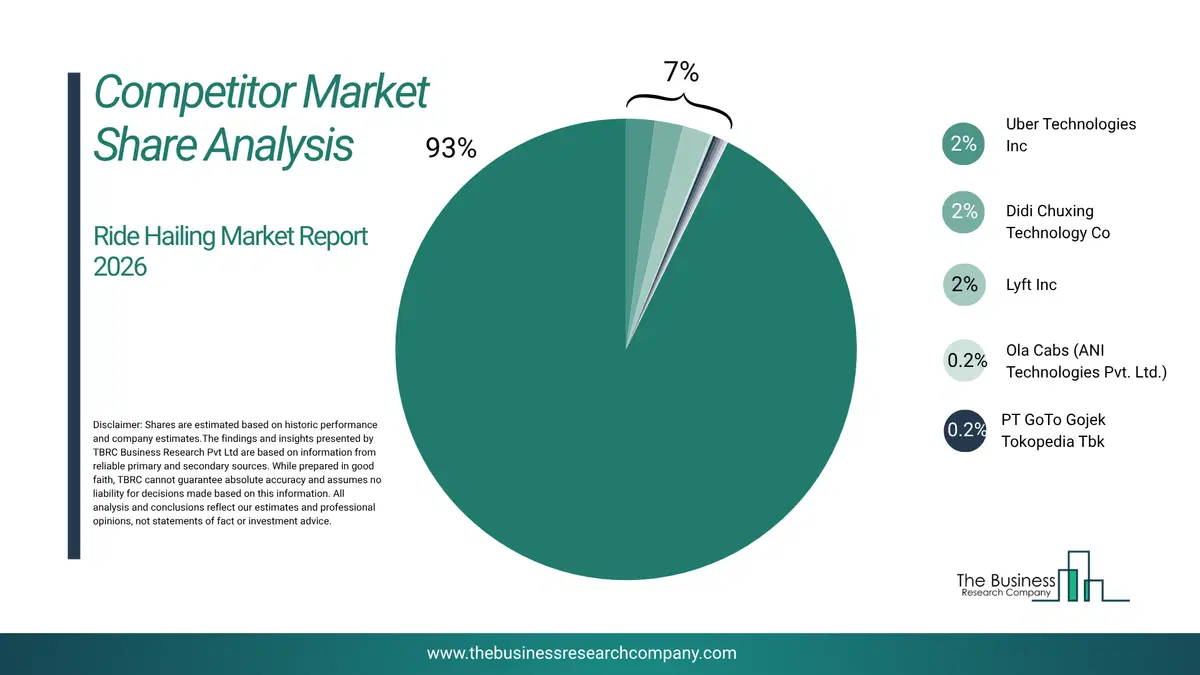
This chart is for illustrative purposes; the full report includes a detailed competitor analysis and comprehensive overview of the top 10 companies in the market.
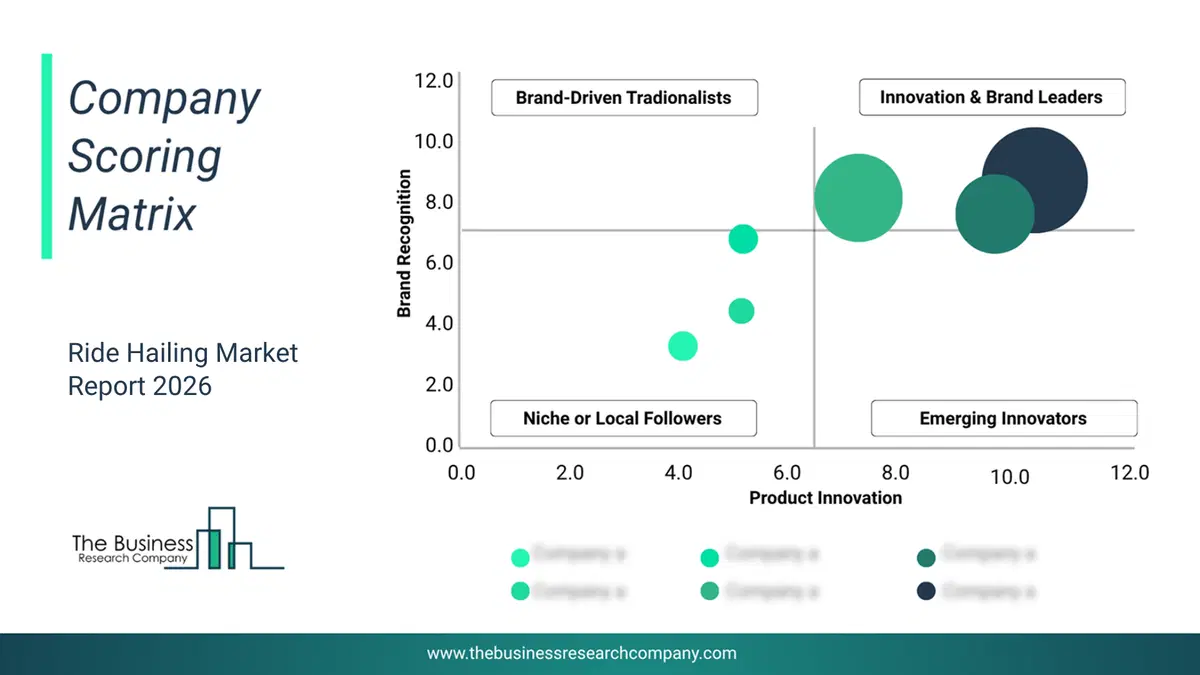
This chart maps companies by product innovation and brand strength, with bubble size indicating relative revenue, helping identify market leaders, challengers, and niche players. This is an illustrative chart; the full report provides a complete and accurate competitive analysis.
Global Ride Hailing Market Trends and Insights
Major companies operating in the ride-hailing market are focusing on innovating products, such as the ride hailing services app, to provide reliable services to customers. Ride-hailing services apps are applications that connect passengers with local drivers using their personal vehicles. For instance, in March 2023, Godugo Travel Solutions Private Limited, an India-based company that provides a vehicle booking mobile app for taxi services, launched Godugo. Godugo is a ride-hailing app that allows drivers to run their own businesses through the app. This app includes features such as an advanced system of systems (SOS) system that sends alerts to the phones of those using the app within a 1km radius and the nearest police station when a woman passenger or driver feels threatened.What Are Latest Mergers And Acquisitions In The Ride Hailing Market?
In March 2025, Bolt, an Estonia based provider of ride hailing, scooter and e bike rentals, car rental, and shared mobility services, acquired Viggo for an undisclosed amount. With this acquisition, Bolt strategically expanded its ride hailing footprint into the Danish market to strengthen its presence in Northern Europe and enhance local service offerings. Viggo is a Denmark based provider of ride hailing services operating an all electric vehicle fleet and serving customers across Denmark’s key urban centers.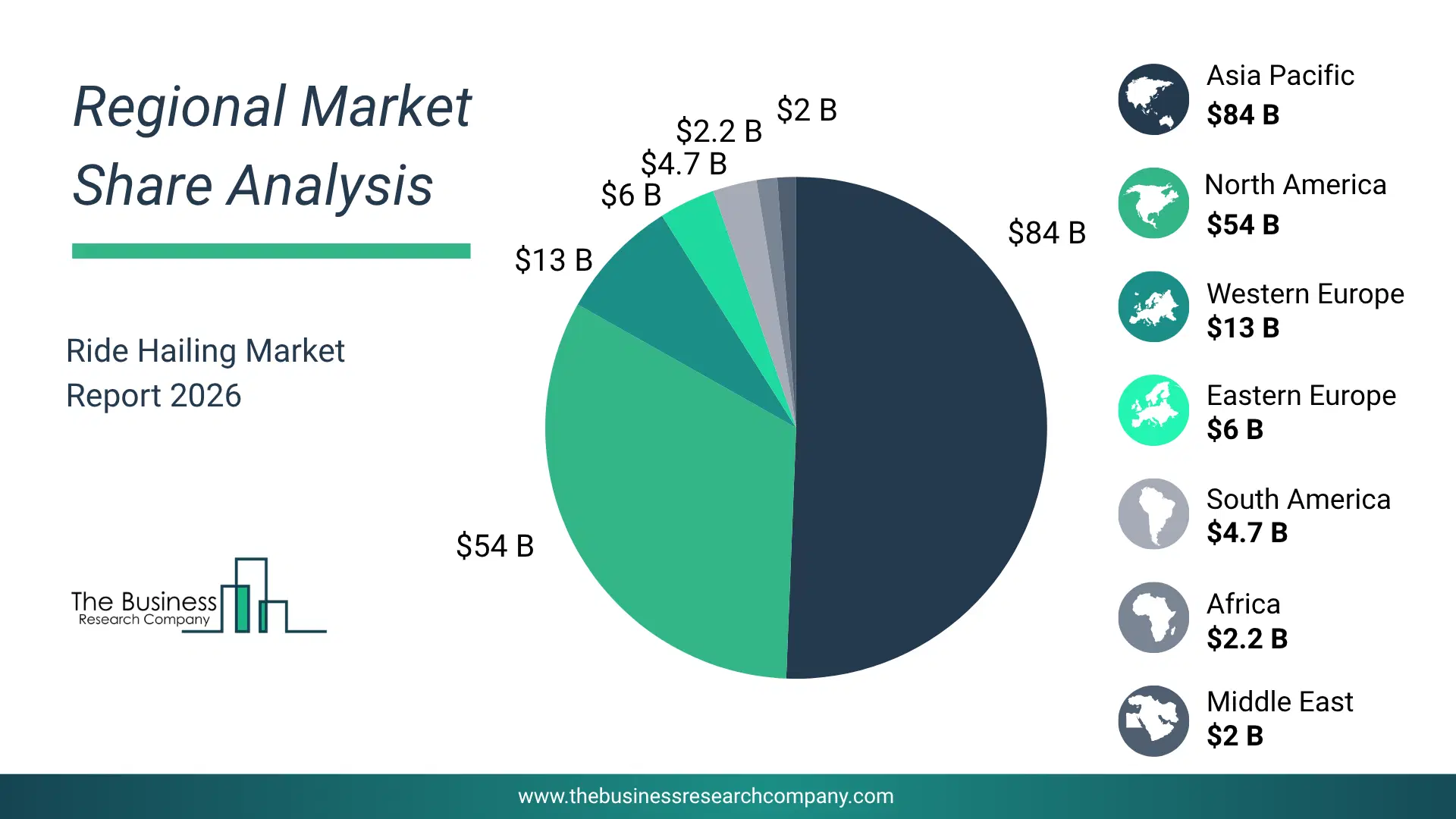
Regional Outlook
Asia-Pacific was the largest region in the ride hailing market in 2025. Western Europe was the second largest region in the global ride hailing market share. The regions covered in this market report are Asia-Pacific, South East Asia, Western Europe, Eastern Europe, North America, South America, Middle East, Africa. The countries covered in this market report are Australia; Brazil; China; France; Germany; India; Indonesia; Japan; Taiwan; Russia; South Korea; UK; USA; Canada; Italy; Spain.What Defines the Ride Hailing Market?
The ride hailing market includes revenues earned by entities by connecting local drivers and assailants using an online platform to provide travelling services. The market value includes the value of related goods sold by the service provider or included within the service offering. Only goods and services traded between entities or sold to end consumers are included.How is Market Value Defined and Measured?
The market value is defined as the revenues that enterprises gain from the sale of goods and/or services within the specified market and geography through sales, grants, or donations in terms of the currency (in USD unless otherwise specified). The revenues for a specified geography are consumption values that are revenues generated by organizations in the specified geography within the market, irrespective of where they are produced. It does not include revenues from resales along the supply chain, either further along the supply chain or as part of other products.
This chart presents market attractiveness based on a quantitative evaluation of growth, competition, strategic alignment, and risk, offering a clear view of opportunity areas for decision-making. This chart is for illustrative purposes; the full report contains the complete analysis.

This chart highlights the Total Addressable Market (TAM) by estimating the maximum revenue opportunity using an assumption-driven approach, supporting strategic planning and opportunity sizing across markets. The chart is illustrative; the full report provides a more comprehensive analysis.
What Key Data and Analysis Are Included in the Ride Hailing Market Report 2026?
The ride hailing market research report is one of a series of new reports from The Business Research Company that provides market statistics, including Market Report 2026?global market size, regional shares, competitors with the market share, detailed market segments, market trends and opportunities, and any further data you may need to thrive in the ride hailing Market Report 2026? The market research report delivers a complete perspective of everything you need, with an in-depth analysis of the current and future state of the Market Report 2026?Ride Hailing Market Report Forecast Analysis
| Report Attribute | Details |
|---|---|
| Market Size Value In 2026 | $178.53 billion |
| Revenue Forecast In 2030 | $252.14 billion |
| Growth Rate | CAGR of 9.2% from 2026 to 2030 |
| Base Year For Estimation | 2025 |
| Actual Estimates/Historical Data | 2020-2025 |
| Forecast Period | 2026 - 2030 |
| Market Representation | Revenue in USD Billion and CAGR from 2026 to 2030 |
| Segments Covered | Vehicle Type, Service Type, End-User |
| Regional Scope | Asia-Pacific, Western Europe, Eastern Europe, North America, South America, Middle East, Africa |
| Country Scope | The countries covered in the report are Australia, Brazil, China, France, Germany, India, Indonesia, Japan, Taiwan, Russia, South Korea, UK, USA, Canada, Italy, Spain. |
| Key Companies Profiled | Uber Technologies Inc., Lyft Inc., DiDi Chuxing Technology Co., Grab Holdings Inc., Ola Cabs, Bolt Technology OÜ, BlaBlaCar, Gett Inc., Curb Mobility, Gojek, Via Transportation Inc., Cabify, Wingz Inc., Addison Lee Ltd., Yandex.Taxi, Easy Taxi, LeCab, Zūm Services Inc., T3 Mobility, Heetch, Beat, Meru Cabs, Ryde Technologies, FastGo, GoCatch, Liftango, Blacklane GmbH, Shohoz |
| Customization Scope | Request for Customization |
| Pricing And Purchase Options | Explore Purchase Options |