
Sake Market Report 2026
Global Outlook – By Type (Ordinary sake, Junmai, Honjozo, Junmai Ginjo, Ginjo, Junmai Daiginjo), By Range (Premium, Medium, Low), By Application (Commercial Use, Home Use) – Market Size, Trends, Strategies, and Forecast to 2030
Sake Market Overview
• Sake market size has reached to $10.16 billion in 2025 • Expected to grow to $13.22 billion in 2030 at a compound annual growth rate (CAGR) of 5.5% • Growth Driver: Rising Alcohol Consumption Fuels Growth In The Sake Market • Market Trend: Innovative Approaches To Premium Beverage Positioning • North America was the largest region in 2025.What Is Covered Under Sake Market?
Sake is a Japanese alcoholic beverage made from fermented rice. It is a light-colored sweet noncarbonated drink with about 14 to 16 percent alcohol. The main ingredients of sake are rice from particular strains finely processed to remove the outer layers, shrinking the grain to between 50% and 70% of its original size, water, and koji or Aspergillus oryzae fungus that converts the rice starch to fermentable sugars. The main types of sake are junmai, honjozo, junmai ginjo, ginjo, junmai daiginjo, and Oodinary sake. Junmai refers to the sake made with ingredients such as water, rice, koji, and yeast. The various age groups include 20-40 years old, 40-60 years old, and above 60 years old. The various ranges include premium, medium, and low. These are used in various applications such as commercial use, and home use.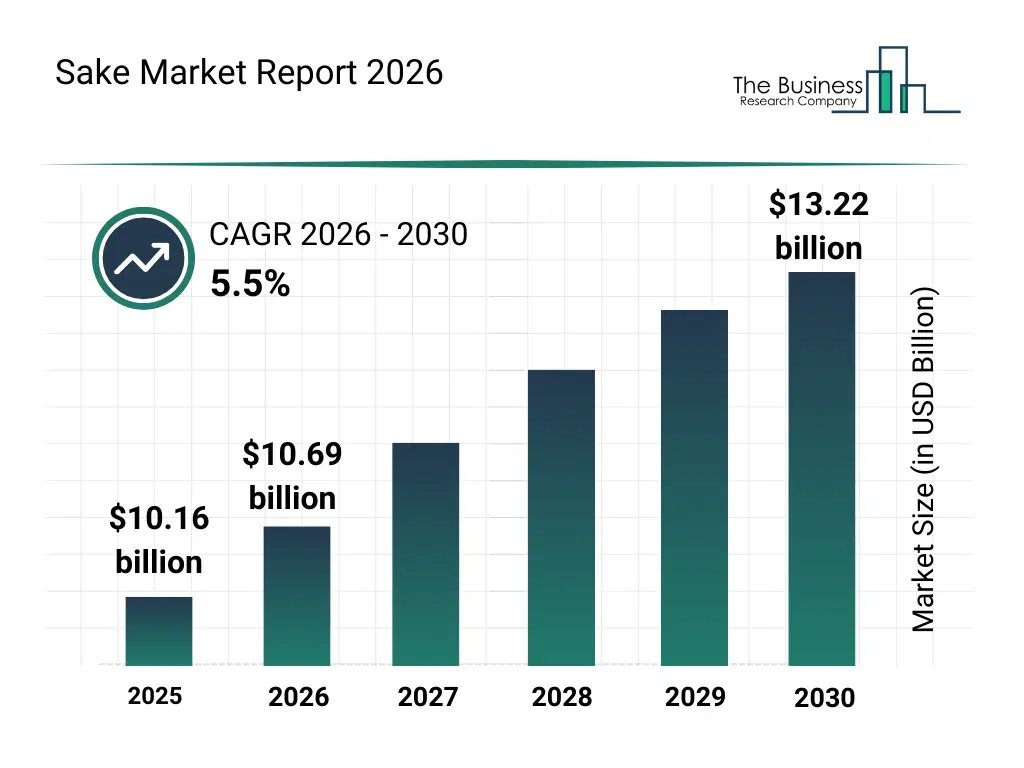
What Is The Sake Market Size and Share 2026?
The sake market size has grown strongly in recent years. It will grow from $10.16 billion in 2025 to $10.69 billion in 2026 at a compound annual growth rate (CAGR) of 5.2%. The growth in the historic period can be attributed to cultural significance of sake in japan, established domestic consumption patterns, traditional brewing knowledge transfer, stable rice cultivation for brewing, growth of on-premise consumption channels.What Is The Sake Market Growth Forecast?
The sake market size is expected to see strong growth in the next few years. It will grow to $13.22 billion in 2030 at a compound annual growth rate (CAGR) of 5.5%. The growth in the forecast period can be attributed to increasing global interest in japanese cuisine, expansion of premium alcoholic beverage demand, rising exports to western markets, growing focus on brand storytelling, innovation in sake flavor profiles. Major trends in the forecast period include premiumization of traditional sake varieties, rising demand for craft and artisanal sake, growing popularity of flavored and infused sake, expansion of international sake consumption, enhanced focus on authentic brewing practices.
Global Sake Market Segmentation
1) By Type: Ordinary sake, Junmai, Honjozo, Junmai Ginjo, Ginjo, Junmai Daiginjo 2) By Range: Premium, Medium, Low 4) By Application: Commercial Use, Home Use Subsegments: 1) By Ordinary Sake: Futsushu (Regular Sake), Table Sake 2) By Junmai: Junmai Sake (Pure Rice Sake), Tokubetsu Junmai (Special Junmai Sake) 3) By Honjozo: Honjozo Sake (With A Small Amount Of Distilled Alcohol), Tokubetsu Honjozo (Special Honjozo Sake) 4) By Junmai Ginjo: Junmai Ginjo Sake (Rice Polished To At Least 60%), Tokubetsu Junmai Ginjo 5) By Ginjo: Ginjo Sake (Rice Polished To At Least 60% With Added Alcohol), Tokubetsu Ginjo 6) By Junmai Daiginjo: Junmai Daiginjo Sake (Rice Polished To At Least 50%), Tokubetsu Junmai DaiginjoWhat Is The Driver Of The Sake Market?
The increased alcohol consumption is expected to propel the growth of the sake market going forward. Alcohol is a clear, evaporative liquid created by fermenting sugars and is commonly used as a recreational beverage. Increased alcohol consumption can be attributed to influences such as societal norms, advertising techniques, and shifts in lifestyle. The rise in alcohol consumption is benefiting the sake market as it boosts interest in traditional Japanese rice wine among local and global buyers. For instance, in November 2025, according to the Organisation for Economic Co-operation and Development (OECD), a France-based intergovernmental organization, average alcohol consumption across OECD countries reached 8.5 litres of pure alcohol per person in 2023, with several member nations exceeding 11.5 litres. Therefore, the increased alcohol consumption is driving the sake industry.Key Players In The Global Sake Market
Major companies operating in the sake market are Gekkeikan Sake Co., Ltd., Takara Shuzo Co., Ltd., Asahi Shuzo Co., Ltd. (Dassai), Tatsuuma-Honke Brewing Co., Ltd., Ozeki Co., Ltd., Hakkaisan Brewery Co., Ltd., Dewazakura Sake Brewery Co., Ltd., Kokuryu Brewery Co., Ltd., Tatenokawa Shuzo Co., Ltd., Tosatsuru Sake Brewing Co., Ltd., Homare Sake Brewery Co., Ltd., Sohomare Sake Brewery Co., Ltd., Shiragiku Shuzo Co., Ltd., Hananomai Brewing Co., Ltd., Daisekkei Sake Brewing Co., Ltd., Matsuse Sake Brewery Co., Ltd., Azuma Shuzo Co., Ltd., Dojima Sake Brewery Co., Ltd., Wakaze Sake Brewery, Nara Toyosawa Shuzo Co., Ltd
This chart is for illustrative purposes; the full report includes a detailed competitor analysis and comprehensive overview of the top 10 companies in the market.
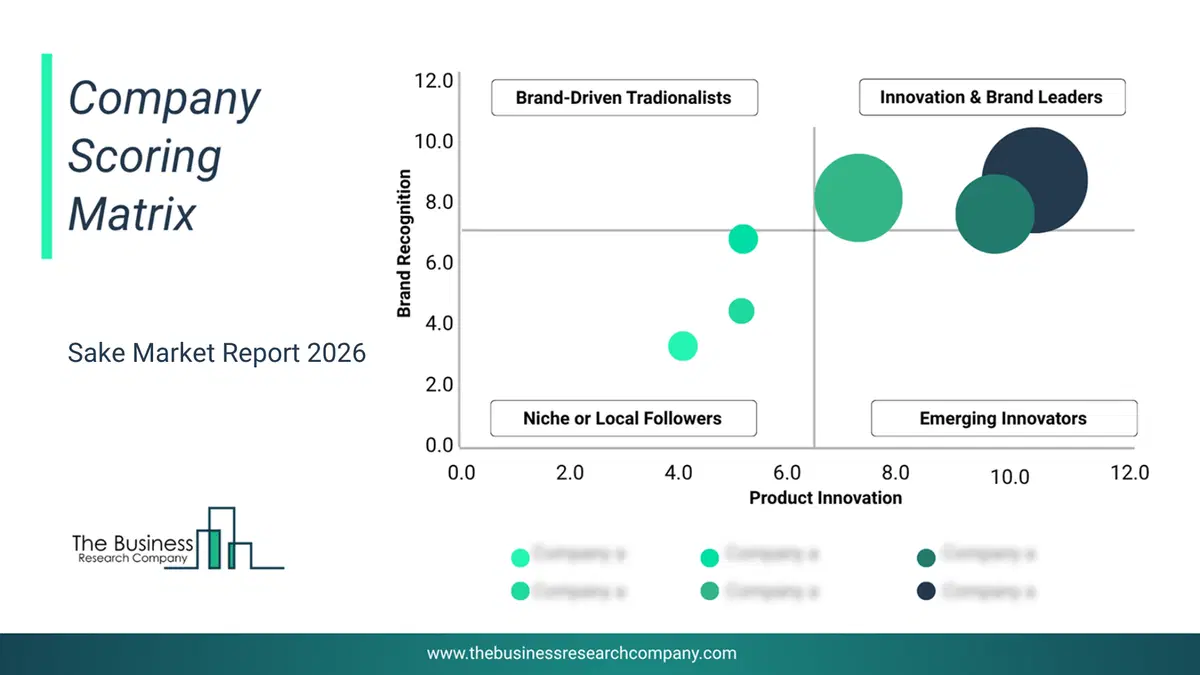
This chart maps companies by product innovation and brand strength, with bubble size indicating relative revenue, helping identify market leaders, challengers, and niche players. This is an illustrative chart; the full report provides a complete and accurate competitive analysis.
Global Sake Market Trends and Insights
Major companies operating in the sake market are focusing on developing innovative premium-grade product lines such as terroir-driven everyday junmai daiginjo to enhance consumer access to refined sake quality in regular dining and casual drinking occasions. Terroir-driven everyday junmai daiginjo is a premium sake brewed with highly polished, locally sourced rice and regional water to reflect a strong sense of place while being positioned for approachable, frequent consumption, enabling elegant aromas and clean umami in everyday settings. For instance, in August 2025, Tsunan Sake Brewery Co., Ltd., a Japan-based sake brewery, launched GO TERRACE, a junmai daiginjo designed for daily premium enjoyment using Uonuma-grown Koshihikari rice and mountain spring water with floral aromatics, gentle sweetness, and snowmelt-like umami. GO TERRACE enhances the casual drinking experience by merging high-quality craftsmanship with accessibility for regular meal pairings and social occasions.What Are Latest Mergers And Acquisitions In The Sake Market?
In March 2023, Shaw-Ross International Importers, a US-based alcohol importer, acquired TYKU Sake for an undisclosed amount. This acquisition complements Shaw-Ross International Importers’ Japanese portfolio by expanding their range of premium sakes. TYKU Sake is a US-based company producing sake and other spirits.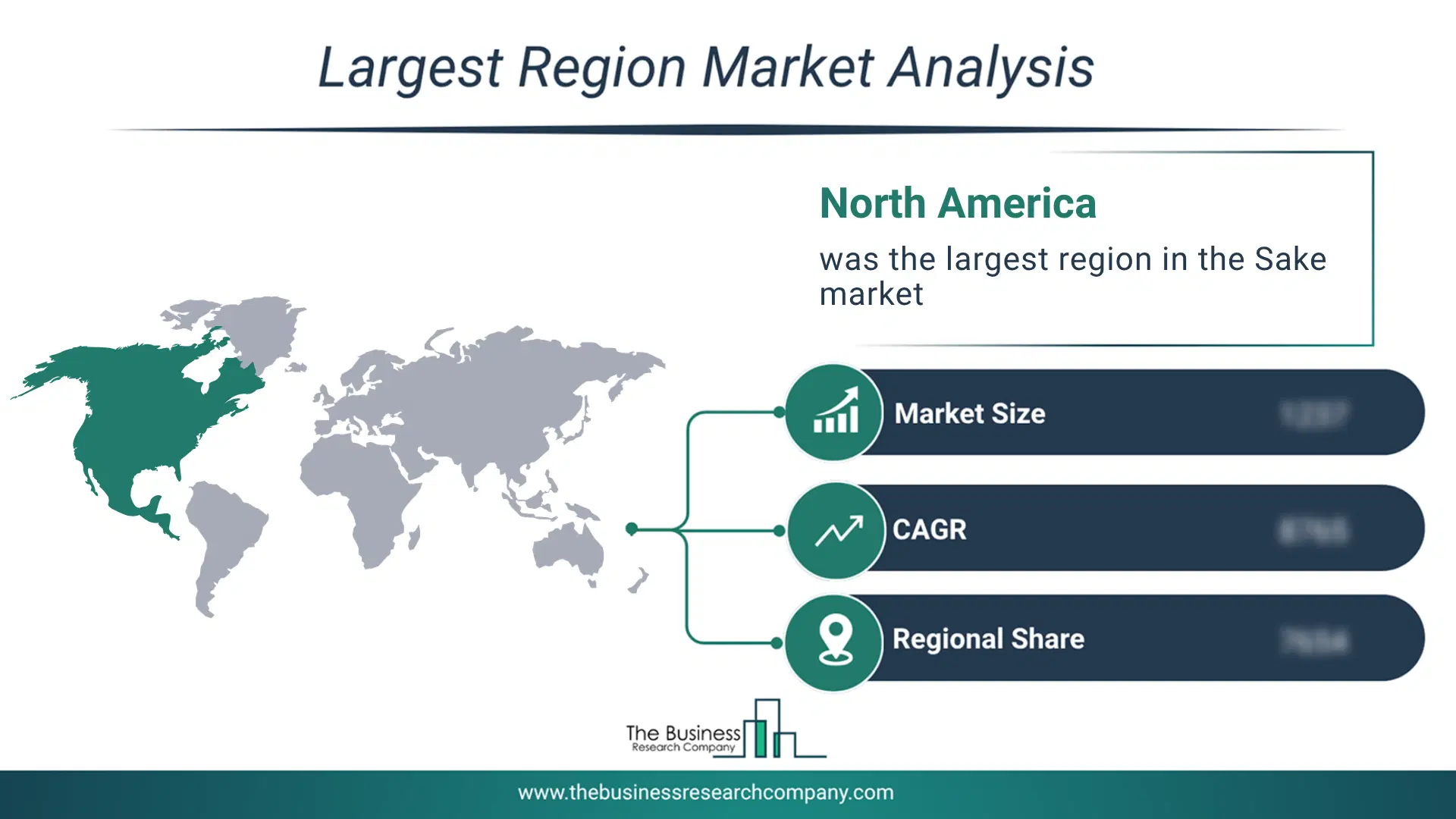
Regional Outlook
North America was the largest region in the sake market in 2025. The regions covered in this market report are Asia-Pacific, South East Asia, Western Europe, Eastern Europe, North America, South America, Middle East and Africa. The countries covered in this market report are Australia, Brazil, China, France, Germany, India, Indonesia, Japan, Taiwan, Russia, South Korea, UK, USA, Italy, Spain, CanadaWhat Defines the Sake Market?
The sake market consists of sales of Futsushu, Tokubetsu Honjozo, Shiboritate, Nigori, and Jizake. Values in this market are ‘factory gate’ values, that is the value of goods sold by the manufacturers or creators of the goods, whether to other entities (including downstream manufacturers, wholesalers, distributors, and retailers) or directly to end customers. The value of goods in this market includes related services sold by the creators of the goods.How is Market Value Defined and Measured?
The market value is defined as the revenues that enterprises gain from the sale of goods and/or services within the specified market and geography through sales, grants, or donations in terms of the currency (in USD unless otherwise specified). The revenues for a specified geography are consumption values that are revenues generated by organizations in the specified geography within the market, irrespective of where they are produced. It does not include revenues from resales along the supply chain, either further along the supply chain or as part of other products.
This chart presents market attractiveness based on a quantitative evaluation of growth, competition, strategic alignment, and risk, offering a clear view of opportunity areas for decision-making. This chart is for illustrative purposes; the full report contains the complete analysis.

This chart highlights the Total Addressable Market (TAM) by estimating the maximum revenue opportunity using an assumption-driven approach, supporting strategic planning and opportunity sizing across markets. The chart is illustrative; the full report provides a more comprehensive analysis.
What Key Data and Analysis Are Included in the Sake Market Report 2026?
The sake market research report is one of a series of new reports from The Business Research Company that provides market statistics, including industry global market size, regional shares, competitors with the market share, detailed market segments, market trends and opportunities, and any further data you may need to thrive in the sake industry. The market research report delivers a complete perspective of everything you need, with an in-depth analysis of the current and future state of the industry.Sake Market Report Forecast Analysis
| Report Attribute | Details |
|---|---|
| Market Size Value In 2026 | $10.69 billion |
| Revenue Forecast In 2030 | $13.22 billion |
| Growth Rate | CAGR of 5.2% from 2026 to 2030 |
| Base Year For Estimation | 2025 |
| Actual Estimates/Historical Data | 2020-2025 |
| Forecast Period | 2026 - 2030 |
| Market Representation | Revenue in USD Billion and CAGR from 2026 to 2030 |
| Segments Covered | Type, Range, Application |
| Regional Scope | Asia-Pacific, Western Europe, Eastern Europe, North America, South America, Middle East, Africa |
| Country Scope | The countries covered in the report are Australia, Brazil, China, France, Germany, India, Indonesia, Japan, Taiwan, Russia, South Korea, UK, USA, Canada, Italy, Spain. |
| Key Companies Profiled | Gekkeikan Sake Co., Ltd., Takara Shuzo Co., Ltd., Asahi Shuzo Co., Ltd. (Dassai), Tatsuuma-Honke Brewing Co., Ltd., Ozeki Co., Ltd., Hakkaisan Brewery Co., Ltd., Dewazakura Sake Brewery Co., Ltd., Kokuryu Brewery Co., Ltd., Tatenokawa Shuzo Co., Ltd., Tosatsuru Sake Brewing Co., Ltd., Homare Sake Brewery Co., Ltd., Sohomare Sake Brewery Co., Ltd., Shiragiku Shuzo Co., Ltd., Hananomai Brewing Co., Ltd., Daisekkei Sake Brewing Co., Ltd., Matsuse Sake Brewery Co., Ltd., Azuma Shuzo Co., Ltd., Dojima Sake Brewery Co., Ltd., Wakaze Sake Brewery, Nara Toyosawa Shuzo Co., Ltd |
| Customization Scope | Request for Customization |
| Pricing And Purchase Options | Explore Purchase Options |