
Sample Collection Devices Market Report 2026
Global Outlook – By Product Type (Needles And Syringes, Containers, Bags, Chromosome Harvesters, Cell Harvesters, Medical Suitcases, Other Product Types), By Sample Type (Blood, Urine, Other Sample Types), By Application (Diagnostics, Treatment), By End-Use (Hospitals, Diagnostics Centers, Blood Banks, Other End-Uses) – Market Size, Trends, Strategies, and Forecast to 2030
Sample Collection Devices Market Overview
• Sample Collection Devices market size has reached to $11.15 billion in 2025 • Expected to grow to $14.42 billion in 2030 at a compound annual growth rate (CAGR) of 5.2% • Growth Driver: Increasing Number Of Diagnostic And Screening Tests Fueling The Growth Of The Market Due To Growing Healthcare Awareness And Demand For Early Disease Detection • Market Trend: Next-Generation Dried Blood Sampling System Enhances Accuracy And Convenience • North America was the largest region in 2025 and Asia-Pacific is the fastest growing region.What Is Covered Under Sample Collection Devices Market?
Sample collection devices are specialized tools used to safely collect, store, and transport biological specimens for diagnostic, research, or forensic purposes. This device maintains the integrity and sterility of the sample from the point of collection to analysis and ensures accurate, contamination-free sampling, which is critical for reliable test results. The main product types of sample collection devices include needles and syringes, containers, bags, chromosome harvesters, cell harvesters, medical suitcases, and others. Needles and syringes are medical devices used together to inject fluids into or withdraw fluids from the body. These devices are used to collect various sample types, such as blood, urine, and others. Sample collection devices are applied in diagnostics and treatment, serving end-users such as hospitals, diagnostic centers, blood banks, and others.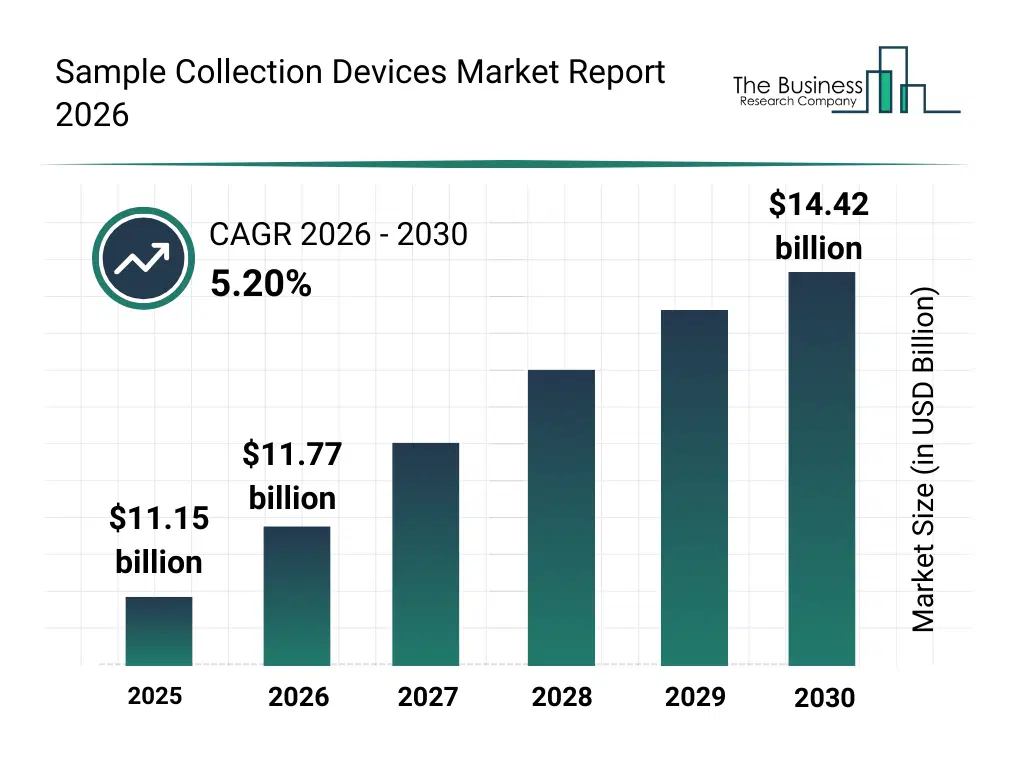
What Is The Sample Collection Devices Market Size and Share 2026?
The sample collection devices market size has grown strongly in recent years. It will grow from $11.15 billion in 2025 to $11.77 billion in 2026 at a compound annual growth rate (CAGR) of 5.5%. The growth in the historic period can be attributed to limited availability of standardized collection devices, reliance on manual sample collection methods, growing hospital and diagnostics infrastructure, increasing awareness of biosafety, adoption of conventional syringes and containers.What Is The Sample Collection Devices Market Growth Forecast?
The sample collection devices market size is expected to see strong growth in the next few years. It will grow to $14.42 billion in 2030 at a compound annual growth rate (CAGR) of 5.2%. The growth in the forecast period can be attributed to development of automated and smart sample collection devices, rising demand for minimally invasive sampling, expansion of blood banks and diagnostics centers, increasing adoption of cold chain logistics, integration of IoT and digital monitoring in sample collection. Major trends in the forecast period include rising demand for safe and sterile sample collection devices, growing adoption of automated and precision collection tools, expansion of blood, urine, and cell sample collection applications, increasing focus on cold chain and sample transport solutions, enhanced regulatory compliance and quality assurance.
Global Sample Collection Devices Market Segmentation
1) By Product Type: Needles And Syringes, Containers, Bags, Chromosome Harvesters, Cell Harvesters, Medical Suitcases, Other Product Types 2) By Sample Type: Blood, Urine, Other Sample Types 3) By Application: Diagnostics, Treatment 4) By End-Use: Hospitals, Diagnostics Centers, Blood Banks, Other End-Uses Subsegments: 1) By Needles And Syringes: Hypodermic Needles, Safety Needles, Insulin Syringes, Butterfly Needles, Disposable Syringes 2) By Containers: Blood Collection Tubes, Urine Collection Containers, Stool Collection Containers, Cryogenic Vials, Sample Transport Containers 3) By Bags: Blood Bags, Urine Collection Bags, Infusion Bags, Sample Storage Bags, Dialysis Bags 4) By Chromosome Harvesters: Automated Chromosome Harvesters, Manual Chromosome Harvesters, Cell Culture Harvesters, Mitotic Arrest Harvesters, Chromosome Spreading Devices 5) By Cell Harvesters: Automated Cell Harvesters, Centrifugal Cell Harvesters, Filtration-Based Cell Harvesters, Magnetic Bead Cell Harvesters, Manual Cell Harvesters 6) By Medical Suitcases: Portable Sample Collection Kits, Cold Chain Transport Cases, Sterile Medical Supply Cases, Multi-Compartment Medical Suitcases, Emergency Sample Collection Kits 7) By Other Product Types: Swabs, Microcapillary Tubes, Lancets, Sample Preservation Kits, Disposable GlovesWhat Is The Driver Of The Sample Collection Devices Market?
The increasing number of diagnostic and screening tests is expected to propel the growth of the sample collection devices market in the future. Diagnostic and screening tests refer to medical procedures used to detect, identify, or monitor diseases or conditions in individuals. The rise in diagnostic and screening tests is due to growing healthcare awareness among the population as people increasingly seek early detection to prevent serious illnesses. Sample collection devices enhance diagnostic and screening tests by ensuring accurate and reliable specimen collection, enabling timely and precise disease detection. They improve testing efficiency and patient comfort, supporting better healthcare outcomes. For instance, in December 2024, according to the National Health Service, a UK-based government department, the number of diagnostic tests by activity reached 2,544,809 in 2024, an increase from 2,312,030 in 2023. Therefore, the increasing number of diagnostic and screening tests is driving the growth of the sample collection devices industry.Key Players In The Global Sample Collection Devices Market
Major companies operating in the sample collection devices market are Cardinal Health Inc, Thermo Fisher Scientific Inc, Merck KGaA, Becton Dickinson and Company, Grifols S A, Terumo Corporation, SD Biosensor Inc, Haemonetics Corporation, Sarstedt Aktiengesellschaft And Co, Macopharma S A, Bio Rad Laboratories Inc, KABE LABORTECHNIK GmbH, Trajan Scientific and Medical Pty Ltd, Owen Mumford Limited, Mitra Industries Private Limited, CML Biotech P Ltd, Kawasumi Laboratories Inc, Demophorius Healthcare Ltd, Ljungberg And Kögel Aktiebolag, Romed Holland B V, Greiner Bio One International GmbH, HiMedia Laboratories Pvt Ltd
This chart is for illustrative purposes; the full report includes a detailed competitor analysis and comprehensive overview of the top 10 companies in the market.
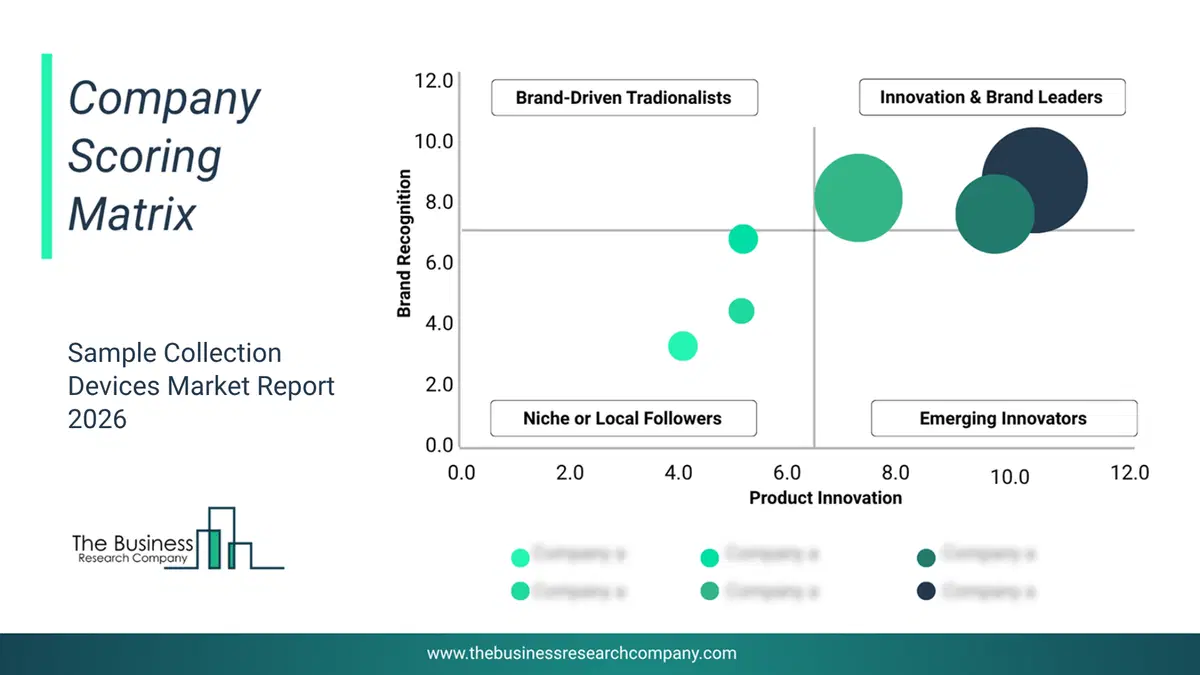
This chart maps companies by product innovation and brand strength, with bubble size indicating relative revenue, helping identify market leaders, challengers, and niche players. This is an illustrative chart; the full report provides a complete and accurate competitive analysis.
Global Sample Collection Devices Market Trends and Insights
Major companies operating in the sample collection devices market are focusing on developing advanced devices, such as volumetric dried blood sampling, to improve sample accuracy, enhance patient convenience, enable remote diagnostics, and ensure reliable results for laboratory analysis. Volumetric dried blood sampling refers to collecting a precise, fixed volume of blood that is dried on a specialized medium for later laboratory analysis. For instance, in February 2025, Tasso Inc., a US-based medical technology company, launched a next-generation dried blood spot (DBS) collection system that combines the Tile-T20 cartridge with the Tasso Mini device, enabling precise, volumetrically controlled blood collection in a virtually painless and user-friendly manner. This innovative system is designed to improve the patient experience and streamline processes in clinical trials, remote diagnostics, and sports anti-doping testing by eliminating the need for traditional finger sticks and enhancing sample accuracy and convenience.What Are Latest Mergers And Acquisitions In The Sample Collection Devices Market?
In March 2024, Halma plc, a UK-based technology company, acquired Rovers Medical Devices B.V. for $96.07 million (€85 million). With this acquisition, Halma aims to strengthen its healthcare portfolio by advancing women’s health through Rovers Medical Devices’ innovative sample collection technologies to enhance cervical cancer screening and support WHO’s cancer prevention goals. Rovers Medical Devices B.V. is a Netherlands-based medical technology company specializing in sample collection devices.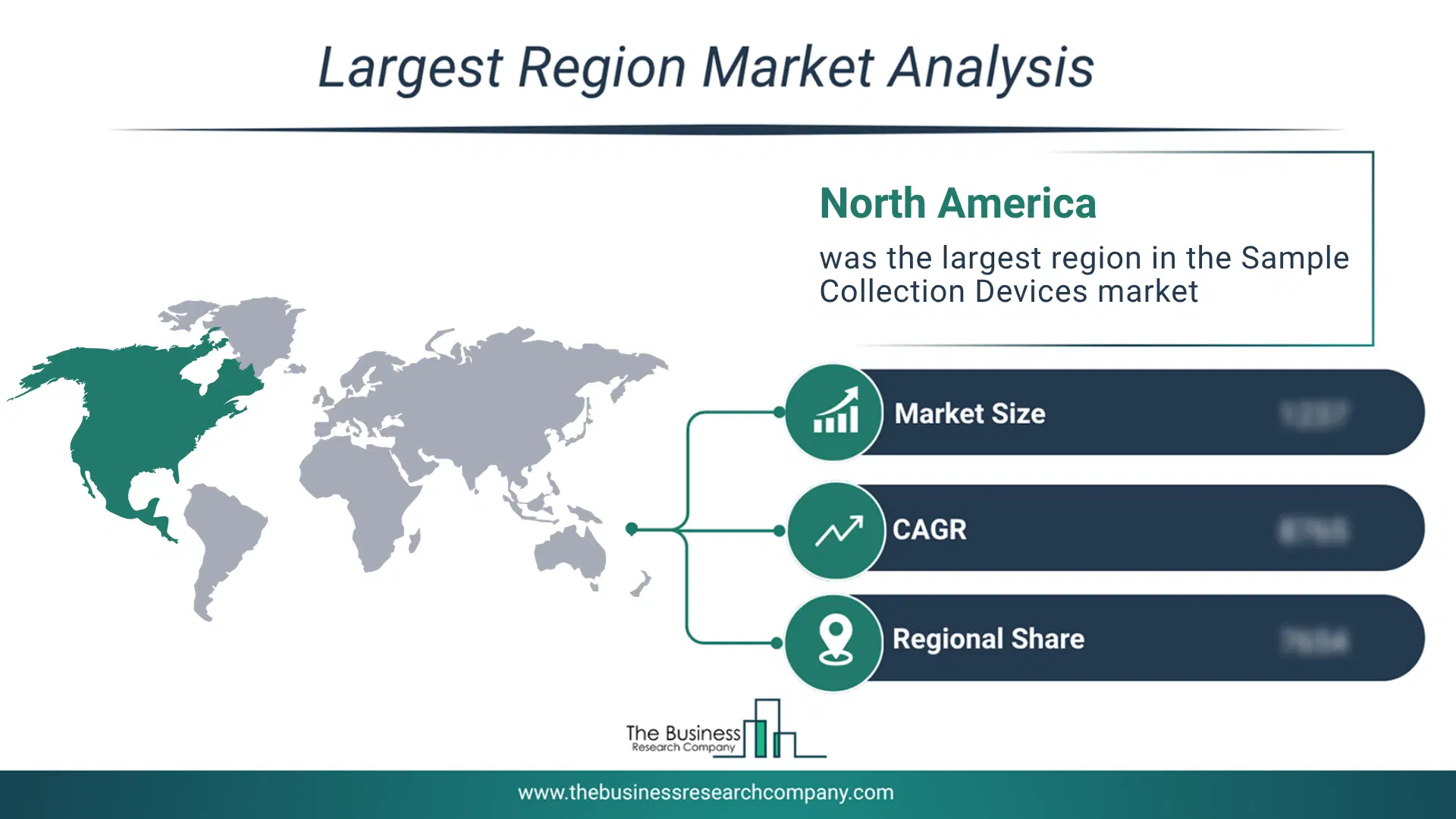
Regional Outlook
North America was the largest region in the sample collection devices market in 2025. Asia-Pacific is expected to be the fastest-growing region in the forecast period. The regions covered in this market report are Asia-Pacific, South East Asia, Western Europe, Eastern Europe, North America, South America, Middle East, Africa. The countries covered in this market report are Australia, Brazil, China, France, Germany, India, Indonesia, Japan, Taiwan, Russia, South Korea, UK, USA, Canada, Italy, SpainWhat Defines the Sample Collection Devices Market?
The sample collection devices market consists of sales of swab-based collection devices, blood collection devices, urine collection devices, saliva collection devices, stool collection devices and sputum collection devices. Values in this market are ‘factory gate’ values, that is, the value of goods sold by the manufacturers or creators of the goods, whether to other entities (including downstream manufacturers, wholesalers, distributors, and retailers) or directly to end customers. The value of goods in this market includes related services sold by the creators of the goods.How is Market Value Defined and Measured?
The market value is defined as the revenues that enterprises gain from the sale of goods and/or services within the specified market and geography through sales, grants, or donations in terms of the currency (in USD unless otherwise specified). The revenues for a specified geography are consumption values that are revenues generated by organizations in the specified geography within the market, irrespective of where they are produced. It does not include revenues from resales along the supply chain, either further along the supply chain or as part of other products.
This chart presents market attractiveness based on a quantitative evaluation of growth, competition, strategic alignment, and risk, offering a clear view of opportunity areas for decision-making. This chart is for illustrative purposes; the full report contains the complete analysis.

This chart highlights the Total Addressable Market (TAM) by estimating the maximum revenue opportunity using an assumption-driven approach, supporting strategic planning and opportunity sizing across markets. The chart is illustrative; the full report provides a more comprehensive analysis.
What Key Data and Analysis Are Included in the Sample Collection Devices Market Report 2026?
The sample collection devices market research report is one of a series of new reports from The Business Research Company that provides market statistics, including industry global market size, regional shares, competitors with the market share, detailed market segments, market trends and opportunities, and any further data you may need to thrive in the sample collection devices industry. The market research report delivers a complete perspective of everything you need, with an in-depth analysis of the current and future state of the industry.Sample Collection Devices Market Report Forecast Analysis
| Report Attribute | Details |
|---|---|
| Market Size Value In 2026 | $11.77 billion |
| Revenue Forecast In 2030 | $14.42 billion |
| Growth Rate | CAGR of 5.2% from 2026 to 2030 |
| Base Year For Estimation | 2025 |
| Actual Estimates/Historical Data | 2020-2025 |
| Forecast Period | 2026 - 2030 |
| Market Representation | Revenue in USD Billion and CAGR from 2026 to 2030 |
| Segments Covered | Product Type, Sample Type, Application, End-Use |
| Regional Scope | Asia-Pacific, Western Europe, Eastern Europe, North America, South America, Middle East, Africa |
| Country Scope | The countries covered in the report are Australia, Brazil, China, France, Germany, India, Indonesia, Japan, Taiwan, Russia, South Korea, UK, USA, Canada, Italy, Spain. |
| Key Companies Profiled | Cardinal Health Inc, Thermo Fisher Scientific Inc, Merck KGaA, Becton Dickinson and Company, Grifols S A, Terumo Corporation, SD Biosensor Inc, Haemonetics Corporation, Sarstedt Aktiengesellschaft And Co, Macopharma S A, Bio Rad Laboratories Inc, KABE LABORTECHNIK GmbH, Trajan Scientific and Medical Pty Ltd, Owen Mumford Limited, Mitra Industries Private Limited, CML Biotech P Ltd, Kawasumi Laboratories Inc, Demophorius Healthcare Ltd, Ljungberg And Kögel Aktiebolag, Romed Holland B V, Greiner Bio One International GmbH, HiMedia Laboratories Pvt Ltd |
| Customization Scope | Request for Customization |
| Pricing And Purchase Options | Explore Purchase Options |